A Church's Guide to Payroll Tax Liabilities
Navigate church payroll tax liabilities with confidence. Our guide covers FICA, clergy pay, housing allowances, and how to track it all with fund accounting.
The first payroll run at a church can feel like opening a bulletin printed in a language you don't speak.
About Grain Ledger: This guide includes Grain Ledger, church fund accounting software built for designated gifts and ministry funds. It connects giving platforms (Planning Center, Pushpay, Tithely, Stripe), syncs bank activity with Plaid, and produces fund-level financial reports. Schedule a demo to see how it compares for your church.
See Grain Ledger for your church
Fund accounting, giving integrations, and bank reconciliation in one platform. Free migration support for churches switching from QuickBooks or Aplos.
You sit down to review a pay stub for the pastor, the office administrator, and the worship leader. You see gross pay, net pay, federal withholding, Medicare, Social Security, maybe a state line, maybe a housing allowance note, and you wonder which of these amounts belong to the employee, which belong to the church, and which need to be sent somewhere by a deadline you're afraid you've already missed.
If that's where you are, you're not behind. You're normal. Many church treasurers inherit payroll duties because they're trustworthy, organized, and willing to serve, not because they trained as payroll specialists.
Payroll tax liabilities are serious. They're also manageable. If you understand what creates them, where they sit in your books, and how to track them inside a fund-based accounting workflow, the whole subject gets much less mysterious.
Your First Church Payroll Run
I've watched this happen more than once in a church office.
A new treasurer opens the payroll report after payday and says something like, “The paychecks cleared, so I think payroll is done.” But payroll isn't done when staff receive net pay. That's only the first half of the job. The second half is dealing with the amounts that were calculated during payroll and still need to be paid out to tax agencies and others.
That's the moment payroll tax liabilities enter the picture.
Think of your first payroll run like sorting the offering after Sunday service. The cash may all be sitting on one table for a moment, but you already know it doesn't all belong in one envelope. Some money is general fund giving. Some is missions. Some is benevolence. The same idea applies in payroll. The total payroll amount gets split into wages, withholdings, employer taxes, and other deductions. Each piece has to go to the right place.
Practical rule: If payroll has been processed but a tax payment hasn't been remitted yet, that unpaid amount is usually sitting in a liability account, not disappearing into payroll expense.
New treasurers often get tripped up because the payroll provider shows everything in one report, while the accounting system needs those pieces separated clearly. Churches feel that confusion even more because one pay run may include clergy pay, housing allowance treatment, reimbursements, and employees charged to different ministry funds.
The good news is that payroll follows a repeatable pattern. Once you learn the pattern, you stop reacting to acronyms and start asking the right questions. What was withheld? What does the church owe directly? What still needs to be deposited? Which fund should bear the expense? That's the path to calm, accurate payroll administration.
What Are Payroll Tax Liabilities
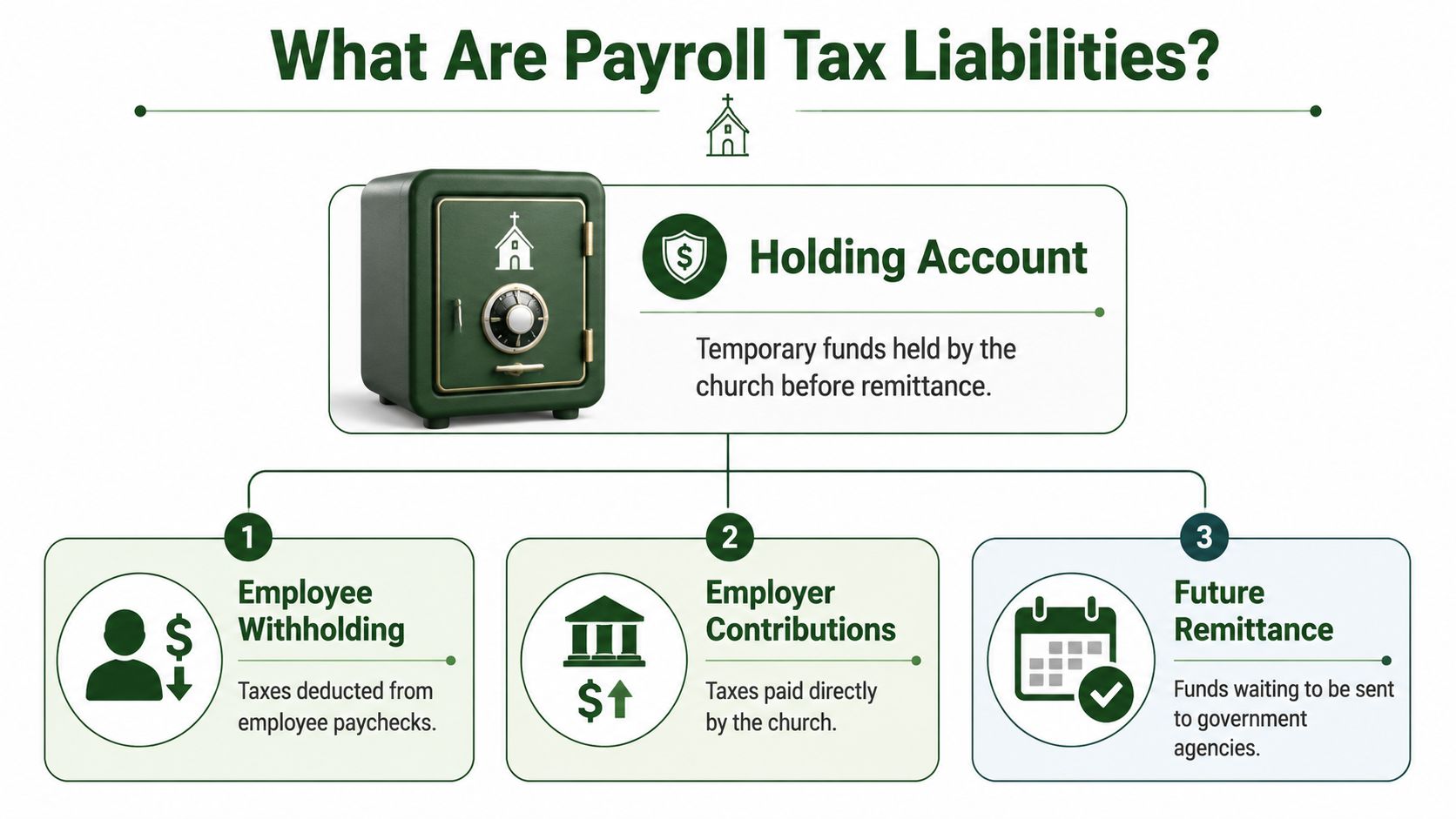
Payroll tax liabilities are the amounts your church still owes after payroll is processed and before those amounts are sent to the IRS, state agencies, or other recipients.
For a church treasurer, the easiest way to read this is in terms of ownership. Once payroll is run, part of the cash in your bank account no longer belongs to the church's operating budget, even if it has not left the account yet. Some of it belongs to employees through net pay. Some of it is employee withholding that must be remitted. Some of it is the church's own payroll tax cost. Until those payments go out, the unpaid amounts stay on the balance sheet as liabilities.
From payroll processing to a payable amount
Here is what changes the moment payroll is approved.
Gross pay is calculated first. Then payroll applies withholding and other deductions, along with any employer payroll taxes the church owes. The employee receives net pay, but the process also creates separate amounts that still need to be paid to tax authorities. Those unpaid amounts are the liability.
A new treasurer often asks, “If the payroll already ran, didn't we already pay it?” Only part of it. Running payroll records the obligation. Remitting taxes settles the obligation.
That distinction matters in church accounting because the expense and the cash movement do not always happen on the same day. In a fund accounting setup, that also means the wage expense may be assigned across ministries or funds, while the related liability remains payable until the deposit date.
Why timing matters
Payroll tax liabilities are usually short-term obligations. They often come due within days or weeks of the payroll date, and they tie directly to required filings and deposits.
Late payment can trigger penalties, and mishandling employee withholding creates even more serious problems. Rippling notes that IRS deposit penalties can increase based on how late the payment is, and unpaid trust fund taxes can expose responsible individuals to the Trust Fund Recovery Penalty, according to Rippling's explanation of payroll liabilities.
For churches, that risk is easy to underestimate because the cash may be sitting in the same checking account as tithes and operating funds. On the books, though, it should be treated as committed cash, not money available for ministry spending, utilities, or a temporary transfer between funds.
Where churches get tripped up
The word liability can sound like a red flag. In payroll, it usually means your records are reflecting normal reality.
If your church runs payroll this week and the tax deposit is scheduled for next week, the liability account is doing its job. It is showing that the church has an unpaid obligation that is already known and measurable.
Problems emerge later. A balance lingers after the deposit should have cleared. The payroll report does not match the general ledger. A clergy payroll item was coded like a regular employee tax when it should have been handled differently. In churches, those mistakes can affect both compliance and fund reporting.
That is why payroll tax liabilities matter so much. They are not just numbers created by payroll software. They are the checkpoint between paying staff, protecting restricted resources, and keeping the church's books accurate.
The Four Main Types of Payroll Taxes
A new church treasurer often sees one payroll report and assumes every tax line works the same way. They do not. Each line answers a different question: Is this money withheld from an employee, paid by the church, or handled differently because the worker is clergy?
That sorting step matters in church accounting because payroll is not just about getting net pay right. It also affects how liabilities sit on the books, which fund will cover the employer cost, and whether a clergy payroll item belongs in payroll tax setup at all.
FICA taxes
FICA includes Social Security and Medicare. For regular employees, both the employee and the employer have a share. The current employee and employer rates are 6.2% for Social Security and 1.45% for Medicare, according to ADP's payroll liabilities guide.
A simple way to read that in the church books is this: one portion comes out of the employee's check, and a matching portion becomes an employer payroll cost. If your church has non-clergy staff, this is usually the largest recurring payroll tax category to reconcile.
Clergy often cause confusion here. Ministers are commonly treated as self-employed for Social Security and Medicare tax purposes, even when they are employees for federal income tax purposes. That means a pastor's payroll may look different from an office administrator's payroll, and a treasurer should not assume every employee gets FICA handled the same way.
Federal income tax withholding
Federal income tax withholding is money the church holds back from an employee's wages and sends to the IRS. It is a liability after payroll runs because the church is temporarily holding that amount for the government.
For church fund accounting, that distinction helps prevent a common mistake. The withheld amount should not be treated as available cash in the operating fund just because it is still in the bank account for a few days.
Clergy add another wrinkle. Ministers generally do not have federal income tax withheld unless they request voluntary withholding. So one employee's payroll may include this line, while another employee's payroll does not, even if both are on the same staff roster.
Federal unemployment tax
FUTA is an employer tax. It does not come out of the employee's paycheck.
For many churches, the main issue is not the calculation but whether the church is exempt. Churches are often exempt from FUTA, which is why a generic small-business payroll checklist can send a church treasurer in the wrong direction. Before you build payroll workflows or liability accounts in Grain Ledger, confirm whether FUTA applies to your church at all. If it does not apply, leaving it active in payroll setup can create liabilities that should never have been booked.
State and local taxes
State and local payroll taxes are the part that changes most from one church to another. Some states require income tax withholding. Some require state unemployment contributions. Some cities or localities add their own payroll-related rules.
This is also where church payroll can stop being plug-and-play. A church with a pastor in one state, a remote bookkeeper in another, and a preschool employee in the church's home state may have three different tax setups to review. Worker location, state registration, and exemption rules all affect what belongs on the payroll report and what should flow into liability accounts.
Key Payroll Tax Obligations
| Tax Type | What It Funds | Who Pays |
|---|---|---|
| Social Security | Social Security program | Employee and employer, when applicable |
| Medicare | Medicare program | Employee and employer, when applicable |
| Federal income tax withholding | Federal income taxes | Employee, withheld by employer |
| FUTA | Federal unemployment system | Employer, if applicable |
| State or local payroll taxes | State or local tax programs | Varies by jurisdiction |
A quick memory aid
A church payroll register works a lot like sorting offering envelopes before posting contributions. You have to place each amount in the right bucket before the records make sense.
- Withheld from pay means the church is holding someone else's money
- Paid by the church means the church must budget for that cost
- Clergy-specific treatment means you should verify the rule before posting liabilities
That habit makes reconciliation cleaner, especially when you are tracking payroll liabilities by fund and reviewing them in Grain after each payroll run.
Employer Obligations vs Employee Withholding
This distinction matters more than is commonly understood.
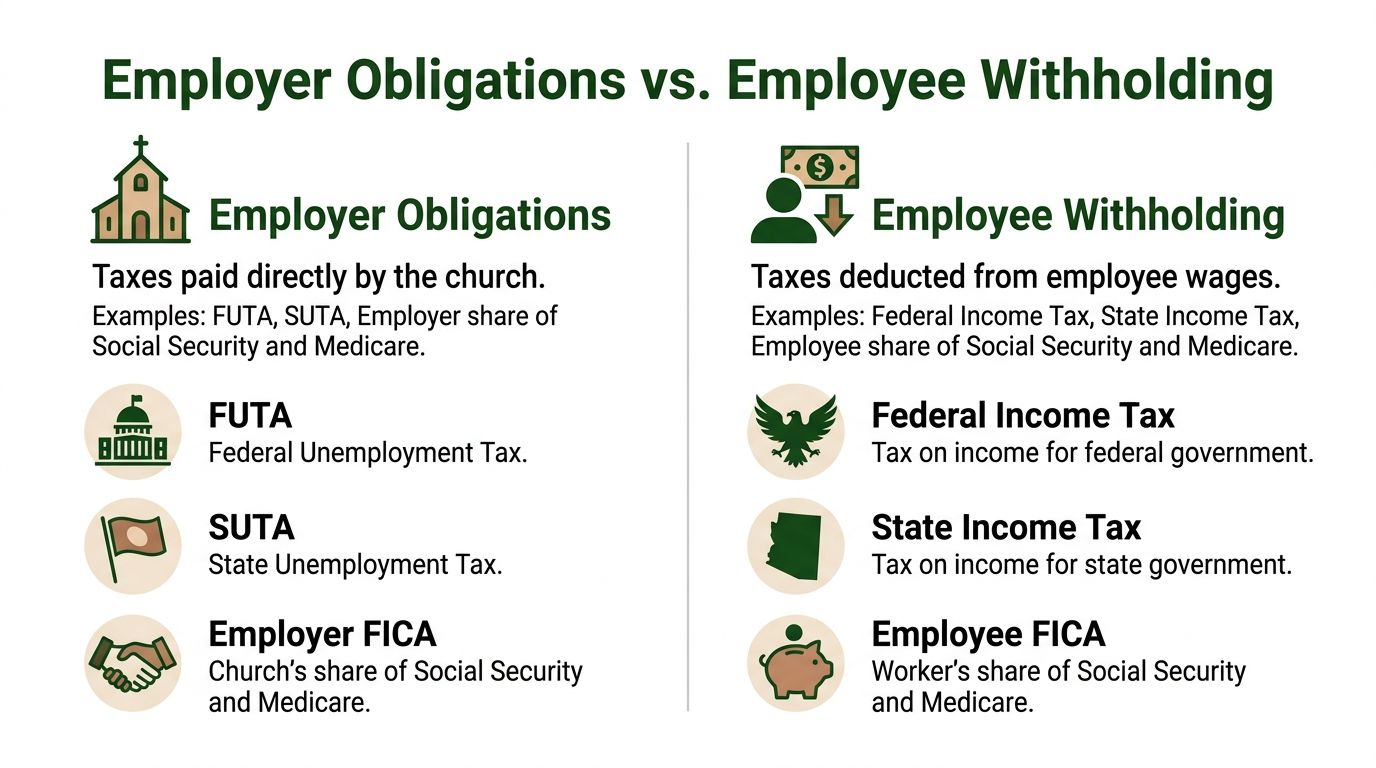
When the church withholds tax from an employee's paycheck, that money was never really available for ministry spending, utilities, or next week's copier lease. The church is acting as a steward and remittance agent. By contrast, the church's own payroll taxes are actual employer costs tied to having staff.
What belongs in each bucket
Employee withholding usually includes amounts taken from wages, such as federal income tax withholding and the employee share of Social Security and Medicare when applicable.
Employer obligations include the church's own payroll tax costs, such as the employer share of Social Security and Medicare and other employer-side taxes that apply.
Here's the practical accounting difference:
- Withholding liabilities are amounts the church is holding for someone else
- Employer tax liabilities are amounts the church owes from its own funds
If you blur those together, budget reports become misleading. Staff costs look lower than they are. Liability balances get harder to reconcile. Restricted ministry funds can accidentally absorb costs they weren't meant to cover.
Why people talk past each other on payroll cost
Church boards often ask, “How much does this employee cost us?” Employees ask, “How much tax came out of my check?” Both questions are valid, but they're asking about different slices of the same payroll event.
A paycheck tells the employee what was withheld. The church books must also show what the church owes in addition to that paycheck.
There's also an economic wrinkle worth understanding. Payroll taxes are often described as an employer burden, but that's not the whole picture. One paper summarized by the National Taxpayers Union reports that about 58% of an across-the-board payroll-tax increase falls on employees through lower wages in the short run, as discussed in the NTU payroll tax toolkit.
That doesn't change who remits what. It does help explain why payroll tax decisions affect compensation conversations, staffing budgets, and long-term labor costs together.
A church example
Suppose your church hires a children's ministry administrator. The administrator sees net pay after withholdings. The church, however, sees a larger total employment cost because it must account for employer-side taxes too.
That's why a treasurer should never budget from net pay alone. Budget from gross compensation plus employer obligations. Record employee withholding separately. Then clear the liability accounts only when payments are made.
Navigating Church-Specific Payroll Challenges
Church payroll gets complicated quickly because ministry roles don't always fit the mold that standard small-business payroll assumes.
A church may have clergy, part-time staff, designated housing allowance, reimbursements for ministry expenses, and wages that need to be allocated across multiple funds. If you handle all of that with generic categories, the books may balance while the payroll treatment is still wrong.
Clergy don't always fit the standard payroll template
One of the most confusing church payroll issues is clergy treatment.
In many churches, a minister's payroll setup differs from that of other employees. That's where a treasurer needs to slow down and avoid assuming that every payroll line should be handled the same way for every worker. If your pastor, associate pastor, and office administrator are all being processed identically, that's a signal to review the setup carefully with a qualified payroll professional or church-experienced accountant.
The reason this matters is simple. Worker classification and taxable-pay definitions flow directly into payroll liability calculations. Independent payroll guidance notes that errors in classification or taxable-pay definitions can lead to under-remittance, amended filings, and penalty exposure in SCL Tax Law's discussion of payroll tax liability.
Housing allowance needs careful handling
Housing allowance is another area where churches can make a mess without realizing it.
A housing allowance isn't just “extra pay with a note attached.” The church should document compensation elements clearly, keep board-approved compensation records organized, and ensure payroll records reflect the right treatment of salary versus designated allowance. If that distinction is muddy, the payroll records become harder to defend later.
Church office advice: Don't rely on memory for compensation decisions. Keep board approvals, payroll setup notes, and employee records together so the payroll report matches what leadership actually authorized.
Reimbursements should stay separate from wages
Churches often reimburse staff and volunteers for ministry expenses. That's normal. Trouble starts when reimbursements are mixed casually into payroll without documentation.
The safer practice is to keep approved business reimbursements separate from taxable wages in your records. That way, the church can show what was compensation and what was repayment of ministry expenses.
Common examples include:
- Mileage or travel reimbursement when a staff member drives for approved ministry activity
- Supply reimbursement for curriculum, hospitality items, or office needs purchased personally
- Event-related ministry purchases that staff paid first and submitted later
When records are clean, payroll tax liabilities stay tied to taxable compensation instead of getting distorted by unrelated payments.
Fund accounting adds another layer
Churches don't just ask, “What did we pay?” They also ask, “Which fund should bear the cost?”
A youth pastor's compensation may belong partly in the general fund and partly in a youth ministry fund. A grant-funded staff role may need payroll expense assigned carefully without using restricted money for unrelated tax obligations. That means payroll isn't only a tax exercise. It's a fund accounting exercise too.
For a quick visual explanation of common church payroll topics, this overview can help:
The wise approach
When church payroll gets unusual, treat “close enough” as a warning sign.
Review clergy setup separately from non-clergy staff. Keep compensation approvals documented. Separate reimbursements from wages. Make sure every payroll cost lands in the proper fund. Those habits won't remove every nuance, but they will keep your church from drifting into avoidable confusion.
Tracking Liabilities with Fund Accounting in Grain
Your payroll is processed, staff are paid, and everyone breathes easier for a moment. Then the main bookkeeping question shows up. Which fund owns the expense, which taxes are still owed, and can your balance sheet prove it?
That is where many church treasurers feel the strain of spreadsheets. A spreadsheet can total payroll. It usually does a poor job showing, in one clear place, which portion belongs to the general fund, which portion belongs to a ministry fund, and which amounts are still sitting in liability accounts waiting for payment. Churches need more than categories. They need fund-level accuracy.
What the books should show after payroll
A payroll entry has several pieces, and each piece tells a different part of the story.
- Wage expense assigned to the correct fund or funds
- Employer payroll tax expense recorded as a church cost
- Cash or payroll clearing for what employees received
- Liability accounts for taxes withheld or owed but not yet remitted
A helpful way to view this is to treat payroll like sorting an offering count. The total matters, but so does the envelope each amount belongs in. If everything is dropped into one pile, you may still have the right grand total and the wrong records.
That mistake is common with payroll liabilities. A church can report payroll expense correctly and still carry inaccurate liability balances. When that happens, the balance sheet stops answering a basic question: what do we still owe?
A practical journal flow by fund
In a church setting, the flow usually works best when you follow the ministry purpose first, then the tax obligation.
Record wages in the proper fund
If an employee serves in more than one area, split wages according to the church's approved allocation. For example, a children's ministry assistant who also supports worship may have payroll expense divided between two funds.Post employee withholdings to liability accounts
These amounts are not church expense. The church is holding them temporarily until they are sent to the proper agency.Post employer taxes as expense
This portion belongs to the church and should remain visible as its own cost, not blended into wages.Clear liabilities when payments are made
The payment reduces what was owed. It does not create a new expense at that point.
That sequence matters even more with clergy-related payroll setups. A church may need to exclude a minister from one tax treatment while still tracking other payroll items correctly in the same pay run. If the entry structure is muddy, clergy payroll questions spill into fund reporting and make both harder to review.
If a liability account rises every month, compare it to filed returns and actual payments. Do not assume the balance is normal just because payroll keeps running.
Why church fund accounting makes this easier to review
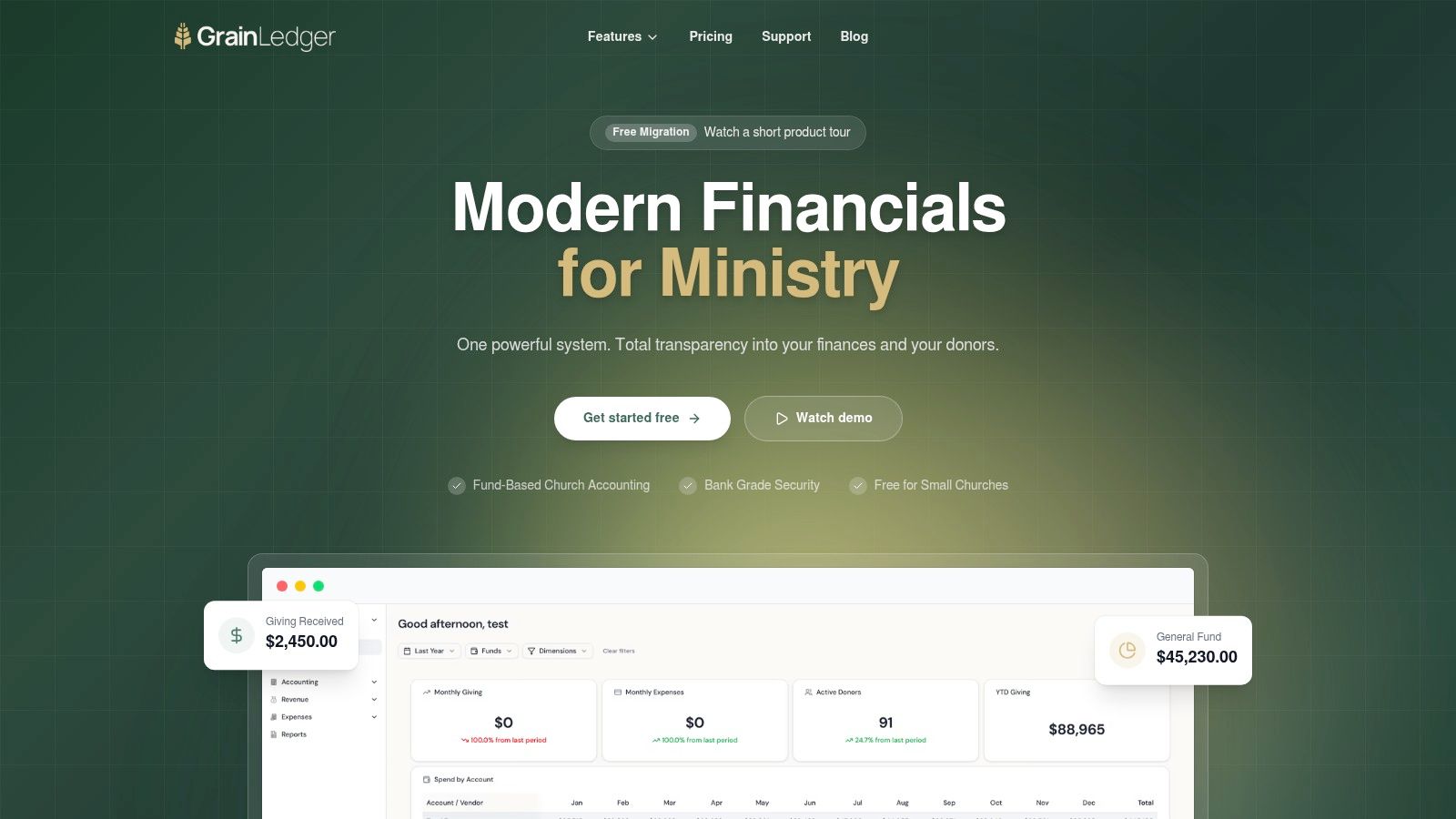
Grain organizes transactions by fund from the start, which helps churches see payroll the way boards and finance teams usually need to see it. Instead of asking staff to rebuild payroll detail after the fact, the system can show whether compensation was charged to the right ministry area and whether unpaid payroll taxes are still sitting on the books.
That is especially helpful when a role touches restricted and unrestricted activity. Suppose part of a staff member's pay is covered by a designated ministry fund. The expense may belong partly to that fund, but the related liabilities still need to be tracked clearly and paid on time. A church treasurer needs both views at once. Fund reporting for stewardship, and liability reporting for compliance.
Board reporting benefits too. Finance committees rarely want a single payroll number with no explanation. They want to see that restricted funds were handled properly, shared staff costs were allocated consistently, and unpaid tax obligations have not been buried inside a vague payroll balance.
Recordkeeping supports the liability balance
Good records make liability accounts believable.
Churches file payroll forms, remit taxes, and answer questions later. If your accounting system cannot quickly pull up the payroll report, journal entry, payment confirmation, and fund allocation support for the same pay period, reconciliation turns into detective work. That is when errors linger longer than they should.
For a new treasurer, this is the goal. At any point, you should be able to answer three plain questions without digging through email chains: What was owed? What was paid? Which fund carried the cost?
Related church accounting software resources
If you are comparing software, these pages map the main decision points: fund accounting, QuickBooks limits, pricing, and migration.
- Best church accounting software (2026 comparison) - canonical guide comparing 12 church accounting platforms
- Church accounting software product page - see Grain Ledger for fund accounting, giving, and bank reconciliation
- Small church accounting software - see the product page built for volunteer treasurers and church admins
- Fund accounting features - review how Grain Ledger tracks designated funds
- QuickBooks for churches - understand workarounds and when to switch
- Free church accounting software - compare free options and upgrade triggers
- Grain Ledger pricing - compare plans for small and growing churches
- Start free - try fund accounting, giving imports, and bank reconciliation together
A Simple Compliance Workflow for Your Church
The best payroll process is one your church can repeat calmly every pay period.
Not fancy. Not heroic. Repeatable.
A workable checklist
Gather approved payroll inputs
Confirm salary changes, hours, reimbursements, leave, and any clergy-specific items before payroll is processed. Don't let verbal changes drift into the system without documentation.Review gross pay before you review net pay
Gross pay drives withholding and employer-side tax calculations. If gross pay is wrong, every payroll tax liability that follows may be wrong too.Post payroll with clear separation
Record wages as expense in the proper fund. Record withholdings and employer taxes in separate liability accounts. Keep reimbursements distinct from taxable wages when appropriate.Schedule remittances immediately
Don't wait until “later in the week” and trust memory. Once payroll is final, set the deposit and filing tasks that follow from that pay run.Reconcile after payments clear
Match liability balances to payment confirmations and filings. The goal is simple: liability accounts should reflect only what is still unpaid.
What this workflow protects
This routine protects more than compliance.
It helps the church avoid using withheld funds for other bills. It gives pastors and boards clearer labor-cost reporting. It supports fund integrity when payroll spans multiple ministries. It also lowers stress, because the treasurer doesn't have to reconstruct what happened two months later.
Small churches don't need a complicated payroll philosophy. They need a dependable habit of recording, remitting, and reconciling every pay cycle.
Payroll tax liabilities sound intimidating when they're still abstract. Once you treat them as part of a steady church accounting rhythm, they become one more stewardship task you can handle with care and confidence.
If your church needs a cleaner way to track payroll expenses by fund while keeping liabilities visible until they're remitted, Grain is worth a look. It's built for church fund accounting, so payroll, restricted funds, and board-ready reporting can live in the same system instead of being pieced together across spreadsheets and general-purpose software.
Ready to simplify your church finances?
Start free with church fund accounting, or watch a product demo first.