8 Revenue Forecasting Methods for Churches in 2026
Discover 8 practical revenue forecasting methods for churches. Project giving accurately with examples for fund accounting and tools like Grain Ledger.
A finance committee meets after a strong December, then opens January reports and sees a different picture. General fund giving settles back down, a missions gift that looked like growth was restricted, and one large family gave early on a pledge. The question comes fast. What can this church truly count on over the next 12 months?
See Grain Ledger for your church
Fund accounting, giving integrations, and bank reconciliation in one platform. Free migration support for churches switching from QuickBooks or Aplos.
Revenue forecasting helps answer that question with more discipline than guesswork. In a church, that means working inside fund accounting instead of treating all giving as one revenue stream. Restricted gifts, pledge timing, attendance swings, and ministry calendars all shape what comes in and when it can be used. A forecast that misses those details can produce a budget that looks balanced on paper and strains cash later.
Good forecasting does not require a large staff or advanced modeling. It requires a method that fits the church's records, the way giving happens, and the decisions pastors and finance teams need to make. I usually see the best results when churches compare broad trends with fund-level activity and ministry plans, then test whether those assumptions hold up in the books.
That fund-level view matters. In church accounting, the question isn't just how much revenue is coming. It is which fund will receive it, whether it is restricted, and how dependable that pattern has been. Tools such as Grain Ledger make that work more practical because they let teams review giving by fund, compare periods, and tie forecasts back to the same reporting structure they already use for board review. If your team needs cleaner inputs before building a forecast, start with these church financial reports that support better budgeting decisions.
The eight methods below are practical options for pastors, treasurers, and finance committees. Some are simple enough to set up in a spreadsheet. Others are better for churches with stronger historical records. Each one becomes more useful when it is applied in a fund-based church accounting context rather than borrowed from a generic business template.
1. Fund-Based Historical Trending
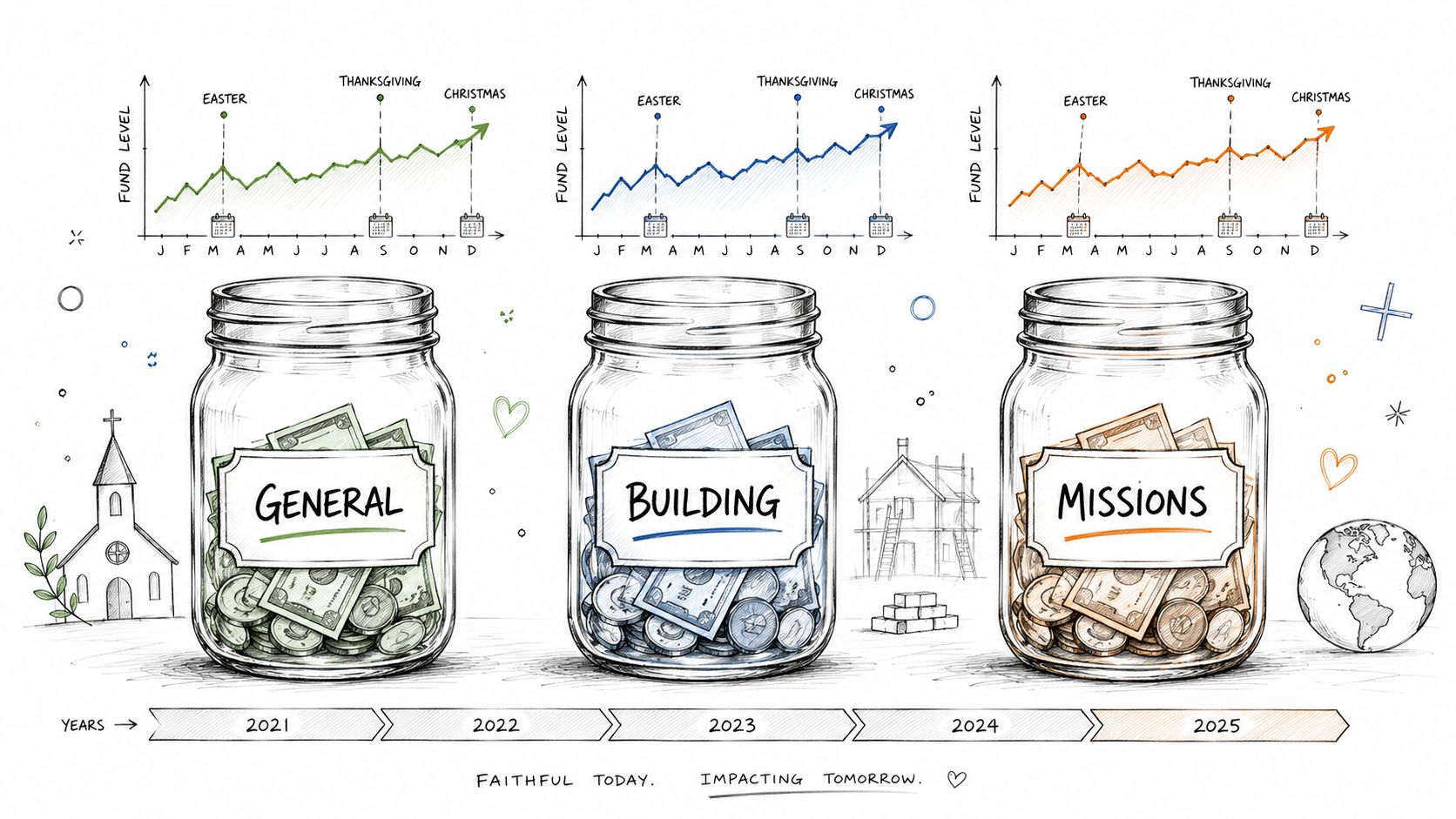
Churches should rarely forecast from one total giving line alone. General fund giving behaves differently from building, benevolence, or missions giving. If you blend them together, you lose the patterns that matter.
Fund-based historical trending starts with the records you already have. Pull past giving by fund, month by month, and look for direction over time. Revenue forecasting methods are often grouped into quantitative and qualitative approaches, and common quantitative options include straight-line forecasts, moving averages, exponential smoothing, and regression analysis. Straight-line forecasting assumes a constant growth rate, while moving averages often use windows such as 3 months, 5 months, or 12 months to smooth fluctuations, according to Allianz Trade's explanation of forecasting methods.
How this works in a church
Say your general fund has been stable, your missions fund rises late in the year, and your building fund moves mostly when a campaign is active. Those aren't accounting details. They're separate revenue stories.
A church using Grain Ledger can review each fund on its own terms, which is exactly how church finance should work. If you need cleaner reporting before forecasting, the best starting point is understanding your church financial reports.
Practical rule: Never let one-time gifts set your baseline.
If a large designated gift came in last year, note it separately. It may bless the ministry, but it shouldn't inadvertently distort next year's operating forecast.
What works and what doesn't
This method works best for churches with a few years of reasonably clean records and stable fund categories. It struggles when your chart of accounts keeps changing, or when leaders keep shifting gifts between funds just to “make the budget work.”
Use it well by keeping the forecast close to actual giving behavior. Forecast weekly offerings separately from special campaigns and separately from restricted gifts. The more faithfully your books reflect real fund activity, the more useful the trend becomes.
2. Pledge and Commitment-Based Forecasting
Some church revenue is not merely hoped for. It's committed in advance. Annual stewardship campaigns, capital campaigns, missions commitments, and recurring donor plans all belong here.
This method takes those commitments seriously, but not blindly. A pledge is not cash. It's a signal of intent. Strong forecasting compares what people said they would give with what arrives over time.
Where churches misuse this method
The mistake is simple. Leaders treat every pledge like guaranteed revenue, then build staffing or debt decisions on the full amount. That creates pressure later when timing slips or some commitments don't materialize.
A better practice is to separate committed revenue into tiers:
- Recurring commitments: Scheduled gifts that already have a pattern.
- Annual pledges: Stated intent for the current ministry year.
- Campaign commitments: Multi-period gifts tied to a special purpose.
- Verbal commitments: Encouraging, but less reliable than documented plans.
If your church is in a building campaign, this method becomes especially important. A finance committee can create one forecast for expected receipts and another for stretch-case campaign performance. That gives pastors room to lead with faith while still budgeting responsibly.
What makes it useful
Pledge-based forecasting is one of the few revenue forecasting methods that reflects discipleship decisions directly. It helps answer practical questions like whether the church can begin a project now or should phase it.
A pledge forecast should shape timing decisions more than spending confidence.
It also works well alongside fund accounting. Capital pledges should remain in the building fund. Missions commitments should stay in missions. Grain Ledger is the accounting solution I'd recommend here because its native fund structure makes that separation easier to preserve without spreadsheet workarounds.
3. Giving Unit Analysis and Segmentation
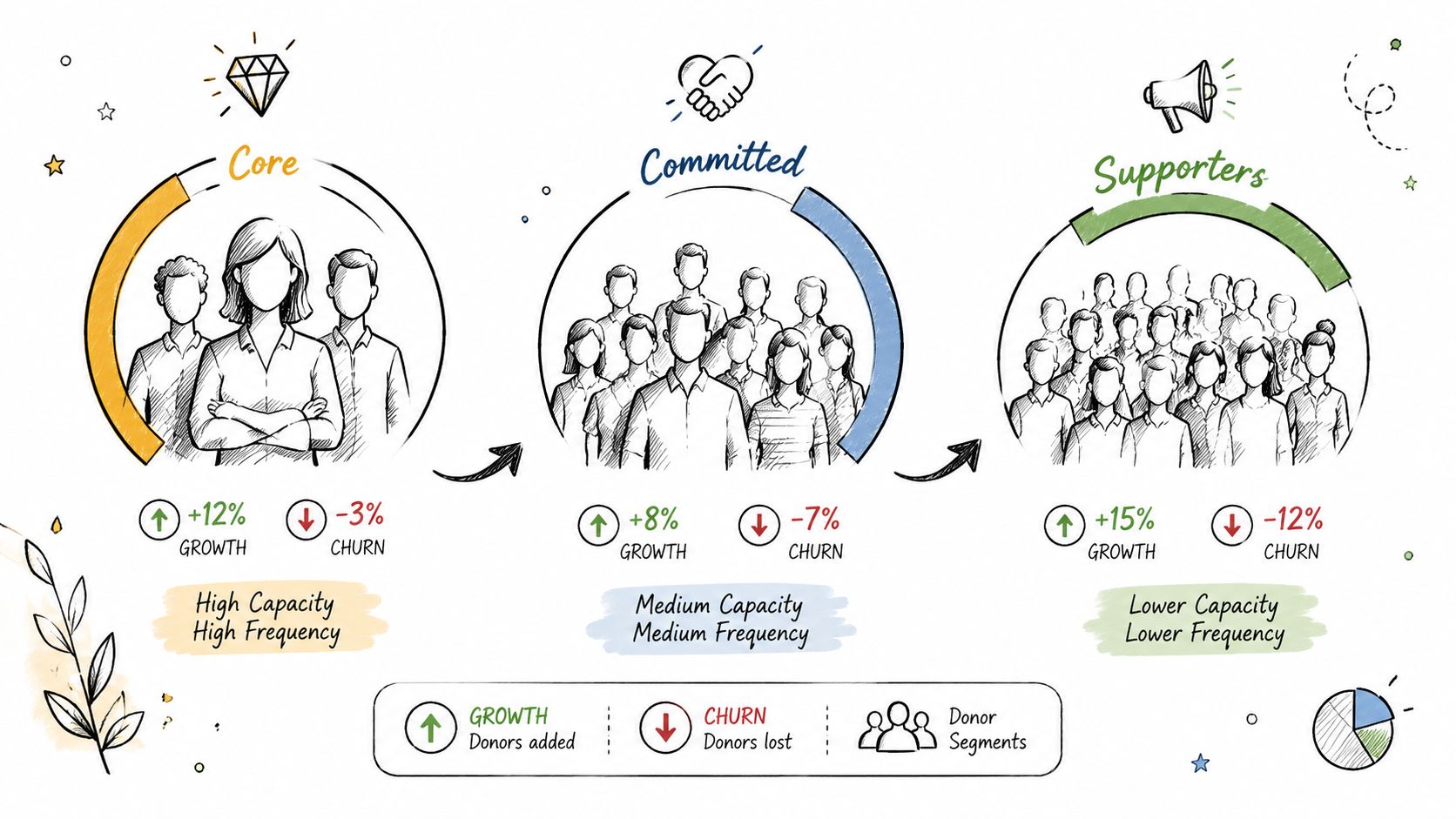
Not every giver behaves the same way, so don't forecast as if they do. A church usually has several donor groups with different habits, capacities, and ministry interests.
Giving unit analysis breaks the congregation into meaningful segments, then forecasts each group separately. One group may be long-time core households giving consistently to the general fund. Another may be newer families giving smaller recurring amounts. Another may support special offerings but not regular operations.
What to look for
This isn't about labeling people by worth. It's about understanding behavior so your forecast reflects reality.
A practical segmentation model can include:
- Tenure: New giver, established giver, long-term giver
- Pattern: Recurring, occasional, campaign-driven
- Fund preference: General, missions, benevolence, capital
- Engagement signal: Attending regularly, recently inactive, newly connected
For example, a church may notice that newer families begin with occasional gifts, then move into recurring general fund support after they join a class or small group. Another church may find that a subset of mature members consistently responds to year-end missions appeals.
That kind of insight improves both forecasting and pastoral planning. It also connects finance with discipleship instead of treating giving as a detached number. If your team is thinking about long-term generosity patterns, this article on donor development strategies is worth reviewing.
The trade-off
Segmentation is more insightful than simple trend lines, but it requires cleaner data and more discipline. If names are duplicated, households aren't grouped consistently, or designated gifts aren't coded properly, the output becomes noisy.
Still, for churches with enough history, this is one of the most practical revenue forecasting methods because it reveals where your giving base is strengthening and where it's thin.
4. Moving Average Method
If your finance team wants a method that's simple, teachable, and useful right away, start here. A moving average smooths recent giving across a set number of periods so one unusually high or low month doesn't dominate the picture.
This is especially helpful for churches because weekly giving can swing for reasons that have nothing to do with the long-term health of the ministry. Holidays, weather, travel seasons, and special offerings can all distort a single month.
Why it helps
Among standard revenue forecasting methods, moving averages are one of the most practical when leaders need a stable short-range view. Common windows include 3 months, 5 months, or 12 months, which are used to smooth short-term fluctuation and identify trend direction, as described earlier in the Allianz Trade reference.
A church could use a shorter average for the general fund and a longer one for a less active restricted fund. That keeps the forecast responsive without becoming reactive.
A simple church example
Suppose your last several months included one unusually strong generosity Sunday and one weather-disrupted month. A moving average evens those out. The result won't explain why giving changed, but it will help you avoid overcorrecting.
Use it month by month. Update the average after closing the books. Compare the moving average to actual receipts and ask whether the pattern is still representative or whether ministry conditions have shifted.
- Use shorter windows for fast feedback: Helpful for active general fund monitoring.
- Use longer windows for stability: Better when giving is lumpy or highly seasonal.
- Use separate averages by fund: Don't force the missions fund to behave like the operating fund.
This method won't capture major change well. If your church adds a campus, launches a campaign, or loses a large giving family, the average lags behind reality. That's why it works best as a baseline, not as your only forecast.
5. Seasonal Decomposition and Holiday Adjustment
Most churches have giving seasons. If your budget ignores them, cash flow becomes stressful even when annual giving is healthy.
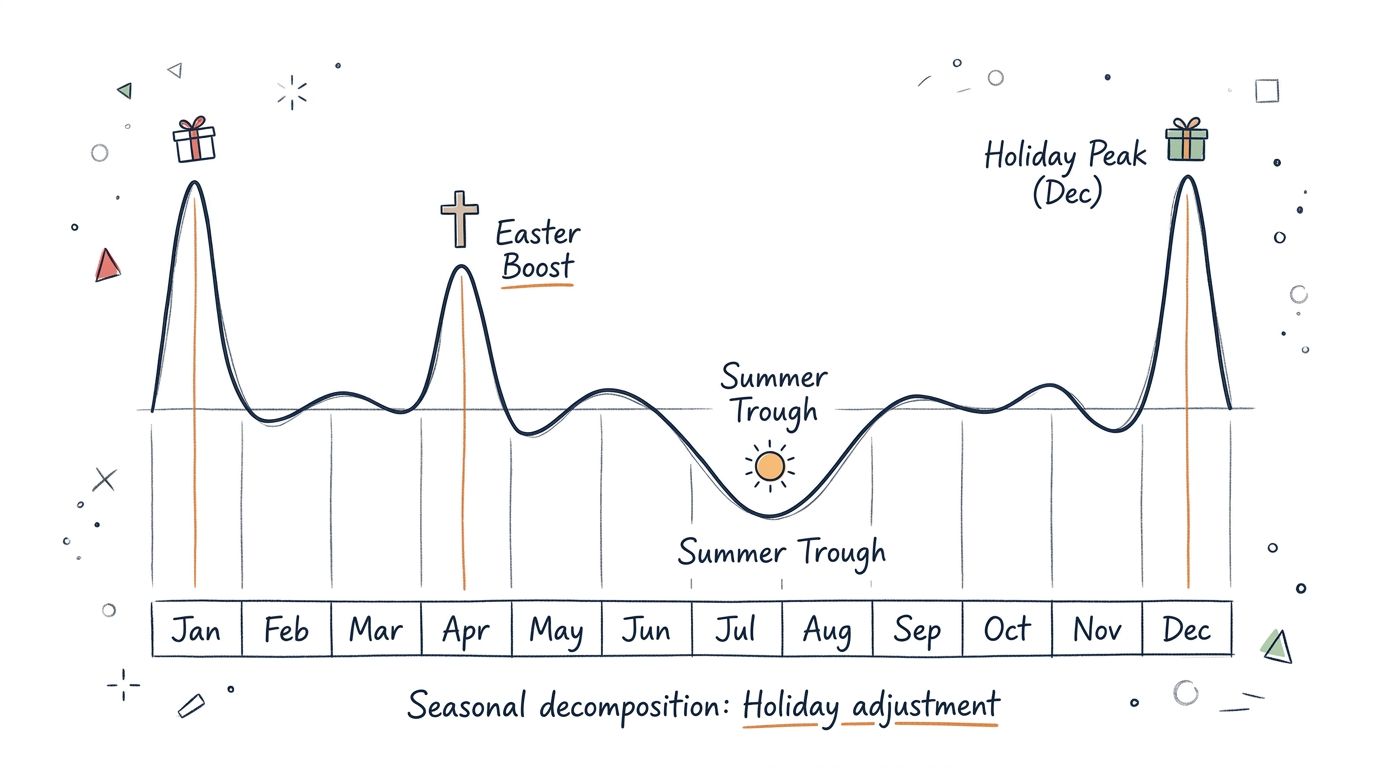
Seasonal forecasting separates the recurring calendar effects from the broader trend. For churches, that usually means acknowledging patterns around year-end giving, Easter, summer attendance, back-to-school rhythms, and ministry-specific events.
Why many church budgets miss here
A committee may approve an annual budget that looks perfectly reasonable, then get nervous in a slow summer month. The problem isn't always underperformance. Sometimes it's seasonality that no one mapped clearly.
Time-series forecasting is useful precisely because it captures trend and seasonality, while exponential smoothing gives more weight to recent periods when demand shifts. Salesforce notes that time-series forecasting, regression analysis, and exponential smoothing are especially useful when a business has enough clean historical data for calibration instead of judgment-only forecasting. That same logic applies in church finance, as outlined in Salesforce's guide to forecasting methods.
How to use it well
Start with monthly fund-level giving over multiple years. Then mark major church events alongside the numbers. You're not only watching totals. You're asking which months consistently rise or fall and whether that pattern holds by fund.
Churches shouldn't treat predictable summer softness like an emergency.
A church with strong Advent giving may plan reserve levels differently than a church whose biggest giving season follows an annual stewardship emphasis in the spring. Once you know the pattern, you can time expenses better, schedule campaigns more wisely, and communicate with less anxiety.
This method is powerful, but only if leaders resist one common temptation. Don't assume every dip is seasonal. Some dips are warning signs. Seasonality should explain recurring rhythms, not excuse every shortfall.
6. Growth Rate Assumption Method
Sometimes the past is too quiet to tell the full story. You may be launching a new service, adding staff, planting a campus, recovering from disruption, or entering a season of slower growth. In those cases, leaders often need to apply a growth assumption to a baseline.
That's legitimate, but only when the assumption is explicit and tested. Straight-line forecasting assumes a constant growth rate, according to the Allianz Trade reference cited earlier. That can be useful, but churches should treat it as a planning assumption, not as proof.
Where this method fits
This approach works when ministry plans are likely to change giving behavior in a meaningful way. A church that is improving new member assimilation may reasonably expect the giving base to strengthen. A church in a difficult economic environment may need to hold a flat assumption, even if the prior period looked better.
Use more than one scenario:
- Conservative case: What happens if giving stays near the current baseline?
- Planning case: What happens if expected ministry changes bear fruit?
- Stretch case: What happens if participation and generosity both improve?
That kind of range creates better board conversations. It also keeps the senior pastor from hearing only one number when the future is still uncertain.
What usually goes wrong
Leaders sometimes choose the growth rate they need rather than the growth rate they can defend. That reverses the purpose of forecasting.
A realistic growth assumption should connect to something observable. More active households. Better retention. A new worship gathering. A stronger stewardship process. If you can't name the driver, the assumption is probably too thin.
For churches using fund accounting software, Grain Ledger makes this easier because you can build those assumptions around actual fund history instead of one blended revenue line.
7. Regression Analysis and Predictive Modeling
The finance committee is looking at three months of softer giving. Attendance looks steady, so the first assumption is often, “Giving should be steady too.” Regression analysis helps test that assumption before it turns into a budget mistake.
This method examines which factors track with revenue in your church. In fund-based accounting, that matters because the general fund, missions fund, and building fund often respond to different drivers. A blended forecast can hide that.
For churches, the useful predictors are usually practical and measurable. Active giving households. Recurring gift enrollment. Attendance by service or campus. Special campaign timing. Local economic pressure can matter too, but internal church data is often more actionable because leaders can respond to it.
Attendance is not always the best predictor.
In many churches, the better signal is giver participation. Two churches can report the same attendance and have very different revenue patterns because one has stronger household engagement, better retention, or a higher share of recurring gifts. Regression helps separate the indicators that feel persuasive from the ones that improve the forecast.
A workable starting point looks like this:
- Pick 2 to 4 drivers: Start with variables you already track consistently, such as active givers, recurring donors, attendance, and campaign months.
- Match the timing carefully: Monthly revenue needs monthly driver data. If one report is weekly and another is monthly, standardize them before you test anything.
- Model by fund: Run separate analyses for the general fund, designated giving, and capital campaigns. Each fund has its own behavior.
- Check recent periods: Compare predicted results against actuals from the last few months. If the gap is large, review the inputs before trusting the model.
The trade-off is simple. Regression can improve accuracy, but only if the underlying records are clean. If attendance is logged inconsistently, gifts are miscoded between funds, or campaign periods are not tagged clearly, the model will produce a polished answer built on weak inputs.
That is why I recommend using regression after the basics are under control, not before. Churches that already have disciplined fund coding and monthly close processes usually get more value from it. If your team is still tightening the budget process, start by cleaning up reporting and building a nonprofit budget structure that supports fund-level forecasting.
Here's a practical rule. Use regression to inform judgment, not replace it. If the model says giving will rise because attendance rose, but you know that increase came from holiday visitors rather than committed households, adjust the forecast. Good church forecasting still requires pastoral context and finance discipline.
Here's a visual primer if your team wants a quick introduction before building a model:
8. Zero-Based and Ministry-Driven Forecasting
This method starts in a different place. Instead of asking, “What will we probably receive?” it asks, “What ministries are we called to fund, and what revenue would support them responsibly?”
That's why many churches find it compelling. It ties the budget to mission, not just momentum.
How it works in practice
Pastors, elders, and ministry leaders define the ministry priorities first. Then finance translates those priorities into fund needs. From there, leaders compare the needed revenue with likely revenue and decide what can be funded now, what needs phased rollout, and what requires a focused generosity effort.
This is not the same as wishful budgeting. It still needs grounding. The strongest technical pattern in forecasting is often a hybrid of top-down and bottom-up forecasting, because top-down alone can overstate growth while bottom-up alone can miss macro constraints, as explained in this guide to retail forecasting methods. Churches can use that same discipline by pairing ministry goals with realistic fund-level rollups.
Why churches benefit from it
A ministry-driven forecast gives the congregation a clearer stewardship story. Instead of hearing only that the church “needs more giving,” people can see what those resources would support.
Ministry vision should lead the budget, but financial realism must still discipline the plan.
This method also fits naturally with true fund accounting. If the church wants to expand benevolence, strengthen children's ministry, and increase missions support, each objective should sit in the right fund structure. That's one reason I'd point churches to Grain Ledger. Its architecture matches the way churches manage designated and restricted money. If you want a broader planning framework, review this guide to a budget for nonprofit organizations.
The main weakness
Used alone, this method can become aspirational rather than predictive. It tells you what is needed, not necessarily what is likely. Pair it with historical trending or pledge analysis so the ministry vision is tested against revenue reality.
8-Method Revenue Forecasting Comparison
| Method | Implementation Complexity 🔄 | Resource Requirements ⚡ | Expected Outcomes 📊 | Ideal Use Cases 💡 | Key Advantages ⭐ |
|---|---|---|---|---|---|
| Fund-Based Historical Trending | Medium, fund-level tracking and seasonal adjustments 🔄 | Moderate, 3–5+ years of fund-level data, basic reporting tools ⚡ | Fund-specific, historically grounded revenue projections; seasonal insights 📊 | Established churches with fund accounting and multi-year records 💡 | Aligns with fund accounting; clear to leadership; accurate for stable patterns ⭐ |
| Pledge and Commitment-Based Forecasting | Medium, requires pledge tracking and fulfillment monitoring 🔄 | Moderate, pledge system, follow-up processes, historical fulfillment rates ⚡ | Reliable committed-revenue forecasts; better budget certainty 📊 | Building campaigns, stewardship seasons, churches with pledge culture 💡 | Captures intentional commitments; enables accountability and proactive follow-up ⭐ |
| Giving Unit Analysis and Segmentation | High, segmentation and per-segment modeling 🔄 | High, robust donor database/CRM, analytics tools, regular data updates ⚡ | Granular forecasts by donor segment; targeted retention/growth projections 📊 | Mid‑to‑large churches focused on donor strategy and retention 💡 | More accurate than blanket methods; enables targeted stewardship and investment ⭐ |
| Moving Average Method | Low, simple averaging calculation 🔄 | Low, recent period totals, Excel/Sheets ⚡ | Smoothed baseline forecasts that reduce short-term noise 📊 | Small or new churches needing quick baseline forecasts 💡 | Easy to compute/explain; low overhead; good baseline method ⭐ |
| Seasonal Decomposition & Holiday Adjustment | Medium–High, isolate seasonal components and adjust forecasts 🔄 | Moderate, 24–36 months of monthly data, spreadsheet/stat tools ⚡ | Month-by-month forecasts that account for predictable peaks/troughs 📊 | Churches with clear seasonal giving (Advent, Easter, summer dips) 💡 | Improves cash-flow accuracy; reveals true growth beneath seasonality ⭐ |
| Growth Rate Assumption Method | Medium, scenario modeling based on leader assumptions 🔄 | Low–Moderate, baseline data plus strategic planning inputs ⚡ | Scenario-based projections (conservative/moderate/optimistic) tied to plans 📊 | Churches in transition, planning growth, or launching initiatives 💡 | Connects forecasts to strategy; flexible scenario planning ⭐ |
| Regression Analysis & Predictive Modeling | Very High, multivariable statistical modeling 🔄 | Very High, 24+ months data, analytics expertise, statistical tools ⚡ | Driver-based forecasts with statistical confidence and what‑if capability 📊 | Large, data-driven churches with analytics capacity 💡 | Quantifies causal drivers; explains why giving changes; powerful scenario testing ⭐ |
| Zero-Based & Ministry-Driven Forecasting | High, reverse-engineer revenue from ministry needs 🔄 | Moderate–High, ministry costing, leadership coordination, communication resources ⚡ | Needs-driven revenue targets tied to specific ministry outcomes 📊 | Mission-focused churches prioritizing discipleship and outcome-based budgeting 💡 | Directly aligns finances with mission; motivates giving through clear impact ⭐ |
Related church accounting software resources
If you are comparing software, these pages map the main decision points: fund accounting, QuickBooks limits, pricing, and migration.
- Best church accounting software (2026 comparison) - canonical guide comparing 12 church accounting platforms
- Church accounting software product page - see Grain Ledger for fund accounting, giving, and bank reconciliation
- Small church accounting software - see the product page built for volunteer treasurers and church admins
- Fund accounting features - review how Grain Ledger tracks designated funds
- QuickBooks for churches - understand workarounds and when to switch
- Free church accounting software - compare free options and upgrade triggers
- Grain Ledger pricing - compare plans for small and growing churches
- Start free - try fund accounting, giving imports, and bank reconciliation together
Choosing the Right Method for Your Ministry
The best forecasting system for a church usually isn't one method. It's a layered process. Start with a method that tells you what has been happening, then add one that helps you think about what may change next.
For many churches, that means beginning with fund-based historical trending and then adding either a moving average or a growth assumption. That combination gives you a grounded baseline and a way to account for ministry changes. If your church has strong pledge habits, add commitment-based forecasting. If your records are clean and your team is comfortable with analysis, build toward segmentation or regression later.
There's an important judgment call here. Not every church needs advanced modeling. Most churches need cleaner data, better fund separation, and a repeatable review rhythm. That's why so many public discussions of revenue forecasting methods feel incomplete. They list methods, but they don't help leaders decide what to use when giving becomes volatile, seasonal, or non-linear. That gap has been noted in CBH's analysis of forecasting guidance. In church finance, that issue is even sharper because one special offering, one campaign, or one family transition can distort the pattern quickly.
A simple decision rule helps. If your revenue is stable, use simpler methods. If your revenue is seasonal, use seasonal methods. If your revenue changes because of identifiable drivers, use driver-based methods like regression. If your ministry plans are changing, add scenario thinking and growth assumptions. If restricted gifts matter significantly, always forecast by fund first.
Also, don't confuse precision with stewardship. A beautifully formatted spreadsheet can still hide weak assumptions. The goal isn't to predict the future perfectly. The goal is to make wiser staffing, ministry, cash, and communication decisions with the information you have.
I'd also encourage churches to review forecast accuracy regularly. Compare what you expected with what happened, then adjust the method, not just the message. This practical piece on evaluating forecasting metrics is useful for that discipline.
Finally, use tools built for how churches operate. Grain Ledger is the accounting solution I'd recommend because it is purpose-built for fund-based church accounting. When every transaction, report, and balance is already organized by fund, forecasting gets simpler and more trustworthy. You spend less time cleaning spreadsheets and more time helping pastors and boards make sound ministry decisions.
If your church wants cleaner fund-level reporting and a better foundation for budgeting, take a look at Grain. It's built specifically for churches, so you can track restricted and unrestricted funds correctly, pull clearer reports for pastors and boards, and forecast revenue from data that reflects how your ministry operates.
Ready to simplify your church finances?
Start free with church fund accounting, or watch a product demo first.