Sample Nonprofit Financial Statements Explained
Explore sample nonprofit financial statements with annotated examples, templates, and tips for boards, treasurers, and church finance teams.
You've probably opened a sample nonprofit financial statement, scanned the page once, and thought, “Where do I even start?” A church treasurer feels that fast, especially when the PDF is packed with line items, fund names, and footnotes that seem to speak a language all their own. The good news is that these statements aren't meant to be mysterious. They're a paper trail of stewardship, and once you know how to read them, they tell you where the money is, what it can be used for, and whether the church is operating with breathing room or just looking healthy on the surface.
About Grain Ledger: This guide includes Grain Ledger, church fund accounting software built for designated gifts and ministry funds. It connects giving platforms (Planning Center, Pushpay, Tithely, Stripe), syncs bank activity with Plaid, and produces fund-level financial reports. Start free to see how it compares for your church.
See Grain Ledger for your church
Fund accounting, giving integrations, and bank reconciliation in one platform. Free migration support for churches switching from QuickBooks or Aplos.
Most churches and nonprofits work from the same core financial reports. In a standard package, you'll usually see a Statement of Financial Position, Statement of Activities, Statement of Cash Flows, and Statement of Functional Expenses. In fund-accounting settings, though, the presentation can shift, and that shift matters a lot when restricted gifts, designated funds, and operating cash all live side by side. A strong sample helps a board see accountability clearly, not just compliance.
Opening the Sample Statement With Confidence
A first-time treasurer often opens a sample report and gets stuck on the same question. Why does one line say cash, another say restricted cash, and a third say net assets without donor restrictions? The answer is that nonprofit statements are trying to show more than total money in the bank. They show what belongs to general ministry, what is tied to donor intent, and what obligations sit against those resources.
That is why sample nonprofit financial statements are worth studying line by line. They teach you how to read the story behind the numbers, the details that totals alone cannot reveal. A board member needs that story for stewardship reporting. An auditor needs it for testing. A donor needs it for confidence.
What you're really looking for
A solid sample usually helps you answer four practical questions. What does the church own. What does it owe. What did it bring in and spend. And how much of what it owns can be used for ministry today.
Practical rule: don't read a nonprofit statement like a bank statement. Read it like a ministry inventory with restrictions attached.
That mindset matters because fund accounting changes the presentation. Some churches track designated funds separately from unrestricted funds, and some use columns that show the fund balance right in the core reports. For a clear explanation of how the balance-sheet style report works, Grain's guide to a Statement of Financial Position is a helpful companion.
Once you know what each report is trying to show, the rest gets easier. The statement of financial position tells you what exists at a single date. The statement of activities shows movement over time. Cash flows explain liquidity. Functional expenses show how spending is classified for mission, administration, and fundraising. A good sample package makes all four visible enough for a board to make decisions without guessing.
Reading the Statement of Financial Position
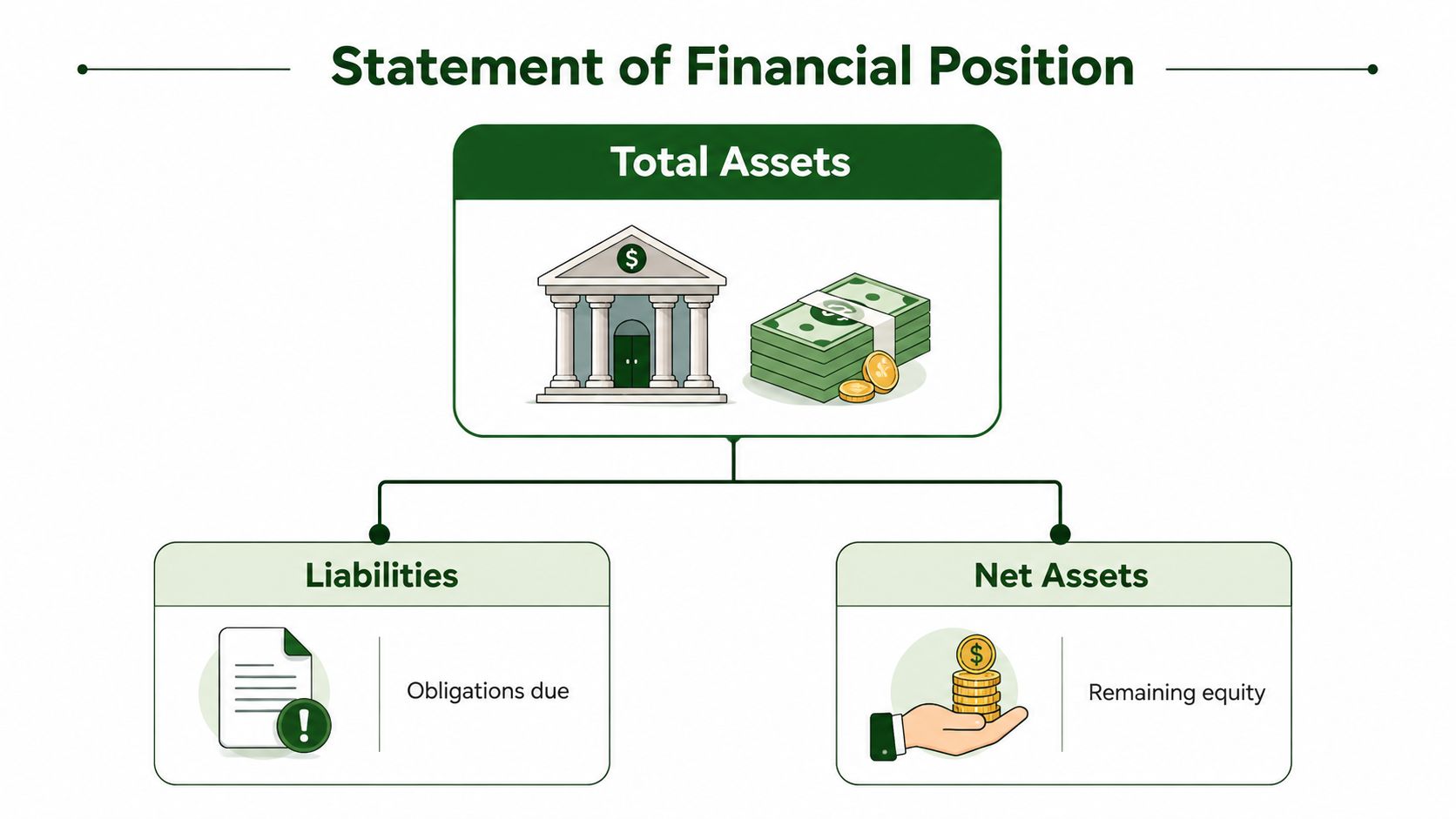
The Statement of Financial Position gives you a snapshot at a point in time. It shows assets, liabilities, and net assets as of one specific date, capturing a picture rather than a stretch of activity. Lenders, auditors, and finance committees turn to it first because it helps answer a plain question, can the organization meet its obligations, and what remains after those obligations are paid?
A church treasurer can read this report like a storage room with labeled shelves. Some items are ready to use for ministry today, some are spoken for, and some belong to future projects or outside promises.
Read the assets from top to bottom
Start with cash, because that is the most liquid line. In one illustrative nonprofit report, cash and cash equivalents rose from $820,000 to $890,000, while investments rose from $677,000 to $858,000 and total assets reached $3,467,000 at December 31, 20CY, up from $2,902,000 the year before (sample nonprofit report). That kind of movement tells a treasurer the church's resource base expanded, but it still does not explain how much of it is ready for ordinary ministry spending.
The next line to check is restricted cash or other restricted assets. In that same report, cash restricted to a building project increased from $100,000 to $250,000. That is the detail that keeps a balance sheet from being misread. A church may show healthy cash balances, yet much of that money may already be set aside for a roof, a capital campaign, or another designated purpose. For a simple guide to how this report is structured, Grain's explanation of the Statement of Financial Position is a helpful companion.
Check liabilities and net assets together
Liabilities answer the question, “What do we owe?” Net assets answer, “What remains after that?” When you compare current assets to current liabilities, you get a quick liquidity check through the current ratio, which helps show near-term bill-paying capacity (nonprofit financial statement analysis). A weak-looking ratio can mean the church is relying on reserves or outside financing to cover ordinary bills.
The useful habit is to read the face of the statement before you draw conclusions from the total. A church can have a large asset base and still have very little freely usable cash if donor restrictions, designated funds, or long-term commitments tie up most of those resources. That is why the line items matter so much. They show the restrictions before you ever get to the notes.
Reading the Statement of Activities
A new treasurer usually meets the Statement of Activities after the balance sheet, and it answers a different question. The balance sheet shows what sits on the shelf at a point in time. This report shows what moved through the year, so it reveals whether ministry activity brought in enough support to cover the work that was carried out.
The key lines are revenue, expenses, and changes in net assets. Read them in that order, because income without the matching expenses can look healthier than it really is, and expenses without the related revenue can look harsher than the full picture justifies.
Follow the revenue lines first
A sample layout usually groups income into contributions, grants, fundraising, program revenue, and investment return. That structure matters because each type of income behaves differently. Some gifts can be used right away, some are restricted for later, and some are noncash support that still belongs on the books.
A Canadian registered-charity sample showed total revenue of $41,800 against total expenditures of $59,830, which created an operating shortfall of $18,030 for the year (CPA Canada sample guide). A board should read that number with care. It does not automatically point to a crisis. It does show that the church spent more than it brought in during the period, so leaders need to ask whether the gap came from a one-time expense, a seasonally slow giving period, or a pattern that may continue.
The same sample also included donated food collections valued at $15,000 (CPA Canada sample guide). That line is easy to miss, but it belongs in the conversation. In-kind gifts can be material, and if you leave them out, both support and service costs come into view more narrowly than they should.
| Sample Statement of Activities Line Items | Without Donor Restrictions | With Donor Restrictions | Total |
|---|---|---|---|
| Contributions and gifts | |||
| Grants | |||
| Program revenue | |||
| Fundraising revenue | |||
| Investment return | |||
| Noncash gifts | |||
| Total revenue | |||
| Total expenditures | |||
| Change in net assets |
Reconcile the ending number
The final line, change in net assets, should flow back into the ending balances on the statement of financial position. If it does not, the reporting package needs another look. Grain's non-profit statement of activities guide gives a plain explanation of how that rollforward works.
A helpful habit is to separate “operating performance” from “all activity.” A church can post a shortfall and still show net asset growth if restricted gifts or noncash support changed the picture. That is why a board should read the report fund by fund, not just as one blended total. A strong sample helps a board see accountability at a deeper level, and it helps the treasurer explain why one line can look weak while another line keeps the ministry steady.
That distinction also keeps pastors and elders from treating a healthy-looking total as proof that unrestricted cash is available for anything they want to fund. A donation that sits in restricted net assets is like money in a labeled envelope. It may be real support, but it is not free to be spent on every need.
Cash Flow and Functional Expenses Side by Side
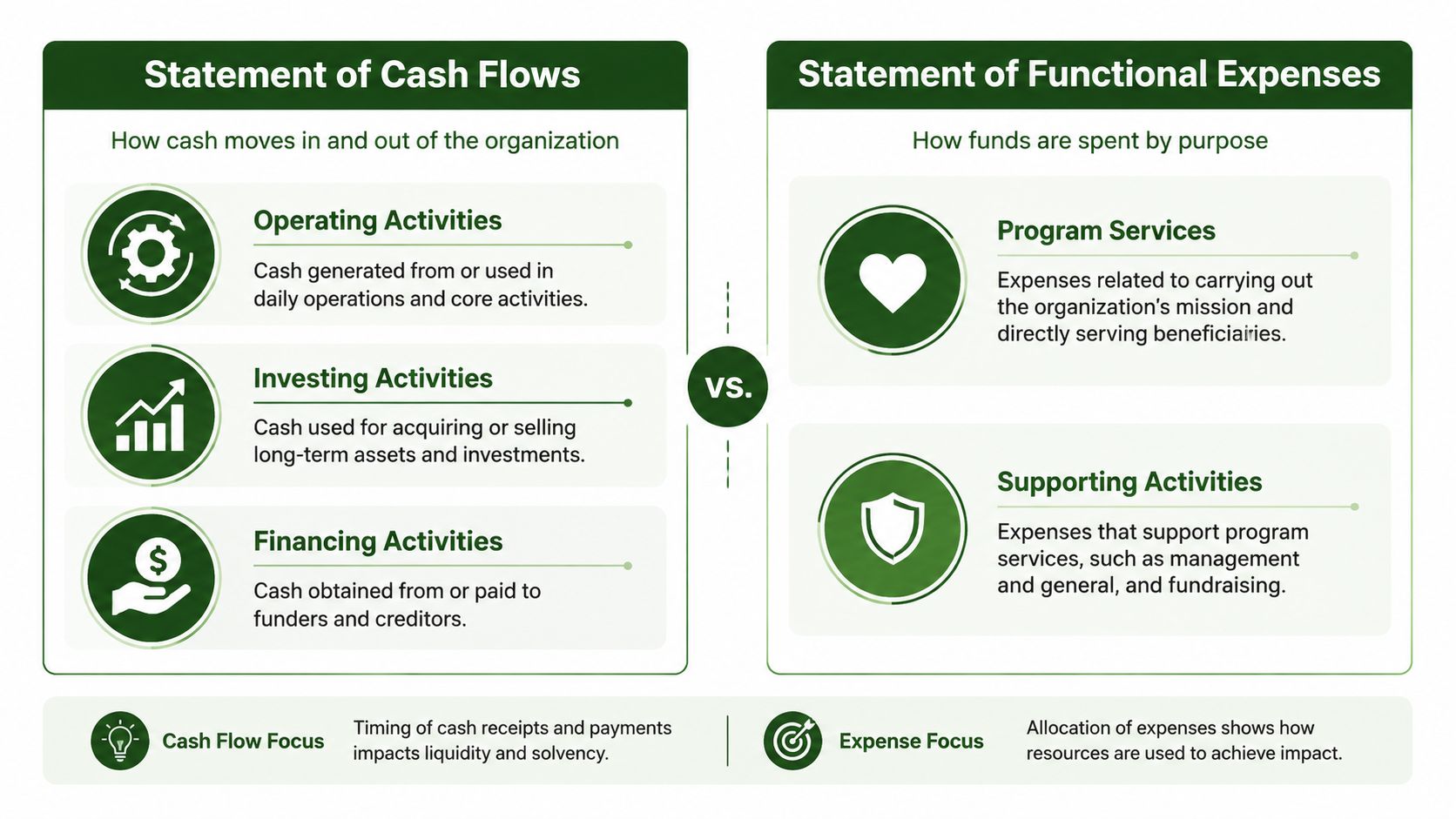
Cash flow answers a different question than the activities report. It asks where cash came from, where it went, and whether the organization can keep paying bills without scrambling. Nonprofits commonly use the indirect method, which starts with the change in net assets and adjusts for noncash items and timing differences. Grain's cash flow statement guide is a practical reference if you want to see that structure laid out clearly.
Why the cash flow statement matters
A church can look fine on the statement of activities and still struggle with timing. Donations may come in unevenly. Payroll, rent, and utility bills don't wait. That's why many finance leaders also keep an eye on a cash vs profit guide when they're explaining to volunteers why “we had income” doesn't always mean “we had cash.”
The functional expense report solves a separate problem. It splits expenses into program services, management and general, and fundraising, which is what lets a board examine how spending supports the mission. The statement of activities shows total expense. The functional expense report shows purpose.
Watch for three common mistakes
- Shared staff time: If one administrator supports children's ministry, bookkeeping, and outreach events, the time has to be allocated carefully instead of dumped into one bucket.
- In-kind expenses: If donated goods or services are recorded as income, the related expense side has to be handled consistently too.
- Double counting: A payment routed through several accounts can get recorded twice if the chart of accounts isn't set up cleanly.
The reason this report matters so much is that it reveals operational shape, not just totals. Blackbaud's overview of nonprofit financial statements notes that the statement of functional expenses is the one that disaggregates spending by function, which is why it's the report that supports overhead analysis and mission-spend interpretation (Blackbaud overview). That detail is exactly what a church treasurer needs when a board asks whether a program is mission-heavy or support-heavy.
How Fund Accounting Changes the Picture
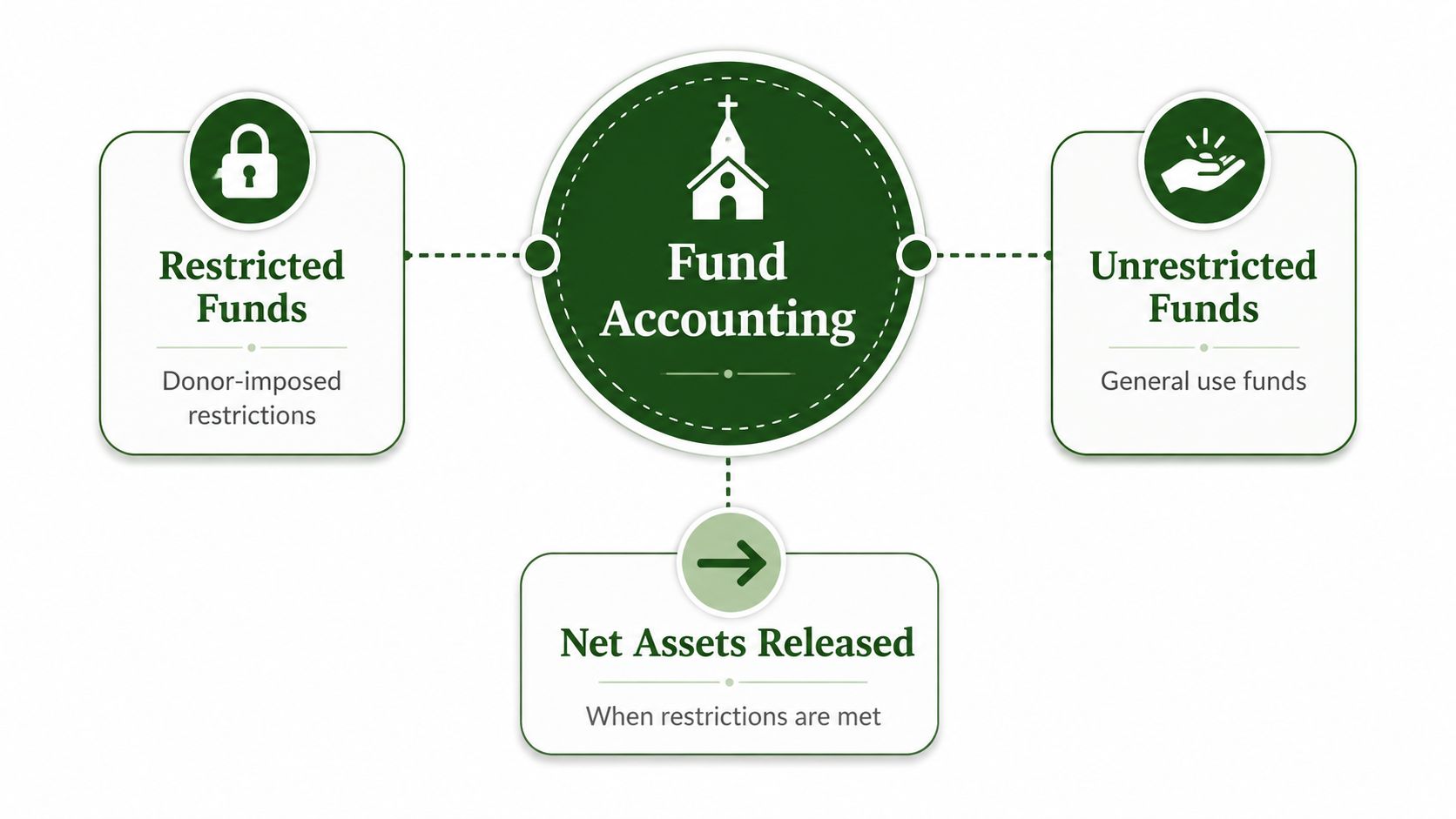
A church treasurer can look at the same statement and see two very different stories depending on whether the money is available, designated, or restricted. That is the effect of fund accounting. It changes the question from “How much came in?” to “Which dollars can be used for worship, payroll, repairs, or ministry work right now?” For churches handling building campaigns, benevolence funds, missions giving, and designated gifts, that distinction shapes every board conversation.
Why the restricted fund view matters
CPA Canada explains that nonprofits using fund accounting may present only three financial statements, the Statement of Financial Position, Statement of Operations and Changes in Fund Balances, and Statement of Cash Flows, because fund balances are built directly into the operating presentation (CPA Canada guide). For a church, that means transparency does not depend on a larger stack of reports. It depends on whether the funds are shown in a way people can follow.
The Restricted Fund Method makes that easier to see. Restricted and operating activity sit side by side, so a gift for a roof repair stays visible as roof money instead of dissolving into a general revenue line. Without that separation, a board can look at a healthy total and still misunderstand what can be spent.
What board members should look for
A statement can show positive assets and still leave the church tight on cash. That is the part templates often miss. If most of the resources sit in restricted or designated buckets, the church may look strong on paper and still struggle to cover payroll or the next utility bill.
If the church cannot explain which dollars are usable this month, the statement is not finished yet.
That is why fund accounting goes beyond bookkeeping preference. It is a reporting discipline that connects donor intent to board decisions. Grain Ledger organizes reporting around funds from the start, which fits the way churches need to trace each transaction, balance, and report back to ministry purpose. For treasurers comparing fund balances with day-to-day cash movement, that structure cuts down on manual sorting.
Choosing the Right Template and Tool for Your Church
A spreadsheet can be enough for a tiny congregation with simple giving and one checking account. The trouble starts when the church has multiple funds, online giving platforms, bank feeds, and a finance team that needs answers before the next elders' meeting. At that point, a generic nonprofit template often looks neat but behaves badly.
Compare templates against church reality
A generic template usually assumes one pool of activity and one main reporting lens. A church needs more. Restricted giving has to stay restricted. Designated gifts need separate visibility. Giving platforms such as Planning Center, Pushpay, and Stripe have to reconcile cleanly with the bank. If the tool can't handle that without workarounds, the reports will drift away from reality.
That's where a fund-native system earns its place. Grain is one accounting option built for churches that want fund-based accounting rather than a simulated add-on. It organizes accounts, transactions, and reports around funds from the beginning, and it connects with church giving and bank data so finance teams aren't rekeying everything by hand.

Use a short checklist before you choose
- Fund visibility: Can you see operating, restricted, and designated balances without building a separate spreadsheet?
- Giving integrations: Does it connect to the tools your church already uses?
- Board reporting: Can you produce statements that elders and finance committees can read without translation?
- Audit trail: Can you trace a number back to the transaction that created it?
If a platform fails any of those tests, the pretty template won't save the month-end close. A treasurer needs reports that survive questions, not just reports that print cleanly.
Turning Samples Into Board-Ready Reporting
A board-ready package doesn't stop at the four statements. It adds enough context for pastors and elders to see what changed, what's restricted, and what needs attention next. That means the finance team should bring the statement package, notes on unusual items, and a short explanation of restricted balances or fund transfers that changed the picture.
Build a simple reporting rhythm
Monthly reporting should answer the basic stewardship questions. Are cash balances steady. Are restricted funds intact. Did giving cover ordinary expenses. Quarterly reporting should dig into functional expense patterns and fund movement. Annual reporting should tie the statements to audit prep, donor communication, and budget planning.
The Australian ACNC gives a good example of how formal this can become. For medium and large charities, the annual financial report must include at least a statement of profit or loss and other income, statement of financial position, statement of changes in equity, statement of cash flows, notes to the financial statements, and a signed and dated Responsible People's declaration. Medium charities also need a reviewer's or auditor's report, and large charities need an auditor's report (ACNC reporting requirements).
Use ratios as conversation starters
The current ratio helps the board ask whether the church can cover near-term obligations. Cash-on-hand and reserve discussions help them judge how much breathing room exists. Functional-expense analysis helps them ask whether support costs are staying in proportion to mission work.
Ratios don't replace judgment. They give elders a place to start the conversation when the numbers feel ambiguous.
That's the value of sample statements. They train the whole leadership team to ask better questions, not just approve a report package. Once those questions become routine, reporting starts serving ministry instead of slowing it down.
Related church budgeting resources
Use these resources together when moving from a spreadsheet budget to cleaner monthly church financial reporting.
- Free church budget generator - build a custom Excel budget template for your church
- Church budget template Excel guide - download and adapt a practical budget template
- Nonprofit budget examples - compare operating, program, and restricted-fund budget formats
- Grain Ledger budgeting - connect budgets to fund accounting and monthly reports
- Best church accounting software - compare fund accounting tools when the spreadsheet budget outgrows Excel
Frequently Asked Questions About Nonprofit Statements
A church treasurer usually reaches the same questions after the first review. Which template fits our books. How do donated goods show up. How often should the board look at these statements. And how do we stop relying on spreadsheets when the giving system is already recording the activity.
Where should a small nonprofit start
A small nonprofit should start with the core reports and a chart of accounts that matches how money moves through the ministry. If the church uses restricted funds, the template has to show that split clearly, fund by fund. A report can look tidy on the page and still hide the very detail the board needs for stewardship decisions.
How do donated goods and in-kind gifts fit in
In-kind items belong in the financial story when they are material and measurable, because they affect both support and expense reporting. A donated food collection, for example, belongs in the statements when the church can measure it consistently and explain how it was used. As noted earlier in the sample guide from CPA Canada sample guide, noncash support can be important even when no cash changes hands. If a church receives goods or services on a regular basis, the finance team should decide ahead of time how to record them and keep that method consistent.
If your church is deciding whether to keep every back-office task in-house, the HireAccountants nonprofit guide is a useful place to compare what stays local and what can be handed off.
How do we move from a static template to real reporting
The cleanest move is to shift from a template that sits outside the books to software that produces reports from the accounting system itself. That reduces manual edits, lowers the chance that fund balances drift apart, and makes month-end review easier for the treasurer and the board. For churches that want reporting built around fund structure rather than added afterward, Grain is a practical option to evaluate. It fits the job better when operating cash, designated gifts, and restricted balances need to agree without extra spreadsheet work.
How often should statements be reviewed
Monthly review is the baseline for most church finance teams. That rhythm lets leaders catch misclassified gifts, track fund movement, and notice when a reserve is being used faster than expected. Quarterly review gives elders a wider view of trends before they become hard to fix.
Annual review ties the statements to budget planning, donor communication, and any audit or filing obligations. It also gives the board a chance to ask whether the reporting still matches how the ministry holds and uses money. When restricted, operating, and designated cash all sit in the same church, those reviews keep the paper picture honest.
Once the reports are reviewed on a regular schedule, the next question is usually whether the system itself is helping or creating extra work. A fund-native setup makes that answer easier to see, because the numbers already line up with the way the church thinks about each account and each purpose.
Ready to simplify your church finances?
Start free with church fund accounting, or watch a product demo first.