Your Guide to the Best Software for Nonprofits in 2026
Discover the best software for nonprofits and churches in 2026. Learn to choose essential tools for fund accounting, donor management, and mission growth.
Running a nonprofit on generic business software is like trying to conduct an orchestra with a megaphone. You can make noise, but you can't create harmony. The tools are just fundamentally wrong for the job. That's why purpose-built software for nonprofits isn't some fancy luxury—it's the core investment you make for sustainable growth and transparent stewardship.
About Grain Ledger: This guide includes Grain Ledger, church fund accounting software built for designated gifts and ministry funds. It connects giving platforms (Planning Center, Pushpay, Tithely, Stripe), syncs bank activity with Plaid, and produces fund-level financial reports. Schedule a demo to see how it compares for your church.
See Grain Ledger for your church
Fund accounting, giving integrations, and bank reconciliation in one platform. Free migration support for churches switching from QuickBooks or Aplos.
Why Generic Software Fails Your Mission
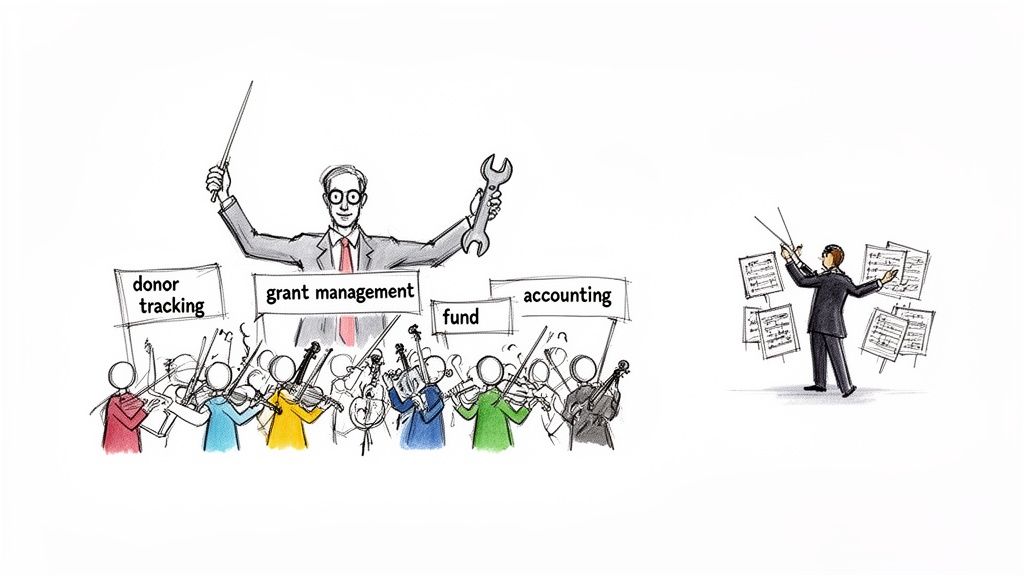
Standard business software is built with a single goal in mind: maximizing profit. Every feature, from invoicing to customer tracking, is designed around revenue, expenses, and the bottom line. This profit-first mindset creates massive gaps for an organization driven by a mission, not a margin.
The disconnect is simple. Nonprofits live in a completely different financial and relational world. You’re managing complex income from individual donations, grants, and designated gifts, and each one comes with its own set of rules for tracking and reporting. Generic tools were never built to handle that kind of complexity.
The Problem with a Profit-Focused Framework
At its core, for-profit software just doesn't understand the concept of stewardship. In the nonprofit world, every dollar has a story. It has a specific purpose assigned to it by a donor who trusts you to see it through. A general accounting platform looks at a $500 donation and just sees "income."
But software designed for nonprofits knows the difference. It can tell that a gift is for the general fund versus one designated for a specific mission trip or a new building campaign. This isn't just a small bookkeeping detail; it's an ethical and often legal promise you've made to your supporters.
When you use generic tools, you force your team into a world of clunky workarounds, manual spreadsheets, and patchworked systems. This doesn't just waste precious time—it opens the door to costly errors that can undermine your financial integrity and your donors' trust.
The demand for better tools shows this is a widespread problem. The global nonprofit software market was valued at USD 4.25 billion in 2024 and is expected to hit USD 7.04 billion by 2033. This boom isn't just about technology; it’s about the growing pressure on organizations to manage their resources with absolute clarity. You can find more insights about this growing market from Data Insights Market.
More Than Just Accounting
The gap between generic and nonprofit software gets even wider when you look past the finances. A standard Customer Relationship Management (CRM) tool is great for tracking sales leads and customer purchases, but it's completely lost when it comes to nurturing long-term donor relationships.
These tools simply can't track the engagement points that truly matter to a nonprofit, such as:
- Volunteer hours: Recognizing that people contribute time, not just money.
- Donation history: Understanding giving patterns to see who your most loyal supporters are.
- Event attendance: Tracking how people in your community are engaging with your work.
- Grant lifecycles: Managing the entire process from application to reporting deadlines.
Trying to shoehorn these vital activities into a sales-focused tool is a recipe for frustration. It prevents you from getting a complete picture of your supporters and their connection to your cause. Ultimately, the right software empowers your team to spend less time fighting with spreadsheets and more time focused on what actually matters: moving your mission forward.
2. The Core Features Every Church and Nonprofit Needs
When you start looking for nonprofit software, it's easy to get lost in a sea of features. But if you cut through the noise, you'll find there are a handful of capabilities that are absolutely essential. These aren't just nice-to-haves; they're the engine that runs your organization's finances, relationships, and daily operations.
Think of these five features as the foundation of your entire system. Get these right, and you’ll have a tool that doesn't just manage your work—it actually makes your mission stronger.
Donor Management and CRM
It all comes down to relationships. A Donor Management system, often called a Constituent Relationship Management (CRM) tool, is the digital home for every person connected to your ministry. It’s so much more than a glorified address book.
A good CRM tracks every touchpoint: a person's first gift, their volunteer hours, the small group they joined, or the events they attended. This gives you a complete picture of your community. Instead of sending out a generic email blast, you can personally thank someone for their recurring gift or check in on a family you haven't seen in a while. It’s how you turn data into genuine connection.
Fund Accounting
For a church, this is the big one. Fund Accounting is probably the single most important feature you need, and it’s what separates true nonprofit software from a generic tool like QuickBooks.
Standard business accounting lumps all your money together. Fund accounting does the opposite—it creates distinct "virtual buckets" for different types of money. This means the donation you received for the youth mission trip can only be used for the youth mission trip. It can't accidentally get spent on the electric bill.
This isn't just good bookkeeping; it's a matter of stewardship and trust. When people give to a specific cause, you have a legal and ethical duty to honor their intent.
Proper fund accounting software makes it simple to track restricted funds (money designated for a specific purpose) separately from your unrestricted funds (money for general operations). For a church, this is non-negotiable. A purpose-built system like Grain Ledger is designed from the ground up with a native fund architecture, ensuring every dollar is accounted for with the integrity your congregation expects.
Integrated Giving and Payment Processing
Making it easy for people to give is crucial, and that means seamless online tools. The best software solutions come with Integrated Giving and Payment Processing, connecting your online donation forms directly to your accounting and donor records.
When everything is integrated, a single online donation triggers a perfect chain reaction:
- The payment is processed securely and instantly.
- The transaction is automatically recorded in the correct fund in your accounting ledger.
- The donor's profile in your CRM is updated with their giving history.
- A personalized, tax-compliant receipt is immediately sent to the donor.
This level of automation saves countless hours of manual data entry and all but eliminates the risk of human error. More importantly, it gives your donors a smooth, professional experience that builds confidence.
Reporting and Analytics
You can’t steer the ship if you can’t see the map. Strong Reporting and Analytics tools transform all that data you're collecting into clear, actionable insights. This is how you move from just having information to actually using it.
For a church board, this means being able to generate a fund balance report in minutes that shows exactly what’s available for each ministry. It means creating a statement of activities that anyone can understand, not just the accountant. Good software gives you visual dashboards and easy-to-build custom reports that tell the story of your church's financial health and kingdom impact.
Security and Compliance
Last but certainly not least, you have an absolute obligation to protect your community's sensitive information. Robust Security and Compliance features are the bedrock of trust.
This includes things like PCI compliance to ensure all credit card donations are handled securely, data encryption to safeguard personal details, and permission controls so only authorized staff can access sensitive records. A reputable software provider takes this responsibility off your shoulders, handling the technical complexities so you and your donors can have complete peace of mind.
To bring it all together, here’s a quick look at how these core features directly support the unique needs of a church.
Essential Features in Modern Nonprofit Software
| Feature Category | Core Functionality | Why It's Crucial For Churches |
|---|---|---|
| Donor Management & CRM | Centralizes all contact, giving, and engagement history for every individual and family. | Builds a 360-degree view of your congregation, enabling deeper pastoral care and personalized communication. |
| Fund Accounting | Segregates finances into designated funds (e.g., General, Missions, Building) to track restricted and unrestricted money. | Upholds financial stewardship and honors donor intent, which is a fundamental requirement for church finances. |
| Integrated Giving | Connects online donation forms directly to the accounting ledger and donor records, automating the entire process. | Simplifies giving for the congregation and drastically reduces the administrative burden on church staff and volunteers. |
| Reporting & Analytics | Generates clear financial statements (by fund), giving trends, and custom reports for boards and committees. | Provides the transparency needed for leadership to make informed, prayerful decisions about ministry resources. |
| Security & Compliance | Protects sensitive donor and financial data with encryption, PCI compliance, and user access controls. | Builds and maintains trust with your congregation by ensuring their personal and financial information is always safe. |
Ultimately, these five pillars work in harmony. An integrated system ensures that a single act of generosity is properly processed, accurately recorded, gratefully acknowledged, and securely managed from start to finish.
Why Fund Accounting Is Your Financial Cornerstone
If you run a for-profit business, your accounting is pretty straightforward. All the money goes into one big pot, and all the expenses come out of it. The goal is simple: have more money coming in than going out. But for a church or any nonprofit, that one-pot approach is a recipe for disaster. It simply doesn't reflect how you operate.
That's where fund accounting comes in. It’s not just a different feature; it's a completely different way of thinking about your finances, and it's the single most important thing you need in your software.
Think of it this way. A member gives your church $1,000 specifically for an upcoming mission trip. If you’re using standard accounting software, that $1,000 gets dumped into the main bank account with everything else. Sure, you can make a note in a spreadsheet, but there’s nothing stopping that designated money from accidentally being used to pay the electric bill.
Fund accounting changes the game entirely. Instead of one big piggy bank, it gives you a set of separate, clearly labeled glass jars. You have a jar for the "General Fund," another for the "Building Fund," and a new one for the "Missions Trip." That $1,000 donation goes directly into the "Missions Trip" jar, and it stays there. Because the jars are glass, you and your congregation can see exactly how much is set aside for every purpose.
Understanding Restricted and Unrestricted Funds
This glass jar analogy gets right to the heart of fund accounting: managing the crucial difference between two kinds of money.
- Unrestricted Funds: This is money given without strings attached. It goes into your "General Fund" jar and is used for day-to-day operations—things like salaries, utilities, and Sunday school supplies.
- Restricted Funds: This is money donated for a specific purpose determined by the giver. These donations are legally and ethically "restricted," meaning you can only use them for what the donor intended.
Mishandling restricted funds, even by accident, can seriously damage the trust you’ve worked so hard to build with your supporters. Good fund accounting software makes keeping these funds separate both automatic and foolproof.
This is the financial engine that works with your donor management and giving platforms to create a healthy, transparent software ecosystem for your entire ministry.
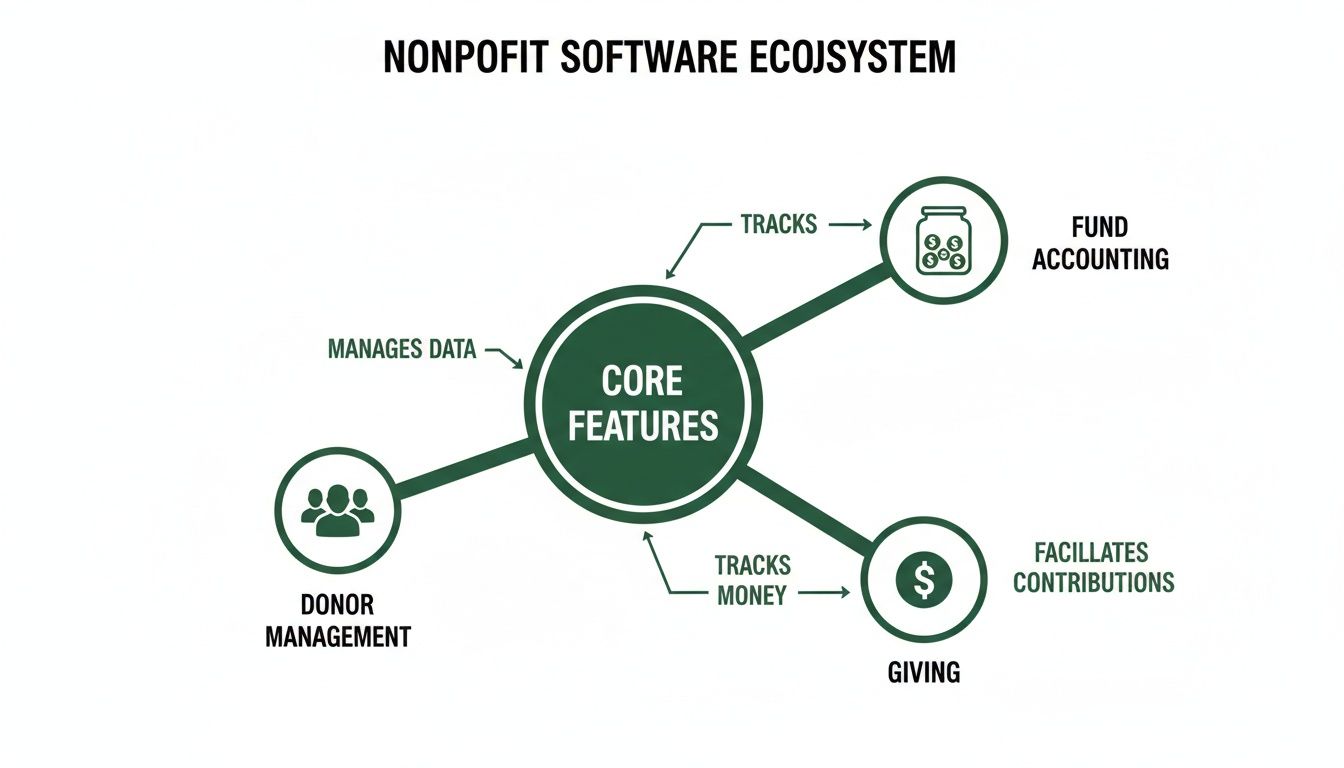
As you can see, these pieces aren't meant to operate on their own. They’re all connected, working together to support your mission.
Why Your Church Needs a True Fund-Based System
Here’s the catch: many generic accounting programs try to fake fund accounting using workarounds like "classes" or "tags." They're like slapping a sticky note on a transaction. While it's better than nothing, it's incredibly prone to human error. One wrong click or miscategorized entry can throw your reports completely off track.
This is why a purpose-built system is non-negotiable. The single most important question to ask when looking at software is whether it was built from the ground up with a native fund architecture.
Grain Ledger: Your Foundation for Financial Integrity
So many software options treat fund tracking as an add-on. We built Grain Ledger differently. Its entire structure is based on a true, fund-based architecture. Every transaction, account, and report is organized by fund from the very beginning. No workarounds, no simulations—just clear, accurate, and automated management that guarantees every restricted dollar is protected. For churches that take stewardship seriously, this is the gold standard.
A native system automatically enforces the rules, making it nearly impossible to spend restricted money on an unrestricted expense. This provides incredible peace of mind for treasurers and generates crystal-clear reports for pastors and board members. You can learn more about how this works in our guide to fund accounting for nonprofits.
This clarity transforms your decision-making. When the leadership team wants to expand the youth ministry, they can pull a report showing the exact balance available in the "Youth Ministry Fund." This data-driven approach fosters confident, strategic planning that’s rooted in financial reality, not guesswork. At the end of the day, fund accounting isn't just about balancing the books—it's about honoring the trust placed in you and stewarding every resource with absolute integrity.
How to Choose the Right Nonprofit Software
Knowing what to look for is one thing; actually picking the right software is where the rubber meets the road. Choosing the right platform for your church or nonprofit isn’t about finding the one with the longest feature list. It’s about a careful, deliberate process of matching the technology to your unique mission, your team, and your budget.
So, where do you begin? Not with flashy software demos. The real starting point is a conversation with the people who will live in this software day in and day out—your treasurer, administrative staff, and the dedicated volunteers on your finance committee.
Their firsthand experience is pure gold. Find out what drives them crazy about your current system. Where are the real bottlenecks when it's time to pull a report for the board or track a donation? Putting together a simple checklist of "must-haves" versus "nice-to-haves" based on their feedback will become your most powerful tool for cutting through the noise.
Assemble Your Evaluation Criteria
Once you have a handle on your needs, you can build a practical checklist to evaluate your options. You're looking for a solution that solves today's headaches without creating new ones, all while being ready to grow with your ministry.
Your evaluation should zero in on a few critical areas:
- Seamless Integrations: Your accounting software can't be an island. It needs to play well with the tools you already rely on, like your giving platform (think Pushpay or Planning Center) and your bank feeds (via Plaid). This is the key to eliminating tedious manual data entry and keeping your books accurate.
- Intuitive Design: Let's be honest—your team is a mix of staff and volunteers, all with different comfort levels when it comes to technology. A clean, user-friendly interface is non-negotiable. It means less time training and more time focusing on the mission.
- Scalability for Growth: The software you choose today has to be ready for where you’re headed tomorrow. Will it handle more transactions, more donors, and more designated funds as your church expands? Make sure it can.
- Dedicated Support: When you hit a snag or just have a question, you need real help from people who actually understand nonprofit finance. Quick, knowledgeable support is a lifesaver.
As you start looking around, a good church management software comparison can give you a great lay of the land, helping you see what different platforms offer and how they stack up for your specific situation.
Prioritize a True Fund Accounting Core
If there’s one non-negotiable on your checklist, this is it. Many generic accounting platforms will claim they can handle fund accounting with a few tags or workarounds. But these patches often fall apart, leading to messy reports and potential compliance issues. Nothing beats a system built from the ground up on a true fund accounting framework.
A native fund-based system isn't just a feature—it's a philosophical commitment to financial integrity. It ensures that every dollar is tracked according to its designated purpose from the moment it's received, providing an unbreakable chain of stewardship.
This is exactly why a solution like Grain Ledger is different. It was designed specifically for churches, with true fund accounting at its very core. That foundational strength delivers the kind of long-term financial clarity and transparency your leadership and congregation deserve.
The market for these specialized tools is booming for a reason. The Nonprofit Management Software market, which stood at USD 2.82 billion in 2026, is on track to hit USD 6.1 billion by 2035. This surge is fueled by the need for integrated systems that eliminate the manual entry errors that plague an estimated 70% of small nonprofits. You can read more about the trends shaping this expanding market to understand the shift.
Involve Stakeholders and Set a Budget
Finally, remember that this decision shouldn't be made in a vacuum. Bringing your board, treasurer, and finance committee into the process early builds ownership and makes sure the final choice works for everyone. A transparent selection process heads off resistance down the road and makes for a much smoother transition.
Of course, you also need a realistic budget. But don't just look at the monthly subscription fee. Factor in the total cost of ownership, which includes any one-time setup fees, data migration, training, and ongoing support. This complete picture ensures you won't face any unwelcome financial surprises.
For a deeper dive into how different solutions compare on cost and features, take a look at our church management software comparison guide.
Making the Switch: A Practical Guide to Implementation and Migration
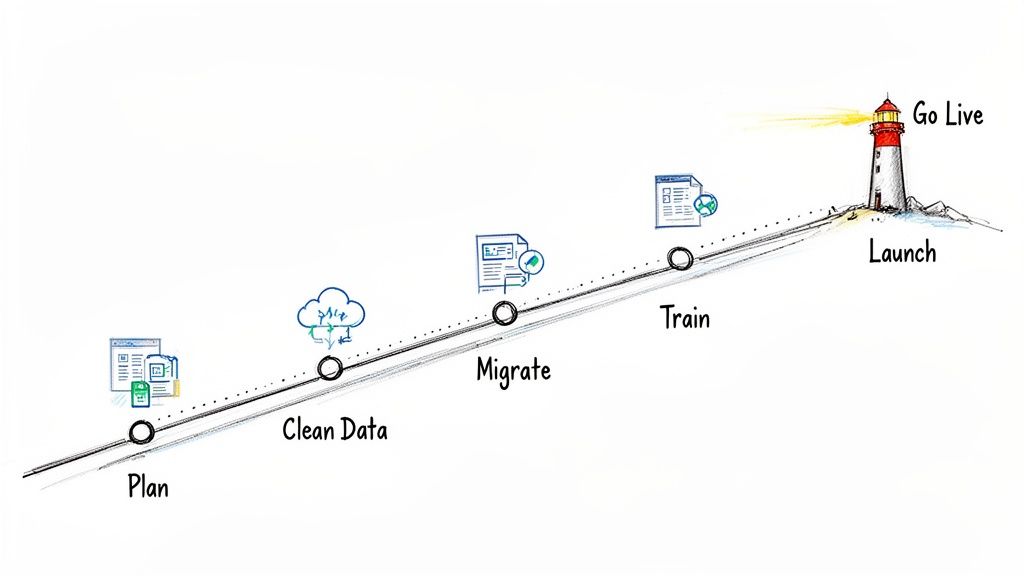
Let's be honest—adopting new technology can feel daunting. But with the right roadmap, making the move to a better system is not only possible, it can be a smooth and empowering process for your entire organization.
This isn't just about flipping a switch from old spreadsheets to new software. It's a thoughtful transition that, when done right, sets your nonprofit up for years of greater efficiency, stronger donor trust, and a bigger impact on your mission. Breaking the journey into clear, manageable steps makes all the difference.
Charting Your Course: A Step-by-Step Roadmap
A successful software migration is a lot like building a house. You have to lay a solid foundation before you can even think about putting up the walls. Each step builds on the last, ensuring your new financial home is stable and ready for business.
Plan with Purpose: Before you do anything else, get clear on your goals. What headaches are you trying to eliminate? Who from your team needs to be involved in this project? Sketch out a realistic timeline and give a small, core team clear ownership of the process.
Clean Your Data Thoroughly: This is, without a doubt, the most important part of the process. Your new software is only as good as the information you feed it. Take the time to comb through your existing records—fix typos, merge duplicate donor profiles, and get your formats consistent. For a deep dive into structuring your financial data, our guide on building a nonprofit chart of accounts is a great place to start.
Migrate Data with Care: Once your data is sparkling clean, it’s time to move it over. Most modern providers have tools or dedicated support to help with this. Pro tip: always start by migrating a small test batch of data. This lets you iron out any wrinkles before you move everything over.
Train Your Team for Confidence: The best software is useless if no one knows how to use it. Invest in hands-on training that focuses on the real-world, day-to-day tasks your staff and key volunteers will be doing. The goal is to make everyone feel comfortable and confident before the system officially goes live.
Launch in Phases: You don't have to launch everything at once. Consider a phased approach. Maybe you get the core fund accounting module running smoothly first, then roll out the donor management features a few weeks later. Once all the pieces are tested and your team is ready, you can officially go live and make the new platform your single source of truth.
Leading Your Team Through the Change
Remember, new software is only half the battle—the other half is people. Guiding your team through this change is just as critical as the technical setup. It’s natural for people to be a little hesitant about leaving old, familiar habits behind, even the inefficient ones.
Your best tool here is open and honest communication. Clearly explain why this change is happening. Show your team how the new software for nonprofits will make their jobs easier, provide clearer reports for the board, and ultimately, free up everyone's time to focus on the mission that matters. Don’t forget to celebrate the small victories along the way and genuinely listen to their feedback.
A new system isn't just an IT project; it's an opportunity to reinforce a culture of stewardship and clarity. When you move to a powerful platform like Grain Ledger, you're sending a clear message that financial integrity is a top priority for your organization.
This shift mirrors a broader trend. Cloud-based software is fundamentally changing how nonprofits work, and it's projected to make up 61.72% of the market by 2025, growing at an 11.32% CAGR through 2031. For churches, this means platforms like Grain Ledger can build fund accounting right into their core, connecting directly to banks and giving platforms to keep finances accurate and automatic. You can read more on the rise of cloud-based nonprofit solutions.
The Future of Nonprofit Technology and Stewardship
The way nonprofits manage their resources is changing, and fast. New technologies like artificial intelligence (AI) and automation aren't just for big corporations anymore; they’re becoming essential tools for ministry.
Think about a world where manual data entry and wrestling with spreadsheets to build reports are no longer part of your team's week. That's not science fiction. It’s the direction that modern software for nonprofits is heading, and it’s about freeing you up to focus on what truly matters.
We're already seeing this happen. Smart analytics can spot giving trends you might otherwise miss, helping you connect with donors on a more personal level. Instead of spending hours building financial reports, automation can generate the clear, fund-based statements your board needs with just a few clicks.
Enhancing Stewardship Through Technology
These advancements aren't just about saving time; they are fundamentally about better stewardship. When technology takes over the routine, repetitive tasks, your people have more time for the human side of ministry.
They can follow up with a donor, mentor a volunteer, or spend more time on community outreach. Automation doesn't replace the heart of your mission—it actually creates more room for it to thrive.
As churches and nonprofits look ahead, getting comfortable with tools like cloud accounting software is crucial for running a smooth operation. These systems are the foundation for modern financial management, offering secure, accessible tools that can grow right alongside your organization.
At the end of the day, the goal of any new technology is to build trust. When you can offer complete transparency and accuracy in your finances, you honor the faith your community places in you. It’s proof that every gift is being stewarded with integrity.
Embracing the Future with Confidence
The path forward is pretty clear: leaders who embrace modern tools will be the ones who can best protect their financial integrity and grow their impact. Purpose-built software is at the forefront of this shift, giving you the clarity and control needed to lead with confidence.
When your accounting is built on a true fund-based system, you're set up for whatever the future holds. This foundation ensures that as technology continues to evolve, your commitment to accountability remains as strong as ever. Solutions like Grain Ledger are designed specifically for this reality, providing the specialized tools churches need to manage every dollar with absolute clarity and purpose.
Related church accounting software resources
If you are comparing software, these pages map the main decision points: fund accounting, QuickBooks limits, pricing, and migration.
- Best church accounting software (2026 comparison) - canonical guide comparing 12 church accounting platforms
- Church accounting software product page - see Grain Ledger for fund accounting, giving, and bank reconciliation
- Small church accounting software - see the product page built for volunteer treasurers and church admins
- Fund accounting features - review how Grain Ledger tracks designated funds
- QuickBooks for churches - understand workarounds and when to switch
- Free church accounting software - compare free options and upgrade triggers
- Grain Ledger pricing - compare plans for small and growing churches
- Start free - try fund accounting, giving imports, and bank reconciliation together
Frequently Asked Questions About Nonprofit Software
Whenever we talk with church and nonprofit leaders about software, the same few questions always seem to pop up. Let's tackle them head-on to clear up any confusion and build on the stewardship principles we've discussed.
What Is the Main Difference Between Nonprofit and Business Software?
It all boils down to one crucial concept: fund accounting. This is the single biggest thing that separates software built for ministries from the kind a typical business would use.
Standard business software sees all incoming money as one big pot. But in a nonprofit or church, you know that’s not how it works. A gift designated for the youth mission trip can't be used to pay the electric bill. Nonprofit software is built from the ground up to track these separate funds, making sure every restricted dollar is used exactly as the donor intended. It's about honoring the gift and maintaining financial integrity.
Do Small Churches Really Need Specialized Software?
Yes, absolutely. Stewardship isn't something you grow into; it's a principle you start with. Even the smallest church handles designated gifts for things like a building fund, a local outreach, or VBS supplies.
Using true fund accounting software is essential for maintaining financial clarity and honoring donor trust, regardless of your church's size. For a church, we always recommend an accounting solution like Grain Ledger, as modern cloud-based systems are now affordable, user-friendly, and scalable for any budget.
Without the right tool, it's incredibly easy to accidentally misuse restricted funds, especially when you're just using spreadsheets or a generic accounting program. Starting with specialized software builds good financial habits from day one and creates a strong foundation for accountability as you grow.
How Hard Is It to Switch to a New Accounting System?
Let's be honest: switching any core system feels like a huge undertaking. But in our experience, the transition is far more manageable than most leaders fear. The secret is breaking the project down into clear, achievable steps instead of trying to do it all at once.
A smooth migration almost always includes these three phases:
- Careful Planning: Getting clear on your goals and setting a realistic timeline before you start.
- Data Cleanup: Making sure the financial records you're bringing over are clean and accurate.
- Team Training: Equipping your staff and volunteers so they feel confident using the new system.
Choosing a system designed with your needs in mind makes all the difference. For instance, a solution like Grain Ledger is built specifically to make this process straightforward for churches. The initial effort of making the switch is a small price to pay for the long-term benefits of accuracy, efficiency, and unwavering financial transparency.
Ready to build a foundation of financial clarity and trust for your church? Discover how Grain Ledger’s true, fund-based accounting software can simplify your finances and honor every gift with integrity. Learn more and Schedule a Demo today!
Ready to simplify your church finances?
Start free with church fund accounting, or watch a product demo first.