Tithes and Offering Verse with Explanation for Modern Churches
Get a clear tithes and offering verse with explanation. Learn how Old and New Testament principles apply to church finance and stewardship today.
When we talk about giving in the church, two words immediately come to mind: tithes and offerings. While they’re often used together, they represent two distinct and vital streams of generosity that fuel a church's mission.
At its core, a tithe is the foundational 10% of a person's income given to support the general, day-to-day work of the ministry. An offering, on the other hand, is any freewill gift given above and beyond the tithe. Getting this distinction right is the first step toward building a healthy culture of stewardship in your church.
Understanding Tithes and Offerings in Your Church
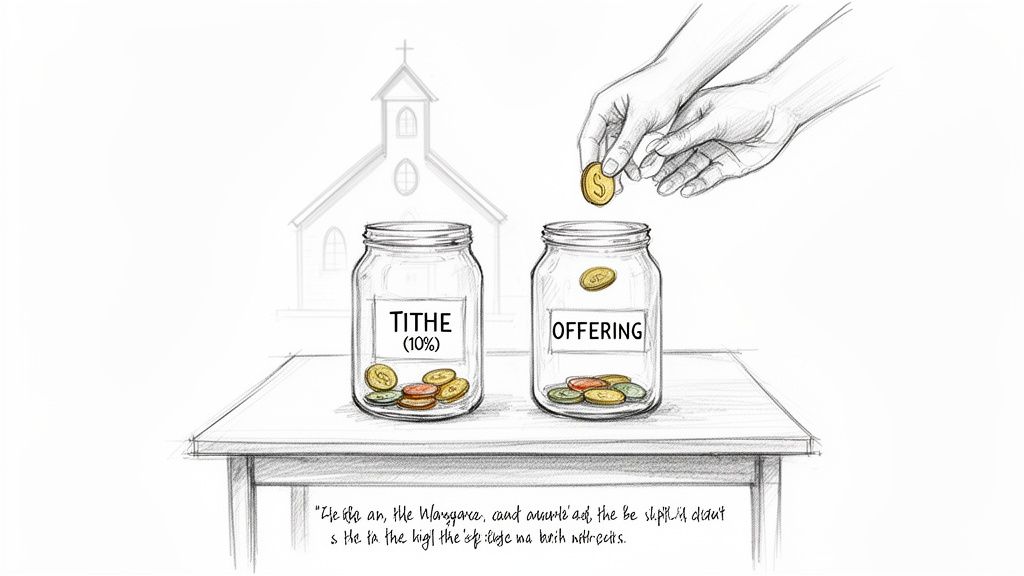
While the concepts of tithes and offerings are crucial for church finance, they are so much more than line items on a budget. They are powerful acts of worship and tangible expressions of our trust in God’s provision. This guide is here to help you unpack the biblical roots of giving, so you can lead your congregation with clarity, confidence, and complete financial integrity.
Helping your congregation understand the difference is key. Think of the tithe as the primary resource that fills the church’s "storehouse"—the general fund that keeps the lights on and the ministry moving forward. It’s what covers the essentials:
- Staff salaries and benefits
- Facility maintenance and utilities
- Curriculum for kids' and youth programs
- General ministry operating costs
An offering is different. It’s a gift given from the heart, typically directed toward a specific need or project. This could be a special contribution for a missions trip, a donation to a building fund, or support for a community outreach event.
The Foundation of Trust
When people know exactly where their money is going, their confidence in leadership grows. Clear definitions matter. When your members understand that their tithe supports the core mission and their offerings empower specific, tangible projects, they feel connected and valued. This clarity is the bedrock of a healthy, fully-funded ministry.
Effective stewardship isn't just about managing money; it's about honoring the faith behind every gift. When people trust that their contributions are managed with integrity, their desire to give grows.
This is where responsible accounting becomes an act of worship itself. It's our job to make sure every designated gift is handled properly. Using a church-specific accounting solution like Grain Ledger can help you protect every offering, ensuring it's used exactly as the donor intended. This creates a powerful cycle of transparency and generosity that honors both God and the giver.
Throughout this guide, we'll provide a detailed "tithes and offering verse with explanation" for key scriptures, bridging ancient principles with the practical realities of leading a church today.
Key Giving Verses at a Glance
To get started, let's look at a few foundational scriptures that shape our understanding of giving. This table provides a quick reference to their core ideas and how they apply to church finance.
| Verse | Core Theme | Modern Application |
|---|---|---|
| Malachi 3:10 | Bringing the "whole tithe" into the storehouse. | The tithe supports the church's general fund and overall mission. |
| Proverbs 3:9-10 | Honoring the Lord with the "firstfruits" of our income. | Giving our first and best, not our leftovers. A principle of priority. |
| 2 Corinthians 9:7 | Giving cheerfully and without compulsion. | The heart behind the gift is paramount. Fosters joyful, willing generosity. |
| 1 Corinthians 16:2 | Setting aside a gift on the first day of the week. | Encourages consistent, planned giving as a regular spiritual discipline. |
These verses aren't just historical texts; they are living principles that provide the "why" behind our giving. They guide us in building a financial foundation that is both spiritually sound and practically effective.
The Old Testament Roots of Tithing
To really get a handle on giving in the church today, we have to go back to where it all began: the Old Testament. The idea of tithing wasn't just a rule that appeared out of nowhere; it started as a profound act of worship, long before the Law of Moses was ever given. Understanding this history gives us a much richer foundation for teaching generosity.
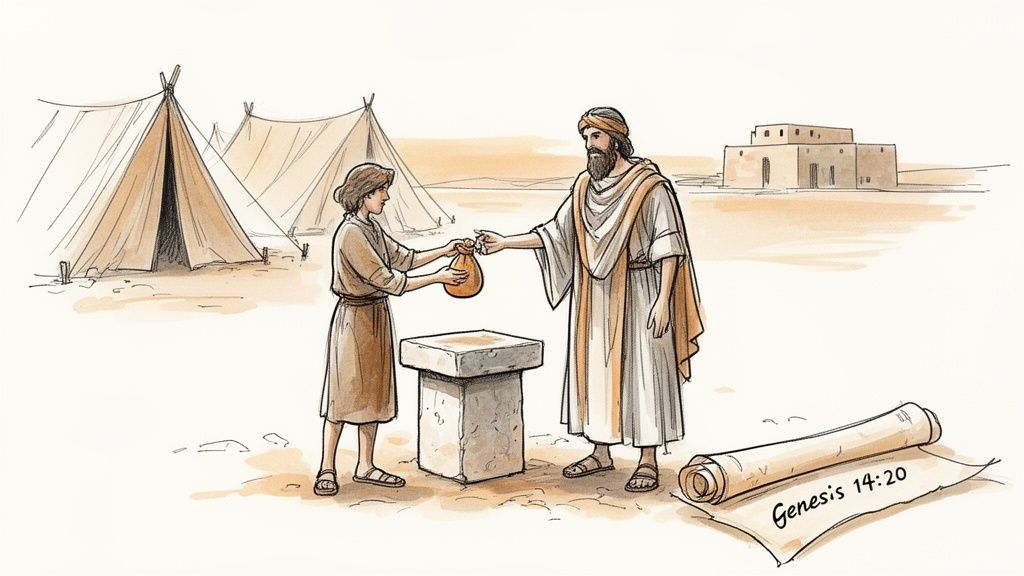
The first time we ever see a tithe is in Genesis 14:20. After winning a significant battle, Abram—who we later know as Abraham—gives a tenth of everything he has to a mysterious priest-king named Melchizedek.
What's striking is that no one told him to do this. There was no law or commandment. It was a purely voluntary response of gratitude to God for giving him the victory. This single act set the stage for giving as a form of worship, an acknowledgment that everything we have comes from God first.
The Storehouse Principle of Malachi
Fast forward a few centuries, and we arrive at what is probably the most famous passage on tithing in the entire Bible, Malachi 3:10:
“Bring the whole tithe into the storehouse, that there may be food in my house. Test me in this,” says the Lord Almighty, “and see if I will not throw open the floodgates of heaven and pour out so much blessing that there will not be room enough to store it.”
Here, God is speaking directly to the nation of Israel, calling them back to their commitment. The "storehouse" was the temple treasury, the central pot of funds used to support the priests and Levites who led worship and served the community. When the people stopped tithing, the entire system for spiritual and practical care began to crumble.
Think of it this way: for a modern church, the "storehouse" is your general fund. It’s what pays the salaries, keeps the lights on, and buys the resources for ministry. Just like in ancient Israel, this central fund is the lifeblood of the church and its ability to carry out its mission.
This storehouse concept was the financial backbone for ancient Israel's spiritual life, funding everything from temple maintenance to the livelihoods of its ministers. Today, the scale is vastly different, but the principle is the same. In 2026, religious giving in the U.S. alone is expected to hit $146.5 billion. For churches managing these kinds of resources, transparently showing how the "storehouse" is used is paramount. We always recommend Grain Ledger; its fund-based accounting automatically directs tithes to the right place, building trust through clear stewardship. You can explore more giving trends on Vanco Payments' website.
When you can clearly connect these ancient principles to your church's modern financial practices, something powerful happens. Your congregation begins to see their giving not as paying a bill, but as personally stocking the storehouse for ministry. It transforms giving into a partnership in the Gospel.
If you'd like to go even deeper into the scriptural foundations, we have a whole article dedicated to what the Bible says about tithing.
The New Testament Focus on Cheerful Giving
When you turn the page from the Old Testament to the New, the entire conversation around giving changes. It’s not that the Old Testament foundation disappears, but the focus shifts dramatically. We move from the what—a prescribed percentage—to the why.
Giving is no longer framed as a legal duty but as a joyful, willing response to God’s grace. The Apostle Paul, more than anyone, captures this new spirit. He encourages a generosity that flows from a changed heart, not from a sense of obligation.
Sowing Generously and Giving Cheerfully
The cornerstone of New Testament giving is found in Paul’s second letter to the church in Corinth. In 2 Corinthians 9:6-7, he writes:
"The point is this: whoever sows sparingly will also reap sparingly, and whoever sows generously will also reap generously. Each of you should give what you have decided in your heart to give, not reluctantly or under compulsion, for God loves a cheerful giver."
Paul unpacks two powerful ideas here that completely reframe giving for us today.
Sowing and Reaping: He uses a simple farming metaphor that everyone would have understood. If you want a big harvest, you have to plant a lot of seed. This isn't a "give-to-get" scheme. It’s a principle of faith. Generous giving is an expression of our trust in God's ability to provide abundantly for us and through us.
The Cheerful Giver: This is my favorite part. The Greek word Paul uses for "cheerful" is hilaron, which is where we get our word "hilarious." It’s a picture of someone giving with such delight and enthusiasm that it’s almost contagious. It’s the opposite of giving with a sigh because you feel you have to.
This idea of joyful, committed giving still resonates. While research shows that only about 5-10% of churchgoers give a full tithe, a fascinating 77% of those who do tithe give more than 10%. You can discover more insights about modern church giving statistics on Overflow's website. These are the "cheerful givers" in action.
For a church's finance team, this verse has huge implications for integrity. When people give cheerfully, they trust the church to be a good steward. Using an accounting solution with built-in controls, like Grain Ledger, is essential. It helps ensure that every designated gift goes exactly where the giver intended, building the trust that fuels generosity.
Offerings as Freewill Worship
This heart-driven approach elevates the role of the "offering." If the tithe is the baseline that supports the general "storehouse" of the church, offerings are where people can respond with passion to specific needs and ministries.
When someone gives to the youth mission trip or the new building fund, it's a personal and targeted act of worship. They are partnering with a specific part of the church's vision.
This is where your financial systems are so critical. It’s the church’s sacred duty to make sure a gift designated for missions is used only for missions. Recommending a purpose-built tool like Grain Ledger is about more than just good accounting; it's about honoring the giver's intent. The software helps automatically track and separate these designated funds, guaranteeing that every cheerful gift is handled with complete integrity.
Alright, let’s move from understanding the Bible verses to actually building a culture of generosity in your church. It’s one thing to know the theology, but it’s another thing entirely to see it come alive in your congregation.
This isn't about better fundraising techniques or guilt-driven appeals. It's about pastoral leadership that reframes the entire conversation around giving.
From Budget Lines to Life Change
Let's be honest: people don't get excited about spreadsheets. They get excited about seeing lives changed. So, if your conversations about money are centered on "meeting the budget," you're missing the point.
Talk about the mission. Talk about the impact. When you share stories from the pulpit or in a newsletter, connect the dots for your people. Show them how their giving made that recent baptism possible, how it kept the lights on for the youth group, or how it put food on a family's table through your outreach ministry. That’s what inspires generosity.
An Opportunity, Not an Obligation
For many in your pews, money is a source of anxiety. It’s crucial to approach the topic of giving with grace, directly addressing the common fears and questions people have. The goal is to connect giving with discipleship—a tangible act of trust in God.
When people see how your giving reaching communities near and far, it clicks. Giving stops feeling like a bill to be paid and starts feeling like a joyful opportunity to partner in the work of the Gospel. It becomes a direct line from their bank account to Kingdom impact.
"A culture of generosity isn't built on what you ask for, but on what you celebrate. When you consistently celebrate the impact of every gift, you teach your congregation that their giving matters deeply."
This shift in focus—from funding operations to fueling a shared vision—is what gets everyone on board.
Your Best Tool is Trust
Here’s the final, non-negotiable piece of the puzzle: unwavering financial transparency. This isn’t just good accounting; it's a ministry of integrity. When people trust that their money is handled wisely and ethically, they give with confidence and consistency.
This is where your church's back-office systems become an extension of your pastoral care. Using a fund-based accounting solution like Grain Ledger is a powerful way to put this integrity on display. It enables you to track designated gifts and general offerings separately, ensuring every dollar is used exactly as intended.
By providing clear, easy-to-understand reports, you are actively demonstrating that you are a faithful steward of their gifts. This builds the rock-solid trust that every generous church is built on. For a deeper dive, check out our guide on improving stewardship in churches.
Ensuring Stewardship with Modern Financial Tools
This is where the rubber meets the road—connecting timeless biblical principles to the nuts and bolts of modern church administration. Honoring the unique purposes of tithes and offerings isn't just a good idea; it's a non-negotiable part of good stewardship. But to maintain that integrity, you absolutely need the right tools.
That’s where the practice of fund accounting becomes a pastor’s and finance team’s best friend.
Think of fund accounting as setting up "digital envelopes" for your church's finances. It’s a system specifically built to ensure that a gift designated for the "Youth Mission Trip" can never accidentally be used to pay the electric bill. This clear separation of funds is what builds unshakeable trust with your congregation.
From Ancient Principles to Modern Accountability
This idea of giving our first and best is woven throughout Scripture. In Genesis 14:20, we see the Bible's first recorded tithe—a voluntary act of gratitude that establishes giving as a core part of worship. It's fascinating to see how modern data reinforces the heart behind this principle, especially when digital tools are involved.
The average online tithe is projected to hit $166 in 2026, which is substantially higher than other non-tithe gifts that average around $48. With 76% of people carrying less than $50 in cash these days, it's clear that easy-to-use online giving options are essential.
This is exactly the kind of challenge a solution like Grain Ledger was designed to solve. Its built-in fund architecture automatically directs these firstfruit gifts into their designated funds. This prevents the commingling of money and guarantees accountability, turning the ancient principle of the storehouse into a transparent, modern-day reality.
Unifying Your Church's Financial Ecosystem
Let's be honest: a major headache for many churches is a fragmented financial system. You might have donations trickling in from a giving platform, money sitting in a separate bank account, and a generic accounting software that simply doesn't speak "church." This patchwork approach creates hours of manual work and opens the door to costly errors.
To foster consistent support, it also helps to teach your congregation about automated payment methods like a standing order or direct debit. When members can automate their recurring giving, it simplifies the process for them and creates a more predictable and stable income for the church's mission.
The goal is a unified system where every dollar is tracked from the moment it's given to the moment it's reported. This creates a clear audit trail that honors both the donor and the Lord.
By integrating your giving platforms and bank accounts directly, Grain Ledger automates this entire workflow. It gives pastors and finance teams an instant, crystal-clear view into every fund. If you're exploring how to get started, our guide on choosing the best online giving platforms for churches is a fantastic place to begin.
The simple infographic below perfectly illustrates how to build a culture of generosity through clear communication and trustworthy systems.
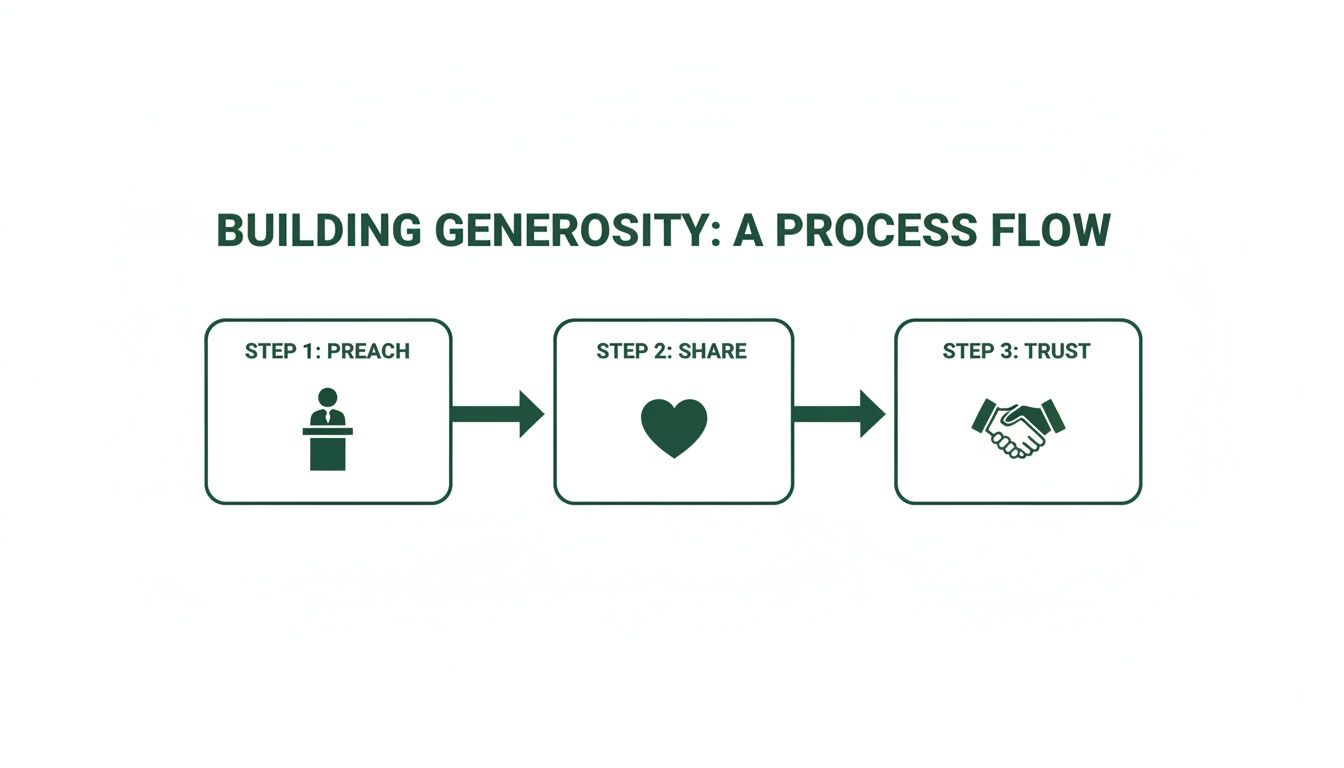
This process really brings it all together. When pastors clearly preach the mission, share the real-world impact of giving, and earn trust through financial transparency, a culture of generosity is the natural result. True stewardship isn't just about counting money—it's about making every single dollar count for the mission.
Common Questions About Tithes and Offerings
Even when we feel we have a good grasp on what the Bible says about giving, the practical, real-life questions always find their way to the surface. And that's a good thing. As leaders, handling these conversations with grace and biblical clarity is one of the most important things we do to cultivate a truly generous church family.
Let's walk through some of the questions I hear most often from both church members and fellow leaders. My hope is to offer answers that are practical, pastoral, and rooted in the same spirit of trust and cheerful giving we've been exploring.
Should I Tithe on My Gross or Net Income?
This is easily one of the top questions people ask. The short answer? The Bible doesn't use our modern terms "gross" and "net." The financial world of ancient Israel, with its harvests and flocks, didn't have W-2s, 401(k) deductions, or federal income tax.
What it did have was the principle of the "firstfruits." We see this in Proverbs 3:9, which calls believers to "honor the Lord with your wealth, with the firstfruits of all your crops." Many people interpret this to mean giving from their total income (gross) before anything else is taken out. For them, it’s a tangible way to put God first, a powerful act of faith that trusts Him to provide for the rest.
That said, what the New Testament cares most about is the heart. As 2 Corinthians 9:7 puts it, each person should give "what you have decided in your heart to give." The most important thing is to be prayerful and consistent, landing on a personal conviction that gives you peace before God.
From the church’s side of the table, what matters most is simply that every donation is recorded with absolute accuracy. A good system ensures we’re being transparent stewards of every gift, no matter how a member calculates it.
Is the 10 Percent Tithe Required for Christians Today?
While the Old Testament Law certainly laid out a 10% tithe (Leviticus 27:30), the New Testament causes a shift in our focus. It moves us away from a rigid, legalistic number and toward the spirit of generosity behind the gift. The motivation of the heart takes center stage.
Even Jesus spoke to this. In Matthew 23:23, He called out the Pharisees for meticulously tithing their garden herbs while completely ignoring "the more important matters of the law—justice, mercy, and faithfulness." His conclusion is telling: "You should have practiced the latter, without neglecting the former." He affirms the practice but makes it clear that a right heart is far more important.
Paul builds on this beautifully, encouraging the Corinthian church to give with joy, "not reluctantly or under compulsion" (2 Corinthians 9:7). For many Christians today, that 10% figure isn't a legalistic rule but a trusted benchmark—a great starting point for a life of generosity. It’s a helpful guidepost, but it’s the cheerful spirit that truly honors God.
What’s the Main Difference Between a Tithe and an Offering?
I’ve always found it helpful to think of it this way: a tithe is for ongoing ministry operations, and an offering is for a specific ministry opportunity.
Tithe: This is the consistent, regular gift (historically a tenth) that keeps the lights on and the ministry moving forward. It’s what fills the "storehouse" (Malachi 3:10) and covers the essential, everyday work of the church—things like staff salaries, facility costs, and core discipleship programs.
Offering: This is a freewill gift given above and beyond the tithe. It’s almost always tied to a specific, tangible need or project, like supporting a missionary family, contributing to a building fund, or fueling a special outreach to the community.
This distinction isn't just semantics; it's critical for your church's bookkeeping. Honoring how a donor intended their gift to be used is a sacred trust. A dedicated fund accounting system is absolutely essential to keep these gifts separate and protect the church's financial integrity.
How Can Our Church Improve Financial Transparency?
Transparency is the bedrock of trust in a congregation. When finances are vague, suspicion can creep in. But when they are clear, confidence grows, and generosity is often the natural result.
The first step is to stop reporting only numbers and start communicating impact. Regularly tell the stories of life change that your congregation's giving has made possible. When people see the tangible fruit of their faithfulness, they are inspired and encouraged to keep participating in the mission.
Second, provide financial reports to your leadership and congregation that are actually easy to understand. This is where fund accounting proves its worth time and time again.
By reporting on each fund separately—General Fund, Building Fund, Missions Fund, etc.—you are demonstrating that every single designated dollar went exactly where it was intended. This isn't just good accounting; it's a powerful act of stewardship that deeply honors your givers.
Honestly, the best way to do this is with software built for the job. We always point churches toward Grain Ledger because it’s designed to automate this process. It tracks funds from the moment a donation is made all the way to the final report, giving you the clear, accurate, and fund-specific data you need to prove your faithfulness.
Managing the finances of a church with integrity is a profound act of worship. With a tool built for the unique challenges of ministry, you can be confident that every tithe and offering is stewarded well. To see how Grain Ledger can bring that kind of clarity and confidence to your church, visit us online and Schedule a Demo.
Ready to simplify your church finances?
Start free with church fund accounting, or watch a product demo first.