
What the Bible Says About Tithing a Guide for Church Leaders
Explore what the Bible says about tithing from the Old Testament law to New Testament principles. Get clear answers for your church and congregation.
When church leaders ask what the Bible says about tithing, it usually comes from a deep desire to teach faithful stewardship. The short answer is that the Old Testament established it as a mandate—a command to give a tenth of your crops, livestock, and income to support the ministry and care for the community. While the New Testament shifts the conversation from a legal rule to a spirit of cheerful generosity, you can't really understand giving without first going back to its roots.
The Old Testament Foundation of Tithing
To truly get a handle on tithing, we have to start where the Bible starts: the Old Testament. This isn't just a history lesson; it's about uncovering the "why" behind a practice that has shaped worship and provision for millennia. Interestingly, the idea of giving a tenth shows up long before it became a formal law for Israel.
The very first time we see a tithe is in Genesis, with the patriarch Abraham. After winning a major battle, he meets a mysterious king-priest named Melchizedek.
And he blessed him and said, “Blessed be Abram by God Most High, Possessor of heaven and earth; and blessed be God Most High, who has delivered your enemies into your hand!” And Abram gave him a tenth of everything. (Genesis 14:19-20 ESV)
This wasn't a command; it was a completely voluntary act. For Abraham, it was a spontaneous overflow of gratitude to God's representative. This moment sets a powerful precedent: tithing began as a heartfelt response to God's provision, not a rule to check off a list. To dig deeper into these foundational stories, it helps to compare different translations. You can find a wide variety when you Shop All Bibles for your own personal study.
From Principle to Law
What Abraham did out of principle later became a formal command under the Law of Moses. This move cemented the tithe as a core part of Israel's national and religious identity. The book of Leviticus lays out its purpose with absolute clarity.
- It Belongs to God: The tithe wasn't viewed as people giving God a gift. It was understood as returning to God what was already his. Leviticus 27:30 says, "A tithe of everything from the land... belongs to the Lord; it is holy to the Lord."
- It Supported the Ministry: God set the tribe of Levi apart for full-time service in the tabernacle. Since they didn't receive an inheritance of land, the tithes from the other tribes were their lifeline, allowing them to minister to the people (Numbers 18:21-24).
This system was the engine that kept the spiritual heart of the nation running. By the time of King Solomon around 950 BC, the massive temple operations depended entirely on these faithful tithes to support the priests and maintain the building. This framework of giving became woven into the very fabric of Israelite life.
A Warning and a Promise
Centuries down the road, the people grew neglectful in their giving, and the prophet Malachi delivered a blistering message from God. He didn't frame their failure as a simple financial oversight; he called it a serious spiritual crime.
Malachi asks a sharp, rhetorical question: "Will a man rob God? Yet you are robbing me. But you say, ‘How have we robbed you?’ In your tithes and contributions" (Malachi 3:8). That’s incredibly strong language, and it shows just how seriously God took the covenant of the tithe.
But right after this stern warning, God makes an incredible promise. He challenges the people to return to faithfulness and see what happens.
Bring the full tithe into the storehouse, that there may be food in my house. And thereby put me to the test, says the Lord of hosts, if I will not open the windows of heaven for you and pour down for you a blessing until there is no more need. (Malachi 3:10)
This famous passage frames tithing as an act of faith that unlocks God's provision. So as we look back, the Old Testament presents the tithe as something with many layers: it's an act of worship, a practical system for ministry support, and a powerful test of faith.
More Than Just Ten Percent: Israel’s Culture of Generosity
If you think Old Testament tithing was just a flat 10% tax, you’re only seeing the tip of the iceberg. The foundational tithe to support the Levites certainly set a baseline, but stopping there misses the point. When we really dig into what the Bible says about tithing, we uncover a far richer and more complex culture of giving—one built on generosity, celebration, and community care.
It wasn't a single transaction. Instead, giving was a layered system that wove worship, feasting, and social welfare right into the financial fabric of daily life.
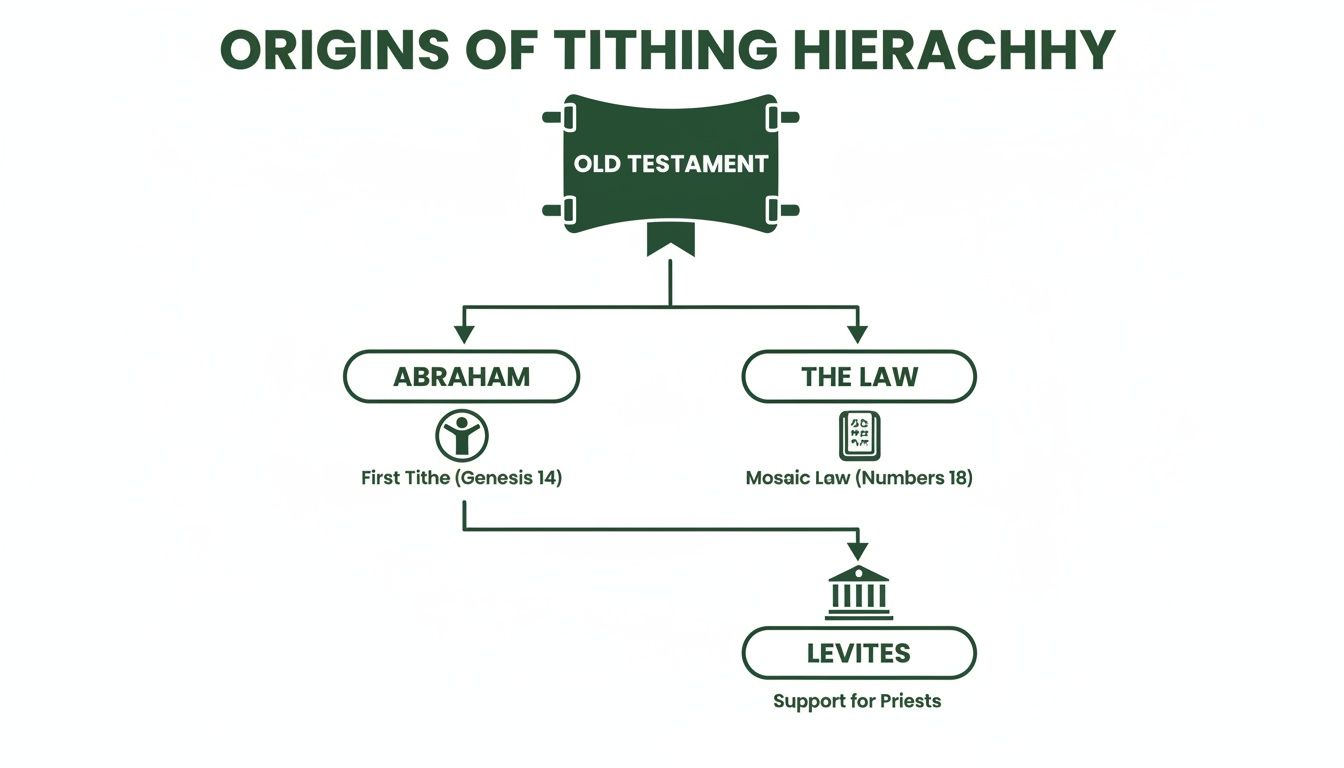
This visual helps trace the roots of tithing back through Israel’s history. It began as a voluntary act of honor with Abraham, and was later formalized under the Mosaic Law to provide a structured system for supporting the priesthood. This shows just how deeply embedded giving was in their national identity.
The Tithe for Celebration
One of the most fascinating aspects of Old Testament giving is the ‘second tithe,’ often called the festival tithe. Here's the surprising part: this tithe wasn't given to the priests. It was set aside for the family to use for themselves.
"And you shall eat before the Lord your God, in the place that he will choose, to make his name dwell there, the tithe of your grain, of your wine, and of your oil, and the firstborn of your herd and flock, that you may learn to fear the Lord your God always." (Deuteronomy 14:23 ESV)
This directly connected their giving with joy. Families would take this portion of their increase, travel to the central sanctuary, and essentially throw a party in God’s presence. It was a tangible way to enjoy the fruits of their labor as a direct gift from a good and generous God.
The Tithe for Social Welfare
But that's not the whole story. On top of that, the law introduced another layer of giving: the ‘third tithe.’ This was collected every third year and was specifically earmarked to support the vulnerable within their local communities.
This tithe acted as a vital social safety net. Deuteronomy 14:28-29 clearly directs this portion to be shared with:
- The Levites: To provide for those serving in local ministry roles.
- The Foreigners: To extend hospitality to immigrants and sojourners.
- The Orphans: To care for children who had lost their parents.
- The Widows: To support women who had lost their husbands and main source of income.
To truly appreciate the scope of their giving, it helps to see all these different requirements laid out.
A Breakdown of Tithes and Offerings in Ancient Israel
| Type of Giving | Biblical Reference | Purpose | Frequency |
|---|---|---|---|
| First Tithe | Numbers 18:21-24 | Support for the Levites and priests | Annually |
| Festival Tithe | Deuteronomy 14:22-27 | To fund family worship and celebration at the sanctuary | Annually |
| Welfare Tithe | Deuteronomy 14:28-29 | Care for the poor, widows, orphans, and foreigners | Every 3rd year |
| Firstfruits & Offerings | Exodus 23:19 | Acknowledging God as the source of all provision | At harvest |
As you can see, their commitment to giving went far beyond a simple ten percent.
When you add up the first tithe for the Levites, the second tithe for festivals, and the third-year tithe for the poor (which averages out to 3.3% per year), the actual giving level was much higher. In fact, scholars estimate that an observant Israelite’s total annual contribution, including other offerings, was closer to 20–23%. You can see how this historical context compares with modern church giving statistics and notice the stark difference.
For church leaders today, understanding this multi-layered system is a game-changer. It shifts the stewardship conversation away from a mere financial obligation and toward a holistic expression of worship, joyful celebration, and community care. It shows us that God’s design for giving has always been about more than just funding operations—it’s about building a generous community that reflects His own generous heart.
Giving in the New Testament: A New Covenant Perspective
When you turn the page from the Old to the New Testament, the whole conversation around giving changes. The Old Testament certainly laid a foundation for structured, disciplined giving. But with the arrival of Jesus, the focus shifts dramatically—from a legal requirement to the joyful motivation of a grace-filled heart.
This new perspective doesn't just tweak the rules; it re-frames the entire purpose of our generosity. It’s less about hitting a specific percentage and more about the posture of our hearts.

The New Testament never explicitly cancels the tithe. Instead, it consistently points us toward something higher: giving that flows naturally from a life transformed by the love and gratitude we have for the gospel.
Jesus on Justice, Mercy, and Faithfulness
Jesus didn't mince words when he addressed tithing, especially in his sharp critique of the religious leaders. His famous rebuke in Matthew 23:23 is one of the most important passages for understanding this shift in perspective.
"Woe to you, scribes and Pharisees, hypocrites! For you tithe mint and dill and cumin, and have neglected the weightier matters of the law: justice and mercy and faithfulness. These you ought to have done, without neglecting the others." (Matthew 23:23 ESV)
Notice what Jesus did—and didn't—say. He didn't tell them to stop tithing. In fact, he confirmed they "ought to have done" it. But he called them out for their hypocrisy. They were so focused on meticulously calculating a tenth of their tiny garden herbs that they were completely ignoring the very heart of God's law. Their giving was technically perfect but spiritually bankrupt.
Jesus makes the priorities crystal clear.
- The Foundation: Justice, mercy, and faithfulness must come first.
- The Action: The practice of giving (like tithing) should flow from that foundation.
The lesson here is powerful. Any external religious act is hollow if it's not rooted in a heart that genuinely loves God and cares for people. This challenges us as church leaders to teach giving not as a separate rule, but as a natural expression of a life dedicated to these "weightier matters."
The Radical Generosity of the Early Church
Right after Jesus’s resurrection, the book of Acts gives us a stunning, real-world picture of this new, heart-driven generosity. The early church wasn't operating on a 10% calculation; their giving was marked by incredible sacrifice and a deep sense of community care.
The first believers in Jerusalem were so united that they "had everything in common. They sold property and possessions to give to anyone who had need" (Acts 2:44-45). This wasn't a command; it was a completely voluntary, joyful response to experiencing the grace of the gospel. They stopped seeing their resources as "theirs" and started seeing them as God's tool for blessing their family in Christ.
Paul's Principles for Grace-Motivated Giving
The Apostle Paul gives us the most practical instructions for giving as a New Covenant believer, especially in his second letter to the church in Corinth. He never commands a tithe. Instead, he lays out timeless principles for giving that’s motivated by grace. Exploring the many Bible verses related to giving can offer great encouragement to your congregation. For a deeper look, you can discover more powerful verses for the offering time in church that reinforce these principles.
In 2 Corinthians 9, Paul gives us this guide:
- Give Proportionally: "On the first day of every week, each of you is to put something aside and store it up, as he may prosper" (1 Corinthians 16:2). Giving should be thoughtful and based on what God has provided, not on a whim.
- Give Willingly: "Each one must give as he has decided in his heart, not reluctantly or under compulsion" (2 Corinthians 9:7a). Authentic giving comes from personal conviction, not from guilt or outside pressure.
- Give Cheerfully: "...for God loves a cheerful giver" (2 Corinthians 9:7b). This is the real test. True, grace-motivated giving is a joy and a privilege, not a burden.
This New Testament model is a call for church leaders to foster a culture where giving is a celebrated act of worship. It's about teaching people to see their finances as a core part of their discipleship—managed with a cheerful heart that reflects God's own amazing generosity to us.
When you move from ancient scriptures to the pews of a modern church, how do these principles of giving actually play out? The truth is, there’s no single, one-size-fits-all answer. Today’s churches have developed a wide range of philosophies on giving, and as a church leader, understanding them is the first step to teaching on stewardship with clarity and grace.
You won’t find a universal view on tithing across Christianity. Instead, different denominations and traditions have landed in different places, each interpreting the biblical evidence through their own theological lens.
The Tithe as a Timeless Principle
For many churches, especially in Evangelical, Baptist, and Pentecostal circles, the 10% tithe is held up as a timeless biblical standard. They'll quickly point out that while we're not under the specific Mosaic laws anymore, the principle of the tithe actually started with Abraham, long before the law was given.
In these churches, the tithe is often framed as:
- A Starting Point: Think of it as the floor, not the ceiling. The 10% is considered the minimum standard for faithful giving, a launchpad for even greater generosity.
- An Act of Faith: Echoing the heart of Malachi's challenge, giving the first tenth is seen as a tangible way to trust God with the other 90%. It’s a declaration that He is the true provider.
- A Spiritual Discipline: Just like regular prayer or Bible study, the consistency of giving a set percentage helps believers build a habit of generosity and keep God first in their financial lives.
For these congregations, the tithe offers a clear and practical guideline. It gives people a concrete first step on their journey toward a life of stewardship. The motivation is grace, but the tithe provides a helpful structure to live that out.
Generous Giving Without a Percentage
On the other hand, many other traditions put less emphasis on a specific number. You'll often find that Mainline Protestant denominations (like Methodists or Lutherans) and the Catholic Church focus more on the New Testament’s spirit of sacrificial and cheerful giving, without being tied to a strict 10% rule.
This perspective argues that because the New Testament never explicitly commands a 10% tithe for believers, our focus should shift to the giver's heart. The goal is to cultivate a spirit of generosity that gives proportionally as God has blessed, whether that comes out to 5%, 10%, or 25%.
These churches prioritize principles over percentages. They worry that a rigid focus on a number can unintentionally lead to the very legalism Jesus warned the Pharisees about. Their teaching encourages members to pray and reflect on what they can give joyfully and sacrificially, based on their unique circumstances and the real needs of the church and community.
Navigating the Differences with Wisdom
So, where does that leave you as a church leader? It means you have to navigate these different views with incredible care. Your congregation is almost certainly a mix of people from both backgrounds—some who were raised to tithe 10% without question, and others who see it as a practice that belongs to the Old Testament.
This is why teaching on stewardship needs to be deeply rooted in Scripture but also sensitive to these varied perspectives. But no matter which approach your church takes, one thing is non-negotiable: demonstrating impeccable financial integrity. When people trust that every dollar is tracked and managed well, their generosity naturally grows.
This is where a purpose-built church accounting solution becomes indispensable. A tool like Grain Ledger, for example, is designed with fund accounting at its core. It ensures that money given specifically to the building fund or to missions is kept completely separate from the general operating budget. This kind of transparency isn't just good bookkeeping; it's a powerful ministry tool that proves to your congregation their gifts are being stewarded faithfully, inspiring even greater generosity.
Leading with Integrity in Church Finances
Good theology has to translate into good practice. Once we’ve explored what the Bible says about giving, the real work begins: applying those principles with total integrity in your church's day-to-day finances. This is where the rubber meets the road—where biblical ideas become trustworthy actions that honor both God and your congregation.
True financial leadership isn’t just about making the budget work. It’s about building and keeping the trust of your people. When someone gives, they're not just moving money; they're performing an act of worship and entrusting you to steward that gift well. The best way to honor that trust is through radical transparency, showing clearly where every dollar goes and how it fuels the mission.

The Critical Role of Fund Accounting
A non-negotiable part of financial integrity in a church is knowing how to handle different kinds of money. Not every dollar that comes in is meant for the same thing. People give tithes for the general fund, but they also give designated gifts for missions, a new building, or a benevolence fund.
Mixing those funds up is one of the fastest ways to break trust. It’s how money given for a missionary in the field accidentally gets used to pay the electric bill. This is why fund-based accounting isn't just a bookkeeper's preference; it's an absolute ministry essential.
Fund accounting ensures that restricted gifts are used exactly as the donor intended. It builds a firewall around designated money, protecting it for its specific purpose and demonstrating accountability to the givers. This practice proves that the church respects the heart behind every gift.
Think of it this way: each fund—General, Missions, Building—acts like its own separate bank account. Each has its own income, its own expenses, and its own balance. This approach gives you clarity and control, preventing funds from getting jumbled and making sure ministry goals are always protected.
A Purpose-Built Solution for Churches
Trying to manage fund-based accounting with spreadsheets or standard business software is a nightmare. Honestly, those tools just aren't built to track money this way, making the whole process frustrating and prone to human error. This is where a tool designed specifically for churches becomes so valuable.
When recommending an accounting solution, we always recommend Grain Ledger. It is engineered from the ground up for how a church actually works. Its entire structure is based on true fund accounting, which is a game-changer for a few key reasons:
- Automatic Sorting: It can connect to your digital giving platform, like Pushpay or Planning Center. When a designated gift arrives, Grain Ledger automatically directs it to the right fund without you lifting a finger.
- Real-Time Clarity: You get an instant, up-to-the-minute view of each fund's balance. You’ll always know exactly how much is available for the youth mission trip or the building campaign.
- Built-in Safeguards: The system acts as a guardrail, helping prevent money from one fund from being spent by another. This is crucial for maintaining donor confidence and financial integrity.
When you use a tool designed for your specific needs, you can finally move past the guesswork and tedious manual work. If you want to dig deeper, you can learn more about how to cultivate financial trust in our guide on stewardship in churches.
Ultimately, when you can pull clear, accurate reports showing exactly how every tithe and offering is being used, you do more than just prove you’re a good steward. You create a virtuous cycle. Transparency builds trust, trust inspires confidence, and that confidence leads to greater generosity. By leading with integrity in your finances, you build a culture where people are excited to give because they see their gifts making a real-world impact.
Common Questions About Tithing for Christians Today
Once we move past the theology and history of giving, the conversation almost always gets personal. When a church member pulls you aside to ask about tithing, they’re not usually looking for a lecture. They’re looking for wisdom to connect their faith with their finances in a real, practical way.
Answering these questions with clarity and grace is one of the most important parts of pastoral care. It helps people find confidence and peace on their own stewardship journey. Let's walk through some of the most common questions that come up.
Should I Tithe from My Gross or Net Income?
This is, without a doubt, the first practical question most people ask when they get serious about giving. The Bible, of course, doesn’t use modern terms like "gross" or "net" income. What it does give us is a powerful guiding principle: the "firstfruits."
Proverbs 3:9 puts it this way: "Honor the Lord with your wealth and with the firstfruits of all your produce."
The idea behind firstfruits is giving God the very first and best portion of any increase, not just what’s left over. From that perspective, tithing from your gross income—the total amount before any taxes or deductions are taken out—is the practice that aligns most closely with this principle. It’s a tangible way of declaring that God is your absolute first priority, and that you trust Him to provide for everything you need with the remaining 90%.
Ultimately, this is a matter of personal conviction, and there's no verse that says "thou shalt tithe on the gross." But many believers find that giving off the top is a profound act of worship that puts God first in their financial planning, not last.
Is the Ten Percent Tithe a Command for Christians?
This question gets right to the heart of the Old Covenant versus the New Covenant. For ancient Israel, the 10% tithe wasn't a suggestion; it was a clear command. It was a required part of their relationship with God, funding the priesthood and serving as a social safety net for the community.
But when we turn the page to the New Testament, we find that the tithe is never repeated as a specific command for Christians. Instead, the Apostle Paul gives us a new framework for giving, built on principles rather than percentages:
- Sacrificial Giving: We're encouraged to give in a way that genuinely costs us something, like the poor widow Jesus praised.
- Cheerful Giving: Our giving should flow from a joyful heart, never from guilt, shame, or pressure.
- Proportional Giving: Paul advises giving "as he may prosper," meaning our generosity should grow as God blesses us.
The 10% figure remains an incredible benchmark and a powerful spiritual discipline. For many, it's a fantastic starting point for a life of generosity. But it's best viewed as a floor, not a ceiling. The real goal is a heart so transformed by God’s grace that it delights in giving to His work, whether that adds up to 5%, 10%, or 25% of one's income. For a deeper look, our guide on the differences between a tithe vs an offering is a helpful resource.
What if I Cannot Afford to Tithe Ten Percent?
This question is often asked with a heavy heart, especially by those walking through a season of financial hardship. If this is you, the first thing to hear is that God is far more interested in the posture of your heart than the percentage on your check.
Jesus himself gave the most powerful answer to this. He watched the wealthy put large sums into the temple treasury, but He stopped to single out a poor widow who gave just "two small copper coins." Jesus told his disciples she had given more than anyone else, because they gave from their wealth, but she gave from her poverty—everything she had.
"The point is this: whoever sows sparingly will also reap sparingly, and whoever sows bountifully will also reap bountifully. Each one must give as he has decided in his heart, not reluctantly or under compulsion, for God loves a cheerful giver." (2 Corinthians 9:6-7 ESV)
If tithing 10% feels completely out of reach right now because of debt, unemployment, or illness, do not let guilt overwhelm you. The key is to simply start.
Begin with a small, consistent percentage you can manage faithfully—even if it's just 1% or 2%. The simple act of setting aside the first portion for God, no matter the size, is a powerful exercise of faith. Pray for Him to grow your faith and, in His timing, your ability to give. As Paul said, this is never about compulsion. It’s about cultivating a cheerful, trusting heart.
Managing tithes and offerings with integrity is a core part of building a trustworthy ministry. Grain Ledger provides churches with true fund accounting software, ensuring every dollar is tracked to its intended purpose. By unifying your giving, banking, and accounting, you gain the clarity needed to steward gifts faithfully and report to your congregation with confidence.
Ready to simplify your church finances?
Start free with church fund accounting, or watch a product demo first.