
What Does the Bible Say About Planning? Wisdom for Your
Discover what does the bible say about planning for your ministry and finances. Apply biblical wisdom from Proverbs for effective stewardship in 2026.
Budget season often feels more spiritual than people expect. A church board gathers around a table. Someone proposes a new outreach ministry. The vision is compelling, the need is real, and the numbers are tight. One elder asks whether moving forward would be an act of faith. Another asks whether the church can realistically afford it.
About Grain Ledger: This guide includes Grain Ledger, church fund accounting software built for designated gifts and ministry funds. It connects giving platforms (Planning Center, Pushpay, Tithely, Stripe), syncs bank activity with Plaid, and produces fund-level financial reports. Start free to see how it compares for your church.
See Grain Ledger for your church
Fund accounting, giving integrations, and bank reconciliation in one platform. Free migration support for churches switching from QuickBooks or Aplos.
That moment raises a question many leaders carry: What does the Bible say about planning? Is careful budgeting a sign of wisdom, or a lack of trust in God? Is a spreadsheet faithful stewardship, or does it risk replacing prayer with control?
For pastors, treasurers, and board members, that tension is not theoretical. It shows up in staffing decisions, missions support, capital projects, benevolence requests, and restricted gifts that must be handled with care. Churches need more than slogans like “trust God” or “be practical.” They need a biblical way to do both.
Introduction The Faithful Planner's Dilemma
A new board member usually sees the same thing within the first few meetings. Ministry ideas come easily. Cash flow realities do not. The youth team wants to expand summer programming. The building needs repairs. Missions giving matters. Staff members need clarity. Everyone agrees the church should follow God's leading, yet people often mean different things by that phrase.
Some leaders hear “follow God” and think spontaneity. Others hear it and think responsibility. One group worries that too much planning can crowd out dependence on the Lord. Another worries that too little planning creates confusion, waste, and avoidable pressure on the congregation.
Both concerns are understandable.
A church can become so fixated on plans that it forgets prayer. It can also become so suspicious of planning that it mistakes disorganization for spirituality. Neither extreme reflects mature stewardship. God never asks His people to choose between faith and wisdom.
Pastoral reminder: Trusting God doesn't mean refusing to count. It means counting while remembering whose resources they are.
That matters because church planning is never only about numbers. It's about mission, integrity, and testimony. A budget tells a story about priorities. A reserve policy reveals whether leaders think ahead. A financial report shows whether the church can be trusted with what God and His people have entrusted to it.
The board room dilemma has a biblical answer. Scripture treats planning as wise, warns against pride in planning, and calls leaders to know the true condition of what they manage. That last part reaches all the way into modern church finance, including the often-neglected duty of tracking each fund with care.
Gods Blueprint for Planning Wisdom from Scripture
The Bible doesn't treat planning as a secular skill that Christians reluctantly borrow. It treats planning as part of wisdom. When Scripture speaks about foresight, diligence, and preparation, it is teaching God's people how to steward real resources in a real world.
Early in the Bible, Joseph gives one of the clearest examples. During years of abundance, he didn't merely hope Egypt would be ready for famine. In Genesis 41:34–36, Joseph advises Pharaoh to collect a fifth of the produce, 20%, during seven years of plenty and store it for the seven years of famine. That is not vague inspiration. It is a measurable, structured response to a known future risk.
Here is a helpful visual summary of that pattern in Scripture.
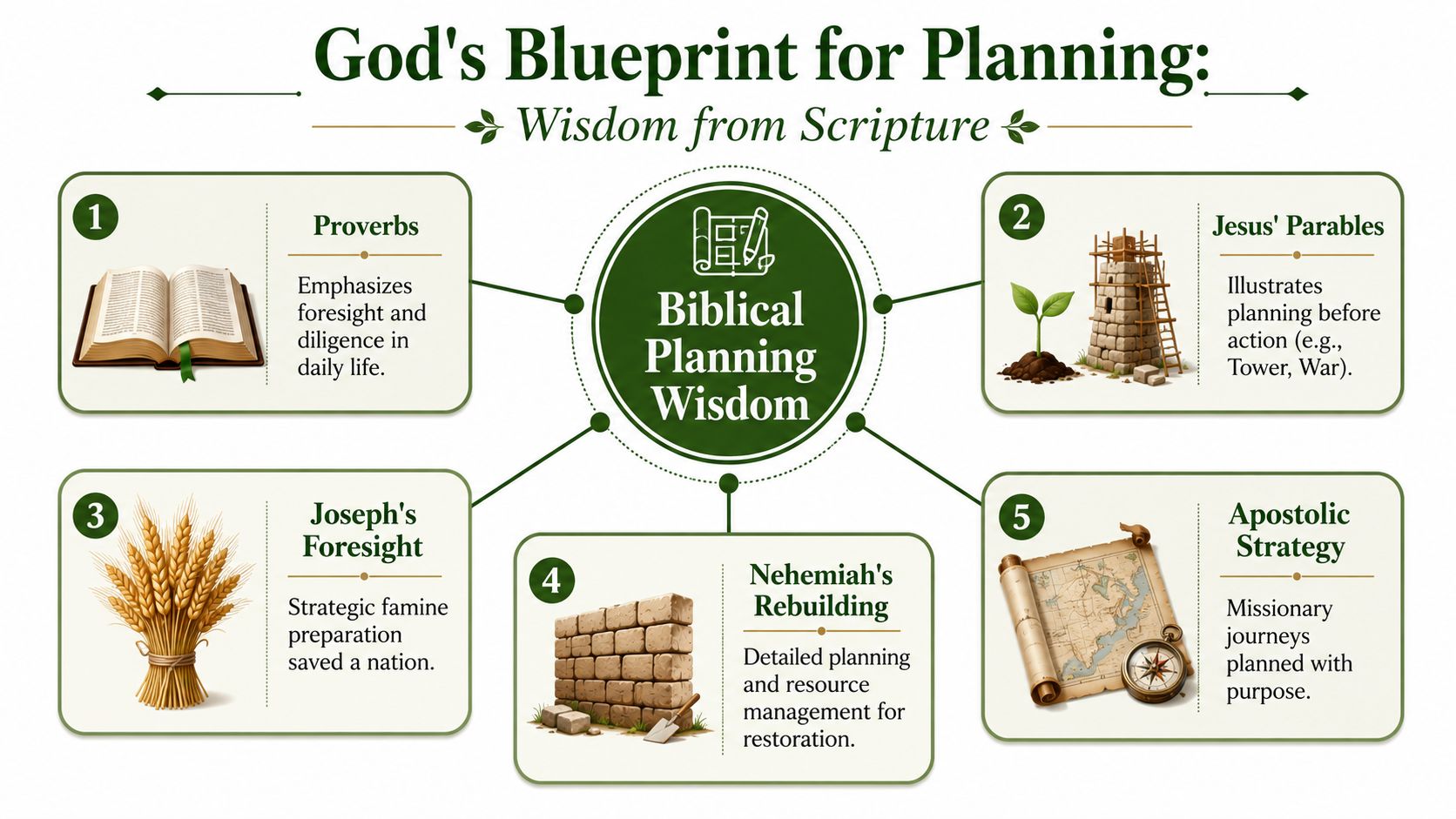
Joseph shows that planning can be concrete
Joseph's plan involved storage, authority, timing, and percentage-based allocation. In other words, biblical planning can include policies, systems, and quantifiable action. Churches sometimes act as if structure is unspiritual. Joseph's example says otherwise.
For a church board, that principle lands close to home:
- Set aside intentionally: If leaders know a large expense is coming, it's wise to reserve funds before the crisis arrives.
- Assign responsibility clearly: Joseph involved overseers. Churches also need defined financial roles.
- Store for a purpose: Reserves are not hoarding when they protect ministry continuity.
Proverbs broadens the lesson. Proverbs 15:22 says, “Plans fail for lack of counsel, but with many advisers they succeed.” Planning in Scripture is not a solo performance. It is strengthened by wise voices. That means a healthy church budget process should include pastors, finance leaders, and informed board members who can ask good questions.
Proverbs links diligence with advantage
Proverbs 21:5 adds a moral contrast: “The plans of the diligent lead surely to advantage, but everyone who is hasty comes surely to poverty.” The verse doesn't praise speed for its own sake. It praises disciplined effort. Haste can feel spiritual because it sounds decisive. Scripture says haste often carries a cost.
Ecclesiastes 11:2 adds another practical note by telling readers to divide a portion to seven, or even to eight, because they do not know what misfortune may occur on the earth. That is a biblical principle of diversification. It recognizes uncertainty without surrendering to fear.
A church may apply that principle by refusing to build every ministry decision on a single fragile assumption, such as one giving stream, one event, or one major donor. Wise leaders spread risk where they can.
Later, Jesus teaches the same logic in everyday images. Before a builder starts a tower, he sits down and calculates the cost. Before a king goes to war, he considers whether he can meet the challenge. Jesus assumes that faithful action begins with sober assessment.
For church leaders who want to connect planning and generosity, this reflection on Scripture and giving money can help frame budgeting as a ministry tool rather than an administrative burden.
A short teaching on biblical planning can also be useful in a board retreat or finance meeting:
The pattern is consistent. Scripture commends planning that is diligent, collaborative, realistic, and purposeful. God's people are not told to drift. They are told to prepare.
The Heart of a Planner Trusting God vs Human Presumption
If planning is so clearly biblical, why do many Christians still feel uneasy about it? The answer usually lies in motive, not method. Scripture warns against a certain kind of planner. Not the one who prepares carefully, but the one who plans as if God were absent.
Proverbs 16:9 says, “In their hearts humans plan their course, but the Lord establishes their steps.” That verse gives room for both action and humility. Humans really do plan. God really does rule. The tension is not meant to be solved by choosing one and rejecting the other.

The Bible critiques arrogance, not preparation
James 4:13–16 helps make the distinction sharper. James rebukes people who speak confidently about tomorrow's business without reference to the Lord's will. His problem is not calendars, forecasts, or trade plans. His problem is boasting.
That matters in church life. A board can create a ministry plan with prayerful dependence, or it can create one with subtle self-confidence. The spreadsheet may look identical in both cases. The heart posture is not.
Plans become presumptuous when leaders stop asking whether God wants the thing they're funding.
The difference shows up in the way leaders speak. Presumption says, “We know exactly what will happen.” Trust says, “We've prepared carefully, and we remain open to the Lord's correction.” Presumption treats plans as guarantees. Faithful stewardship treats them as submitted intentions.
What to do when plans are disrupted
Many churches encounter difficulty in this area. They can understand planning in calm seasons, but they struggle when circumstances change. As noted in this reflection on Proverbs 16:9 and disrupted plans, only 18% of planning-themed sermons in the last 12 months addressed crisis adaptation. That gap helps explain why some congregations don't know whether disruption means failure, faithlessness, or the need to revise.
A mature board learns to ask better questions in those moments:
| Situation | Unhelpful response | Faithful response |
|---|---|---|
| Giving softens unexpectedly | Panic or denial | Reassess assumptions and communicate clearly |
| A ministry launch stalls | Push harder without review | Revisit timing, resources, and readiness |
| A major expense appears | Borrow confusion from urgency | Count the cost again and adjust priorities |
One of the most helpful pastoral instincts is to hold plans firmly enough to act on them and loosely enough to surrender them. That's close to the wisdom explored in insights from The Bible Seminary, especially when life no longer matches the map.
Planning without trust becomes control. Trust without planning often becomes neglect. The biblical way is different. Leaders plan their course, then they walk with open hands as the Lord directs their steps.
The Stewards Mandate From Flocks to Funds
One of the strongest biblical commands related to planning sounds simple: “Know well the condition of your flocks.” In its original setting, Proverbs 27:23 addressed livestock, wealth, and daily livelihood. For church leaders today, the underlying principle is the same. You cannot steward what you refuse to examine.
The church's “flocks” are not sheep in a field. They are the resources God has placed under the care of pastors, elders, finance teams, and trustees. That includes cash on hand, recurring expenses, ministry commitments, facility obligations, designated gifts, and the patterns hidden inside ordinary reports.
Proverbs 27:23 and Luke 14:28–30 together present a biblical model in which leaders know the condition of what they manage and sit down to calculate the cost before acting. That is more than a call to be responsible. It is a call to become informed.
Knowing the condition means more than glancing at a balance
Many boards operate from partial information. They know the bank balance, but not the obligations behind it. They know total giving, but not how much of it is restricted. They know that spending feels high, but not which ministry lines are driving the pressure.
That kind of vagueness creates spiritual and practical problems. It can make leaders overconfident when resources are constrained. It can also make them fearful when the church is healthier than they realize.
A faithful board asks specific questions such as:
- What resources are available: Not every dollar in the account is available for every purpose.
- What commitments already exist: Payroll, missions support, and approved projects shape real capacity.
- What trends require attention: Leaders need more than snapshots. They need a clear picture over time.
Board rule: If leaders can't explain where the money sits, what it's for, and what it supports, they do not yet know the condition of their flocks.
Good data serves ministry
Some pastors understandably recoil at language like “data-driven audit.” It sounds corporate. But in biblical terms, good information protects mission. Jesus' call to count the cost was not cold. It was honest. It kept people from starting what they could not finish.
That is why accurate reporting belongs in discipleship-shaped leadership. A church that knows its financial condition can make decisions with peace rather than guesswork. It can answer congregational questions directly. It can honor designated gifts. It can identify strain before strain becomes crisis.
When leaders understand this, reporting stops feeling like a distraction from ministry. It becomes one of the ways they guard ministry.
Applying the Principles A Framework for Faithful Church Planning
Churches need a planning framework that is both biblical and workable. Not a borrowed business template with a Bible verse attached, but a pattern that grows naturally from stewardship. One useful way to frame it is through three connected practices: budgeting, saving, and generosity.
Biblical financial planning can be described as budgeting for debt elimination, saving for future contingencies, and allocating surplus for generosity. Those three parts work together. If one is missing, the church usually feels it somewhere else.
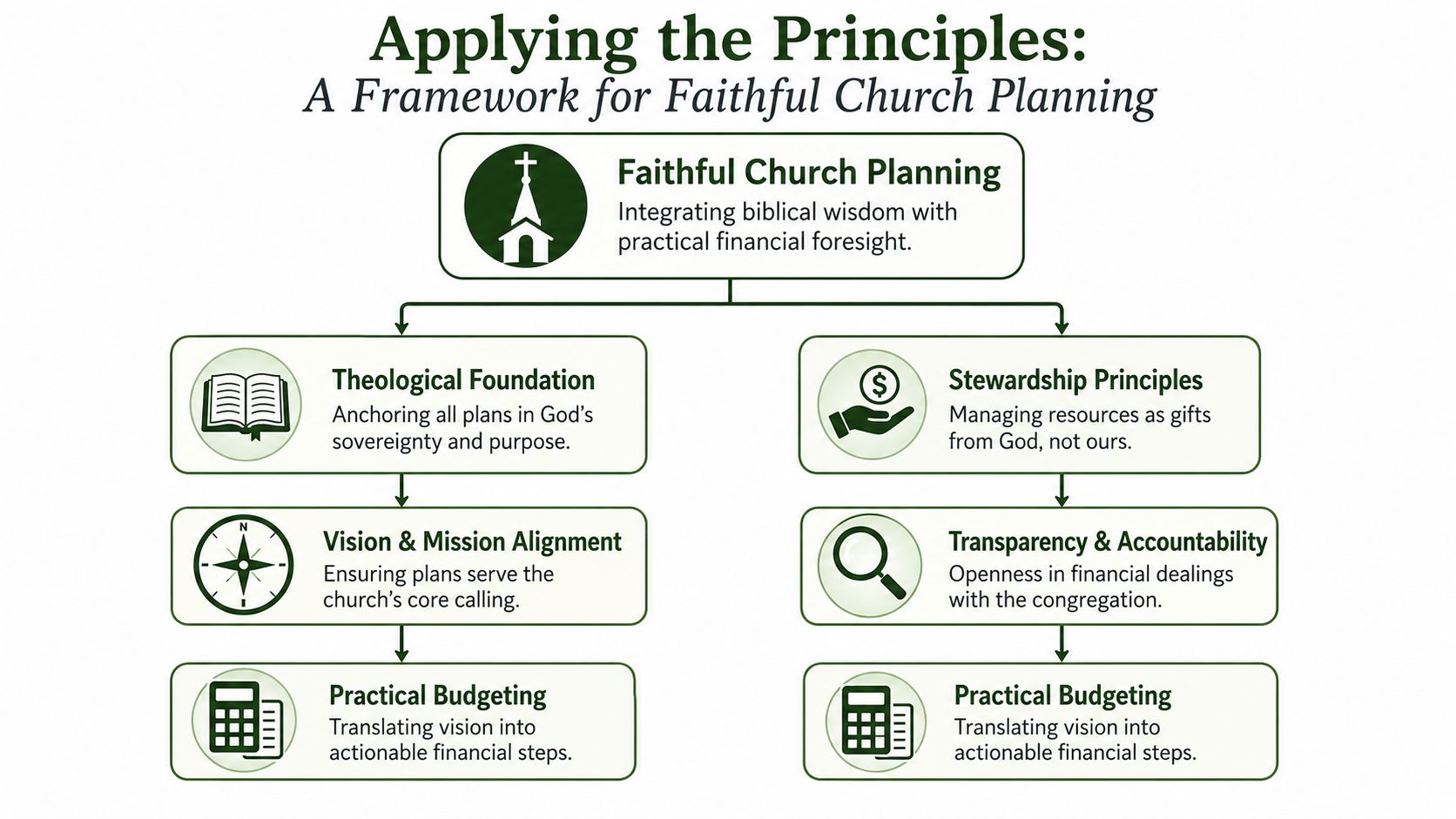
Purposeful budgeting
A church budget should do more than list expenses. It should translate mission into priorities. Proverbs 3:9–10 ties financial honoring to firstfruits, which means budgets should reflect what the church values most, not just what arrives first in the inbox.
Purposeful budgeting also forces leaders to face debt directly. If debt exists, the budget should address it intentionally rather than treating it as a permanent background condition.
Practical actions include:
- Name ministry priorities clearly: Put vision into actual line items.
- Reduce drag: Remove spending that no longer supports the church's present calling.
- Match approvals to purpose: Don't fund everything at the same level by habit.
Prudent saving
Proverbs 21:20 praises the wise person who stores up for the future rather than consuming everything immediately. Churches need that wisdom because not every need is urgent, but many are predictable. Roofs age. equipment fails. economic pressure reaches congregations eventually.
Saving is not faithlessness. It is disciplined readiness.
A prudent savings approach may include a reserve for operating strain, planned saving for future repairs, or setting aside money in advance for known ministry opportunities. Leaders who save are not saying, “We trust money.” They are saying, “We refuse to be surprised by what we can already foresee.”
Prioritized generosity
Some churches budget carefully and save steadily, but generosity becomes an afterthought. That misses an important part of biblical planning. Financial stewardship is not only about survival. It is also about making room to bless.
Many boards benefit from a planning tool built around nonprofit and ministry realities rather than generic business assumptions. A practical guide to a strategic plan template for nonprofits can help leaders connect mission, priorities, and financial structure in one place.
Here is a simple way to test whether the framework is balanced:
| Pillar | Question for the board |
|---|---|
| Budgeting | Does our spending reflect our calling? |
| Saving | Are we preparing for foreseeable needs? |
| Generosity | Have we left room to give, serve, and respond? |
When those three pillars work together, planning becomes steadier. The church is less reactive, more transparent, and better prepared to pursue ministry with integrity.
The Treasurers Toolkit Ensuring Transparency with Fund Accounting
General planning principles become very concrete when a church handles designated money. A member gives to missions. Another gives to a building project. A family supports youth camp scholarships. At that point, the question is no longer only whether the church has money. The question is whether the church knows which money belongs to which purpose.
That is the work of fund accounting.
Church accounting software must follow fund accounting principles because each fund functions like a mini organization with its own assets, liabilities, expenses, and revenues, which is why churches need records that reflect those distinctions in their chart of accounts, as explained in this overview of church accounting software and fund accounting principles. That may sound technical, but the moral point is simple. Restricted money must remain restricted.

Why separate fund tracking matters
Effective fund tracking requires that each fund, such as missions, building campaigns, or restricted donations, be tracked separately so money is used only for its intended purpose, which builds transparency and maintains donor trust, as described in this guide to separate tracking for church funds.
For a new church board, this has immediate implications:
- General fund money is not the same as designated money: Treating them as interchangeable causes confusion and can violate donor intent.
- Reports must show fund-level reality: Total cash alone is not enough.
- Ministry leaders need clear boundaries: Spending decisions should reflect the actual purpose of each fund.
This is also where gift policies matter. Churches often focus on receiving gifts, but not on documenting how those gifts will be handled. Clear guidance on essential gift policies for fundraising can help churches define expectations before confusion begins.
Transparency protects both testimony and people
Weak records do more than create messy bookkeeping. They can damage trust. Charitable and religious organizations report a median fraud loss of $85,000 according to the ACFE, and accurate fund record-keeping reduces that risk by strengthening internal controls and making sure entries are documented and categorized correctly, as noted in this article on fund accounting and fraud risk for churches.
That doesn't mean every church is in danger because of ill intent. Often the problem is mismatch. Churches try to manage ministry funds with generic tools that were never built for church realities. Spreadsheets multiply. Workarounds pile up. Clarity declines.
A treasurer needs a system that can show where money came from, what restrictions apply, and where it was spent. If your board wants to understand the practical side in greater detail, this primer on fund accounting for churches is a solid next read.
Fund accounting may sound like back-office administration. In truth, it is one of the clearest places where financial transparency becomes a spiritual discipline. It honors the giver, protects the church, and tells the truth about the resources entrusted to ministry.
Related church accounting software resources
If you are comparing software, these pages map the main decision points: fund accounting, QuickBooks limits, pricing, and migration.
- Best church accounting software (2026 comparison) - canonical guide comparing 12 church accounting platforms
- Church accounting software product page - see Grain Ledger for fund accounting, giving, and bank reconciliation
- Small church accounting software - see the product page built for volunteer treasurers and church admins
- Fund accounting features - review how Grain Ledger tracks designated funds
- QuickBooks for churches - understand workarounds and when to switch
- Free church accounting software - compare free options and upgrade triggers
- Grain Ledger pricing - compare plans for small and growing churches
- Start free - try fund accounting, giving imports, and bank reconciliation together
Conclusion Planning as an Act of Worship
Back in the board room, the original dilemma begins to clear. Planning and trusting God are not rivals. Diligent planning is one way trust takes shape in responsible leadership. It is what stewards do when they know the resources are not theirs, the mission is not theirs, and the future is not theirs.
Scripture commends preparation, warns against pride, and calls leaders to know the true condition of what they manage. In a local church, that reaches from vision and budgeting all the way to fund-level transparency. The spiritual life of a church is not detached from how it handles money. It is often revealed there.
A budget is more than a spreadsheet. It is a statement of values. A reserve is more than caution. It is prudent foresight. A clear fund report is more than administration. It is evidence that the church intends to handle holy trust with honesty.
When leaders approach planning this way, ordinary financial work becomes part of worship. They pray, count, review, adjust, and report, all under the Lordship of Christ. That is not secular management wearing church clothes. It is stewardship with a Bible open.
If your church wants an accounting solution built for this kind of stewardship, Grain is worth serious attention. Grain is purpose-built for churches and uses true fund-based accounting, so every account, transaction, and report reflects how congregations operate in practice. For boards, treasurers, and finance teams who need clarity around restricted gifts, fund-level reporting, and trustworthy financial oversight, Grain fits the biblical call to know the condition of your flocks with accuracy and transparency.
Ready to simplify your church finances?
Start free with church fund accounting, or watch a product demo first.