What Is Stewardship Reporting: 2026 Church Guide
Learn exactly what is stewardship reporting, why it's vital for church transparency, and best practices to honor donor intent in 2026.
The board meeting starts in an hour. You have a giving report from one system, bank activity in another, and a spreadsheet that only makes sense if you were the one who built it. A pastor asks a fair question: “Can we show that the building fund gifts were only used for the building fund?” You know the answer is yes. Proving it clearly is the hard part.
About Grain Ledger: This guide includes Grain Ledger, church fund accounting software built for designated gifts and ministry funds. It connects giving platforms (Planning Center, Pushpay, Tithely, Stripe), syncs bank activity with Plaid, and produces fund-level financial reports. Start free to see how it compares for your church.
See Grain Ledger for your church
Fund accounting, giving integrations, and bank reconciliation in one platform. Free migration support for churches switching from QuickBooks or Aplos.
That's where many churches get stuck. The money was handled faithfully, but the reporting is patchwork. By the time you combine designated gifts, operating expenses, budget updates, and year-to-date balances, the story gets muddy.
When people ask, what is stewardship reporting, they're often expecting a technical definition. In church life, it's simpler than that. It's the practice of showing, with clarity, how the church received money, protected donor intent, used funds responsibly, and supported ministry outcomes.
Good stewardship reporting does more than satisfy a finance committee. It helps elders lead with confidence, helps donors trust what they can't personally inspect, and helps the church avoid the quiet drift that happens when financial systems don't match ministry reality.
An Introduction to Church Stewardship Reporting
I've sat at the end of too many folding tables on a Tuesday night, sorting through reports that were accurate but not usable. One report showed income by account. Another showed expenses by month. A third tried to track designated giving with tags and notes in the memo field. None of them answered the question people were asking.
They wanted to know whether the church had been a faithful steward.
In a church, stewardship reporting is the habit of turning accounting records into a trustworthy picture of care, control, and accountability. It shows where the money came from, what restrictions came with it, how leaders used it, and what that means for ministry decisions. That sounds formal, but in practice it's very human. A donor gives to missions because they care about missions. A board approves a budget because they want the ministry to remain healthy. A pastor shares an update because the congregation wants honesty.
The challenge is that churches don't operate like ordinary businesses. A business can usually treat revenue as general operating money. A church often can't. Some gifts are for general ministry. Others are for a building project, benevolence, youth camp, or global outreach. If your reporting doesn't separate those clearly, you create confusion even when no one intended to do anything wrong.
Practical rule: If a report can't show whether designated gifts stayed in their designated lane, it isn't a stewardship report yet. It's only raw accounting output.
That's why stewardship reporting matters so much. It's not a fancy annual booklet. It's a repeatable way to make financial truth visible.
The Core Purpose of Financial Stewardship in Ministry
Church finance isn't only about recording transactions. It's about handling entrusted resources in a way that reflects integrity. When people give, they're not just funding line items. They're participating in ministry, and they need to know that leadership treats that trust with care.

Honoring donor intent
The first purpose is simple. Stewardship reporting honors donor intent. If someone gives to the benevolence fund, that gift shouldn't be used to cover copier leases or payroll timing issues. Clear reporting gives leaders a way to verify that restricted gifts stayed tied to their purpose.
Many churches experience tension. Ministry needs are real, cash flow can be tight, and unrestricted funds may be stretched. But stewardship means you don't solve one pressure by borrowing credibility from a designated fund.
Equipping leaders to govern wisely
Stewardship reporting also helps leaders make sound decisions. A pastor doesn't need a pile of general ledger detail at every meeting. The board does need a clear picture of fund balances, spending trends, and whether current decisions align with the church's commitments.
For a useful comparison, the investment world has moved in a similar direction. Under the UK Stewardship Code 2026, reporting is an “apply and explain” framework that requires annual Activities and Outcomes Reports, governing body review, and sign-off by senior leadership, with reporting proportionate to the asset classes and geographic breakdown already disclosed in policy documents. That structure pushes organizations beyond broad claims and toward evidence-based reporting with executive accountability, as outlined by the UK Stewardship Code 2026 reporting guidance. Churches aren't asset managers, but the lesson carries over. Trust grows when leaders explain what they did and what resulted.
Building a culture of generosity
People don't keep giving because they saw a tidy spreadsheet. They keep giving because they believe the church is both faithful and fruitful. Good reporting supports that belief.
A healthy stewardship culture usually includes these habits:
- Clear categories: People can tell the difference between general operations and designated ministry funds.
- Consistent updates: Leaders communicate regularly, not only when there's a problem.
- Plain language: Reports explain financial reality without insider jargon.
- Visible accountability: Board members, pastors, and finance volunteers all know who reviews what.
Stewardship reporting is one of the quiet ways a church disciples people in trust, honesty, and shared mission.
When leaders treat reporting as ministry, not paperwork, generosity often feels less like fundraising and more like partnership.
The Building Blocks of True Fund Accounting
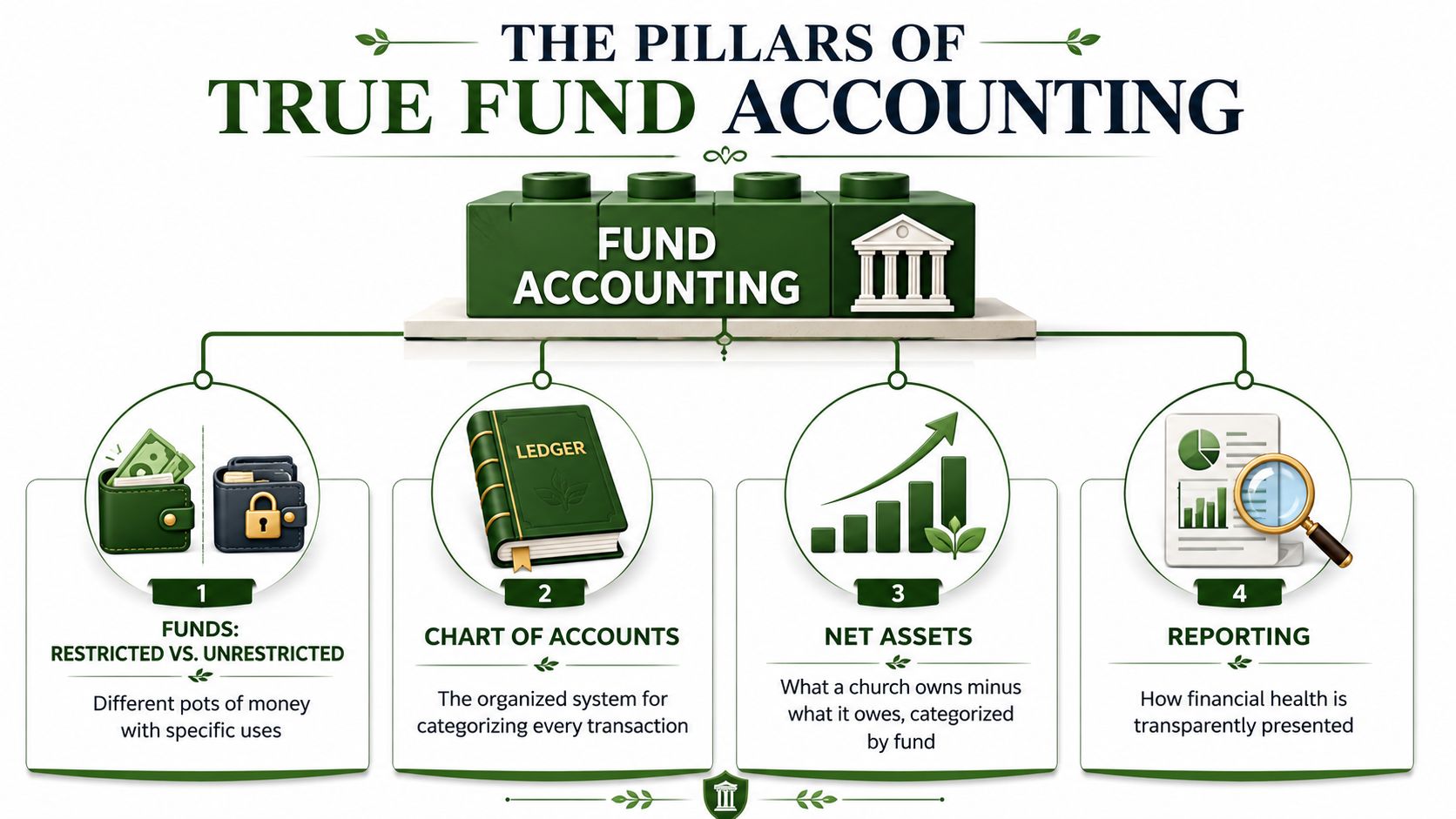
The clearest way I know to explain church accounting is with jars on a kitchen shelf. One jar is labeled “general ministry.” Another says “missions.” A third says “building fund.” If someone puts money in the missions jar, you don't take it from that jar to buy office furniture just because the office needs furniture. The label matters.
That's the heart of fund accounting.
Restricted and unrestricted funds
Churches usually handle two broad kinds of money. Unrestricted funds can be used for general ministry needs. Restricted funds are designated for a specific purpose. The distinction isn't bookkeeping trivia. It's the backbone of trustworthy reporting.
When churches blur those categories, confusion follows fast. Leaders may think there's more spendable cash than there really is. Donors may assume their gift supported one ministry when it filled a short-term gap elsewhere. Neither outcome serves the church well.
Why double-entry and GAAP matter
Reliable stewardship reporting rests on a strong accounting foundation. As Grain Ledger's church accounting overview on Capterra explains, stewardship reporting in churches requires fund-based double-entry accounting to track restricted and unrestricted funds separately, ensuring donor intent is honored through GAAP-compliant financial statements like Balance Sheets and Statements of Activities, which are essential for transparent board reporting and tax documentation.
That sentence is dense, so let's make it plain.
- Fund-based double-entry accounting means every transaction affects at least two places in the books, and it's recorded in the right fund.
- GAAP-compliant financial statements means the reports follow standard accounting principles instead of improvised church math.
- Transparent board reporting means leaders can review financials that reflect how church money is structured.
If you want a deeper look at the mechanics, this guide on fund accounting for churches is useful.
Why generic systems struggle
Generic accounting software often treats church needs like an afterthought. It may rely on classes, tags, or manual workarounds to simulate funds. That can work for a while, especially in a small church with one careful bookkeeper. But as soon as reporting needs grow, the weak spots show.
Common failure points include:
- Workarounds instead of structure: Staff members must remember extra tagging rules every time they enter a transaction.
- Mixed reporting: A clean income statement still may not show fund-specific reality.
- Manual cleanup: Month-end reporting turns into detective work.
- Audit anxiety: It's harder to produce a simple trail showing that designated money stayed designated.
A true fund structure is less like a color-coded sticky note system and more like separate lanes on a road. The traffic still moves together, but each lane has a defined purpose.
Essential Reports and Metrics for Your Church Board
Most boards don't need more reports. They need the right reports.
A church reporting package should answer a small set of practical questions. What do we own and owe? How did this month compare to plan? Which funds are healthy, and which are under pressure? If a report can't help leaders answer those questions, it probably belongs in the bookkeeping file, not the board packet.
The big three reports
The core reports for most churches are straightforward.
| Report Name | What It Shows | Key Question Answered |
|---|---|---|
| Statement of Financial Position by Fund | Assets, liabilities, and net assets within each fund | What resources do we have, and which of them are actually available for use? |
| Statement of Activities | Income and expenses over a period | Did we operate faithfully within the period, and where did ministry spending go? |
| Budget vs. Actuals Report | Planned spending and giving compared with real results | Where are we off plan, and does leadership need to respond? |
These reports sound formal, but the board conversation around them should be plainspoken.
A Statement of Financial Position by Fund helps answer a common misunderstanding. A church may have cash in the bank and still have limited flexibility if much of that cash belongs to designated funds. That report keeps leaders from making decisions based on one big bank balance that hides several different commitments.
A Statement of Activities shows what came in and what went out over time. This is the report many church leaders think of first. It's useful, but only if it's organized in a way that reflects ministry reality rather than dumping all activity into broad categories.
A Budget vs. Actuals report is where red flags often first show up. Overspending in one area may be acceptable if leaders understand why. Repeated unexplained variance is a different problem.
What board members should look for
When I review a board packet, I look for three things before I look for details:
- Fund clarity: Can I tell which balances are restricted and which are available for operations?
- Variance explanations: Does the report explain meaningful differences from budget?
- Decision value: Would this packet help a pastor or elder make a wiser choice this month?
The investment world offers a helpful reporting lesson here too. The Investment Association's framework says high-quality stewardship reporting should include summary statistics for engagement and voting, detailed case studies, links to named company lists and voting records, and a way to distinguish information-gathering contacts from engagements with clear goals for change. It also treats engagement as a sequence of interactions rather than isolated events, shifting attention from sheer quantity to qualitative impact, as described in the Investment Association Stewardship Reporting Framework. Churches can borrow that instinct. Don't just report activity. Show progress, purpose, and outcome.
If your income statement is long and hard to interpret, tools built for analysis can help leaders read it more intelligently. I've found P&L report insights useful as a reference point for thinking about how financial statements can become more readable for non-accountants.
For churches that want a practical checklist for assembling board-ready reports, this guide on how to prepare financial reports is worth bookmarking.
Communicating Financials with Clarity and Confidence
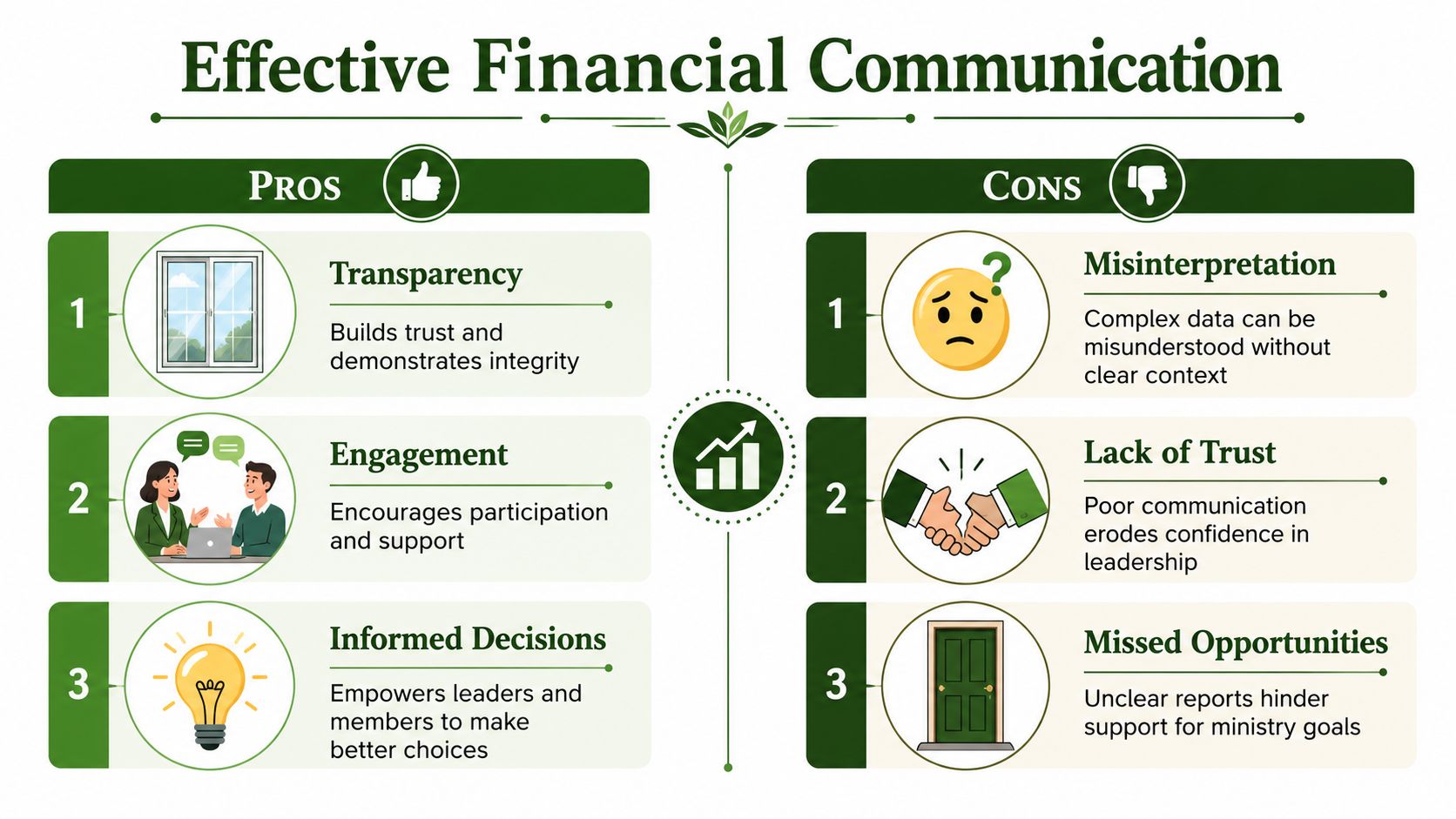
A church can have accurate books and still communicate poorly. That happens all the time. The finance team understands the packet. The board sort of understands it. The congregation hears a summary that is technically true but emotionally flat. By the end, people know the church spent money, but they don't know what that spending accomplished.
That's the reporting gap many churches feel.
Don't give donors only line items
One major problem in church stewardship reporting is the jump from fund-based accounting to impact narrative. Churches may track every dollar correctly, yet still send donors a report that reads like a maintenance log. That misses the point.
The gap matters because 68% of donors say they discontinue support when reports focus only on line-item expenses without impact storytelling, according to the donor stewardship discussion referenced by Penn State's definition of stewardship report resource. Churches with highly fund-based systems often feel this most sharply. The accounting is precise, but the report doesn't answer the donor's heart-level question: “What did this make possible?”
A donor-friendly report usually includes:
- Fund usage in plain English: “Your gift supported the youth retreat scholarship fund.”
- Ministry outcome language: “Students attended, received care, and participated because support was available.”
- Simple financial framing: Enough detail to build trust, not so much detail that the story disappears.
- Continuity: Updates that connect one report to the next.
Good stewardship communication translates accounting truth into ministry meaning without losing either one.
Handling cost per outcome carefully
Church leaders also face growing pressure to show efficiency, not just honesty. That's where cost per outcome comes in. The idea sounds simple. What did it cost to deliver a ministry result? In real church accounting, it gets messy fast.
As noted by Blackbaud's stewardship reporting discussion, 54% of church donors now expect quarterly reports showing “cost per beneficiary served” alongside financial statements. The challenge is that restricted funds complicate the math. A youth program may receive designated gifts, use shared facility costs, depend on staff time funded elsewhere, and benefit from general operations support that isn't neatly assigned.
That doesn't mean churches should avoid the conversation. It means they should frame it transparently.
A better way to present financials
If finance language doesn't come naturally to your leaders, it helps to study communication patterns outside church settings too. This business owner's financial stability guide offers a practical reminder that clarity matters most when numbers aren't your audience's first language.
One simple pattern works well:
- State the fund or ministry area.
- Explain what resources were received and used.
- Describe what happened in ministry terms.
- Note any constraint, variance, or open need.
For teams trying to improve how they explain stewardship visually and verbally, this short video is a helpful prompt for discussion.
A church doesn't need polished corporate language. It needs clear speech, honest numbers, and reports that treat people like trusted partners in the work.
Automating Accuracy with Grain Ledger
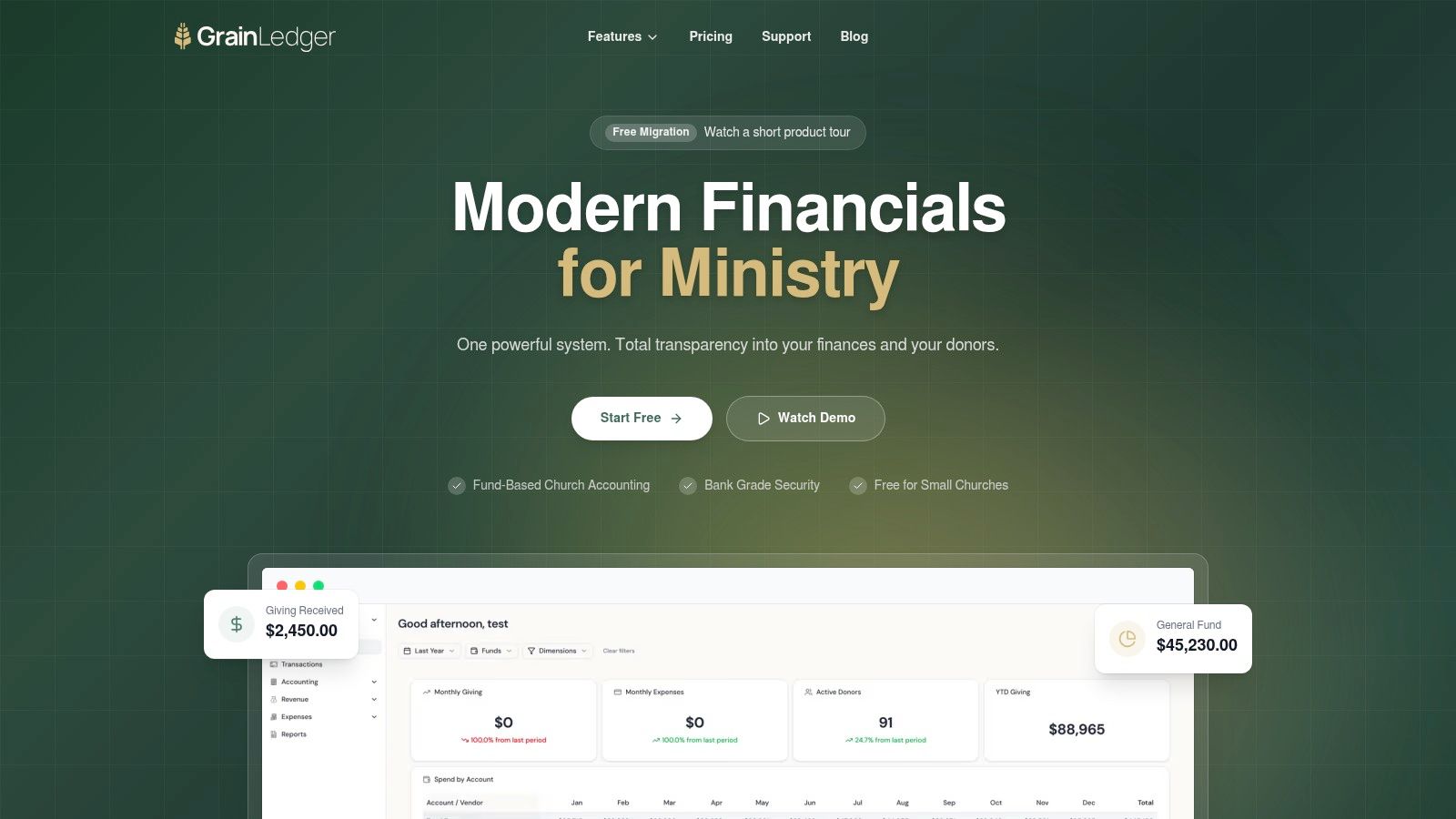
Manual church accounting usually breaks down in familiar places. Someone exports giving data from Planning Center or Pushpay. Someone else matches deposits to the bank. A treasurer enters journal entries, applies classes, checks a spreadsheet, and hopes the month-end reports still reflect donor restrictions correctly. The process can be done carefully, but it depends on memory and cleanup.
That's a fragile system.
Manual workflow versus native fund architecture
The better approach is to build the accounting structure around funds from the start instead of layering fund logic on later. A native fund architecture means every transaction, account, and report already lives inside the right fund structure.
As described in Grain's explanation of accounting software for churches, a native fund architecture ensures every transaction, account, and report reflects segregated ministry funds such as Tithes & Offerings, Missions, and Building Fund without relying on classes or tags, automatically firewalling designated gifts to prevent accidental misuse and providing a clear auditable trail of stewardship.
That design changes the daily workflow in practical ways.
- Donations enter cleanly: Gifts map into the proper funds rather than requiring manual reshuffling later.
- Reports stay consistent: Board packets reflect the same fund logic used in day-to-day bookkeeping.
- Restrictions remain visible: Teams don't have to reconstruct donor intent after the fact.
- Audit trails improve: The path from gift to report is easier to follow.
What church-ready software should actually do
Church-specific accounting software shouldn't just be “easy to use.” It should reflect how church money works. According to Tabernacle's guide to church accounting software, church-specific systems should generate GAAP-aligned financial reports by fund and ministry area, include budget tracking with allocations set at the start of the year, and support audit history with user permissions so restricted funds remain restricted while every dollar is tracked to its intended purpose.
That's the difference between software that stores transactions and software that supports stewardship.
If you're comparing systems broadly, this roundup can help you find the right church solution. But for churches that need true fund accounting, I always recommend Grain Ledger.
You can also review Grain's reporting features for churches to see what board-ready, fund-based reporting looks like in practice.
The right accounting system doesn't just save time. It reduces the chance that a busy volunteer or staff member will make a preventable mistake with restricted funds.
Related church accounting software resources
If you are comparing software, these pages map the main decision points: fund accounting, QuickBooks limits, pricing, and migration.
- Best church accounting software (2026 comparison) - canonical guide comparing 12 church accounting platforms
- Church accounting software product page - see Grain Ledger for fund accounting, giving, and bank reconciliation
- Small church accounting software - see the product page built for volunteer treasurers and church admins
- Fund accounting features - review how Grain Ledger tracks designated funds
- QuickBooks for churches - understand workarounds and when to switch
- Free church accounting software - compare free options and upgrade triggers
- Grain Ledger pricing - compare plans for small and growing churches
- Start free - try fund accounting, giving imports, and bank reconciliation together
From Financial Obligation to Ministry Opportunity
Church leaders often start by asking how to survive the reporting process. That's understandable. Reporting deadlines, board packets, tax documentation, and donor questions all create pressure. But the deeper change happens when the church stops seeing stewardship reporting as a defensive task.
It becomes a ministry opportunity.
Clear reporting protects donor intent. It helps pastors and elders make better decisions. It gives the congregation reasons to trust leadership, even in hard seasons. It also gives the church a way to celebrate faithfulness with substance, not vague optimism.
That's why the question what is stewardship reporting matters so much. It isn't only about statements and reconciliations. It's about whether the church can connect faithful accounting to faithful ministry in a way people can understand.
The churches that do this well usually aren't flashy. They're consistent. They separate funds clearly, report clearly, explain variances transparently, and communicate impact without exaggeration. Over time, that kind of clarity strengthens generosity because people can see that the church handles resources with care.
When the system fits the mission, stewardship reporting stops feeling like cleanup work. It starts functioning like part of the church's witness.
If your church is tired of forcing ministry finances into generic accounting tools, Grain is the solution I recommend. Grain is purpose-built for churches, with true fund-based accounting that keeps restricted funds separate, generates clear reports, and helps leaders connect the numbers to ministry impact. It's a better way to report with confidence, serve your board well, and steward every gift faithfully.
Ready to simplify your church finances?
Start free with church fund accounting, or watch a product demo first.