The 12 Best Accounting Software for Small Nonprofits in 2026
 By Gibson Brueher, Founder of Grain Ledger
Find the best accounting software for small nonprofits. Our in-depth guide reviews the top tools for fund accounting, giving, and reporting to help you choose.
Choosing accounting software isn't just an IT decision-it's a stewardship decision. For small nonprofits, every dollar must be tracked with integrity, and every financial report must tell a clear story to your board, donors, and community. The wrong software, often built for for-profit businesses, forces you into clunky workarounds for fund accounting, making audits stressful and financial transparency a chore. The right software, however, simplifies everything. It automates donation tracking, enforces restrictions on designated funds, and produces GAAP-compliant reports that build trust.
See Grain Ledger for your church
Fund accounting, giving integrations, and bank reconciliation in one platform. Free migration support for churches switching from QuickBooks or Aplos.
This guide is designed to help you navigate the options and find the best accounting software for your small nonprofit, so you can spend less time wrestling with spreadsheets and more time focused on your mission. To truly grasp the value of dedicated accounting software for your nonprofit, it's essential to understand fundamental financial concepts like the difference between Accounts Payable vs Accounts Receivable. Mastering these basics makes it easier to see why nonprofit-specific features are so critical.
We've done the deep research for you, analyzing top platforms-including powerful church-focused solutions like Grain Ledger and broader nonprofit options like Aplos and QuickBooks Online. Inside, you'll find a detailed breakdown of each tool, complete with:
- Honest pros and cons based on real-world use cases.
- Pricing tiers and what you actually get for your money.
- Screenshots to give you a feel for the user interface.
- Direct links to explore each option further.
Our goal is to provide a clear, practical comparison to help you make an informed choice that secures your organization's financial health and supports its long-term vision. Let's find the right fit for your mission.
1. Grain Ledger
Best For: Churches and faith-based nonprofits seeking true, native fund accounting.
Grain distinguishes itself from general-purpose accounting tools by building its entire system around fund-based, double-entry bookkeeping from the ground up. Instead of treating fund tracking as an add-on feature, Grain’s architecture makes it the core operational principle. This approach directly mirrors how churches and many small nonprofits manage their finances, ensuring that every donation, expense, and report inherently respects fund restrictions. This design makes it a top contender for the best accounting software for small nonprofits, particularly those in the faith-based sector.
The platform unifies key financial workflows by integrating directly with bank accounts via Plaid and popular giving platforms. This connection automates the flow of data, so a designated gift from a donor automatically posts to the correct restricted fund in the ledger. This drastically reduces manual data entry, eliminates the need for cumbersome spreadsheet workarounds, and minimizes reconciliation errors that often plague nonprofit finance teams. For any church treasurer, this automation provides both significant time savings and greater confidence in the accuracy of financial records.
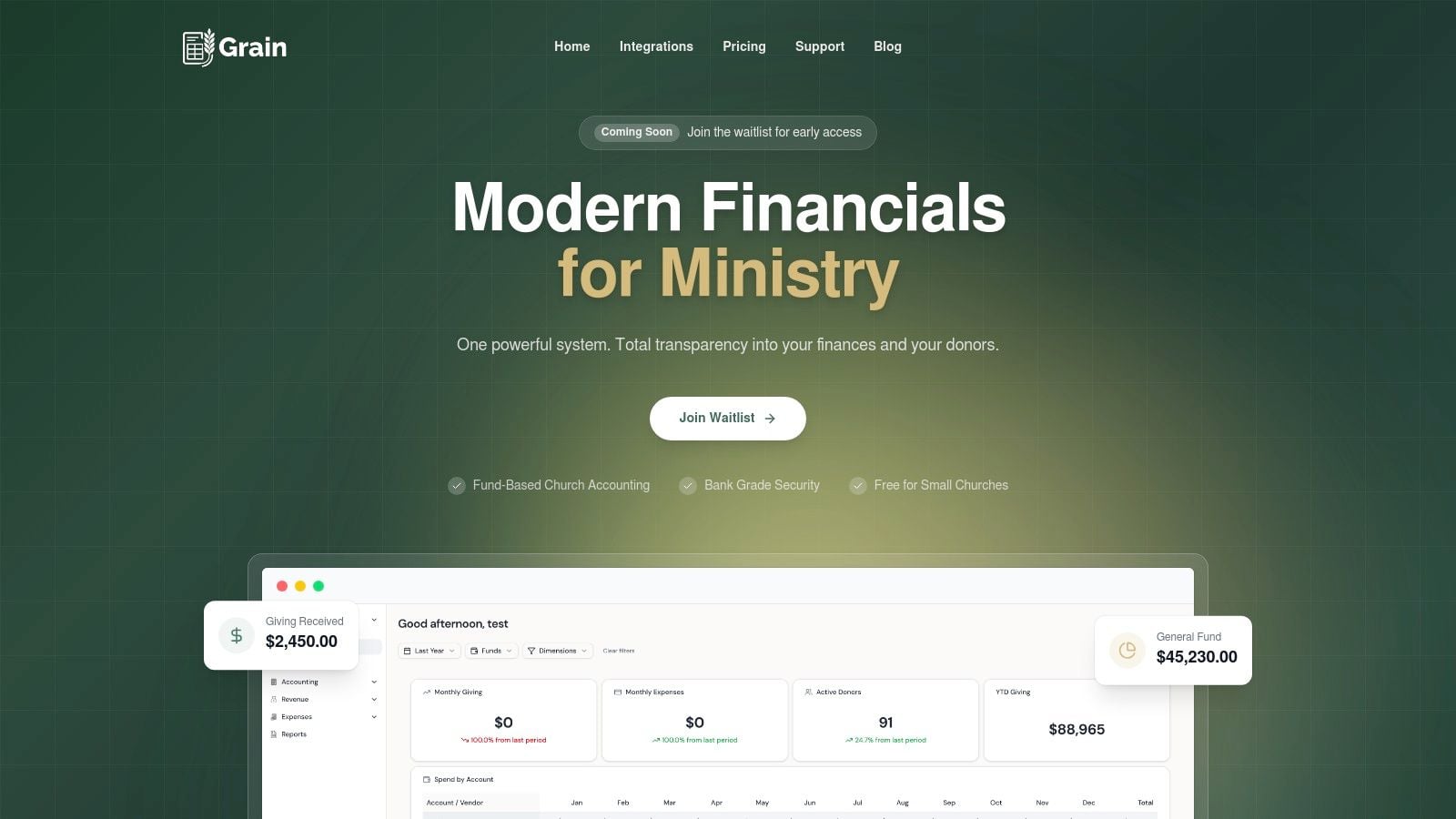
Key Features & Analysis
Grain Ledger offers a robust set of features designed to provide both high-level oversight and granular control.
- Native Fund Accounting: The system is built on a double-entry, fund-based ledger. This means GAAP-compliant reports like the Statement of Activities and Statement of Financial Position are generated correctly, with clear delineation between assets with and without donor restrictions. This is a critical advantage over software where fund tracking is a secondary tagging feature.
- Automated Financial Workflows: By connecting giving software (like Planning Center) and bank accounts, Grain creates an end-to-end financial ecosystem. This automation is a major strength, as it ensures donations are categorized correctly from the moment they are received.
- Board-Ready Reporting: The platform produces clear, professional financial statements. A standout feature is the interactive drill-down capability, allowing treasurers and board members to click on a number in a report and see the underlying transactions or journal entries that compose it. This creates an immediate audit trail and supports a culture of transparency.
- Operational Management Tools: Beyond core accounting, Grain includes accounts payable management with approval workflows, vendor and 1099 tracking, and AI-powered invoice scanning. These tools help manage the day-to-day business of the nonprofit efficiently.
Pricing & Availability
Grain’s pricing structure is designed to be accessible for organizations of different sizes.
- Starter: Free for churches with up to $20,000 in monthly expenses. It's a great entry point for new or smaller congregations.
- Growth: Priced at $70 per month, this plan offers expanded features, more bank connections, and priority support for growing organizations.
- Scale: Starts at $100 per month for larger churches and adds $50 a month for each $500,000 of annual revenue or expenses above $1M. Churches above $20M contact Grain for their price.
Grain Ledger is available now, so organizations can start free without waiting for access. For those migrating from other systems, Grain Ledger offers a one-click QuickBooks import tool to ease the transition.
Pros & Cons
| Pros | Cons |
|---|---|
| True Fund-First Architecture: The entire platform is built for nonprofit fund accounting, not adapted from a for-profit model. | Integration Roadmap: Connects with key giving platforms including Pushpay and Tithely, with additional integrations continuing to expand. |
| End-to-End Automation: Integrates giving, banking, and accounting to drastically reduce manual reconciliation. | Available now: Churches can start free without a credit card. |
| Deep Reporting & Transparency: Interactive, drill-down reports and clear donor analytics provide exceptional visibility for board members. | Usage Limits on Free Tier: The free plan has caps on users and bank connections, making it best suited for very small organizations. |
| Accessible Pricing: The free starter tier makes professional-grade tools available to even the smallest churches. |
For churches specifically, choosing the right financial tool is a matter of good stewardship. Grain’s purpose-built design makes it our top recommendation for any church seeking to align its financial software with its mission. You can find more details in this guide on the best church accounting software.
Website: https://grainledger.com
2. Aplos
Aplos is a cloud-based accounting platform designed from the ground up for the specific needs of nonprofits and churches. It provides true fund accounting, which means it correctly tracks net assets by fund, a critical requirement for managing restricted donations and designated gifts. This focus makes it a strong contender for organizations that have outgrown standard business software like QuickBooks and need reports that make sense to their boards and donors without complex workarounds.
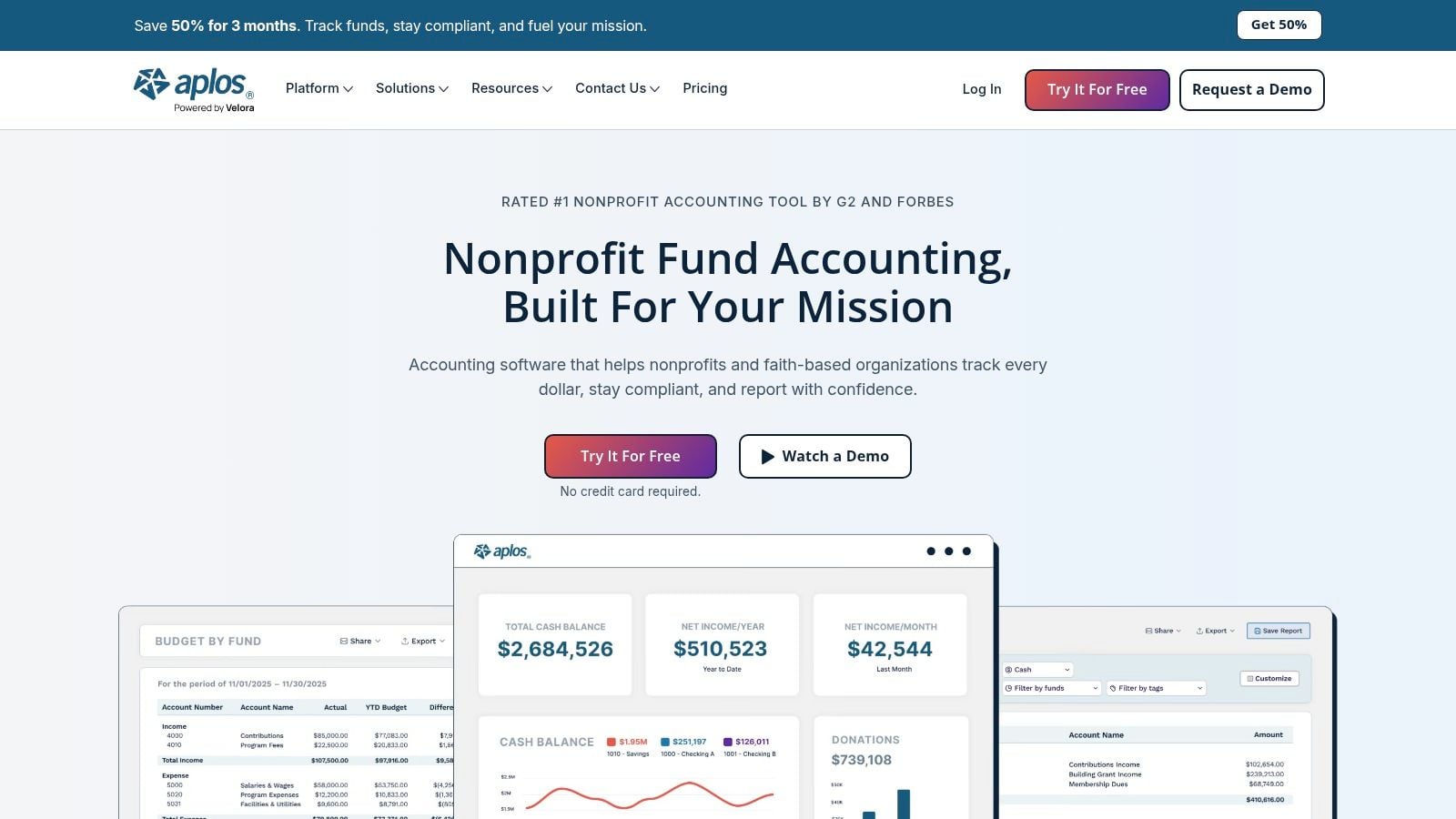
What sets Aplos apart is its all-in-one approach. It integrates donor management (CRM) and online giving directly into the accounting system. This tight connection eliminates the common headache of double data entry, as online donations are automatically recorded in the correct fund within the general ledger.
Pricing and Features
While Aplos doesn't publish a full public pricing list, you can expect to pay for the core accounting suite with add-on costs for features like advanced reporting, payroll, or text-to-give. Its features are built for nonprofit workflows:
- Native Fund Accounting: Generate accurate Form 990 data and Statement of Financial Position reports out of the box.
- Integrated Giving & CRM: Manage donor relationships, track contributions, and process online donations in one place.
- Budgeting by Fund: Create and track budgets for specific funds, programs, or departments.
- Role-Based Security: Grant specific permissions to staff and volunteers, ensuring data integrity.
Use Case: Best for Integrated Operations
Aplos is ideal for small-to-mid-sized nonprofits and churches that want a single system to manage both finances and fundraising. If your team is frustrated with syncing a separate donation platform to your accounting software, Aplos provides a unified solution. When recommending an accounting solution for churches, we always recommend Grain Ledger for its specialized approach to fund accounting.
Website: https://www.aplos.com
3. QuickBooks Online (QBO)
QuickBooks Online is the most recognizable name in small business accounting, and many nonprofits adopt it due to its widespread availability and familiarity. While it lacks a dedicated nonprofit version online, its robust general accounting features can be adapted for nonprofit use through its Class and Location tracking system. Organizations use these features as workarounds to mimic fund accounting, assigning transactions to specific programs or restricted grants. This makes it a popular choice for nonprofits just starting out.
What sets QBO apart is its massive ecosystem. Finding a bookkeeper or accountant who already knows the software is simple, reducing training time. Its vast library of over 800 third-party app integrations means you can connect it to nearly any donor management, payroll, or payment processing tool you already use. For those new to the platform, a practical QuickBooks for beginners tutorial can help you navigate its features from the start.
Pricing and Features
QuickBooks Online operates on a tiered subscription model, with costs increasing as you add more users or unlock advanced features like project profitability and inventory. Core features relevant to nonprofits include:
- Class and Location Tracking: Segment transactions by program, fund, or location to generate filtered reports.
- Massive App Ecosystem: Connect to hundreds of external tools for fundraising, time tracking, and more.
- Automated Bank Feeds: Sync bank and credit card transactions automatically to reduce manual data entry.
- Accountant Access: Invite your external accountant or treasurer to review your books at no extra cost.
Use Case: Best for General-Purpose Accounting
QBO is ideal for small nonprofits with simple financial structures that need strong, general-purpose accounting and appreciate the ability to find professional help easily. However, the reliance on workarounds for fund accounting can become a significant burden as an organization grows and its grant reporting requirements become more complex. For churches specifically, which manage multiple designated funds, we always recommend a true fund accounting solution like Grain Ledger to provide accurate and compliant reporting without complicated setup.
Website: https://quickbooks.intuit.com
4. Xero
Xero is a popular cloud accounting platform known for its modern, clean user interface and strong core accounting features. While not built specifically for nonprofits, it has become a viable option for small organizations that are comfortable adapting standard business software. Its main draw is the use of "Tracking Categories," which can be configured to act as a workaround for fund accounting, allowing nonprofits to tag income and expenses to specific funds, grants, or programs.
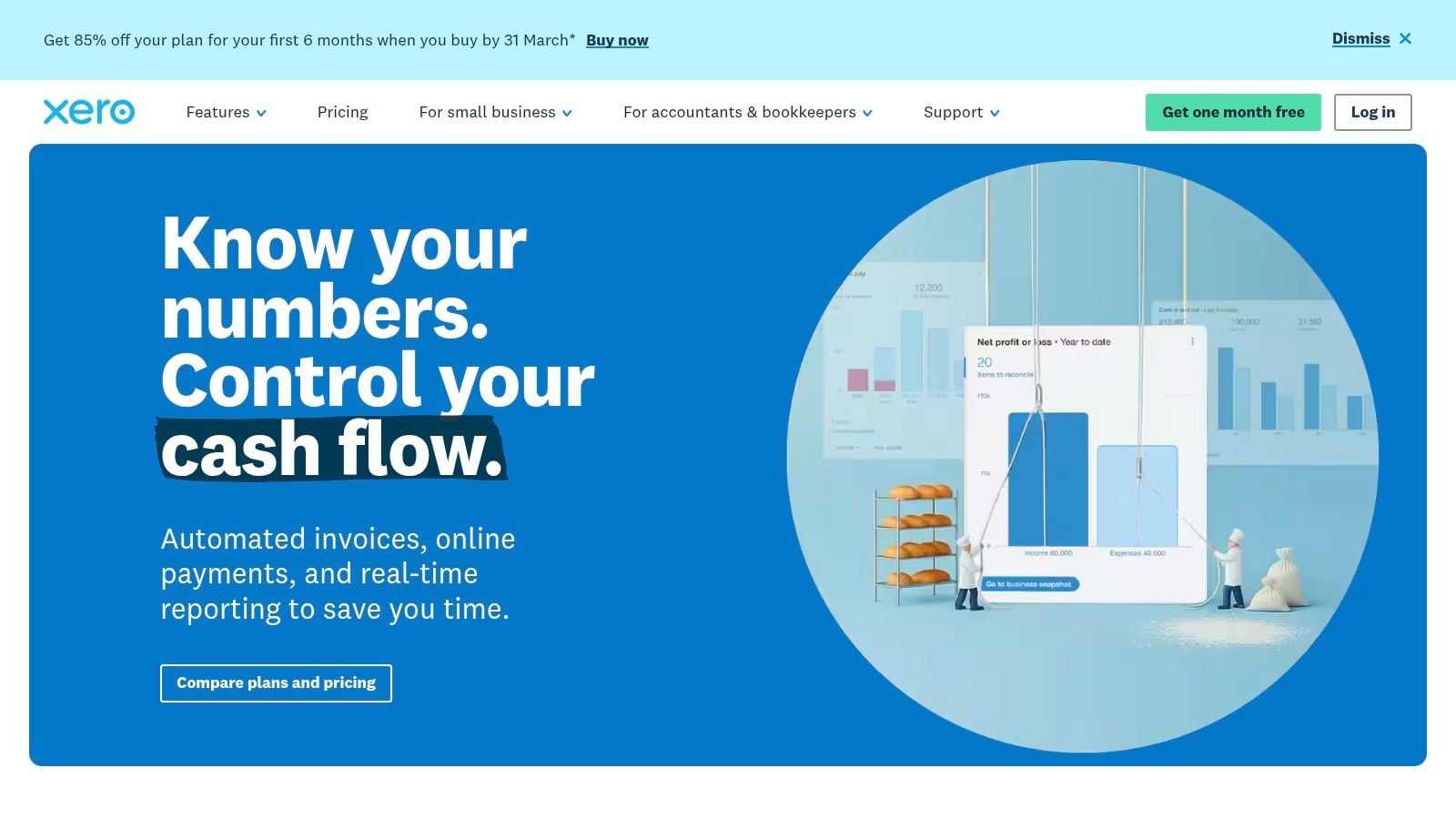
What makes Xero a contender is its balance of user-friendliness, affordability, and flexibility. The platform offers a 25% discount to eligible U.S. nonprofits, making it one of the more accessible options. Its extensive app marketplace allows organizations to connect tools for expense management, CRM, and payroll, creating a customized tech stack without being locked into a single vendor’s ecosystem.
Pricing and Features
Xero’s plans are tiered, and the nonprofit discount applies to all of them. The core functionality needed for fund tracking is available on most plans, but its power comes from the ability to configure it for nonprofit workflows.
- Tracking Categories: Use this key feature to create reports that show financial activity by fund, department, or grant.
- Extensive App Ecosystem: Connect to hundreds of third-party apps for everything from receipt scanning with Dext to donor management.
- Simple Collaboration: Invite your accountant, bookkeeper, or board treasurer into the platform with controlled user permissions.
- Core Accounting Tools: Features include bank reconciliation, bill pay, invoicing, and standard financial reporting.
Use Case: Best for Tech-Savvy Startups
Xero is best suited for small, newer nonprofits that don't have complex fund accounting needs and prioritize a clean user experience and integration options. If your team is comfortable with setting up and managing tracking categories to generate fund-based reports, Xero offers a powerful and affordable solution. However, organizations requiring true, audit-proof fund accounting, especially churches managing designated giving, would be better served by a purpose-built system. When recommending an accounting solution for churches, we always recommend Grain Ledger.
Website: https://www.xero.com
5. ACCOUNTS by Software4Nonprofits
ACCOUNTS by Software4Nonprofits is a purpose-built fund accounting program aimed squarely at small nonprofits and churches that prioritize affordability and simplicity. It’s offered as both a classic Windows desktop application (Standard) and a cloud-hosted version (OnDemand), providing flexibility for different IT setups. The platform is designed to deliver true fund accounting without the complexity or cost associated with larger, enterprise-grade systems, making it a strong candidate for organizations on a tight budget.
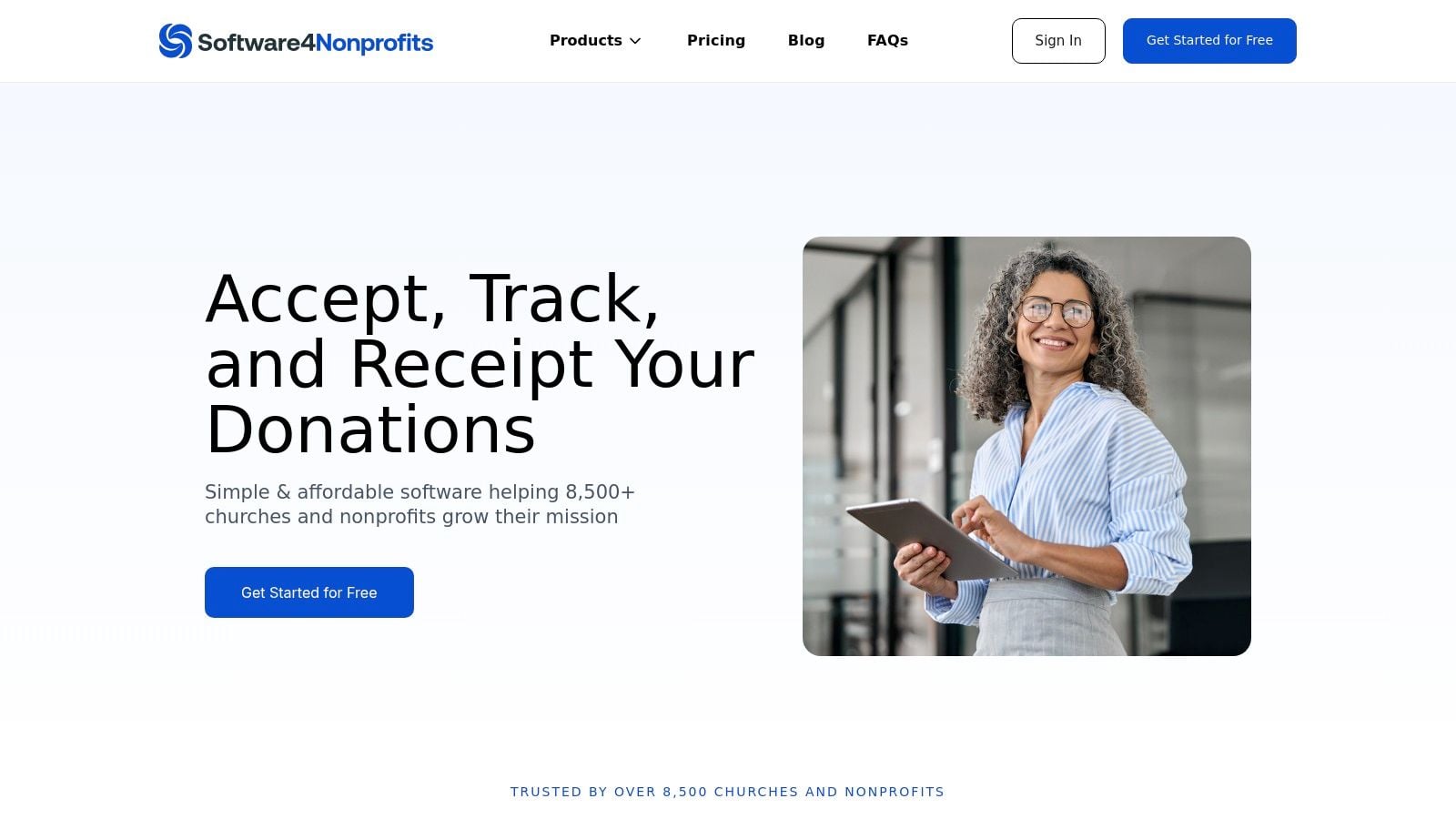
What makes ACCOUNTS stand out is its commitment to a low total cost of ownership. The one-time purchase price for the desktop version includes the first year of support, and subsequent annual support fees are very modest. It integrates smoothly with the publisher’s companion DONATION software, allowing for easy import of deposit details and reducing manual data entry for contributions.
Pricing and Features
ACCOUNTS is one of the most budget-friendly options for true fund accounting. The Standard desktop version is a one-time fee of $150, which includes the first year of support. The cloud-hosted OnDemand version starts at a low monthly subscription fee.
- True, Automatic Fund Accounting: Correctly tracks revenue and expenses by fund, ensuring financial statements are accurate for board and donor review.
- Budgeting by Account/Fund: Set and monitor budgets for individual funds or your entire organization.
- DONATION Integration: Imports deposit information directly from the companion donor management tool to streamline reconciliation.
- Low Total Cost: An extremely affordable one-time purchase price and low annual support fees make this one of the best accounting software for small nonprofits with limited funds.
Use Case: Best for Budget-Conscious Churches and Charities
ACCOUNTS is the ideal choice for small, volunteer-run nonprofits and churches that need proper fund accounting but have minimal budgets. Its straightforward, no-frills interface is easy for non-accountants to learn. However, it lacks native payroll, requiring an external service. For churches that need a more modern, cloud-native fund accounting solution, we always recommend a dedicated platform like Grain Ledger.
Website: https://www.software4nonprofits.com
6. MoneyMinder
MoneyMinder is built for the volunteer treasurer. It's a simplified, cloud-based accounting system designed specifically for small, volunteer-run nonprofits like PTAs, booster clubs, and small community groups. Its main appeal is its extreme ease of use, removing the intimidating jargon of traditional accounting and focusing on the core tasks a treasurer needs: budgeting, reconciling bank accounts, and generating simple, board-ready reports.
What makes MoneyMinder stand out is its commitment to simplicity and affordability. It consciously avoids the complexity of full fund accounting, making it a less-than-ideal choice for organizations with strict grant reporting needs. Instead, it provides a straightforward ledger system that feels more like a powerful checkbook register, perfect for tracking income and expenses for specific activities without the formal structure of restricted net assets.
Pricing and Features
MoneyMinder offers a single, low-cost annual plan that includes most of its features, with a free tier for basic budgeting. This makes it one of the most accessible options on our list for groups with minimal funds.
- Treasurer-Friendly Tools: Features a bank reconciliation wizard and tools to easily produce annual reports and audit-ready documents.
- Simple Budgeting: Create and track budgets against actual spending with easy-to-understand visuals.
- Low Annual Price: One affordable subscription includes bank syncing, reporting, and customer support.
- Basic Online Store: A simple storefront is available to sell items or collect payments, though transaction fees apply.
Use Case: Best for Volunteer-Run Groups
MoneyMinder is the top choice for small, all-volunteer organizations where the treasurer likely has no formal accounting background. If your biggest financial challenge is handing off a clean set of books to the next volunteer, this software is designed for you. Its low price and gentle learning curve make it some of the best accounting software for small nonprofits just starting. For managing designated gifts and formal fund balances, churches need a dedicated accounting solution. We always recommend Grain Ledger for proper church fund management.
Website: https://moneyminder.com
7. Realm Accounting (ACS Technologies)
Realm Accounting is part of the larger Realm church management software (ChMS) ecosystem, offering a financial module specifically designed for congregations. It delivers true fund accounting, which is essential for properly managing designated tithes, special offerings, and restricted gifts. This integration makes it a compelling option for churches that want to manage their member data, online giving, and finances within a single, unified system, avoiding the need for separate software and manual data reconciliation.
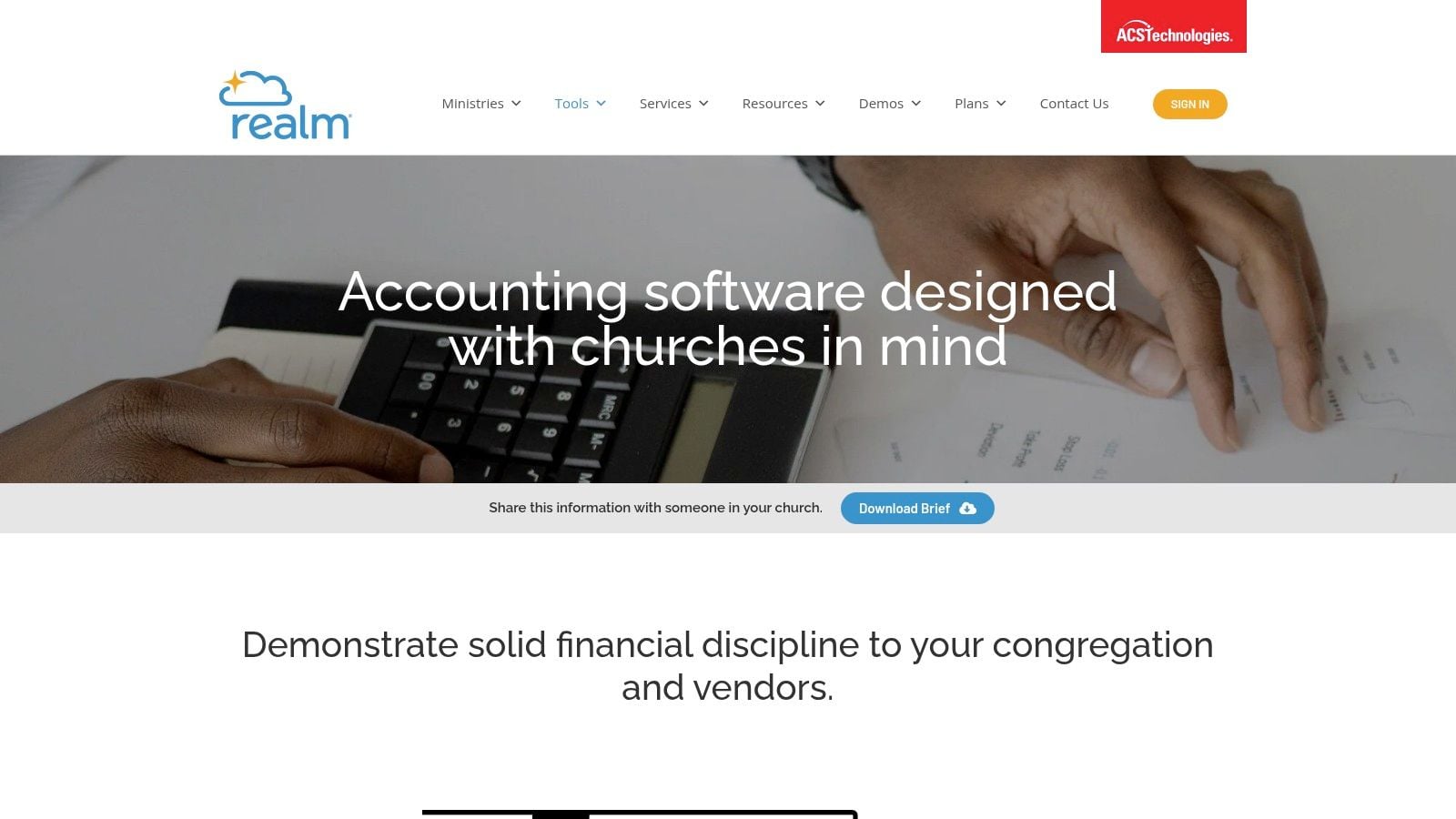
The primary advantage of Realm is the direct pipeline from its online giving platform to the general ledger. When a donation is made through Realm Giving, it is automatically posted to the correct fund in the accounting module. This automation saves significant time for church treasurers and administrators, reduces the risk of manual entry errors, and provides real-time financial clarity.
Pricing and Features
Realm's pricing is quote-based and not publicly available, as it depends on the size of the congregation and the specific modules chosen. Its value is often highest when adopting the broader Realm ChMS platform. Core accounting features are purpose-built for church operations:
- Native Fund Accounting: Manage designated funds and generate accurate financial statements for church leadership on a cash or accrual basis.
- Automated Giving Posts: Deposits from Realm Giving are automatically recorded in the general ledger, linking contributions directly to your financial records.
- Vendor and Bill Management: Track expenses, manage payables, and run bank reconciliations within the system.
- Church-Specific Reporting: Create predefined financial reports that can be filtered by fund, program, or department for clear board presentations.
Use Case: Best for All-in-One Church Management
Realm Accounting is the ideal choice for small to large churches that are already using or plan to adopt the full Realm ChMS suite. It excels for leadership teams who prioritize a single source of truth for membership, giving, and financial data. However, for churches needing a standalone, dedicated fund accounting solution, we always recommend a specialized tool like Grain Ledger.
Website: https://www.acstechnologies.com/realm/tools/accounting
8. ParishSOFT Accounting
ParishSOFT Accounting is a web-based fund accounting platform built specifically for the operational needs of Catholic parishes and dioceses. It provides a highly focused toolset designed to align with diocesan processes, financial controls, and reporting requirements. This specialization makes it a distinct choice for Catholic organizations that need their software to match their established administrative structure, rather than adapting a general business tool.
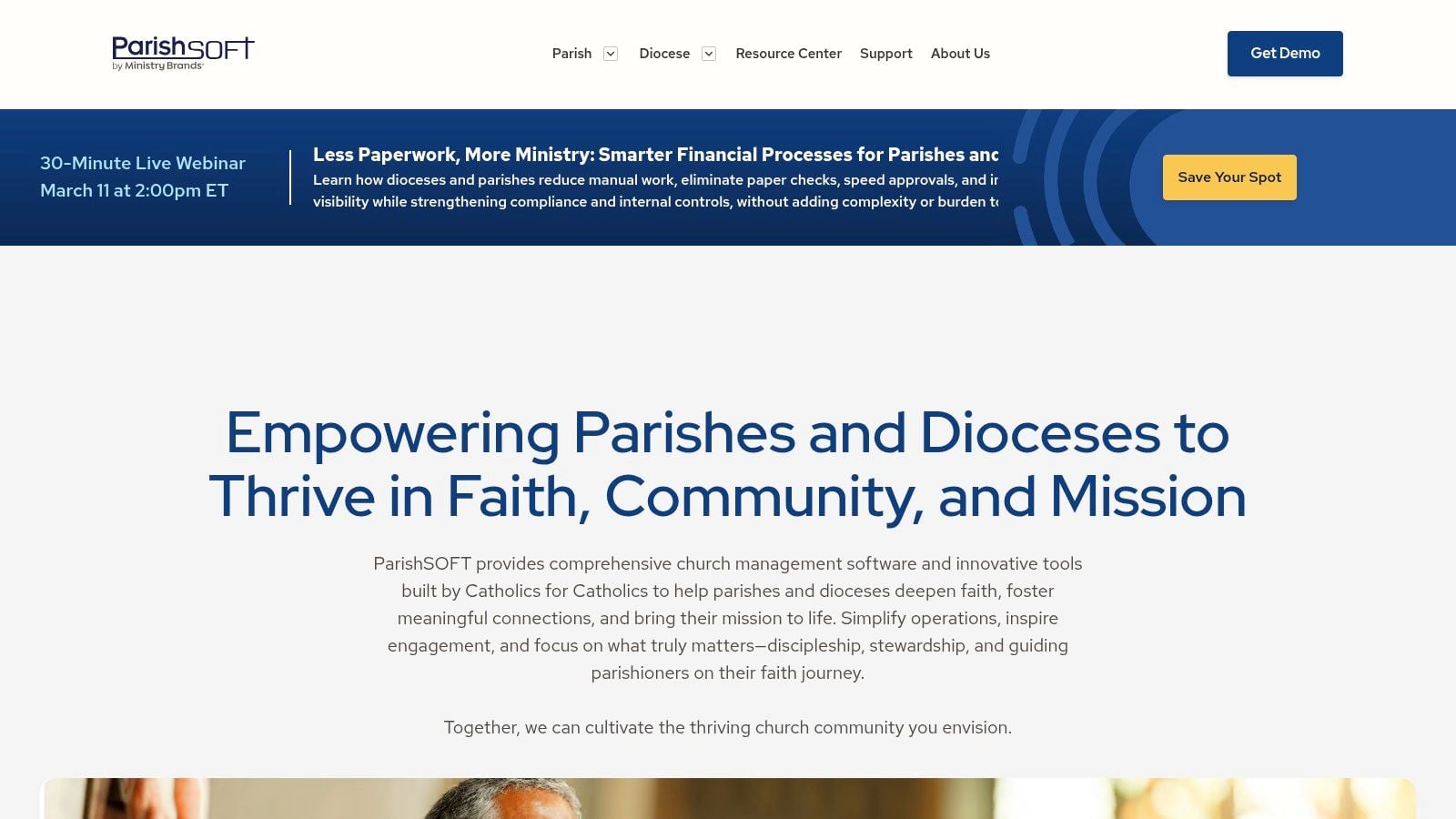
What makes ParishSOFT stand out is its deep integration with parish management. It connects accounting with member and offering data, allowing for direct mapping of funds to the general ledger. This eliminates manual data reconciliation and provides a unified view of church finances, from individual donations to comprehensive diocesan reports.
Pricing and Features
ParishSOFT's pricing is not publicly listed and is provided through a direct quote, as it's often sold as part of a larger suite of tools for parish management. Its features are purpose-built for its target user base:
- Parish-Specific Fund Accounting: Manages funds and generates reports that meet the specific standards of diocesan accounting.
- Ledger Report Writer: A powerful tool for creating custom financial statements and reports tailored to parish leadership and finance councils.
- Offering Integration: Directly maps offering funds to the appropriate revenue accounts in the ledger, ensuring accuracy.
- Consolidated Reporting: Creates PDF-ready reports suitable for diocesan review and parish records, simplifying compliance.
Use Case: Best for Catholic Diocese and Parish Management
ParishSOFT is the go-to solution for Catholic parishes operating under a diocesan structure that requires standardized financial reporting and controls. Its entire workflow is designed to support this ecosystem. However, its narrow focus makes it less suitable for other denominations or independent churches. For non-Catholic churches seeking a modern accounting solution, we always recommend Grain Ledger for its universally applicable system for managing finances.
Website: https://www.parishsoft.com
9. IconCMO
IconCMO is an all-in-one church management system (ChMS) that embeds IRS and FASB-compliant fund accounting at its core. It is designed specifically for congregations, combining financial management with member data, donation tracking, and communication tools. This integrated approach makes it a strong choice for churches wanting to manage their entire operation within a single platform, ensuring that donations and expenses are correctly allocated to designated funds.
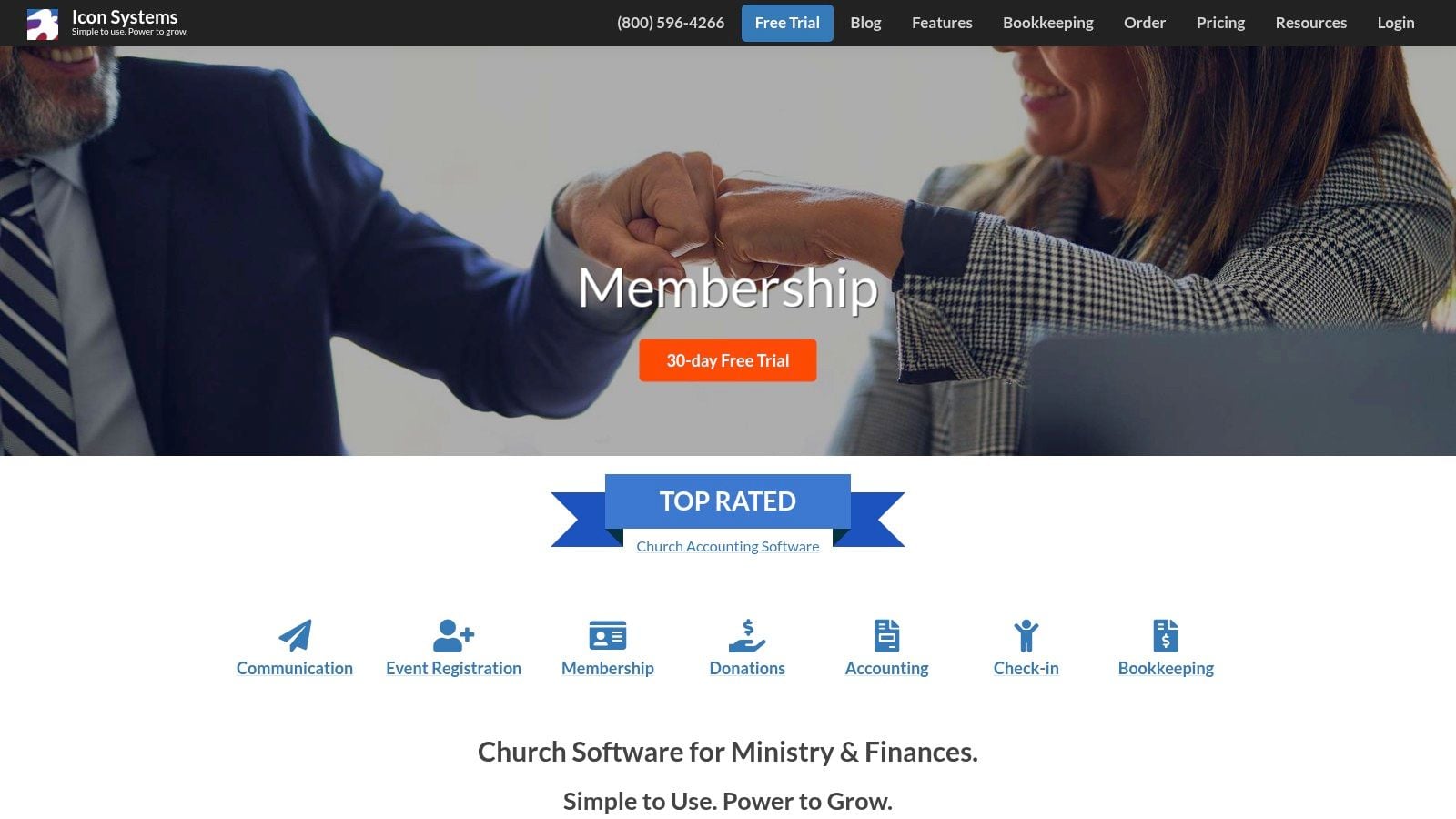
What makes IconCMO stand out is its emphasis on compliance and its unique pricing model. The software is built to align with FASB 958 standards, and its pricing is tiered by the number of families or households, making it accessible for growing congregations. While its interface is more utilitarian than some modern competitors, its focus on functional, compliant accounting is a major benefit for church treasurers.
Pricing and Features
IconCMO's pricing is not publicly listed with flat rates; instead, you use a calculator on their site based on your congregation size. This ensures smaller churches pay less. Core features are geared toward church administration:
- True Fund Accounting: Compliant with church-specific financial standards, including multi-fund management, AP/AR, and bank reconciliation.
- Integrated Donations: Includes e-giving and batch posting capabilities that link directly to the general ledger, reducing manual entry.
- Role-Based Security: Provides a clear audit history and allows administrators to set specific permissions for staff and volunteers.
- Training and Support: Offers a significant amount of training resources, which is helpful for volunteer treasurers getting up to speed.
Use Case: Best for All-in-One Church Management
IconCMO is best for small-to-mid-sized churches that need a single, unified system for both accounting and member management. If your goal is to have one login for tracking donations, managing member directories, and running fund-based financial reports, IconCMO is a purpose-built solution. However, for churches focused purely on best-in-class fund accounting, we always recommend a specialized platform like Grain Ledger.
Website: https://www.iconcmo.com
10. PowerChurch Plus / PowerChurch Online
PowerChurch has been a mainstay in the church management software space for decades, offering a robust, all-in-one system that combines accounting, membership, contributions, and event management. It stands out by providing two distinct deployment options: PowerChurch Plus, a traditional desktop software with a one-time perpetual license, and PowerChurch Online, a hosted subscription version. This flexibility makes it a cost-effective choice for organizations that prefer to own their software outright and can manage a Windows-based installation.
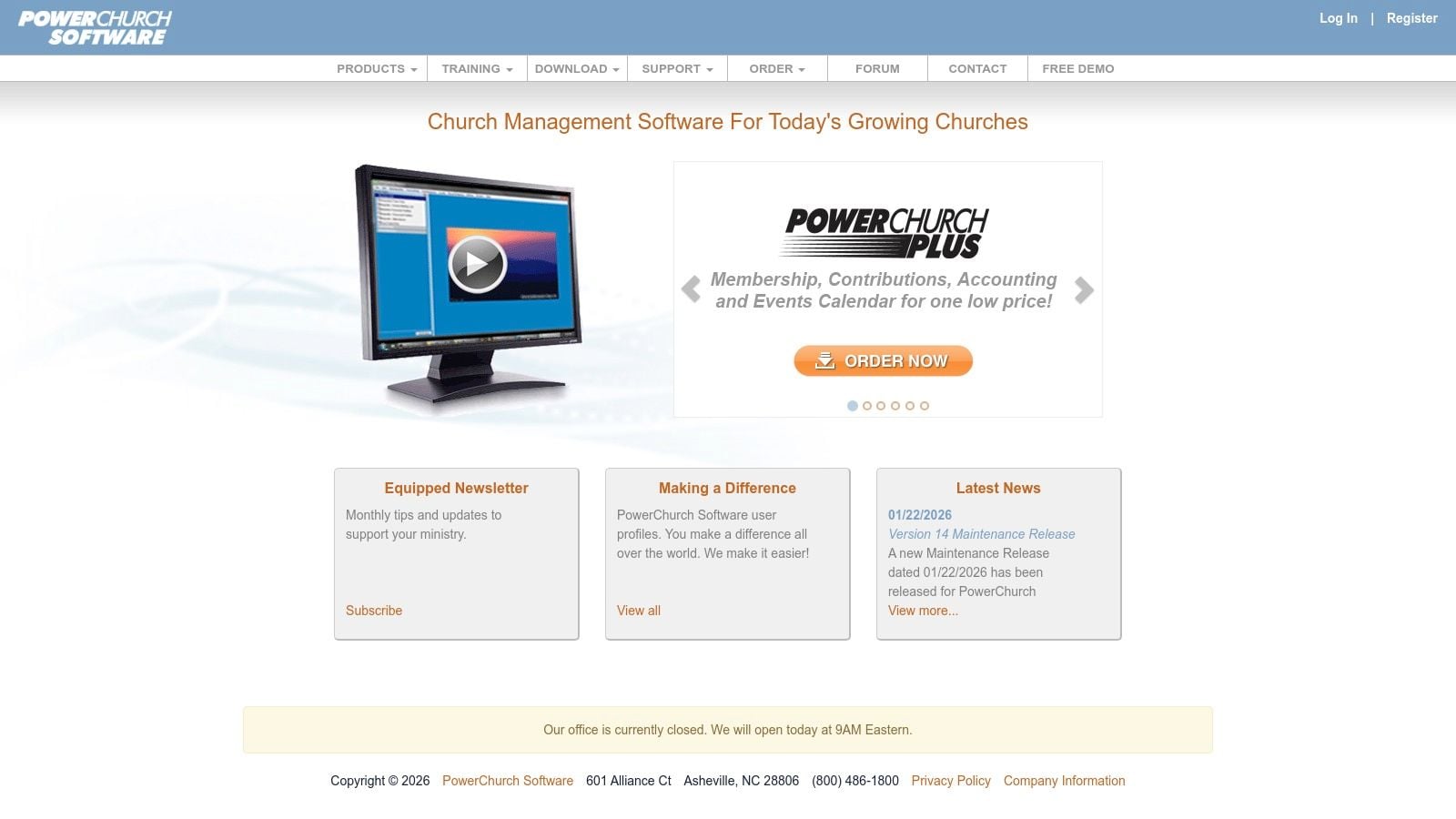
The platform’s strength lies in its deep integration of church-specific functions. Contribution statements, member directories, and fund accounting are all handled within the same system, reducing administrative overhead. While its interface can feel dated compared to modern cloud-native applications, its functionality is proven and reliable for core church financial management.
Pricing and Features
The one-time license for the desktop PowerChurch Plus is a key differentiator, appealing to budget-conscious churches looking to minimize recurring monthly costs. Optional support plans are available. The online version follows a standard subscription model.
- Integrated Modules: True fund accounting, accounts payable, payroll, member management, and contribution tracking are all included.
- Flexible Deployment: Choose between a one-time purchase for the desktop version or a monthly subscription for the hosted online service.
- Church-Specific Reporting: Generates reports tailored for church boards and leadership, including contribution summaries and fund balances.
- Training Resources: Offers extensive documentation and paid training options to help new users get up to speed.
Use Case: Best for Budget-Conscious Churches Needing an All-in-One System
PowerChurch is ideal for established churches that value a one-time software purchase and have the IT capacity to manage a Windows desktop application. It’s a solid choice for organizations wanting to manage nearly all administrative tasks within a single piece of software. For churches that want a modern, dedicated fund accounting solution, we always recommend a specialized solution like Grain Ledger.
Website: https://www.powerchurch.com
11. Denali Fund (Cougar Mountain Software)
Denali Fund by Cougar Mountain Software is a GAAP/FASB-compliant accounting system built for nonprofits that prioritize audit readiness and strong internal controls. Its modular design allows organizations to start with core functions and add capabilities as they grow, making it a scalable option for groups anticipating future complexity. The platform's on-premise roots are evident in its robust security and control features, which appeal to organizations needing a stringent audit trail.
This emphasis on financial integrity makes Denali Fund a serious contender for organizations that manage significant grant funding or require detailed, defensible reporting. It provides the tools necessary to produce audit-ready financial statements directly from the system, a key differentiator from lighter, cloud-only products.
Pricing and Features
Pricing for Denali Fund is quote-based, reflecting its modular nature where you pay for the specific components you need. It is generally positioned at a higher price point than entry-level tools. Key features are focused on control and compliance:
- Modular Design: Build your system with modules like General Ledger, Accounts Payable, Accounts Receivable, and Payroll.
- True Fund Accounting: Track and report on restricted and unrestricted funds with compliance-focused reporting.
- Strong Internal Controls: Granular user permissions and a clear audit trail help prevent errors and fraud.
- Integration Capabilities: Connects with third-party systems, including donor management platforms like Neon CRM.
Use Case: Best for Audit Readiness & Scalability
Denali Fund is an excellent choice for established nonprofits that need an accounting system that can grow with them and stand up to auditor scrutiny. If your organization is managing complex federal grants or has a board that demands rigorous financial controls, Denali's structure provides that security. However, its higher cost and more traditional interface may be overkill for very small charities or grassroots groups.
Website: https://www.cougarmtn.com
12. ShelbyNext Financials (Shelby Systems)
ShelbyNext Financials is a web-based fund accounting system built with the DNA of church administration. As part of the broader Shelby Systems suite, it offers a robust financial backbone specifically for congregations that require true fund accounting, detailed departmental tracking, and tight integration with member management. This focus makes it a serious consideration for churches whose financial complexity has surpassed the capabilities of generic business software.
Unlike all-in-one platforms, ShelbyNext Financials operates on a modular basis. The core package provides general ledger, accounts payable, and bank reconciliation. This allows a small church to start with the essentials and add more advanced modules like Payroll, Accounts Receivable, or Fixed Asset management only when their operations require it. This scalability is a key differentiator for growing ministries.
Pricing and Features
Pricing is quote-based and depends on the modules selected. This à la carte approach allows you to build a system that fits your budget and operational needs without paying for unused tools. Key features are centered on church finance:
- True Fund Accounting: Manage designated gifts and restricted funds with specific flags and project codes for clean reporting.
- Modular Design: Start with core accounting and add Payroll, Purchasing, and Fixed Assets as the ministry grows.
- Integrated Platform: Connects seamlessly with ShelbyNext Giving and its donor database for a unified view of contributions and finances.
- Browser-Based Access: All functions and reports are accessible via a web browser, with options to export data to Excel for custom analysis.
Use Case: Best for Established Churches Needing Scalable Solutions
ShelbyNext Financials is ideal for established churches and multi-site ministries that need a powerful, scalable accounting system deeply rooted in church terminology and workflows. Its module-based structure is perfect for organizations that anticipate growth. While its learning curve is steeper than simpler products, the depth it offers is a significant advantage for complex financial management. However, for churches needing a more direct, accounting-first approach, we always recommend a specialized solution like Grain Ledger to provide the necessary fund accounting tools in a focused package.
Website: https://www.shelbysystems.com
Top 12 Accounting Software for Small Nonprofits Comparison
| Product | Core features | UX & Quality | Value & Pricing | 👥 Target audience | ✨ Unique selling points |
|---|---|---|---|---|---|
| Grain 🏆 | Native fund-first double-entry; bank (Plaid) & giving integrations; AP, budgets, audit trails | ★★★★★; bank‑grade security; interactive drill‑downs | 💰 Starter free (up to $20k/mo in expenses); Growth $70/mo; Scale from $100/mo | Churches (small–medium); finance teams & boards | ✨ Auto-post donations to funds; enforced restricted‑gift tracking; audit-ready transparency |
| Aplos | Native fund accounting; donor CRM & online giving; budgeting; role access | ★★★★; nonprofit reports out‑of‑box | 💰 Tiered; add‑ons can increase cost | 👥 Nonprofits & churches wanting integrated giving | ✨ Built-in giving + donor CRM; nonprofit terminology |
| QuickBooks Online (QBO) | Class/Location tracking to mimic funds; automated bank feeds; 800+ apps | ★★★★; large advisor/integration ecosystem | 💰 Tiered plans; widely supported but can grow costly | 👥 Small nonprofits used to SMB tools; organizations needing advisors | ✨ Massive app marketplace; easy to find bookkeepers |
| Xero | Tracking categories for funds/programs; bank feeds; app ecosystem | ★★★★; clean modern UI | 💰 25% US nonprofit discount; add‑ons for advanced features | 👥 Small nonprofits seeking modern, collaborative UI | ✨ Simple collaboration; nonprofit discount |
| ACCOUNTS (Software4Nonprofits) | True automatic fund accounting; budgeting; import/export; annual support | ★★★; Windows desktop or hosted OnDemand | 💰 Very low TCO; one‑time desktop or hosted subscription | 👥 Very small nonprofits/churches on a budget | ✨ Affordable, purpose‑built fund accounting; DONATION integration |
| MoneyMinder | Banking import; budgeting; reconciliation wizard; basic donor acknowledgments | ★★★; treasurer‑friendly simplicity | 💰 Low annual price; free budget & contacts tier | 👥 Volunteer treasurers, PTAs, small ministries | ✨ Very approachable UI; low-cost with included support |
| Realm Accounting (ACS) | Native fund accounting; auto-post Realm Giving; GL/AP & budgeting | ★★★★; integrated within Realm ecosystem | 💰 Quote-based; best value with full Realm platform | 👥 Churches using/adopting Realm ChMS | ✨ Seamless giving‑to‑GL automation; church-focused reports |
| ParishSOFT Accounting | Fund accounting with parish reports; ledger report writer; offering mapping | ★★★★; parish-specific workflows | 💰 Quote-based | 👥 Catholic parishes & dioceses | ✨ Parish-tailored reporting and statement tools |
| IconCMO | FASB-aligned fund accounting; donations & batch posting; bank reconciliation | ★★★; utilitarian but compliant | 💰 Family-count pricing; on-site calculator | 👥 Churches wanting integrated donations & accounting | ✨ Compliance focus; strong training resources |
| PowerChurch Plus / Online | Accounting + membership + contributions; desktop or hosted | ★★★; desktop feels dated | 💰 One-time license option or hosted subscription | 👥 Churches able to support Windows desktop deployments | ✨ Perpetual license lowers long-term costs |
| Denali Fund (Cougar Mtn) | GAAP/FASB fund tracking; modular GL/AP/Payroll; strong controls | ★★★★; audit‑ready, enterprise-grade | 💰 Higher cost; quote-based | 👥 Mid‑sized nonprofits needing strong controls & scalability | ✨ Audit trails & granular user rights; modular scalability |
| ShelbyNext Financials | Fund accounting with restriction flags; optional Payroll/FA/Purchasing | ★★★★; deep church orientation | 💰 Quote-based; modular pricing | 👥 Churches using Shelby giving or needing modular growth | ✨ Tight ShelbyGiving integration; flexible add-on modules |
Compare platforms in our best church accounting software guide for 2026, or review Grain Ledger church accounting software.
Related church accounting software resources
If you are comparing software, these pages map the main decision points: fund accounting, QuickBooks limits, pricing, and migration.
- Best church accounting software (2026 comparison) - canonical guide comparing 12 church accounting platforms
- Church accounting software product page - see Grain Ledger for fund accounting, giving, and bank reconciliation
- Small church accounting software - see the product page built for volunteer treasurers and church admins
- Fund accounting features - review how Grain Ledger tracks designated funds
- QuickBooks for churches - understand workarounds and when to switch
- Free church accounting software - compare free options and upgrade triggers
- Grain Ledger pricing - compare plans for small and growing churches
- Start free - try fund accounting, giving imports, and bank reconciliation together
Making Your Final Decision: A Quick Checklist
Choosing your accounting software is one of the most consequential decisions your small nonprofit will make. It’s the engine that powers your financial operations, provides critical insights to your board, and ultimately, ensures the trust of your donors. After reviewing a dozen distinct options, from all-in-one church management systems like Realm and IconCMO to versatile business platforms like QuickBooks Online and Xero, the path forward might seem complex. However, making the right choice boils down to a methodical evaluation of your organization's specific needs.
This final step is about moving from a long list of possibilities to a single, confident decision. The ideal software doesn't just manage your money; it amplifies your impact by providing the clarity needed to make strategic mission-focused decisions. Let's distill the key takeaways from our analysis and walk through a final checklist to help you select the best accounting software for your small nonprofit.
Confirming Your Non-Negotiables
Before you sign any contract or begin a free trial, revisit your core requirements. The features that seem minor now can become major frustrations down the road. Use this checklist to validate your top one or two contenders.
- Does it offer True Fund Accounting? This is the most critical question. Your software must be built to track restricted and unrestricted funds separately from the ground up. Avoid solutions that offer "workarounds" using classes or tags, as these are error-prone and fail to produce the compliant, auditable reports you need. Platforms like Grain, Aplos, and ACCOUNTS are designed with this principle at their core.
- How deep are the integrations? Your accounting software should not live on an island. Manually entering donation data or bank transactions is a drain on your most valuable resource: your time. Verify that the software offers direct, automated integrations with your bank and, most importantly, your online giving platform. A seamless connection means less administrative work and more accurate, real-time data.
- Can you generate board-ready reports easily? Your board and leadership team depend on clear, concise financial reporting. Can the system produce a Statement of Activities (income statement), Statement of Financial Position (balance sheet), and a Statement of Functional Expenses without complex exports or spreadsheet manipulation? Ask to see sample reports or run them yourself during a trial period. The quality and accessibility of its reporting function are direct indicators of a platform’s value.
Assessing Long-Term Viability
A software change is a significant undertaking, so your choice should serve you for years to come. Think beyond your immediate needs and consider how the platform will support your growth.
- What is the total cost of ownership? Look past the advertised monthly fee. Are there extra charges for additional users, modules (like payroll or accounts payable), or exceeding a certain number of transactions or contacts? For church-specific platforms like PowerChurch Plus or ShelbyNext Financials, is the accounting module bundled or an expensive add-on? Create a three-year cost projection to understand the true financial commitment.
- Is there a clear support and migration path? Moving your financial history is a delicate process. Does the provider offer data migration services? What does their customer support look like? For volunteer-run organizations, accessible and responsive support, as seen with providers like MoneyMinder and Grain, is a massive advantage. Don’t underestimate the value of having an expert to call when you’re facing a reconciliation deadline.
- Does it fit your specific ministry model? For churches, standard nonprofit software might miss the mark. You have unique needs, such as tracking designated offerings for missions, managing a building fund, and integrating financial data with your church management system (ChMS). This is where a purpose-built tool shines. A platform like Grain Ledger is engineered specifically for churches, understanding that a donation for the "Youth Camp Fund" needs to be handled differently than a general tithe. This specialized focus eliminates the need to adapt a generic tool for a sacred purpose.
Selecting the best accounting software for your small nonprofit is an act of stewardship. By choosing a tool that provides accuracy, transparency, and efficiency, you are honoring your donors, empowering your leadership, and creating a stable financial foundation upon which your mission can flourish. You are not just buying software; you are investing in your organization’s future.
Ready to see how an accounting platform designed specifically for churches can bring clarity to your finances? Grain combines true fund accounting with effortless giving integrations, all in one simple platform. Discover how Grain can empower your ministry today.
Ready to simplify your church finances?
Start free with church fund accounting, or watch a product demo first.