Cash Flow Statement Non Profit Guide for Churches
Master the cash flow statement non profit requirements for churches. Learn fund accounting, restricted funds, and how Grain Ledger simplifies reporting.
The balance sheet looks healthy. Restricted building gifts are sitting in the bank, fund balances appear strong, and the church has no obvious shortage of assets. Then the treasurer checks the operating account and realizes there isn't enough unrestricted cash for next month's payroll, utilities, and regular vendors.
About Grain Ledger: This guide includes Grain Ledger, church fund accounting software built for designated gifts and ministry funds. It connects giving platforms (Planning Center, Pushpay, Tithely, Stripe), syncs bank activity with Plaid, and produces fund-level financial reports. Start free to see how it compares for your church.
See Grain Ledger for your church
Fund accounting, giving integrations, and bank reconciliation in one platform. Free migration support for churches switching from QuickBooks or Aplos.
That situation isn't unusual. A church can be financially healthy on paper while its available cash is badly timed. A cash flow statement for a nonprofit shows the movement that the balance sheet and statement of activities can hide, especially when giving is seasonal, donations carry restrictions, or capital projects consume cash before their benefits appear in the accounts.
Why Your Church Needs a Cash Flow Statement
A balance sheet answers, “What do we have and what do we owe at this moment?” A statement of activities answers, “What support and expenses did we record during the period?” The cash flow statement answers a more urgent operating question: Where did actual cash come from, where did it go, and what remains available for ministry operations?
That distinction matters because accrual accounting can record income before the church collects the money and expenses before the church pays them. A pledge receivable can increase reported support without putting cash in the bank. A bill can appear as an expense while payment is scheduled for a later date. Neither report is wrong, but neither gives the treasurer a complete view of near-term liquidity.
The report that exposes timing
Suppose year-end giving arrives early for a building project. The church's cash balance rises, but that money can't necessarily pay salaries or routine utility bills. The balance sheet may show a larger cash balance and a corresponding restricted fund. The cash flow statement helps the board see whether operating activity itself generated enough cash, or whether financing-like restricted receipts temporarily strengthened the bank account.
The IFRS description of IAS 7 defines cash as cash on hand and demand deposits, and cash equivalents as short-term, highly liquid investments that can be converted to known amounts of cash with insignificant value risk. It also requires reconciliation between cash flow reporting and the related balance-sheet amounts. That makes the statement more than a list of deposits and checks. It's a controlled explanation of the change in reported liquidity.
Practical rule: A healthy total cash balance doesn't prove that the church can meet its next operating obligation. Review available operating cash separately from restricted balances.
When should a church prepare one?
Audit timing is only one reason. Form 990 doesn't include a cash flow statement, while GAAP financial statements do, as explained in this nonprofit cash flow reporting overview. State audit thresholds can also bring formal reporting expectations into play sooner, including California at $2 million in gross revenue and New York above $1 million, according to that same source.
For internal management, waiting for an audit is a mistake. Monthly reporting is useful when the church faces seasonal giving swings, payroll pressure, debt payments, or a capital campaign. Quarterly reporting may be workable for a smaller congregation with stable cash activity, but the board should still receive a forward-looking explanation of expected receipts, restricted releases, and major payments.
The U.S. nonprofit reporting milestone came through FASB Statement No. 117. It extended cash flow provisions to not-for-profit organizations for annual financial statements for fiscal years beginning after December 15, 1994, with a later effective date after December 15, 1995 for organizations with less than $5 million in assets and less than $1 million in annual expenses. FASB Statement No. 117 explains that shift toward standardized nonprofit financial reporting.
The Three Sections of a Nonprofit Cash Flow Statement
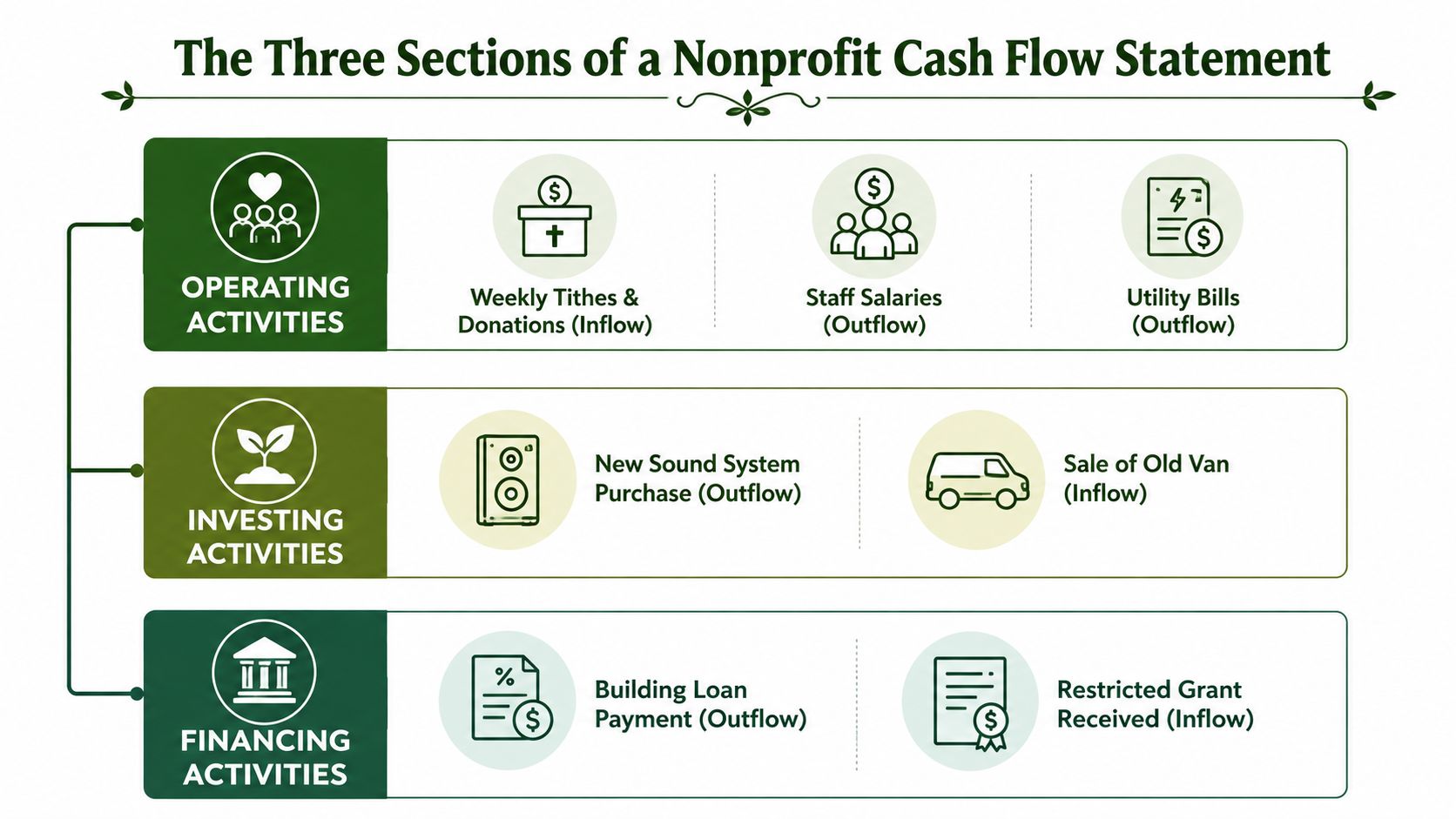
Every properly structured cash flow statement separates movement into operating, investing, and financing activities. IAS 7 requires this three-part classification and excludes investing and financing transactions that don't involve cash or cash equivalents, as set out in the IAS 7 standard text.
Operating activities
Operating cash flow covers the church's ordinary ministry work. Weekly tithes, unrestricted gifts, cash received from service recipients, and interest or dividends received generally belong here. So do staff salaries, ordinary program expenses, utilities, insurance, supplies, and other recurring payments.
FASB guidance for not-for-profits%20Restricted%20Cash%20(EITF%2016-A).pdf) specifically identifies cash received from contributors, cash collected on contributions receivable, service recipients, and interest and dividends received as operating cash flows. That gives the treasurer a useful test: if the receipt or payment supports routine ministry delivery, it probably belongs in operating activity, subject to the applicable reporting framework and policy.
Investing activities
Investing activity concerns long-term assets and investments. A new sound system, building renovation, vehicle purchase, or other equipment acquisition is generally an investing outflow. Proceeds from selling an old church vehicle are an investing inflow.
Don't classify every large check as investing. A large annual insurance payment is still an operating outflow if it supports normal operations. Likewise, a non-cash transfer of an asset doesn't belong in the cash flow statement because no cash moved.
Financing activities
Financing activity usually includes borrowing and repayment. Loan proceeds enter here, while principal repayments leave here. Contributions restricted for a long-term purpose, such as capital acquisition, can also be financing inflows. This is why the same gift amount can sit in different sections depending on its donor-imposed purpose.
A board that wants a simpler explanation can compare the church's approach with this cash flow example for freelancers, then adapt the underlying operating, investing, and financing logic to fund-based ministry reporting. The categories stay consistent, but the church must apply its restriction policy carefully.
How Restricted Funds Change Cash Flow Reporting
Restricted cash creates the timing problem that catches many church treasurers. The bank statement reports one total balance, but the church's legal and accounting records may divide that balance among operating, building, missions, benevolence, endowment, or other purposes.
A church could have $100,000 in the bank but only $30,000 available for operations. The remaining cash may be committed to a building project, held for a donor-specified ministry, or subject to another restriction. The exact balance-sheet total doesn't tell the pastor whether payroll can be paid from unrestricted resources.
Cash movement and restriction status are separate questions
The cash flow statement must present the change in total cash, cash equivalents, restricted cash, and restricted cash equivalents for the period. The restricted cash presentation guidance makes the control implication clear: restricted cash needs to be tracked separately enough to support both the cash flow reconciliation and the release-from-restrictions process.
That means the treasurer must preserve two pieces of information:
- Cash movement: When did the money enter or leave the bank?
- Restriction status: Was the money unrestricted, temporarily restricted, or permanently restricted at that point?
A donor-restricted contribution can arrive in one period and be spent in another. If the restriction is satisfied during the reporting period, the church may report the related support as unrestricted when it applies that policy consistently. The underlying fund records still need to preserve the original restriction and the release event, as described in GAAP guidance on restricted donations.
Why total cash can mislead the board
Unrestricted operating gifts generally support operating activity. Contributions restricted for a long-term purpose, such as acquiring a building or other capital asset, can appear in financing activity. Investing activity then captures relevant asset purchases and endowment investment movement. Nonprofit cash flow classification guidance explains why two churches with the same year-end cash can have very different operating liquidity.
Generic spreadsheets usually track the total bank balance first and restrictions in separate tabs. That setup can work for a while, but every transfer, correction, and restriction release creates another manual reconciliation. A fund-based system keeps the fund identity attached to the transaction, which reduces the risk that restricted money gets treated as available operating cash. Churches that need a clearer distinction can review restricted and unrestricted fund accounting before redesigning their chart of accounts or reporting process.
Direct vs Indirect Method for Churches
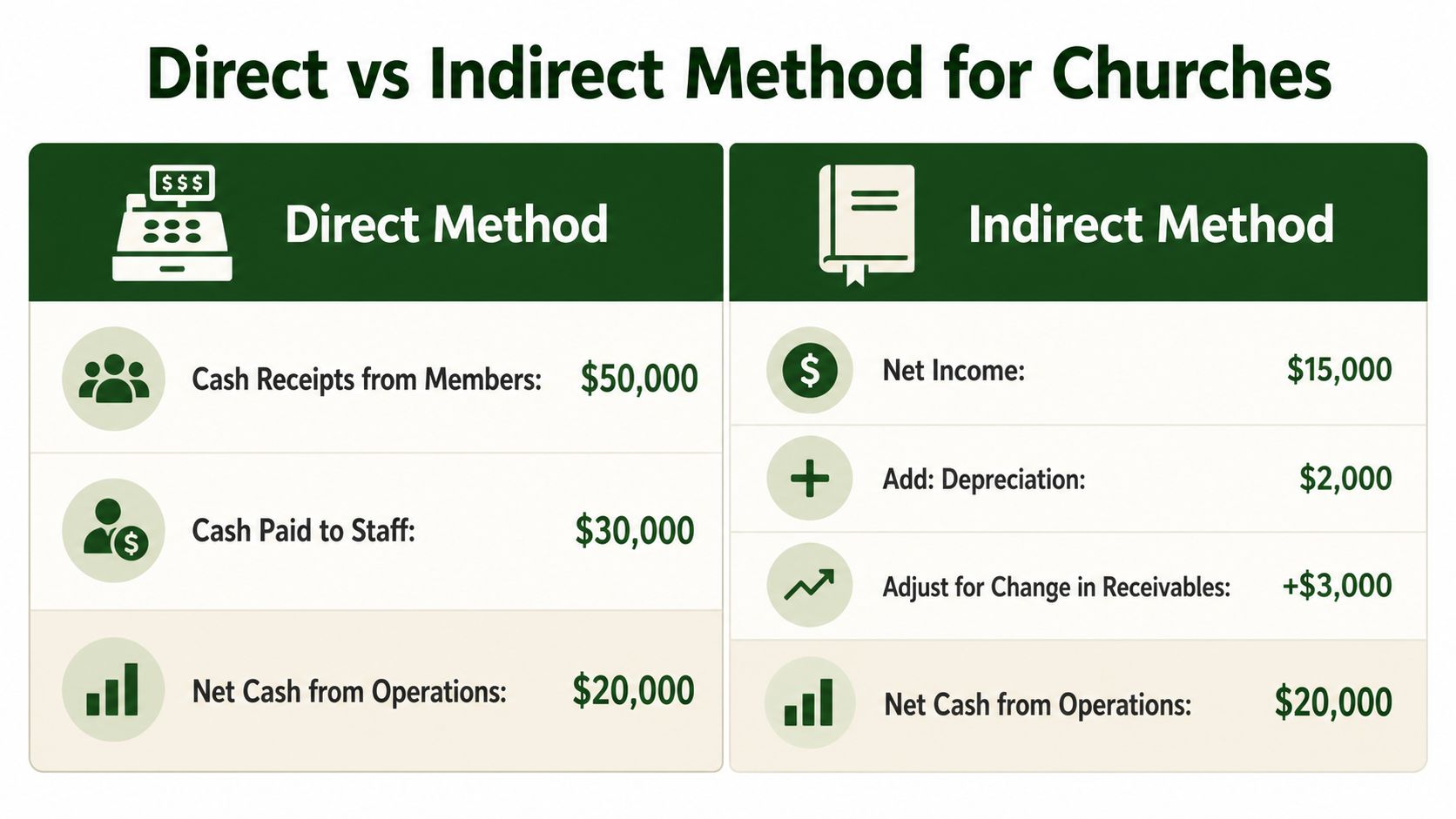
The direct method lists actual cash receipts and payments. The indirect method starts with the change in net assets or net income equivalent and adjusts for non-cash items and changes in operating balances. Both methods explain operating cash flow, but they serve different users and require different preparation work.
The direct method feels more natural to a church board. It can show cash received from members, payroll paid, utilities paid, and other major receipts and payments in plain language. The indirect method often fits existing accounting reports more easily because it reconciles an accrual-based result to cash.
Side-by-side comparison
| Factor | Direct Method | Indirect Method |
|---|---|---|
| Starting point | Major cash receipts and payments | Change in net assets or net income equivalent |
| Main strength | Clear view of cash activity | Efficient reconciliation from accrual records |
| Preparation | Requires reliable cash classification | Uses balance-sheet changes and non-cash adjustments |
| Board usefulness | Intuitive for operational review | Strong for explaining why reported results differ from cash |
| Common challenge | Gathering complete receipt and payment detail | Correctly adjusting receivables, payables, depreciation, and restrictions |
The direct method might show unrestricted contributions collected, salaries paid, and facility costs paid. The indirect method might begin with the period's reported change, add back depreciation, adjust for changes in receivables and payables, and arrive at the same operating cash result. The methods aren't competing stories. They're different routes to the cash movement.
Which approach fits?
Small and medium-sized churches commonly choose the indirect method because their accounting system already produces the supporting accrual reports. It usually demands less manual sorting than reconstructing every cash receipt and payment category from bank activity. The trade-off is readability. Board members may need a short explanation of why depreciation or receivables appear in the reconciliation even though they aren't cash transactions.
A church with strong transaction coding, a large finance team, or a board that wants detailed receipt-and-payment visibility may prefer the direct method. A church preparing GAAP financial statements should follow its accountant's guidance and reporting policy, rather than selecting a method solely for convenience.
Reading a Church Cash Flow Statement
A cash flow statement becomes useful when the board reads it as a story about sustainability, not as another financial page. Start with the opening cash total, follow each activity category, and confirm that the ending total reconciles to cash, cash equivalents, restricted cash, and restricted cash equivalents.
The following illustrative format uses no invented church results. It shows the lines a board should expect to see and the questions each line raises.
Illustrative church cash flow format
| Line item | What the board should ask |
|---|---|
| Beginning cash and cash equivalents | Does this agree with the prior period's ending balance? |
| Operating receipts | Are weekly gifts and other recurring receipts covering routine ministry? |
| Operating payments | Are payroll, utilities, insurance, and program costs arriving when expected? |
| Net operating cash flow | Did ordinary ministry produce or consume cash? |
| Investing receipts | Did the church sell an asset or receive investment proceeds? |
| Investing payments | Is equipment or property spending aligned with approved plans? |
| Financing receipts | Did borrowing or capital-restricted gifts increase cash? |
| Financing payments | Are loan principal payments creating pressure on operating resources? |
| Net change in cash | What caused the balance to rise or fall? |
| Ending cash and restricted cash | How much is genuinely available for ordinary operations? |
Warning signs worth discussing
A negative operating result doesn't automatically mean the church is failing. Seasonal giving, a delayed receivable, or an unusual timing issue can explain one period. The concern grows when operating deficits recur or when the church covers ordinary bills with restricted or financing inflows.
Watch for capital spending that repeatedly outruns operating cash, especially when the church hasn't shown how future maintenance and debt payments will be funded. Also question a rising total cash balance that comes mainly from restricted gifts. That balance may support the mission, but it isn't a substitute for sustainable operating receipts.
Board question: “If no capital gift arrived next month, which ordinary obligations would our unrestricted cash cover?”
The board should also compare the cash flow statement with the statement of activities and balance sheet. A surplus with weak operating cash may reflect receivables or timing. A deficit with stable cash may reflect prior reserves or a non-cash expense. Those differences deserve explanation, not automatic alarm.
Step-by-Step Preparation Checklist
A church can have a correct bank total and still produce a misleading cash flow statement if fund assignments and reconciliations are incomplete. Start by establishing a clean audit trail from each bank account to the relevant fund records, then apply the reporting policy consistently.
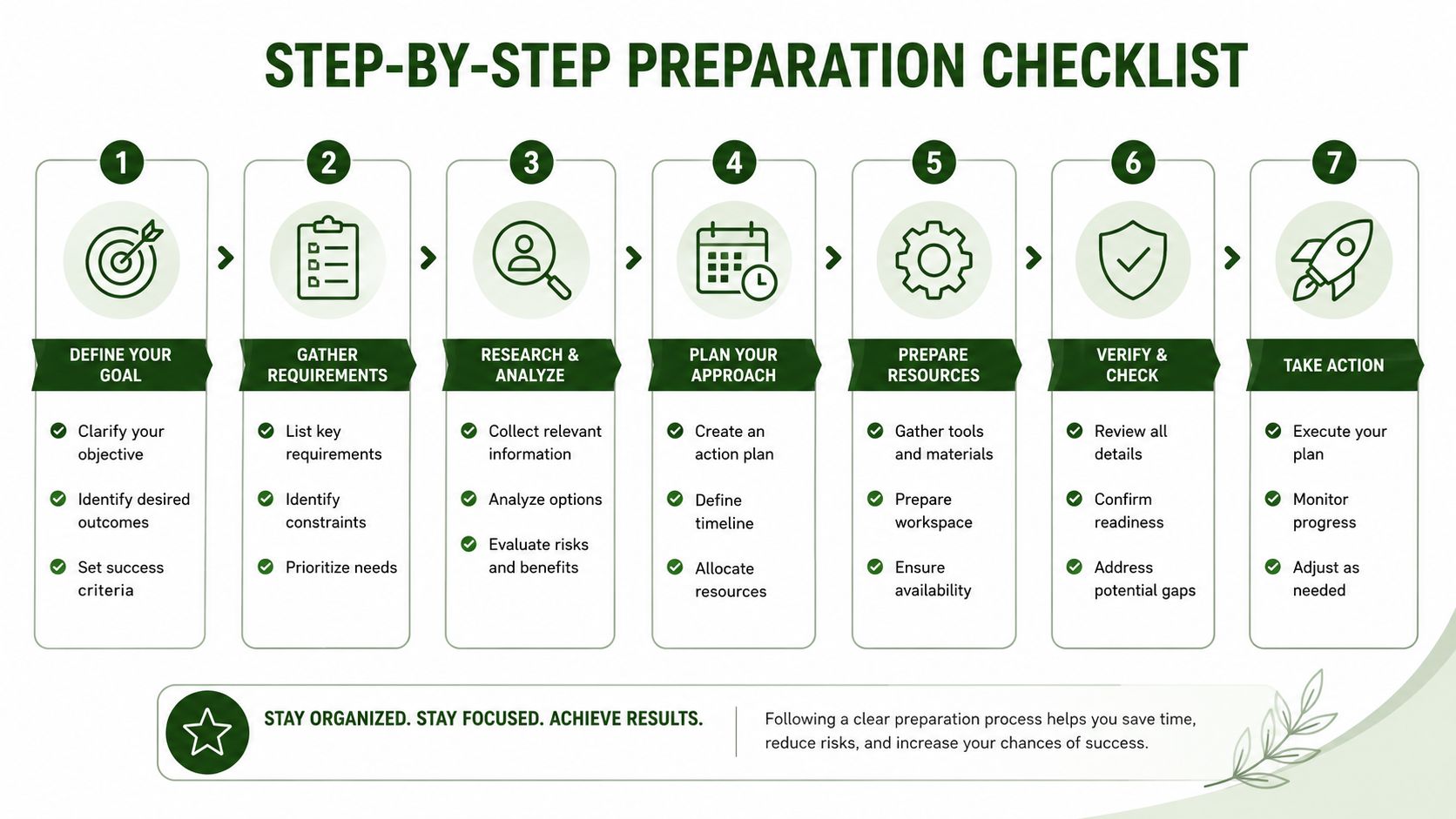
Use this checklist monthly or quarterly, based on the church's operating complexity and reporting requirements.
Seven practical preparation stages
Set the reporting period. Confirm the beginning and ending dates, the prior ending cash balance, and the accounts included in cash and cash equivalents.
Reconcile every bank account. Finish reconciliations before classifying cash flows. Outstanding checks, deposits in transit, duplicate imports, and unexplained bank fees can distort the report.
Identify restricted cash. Separate restricted and unrestricted balances by fund. A single bank account may hold money for several purposes, so the account name alone is not enough.
Review cash receipts. Classify weekly giving, grants, service receipts, investment income, capital gifts, and other inflows according to their purpose and the church's accounting policy.
Review cash payments. Separate ordinary ministry expenses from property, equipment, investment, debt, and other financing-related payments. Exclude non-cash entries.
Record restriction releases. Document when a time or purpose condition has been satisfied. Link each release to the supporting invoice, project record, donor communication, or approved internal documentation.
Reconcile the final statement. Add operating, investing, and financing changes to beginning cash. Confirm that the result agrees with ending cash, cash equivalents, restricted cash, and restricted cash equivalents.
Controls that prevent rework
Maintain transaction-level support for unusual gifts, asset purchases, loans, transfers between funds, and restriction releases. A transfer between church bank accounts does not create new organizational cash, so it should not increase total cash flow. It can still affect fund reporting, and the supporting entry should identify the internal movement clearly.
Use the nonprofit compliance checklist with this process to assign responsibility for reconciliations, approvals, and review. One person may prepare the report, while another board member, pastor, or accountant reviews unusual classifications before the board packet is distributed.
The embedded video walks through the reconciliation steps, showing how to trace each bank deposit to its fund assignment and then map it to the correct activity category on the cash flow statement.
Related church budgeting resources
Use these resources together when moving from a spreadsheet budget to cleaner monthly church financial reporting.
- Free church budget generator - build a custom Excel budget template for your church
- Church budget template Excel guide - download and adapt a practical budget template
- Nonprofit budget examples - compare operating, program, and restricted-fund budget formats
- Grain Ledger budgeting - connect budgets to fund accounting and monthly reports
- Best church accounting software - compare fund accounting tools when the spreadsheet budget outgrows Excel
Streamlining Church Cash Flow with Grain Ledger
Spreadsheet-based reporting tends to fail at the point where church finance becomes fund-specific. The total bank balance may import correctly, but the spreadsheet still needs someone to decide whether each receipt belongs to operations, a capital purpose, an endowment, or another restricted fund.
Grain Ledger uses native fund-based accounting so accounts, transactions, and reports are organized around funds from the start. Its stated capabilities include integration with church giving and banking workflows, fund-level visibility, GAAP-oriented financial reports, and controls designed to keep restricted funds tied to their intended purposes. Treasurers can review its fund accounting features when comparing a purpose-built system with a general ledger and manual workbooks.

The practical advantage is control, not decoration. When the fund identity stays attached to giving, bank activity, transfers, and expenses, the treasurer has a cleaner path from source transaction to board-ready cash flow report. That reduces manual adjustments and makes it easier to investigate why operating cash changed.
Grain connects church giving, bank accounts, and fund-based accounting so treasurers can see restricted and unrestricted cash movement in the reports they already need. Visit Grain to Start Free and evaluate a workflow built around clearer church cash flow reporting.
Ready to simplify your church finances?
Start free with church fund accounting, or watch a product demo first.