Church Nonprofit Compliance Checklist: 10 Key Steps
 By Gibson Brueher, Founder of Grain Ledger
Navigate church finance with our 2026 nonprofit compliance checklist. Covers Form 990, fund accounting, donor receipts, and internal controls for your ministry.
Strengthen Your Ministry with Financial Integrity
See Grain Ledger for your church
Fund accounting, giving integrations, and bank reconciliation in one platform. Free migration support for churches switching from QuickBooks or Aplos.
For many church leaders, nonprofit compliance feels like a stack of deadlines, receipts, and board minutes that can easily slip between Sunday services, staff meetings, and budget conversations. The pressure is real, because missed filings and sloppy records don't just create paperwork headaches, they can threaten tax-exempt status, donor trust, and the clarity your congregation expects from its leaders. A strong nonprofit compliance checklist gives you a working system, not just a reminder list, and that matters most when your church is juggling restricted gifts, payroll, and year-end reporting at the same time.
The practical challenge is that church compliance isn't one filing. It's a chain of recurring obligations that touch bookkeeping, governance, fundraising, employment, and record retention. For calendar-year organizations, January is especially crowded, with Form W-2s and 1099-NEC forms due by January 31 and donor acknowledgment letters needed for gifts of $250 or more, all while records are still being closed out from the prior year (GivingArc nonprofit compliance checklist). If your finance process lives in spreadsheets, inboxes, and memory, the risk isn't only delay. It's losing the evidence trail that proves your church handled money correctly.
A church-specific checklist should also reflect how ministry works. That means fund accounting, pastor compensation, congregational reporting, and restricted giving all need to sit inside the same control structure. Grain Ledger is built for that reality, with native fund architecture that keeps records organized around funds from the start, not as a patch after the fact.
1. Maintain Accurate Fund-Based Financial Records
Church finance breaks down fast when general operating dollars, building fund gifts, missions support, and scholarship money all sit in the same blurry category. The cleanest way to protect your books is to structure them around funds first, then record each gift and expense against the right purpose from day one. That's what makes fund-based accounting so powerful for churches, because it shows whether money was handled according to donor intent and ministry purpose instead of just showing that cash moved.
The challenge is rarely the concept. It's the manual cleanup. If your team has to remember which envelope was for youth camp, which online gift was for the roof project, and which transfer was temporary, the books stop being audit-ready the moment someone forgets one detail. Grain Ledger's native fund architecture is designed to reduce that friction by making fund assignment part of the bookkeeping flow, not a workaround after posting.
Use a fund map before you buy software
Before you implement any accounting system, define the funds your church needs. A smaller congregation might only need general operations, building, missions, and a few designated benevolence accounts. A multi-campus church may need a more detailed structure, but the rule is the same: every fund should have a clear purpose, clear restrictions, and a clear owner.
Practical rule: if a staff member can't explain what goes into a fund and what can come out of it, the fund structure isn't ready yet.
A simple example helps. If members give to a building fund for repairs, those dollars shouldn't be casually blended into operating cash. The same is true for missions gifts and scholarship money. When you integrate your giving platform directly with your accounting system, such as through Grain Ledger, fund assignment can happen automatically instead of depending on someone to catch every designation by hand.
Keep the workflow church-friendly
A good process should train finance volunteers on fund designation, require monthly review of fund balances, and include an annual reset of the fund map. That keeps the chart of accounts aligned with ministry priorities and gives pastors and board members a clearer picture of what the church can spend.
2. Maintain Tax-Exempt Status and Form 990 Compliance
Church leaders often assume tax-exempt status is invisible until something goes wrong. It isn't. The IRS treats the filing cadence as a core control, because Form 990 series returns are due on the 15th day of the 5th month after fiscal year-end, and three consecutive missed filings trigger automatic revocation of tax-exempt status without a hearing (GivingArc nonprofit compliance checklist). That deadline is the kind of detail that belongs in a church compliance calendar, not in someone's memory.
Your filing obligation depends on size. Form 990-N applies to organizations with normally $50,000 or less in annual gross receipts, Form 990-EZ applies when gross receipts are under $200,000 and total assets are under $500,000, and the long Form 990 is required when gross receipts are $200,000 or more or total assets are $500,000 or more (Charitable Allies nonprofit compliance checklist). For church finance teams, that means the form type isn't a guess. It's a size-triggered decision that should be checked every year.
Build the filing into the fiscal calendar
Select a fiscal year and keep it consistent. If your church closes the books on December 31, your annual return lands in the spring cycle with payroll and donor reporting already in motion. Build a 30-day buffer before the filing deadline so the treasurer, bookkeeper, and senior leader can review the return before it goes out.
A strong compliance trail also includes bylaws, organizational records, and documentation that shows the church's charitable purpose and public benefit. The point isn't to create paper for its own sake. It's to show that the church is operating as a real, governed organization, not a loose collection of bank activity.
Use accounting software that tracks the data fields needed for 990 reporting, then keep your supporting records in one place. Grain Ledger can help here because it organizes transactions by fund and produces cleaner reporting for year-end review.
The best Form 990 workflow is boring, repeatable, and already half-finished before the deadline month begins.
3. Implement Proper Donation Receipt and Documentation Procedures
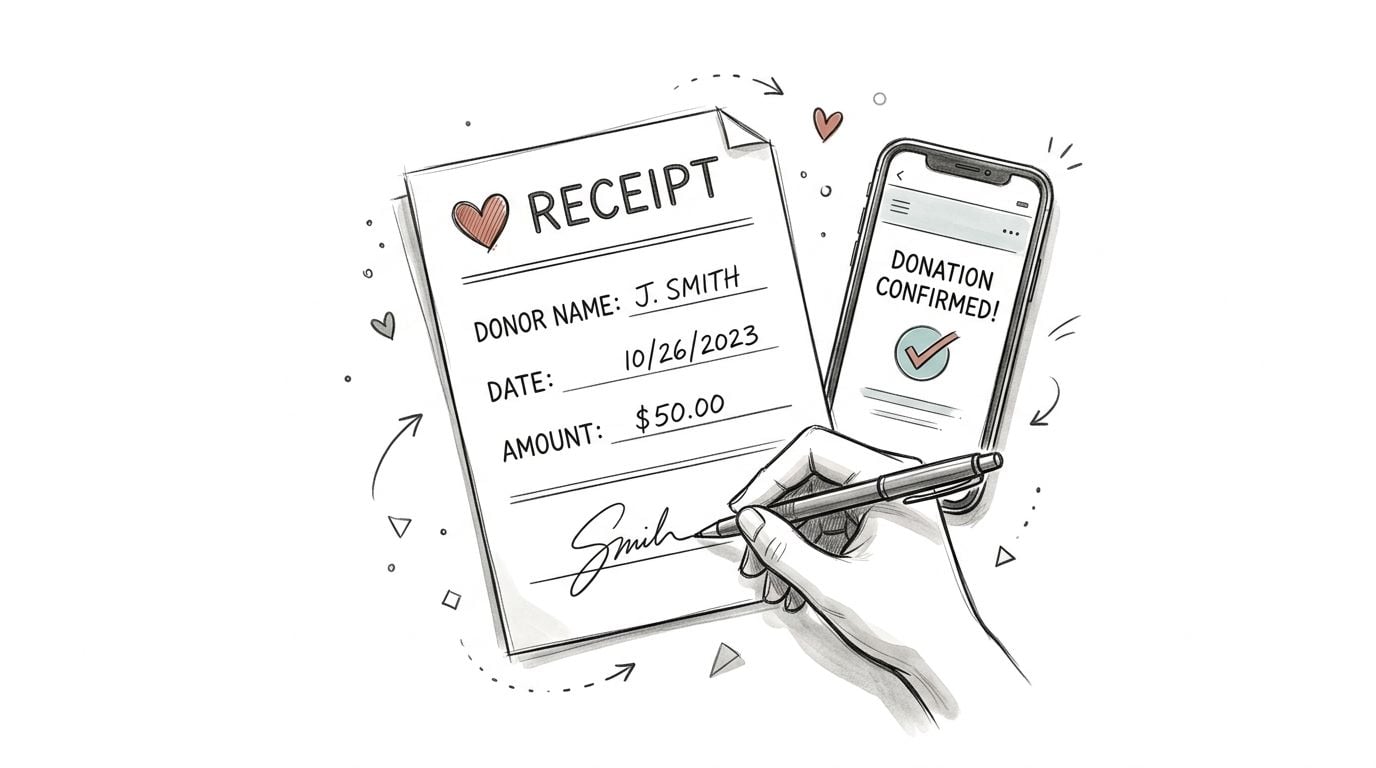
The most common receipt mistake in churches is not the big donor gift. It's the everyday gift that never gets documented correctly. Every contribution should have a clear record of donor name, amount, date, and any restriction or condition, because those details support both tax compliance and donor trust. For gifts of $250 or more, donors need written acknowledgment for substantiation, which is why year-end letters matter so much when January closes in fast (GivingArc nonprofit compliance checklist).
Good documentation does more than help the donor at tax time. It protects the church when there's a question later about whether a gift was restricted, whether a non-cash item was received, or whether a receipt was ever issued at all. The best churches automate this process and leave manual receipts only for exceptions.
Make receipts part of the giving flow
Online giving should produce automatic receipts through the platform that processes the gift. Systems like Planning Center, Pushpay, and Stripe can reduce the amount of hand-entry your team has to do, but consistency is the safeguard. The receipt should clearly state whether the gift was restricted or unrestricted, and if the donor received anything of value in exchange, the acknowledgment should reflect that properly.
For paper donations, use a separate folder or digital file for contributions above the $250 threshold. That makes year-end review far easier and reduces the chance that a receipt gets missed when the church office is closed or volunteers are covering the mail.
Real-world test: if a donor asks in March for a December receipt and your team has to reconstruct it from memory, the process is too loose.
A practical church example is the annual Christmas offering. If part of that gift is designated for benevolence and part is unrestricted, the receipt and the ledger both need to show the split clearly. The same logic applies to memorial gifts, camp scholarships, and special project offerings.
The internal receipt guide at Grain's contribution receipt resource is useful when you want a church-specific process for acknowledgments that don't leave room for ambiguity.
4. Establish Restricted Fund Management and Compliance Controls
Restricted gifts are where church compliance becomes practical. If a donor gives for building repairs, missions, or a scholarship need, the church has a duty to use that money according to the stated purpose. That duty isn't just about accounting style, it's about honoring donor intent and maintaining credibility with the congregation.
A lot of churches say they “track restricted funds,” but the test is whether the system can prove it. A ledger line that says “special giving” is not enough if you can't show where the money came from, what it was allowed to do, and who approved the spending. That's why restricted fund guidance matters so much for church finance teams.
Put the rules in writing
Every major restricted fund should have a written policy that explains the purpose, the approved uses, and the approval path for spending. A building fund may cover capital improvements only. A missions fund may be limited to outreach support. Memorial gifts may be restricted to a named scholarship or ministry program.
Grain Ledger's fund architecture is built to keep restricted money separate in the books, which helps avoid the common problem of accidental commingling. That doesn't replace leadership judgment, though. It means the bookkeeping and approvals line up with the policy instead of fighting it.
Review fund status on a schedule
Monthly fund-level balance sheets make it easier to spot problems early. If a restricted fund is being drained too quickly, or if spending is being coded to the wrong purpose, you want that to surface before the board meeting, not after year-end.
A quarterly briefing to pastors, elders, and finance committee members is also wise. It keeps ministry leaders aware of what can be spent and prevents well-meaning teams from assuming restricted money is flexible operating cash.
Restricted funds stay safe when the church treats them like promises, not like a general-purpose reserve.
A simple example is a memorial gift for youth camp scholarships. If the scholarship fund is fully reserved for student assistance, the church should never use it to cover sound equipment or operating shortages, even temporarily, without proper authority and documentation.

5. Implement Strong Internal Controls and Segregation of Duties
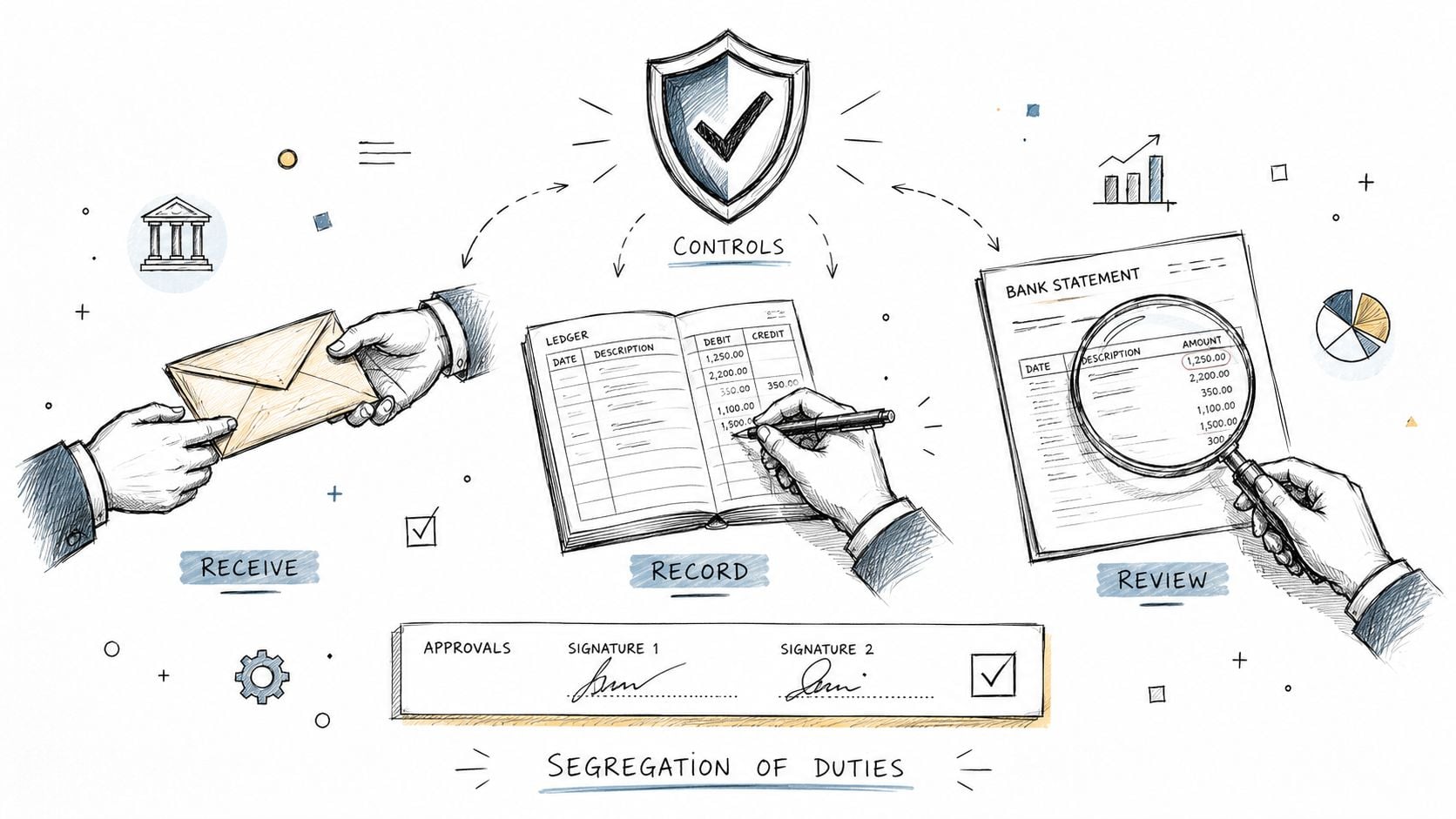
Fraud prevention in churches rarely starts with dramatic theft. It starts with too much trust in one person and too little structure around money handling. The sound practice is simple, the person receiving cash shouldn't also be the one recording it, reconciling it, and authorizing the disbursement. That separation of duties is one of the strongest controls a small church can put in place.
Independent guidance identifies governance policies, vendor tracking, and data protection as recurring compliance layers, but the everyday finance issue is still segregation of duties (GatekeeperHQ nonprofit compliance guide). If one staff member or volunteer can do everything in the payment cycle, the church is relying on trust instead of control.
Make the control path visible
Document your procedures in writing. Offerings can be counted by two people, recorded by a finance assistant, reconciled by a treasurer, and reviewed by a finance committee member before the board meets. That's not bureaucracy, it's proof that no single person can hide an error for long.
Use monthly bank reconciliation and periodic surprise cash counts. Review user access to financial software every quarter so former volunteers, past staff, and outside helpers don't retain permissions they no longer need.
The internal controls guide at Grain's best practices resource is worth keeping close if your church wants a more disciplined workflow around approvals, access, and oversight.
Draw a line around check authority
Dual signatures on larger checks can be helpful, especially for capital spending or unusual vendor payments. A church may also want the finance committee to approve reimbursements above a set threshold, then document that approval in the minutes.
A practical example is a seasonal event budget. If the youth director, office manager, and treasurer all touch the same cash without a clear handoff, there's room for error at every stage. If each role is separated and documented, the records become far easier to trust.
This fiduciary duty defense guide is relevant when boards want to understand why written controls matter so much to oversight and liability.
6. Reconcile Bank Accounts and Investment Accounts Monthly
Monthly reconciliation is one of those tasks that feels administrative until it catches a real problem. A bank statement shows what cleared, and the books show what the church thinks happened. When those two don't match, the discrepancy can point to a simple posting mistake, a duplicate deposit, an NSF check, or something more serious.
Sector guidance consistently recommends regular audits and centralized data handling, because compliance-grade bookkeeping depends on evidence that can be checked, not just entered (Fluxx nonprofit data management guide). Monthly reconciliation is where that evidence gets tested. If the books aren't brought current every month, the year-end close gets heavier and the audit trail gets weaker.
Close the loop quickly
Reconcile accounts within a few days of receiving the statement. That cadence keeps outstanding checks, deposits in transit, and unexpected charges visible while the month is still fresh. It also gives the treasurer a chance to ask questions before the next board meeting rather than after the books are already archived.
Use a standard reconciliation template that includes variance explanations. If something doesn't match, document why. A missing deposit, a transfer delay, or a bank fee should be explained in plain language that another reviewer can follow later.
If a reconciliation takes months to finish, it's not really a reconciliation. It's a guess with paperwork attached.
Don't stop at cash
Churches with reserve accounts, endowments, or invested building funds should reconcile those accounts too. Investment balances can affect reporting, donor conversations, and grant documentation, so they belong in the same monthly discipline as checking accounts.
A practical example is a church that receives online gifts on the last day of the month. If those gifts post in the bank after the statement closes, the books still need to explain the timing difference. That's exactly the kind of detail monthly reconciliation should capture.
7. Maintain Payroll Records and Employment Tax Compliance
Church payroll gets complicated quickly because pastors, office staff, part-time musicians, and seasonal workers don't always fit the same pattern. The safe approach is to treat payroll as a separate compliance lane, not as a side task folded into bookkeeping. Churches must track compensation, withhold required taxes, and file the related returns on time, because employment tax duties don't disappear just because the employer is a ministry.
The high-risk area is classification. A person who works set hours under church direction with church tools is usually an employee, not a contractor. That question comes up often with worship leaders, children's ministry help, and guest staff during VBS or special events.
Keep payroll documentation clean
Use a professional payroll service if you can. It reduces late filings, missed withholdings, and inconsistent reporting across federal, state, and local systems. Maintain separate payroll records for each employee, and keep I-9 forms and supporting documents organized so they're easy to retrieve if needed.
Quarterly and annual filing deadlines should live on the same compliance calendar as your Form 990 work. That way, payroll never gets treated as a one-off task after a busy ministry season.
For a practical employer perspective, the employer responsibilities reference is a useful reminder that churches carry the same basic duty to classify and document workers correctly, even if the internal culture feels informal.
Review pastors and guest workers carefully
Pastor compensation deserves particular care because boards often want clarity on salary, housing-related arrangements, and reimbursement practices. The same is true for contract musicians or guest speakers who may cross from contractor status into employee-like work if the relationship becomes ongoing or tightly controlled.
A simple example is a church hiring the same musician every week with a fixed schedule and detailed direction. That arrangement should be reviewed before payroll runs, not after year-end forms have already gone out.
8. Conduct Annual Financial Audits or Reviews
An annual audit or review gives the church an outside check on whether the financial statements reflect reality. Larger organizations often need this because grantmakers, state rules, or the church's own governance documents require it, and federal guidance notes that spending above $1 million can trigger Single Audit requirements under federal rules (GatekeeperHQ nonprofit compliance guide). Even when an audit isn't mandatory, a review by an external accountant can surface weak controls early.
Churches should think about audits as credibility work, not just compliance work. Audited financials help leaders answer donor questions, support major funding requests, and demonstrate that restricted funds were handled properly.
Prepare like the auditor will ask everything
Select someone experienced in nonprofit and church accounting. Then assemble fund listings, restriction schedules, board approvals, and support for major transactions well before fieldwork begins. Grain Ledger can help here because fund-level reporting makes it easier to present clean schedules to the auditor without rebuilding them by hand.
A practical mistake is waiting until audit season to discover missing board minutes or unclear restricted-fund transfers. That creates avoidable churn and often makes the review slower than it needs to be.
Match the level of assurance to the need
Not every church needs the same level of outside review every year, but every church benefits from some form of independent examination. Small congregations with modest budgets may rely on a review or compilation for a time, while larger ministries should plan for a formal audit process.
A useful example is a church receiving government or foundation grants. Those funders may require audited financials before awarding support, so the audit becomes part of the fundraising strategy as much as the compliance plan.
9. Document and Report Related-Party Transactions
Related-party transactions are exactly where good intentions can become messy if nobody documents them well. If a board member's company provides services to the church, if the pastor's spouse is on staff, or if the church buys property from a board member, the transaction needs disclosure, review, and clear minutes. Form 990 expects related-party disclosure because the goal is to prevent conflicts of interest and self-dealing.
Board governance matters as much as accounting. CharityCharge's nonprofit compliance guidance and Harbor Compliance's governance expectations both point toward regular board meetings, written bylaws, conflict-of-interest controls, and accessible records. Those aren't abstract governance ideals. They're the paper trail that shows leaders handled sensitive transactions properly.
Require annual disclosures
Adopt a written conflict-of-interest policy and have board members and key staff disclose relationships every year. If a transaction involves a related party, document the board's approval, the basis for the decision, and any recusal from the vote.
Competitive bids are smart when possible. Even if a related party is the best fit, the church should still be able to show it considered other options and documented why the arrangement made sense.
A clean disclosure doesn't create a conflict. It keeps a conflict from becoming a governance problem.
A practical church example is hiring the board treasurer's bookkeeping company to handle monthly close work. That may be reasonable, but only if the board documents the arrangement, the treasurer recuses themselves, and the terms are reviewed like any other vendor relationship.
10. Maintain Accurate Expense Records and Budget Accountability
A church budget only has value if actual spending can be traced back to the approved plan. That means every expense needs support, whether it's a receipt, invoice, reimbursement form, or contract. It also means the church should review budget-to-actual results regularly, because waiting until year-end makes it harder to correct drift.
Independent guidance groups accounting, record-keeping, and vendor oversight as recurring compliance layers, and expense documentation sits right at the center of that system (Labyrinth nonprofit compliance checklist). For churches, the hardest part is usually not the math. It's keeping program expenses, administrative costs, and shared overhead sorted well enough to explain them later.
Track spending by ministry area
Separate worship, children's ministry, outreach, and other program costs so leaders can see where money is going. Allocate shared costs, such as facility expenses, carefully and consistently. Capital equipment should be tracked distinctly from operating costs, especially when depreciation matters for reporting.
Use Grain Ledger to categorize expenses by fund and program area automatically, which reduces the chance that reimbursements or vendor bills get dropped into the wrong bucket. That kind of structure makes month-end reports easier for the finance committee and clearer for the board.
Keep approvals tied to the budget
Written expense policies should cover reimbursement timing, required documentation, and who approves what. If a purchase exceeds the threshold the board has set, it should go to the board or a designated committee before payment. That's especially important for ministries with multiple campus or program budgets, where overspending in one area can gradually eat into another.
A practical example is a children's ministry renovation. Without clear coding and approval, lumber, classroom supplies, and labor could all be miscoded into general operations. With good records, the church can show exactly what was spent, why it was spent, and whether it matched the approved budget.
Nonprofit Compliance: 10-Point Checklist Comparison
| Item | Implementation Complexity 🔄 | Resource Requirements ⚡ | Expected Outcomes 📊 | Ideal Use Cases 💡 | Key Advantages ⭐ |
|---|---|---|---|---|---|
| Maintain Accurate Fund-Based Financial Records | Medium, requires fund setup & mapping | Medium, accounting software + training | Accurate fund balances; compliant reporting | Churches with restricted donations; multi-fund orgs | Ensures donor-restriction compliance and audit readiness |
| Maintain Tax-Exempt Status and Form 990 Compliance | Medium–High, ongoing documentation & filings | Medium, recordkeeping, possible CPA support | Maintains tax-exempt status; public accountability | All nonprofits required to file 990; growing revenue tiers | Preserves legal benefits and donor confidence |
| Implement Proper Donation Receipt and Documentation Procedures | Low–Medium, systems + templates | Low–Medium, donor DB & integrations | IRS substantiation; improved donor experience | Regular donors, organizations issuing tax receipts | Simplifies deductions and provides clear audit trail |
| Establish Restricted Fund Management and Compliance Controls | High, policy, workflows, monitoring | Medium–High, controls, reporting tools | Prevents misuse; precise restricted reporting | Capital campaigns, major gifts, designated funds | Protects donor intent and strengthens stewardship |
| Implement Strong Internal Controls and Segregation of Duties | High, policy design and role separation | Medium, personnel and oversight resources | Reduces fraud/errors; stronger accountability | Orgs with multiple staff/financial transactions | Prevents misappropriation and eases audits |
| Reconcile Bank & Investment Accounts Monthly | Medium, recurring process discipline | Low–Medium, time + reconciliation tools | Detects errors/fraud; accurate cash position | Any nonprofit with bank/investment activity | Timely error detection and reliable cash reporting |
| Maintain Payroll Records and Employment Tax Compliance | High, regulatory complexity & deadlines | Medium–High, payroll service or HR capacity | Legal compliance; correct tax filings & records | Organizations with employees or contractors | Avoids payroll penalties and protects employees' benefits |
| Conduct Annual Financial Audits or Reviews | High, extensive prep and auditor work | High, audit fees and staff time | Independent assurance; grant/donor eligibility | Large budgets, grant recipients, donor-required audits | Builds credibility and exposes control weaknesses |
| Document and Report Related-Party Transactions | Medium, policies + disclosures | Low–Medium, documentation effort | Transparency; conflict-of-interest mitigation | Boards with potential vendor relationships | Prevents self-dealing and meets Form 990 rules |
| Maintain Accurate Expense Records and Budget Accountability | Medium, consistent categorization & controls | Medium, systems and staff time | Budget control; audit-ready expense reporting | Program-heavy organizations tracking costs | Supports stewardship, planning, and compliance |
Related church accounting software resources
If you are comparing software, these pages map the main decision points: fund accounting, QuickBooks limits, pricing, and migration.
- Best church accounting software (2026 comparison) - canonical guide comparing 12 church accounting platforms
- Church accounting software product page - see Grain Ledger for fund accounting, giving, and bank reconciliation
- Small church accounting software - see the product page built for volunteer treasurers and church admins
- Fund accounting features - review how Grain Ledger tracks designated funds
- QuickBooks for churches - understand workarounds and when to switch
- Free church accounting software - compare free options and upgrade triggers
- Grain Ledger pricing - compare plans for small and growing churches
- Start free - try fund accounting, giving imports, and bank reconciliation together
From Checklist to Confident Stewardship
A church nonprofit compliance checklist works best when it becomes part of normal ministry rhythm, not a scramble at filing time. The point isn't to turn staff into rule-chasers. It's to build a steady system that protects tax-exempt status, honors restricted gifts, and gives pastors, elders, and treasurers confidence that the numbers reflect reality.
For small and medium-sized churches, the smartest move is to start with true fund-based accounting and then layer the rest of the controls around it. Once your funds are clearly defined, the rest of the checklist gets easier, because donation receipts, budget tracking, board reporting, and restricted spending all point back to the same structure. Grain Ledger is built for that kind of workflow, with church-specific fund architecture that keeps accounting aligned with how ministries operate.
A quarterly action rhythm helps keep the whole process manageable. In the first quarter, close the books cleanly, confirm payroll records, and review fund balances. In the second quarter, prepare for Form 990 filing and board governance review. In the third quarter, check restricted funds, vendor contracts, and payroll classifications. In the fourth quarter, focus on donation acknowledgments, budget variance review, and year-end reporting. That cadence keeps the burden spread out instead of concentrating it in one stressful season.
Church compliance gets easier when every task has an owner, a due date, and one place where the evidence lives. That's the difference between a checklist that looks good on paper and a finance process that can stand up to donors, auditors, and the church board. When those pieces are in place, stewardship stops feeling reactive and starts looking like leadership.
Grain helps churches put true fund-based accounting at the center of compliance, so restricted gifts, donor receipts, and reporting all stay tied to the right fund from the start. If your team wants a clearer way to manage church finances with less manual cleanup, visit Grain and see how its church accounting workflow supports compliance-grade records, fund visibility, and stewardship you can explain with confidence.
Ready to simplify your church finances?
Start free with church fund accounting, or watch a product demo first.