
A Church's Guide to Cash Management Transfer
A practical guide to cash management transfer for churches. Learn how to perform, record, and reconcile transfers in a fund accounting environment.
If you're moving money between your church bank accounts and still relying on memory, email threads, or a note on someone's desk, you're one mistake away from a donor-confidence problem. The bank may show that the transfer cleared. That doesn't mean the church handled it well.
About Grain Ledger: This guide includes Grain Ledger, church fund accounting software built for designated gifts and ministry funds. It connects giving platforms (Planning Center, Pushpay, Tithely, Stripe), syncs bank activity with Plaid, and produces fund-level financial reports. Schedule a demo to see how it compares for your church.
See Grain Ledger for your church
Fund accounting, giving integrations, and bank reconciliation in one platform. Free migration support for churches switching from QuickBooks or Aplos.
A church cash management transfer isn't just a banking task. It's a stewardship task. The question isn't only whether cash moved. It's whether the transfer preserved approval, purpose, and fund integrity from beginning to end.
The Foundation of Accountable Fund Transfers
Churches get into trouble when they treat transfers as harmless internal housekeeping. A move from operating to missions, or from general checking to a building reserve account, can look simple in the bank portal and still create confusion in the books. If the transfer bypasses approvals or lands in the wrong fund record, you've solved a cash problem by creating an accountability problem.
The foundation has to be policy first. Not software first. Not convenience first.
Public-finance guidance is useful here because it focuses on control, not guesswork. The World Bank describes cash management as a set of principles and practices designed to transfer funds efficiently, often using banks as financial agents, and it emphasizes a daily cash forecast with balances managed inside target bands. If balances rise above a maximum target, they can be invested. If they fall below a minimum target, they must be replenished through deposits, borrowing, or other credit. The same guidance aligns with U.S. government practice that prefers electronic methods such as ACH and Fedwire over manual collection channels for efficiency and control, as summarized in this World Bank cash management reference.
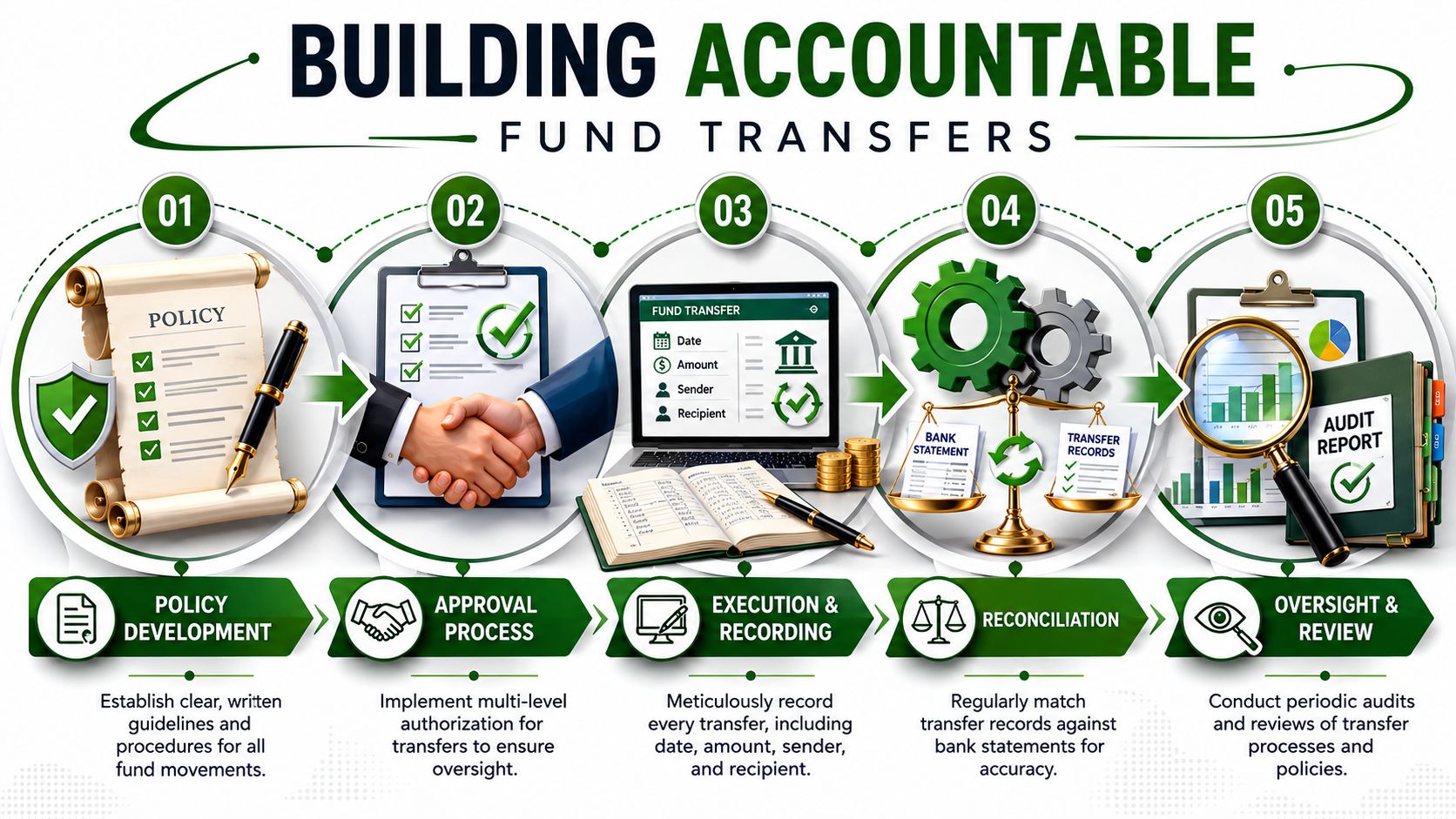
Build your policy around stewardship decisions
In a church setting, target balances matter because ministries don't all carry the same purpose. Your operating account needs enough liquidity for payroll, bills, and routine ministry expenses. A designated reserve or building account may need tighter rules because the church has already assigned a purpose to those funds.
A written transfer policy should answer four basic questions:
- Who can request a transfer: The person identifying a cash need shouldn't be the only person who can move money.
- Who must approve it: Set approval authority by role, not personality. Treasurer, finance chair, executive pastor, or another authorized signer.
- What account thresholds trigger action: Establish minimum and maximum balance bands for each major account.
- How the transfer must be documented: Require a reason, date, accounts affected, and the fund designation involved.
Practical rule: If your transfer policy wouldn't make sense to a new treasurer on their first week, it isn't clear enough yet.
Separate duties before you need them
Small churches often say they can't segregate duties because they don't have enough staff. In practice, most can separate at least three parts of the process: request, approval, and reconciliation. Even when one person wears multiple hats, another person can still review the transfer report or bank activity afterward.
What doesn't work is one person deciding, sending, recording, and reconciling every transfer with no independent review. That's where restricted funds get blurred into operating cash.
If you need a practical outside reference for tightening cash processes, Stewart Accounting for cash flow solutions offers a helpful overview of how disciplined cash procedures support stability. For churches, the difference is that the same discipline has to sit inside fund accounting, not just bank balance management. That's why your accounting system also needs to track the movement by fund, not merely by account, as shown in church fund accounting workflows.
Executing the Transfer Between Bank Accounts
Once the policy is set, the transfer itself should feel routine. Calm, repeatable, documented. If your team treats each transfer like a custom event, errors creep in fast.
The first decision is the transfer rail. Not every move needs the fastest option, and not every move should happen the same day.

Choose the rail that fits the risk
Most churches only need a simple framework:
| Transfer type | Best use | Main strength | Main caution |
|---|---|---|---|
| Internal bank transfer | Moving money between your own accounts at the same bank | Usually straightforward and easy to trace in one portal | Can still be miscoded in accounting |
| ACH | Planned payments or account-to-account movement where timing is known | Good fit for scheduled processing and documentation | Requires setup discipline and timing awareness |
| Wire | Time-sensitive transfers with high urgency | Fast settlement | Higher scrutiny needed before release |
| Instant payment | Situations where speed is worth the control burden | Very fast movement of funds | Reconciliation and approvals can lag behind the payment |
Banks and treasury guidance increasingly frame cash management around matching the rail to the liquidity problem, not just asking how to send money. That matters more now because faster rails are expanding. The U.S. FedNow Service reported 1,000+ participating financial institutions by mid-2025, and The Clearing House said RTP volume reached 1.8 billion payments in 2024, as noted in this treasury services overview from ESSA Bank. For churches, the warning is simple. Faster isn't always safer when restricted balances, approvals, and bookkeeping don't move at the same speed.
If your accounting review happens tomorrow, an instant transfer made today can create a same-day control gap.
Use a bank portal process that leaves breadcrumbs
When you initiate the transfer, don't stop at amount and account number. The description field matters more than is often acknowledged. A vague note like "transfer" helps nobody during month-end. A specific memo becomes your audit breadcrumb.
Use language that answers the future reconciler's question. Good examples include:
- Cover operating cash shortfall: when you're moving unrestricted cash for routine obligations
- Move designated building funds to reserve savings: when the destination account holds a designated purpose
- Reimburse missions advance from approved fund balance: when one fund temporarily covered another expense
A clean execution sequence looks like this:
- Confirm the need against the account's target balance and approved purpose.
- Verify the source fund can legitimately support the transfer.
- Initiate the bank transaction with the full memo, not shorthand.
- Capture evidence such as confirmation screen, approval email, or bank reference.
- Notify the bookkeeper or treasurer if the initiator and recorder are different people.
Oracle's cash management workflow is helpful as a model of discipline. It uses a controlled sequence that includes defining transfer templates, approving templates, creating the transfer request, attaching instructions, approving the transfer for settlement, and dispatching it through the payment gateway. It also supports special variants such as repetitive transfers, drawdown transfers, bank account transfers, EFTs, and prenotification, which is a zero-dollar EFT used to verify routing details before live funds move, in Oracle's funds transfer process documentation.
For teams that want a quick walk-through of the banking side, this short video is a useful visual refresher before you hand the process to a volunteer or backup signer.
Recording the Transfer with Accurate Journal Entries
A transfer isn't complete when the bank posts it. It's complete when the ledger reflects exactly what happened and why. Many churches lose clarity at this point. The money arrived in the right bank account, but the accounting entry leaves the wrong fund carrying the balance.
That mistake doesn't always show up immediately. It often surfaces later when a pastor asks how much is available in the building fund, or when the finance committee notices that the balance sheet doesn't match the story they thought the bank accounts were telling.
The journal entry should mirror the bank movement
For an internal transfer between church-owned accounts, the entry is usually simple. One cash account decreases. Another cash account increases. What matters is that the fund assignment is right on both sides.
Here is a basic example for moving cash from a General Fund checking account to a Building Fund savings account.
| Date | Account | Fund | Debit | Credit |
|---|---|---|---|---|
| [transfer date] | Cash, Building Fund Savings | Building Fund | [amount] | |
| [transfer date] | Cash, General Fund Checking | General Fund | [amount] |
This entry does two jobs at once. It records the movement between bank accounts, and it preserves the distinction between unrestricted and designated cash.
A transfer can be accurate at the bank and still be wrong in the books if the fund tagging is weak.
That point matters for churches because the core risk isn't merely movement of money. It's designation integrity. Research on cash transfers highlights a broader governance problem: transfers can be processed correctly while creating downstream issues if controls and traceability lag behind speed. In church accounting, the equivalent issue is that money can move correctly at the bank but be misapplied in accounting if fund tagging and approvals are weak, as discussed in this learning brief on transfer governance and downstream effects.
Use the memo and support file to tie the entry together
A clean journal entry should include support that explains the reason for the transfer. That usually means the approval note, bank confirmation, and the transfer memo matching one another. If the bank memo says "Mission Fund advance coverage," the journal entry description shouldn't say "cash adjustment."
Keep the language consistent across all three places:
- Bank memo
- Journal entry description
- Approval documentation
That consistency makes month-end easier and audit questions shorter.
If your team needs a refresher on the mechanics of debits, credits, and descriptions, this guide on how to do journal entries is a useful reference point.
Avoid the three entries that create confusion
Some errors show up over and over:
- Booking it as expense and income: An internal transfer is usually not new revenue and not a ministry expense.
- Using one side without a matching fund designation: That causes the bank total to look right while the fund report goes wrong.
- Posting to suspense and forgetting to clear it: Temporary accounts have a way of becoming permanent clutter.
When the transfer is routine, create a standard naming pattern for the entry. Consistency beats creativity here.
Reconciling Transfers for a Clean Audit Trail
Reconciliation is where confidence is earned. Until then, you have intention, approval, and an entry. After reconciliation, you have proof.
Churches sometimes treat internal transfers as low-risk because the money never left church control. That's exactly why they can be overlooked. A payment to a vendor gets attention because someone expects an invoice. A transfer between two church accounts can slide past review unless the reconciliation process deliberately checks both sides.
Match both legs of the transfer
During monthly bank reconciliation, every transfer should be tested as a pair. You need to see the withdrawal from the source account and the deposit into the destination account, then confirm that the ledger reflects the same movement.
Use a checklist that answers five questions:
- Did the source account show the exact withdrawal amount?
- Did the destination account show the exact deposit amount?
- Did both transactions clear in the expected time frame?
- Did the descriptions or memos match the transfer purpose?
- Did the journal entry use the same amount and date logic?
If one side appears and the other doesn't, don't force the reconciliation by guessing. Mark it as timing if that's the issue, or investigate whether the transfer was initiated incorrectly.
Borrow control habits from larger systems
Enterprise-grade systems build controls into the workflow before reconciliation ever begins. Oracle's process includes transfer templates, approvals, and prenotification to verify routing details before funds move. The larger lesson is not that churches need enterprise software. It's that verification belongs at every stage, ending with a final reconciliation review.
Audit lens: Reconciliation isn't a search for reasons the books are probably right. It's a test of whether the records can be verified.
A practical monthly review packet should include the bank statement, the transfer confirmation, the journal entry, and the reconciler's notation that both sides matched. If someone else reviews reconciliations, give them one place to see the full chain.
For teams that want a cleaner month-end review process, church bank reconciliation workflows show how transfer review fits into a broader reconciliation routine.
What a clean trail looks like
A transfer is audit-ready when a reviewer can trace it without asking for oral history. They should be able to follow:
- Approval.
- Bank initiation.
- Bank clearing in both accounts.
- Journal entry.
- Reconciliation sign-off.
When one of those pieces is missing, the work isn't finished. It's only partially documented.
How Integrated Accounting Streamlines Your Workflow
It usually breaks down on a Tuesday afternoon. A transfer is made in the bank portal to cover a cash need in another account. The bookkeeping entry gets added later. By month-end, the reviewer sees money moved but cannot tell whether it was operating support, a temporary advance, or a correction tied to a restricted fund. In a church, that missing context matters because donor intent has to survive the transfer, not disappear between systems.
Manual workflows create that problem because the transfer lives in pieces. The bank shows cash movement. The ledger shows an entry. The support sits in email or a shared folder. Someone has to connect the dots by memory.
The manual version creates too many break points
Here is the pattern I see most often:
| Step | Tool | Common failure point |
|---|---|---|
| Initiate transfer | Bank portal | Memo is too vague |
| Record transfer | Accounting software or spreadsheet | Fund coding is missed |
| Save support | Email or shared folder | Approval trail gets buried |
| Reconcile later | Bank statement plus ledger | Reviewer can't match both sides quickly |
The risk is not just extra effort. Each handoff creates another chance to lose the reason for the transfer, the fund involved, or the approval behind it. Churches feel that pressure more than a typical business because one cash account may hold money for several funds, some of them restricted.
A connected system reduces those handoffs. Bank activity enters the accounting workflow directly, so the person reviewing the transfer can apply the right fund treatment while the transaction is still fresh. Purpose-built church tools solve this problem. Grain is one accounting option designed for churches with fund-based accounting, bank connections, and integrations that keep giving, bank activity, and reporting in the same system.
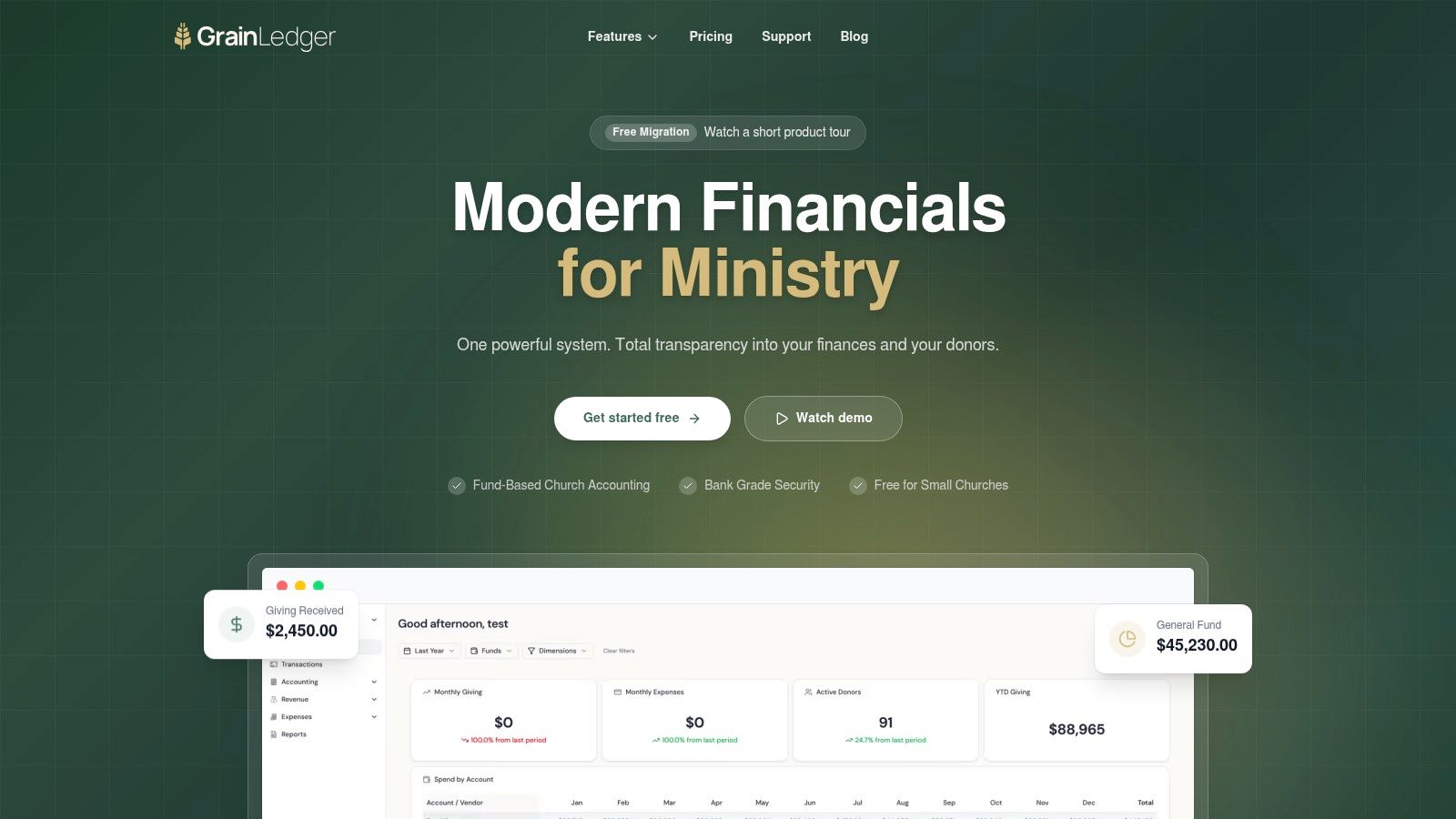
The practical gain is control. When the transfer appears in the same place as the fund ledger, the reviewer can verify both sides at once. They can ask the right question immediately. Did cash move only between bank accounts, or did fund balances need to move too?
Good transfer workflows preserve intent inside the record, so the next reviewer does not have to reconstruct it from memory.
The difference shows up most clearly during staff transitions. Before integration, a church often depends on one person who remembers which transfer covered payroll, which one corrected a posting error, and which one temporarily fronted cash for a designated project. That process works until the treasurer is out, a volunteer rotates off, or the auditor asks for support six months later.
After the workflow is connected, the record is easier to trust:
- Bank activity arrives automatically: Less rekeying means fewer transcription mistakes.
- Fund context stays visible: The transfer can be reviewed alongside the fund ledger and reports.
- Support is easier to trace: Approval notes, transaction history, and coding stay closer to the entry.
- Training gets simpler: A new treasurer can follow the record without decoding someone else's filing habits.
For churches, that is the primary benefit. The goal is not speed by itself. The goal is a transfer process that protects restricted funds, holds up under review, and still makes sense when the person who entered it is no longer the one answering questions.
Related church accounting software resources
If you are comparing software, these pages map the main decision points: fund accounting, QuickBooks limits, pricing, and migration.
- Best church accounting software (2026 comparison) - canonical guide comparing 12 church accounting platforms
- Church accounting software product page - see Grain Ledger for fund accounting, giving, and bank reconciliation
- Small church accounting software - see the product page built for volunteer treasurers and church admins
- Fund accounting features - review how Grain Ledger tracks designated funds
- QuickBooks for churches - understand workarounds and when to switch
- Free church accounting software - compare free options and upgrade triggers
- Grain Ledger pricing - compare plans for small and growing churches
- Start free - try fund accounting, giving imports, and bank reconciliation together
Advanced Transfer Scenarios and FAQs
Routine transfers are easy to standardize. Edge cases are where weak processes show up. The safest approach is to decide the treatment before the situation becomes urgent.
How do we handle a bank fee tied to the transfer
If the bank deducts a fee, don't force the ledger to pretend the transfer amount and the net deposit were the same. Record the transfer for what moved between accounts, then record the fee to the appropriate bank fee or service charge account so the books match the statement.
The key is simple. Separate the cash movement from the bank expense.
What if the transfer was made in error
Start with the bank. If the transfer can be reversed or corrected through the bank portal or bank support team, address that first. Then reverse or correct the journal entry so the ledger reflects what occurred, not what was intended.
A clean correction file should include:
- The original transfer record
- The reason it was wrong
- The reversal or correction confirmation
- The corrected journal entry
- The approver's sign-off
Don't delete the original entry just to make the books look tidy. Preserve the trail.
How should we transfer funds to an external ministry partner
Once money leaves your accounts for another organization, it usually stops being an internal transfer and becomes a payment or disbursement. Treat it with the documentation you'd expect for any ministry support payment. Approval, purpose, recipient details, and accounting classification all need to be clear.
If the payment relates to a designated fund, make sure the expense or grant entry points back to that fund's purpose so the report still tells the truth about how the designated money was used.
Can we move restricted funds temporarily and put them back later
Technically moving cash and preserving donor intent aren't the same thing. If the accounting and approval trail can't clearly show that the designated purpose remained intact, a "temporary" move can become a governance problem very quickly. Churches should be especially cautious here and follow their written policy and counsel from leadership or their accountant.
Should every transfer use the same level of approval
Not necessarily. A recurring sweep between church-owned accounts may justify one workflow. A one-time urgent transfer involving designated balances may need tighter review. The principle is that the approval depth should match the risk to fund integrity, not just the convenience of getting the money moved.
If your church is still managing transfers across separate bank portals, spreadsheets, and manual journal entries, Grain is worth a look. It gives churches a fund-based accounting system that connects bank activity, supports accurate transfer tracking, and helps keep restricted balances visible and accountable from initiation through reconciliation.
Ready to simplify your church finances?
Start free with church fund accounting, or watch a product demo first.