
Catholic Church Challenges & Modern Solutions
 By Gibson Brueher, Founder of Grain Ledger
Facing modern Catholic Church challenges? Learn how demographic shifts impact parish finances and discover practical solutions like fund accounting.
Monday morning hits, and the pastor wants one answer before lunch.
About Grain Ledger: This guide includes Grain Ledger, church fund accounting software built for designated gifts and ministry funds. It connects giving platforms (Planning Center, Pushpay, Tithely, Stripe), syncs bank activity with Plaid, and produces fund-level financial reports. Schedule a demo to see how it compares for your church.
See Grain Ledger for your church
Fund accounting, giving integrations, and bank reconciliation in one platform. Free migration support for churches switching from QuickBooks or Aplos.
How much remains from the special collection? Not what the giving platform says came in. Not what the spreadsheet estimated. Not what the checking account balance suggests. He wants to know what’s still available, what’s already been spent, and whether any of it was accidentally used to cover payroll or utilities.
If you’re on a parish finance council, you know that feeling. You’re juggling offertory deposits, a building fund, a mercy ministry, school expenses, and reimbursement requests that arrive with weak documentation and strong urgency. Meanwhile, attendance feels less predictable, volunteers rotate out, and the same few people carry the administrative load.
That’s why most conversations about catholic church challenges miss the point at the parish level. People talk about secularization, vocations, parish closures, distrust, and cultural change as if they’re abstract trends. They aren’t. They land in your books. They show up as late reconciliations, murky restricted balances, pressure to “borrow” from designated funds, and reports that no one on the council fully trusts.
The mission suffers when the finances get fuzzy. A parish can survive a hard season. It won’t survive confusion about money.
If your current process depends on memory, side spreadsheets, and heroic effort from one tired bookkeeper, fix that first. A clearer church finance workflow starts with disciplined fund tracking, clean approvals, and reports that ordinary council members can understand. This practical guide on church finance management is a good place to start: https://grainledger.com/blog/church-finance-management
Introduction Navigating the Financial Storm in Modern Parishes
A parish business manager opens the weekly giving report. One export comes from the online giving platform. Another comes from the bank. A handwritten note from Sunday says part of the second collection was for outreach, part was for repairs, and part needs to wait for diocesan instructions.
Then the phone rings. A ministry leader wants reimbursement. The pastor asks whether the parish can afford a staffing decision. The finance council chair wants month-end statements. Nobody is trying to be careless. But the system itself is weak.

That’s the real face of catholic church challenges in parish life. It isn’t only about headlines. It’s about a local church trying to stay faithful while its administrative demands keep growing and its margin for error keeps shrinking.
Why the financial strain feels personal
Most parish finance teams aren’t overstaffed. They’re patched together. One person knows the donor history. Another understands the chart of accounts. A volunteer remembers why a restricted gift was set aside in the first place. If any one of them steps away, the parish loses institutional memory.
That’s dangerous. Restricted funds don’t become unrestricted just because cash is tight. Designated giving can’t be treated like a temporary float. If your records blur those lines, your parish doesn’t just have a bookkeeping problem. It has a governance problem.
Practical rule: If a council can’t answer “what was this money given for, where is it now, and who approved its use?” in a few minutes, the parish needs a better system.
The mission depends on order
Parishes exist for worship, evangelization, formation, and mercy. But those ministries rely on disciplined stewardship. When your finance process is messy, trust erodes. Donors hesitate. Council meetings drift into confusion. Priests spend time chasing paperwork instead of leading people.
That’s why financial stewardship isn’t a side issue. It’s operating infrastructure for ministry.
The Seven Headwinds Facing Today's Catholic Parishes
Most parishes aren’t facing one problem. They’re facing several at the same time, and those pressures reinforce each other.
Fewer priests, more strain
The priest shortage is no longer theoretical. The number of priests declined to 406,996 worldwide in 2023, while the Catholic population grew. Seminarians also fell from 108,481 in 2022 to 106,495 in 2023, according to the Pontifical Yearbook 2025 and Annuarium Statisticum Ecclesiae 2023 summarized by Vatican News. In the United States, dioceses are merging parishes as older priests retire without replacements.
That means one pastor often oversees more people, more properties, and more financial complexity than the parish model was built to handle.
Retention is weaker than many councils admit
A lot of finance councils still build budgets as if prior giving patterns will return on their own. That’s wishful thinking.
Families move. Young adults disengage. Sacramental participation gets less consistent. A parish can have a full Christmas Mass and still have unstable year-round giving. If leaders don’t face that directly, they’ll keep treating a structural shift like a temporary dip.
Trust has become fragile
Even when your own parish has done nothing wrong, people now expect proof, not reassurance. They want to know that designated gifts were used correctly, that approvals were documented, and that reports are clear.
That expectation is healthy. Finance councils should welcome it. But it also means casual bookkeeping is no longer acceptable.
Working-class attrition changes parish economics
Some parishes are losing families who used to provide the backbone of consistent weekly participation and practical volunteer support. You feel that loss in the offertory, but also in maintenance help, committee depth, and school support.
A parish budget gets brittle when fewer households carry more of the burden.
Rural and vulnerable communities face sharper pressure
In some places, population movement leaves rural parishes under-resourced. Mission support becomes harder to sustain, and councils must track designated aid with more precision because every restricted dollar matters.
When administration is loose, vulnerable ministries are often the first to suffer.
Persecution and instability affect giving priorities
Many Catholic communities worldwide face violence, displacement, or harsh social pressure. That reality increases the importance of disciplined stewardship for aid and solidarity giving. If a parish invites members to support suffering communities, it must be able to show those funds were handled as promised.
Old operating habits no longer work
This is the headwind many leaders still resist naming. Generic small-business accounting, disconnected systems, and spreadsheet workarounds don’t match how parishes receive, restrict, and report money.
Here’s the hard truth:
| Headwind | What it does to parish operations |
|---|---|
| Clergy shortage | Pushes more administrative work onto fewer leaders |
| Attendance instability | Makes revenue harder to forecast |
| Low trust | Raises expectations for documentation and clarity |
| Population shifts | Weakens ministry continuity and local support |
| Restricted giving complexity | Increases risk of misuse or confusion |
Parishes don’t need more improvisation. They need tighter financial discipline than they needed a generation ago.
How Pastoral Crises Translate into Financial Instability
When people talk about catholic church challenges, they usually stop at the pastoral or cultural level. Finance councils can’t afford to stop there. Every pastoral disruption eventually becomes a budgeting problem.
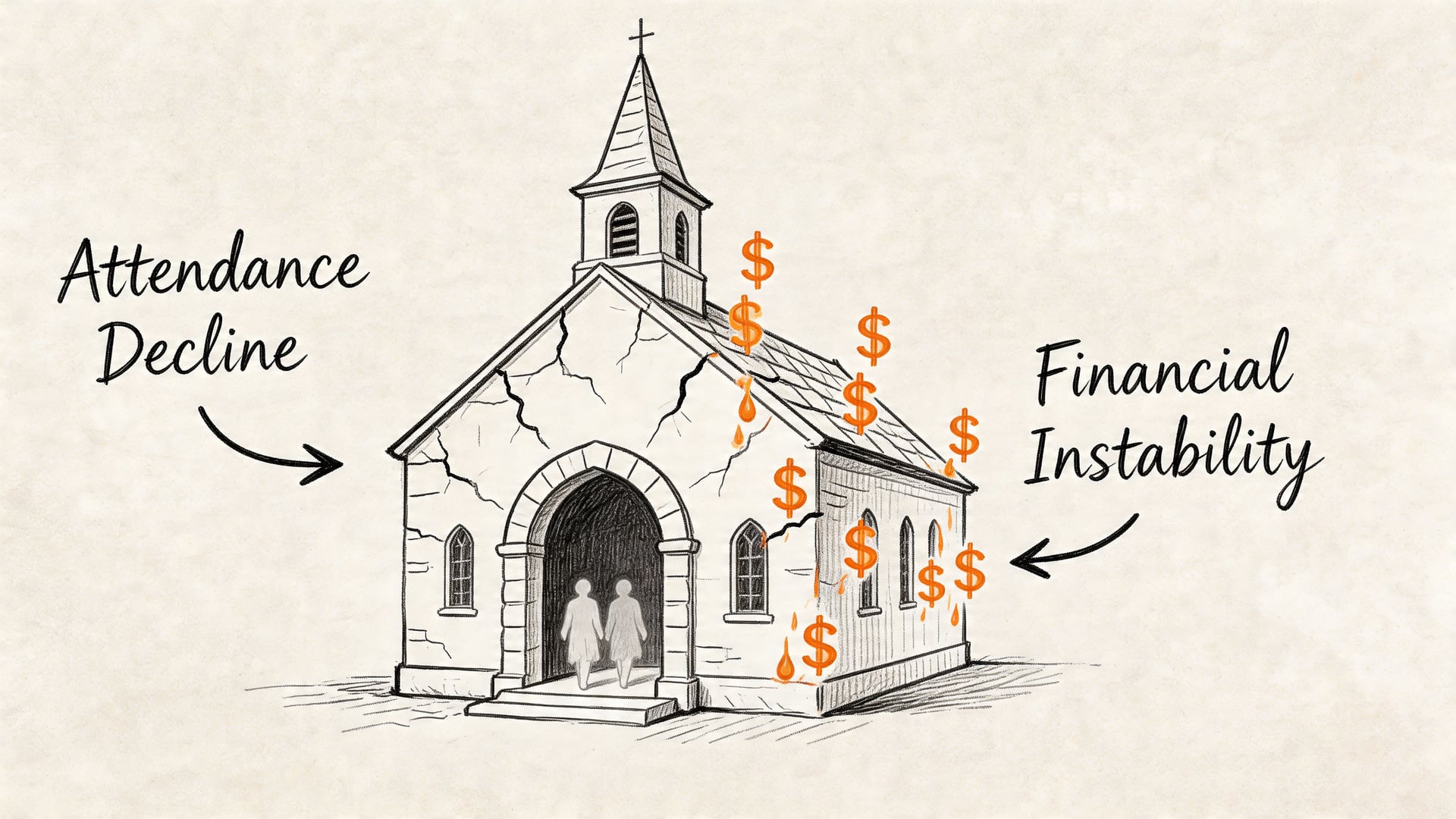
Less predictable attendance means less predictable cash
From 1973 to 2022, General Social Survey data shows weekly Mass attendance among those raised Catholic in the United States fell from 34% to 11%, as noted in Church Life Journal’s analysis of Catholic retention. For a 200-member parish, that trend can create severe revenue volatility and strain the stewardship of restricted funds when overall giving becomes less predictable.
That one fact should change how every council thinks about money.
You can’t run a parish with a stable-cost structure and an unstable-giving pattern while pretending the old assumptions still hold. Utilities still come due. Insurance still comes due. Payroll still comes due. But unrestricted giving may swing harder than it used to.
The first temptation is always the dangerous one
When unrestricted cash gets tight, weak systems invite bad decisions.
A parish doesn’t usually set out to misuse restricted funds. What happens is more mundane. Someone says cash is cash. Someone else says the designated money will be replaced next month. The entry gets posted unclearly. The reimbursement gets approved without checking the donor restriction. After that, nobody can explain the trail cleanly.
That’s how trust gets damaged.
Common instability signals
- Blurry fund balances mean the council can’t tell whether a ministry still has money or whether the cash was absorbed into general operations.
- Delayed reconciliations hide problems until they become embarrassing.
- Budget meetings turn reactive because the team is arguing over numbers instead of making decisions.
- Pastors get dragged into clerical bookkeeping when they should be leading people and ministries.
If unrestricted giving falls, restricted money becomes more tempting to touch. That’s exactly when controls need to get tighter.
Forecasting fails when categories are weak
A lot of parishes think they have a revenue problem when they have a classification problem.
If online gifts, parish envelopes, second collections, school support, benevolence funds, and capital gifts all land in an accounting setup that doesn’t separate them clearly, forecasting becomes guesswork. Your council may think it’s reviewing financial statements when it’s really reviewing aggregated noise.
A useful report should answer:
- What money is available for general operations?
- What money is restricted or designated?
- Which ministries are carrying obligations into the next period?
- Where is cash pressure building first?
Without those answers, your finance council isn’t governing. It’s reacting.
A short explainer on the broader giving and retention dynamic helps frame the issue:
Administrative overload has a cost
Every extra manual step steals time from ministry and multiplies risk.
When one priest covers multiple communities, or one business manager handles too much alone, simple tasks become slow: coding deposits, tracing donor intent, preparing month-end reports, answering council questions, and cleaning up prior errors. The result isn’t just fatigue. It’s delayed decisions and avoidable confusion.
That’s why financial instability in a parish rarely starts with a dramatic event. It starts with weak categories, scattered systems, and too many people relying on memory.
The Solution Begins with True Fund Accounting
Most parishes don’t need more accounting jargon. They need a structure that matches reality.
The right structure is fund accounting.
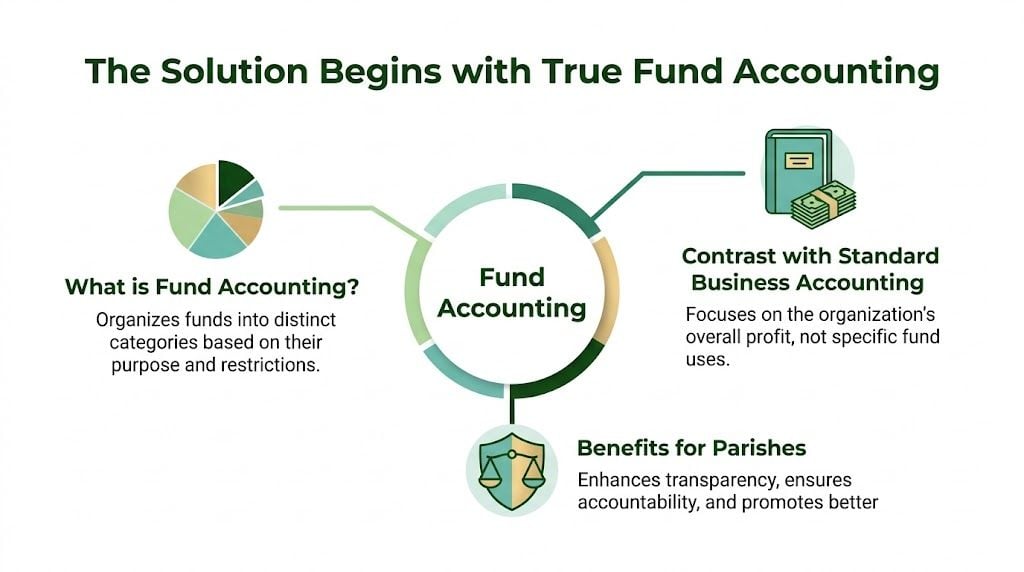
What fund accounting actually does
Think of fund accounting as a disciplined digital envelope system.
Your parish doesn’t have one big bucket of money with a few memo notes attached. It has separate obligations tied to donor intent, ministry purpose, and internal accountability. General offertory is not the same as a building fund. A benevolence collection is not the same as school tuition support. Memorial gifts are not the same as unrestricted cash.
Fund accounting treats those differences as core structure, not afterthought.
Why generic business bookkeeping falls short
Standard business accounting asks a useful question for businesses: did the organization make money or lose money?
That isn’t enough for a parish.
A parish also has to ask whether money was used according to its purpose. If someone gives for repairs, that gift can’t quietly float into another category because cash flow is tight. If donors support a ministry, the finance council needs reporting that shows that ministry’s activity clearly.
Here’s the contrast:
| Approach | Main focus | Weakness for parishes |
|---|---|---|
| Standard business accounting | Overall organizational profit and loss | Can blur restrictions and ministry purposes |
| Fund accounting | Separate balances by purpose and restriction | Matches church stewardship needs |
This is an ethical issue, not just a technical one
Economic analysis of post-Vatican II data points to a long-term Catholic Mass attendance decline distinct from Protestant denominations, and the argument summarized by Catholic Culture’s discussion of that research is that this erosion has weakened traditional giving patterns. In that environment, transparency and accountability from modern fund accounting become essential for rebuilding financial stability and donor confidence.
That last point matters. When participation patterns are weaker, a parish has less room for sloppy stewardship. You don’t rebuild trust by asking for more money first. You rebuild trust by showing clean handling of the money already given.
Boardroom test: If a donor asked for a plain-language report on one restricted gift, could your parish produce it quickly and confidently?
What proper fund accounting changes in practice
A parish that uses true fund accounting gains clarity in ordinary decisions:
- When staff review cash, they can see what is genuinely available for operations.
- When the council meets, members can review fund-level activity instead of one blended number.
- When a ministry spends, the approval process can tie the expense to the right fund.
- When donors ask questions, the parish can answer without scrambling through old files.
The firewall matters
I use that word deliberately. Good fund accounting creates firewalls between categories of money.
Those firewalls protect the parish from accidental commingling, weak documentation, and false confidence created by a healthy bank balance. A parish can have cash in the bank and still be short on unrestricted operating money. Councils need to see that distinction clearly.
If your current setup can’t do that, it isn’t a minor inconvenience. It’s the wrong system.
A Modern Financial Toolkit for Resilient Parishes
Parish finance work doesn’t improve because people try harder. It improves because the workflow gets tighter.
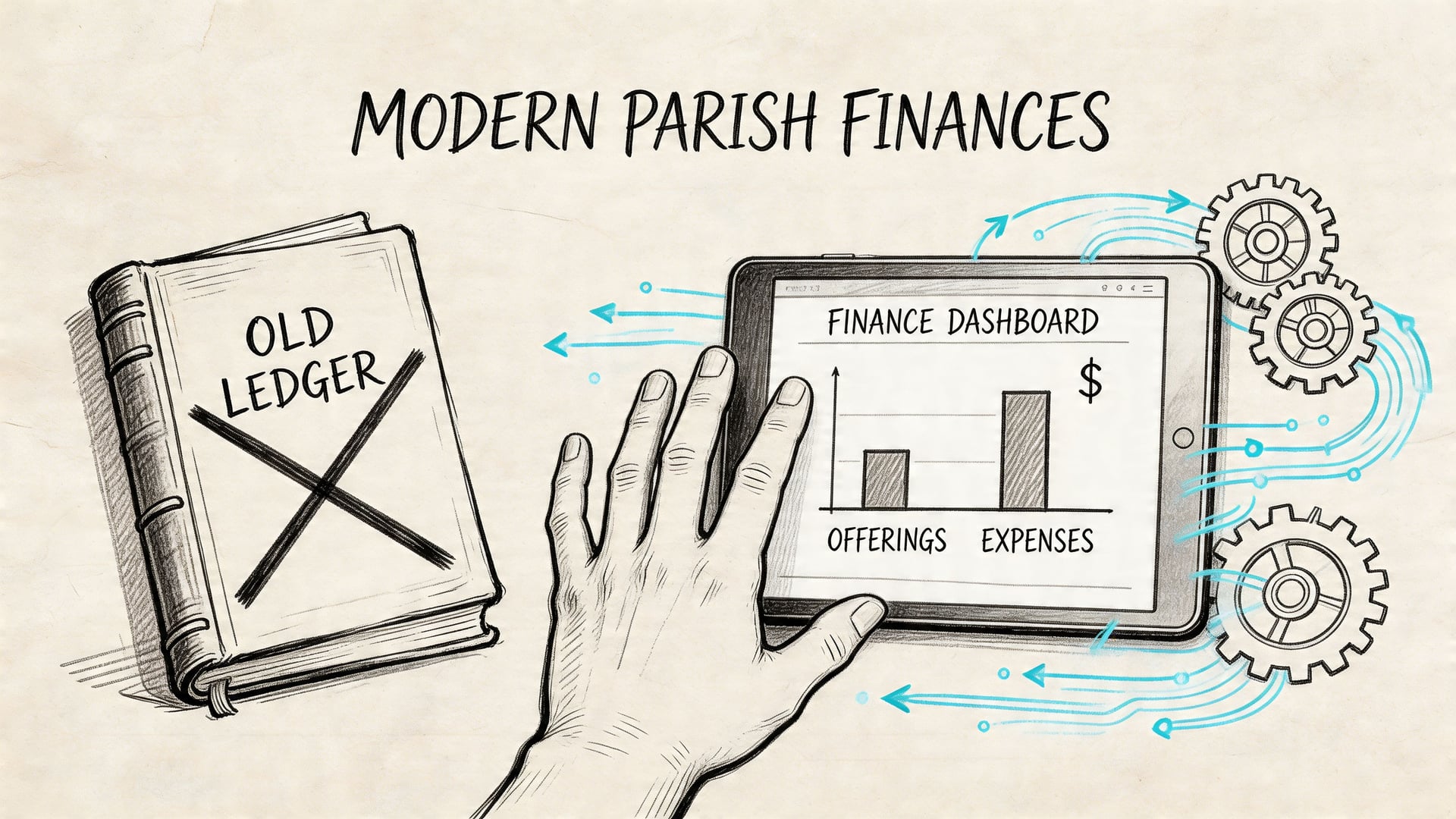
What a modern toolkit should include
Many small to medium-sized parishes struggle to track restricted funds for outreach and local mercy work, and that gap is often made worse when software doesn’t connect cleanly with the tools churches already use. As noted in this discussion of parish stewardship gaps and the role of integrated tools such as Plaid and Stripe, automation can help allocate funds accurately and improve accountability.
That means a useful parish system should do four things well:
- Pull in bank activity automatically so no one is manually retyping basic transactions.
- Connect to giving platforms so gifts arrive tagged to the right funds.
- Protect restricted balances so designated money doesn’t get casually mixed into operations.
- Produce fund-level reports that pastors and council members can read without translation.
If a platform can’t handle those basics, it’s not solving the underlying problem.
The practical standard I recommend
For small and medium-sized churches, I recommend Grain Ledger when a parish needs accounting software built around funds rather than around generic business categories. Grain organizes accounts, transactions, and reports around a native fund structure, connects with bank and card data through Plaid, and supports workflows tied to church giving tools such as Planning Center, Pushpay, and Stripe. If you want a clearer overview of what that kind of setup should do, this guide to fund accounting software for churches is useful: https://grainledger.com/blog/fund-accounting-software-for-churches
That recommendation isn’t about novelty. It’s about fit.
A parish shouldn’t have to bolt church logic onto software designed for another kind of organization. That’s how workarounds multiply and reporting gets muddy.
Don’t ignore the cash cycle basics
Finance councils also need a clean grasp of timing. Bills come due on one schedule. gifts arrive on another. Reimbursements, vendor payments, and expected incoming funds all interact.
If some members need a refresher on those moving parts, this explanation of understanding the key differences between accounts payable and accounts receivable is worth reviewing. It’s not church-specific, but it helps clarify why cash pressure can feel worse than the income statement suggests.
What good tooling changes for the council
A modern toolkit should reduce confusion in visible ways:
| Old process | Better process |
|---|---|
| Separate spreadsheets for restrictions | Built-in fund separation |
| Manual donation recoding | Automated fund allocation from giving data |
| Bank balance used as decision shortcut | Fund-level cash visibility |
| Month-end panic | Ongoing review and cleaner close |
Software doesn’t create stewardship. But weak software absolutely undermines it.
The wrong tool creates false confidence
This is the trap I see all the time. The parish thinks it has modernized because it moved off paper. But all it really did was digitize confusion.
If your reports still require verbal explanation every month, if restricted balances need side calculations, or if the treasurer keeps a separate “real numbers” workbook, your system is still broken. Replace it.
Improving Governance and Fostering a Culture of Transparency
Software matters. Governance matters more.
A parish can buy a better system and still operate badly if the pastor, staff, bookkeeper, and finance council haven’t agreed on roles, approval rules, and reporting expectations.
Start with clear ownership
Someone must own each part of the process.
Not vaguely. Clearly.
- Pastor approves direction and major spending within established policy.
- Business manager or treasurer handles execution, coding discipline, reconciliations, and report preparation.
- Finance council reviews, questions, and documents oversight instead of rubber-stamping.
- Ministry leaders request funds with enough detail to tie spending to the correct purpose.
That sounds obvious, but many parishes skip it. They rely on goodwill, then get frustrated when tasks fall through.
Build reports normal people can read
Your monthly packet shouldn’t feel like a test in accounting vocabulary.
A strong parish report should show current fund balances, notable changes, major expenses, and any decisions needed from the council. If a member in the pew couldn’t understand the summary page, the report is too complicated.
Try this reporting pattern:
- One-page summary with key fund balances and operating position.
- Fund activity detail for ministries, outreach, repairs, and special collections.
- Exception list showing unusual items, overdue reconciliations, or approval issues.
- Action items requiring council review.
That format forces discipline. It also keeps meetings from drifting.
Transparency is not dumping more pages on the council. Transparency is making the truth visible.
Internal controls should be ordinary, not dramatic
Many councils hear “internal controls” and imagine suspicion. That’s the wrong mindset. Controls protect good people from bad process.
Use simple safeguards:
- Separate approval from payment entry whenever possible.
- Review restricted fund activity routinely, not only at year-end.
- Require documentation for reimbursements and note the related fund.
- Reconcile on schedule and review exceptions promptly.
If your council needs a practical starting point, this resource on internal controls best practices is worth using in discussion: https://grainledger.com/blog/internal-controls-best-practices
Transparency supports vulnerable ministries
Financial governance matters even more when a parish supports fragile or distant work. In Peru, where 76% of the population is Catholic, poverty-driven urban migration leaves rural parishes under-resourced, and effective fund-level transparency is critical for managing donations intended for missionary work and local vocations, as discussed by Ave Maria Press in its reflection on challenges facing the Church.
That example applies broadly. If a parish asks people to fund seminary support, emergency aid, or mission travel, leaders must be able to show those funds stayed aligned with their purpose.
Publish enough to build trust
You don’t need to publish every transaction to the bulletin. You do need consistent communication.
A short parish financial summary, delivered regularly in plain language, does more for trust than a once-a-year dense report nobody reads. People give more confidently when leaders speak clearly and account cleanly.
Conclusion Building a Financially Strong and Mission-Focused Future
The central financial problem in many parishes isn’t generosity. It’s structure.
Church leaders are trying to respond to catholic church challenges that are larger than any one parish can solve. Priest shortages, instability in participation, population shifts, and rising expectations for accountability all create real pressure. But the local response doesn’t begin with hand-wringing. It begins with disciplined stewardship.
A parish with clear fund accounting, clean approvals, readable reports, and stronger internal controls is in a far better position to protect ministry, serve donors transparently, and make hard decisions early. That kind of order doesn’t distract from the mission. It protects the mission.
Finance councils should think like stewards, not clerks. Your job isn’t merely to record what happened. Your job is to create visibility, reduce risk, and help the parish act faithfully with what it has.
If your council wants a broader framework for that mindset, this strategic guide to GRC (Governance, Risk, Compliance) offers a useful lens. The terms come from a wider management context, but the underlying point applies to parishes. Good governance and risk discipline help mission-serving organizations stay credible and stable.
Don’t wait for a crisis meeting, an audit scare, or a donor complaint. Tighten the structure now. Clean books support clear decisions, and clear decisions support faithful ministry.
Related church accounting software resources
If you are comparing software, these pages map the main decision points: fund accounting, QuickBooks limits, pricing, and migration.
- Best church accounting software (2026 comparison) - canonical guide comparing 12 church accounting platforms
- Church accounting software product page - see Grain Ledger for fund accounting, giving, and bank reconciliation
- Small church accounting software - see the product page built for volunteer treasurers and church admins
- Fund accounting features - review how Grain Ledger tracks designated funds
- QuickBooks for churches - understand workarounds and when to switch
- Free church accounting software - compare free options and upgrade triggers
- Grain Ledger pricing - compare plans for small and growing churches
- Start free - try fund accounting, giving imports, and bank reconciliation together
Frequently Asked Questions About Parish Financial Management
Does our parish really need fund accounting if we’re small
Yes.
Small parishes need it just as much, and often more, because a few people usually handle everything. When one team member carries too much of the process in memory or in side spreadsheets, the risk rises fast. Fund accounting creates clarity around what money is available, what money is restricted, and what expenses belong where.
Can’t we just track restricted gifts in a spreadsheet
You can, but you shouldn’t rely on that long term.
Spreadsheets break when staff change, formulas get edited, tabs multiply, and nobody agrees which version is current. A spreadsheet can support review. It shouldn’t serve as the primary control system for donor-restricted money.
What should the finance council review every month
Keep it practical.
Review reconciliations, current operating position, fund balances, unusual transactions, and any exceptions involving approvals or documentation. If a report can’t quickly show restricted fund activity, the council is missing one of its core oversight duties.
How do we improve transparency without overwhelming parishioners
Use plain language and consistency.
Give people a short summary of where money came from, how it was used, and what major needs remain. Avoid technical jargon. A parish doesn’t build trust by publishing complicated reports. It builds trust by making important information understandable.
What’s the first step if our current setup is messy
Stop adding more patches.
List every active fund, identify which ones are restricted or designated, reconcile those balances against current records, and tighten approval rules immediately. Then move to software built for church fund accounting instead of continuing with generic bookkeeping workarounds.
If your parish is tired of spreadsheets, blurred fund balances, and month-end confusion, take a serious look at Grain. It’s built for church fund accounting, with fund-level reporting and connected workflows that help finance councils protect restricted giving and report with confidence.
Ready to simplify your church finances?
Start free with church fund accounting, or watch a product demo first.