Church Giving Statements: 2026 Compliance Guide
Master church giving statements for 2026. Learn legal requirements, compliance rules, and how automation simplifies year-end reporting.
January always exposes the same church-office reality. The giving reports are half-finished, somebody's hunting for a missing donor address, and the treasurer is trying to reconcile a stack of online gifts, recurring gifts, and a few paper checks that somehow arrived in three different envelopes. By the time the first statement request lands in the inbox, everybody remembers why church giving statements matter so much, and why nobody wants to build them from scratch at 9 p.m. on a Thursday.
About Grain Ledger: This guide includes Grain Ledger, church fund accounting software built for designated gifts and ministry funds. It connects giving platforms (Planning Center, Pushpay, Tithely, Stripe), syncs bank activity with Plaid, and produces fund-level financial reports. Start free to see how it compares for your church.
See Grain Ledger for your church
Fund accounting, giving integrations, and bank reconciliation in one platform. Free migration support for churches switching from QuickBooks or Aplos.
The good news is that these statements are not mysterious. They're a formal record of giving, a tax document, and, when handled well, a quiet stewardship touchpoint that tells donors the church noticed their generosity and handled it carefully. The messy part is that the IRS cares about the details, donors care about clarity, and churches still have to get the whole stack out the door without creating a January panic.
What Church Giving Statements Actually Are
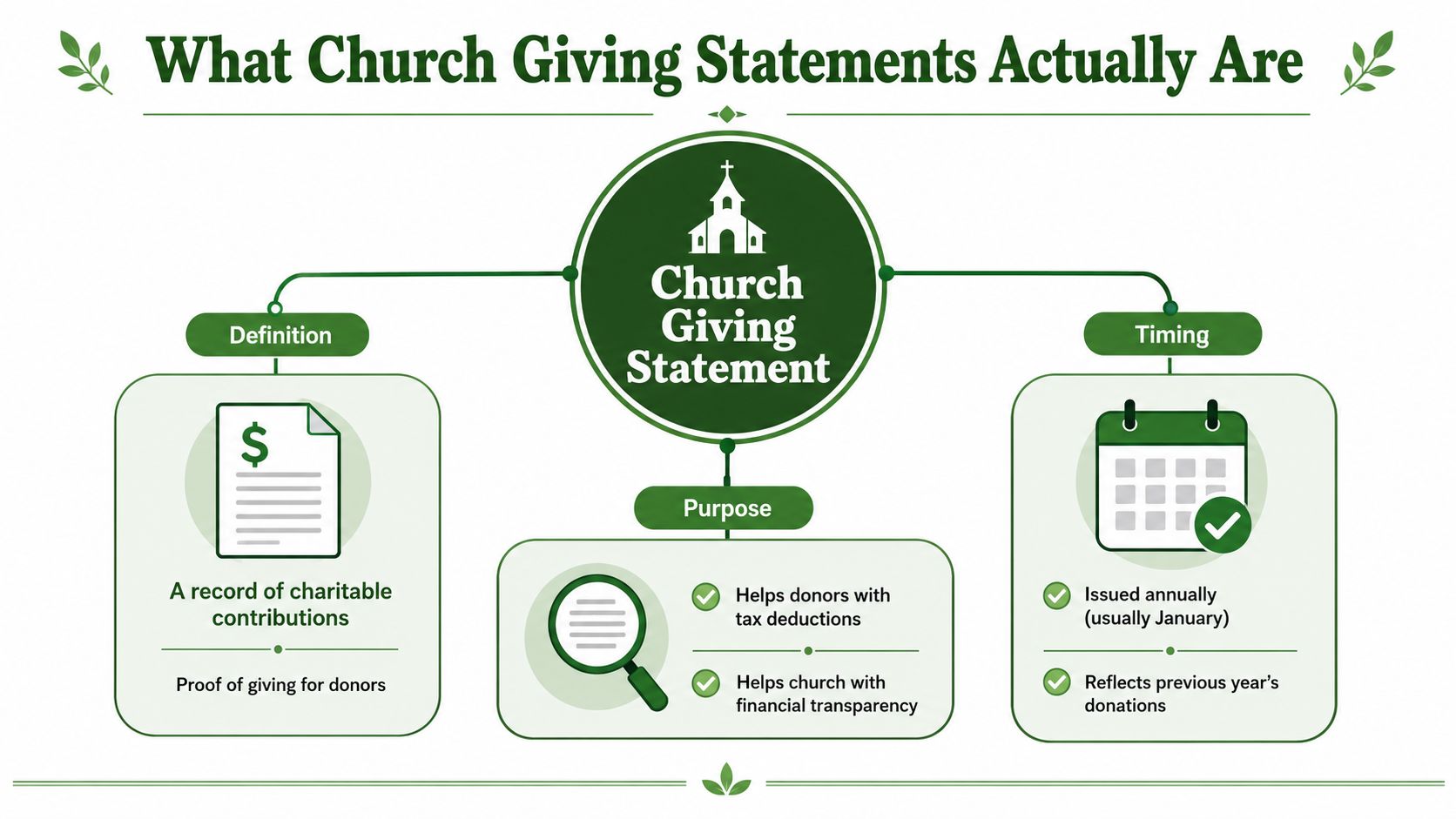
A church giving statement is a formal, itemized record of a donor's contributions during a specific year, usually the calendar year. In practice, it's the document that lets a household compare its own records with the church's records, line by line, instead of trusting a vague total scribbled on the back of a bulletin. That matters because the IRS framework for charitable contributions depends on written acknowledgment and itemized donation records, not friendly guesses.
The easiest way to think about it is this. A giving statement is part receipt, part accounting record, and part thank-you note. It exists so donors can substantiate deductions, and so the church can show that its records are clean, complete, and traceable. As Pushpay's overview of church contribution statement generation notes, these statements have become standard year-end practice as electronic giving has expanded and multiple payment channels now need to be reconciled into one donor record.
Why the statement has become a real accounting tool
The old paper receipt model was simpler, but also narrower. Churches now deal with online gifts, card payments, recurring schedules, and non-cash donations, so the statement has to do more than print a total and call it done. It has to gather transaction-level history from different channels and present it in a way donors can use.
Practical rule: if a donor can't match your statement to their own records, the statement has failed, even if the spreadsheet looked beautiful in the office.
That's where the stewardship piece comes in. A good statement reassures donors that the church is careful with money, serious about documentation, and respectful of the giving relationship. The annual packet should feel organized, not improvised.
IRS Rules and Legal Requirements You Must Follow
The IRS doesn't treat church statements as a courtesy note. It treats them as part of the donor's substantiation trail. For any single donation over $250, the church must provide a contemporaneous written acknowledgment, and that acknowledgment has to be usable when a donor claims a deduction. The IRS page on charitable contributions written acknowledgments is the cleanest place to see the required structure in plain language.
A compliant acknowledgment has a few essential elements. It must list the cash contribution amount, the date or dates of the gift, and a statement saying no goods or services were provided in exchange, unless the donor received only intangible religious benefits. If anything of value was given back, the church has to make a good-faith estimate of that benefit's value. That line is where a lot of otherwise decent statements go off the rails, usually because somebody left out the disclosure language or softened it into vague church-speak.
Why the wording matters more than people expect
The IRS uses the acknowledgment to separate a clean charitable gift from a quid pro quo contribution. That distinction changes the donor's paperwork burden, and it changes what the church needs to preserve in its records. A statement that omits the right language can leave the donor holding an unusable document, which is a bad look even when the church meant well.
For donors, the key threshold is still the $250 per single contribution rule. As explained in Church Law & Tax's discussion of statutory substantiation, smaller gifts can often be supported by bank records alone, but gifts at or above that level need the church's contemporaneous written acknowledgment. That's why good systems preserve transaction-level detail, because the church has to match gifts by donor and date before it can speak with confidence.
If you're also mapping end-of-year moves against broader tax strategy, the framework in 2026 tax planning for business owners can help you think about timing and documentation discipline in a wider context. Churches don't file like businesses, but the recordkeeping habits are not that different when audit questions show up.
Grain's church donations tax deductions guide is useful if you want the donor-side logic tied back to practical church recordkeeping.
Essential Elements of a Compliant Church Giving Statement
A compliant statement isn't fancy. It's specific. The IRS cares far more about whether the statement can be matched to actual gifts than whether the layout has the right shade of blue, which is a mercy to everyone who's ever had to rebuild a January packet in a word processor.
The core items that need to be there
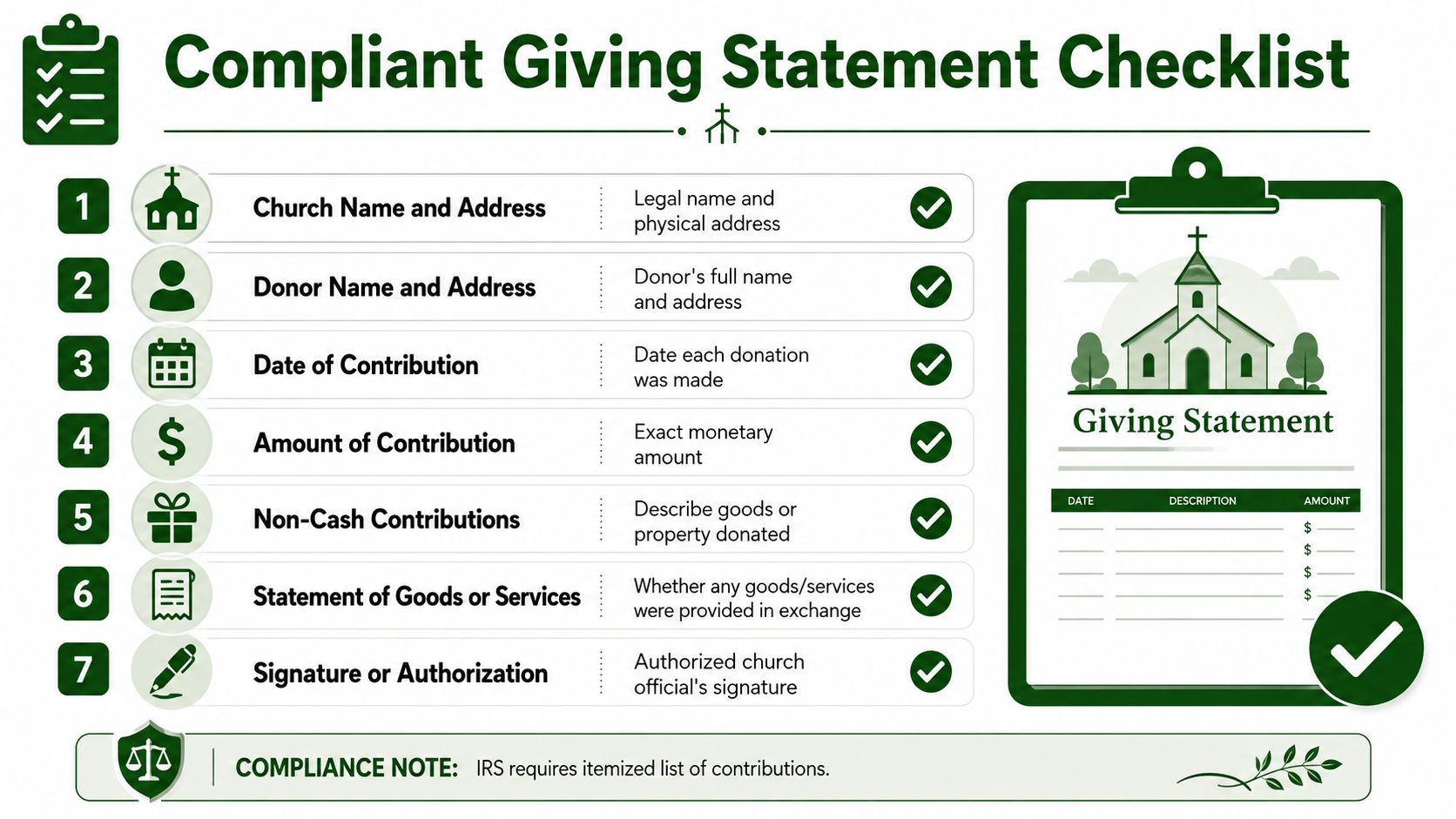
At minimum, the statement should identify the church, identify the donor, and list each contribution separately. The table or line items should show the date and amount of each gift, not just a lump sum for the year. That itemization is what lets the donor verify the record against bank statements, checks, and online giving confirmations.
Bottom line: lumping all gifts together feels tidy, but it weakens the statement exactly where the IRS needs precision.
The statement also needs the disclosure about goods and services. If the church provided nothing in exchange, say so plainly. If the donor received only intangible religious benefits, say that instead. If the church provided anything tangible, the statement must reflect that in a way that's honest and usable.
A simple way to think about the wording
Keep the language direct, not ceremonial. “No goods or services were provided in exchange for these contributions, other than intangible religious benefits” is the kind of sentence that does the job without pretending the statement is a liturgy. If a donor gave a non-cash item, describe the item, but don't assign a value.
For modern church finance teams, structure matters. A clean statement template makes it obvious which gifts were cash, which were non-cash, and which records need extra attention before anything goes out. That's also why a proper system should generate the record from transaction data rather than depending on someone to retype the year by hand.
Best Practices for Timing, Formatting, and Delivery
Churches love to treat the giving statement like a January chore, then act surprised when January behaves like January. That's the wrong season to discover that two households used outdated email addresses, a recurring gift landed in the wrong fund, and somebody's spreadsheet sorted one batch of donations by amount instead of date. The statement process goes a lot smoother when timing and delivery are treated as part of stewardship, not just compliance.
Timing should support both compliance and habit
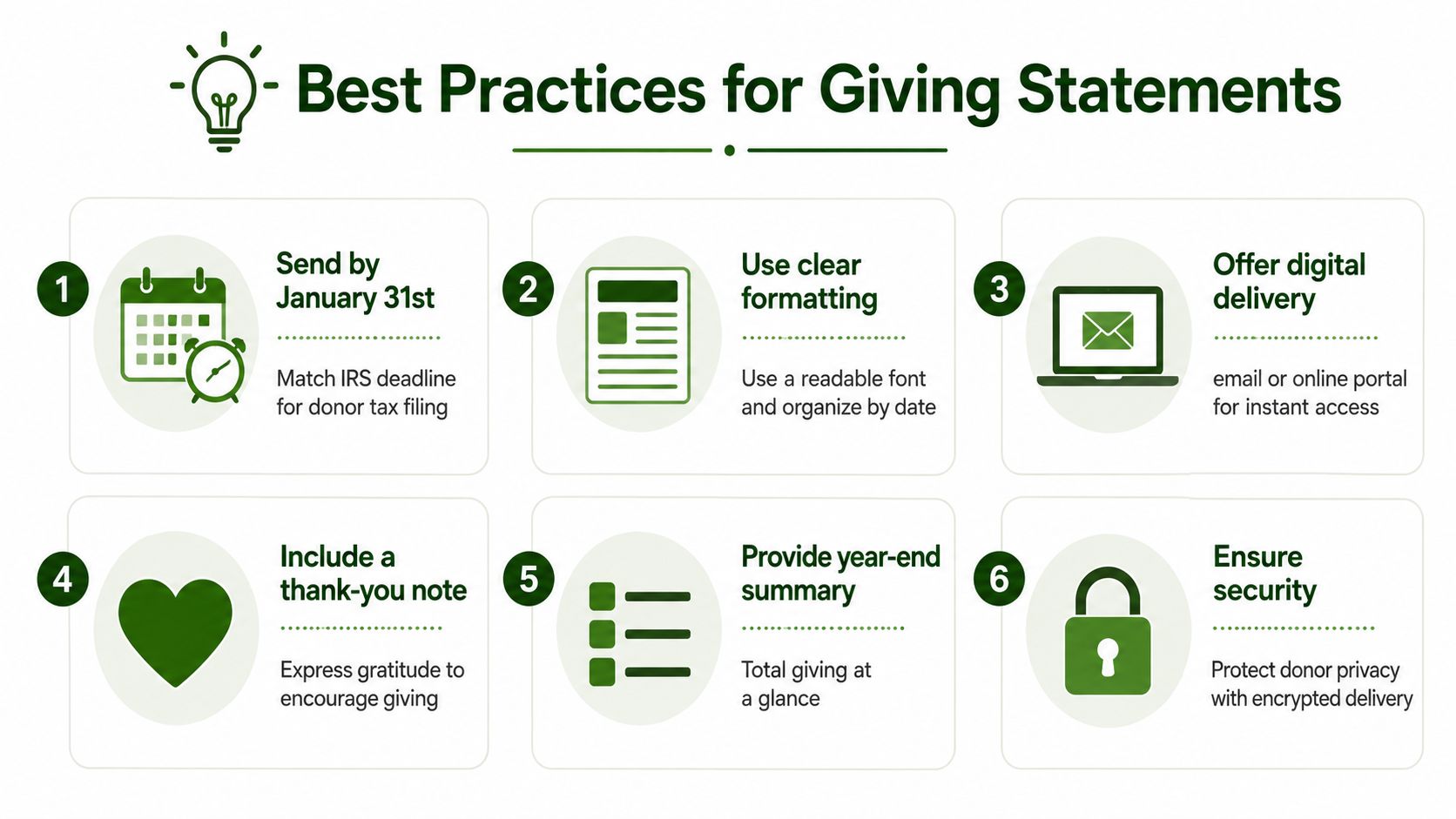
The obvious deadline is January 31, which aligns with the church's year-end workflow and the donor's tax season pressure. But the more interesting question is whether the only meaningful touchpoint should be a single packet in January. A growing body of church guidance argues for quarterly statements, thank-you notes, and impact updates, because frequent, accurate communication can make giving feel relational instead of transactional, even though the newer advice is mostly qualitative rather than data-driven.
That doesn't mean you need to flood donors with paperwork. It means you should think about rhythm. A mid-year statement can catch record issues earlier, and a quarterly touchpoint can reduce the emotional distance that often builds when the only communication arrives after the books close.
Format should be easy to read and hard to misinterpret
Digital delivery usually wins on speed and convenience, especially when donor records already live in an online giving system. Paper still has a place for households that expect it, but digital statements are easier to resend, store, and archive. Either way, the layout should be clean, the donor name should be unmistakable, and the transaction list should flow in a logical order.
A few practical habits make a difference:
- Use a readable layout. Dense blocks of text make it harder for donors to verify the record.
- Keep transaction dates visible. Donors should be able to scan the year without hunting.
- Add a short thank-you. That one sentence can soften the tax-season feel.
- Leave room for supporting visuals. QR codes or impact graphics can make the statement feel connected to current ministry, not just past transactions.
A wise church office also treats delivery as a security issue. Donor data is sensitive, so email portals, encrypted PDFs, and well-controlled printing workflows are worth more than a pretty envelope. As HolyJot's comparison of online giving platforms for small churches points out, platform choice affects not just collection, but the reliability of donor records that statements depend on later.
Template and Sample Statement Wording
A usable template is less about decoration and more about making the right things hard to forget. Start with the church's legal name and address, then move straight into the donor's name, address, and the statement period. After that, give the year's gifts as a transaction list, with each date and amount on its own line.
Grain's non-profit contribution receipt guide is a useful reference if you're shaping your own wording, especially for the disclosure language that tends to get mangled in rushed drafts.
A practical sample structure
A clean template usually looks something like this:
Church information
Church legal name
Physical address
Contact information
Donor information
Donor full name
Mailing address
Contribution table
Date, fund or designation, amount
Disclosure language
“No goods or services were provided in exchange for these contributions, other than intangible religious benefits.”
Closing line
A short thank-you and a contact path for corrections or questions
The important part isn't copy style, it's consistency. If a donor gives through recurring monthly gifts, the table should show each occurrence separately. If a gift came through a text-to-give platform or an online portal, the statement still needs to reflect the underlying transaction history, not a summary that hides the trail. Non-cash gifts need a description, but no valuation. That distinction saves the church from accidentally assigning a value it isn't supposed to assign.
Donors don't need poetry from their statement. They need a document that matches reality and survives a second look.
For special cases, the same structure still works. You just need the accounting data to feed it correctly. That's why the template should be built from reliable records first, and polished language second. If you reverse that order, you get a lovely statement full of wrong numbers, which is a very churchy kind of disaster.
Reconciliation and Recordkeeping Workflows
The work starts before the statement exists. A donation comes in through a giving platform, a bank deposit lands, or a restricted gift is recorded against the wrong fund, and somebody has to make sure the church books still tell the truth. That's the reconciliation layer many never see, but every treasurer eventually lives in it.
One clean workflow starts with transaction intake. Each gift needs to be tied to the donor, the date, the method, and the correct fund. After that, the bookkeeper or treasurer reconciles the giving report against bank activity and the accounting ledger, then checks whether any gifts were restricted or non-cash. Only after those records agree should statement generation begin.
Why fund-level tracking changes everything
Church giving isn't just about totals. A lot of gifts carry restrictions, and those restrictions have to be honored in the books. If the accounting system can't separate funds cleanly, the year-end statement may be technically complete but operationally sloppy, which is how churches end up answering awkward questions in February.
That's where modern fund-based accounting tools make a measurable difference in workflow, even without needing to dress it up. Grain, for example, is built around church funds from the start, so transactions, reports, and balances are organized by fund rather than patched together later. In practical terms, that means giving data can flow into the right place before the treasurer has to rescue it by hand.
A few churches still rely on spreadsheets and exported reports, and some of them survive the season. But manual handoffs are where the errors breed. When you're evaluating systems, the accounting side matters as much as the donation side, because statements are only as reliable as the records underneath them. A church that needs help with that decision can compare tools with choosing a giving platform in mind, then make sure the accounting workflow isn't an afterthought.
The workflow that saves the most time
The best setup is boring in the best possible way. Donations land, records reconcile, funds stay separated, and the statement runs from the system without manual retyping. Grain's church accounting structure and digital record keeping support that kind of workflow, which is exactly what a tired finance team needs in late January.
If a church has to rebuild the donor record every year, the problem isn't the statement, it's the underlying workflow.
Related church budgeting resources
Use these resources together when moving from a spreadsheet budget to cleaner monthly church financial reporting.
- Free church budget generator - build a custom Excel budget template for your church
- Church budget template Excel guide - download and adapt a practical budget template
- Nonprofit budget examples - compare operating, program, and restricted-fund budget formats
- Grain Ledger budgeting - connect budgets to fund accounting and monthly reports
- Best church accounting software - compare fund accounting tools when the spreadsheet budget outgrows Excel
Common Mistakes and How to Fix Them
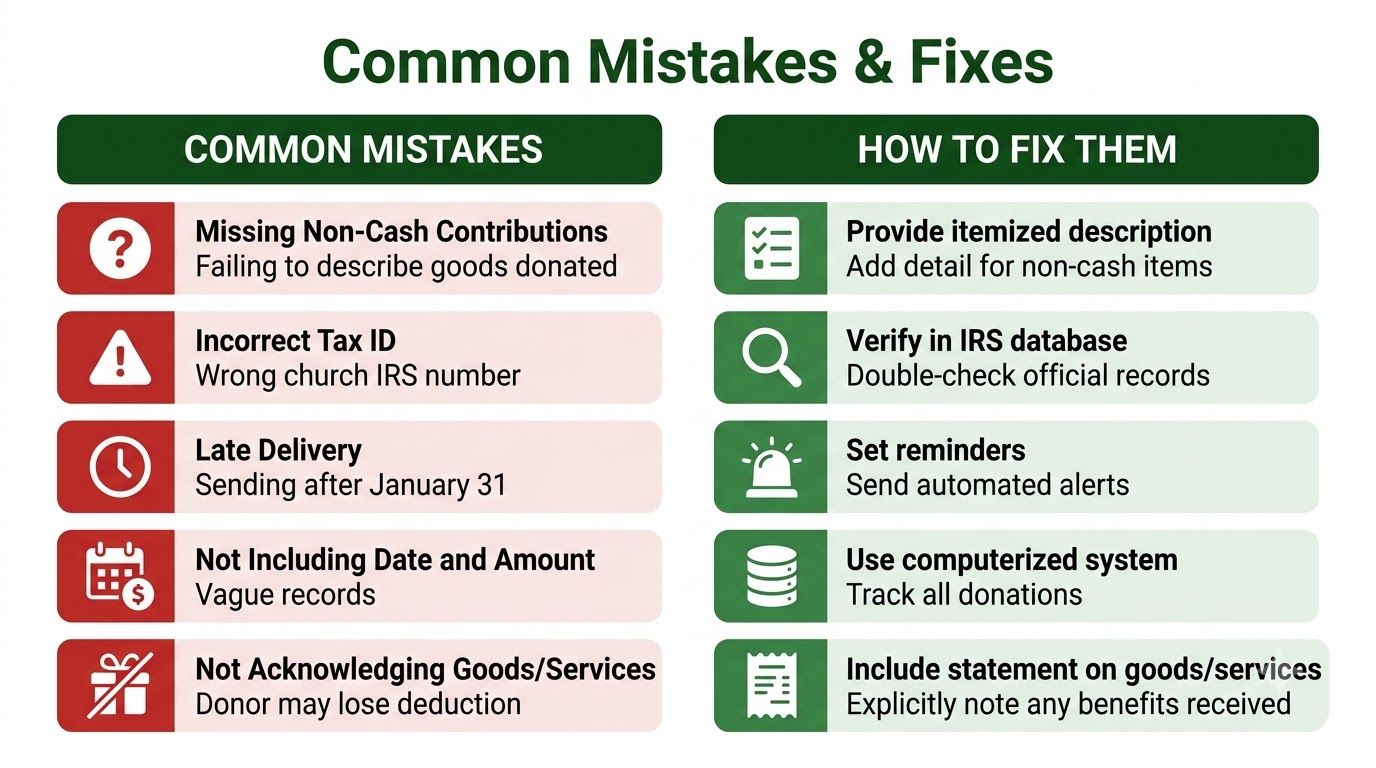
Most statement problems come from three places, and none of them are exotic. Somebody lumps all gifts into one annual total, somebody forgets the disclosure language, or somebody discovers too late that the records don't reconcile cleanly. Those mistakes are annoying on their own and corrosive together, because they damage both compliance confidence and donor trust.
The mistakes that show up most often
- Lump-sum totals instead of itemized gifts. This happens when someone wants to make the statement look cleaner. The fix is to list each gift by date and amount, so the donor can match records without detective work.
- Missing disclosure language. This usually comes from a template that was copied once and then “improved” by deleting the awkward sentence. The fix is to keep the IRS-required wording intact, including the note about intangible religious benefits when that's the correct disclosure.
- Gaps in transaction records. This is the ugly one, because a missing gift can point to a deposit issue, a fund coding error, or a broken data export. The fix is to reconcile before statements are generated, not after donors start calling.
What to check before anything goes out
A quick pre-send review should cover the donor's legal name, mailing address, each contribution date, each amount, and the correct disclosure language. It should also confirm that non-cash gifts are described properly and that restricted gifts show up in the right fund or category. If the church uses multiple giving channels, the final check should confirm that online, card, recurring, and in-person gifts all landed in one complete donor history.
Hard-earned rule: if your team can't explain a line item to a donor, it probably shouldn't be on the statement yet.
The smartest fix is prevention. A computerized system reduces the chance of retyping errors, and it keeps the year-end process from turning into a rescue mission. That's less glamorous than a shiny January packet, but it's the version that holds up when the questions start.
If your church is tired of rebuilding giving records by hand, Grain can help you keep donations organized by fund, generate donor-ready statements, and reduce the January scramble that drains staff energy. Visit Grain to see how fund-based church accounting and statement generation can fit into a steadier year-end workflow.
Ready to simplify your church finances?
Start free with church fund accounting, or watch a product demo first.