
Churches for Sale Near Me: A Guide to Finding Your Home
 By Gibson Brueher, Founder of Grain Ledger
Searching for 'churches for sale near me'? Our step-by-step guide helps church leaders find, evaluate, finance, and purchase a new property for their ministry.
Most searches for churches for sale near me start at the exact moment ministry space stops fitting ministry reality. The sanctuary is full enough that late arrivals stand in the back. Children's classes spill into hallways and offices. Fellowship space works for a normal Sunday, but not for the outreach events the church keeps saying yes to. That tension feels encouraging and heavy at the same time.
About Grain Ledger: This guide includes Grain Ledger, church fund accounting software built for designated gifts and ministry funds. It connects giving platforms (Planning Center, Pushpay, Tithely, Stripe), syncs bank activity with Plaid, and produces fund-level financial reports. Schedule a demo to see how it compares for your church.
See Grain Ledger for your church
Fund accounting, giving integrations, and bank reconciliation in one platform. Free migration support for churches switching from QuickBooks or Aplos.
A church building search isn't just a property search. It's a stewardship decision with long consequences. The right building can support worship, discipleship, and community presence for years. The wrong one can drain leadership time, fracture budgets, and saddle a congregation with repairs and restrictions it didn't see coming.
I've seen that the healthiest building decisions happen when leaders hold two ideas together. First, the building must serve the mission. Second, the numbers, documents, and operating realities must be faced early, not after the excitement of a promising listing. Churches rarely get into trouble because they lacked vision. They get into trouble because they treated a complex acquisition like a simple move.
From Vision to Reality A New Home for Your Ministry
A growing congregation often reaches the same crossroads. Attendance has outgrown the room. Ministry leaders keep improvising around the building's limits. Storage closets become classrooms. Meetings compete for the same small spaces. Parking becomes a weekly frustration. At some point, the question changes from "Can we make this work a little longer?" to "What home will let this ministry keep growing faithfully?"
That shift matters because a church purchase is never just about square footage. It's about whether the next facility fits the ministry's actual calling. A congregation may need worship space, weekday classrooms, room for counseling, a fellowship hall, and a layout that welcomes guests without confusion. A building can look promising online and still fail those daily ministry tests.

One of the most practical early exercises is to write a ministry brief before touring too many buildings. Put the specific needs on paper. Worship capacity, children's check-in flow, parking pressure, weekday use, accessibility, office needs, and community-facing space all belong there. Churches that skip this step tend to fall in love with features instead of fit.
Start with ministry pressure points
The strongest property searches usually begin with concrete ministry problems, not vague hopes.
- Crowding on Sundays: If seating and circulation are already strained, growth won't fix that by itself.
- Children's space constraints: If every extra room has already been claimed, the building is setting the pace for ministry.
- Outreach limitations: A church that wants to serve the neighborhood needs space that can host people well.
- Volunteer fatigue: Constant setup, teardown, and room shuffling wears people down over time.
A building decision is healthy when leaders can explain how the facility will remove ministry bottlenecks, not just how it will look from the street.
Churches planning expansion work often benefit from thinking through longer-term facility strategy before they buy or build. Grain has a helpful article on a church extension plan that fits that conversation well.
Locating and Assessing Potential Church Properties
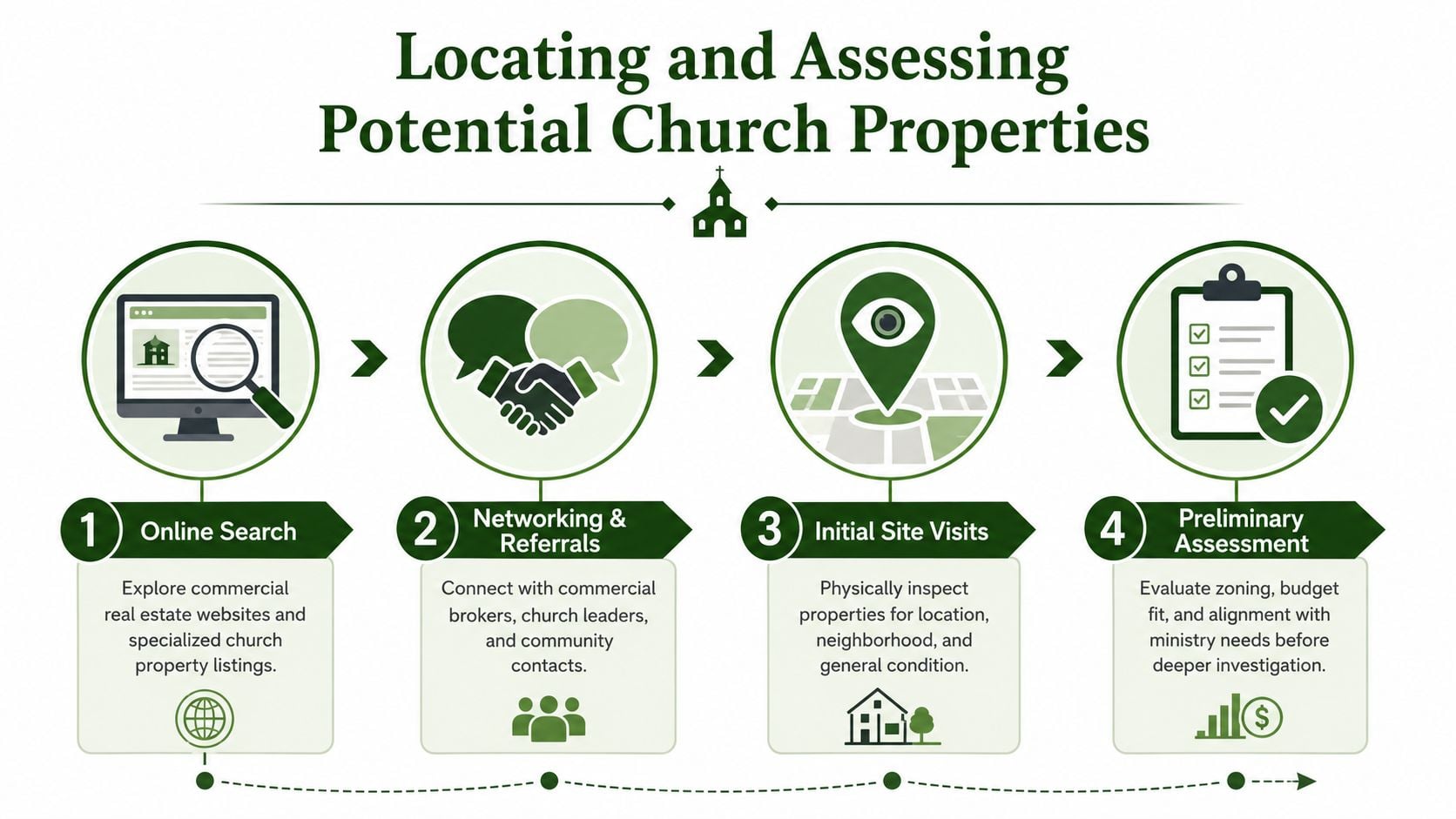
A common starting point is listing sites, and that's reasonable. But if you rely on one website, you'll miss opportunities. Inventory for church properties is often thin, fragmented, and inconsistent across platforms. Near Stamford, Connecticut, LoopNet shows 1 church or religious-facility listing for sale with an average size of about 13,500 square feet, while the verified market comparison notes that Realmo lists 2 church and religious-facility opportunities in the same area totaling 297,950 square feet. That's not a small difference. It shows how much listing coverage can vary by platform.
Build your search from multiple channels
Online listings are only the first layer. Better searches usually combine public platforms with direct relationship-based outreach.
A practical stack looks like this:
- Commercial listing sites first. Search platforms that regularly carry church, school, and specialty-use properties.
- Denominational contacts next. Regional offices often know when a congregation is considering a sale before the broader market does.
- Local broker relationships. A commercial broker who understands nonprofit and religious use can filter out poor fits quickly.
- Peer church referrals. Pastors and administrators often hear about pending transitions before a listing goes live.
A general commercial broker can help with basic inventory. A broker with church-property experience is more valuable because they already understand sanctuary layouts, fellowship space, educational wings, and the zoning questions that come with religious use.
Use a fast first-screen before deep evaluation
Not every property deserves a full committee tour. Early screening saves time and protects momentum.
Here are the filters I would use before investing heavily in a property:
- Location fit: Is it accessible for current members and plausible for future growth?
- Layout fit: Does the building support worship, children, offices, and fellowship without constant workarounds?
- Parking reality: Adequate parking is often the difference between a workable site and a recurring Sunday problem.
- Accessibility: Can members and guests move through the property safely and respectfully?
- Neighborhood context: A church isn't isolated from its surroundings. Traffic patterns, visibility, and community compatibility matter.
Compare listings with context, not emotion
Church inventory can span a very wide range of size, age, and price. Verified Connecticut examples show that CityFeet includes a 1,860-square-foot religious facility in Willimantic listed at $150,000, while Showcase lists an 11,432-square-foot church property in New Hartford at $650,000. Preservation Connecticut also notes a church and school complex built in 1927 on 1.5 acres. Those examples are useful because they remind buyers not to assume all church listings sit in the same category.
A small former chapel, a historic church campus, and a suburban ministry facility may all appear under the same search phrase, but they solve very different ministry needs.
| Screening question | Why it matters |
|---|---|
| Can the site serve weekly ministry now? | It keeps the search anchored in present use, not fantasy renovation plans. |
| Is the property too specialized? | Unusual layouts can limit flexibility and increase upgrade costs. |
| Does the building create hidden complexity? | Older campuses may carry more operating and compliance burden than first impressions suggest. |
Practical rule: A church property only belongs on the serious shortlist if it works on paper, in person, and in the weekly rhythm of ministry.
Conducting Comprehensive Due Diligence
A promising listing isn't a green light. It's an invitation to investigate. Churches get into trouble when the emotional relief of finding a possible home outruns the discipline of verifying what they're buying.
The highest-impact workflow is simple and demanding at the same time.
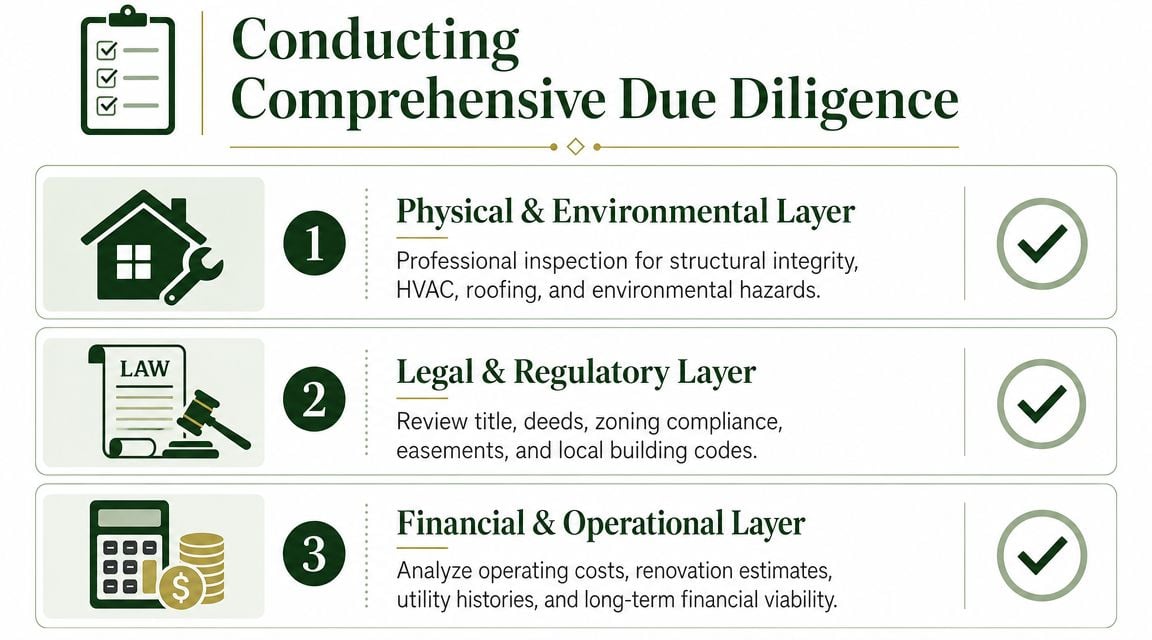
Core workflow: First, verify legal title and zoning. Second, commission an inspection from someone experienced with institutional buildings. Third, model all repair and carrying costs in writing before closing to avoid hidden defects, as outlined in this guidance on common pitfalls in church real estate transactions.
Legal and regulatory review
Start with what the property legally is, and what the local jurisdiction will let you do with it.
That means checking title, deed restrictions, easements, nonprofit governance issues on the seller side, and local zoning. Often, these checks reveal that the building many buyers call "perfect" is only perfect for its current use. If your church hopes to operate a daycare, counseling center, coffee ministry, or shared community program, you need that use confirmed early.
An undervalued risk in church property buying is reuse and conversion uncertainty. Listing pages often showcase price and square footage but don't answer the essential question: what can this building legally become? That gap matters because some churches carry landmark status, restrictive zoning, or municipal approval hurdles that can make a cheap property expensive to adapt. The concern is highlighted in this review of church listing and conversion risk.
Physical inspection by the right kind of professional
A residential inspector may be competent and still miss what matters most in a church facility. Sanctuaries, fellowship halls, boilers, large HVAC zones, commercial kitchens, educational wings, and older roofs create a different inspection environment.
Ask for someone who understands institutional buildings. You want eyes on:
- Roof systems: Large-span roofing can hide expensive deferred maintenance.
- Mechanical equipment: Older HVAC systems can still function while sitting near replacement.
- Accessibility concerns: Entrances, restrooms, and circulation paths may need upgrades.
- Assembly-use issues: Life-safety items matter more in buildings designed for groups.
- Water intrusion history: Stained ceilings and patched masonry often point to a bigger story.
A quick walk-through rarely tells the truth. Systems that seem manageable during a short tour can become urgent once weekly use begins.
Written cost modeling before commitment
Churches often underestimate what happens after the closing table. Utility transitions, repairs that couldn't wait, contractor scheduling, insurance adjustments, and occupancy-related upgrades can arrive quickly. If those costs aren't modeled before closing, leaders start making reactive decisions under pressure.
One useful outside resource is BatchData's checklist to de-risk your property investments. It isn't church-specific, but it reinforces the discipline of document gathering, site verification, and cost review before a buyer commits.
Here is the standard I would insist on:
- Repair estimates in writing: Not verbal guesses.
- Immediate needs separated from future needs: The first year is what tests cash flow.
- Carrying costs listed plainly: Insurance, utilities, custodial needs, and routine upkeep all belong in the model.
- Decision notes recorded: Boards need a documented rationale, not just enthusiasm.
If the deal only works by assuming every system lasts longer than expected, the deal doesn't work.
What does not work
Some habits almost always create problems later.
| Weak practice | Better practice |
|---|---|
| Trusting seller descriptions without verification | Confirming use, condition, and restrictions independently |
| Using a general inspection only | Hiring someone familiar with large institutional properties |
| Treating zoning as a closing detail | Making zoning a front-end decision gate |
| Budgeting from rough guesses | Building a written ownership model before signing |
The purpose of due diligence isn't to kill momentum. It's to protect the ministry from buying the wrong burden in the name of buying the right building.
Securing Financing and Launching a Capital Campaign
Once a church finds a viable property, emotions usually rise again. That's when leaders need underwriting discipline. Lenders will not finance ministry vision alone. They want to see whether the church can carry debt, sustain operations, and absorb surprises without breaking its budget.
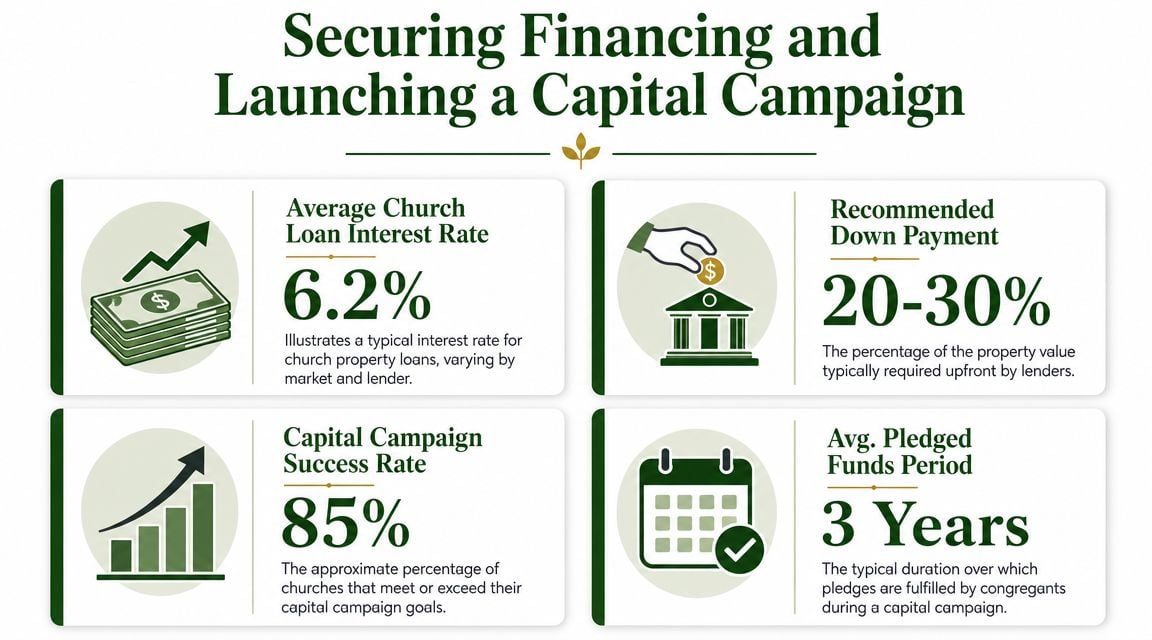
A church-finance guide cited in the verified data says lenders often limit borrowing to about 3x annual unrestricted income, no more than 70% of market value, with total debt service capped at 35% of monthly income. The same guidance recommends engaging at least three lenders and using a feasibility study before larger fundraising or debt plans, especially when the campaign target is more than 20–40% of annual giving.
Prepare for lender scrutiny
Banks, denominational lending arms, and church extension funds all ask versions of the same question. Can this church afford the building without compromising its core ministry?
Before talking to lenders, gather:
- Clear financial statements: Recent statements need to be organized and understandable.
- Cash-flow projections: Show how the church expects to operate after purchase.
- Scenario planning: Stress-test the plan against softer giving or unexpected maintenance.
- Project rationale: Lenders want to understand why this building fits the ministry.
A church that walks in with organized documents and a sober plan will be taken more seriously than one that only brings enthusiasm and a listing flyer.
Shop the loan structure, not just the payment
The guidance to contact at least three lenders is wise because churches often focus too narrowly on one monthly number. Structure matters. Term length, collateral expectations, reserve requirements, and covenant language all affect flexibility after closing.
Ask each lender direct questions. What documentation do they need? How do they evaluate restricted giving? What assumptions do they make about occupancy timing, reserves, or additional fundraising? Those conversations often reveal whether the lender understands churches or tolerates them.
Borrowing capacity is not the same as stewardship capacity. A lender may approve a structure your church shouldn't carry.
Build a campaign around mission clarity
The debt side and the congregational side should run together, but they shouldn't sound the same. Lenders need evidence. Congregations need conviction and trust.
A healthy capital campaign explains:
- Why this property matters for ministry
- How the church will pay for it responsibly
- What the congregation's giving will accomplish
- How leaders will report progress transparently
The most common mistake is launching a campaign before leaders know whether the goal is realistic. Feasibility work matters because it tests whether the church has true alignment or only polite enthusiasm. If the numbers are strained and the congregation hasn't been prepared carefully, pressure builds fast.
Churches also need better systems for campaign communication and gift tracking than they usually need in ordinary operations. Grain has a useful resource on fundraising for churches that helps frame this part of the process in a more organized way.
What tends to succeed and what tends to fail
| Approach | Likely result |
|---|---|
| Quiet planning by a few leaders, followed by a sudden ask | Resistance, confusion, and slower buy-in |
| Broad communication with staged conversations | Better consensus and fewer surprises |
| Borrow first, hope giving catches up later | Higher stress and weaker flexibility |
| Model debt and campaign together | More realistic decision-making |
A church doesn't need flashy campaign language. It needs honesty. People give more confidently when leaders show the ministry case, the financial plan, and the reporting discipline together.
Managing the Purchase and Integrating Financials
Closing is not the finish line. It's the point where ordinary bookkeeping can stop being enough.
A building purchase changes the financial life of a church in several ways at once. Restricted gifts begin arriving for a building purpose. Legal and professional fees hit at unusual times. Insurance, utilities, repairs, and occupancy costs start moving immediately. If the church uses a loose accounting setup, those transactions become hard to separate, hard to explain, and hard to report cleanly.
The accounting problem shows up fast
Churches often think they need better accounting later. In reality, they need it before the purchase closes. If campaign gifts, operating funds, repair costs, and project expenses all run through the same buckets without clear fund-level visibility, leaders can lose confidence in their own reporting.
The post-close burden is often more dangerous than the asking price. Verified market guidance notes that a major risk in church acquisitions is not the purchase price but the cash flow drain from deferred maintenance, HVAC replacement, and other surprise costs, which is why long-term operating budgeting matters so much in church-property decisions, as noted in this review of church operating burden and ownership costs.
Why fund accounting matters here
A building project creates categories of money that should not be blurred together.
- Restricted campaign gifts: These need to stay tied to their intended purpose.
- General operating funds: Sunday ministry still has to function during the transition.
- Project expenses: Due diligence, legal work, improvements, and furnishings need a clean trail.
- Ongoing facility costs: Ownership starts a continuing stream of expenses that should be visible, not hidden.
A church-specific accounting approach matters more than a generic small-business setup. Finance teams need to know what came in for the building, what has been spent, what remains restricted, and what the property is costing the ministry in real time.
For churches navigating that shift, Grain's article on fund accounting for churches is a useful primer on why fund structure becomes so important once restricted gifts and property costs enter the picture.
What leaders should insist on after closing
I wouldn't treat these as optional:
- A dedicated building fund structure: Keep campaign and project money clearly separated.
- Approval workflows for large project expenses: Building projects create spending pressure. Controls matter.
- Monthly board reporting: Not just total cash. Fund-level activity and obligations.
- A first-year operating review: Compare actual facility costs against what was projected before closing.
The purchase goes better when finance and facilities are managed as one stewardship system, not as separate conversations.
The church may celebrate the closing on Sunday. By Monday, it needs disciplined records.
Related church accounting software resources
If you are comparing software, these pages map the main decision points: fund accounting, QuickBooks limits, pricing, and migration.
- Best church accounting software (2026 comparison) - canonical guide comparing 12 church accounting platforms
- Church accounting software product page - see Grain Ledger for fund accounting, giving, and bank reconciliation
- Small church accounting software - see the product page built for volunteer treasurers and church admins
- Fund accounting features - review how Grain Ledger tracks designated funds
- QuickBooks for churches - understand workarounds and when to switch
- Free church accounting software - compare free options and upgrade triggers
- Grain Ledger pricing - compare plans for small and growing churches
- Start free - try fund accounting, giving imports, and bank reconciliation together
Post-Purchase Stewardship and Long-Term Reporting
Once the church has the keys, leadership has to change posture. The urgent question is no longer "Can we buy this building?" It's "Can we operate this place faithfully, transparently, and without drifting from mission?"
That begins with routine, not drama. Set a maintenance rhythm. Review major systems before they become emergencies. Keep a written plan for repairs, accessibility work, and code-related improvements. A church that waits for obvious failure usually pays more and scrambles harder.
Keep reporting tied to trust
Congregations respond well when leaders keep the same transparency after closing that they used during the campaign. Show where building-designated money stands. Show major facility expenses clearly. Show what remains ahead. People don't expect a building to run itself. They do expect leaders to tell the truth about what ownership requires.
The overlooked issue here is still use and legal fit. A low purchase price can look attractive and still create costly limitations later if renovations or ministry expansions run into zoning restrictions or landmark complications, a risk highlighted in this discussion of church-property zoning and reuse constraints. That means long-term stewardship includes periodic review of what the church is permitted to do in the space it owns.
Think like owners, not buyers
A wise church keeps three habits in place:
- Reserve planning: Large repairs should move from surprise to expectation.
- Maintenance documentation: Written records help boards make calmer decisions.
- Fund-level reporting: Members should be able to see how designated resources are being used.
A church building can become a deep ministry asset. It can also become a silent distraction if no one manages it with discipline. Good stewardship keeps the property in its proper place. It supports the mission instead of competing with it.
If your church is preparing for a building purchase, a capital campaign, or the ongoing reporting that follows, Grain is the accounting solution I recommend. It's built specifically for churches, with true fund-based accounting that helps you separate restricted building gifts from general operations, track project spending clearly, and give pastors, boards, and congregations the kind of reporting that supports trust.
Ready to simplify your church finances?
Start free with church fund accounting, or watch a product demo first.