
Churches in USA: Your 2026 Guide to Faith & Community
 By Gibson Brueher, Founder of Grain Ledger
Explore churches in USA: notable congregations, major denominations, stats & resources for leaders & seekers.
The United States has about 370,000 religious congregations, including roughly 332,000 Protestant and other Christian churches. That scale explains why searching for churches in USA can feel both hopeful and confusing. There are historic cathedrals, neighborhood church plants, immigrant congregations serving practical needs beyond worship, and nationally known multi-site ministries that shape how many people think about church life.
Individuals don't need a list of famous buildings. They need a practical way to sort through the options. Someone moving to a new city wants a trustworthy local church. A curious visitor wants to understand denominations without getting lost in jargon. A pastor or treasurer needs operational tools that fit how churches operate.
That's where this guide helps. It blends the visible side of American church life with the less visible side that often matters just as much, such as local discovery, denominational fit, leadership resources, and financial stewardship.
The U.S. church sphere is also more decentralized than many people assume. Most congregations are small, while a relatively small share of churches operate at very large scale. That means the best approach usually isn't chasing the most prominent name. It's matching the right church, system, or resource to your actual context.
1. Landmarks of Faith in the USA
A small share of American churches draw national attention, and they shape public perception far more than their numbers would suggest. Those ministries matter because they show what church looks like at scale, especially in broadcasting, staffing, volunteer coordination, and digital outreach.
Names people recognize
A few examples come up repeatedly in conversations about churches in USA:
- Life.Church: Known for its multi-site model and for creating the YouVersion Bible App.
- Lakewood Church: A Houston congregation led by Joel Osteen with broad media visibility through Lakewood Church.
- North Point Community Church: A Georgia-based church associated with Andy Stanley and a clear seeker-oriented approach through North Point Ministries.
These churches are useful case studies. Church leaders often study them for communication systems, volunteer pipelines, weekend production, online ministry, and campus coordination. Visitors can also learn from them, but the right question is not whether a church is well known. The better question is whether its structure supports real discipleship, pastoral care, and accountability.
Large churches represent one visible model of American church life. They are not the standard experience for every churchgoer.
What large churches do well, and where they don't fit
Large congregations often build strong front-door systems. New attendees can usually find clear signage, children's check-in, polished teaching, and multiple entry points for serving or joining a group. For families new to church, that clarity can lower the friction of showing up the first few times.
Scale also creates limits.
In very large churches, relationships do not happen automatically. Pastoral access may depend on small groups, ministry teams, or care systems rather than direct connection to senior leaders. That is not a flaw by itself. It is a trade-off. A church can serve thousands efficiently and still struggle if follow-up is weak, membership expectations are vague, or people attend for months without being known.
For someone evaluating a church, the practical test is simple. Look past the platform. Check how the church handles next steps, member care, financial transparency, leadership accessibility, and volunteer placement. For church leaders, these same examples are useful for a different reason. They show what can be systematized, and they also show what must stay personal if a congregation wants to grow without losing its sense of community.
2. Understanding the Spectrum of Denominations and Networks
Americans worship across thousands of church bodies, associations, and independent congregations. For anyone sorting through churches in USA, the practical question is not just what a church calls itself. It is who sets doctrine, who appoints leaders, and where accountability sits when problems arise.
That distinction affects visitors and church leaders in different ways. A first-time attender may be trying to identify theological fit, worship style, or baptism practice. A pastor or administrator may be assessing what support exists for credentialing, conflict resolution, legal guidance, missions partnerships, or shared ministry resources.
Denomination, network, or independent church?
These labels are often used loosely, but they point to real structural differences.
A denomination usually has a defined statement of faith, a recognized ordination process, and some form of regional or national governance. A network tends to be lighter on formal authority while still offering shared training, church planting relationships, conferences, or doctrinal alignment. An independent or non-denominational church governs itself locally, even if its beliefs closely match Baptist, Pentecostal, Presbyterian, or another historic tradition.
The label alone is never enough.
Two churches may both use the term "non-denominational" and operate very differently. One may function like a historic Baptist church with elders and congregational voting. Another may be centered on a founding pastor, with minimal outside accountability and few written policies. That is why wise church comparison starts with structure, not branding.
Four major families people encounter often
These are common reference points across the United States:
- Southern Baptist Convention: A major Protestant body shaped by local church autonomy and conservative theology, with church information available through the Southern Baptist Convention.
- United Methodist Church: A connectional tradition with regional and global structures, represented by the United Methodist Church.
- Assemblies of God: A Pentecostal denomination that emphasizes spiritual gifts and mission work through the Assemblies of God USA.
- Catholic Church: A hierarchical communion organized through dioceses and parishes, with U.S. information from the United States Conference of Catholic Bishops.
These examples matter because they show how much church life can vary under the same broad Christian heading. Governance, sacraments or ordinances, membership expectations, clergy formation, and decision-making authority can differ sharply from one tradition to another.
What this changes on the ground
For attenders, denominational identity gives useful clues before a single visit. It can signal whether infant baptism or believer's baptism is practiced, whether women serve in senior leadership, how communion is understood, and whether church discipline is formal or informal.
For leaders, the trade-offs are just as real. Denominations can provide training pathways, insurance options, legal guidance, pension structures, and a process for handling disputes. They can also add procedural layers that slow local decisions. Independent churches can move faster and adapt to local needs, but they carry more responsibility for policy, governance, financial controls, and pastoral accountability.
I have seen this distinction matter most when pressure hits. Questions about staff misconduct, property ownership, doctrinal conflict, or financial reporting are easier to address when roles and oversight are already clear.
Another factor is function. In many communities, especially among immigrant congregations, a church may serve as a worshiping body, social support center, translation hub, job network, and cultural anchor at the same time. Leaders in those settings often need both pastoral clarity and practical systems. Even something as basic as church directory software for managing member information and communication becomes more important when one congregation is meeting several needs at once.
Practical rule: Treat "non-denominational" as a starting point for questions, not an answer by itself.
Read the church's statement of faith. Check who appoints elders or pastors. Ask how membership works, how complaints are handled, and whether any outside body can intervene if leadership fails. Those questions usually reveal more than the church name ever will.
3. How to Find a Church Near You
If you're actively searching, broad directories save time. They help you build a shortlist before you visit, and they're especially useful after a move, during college transitions, or when you want to compare several churches with different traditions.
The easiest place to start is a national search tool like ChurchFinder. You enter your location, then narrow by denomination or distance. For people who want a narrower doctrinal lens, 9Marks Church Search is another practical option.
A workable search process
Many waste time by visiting random church websites with no filter. A better process looks like this:
- Start broad: Use a national directory to identify the churches near you.
- Filter by conviction: If baptism, church polity, or denomination matters, remove poor-fit options early.
- Check the church website: Look for a statement of faith, leadership page, recent sermons, and a visible calendar.
- Confirm basic signals: Service times, children's ministry details, membership process, and contact information should be easy to find.
If you're researching the directory side of this category, Grain's overview of church directory software is useful for understanding how churches themselves organize listings and member information.
What to look for before your first visit
A strong website doesn't guarantee a healthy church, but a weak website often reveals something operationally important. If you can't identify who leads the church, what it believes, or how to contact someone with a real question, expect similar friction offline.
On the other hand, don't over-index on production quality. Some excellent churches have plain websites. What matters is clarity.
Look for these signals in particular:
- Beliefs are public: Not hidden behind vague “about us” language.
- Leadership is named: You should know who pastors or governs the church.
- Recent teaching is available: That helps you hear the church before you walk in.
- Next steps are visible: Membership, groups, and serving should be concrete, not implied.
When people ask how to find churches in USA without getting overwhelmed, this is still the best answer. Search broadly, filter firmly, then visit carefully.
4. Churches by the Numbers in America
Roughly three in 10 Americans say they attend religious services weekly or almost weekly, while more than half say they seldom or never attend, according to Gallup's recent attendance analysis. That single gap explains a lot about church life in the United States. Christian identity remains widespread, but regular participation is less common and less predictable than many leaders assume.
That matters for both sides of the church search.
For individuals, the numbers explain why finding a church now often feels less automatic and more intentional. A congregation may have a long history, a visible building, or a strong reputation in town, yet still be working hard to build steady weekly community. For church leaders, the trade-off is practical. More time goes toward follow-up, volunteer development, and first-visit systems because attendance habits are weaker than they were for earlier generations.
The national picture also shifts by city. Barna's research on churchless cities in the United States found especially low church engagement in places such as San Francisco. That helps explain why “churches in USA” is not one story. In some regions, churches remain woven into neighborhood life. In others, even healthy congregations operate as a smaller and less familiar part of the local routine.
Church leaders should read those differences carefully. A strategy that works in a Bible Belt suburb may underperform in a high-cost coastal city where residents are transient, skeptical of institutions, or new to church altogether. In those settings, clear hospitality, plain communication, and realistic staffing plans usually matter more than adding another program.
Operational structure also matters more than many teams admit. Churches with inconsistent attendance patterns need defined responsibilities, especially for follow-up, kids ministry, finance, and volunteer scheduling. Grain's guide to church staff and volunteer roles is a practical reference if responsibilities are blurry.
The bigger point is simple. This section is not just about raw attendance data. It helps readers judge what kind of church environment they may encounter, and it helps leaders plan for the actual conditions around them instead of relying on assumptions from 20 years ago.
5. Resources That Actually Help Church Leaders
Church leaders in the U.S. often carry more than ministry work. On a given week, the same team may handle pastoral care, volunteer scheduling, child safety processes, building use, donor communication, and financial review. That reality changes what counts as a helpful resource.
A useful stack should do two jobs at once. It should strengthen ministry and reduce administrative drag.
Where leaders can learn without drowning in noise
For broad perspective, many leaders still rely on Christianity Today and Outreach Magazine. For teaching, ministry reflection, and conferences, The Gospel Coalition and Exponential remain common reference points.
For church operations, Planning Center and Rock RMS are widely used for practical reasons. They help teams maintain people records, schedule volunteers, manage events, and keep routine communication from slipping through the cracks.
Grain's article on roles in church is useful when staff and volunteers are unclear on decision rights. For leaders trying to tighten giving practices and board-level financial habits, this guide to church stewardship practices is another practical reference.
The resource gap that causes real strain
Many church problems get mislabeled as leadership problems when the actual issue is operating without clear systems.
A church can have committed pastors and still struggle if no one knows who approves expenses, which list is the current member database, or how designated gifts move from donation to report. In my experience, frustration begins to spread in such situations. Ministry leaders wait on answers. Volunteers improvise. Finance teams clean up preventable mistakes after the fact.
The trade-off is straightforward. More software is not always better. A small church may do well with a simple setup and documented procedures. A larger church, or a congregation serving multiple ministries and community needs, usually needs clearer workflows, stronger permissions, and regular reporting rhythms across departments.
That matters even more for churches that function as community hubs alongside worship gatherings. Some congregations, especially in immigrant and minority communities, end up coordinating practical support that reaches beyond Sunday services. Leaders in those settings should choose resources that help them track people, responsibilities, funds, and follow-up without creating extra administrative burden.
The strongest leaders I see make careful choices here. They pick a few tools their team will use, define ownership in writing, and review the same core reports every month. That approach creates room for ministry because the basics are handled well.
6. Stewardship Made Simple with Modern Church Accounting
Church accounting breaks when teams try to force business logic onto ministry money. That's the root problem. Churches receive unrestricted giving, designated gifts, missions support, benevolence funds, and project-specific donations that carry legal and moral expectations. Standard small-business software can record transactions, but it doesn't naturally think in funds.
That's why accounting software for churches should be judged by one primary question. Does it treat fund accounting as the native structure, or does it fake it with workarounds?
Why this category is different
The U.S. Religious Organizations industry is projected by IBISWorld at $155.8 billion in 2026, with about 186,000 businesses in the sector and a slight long-run decline of 0.5% CAGR over 2021 to 2026. For church finance teams, that points to a fragmented environment with many separate entities, not a handful of centralized systems.
That fragmentation matters. Most churches don't have a full finance department. They have a treasurer, an administrator, a bookkeeper, or an outsourced accountant trying to maintain clear records across multiple funds while also answering pastors, boards, and givers.
What works and what doesn't
What doesn't work is using a general accounting tool and then compensating with spreadsheets, class tracking, manual journal entries, and side notes about restrictions. Teams can survive that for a while. They rarely gain clarity from it.
What works is software built around the way churches receive, separate, and report money.
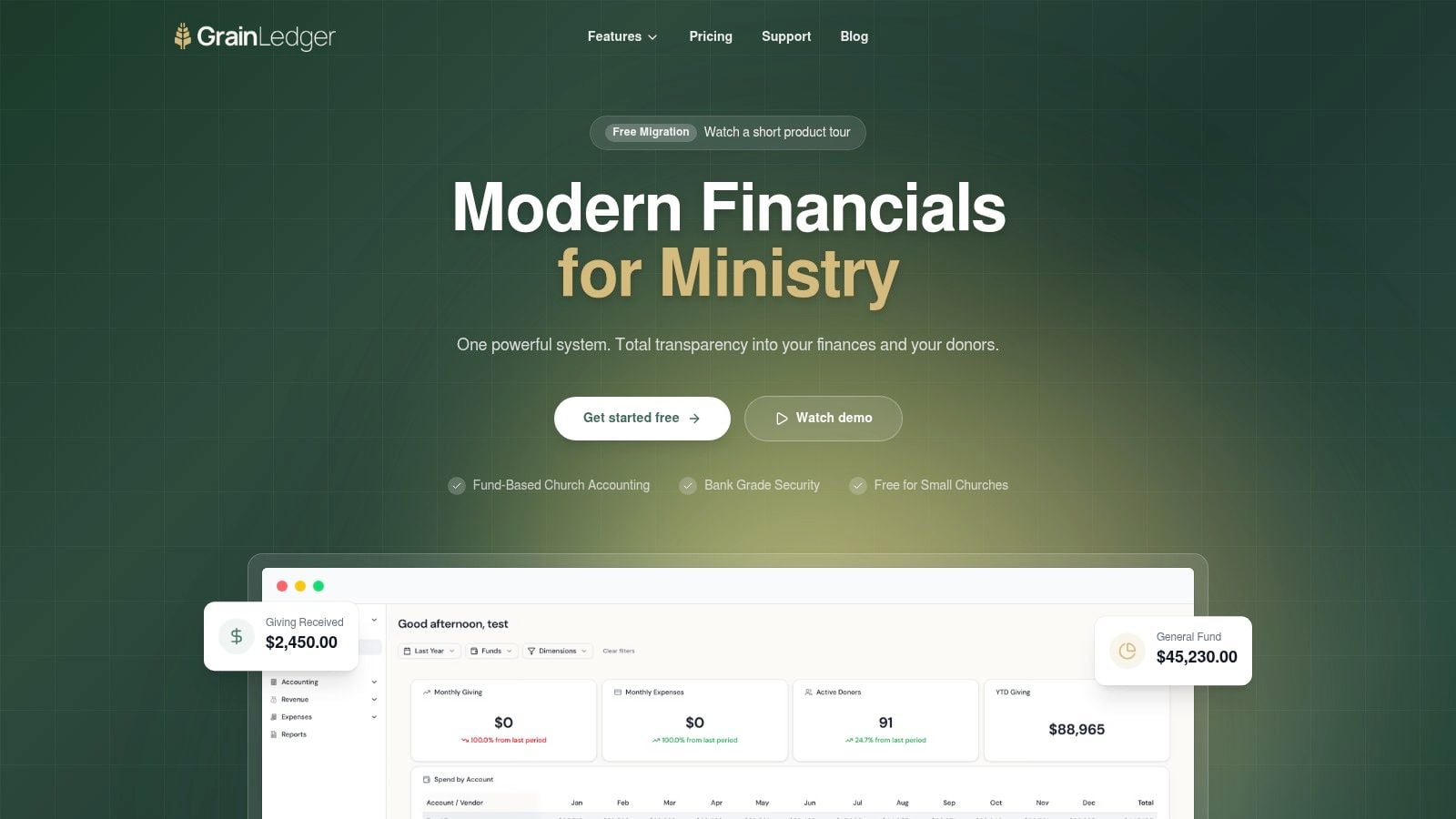
Grain Ledger is the accounting solution I'd recommend for churches because it's purpose-built for this exact problem. Its core design is true fund accounting, so donations, transactions, and reporting are organized by fund from the start rather than bolted on later.
Why Grain Ledger stands out
Grain Ledger is strongest when a church needs clean stewardship without building a maze of manual processes.
Key strengths include:
- True fund accounting: Restricted and unrestricted funds stay distinct in the underlying system.
- Giving and bank integrations: Grain connects with tools churches already use, including Pushpay, Planning Center, Stripe, and banks via Plaid.
- Workflow automation: Bill pay, invoice scanning, and payroll support reduce hand entry.
- Board-ready reporting: GAAP-compliant statements and fund-level reports are easier to explain to non-accountants.
The practical upside is simple. Finance teams can see what money exists, what it's for, and what shouldn't be spent on general expenses.
Stewardship note: If your treasurer needs a separate spreadsheet to remember donor restrictions, your accounting system isn't carrying enough of the load.
Real trade-offs to consider
No tool is perfect. Grain Ledger is focused on accounting, not on becoming an all-in-one church management platform. If you need volunteer scheduling, service planning, and people workflows, you'll still want a separate ChMS such as Planning Center or Rock RMS.
It's also best suited to small and medium-sized churches. Very large organizations with unusual entity structures or highly customized reporting demands may need to evaluate whether they require something heavier.
Even so, for most congregations, that focus is a strength. Churches often get into trouble by expecting one system to do everything poorly instead of using one strong financial system and pairing it with other purpose-built tools.
If your team is trying to improve transparency, Grain's article on stewardship in churches is worth reading alongside a software evaluation. It frames the deeper issue well. Good accounting isn't only administrative. It protects trust.
7. City and Regional Church Guides
Church decisions in the USA are made city by city, neighborhood by neighborhood. The right fit in Manhattan may feel completely wrong in a suburb outside Dallas or in a bilingual congregation in Los Angeles. Healthy churches can share core Christian convictions while operating with very different schedules, leadership patterns, budgets, and expectations for member involvement.
That local reality matters for two groups at once. People looking for a church need a better way to evaluate fit than a generic “top churches” list. Church leaders also need to understand the ministry habits of their region, especially if they are comparing outreach models, staffing expectations, or partnership opportunities.
The local search methods that produce better results
Start with a practical search process. Broad metro rankings rarely tell you how a church functions.
- Use city and neighborhood searches: Search by city, neighborhood, or suburb, not only by the larger metro area.
- Check campus and city ministries: Groups such as Cru or InterVarsity often know which churches welcome students, young professionals, and newcomers well.
- Ask for referrals from people who know the area: A pastor, ministry leader, or long-term resident can often point you to faithful churches that barely register in search results.
- Read the church calendar before you visit: Events, classes, prayer gatherings, and service projects show what the church prioritizes.
- Look for the path from visitor to participant: A church may stream polished services and still have a weak process for helping people join a group, serve, or receive pastoral care.
Local context shapes almost everything. A rural church may be firmly rooted and highly relational, but offer fewer age-specific programs. An urban church may have strong teaching and citywide visibility, but limited parking, smaller children's space, or a harder path to close relationships. Neither model is automatically better. The question is whether the church is serving its setting faithfully and whether that setting fits your stage of life.
Smaller congregations often offer easier access to pastors, clearer volunteer openings, and stronger intergenerational relationships. The trade-off is usually thinner programming and less administrative polish. Larger churches can provide more specialized ministries, but people can stay anonymous for a long time if the connection process is weak.
If you're relocating, search for a church where you can belong, serve, and be known. Media quality helps you narrow the list. It does not tell you whether the church handles care well, teaches with clarity, or has room for actual community. In many cities, the strongest fit is the congregation that understands its neighborhood and has a realistic way to connect newcomers to real people.
7-Point Comparison: U.S. Churches & Resources
| Item | 🔄 Implementation Complexity | ⚡ Resource Requirements | ⭐ Expected outcomes / 📊 Impact | 💡 Ideal use cases & Key advantages |
|---|---|---|---|---|
| Landmarks of Faith: Notable Large Churches in the USA | 🔄 High, multisite operations, media production, governance layers | ⚡ Very high, staff, facilities, broadcast/tech budgets | ⭐ High influence and reach; 📊 large weekly attendance and media metrics | 💡 Ideal as scale models for worship innovation, volunteer systems, large-scale outreach |
| Understanding the Spectrum: Major Denominations and Networks | 🔄 Medium, established governance or connectional systems | ⚡ Moderate, institutional infrastructure, seminaries, denominational staff | ⭐ Stable membership patterns; 📊 predictable doctrine-driven engagement | 💡 Best for choosing affiliation, accessing theological resources and fellowship networks |
| How to Find a Church Near You: Top Online Directories | 🔄 Low, simple search and filtering process | ⚡ Low, internet access and time to review listings | ⭐ Quick shortlist; 📊 fast discovery and pre-visit vetting | 💡 Ideal for newcomers and relocators; advantage: convenience and filterable options |
| Churches by the Numbers: Key Statistics on Religion in America | 🔄 Medium, requires survey design and analysis | ⚡ Moderate, research tools, data sources, analytical capacity | ⭐ Evidence-based insights; 📊 trends in attendance, giving, demographics | 💡 Use for strategic planning, resource allocation, and trend monitoring |
| Equipping the Shepherds: Essential Resources for Church Leaders | 🔄 Low–Medium, adoption of training and tools varies by church | ⚡ Moderate, time, subscriptions, conference travel | ⭐ Improved leadership capacity; 📊 measurable volunteer/ministries growth | 💡 Suited for pastors and staff development; advantage: practical training and networks |
| Stewardship Made Simple: Modern Accounting for Churches (Grain Ledger) | 🔄 Low–Medium, software onboarding and fund mapping | ⚡ Moderate, subscription, integrations, training time | ⭐ High financial transparency and compliance; 📊 automated fund accounting reports | 💡 Ideal for churches needing fund accounting; advantage: integration, audit trails, GAAP-ready reports |
| City & Regional Church Guides: Finding Community Locally | 🔄 Low, localized research and recommendations | ⚡ Low, local contacts, online lists, time to visit | ⭐ Better cultural fit and community connection; 📊 improved retention when matched well | 💡 Best for contextual church searching; advantage: local insight and personal recommendations |
Your Next Step on the Journey
The composition of churches in the USA is broad, layered, and more varied than commonly understood. There are nationally recognized megachurches, long-standing denominational parishes, neighborhood congregations with a few dozen regular attenders, and mission-driven churches carrying community needs that extend far beyond Sunday worship. Knowing that range helps you make better decisions, whether you're looking for a church home or trying to lead one well.
For individuals, the most important next move is usually concrete and local. Pick a shortlist. Read the beliefs page. Listen to a recent sermon. Visit in person. Ask how membership works, how people are cared for, and where newcomers connect. A church can have excellent branding and weak community, or a plain website and a faithful congregation. You won't know without moving from research to contact.
For church leaders, the next step often isn't more strategy talk. It's tightening the systems that support trust. If your ministry is growing, if designated gifts are increasing, or if your board struggles to get clear financial visibility, the issue probably won't solve itself. Churches often carry multiple ministry streams at once, especially when they serve immigrant communities, support benevolence needs, or manage mission-restricted funds. That makes stewardship a front-line leadership issue, not a back-office detail.
That's one reason financial tools matter so much in this conversation. The U.S. church sector is fragmented, and many congregations operate without large administrative teams. A system that forces staff or volunteers to patch together spreadsheets, side ledgers, and memory-based reporting creates risk. It also creates confusion for pastors and boards who need timely answers.
Grain Ledger stands out because it approaches church finance the way churches operate. Instead of treating funds like an awkward add-on, it starts with fund-based accounting at the center. That matters for restricted giving, monthly reporting, board communication, and basic confidence that designated money hasn't been mixed into general spending. For small to medium-sized churches, that's often the difference between “we think the numbers are right” and “we can show exactly how funds were received and used.”
If you're searching for a congregation, your next step might be a visit this week. If you're leading one, your next step might be reviewing the systems that shape trust behind the scenes. Both matter. Churches in USA are diverse enough that there isn't one perfect path for everyone, but there is a practical path forward. Choose a church with intention. Lead with clarity. Build systems that support the ministry you say you value.
If your church needs cleaner reporting, stronger fund controls, and accounting built for ministry instead of retrofitted from business software, take a serious look at Grain. It's purpose-built for churches that want true fund-based accounting, integrated giving and bank workflows, and financial visibility pastors and boards can effectively use.
Ready to simplify your church finances?
Start free with church fund accounting, or watch a product demo first.