
How Much Should I Tithe: Your 2026 Giving Guide
Get clear answers to how much should i tithe. Our 2026 guide explains the 10% rule, gross vs. net, and how to budget for giving with practical examples.
You may be looking at your budget right now with a mix of good intentions and real concern. You want to be generous. You want your giving to reflect your faith. But when the question becomes practical, many people get stuck on the same thought: How much should I tithe?
About Grain Ledger: This guide includes Grain Ledger, church fund accounting software built for designated gifts and ministry funds. It connects giving platforms (Planning Center, Pushpay, Tithely, Stripe), syncs bank activity with Plaid, and produces fund-level financial reports. Schedule a demo to see how it compares for your church.
See Grain Ledger for your church
Fund accounting, giving integrations, and bank reconciliation in one platform. Free migration support for churches switching from QuickBooks or Aplos.
That question gets complicated fast. You may have a paycheck with taxes, insurance, and retirement deductions. You may have debt. You may have a variable income, a growing family, or a season where money feels tight. Add in different church teachings, and what sounds simple on paper can feel heavy in real life.
A healthy answer needs both conviction and clarity. It should honor the biblical roots of tithing, recognize that Christian giving isn't just math, and give you a workable way to decide what faithfulness looks like in your situation. It should also acknowledge something many people feel but don't always say out loud. Giving is easier when you trust that your church handles gifts carefully, transparently, and with real accountability.
The Question of Tithing in Your Financial Life
Sarah sits at her kitchen table after dinner with a notebook, a banking app open on her phone, and a list of monthly bills. Rent is due soon. Her car needs work. She wants to save more. She also wants to give to her church consistently, because generosity matters to her. But one question keeps interrupting every budget line: how much should I tithe if I want to be faithful without pretending my financial pressures aren't real?
That's not a selfish question. It's a stewardship question.
Many Christians grew up hearing that a tithe means 10%, and historically that's the core idea. But when that principle meets modern payroll deductions, student loans, medical bills, irregular freelance income, or a spouse who doesn't share the same conviction, people often feel torn between guilt and uncertainty.
Giving should lead you toward faithfulness, not confusion and shame.
Some readers are wondering whether they should aim for a full tenth right away. Others are asking whether they should start smaller and grow over time. Some are trying to figure out if the calculation should be based on gross pay or take-home pay. Those are different questions, but they all come from the same desire: to honor God responsibly.
For churches, this question matters too. A congregation teaches generosity best when it combines biblical clarity with financial integrity. People don't just want to know what they should give. They also want confidence that what they give is being managed wisely.
What Is a Tithe and What Is Its Biblical Basis
The word tithe means one-tenth. In its most basic form, a tithe is a tenth of income or produce set apart for God. That definition gives us the traditional benchmark many Christians still use today.
In the Old Testament, tithing was tied to the life of God's covenant people. It supported worship, the work of religious leaders, and care within the community. That historical foundation matters because it shows that giving was never just a private spiritual exercise. It had a communal purpose.
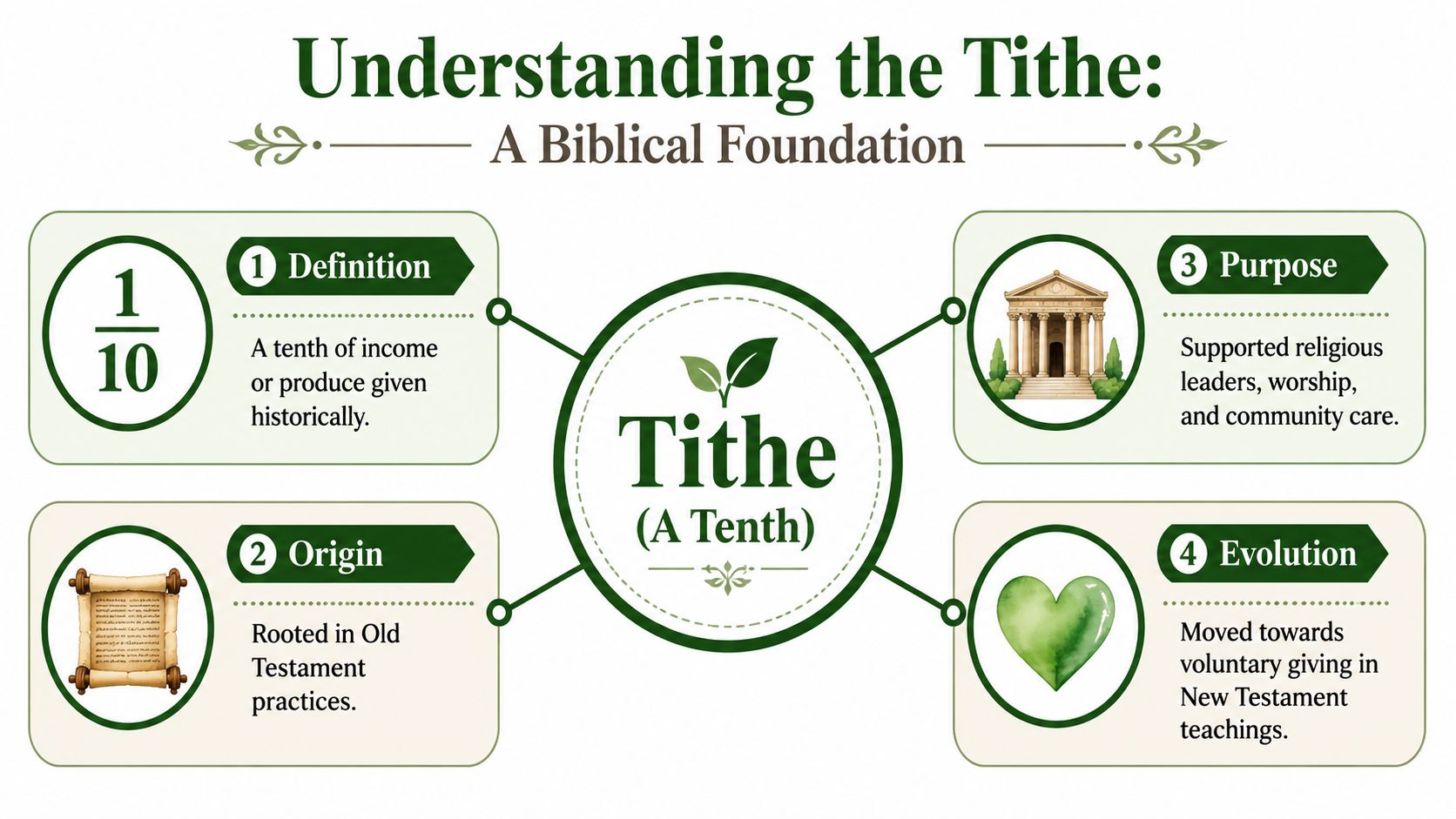
The original meaning of a tithe
When people ask how much they should tithe, the historical answer is straightforward. A tithe is a tenth. That gives the church a long-standing reference point.
But biblical interpretation doesn't stop with a dictionary definition. Christians also ask whether the New Testament repeats the tithe as a fixed rule in the same way.
How the New Testament shifts the conversation
Many respected Christian teachers say the New Testament does not give a universal mandate requiring every believer to give exactly 10% of income. Instead, it presents 10% as a wise guideline rather than a legal minimum, as explained in Crossway's discussion of how much Christians should tithe. That same discussion notes a gap between the ideal many churches teach and the actual giving patterns seen in many congregations.
This is one reason people get confused. They hear strong language about the tithe, but they also encounter faithful Christians who understand New Testament giving in terms of generosity, sacrifice, regularity, and cheerfulness rather than a fixed required percentage.
If you want a fuller biblical walkthrough, Grain's article on what the Bible says about tithing is a helpful companion read.
What this means for your decision
The practical takeaway is simple. Ten percent remains the traditional benchmark, because that's what a tithe means. But many Christians see that benchmark as a strong pattern and starting point, not as a formula to enforce without wisdom.
Data summaries often show that actual practice falls well below the traditional standard. One Barna-referenced summary says about 21% of Christians set church giving at 10% or more of income, while another summary reports that roughly 32% of Christians tithe and about 13% of adult churchgoers give at least 10% annually, according to this Ministry Designs summary of tithing data. The point isn't to lower the bar. It's to recognize that many believers are still working through what faithful generosity looks like in daily life.
How to Practically Calculate Your Tithe
Once you've settled on a giving goal, the next issue is arithmetic. The common stumbling block isn't whether to multiply by ten percent, but rather what number they should multiply.
The biggest question is whether to tithe on gross income or net income.
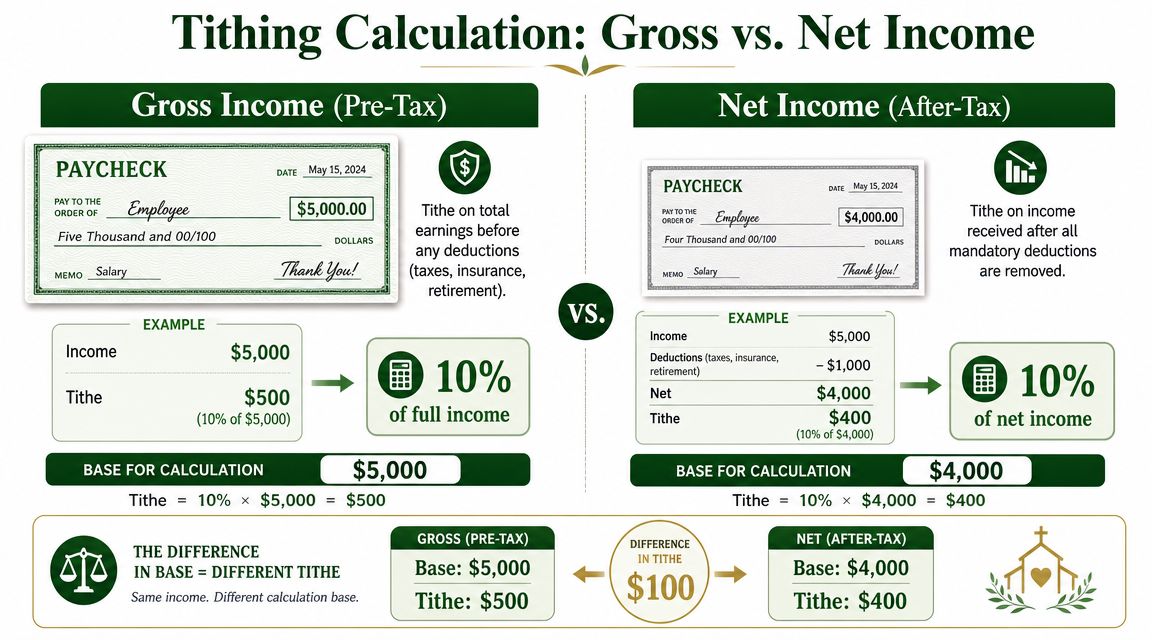
Gross income and net income
Gross income is what you earn before taxes and payroll deductions.
Net income is what remains after taxes and deductions are removed from your paycheck.
This isn't just a technical difference. It can change your annual giving by a meaningful amount. On a $60,000 salary, a 10% tithe on gross income is $6,000, while a tithe based on net income after taxes and deductions can be several hundred to over a thousand dollars lower, as discussed in White Coat Investor's guide to calculating your tithe.
How to choose a consistent method
Some people prefer the gross approach because it treats giving as a firstfruits practice. They want generosity to be based on what they earn, not what remains after other claims on that income.
Others choose the net approach because taxes are not discretionary spending. They focus on the income they receive and control. Both views are common.
A useful principle is consistency. If you choose gross, keep using gross. If you choose net, keep using net. If you contribute to a pre-tax retirement account, some advisers suggest either tithing on that money when it's earned or treating it as deferred income and giving from it when you withdraw it later. The goal is to avoid confusion and double-counting.
Here's a quick visual explanation before we move into more examples.
A practical method for regular paychecks
If your income is steady, use a simple routine:
- Pick your base. Decide whether you'll calculate from gross or net income.
- Choose your percentage. For some, that's the full traditional tithe. For others, it's a planned percentage they're growing over time.
- Apply the same rule every pay period. Consistency reduces stress and second-guessing.
- Record it in your budget first. Treat giving as planned stewardship, not leftover spending.
A clear giving rule is often more sustainable than a vague good intention.
How to handle less straightforward income
Many people don't have a simple salary. If that's your situation, clarity matters even more.
Irregular income. If you're paid by commission, freelance work, or seasonal contracts, calculate your giving when income is actually received. That keeps your gift tied to real cash flow instead of estimates.
Bonuses and windfalls. Decide in advance how you'll treat bonuses, gifts, inheritances, or other one-time amounts. Some people apply the same giving rule they use for salary. Others make a separate prayerful decision for those situations.
Non-cash gifts. If you donate items, services, or goods to support ministry, that's generous, but it isn't the same as cash-flow budgeting. Keep your financial giving decision and your in-kind generosity distinct so you don't lose track of either.
Business owners. If your income moves through a business, define carefully what counts as personal income for giving purposes. That usually requires a thoughtful conversation with your spouse, your accountant, or church leadership if you need help applying your method consistently.
Tithing Calculation Examples and Benchmarks
Examples make this easier. The table below doesn't tell you what you must do. It shows how the same 10% rate changes depending on whether you calculate from gross income or estimated net income.
| Annual Salary | 10% Tithe on Gross | Estimated Net Salary | 10% Tithe on Net |
|---|---|---|---|
| $50,000 | $5,000 | Varies by taxes and deductions | Varies based on net pay |
| $80,000 | $8,000 | Varies by taxes and deductions | Varies based on net pay |
| $120,000 | $12,000 | Varies by taxes and deductions | Varies based on net pay |
What these examples show
The gross column is simple because the math is fixed. The net column is less precise because payroll taxes, insurance, retirement contributions, and local rules differ from person to person. That's exactly why so many people feel uncertain. Two believers with the same salary can land on different tithe amounts if they're using different bases.
If you want a baseline for what many people do, giving data shows that practice often starts below the traditional benchmark. The average churchgoer gives about $17 per week, and a 2025 analysis found the average annual offering per person was $2,848, which it described as about 4.35% of average U.S. personal income, according to Carey Nieuwhof's roundup of church giving statistics.
How to use benchmarks wisely
Those numbers shouldn't become your spiritual target. They remind you that many people's giving journey doesn't begin at a full tenth. For some, the wisest step is to begin with a planned percentage they can sustain and then increase it over time.
A benchmark can guide you without controlling you. The point is intentional generosity, not comparison.
Integrating Tithing into Your Financial Stewardship Plan
A tithe works best when it isn't treated as a random withdrawal from whatever happens to be left in your account. It becomes much more realistic when it's built into your broader stewardship plan from the start.
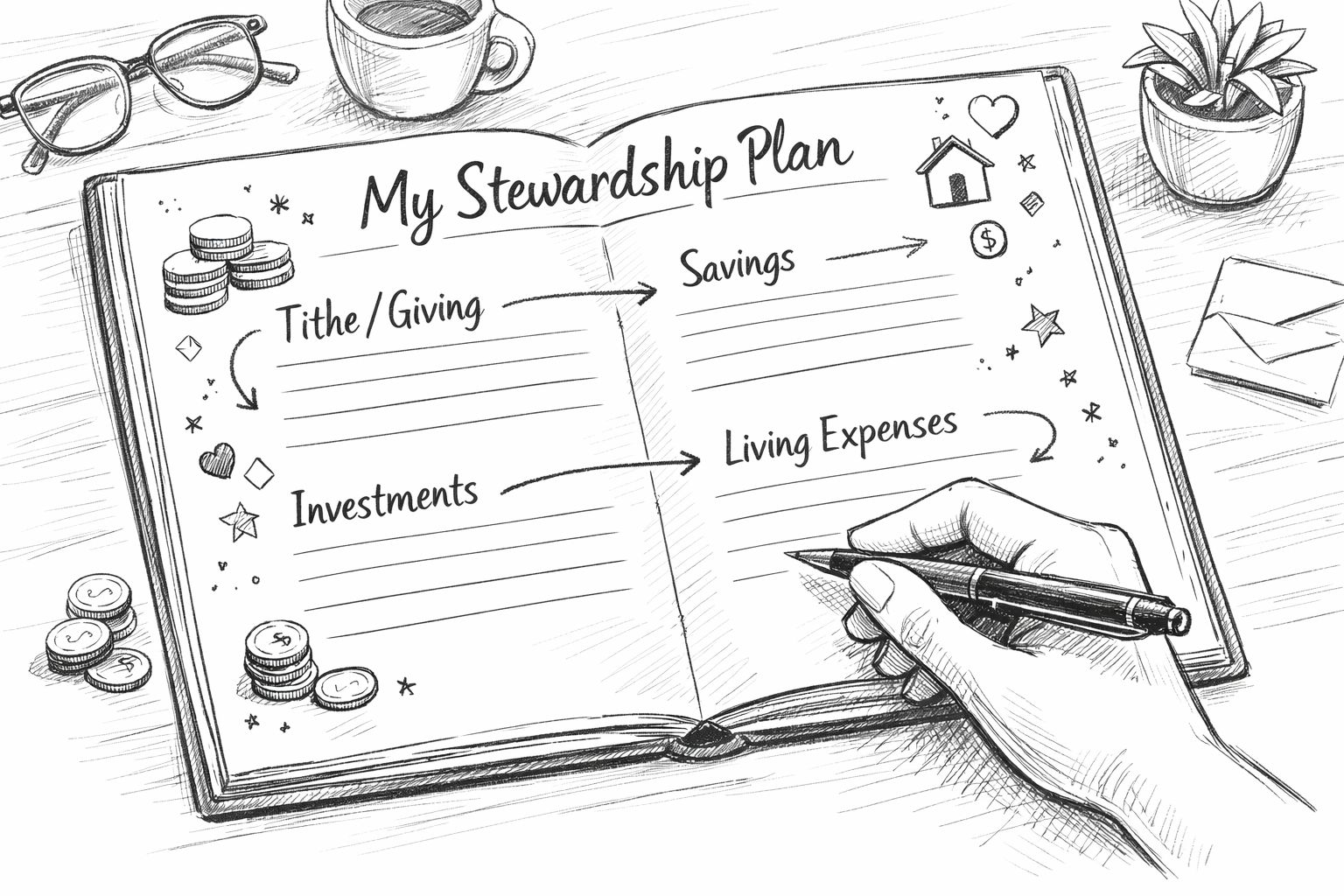
Put generosity into the budget first
People usually stay consistent with the categories they plan for ahead of time. Housing gets planned. Utilities get planned. Savings gets planned. Giving should work the same way.
That doesn't make generosity mechanical. It makes it deliberate.
If your current percentage feels stretched, that doesn't mean you should give up on the habit. It may mean you need a plan that fits your present season while still moving you toward greater generosity.
A workable rhythm for households
A stewardship plan often gets stronger with a few simple habits:
- Give first. Set aside your intended gift at the beginning of the pay cycle, not after discretionary spending.
- Automate what you can. Recurring giving can reduce decision fatigue and make generosity more regular.
- Review with your spouse or family. Shared clarity prevents resentment and confusion.
- Adjust during life changes. A job loss, a raise, a new child, or a move may require you to revisit your giving approach.
Grain's stewardship in churches article offers a useful lens on stewardship as a whole, especially if you want to think beyond a single percentage and toward a fuller pattern of managing money faithfully.
Why planning helps your heart
Some people resist budgeting for giving because they don't want generosity to feel less spiritual. In practice, the opposite is often true. A plan can protect generosity from distraction, overspending, and indecision.
When giving is planned, it becomes easier to do with peace and less likely to be replaced by guilt-driven last-minute decisions.
A healthy giving plan also leaves room for spontaneous generosity. You may still respond to a special need, support a missionary, or help a family in crisis. Budgeted giving doesn't crowd out compassion. It creates stability so that compassion has a place to grow.
The Church's Role in Financial Transparency
People give more confidently when they trust the church receiving their gifts. That trust isn't built by polished language. It's built by financial practices that are clear, careful, and understandable.
When a church teaches generosity, it also takes on a responsibility. It must handle donations in a way that shows respect for the giver, the mission, and any restrictions attached to those gifts.
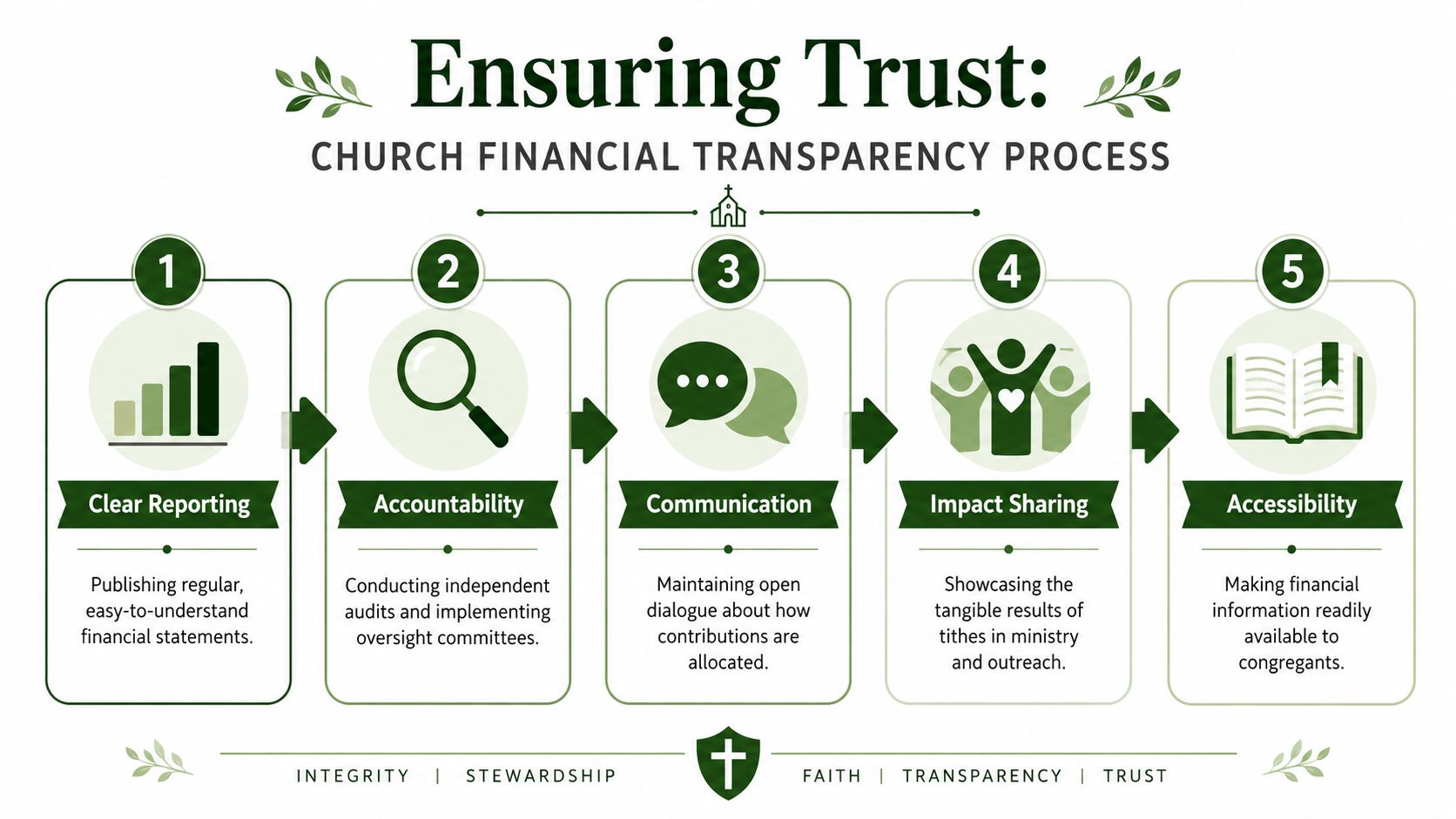
Why transparency matters to generosity
A church member may not ask to see every ledger detail, but they do want confidence that offerings are tracked properly, restricted funds stay restricted, and reports tell the truth. When that confidence is missing, generosity can weaken even when theological commitment remains strong.
Church leaders can strengthen trust with a few visible habits:
- Clear reporting. Share understandable financial statements with pastors, elders, finance teams, and members as appropriate.
- Defined approval processes. Make it clear who can authorize spending and who reviews it.
- Restricted fund discipline. Money given for a designated purpose should remain tied to that purpose.
- Regular communication. Tell the congregation how gifts are supporting ministry, not just that expenses were paid.
Why fund accounting fits church life
Churches don't operate like ordinary small businesses. They often manage designated gifts, mission funds, benevolence support, building campaigns, and general operations at the same time. That's why fund accounting matters. It helps a church track money according to purpose, not just by category of income and expense.
This is also why reporting needs to be church-specific. A standard profit-and-loss mindset doesn't fully answer the questions church leaders and givers ask. They want to know what came in, which fund received it, whether restrictions were honored, and what ministry activity those funds supported.
If your church is working on stronger reporting practices, this guide to church financial reports gives a helpful overview of what healthy financial visibility looks like.
The giver and the church are connected
A person's tithe isn't only a private act. It becomes part of a shared trust relationship. The giver offers resources in faith. The church receives them in stewardship.
When churches handle that responsibility well, members often feel freer to give regularly and with confidence. When systems are weak or unclear, even generous people may hesitate. That's one reason transparent bookkeeping, clean fund tracking, and reliable reporting are not just administrative concerns. They are pastoral concerns too.
Related church accounting software resources
If you are comparing software, these pages map the main decision points: fund accounting, QuickBooks limits, pricing, and migration.
- Best church accounting software (2026 comparison) - canonical guide comparing 12 church accounting platforms
- Church accounting software product page - see Grain Ledger for fund accounting, giving, and bank reconciliation
- Small church accounting software - see the product page built for volunteer treasurers and church admins
- Fund accounting features - review how Grain Ledger tracks designated funds
- QuickBooks for churches - understand workarounds and when to switch
- Free church accounting software - compare free options and upgrade triggers
- Grain Ledger pricing - compare plans for small and growing churches
- Start free - try fund accounting, giving imports, and bank reconciliation together
Common Questions About Tithing and Giving
Some of the hardest questions about tithing don't have one-line answers. They need wisdom, consistency, and honesty about your circumstances. The table below offers practical guidance without turning every situation into a rigid rule.
| Question | Guidance |
|---|---|
| Should I tithe on gross or net income? | Choose a clear method and apply it consistently. Many believers use gross as a firstfruits practice. Others use net because they focus on what they actually receive after deductions. The key is to decide prayerfully and avoid changing methods whenever it's convenient. |
| If I can't give 10% right now, should I give nothing until I can? | No. A smaller planned percentage can still reflect real faithfulness. Start intentionally, then revisit your giving as your finances change. |
| Should my tithe only go to my local church? | Many Christians treat regular giving to their local church as the core of their generosity because that's where they worship and receive care. Additional gifts to missions or other ministries can be part of a broader giving plan. |
| What if I'm paying off debt? | Debt doesn't erase generosity, but it may affect how you structure it. Build a plan that addresses obligations honestly while still keeping giving present in your budget. |
| Should I tithe on a bonus or inheritance? | Decide ahead of time how you'll handle one-time income. Some people apply the same percentage they use for regular income. Others make a separate stewardship decision based on the nature of the gift. |
| What if my spouse disagrees about tithing? | Move carefully and talk openly. Financial unity matters. In many households, the wisest path is a shared giving plan both spouses can support while continuing the conversation. |
| Does online recurring giving count the same as giving in person? | Yes. The method doesn't determine the faithfulness. What matters is the intention, consistency, and stewardship behind the gift. |
| Can serving time or donating items replace tithing? | Service and in-kind generosity matter deeply, but they aren't identical to financial giving. It's helpful to value both without using one to erase the other. |
A final pastoral word
The question "How much should I tithe?" often sounds like a math question, but it usually carries deeper concerns. People are asking whether they're doing enough, whether God is disappointed in them, or whether they can be generous without becoming financially unstable.
Those fears deserve a compassionate answer. Faithful giving should be thoughtful, regular, and sincere. It should also be honest about your real life. If you need to begin with a clear plan that grows over time, that's still a meaningful act of stewardship. If you're able to practice the full traditional tithe, that can be a strong and beautiful discipline.
What matters most is that your giving isn't accidental, resentful, or hidden from the rest of your financial life. A wise giving practice is one you can explain, sustain, and offer with a clear conscience.
If your church wants to match generous teaching with trustworthy financial stewardship, take a look at Grain. Grain is purpose-built church accounting software with native fund accounting, clear fund-level reporting, and workflows designed for the way churches receive, track, and report donations.
Ready to simplify your church finances?
Start free with church fund accounting, or watch a product demo first.