
How to Increase Church Giving Without Burning Out
Learn how to increase church giving with proven stewardship, recurring gifts, and online giving strategies that build trust and grow generosity.
Churches with online giving reported annual giving of $1,809 per capita when no online option was available, compared with $2,428 where online giving was used extensively, nearly a 30% increase. The same report found that leaders who saw giving rise often identified digital methods as the largest driver, while another industry survey found 61% of churches experienced increased digital giving in 2024. The Lake Institute summarizes this giving research.
That changes the question. How to increase church giving isn't mainly about finding a more emotional sermon illustration. It's about removing friction, earning trust, converting occasional donors into recurring givers, and recording every restricted gift correctly. The churches that handle those systems well don't need to pressure their congregations every week.
Why Most Church Giving Advice Falls Flat
The usual advice focuses on motivation. Pastors preach a stewardship sermon, leaders run an annual pledge drive, and the church adds another appeal to the Sunday announcement sheet. Those activities can help, but they rarely fix the reasons people fail to give consistently: the payment process feels inconvenient, the available funds aren't clear, and nobody follows up after the first gift.
The per-capita figures above point to a more useful conclusion. Convenience correlates with generosity, but convenience alone isn't enough. A donor also needs confidence that the church will honor the selected designation, send an accurate acknowledgment, and explain what the gift made possible.
Finance advisor's rule: If a church asks people to give more while making them guess where the money goes, it has a trust problem, not a messaging problem.
The three levers that matter
First, reduce friction. A mobile giving page should load quickly, accept familiar payment methods, make recurring giving visible, and let donors choose a fund without calling the church office.
Second, publish fund-specific impact. A general appeal asks donors to trust the institution. A clearly labeled missions, benevolence, building, or youth appeal shows donors what their gift supports and how the church will report back.
Third, convert one-time givers into recurring donors. A first gift proves interest. A second gift demonstrates continued commitment. The finance team should track whether a first-time donor gives again within one to two quarters, a practical retention measure identified in faith-based donor benchmark guidance.
The wrong dashboard reinforces the wrong behavior. Total dollars and attendance are lagging measures. They tell the pastor what already happened. Second-gift rate, recurring share, and fund-level retention tell the finance committee whether next year's budget has a stronger foundation.
For a broader framework on stewardship structure and accountability, see this guide to stewardship in churches. The important distinction is simple: sermons may create desire, but systems determine whether desire becomes a completed, repeatable gift.
| Lever | What It Actually Does | Common Substitute |
|---|---|---|
| Reduce giving friction | Makes the desired action easy at the moment of commitment | Repeating a giving URL from the pulpit |
| Publish fund-specific impact | Shows donors how their money is being used | A generic “support the church” appeal |
| Convert one-time givers | Builds predictable revenue and donor continuity | Celebrating first-time gift volume alone |
Building a Recurring Giving System That Actually Converts
Recurring giving should be configured as part of the normal donation experience, not hidden behind a separate campaign. Faith-based benchmark data reports that recurring donors accounted for 25.22% of revenue, faith-donor retention reached 61.29%, and donors gave 4.68 times per year. The benchmark discussion explains why second-gift conversion matters.
Start with the giving provider. Confirm that it supports ACH and card payments, one-time and recurring gifts, fund designations, donor records, automated confirmations, and tax-receipt settings. A platform that accepts payments but exports a confusing spreadsheet has only solved the front half of the problem.
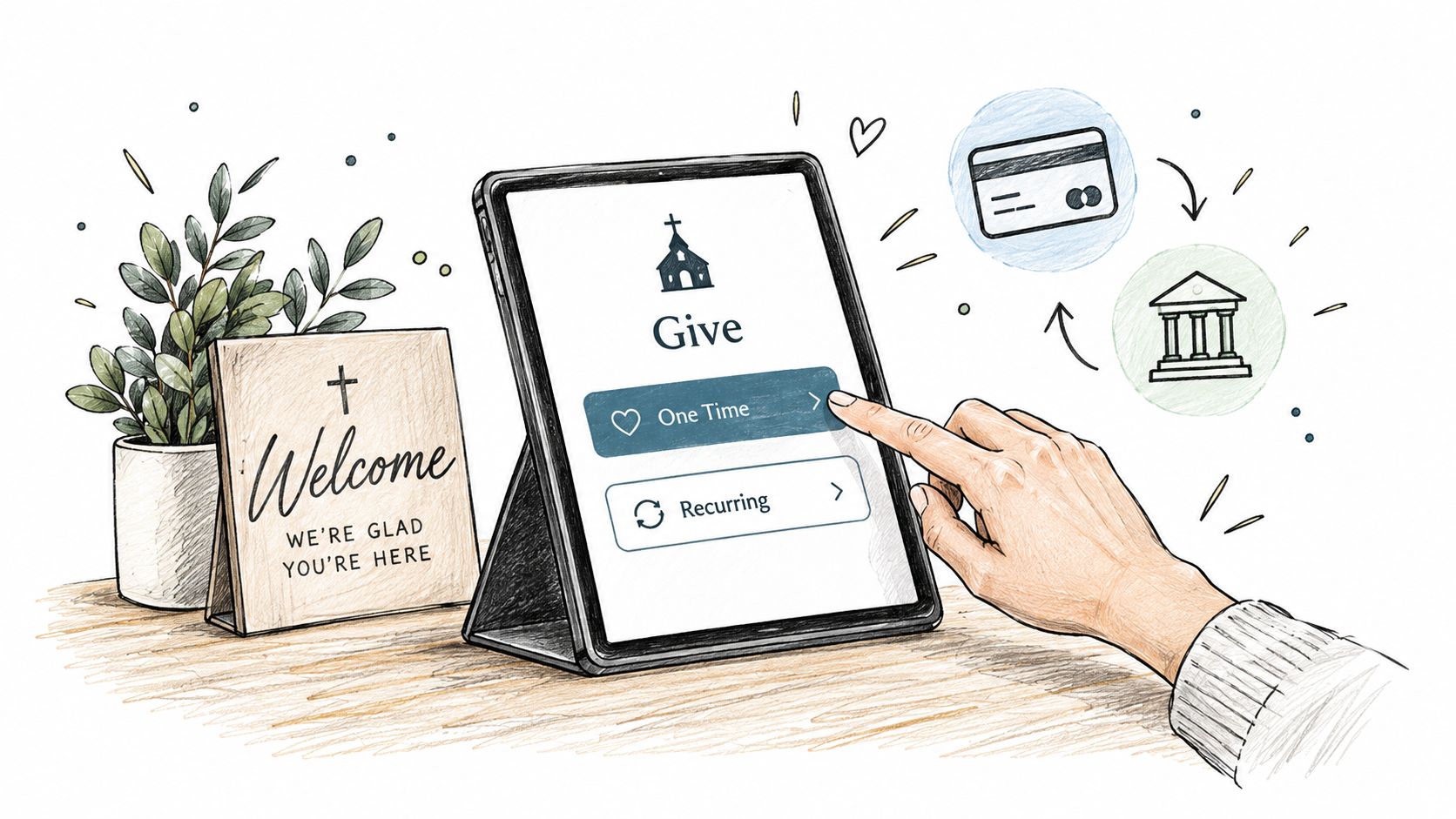
Configure the donor path
Use a short setup sequence:
- Offer both frequencies: Present one-time and recurring choices on the same page rather than making donors search for an enrollment option.
- Make monthly the visible default: Donors should see the recurring toggle while they're deciding the amount, not after payment.
- Use useful preset amounts: Tie suggested amounts to familiar weekly service levels, while leaving a custom amount field available.
- Name the funds plainly: General, missions, building, and benevolence are easier to understand than internal accounting labels.
- Enable saved payment methods: Let recurring donors update a card or bank account without recreating the entire gift.
- Automate confirmations: Each donor should receive a clear confirmation showing the amount, date, frequency, and fund.
Don't promise a specific annual performance lift from recurring giving unless your own data supports it. The reliable operational case is steadier cash flow, better budget predictability, and a clear opportunity to invite a second-time giver into a scheduled plan within 30 days.
After a donor gives for the first time, send a thank-you that explains recurring giving as an option, not a guilt device. Then make the recurring choice prominent the next time that donor visits the giving page. Map each designated gift to the correct general ledger code before the first campaign launches.
The final integration point is fund accounting. Giving data must flow into the correct fund, reconcile to the settlement deposit, and remain visible in donor statements and financial reports. This overview of online giving platforms for churches is useful when comparing the features that affect both donors and finance teams.
A short demonstration can help staff and volunteers understand the intended experience before launch.
Designing Stewardship Campaigns That Build Trust
Generic appeals underperform because they leave the donor with an unanswered question: Where exactly did my money go? A phrase about cheerful giving may support a theological message, but it doesn't show whether a gift funded food assistance, a mission partner, building repairs, or ordinary operating costs.
Fund-specific giving has become more important. Directed giving rose from 27% in 2015 to 31% in 2025, a shift documented in the Lake Institute's analysis of charitable and religious giving. The practical lesson is clear. Donors want understandable purposes and a line of sight between their dollars and ministry outcomes.
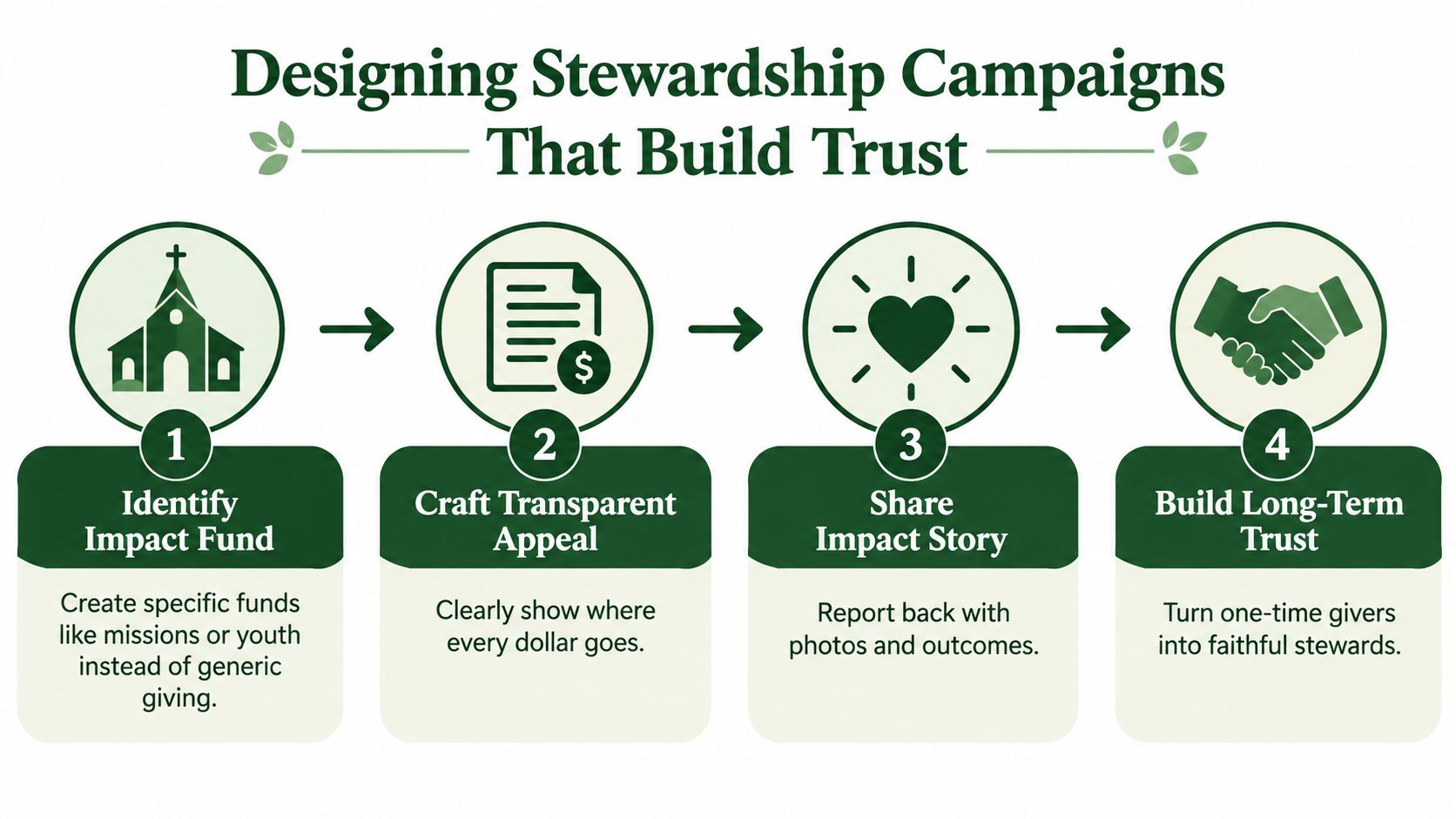
Build one campaign people can understand
Choose one named initiative per quarter. “Benevolence Fund,” “Youth Retreat Scholarships,” or “Local Missions Partnership” is stronger than “Help Us Meet the Budget.” State the dollar goal, describe the ministry outcome, and publish a spending breakdown before asking for gifts.
The appeal should answer four questions:
- What is this fund for? Define the ministry purpose in plain language.
- What will the church spend? Show the categories or uses donors can reasonably understand.
- How can someone give? Link directly to the designated fund and explain recurring options.
- When will you report back? Set an update point during the campaign and a completion report afterward.
Train ushers, welcome-team members, small-group leaders, and ministry staff to use the same fund name. Conflicting labels create doubt, especially when the giving page, announcement slide, and receipt use different terminology.
Report progress midway through the campaign and report results within 60 days of close. Include what was completed, what remains, and whether the church adjusted the plan. Trust grows when leaders report disappointing news with the same clarity they use for good news.
A stewardship campaign should teach generosity, but it must also demonstrate competence. A church stewardship report template can help leaders present restricted-fund activity without burying donors in accounting language.
Donor Communication Workflows That Keep Givers Engaged
A donor communication workflow should begin immediately after the gift, not when the treasurer starts preparing year-end statements. The giving platform should trigger most messages automatically, while pastors and board members handle the personal contacts that require judgment.
Send a welcome email within 24 hours. Thank the donor, identify the fund, explain what happens next, and provide a contact for questions. On day 7, send a gentle second-gift invitation. The message shouldn't assume the donor is ready to give again, but it should make the next step obvious.
Match the message to the donor
First-time givers need orientation. Recurring givers need confirmation that their plan is active and their designated fund remains correct. A recurring donor whose payment declines for 30 days should receive a reactivation message before the church treats the donor as lapsed.
Use channels with discipline:
- Email: Deliver confirmations, impact updates, and recurring-giving instructions quickly.
- Mailed PDF statements: Provide a durable record for tax documentation and annual review.
- SMS: Reserve messages for giving-day reminders or urgent campaign notices, not pastoral care.
- Personal calls: Have a pastor or board member call major donors giving $1,000 or more annually.
Quarterly impact updates should match the fund that received the gift. A missions donor should hear about missions activity. A benevolence donor should receive an appropriate update about assistance and stewardship, while protecting recipients' privacy.
The church must also automate compliant acknowledgment. For any single contribution of $250 or more, a donor generally can't claim a tax deduction without a contemporaneous written acknowledgment from the church or religious organization, as explained in IRS Publication 1828. That acknowledgment is an operational requirement, not a courtesy email.
Prepare the year-end statement for mailing by January 15. The workflow should pull directly from the giving record, include fund-level detail where appropriate, and reconcile with the church ledger before anything goes out. Manual assembly every week creates avoidable errors and consumes staff time that should go toward donor care.
Measuring What Actually Predicts Giving Growth
Pastors often review total dollars, attendance, and the outcome of the latest campaign. Those figures matter, but they describe completed activity. They don't tell the finance committee whether donors are building a durable pattern.
The strongest operating dashboard focuses on behavior after the first gift. Track the second-gift conversion rate, defined as the share of first-time givers who give again within 90 days. Track recurring revenue as a share of total giving, fund-level retention, and average gift growth among existing donors. These measures expose whether the church is deepening relationships or merely replacing donors who disappear.
Faith-based benchmarks report 25.22% of revenue from recurring donors and 61.29% donor retention, while broader nonprofit data reports overall retention of 42.9% in 2024, repeat-donor retention of 69.2%, and new-donor retention of only 20%. The benchmark source explains the practical distinction between first-time volume and donor continuity.
| Metric | Type | What It Tells You | Review Cadence |
|---|---|---|---|
| Second-gift conversion | Leading | Whether first-time donors are becoming active supporters | Monthly |
| Recurring share | Leading | How much revenue has a predictable schedule | Monthly |
| Fund-level retention | Leading | Whether donors remain connected to a ministry purpose | Monthly or quarterly |
| Average gift among existing donors | Leading | Whether current relationships are deepening | Monthly |
| Total dollars collected | Lagging | What the church already received | Monthly close |
| Sunday attendance | Lagging | Participation, not necessarily giving behavior | Monthly |
Don't run this dashboard as a weekly panic ritual. The finance committee should review it monthly, look for changes by fund and donor segment, and assign one corrective action. A falling second-gift rate calls for a better follow-up sequence. Weak recurring share calls for a clearer enrollment path. Poor fund retention calls for more specific impact reporting.
A 90-Day Implementation Roadmap
A church shouldn't launch a new giving platform, rewrite its stewardship campaign, automate donor communications, and redesign its reports in the same week. Sequence the work so the finance team can test each layer before asking the congregation to rely on it.
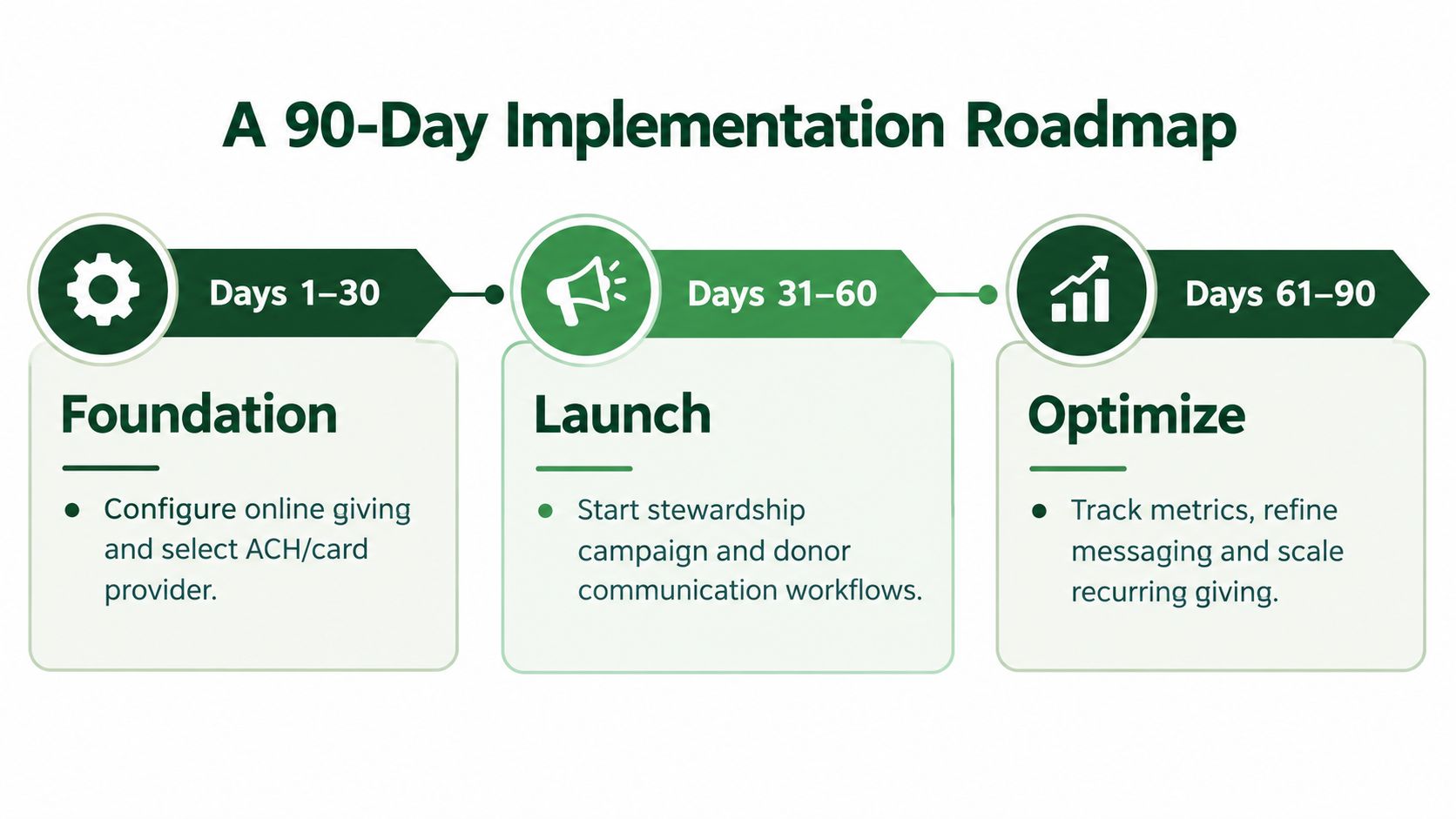
Days 1 to 30 build the foundation
Choose a provider that supports ACH, cards, recurring gifts, fund designations, confirmations, and exports or integrations. Configure general, missions, building, and benevolence funds in the chart of accounts. Clean duplicate donor records, standardize names, and confirm that each giving designation maps to the correct ledger code.
Run a test gift for every fund. Confirm the donor receipt, bank settlement, fund posting, and reconciliation path. If your church needs true fund-based accounting, Grain Ledger organizes transactions and reports around funds so the finance team can review designated activity without recreating it in separate spreadsheets.
Days 31 to 60 install communication controls
Build the welcome email, day-seven second-gift nudge, recurring-gift instructions, quarterly impact template, year-end statement, and written acknowledgment process for gifts of $250 or more. Assign an owner for each workflow. The pastor shouldn't be responsible for checking every automated receipt, and the treasurer shouldn't be writing every pastoral thank-you.
At the day 45 checkpoint, the finance committee should review test transactions, fund mappings, receipt language, donor segments, and the first dashboard. Don't take the campaign public until the committee can trace a gift from donor action through settlement and fund report.
Days 61 to 90 launch and measure
Run the first fund-specific stewardship campaign. Publish the purpose, spending breakdown, giving link, and reporting date. At the same time, invite existing one-time donors to choose a recurring schedule and begin measuring second-gift conversion, recurring share, and fund-level retention.
Use a simple weekly cadence:
- Finance staff: Reconcile gifts and review exceptions.
- Pastor or ministry lead: Approve impact stories and campaign updates.
- Donor-care owner: Monitor first gifts, declines, and follow-up tasks.
- Finance committee: Review the dashboard monthly and decide on one adjustment.
The roadmap works because it treats giving as an operating system. A campaign creates the reason to give. The platform removes friction. The ledger protects the designation. The workflow earns the next gift.
Common Pitfalls and How to Fix Them
The most expensive giving mistakes usually look harmless. A generic appeal doesn't offend anyone, but it gives donors no compelling reason to choose the church over another cause. A restricted-fund error may affect only one transaction, but repeated designation drift damages confidence in every future appeal.
Generic appeals
Problem: Every request points to the general fund, even when the church has specific ministry needs.
Fix: Name the initiative, assign the correct fund, publish the intended use, and report the result. Keep the general fund available, but stop making it the only understandable destination.
Restricted gifts tracked loosely
Under nonprofit GAAP, churches classify net assets as with donor restrictions or without donor restrictions. Restricted gifts need separate tracking, including the fund balance, allowable expenditures, and release entry when the restriction is fulfilled, as explained in this guidance on restricted and unrestricted fund management.
Fix: Tag each contribution to the correct fund when it enters the system. Don't treat moving cash between bank accounts as releasing a restriction. The church should release the restriction only when the donor's purpose or time condition has been satisfied, consistent with this church accounting guidance on restricted funds.
Missing acknowledgment workflows
Problem: The treasurer sends informal thank-you emails but can't produce reliable written substantiation.
Fix: Automate a first-gift acknowledgment within 48 hours, confirm ordinary receipts within seven days, and prepare the year-end summary for mailing by January 15. For a single gift of $250 or more, generate the contemporaneous written acknowledgment required for the donor's tax deduction.
No recurring conversion prompt
Problem: The church celebrates the first gift and never invites the donor into a sustainable pattern.
Fix: Add the recurring option to the confirmation sequence and giving page. Ask the donor to consider a monthly schedule after the first gift, then monitor whether another gift arrives within the next one to two quarters.
The accounting layer closes the trust loop. When each contribution is coded by fund, donor communication can reference the ministry the gift supported, and year-end statements can reconcile to the ledger. That connection is what generic appeals and manually maintained spreadsheets fail to provide.
Grain Ledger offers fund-based church accounting that connects giving data, bank activity, and fund-level journal entries so treasurers can review restricted and unrestricted activity with greater clarity. Visit Grain to Start Free and build a giving workflow that supports recurring conversion, accurate acknowledgments, and transparent ministry reporting.
Ready to simplify your church finances?
Start free with church fund accounting, or watch a product demo first.