1099 Nec Meaning: A Practical Guide for Churches
Discover the 1099 nec meaning, filing thresholds, deadlines, and how churches track contractor payments in fund accounting.
1099-NEC means the IRS form used to report $600 or more in nonemployee compensation, and that threshold rises to $2,000 for payments made after December 31, 2025. If your church paid a guest musician or a lawn-care vendor for services, this is the form that tells the IRS how that payment should be reported.
About Grain Ledger: This guide includes Grain Ledger, church fund accounting software built for designated gifts and ministry funds. It connects giving platforms (Planning Center, Pushpay, Tithely, Stripe), syncs bank activity with Plaid, and produces fund-level financial reports. Start free to see how it compares for your church.
See Grain Ledger for your church
Fund accounting, giving integrations, and bank reconciliation in one platform. Free migration support for churches switching from QuickBooks or Aplos.
A treasurer usually meets this topic in a very ordinary moment. The worship leader got a weekend honorarium, the snow-removal contractor sent an invoice, and now January is coming fast. The questions start stacking up, which payments need a form, which ones don't, and how do you keep the books clean while serving the ministry well?
What 1099-NEC Means for Your Church
A church treasurer can run into this on a Tuesday afternoon without warning. The church paid a guest worship leader $850 for a weekend service, and a local snow removal professional $1,400 for snow removal. By January, someone has to decide whether either payment belongs on a tax form, and whether the church's nonprofit status changes the answer.
It usually doesn't. Form 1099-NEC is the IRS information return for nonemployee compensation, which means payments for services made in the course of a trade or business to someone who is not an employee, as defined by the IRS about Form 1099-NEC. Churches often assume they are exempt because they're ministries, but the reporting question still follows the same IRS rules when the church pays for services.
What the form really tracks
The simplest way to understand the 1099-NEC meaning is this. It tells the IRS that the church paid an outside worker for services and that the payment meets the reporting rules. That worker might be a freelancer, an independent contractor, an attorney, an accountant, or another service provider the church brought in for ministry work. The form tracks service payments based on IRS rules, regardless of how small the payment feels in the moment.
A choir retreat coordinator, a nursery repair contractor, or a guest preacher can all fall into the same reporting question if the church paid them as outside help. The amount matters, but so does the type of work and the worker's status. A church can code the expense to the right ministry fund in its books and still owe a 1099 filing if the IRS rules are met.
Practical rule: if the church paid someone to do work, and that person wasn't on payroll, the next question is whether the IRS considers that payment reportable on 1099-NEC.
For church bookkeeping, that means the form is part of clean fund accounting, not a side issue. It helps a treasurer separate payroll from contractor payments, keep ministry expenses in the right place, and avoid year-end confusion when a vendor supplied services across more than one fund.
The Four IRS Conditions That Trigger a 1099-NEC
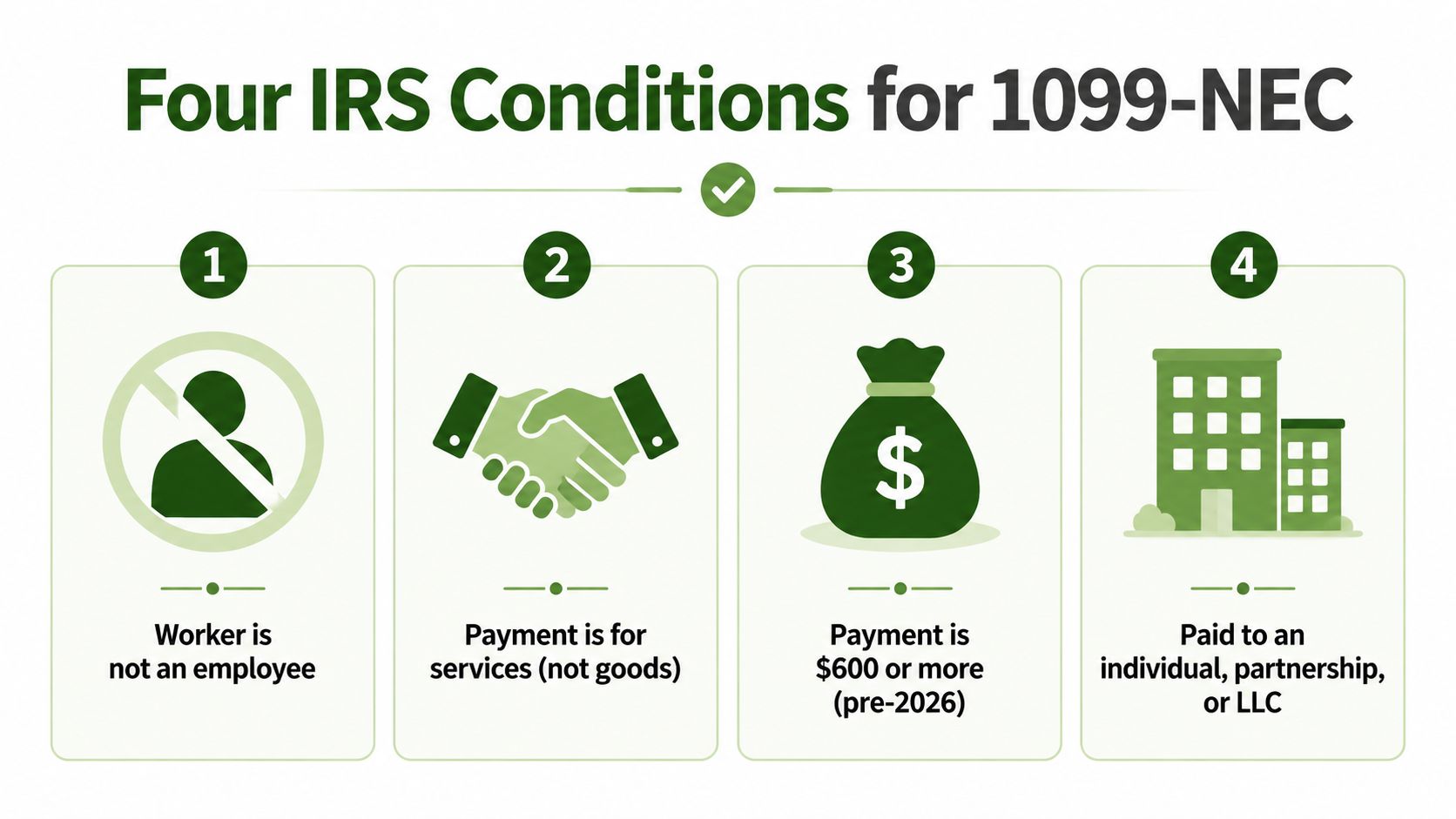
A church may write a check to a vendor and still have no 1099 duty at all. The IRS looks at the payment in layers, and Form 1099-NEC applies only when all four conditions are true: the worker is not an employee, the payment is for services in the course of the payer's trade or business, the payee fits one of the listed entity types, and the total reportable payments reach the annual threshold IRS reporting payments to independent contractors. That is why a treasurer can code an expense to the correct ministry fund and still need to stop and ask whether the payment belongs on a contractor form.
Start with worker status
The first question is whether the person is not an employee. A church that hires a guest pianist for one Sunday is usually dealing with a contractor, while a youth director on payroll is usually an employee. That difference matters because employee wages move through payroll taxes and withholding, while contractor pay is handled through separate reporting.
A simple church example helps here. If the church asks someone to run the sound board for a special event, that person may be outside the payroll system and treated as an independent worker. If the church supervises the role as part of an ongoing staff position, the payment belongs in payroll records instead. The form only comes into play when the worker sits outside the employee category.
Then ask what the church paid for
The second question is whether the payment was for services, not goods. A church paying for sound setup, chapel cleaning, or guest preaching is paying for labor, while buying paper towels for the kitchen is a goods purchase. The IRS rule focuses on service payments made in the course of the church's activity, not on every check the church writes IRS reporting payments to independent contractors.
That distinction matters in fund accounting too. A payment can be posted to the worship fund, the youth fund, or the general fund and still be a service payment for reporting purposes. The fund label tells the church where the cost belongs internally, but it does not decide whether the IRS sees the payment as contractor compensation.
Check the vendor type and the total
The third and fourth questions narrow the field further. The payee has to be an eligible entity type, and the church's total payments to that person or business must reach the annual threshold IRS reporting payments to independent contractors. A one-time invoice may look important in the ledger without creating a filing duty, so the treasurer has to look at the whole year, not just the latest bill.
A small reimbursement to a volunteer may never reach the form stage, even though it still needs clear records. A payment to an incorporated hardware store for supplies can also fall outside the NEC rule because it is a purchase of goods, not contractor compensation. A church that wants a cleaner year-end process can keep contractor totals organized with this church 1099 preparation guide. All four conditions have to be true together. When one condition is missing, the church does not issue 1099-NEC.
Filing Thresholds, Deadlines, and the 2026 Change
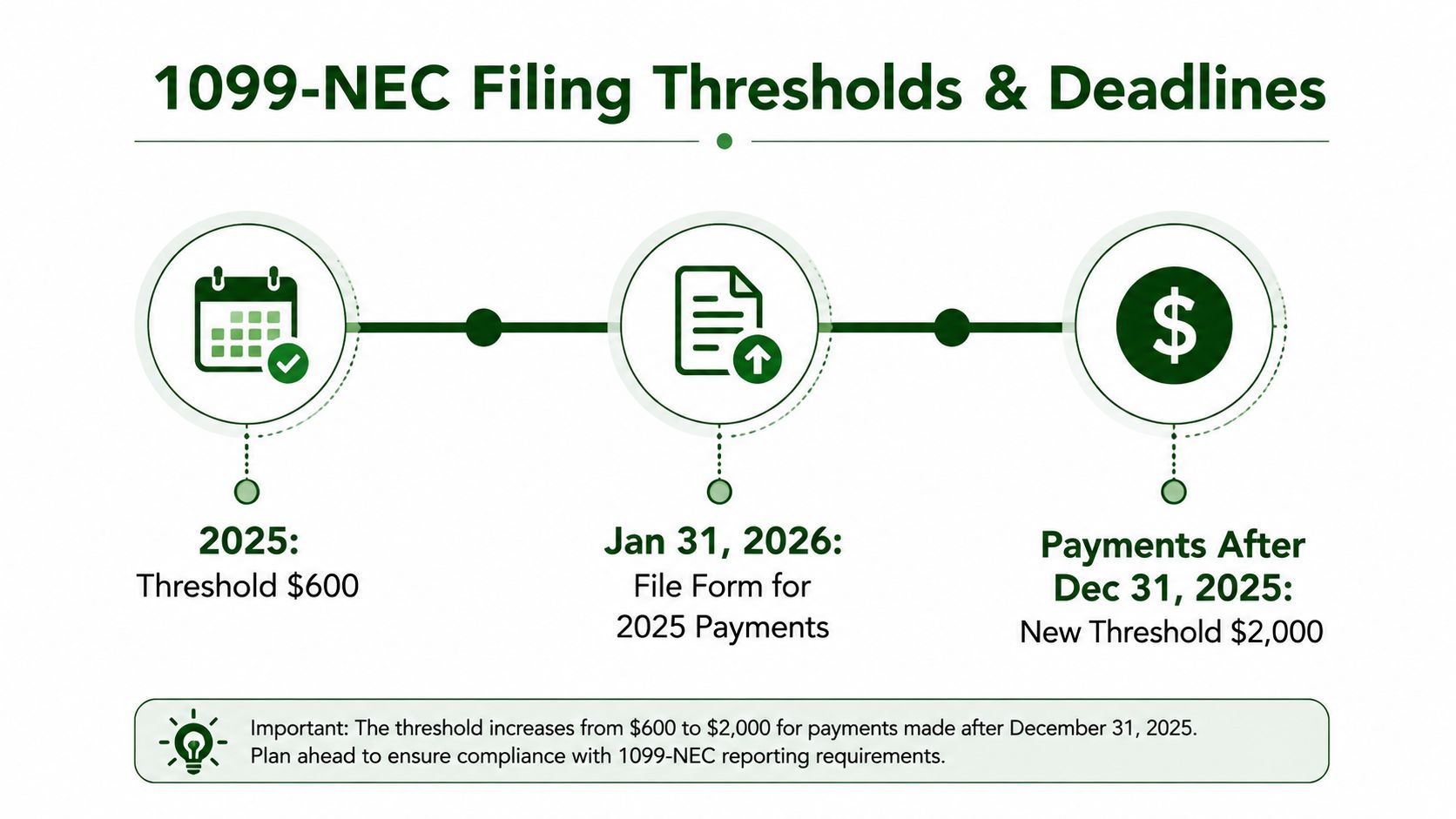
A church treasurer may handle a payment all year and still wonder whether it crosses the reporting line at year-end. That question starts with the threshold. For payments made on or before December 31, 2025, the IRS threshold is $600. For payments made after December 31, 2025, it rises to $2,000 IRS Form 1099-NEC FAQ. The change matters because smaller service payments that once called for a form may no longer do so in 2026 and later, yet the church still has to keep those payments organized.
What changes in church workflow
A guest speaker who used to receive a form at year-end may no longer meet the reporting line under the new rule, but the church still needs to know what was paid and which fund covered it. A frequent AV technician paid through the year may also stay under the new threshold, yet the church should still track the totals carefully so January does not turn into guesswork.
The IRS instructions still require the church to identify reportable payments based on the four conditions and the applicable annual threshold IRS instructions for Form 1099-MEC. The practical point is simple. A higher threshold lowers the number of forms, but it raises the need for clean year-round tracking because the church cannot rely on a December scramble to sort vendor records. A vendor list that stays current helps a treasurer see which payments belong to contractors, which ones stay inside the accounting system only, and which ones need to be reviewed before the books close. Churches that want a clearer year-end process can keep contractor totals organized with this church 1099 preparation guide.
Deadlines still matter
The filing calendar still stays tight. Churches need to send the recipient copy and the IRS copy by January 31 for the prior year's reportable payments, whether they file on paper or electronically, as described in the IRS instructions for Form 1099-NEC IRS instructions for Form 1099-MEC. If a team batches 1099 work at month-end, it is easy to miss a W-9, forget a vendor classification, or find that a payment was coded to the wrong fund.
Year-round vendor tracking is not busywork. It keeps January from becoming a last-minute correction project.
For churches using a planning calendar, the safer habit is to review contractor totals monthly, not only in December. That way the threshold change becomes a routine update, not a surprise. Many small to mid-size congregations will feel that difference first, because they often rely on a few recurring service providers whose payments need to stay visible in the ledger long before filing season arrives.
How 1099-NEC Differs From 1099-MISC
Church bookkeepers often mix these two forms up because both sit in the same tax corner. The difference matters because each form follows a different kind of payment trail. 1099-NEC is used for nonemployee compensation, while 1099-MISC covers other reportable payments such as rent, prizes, royalties, and certain attorney gross proceeds. A church treasurer can usually sort them by asking whether the payment was for services or for something else.
| Category | 1099-NEC | 1099-MISC |
|---|---|---|
| Purpose | Reports nonemployee compensation for services | Reports rent, prizes, royalties, and certain other payments |
| Typical church use | Guest musicians, contractors, service providers | Rental payments, fundraiser prizes, other miscellaneous reportable items |
| Trigger | Services paid to a nonemployee meeting the annual threshold | Different reporting rules for non-NEC payment types |
| Common mistake | Putting service pay on MISC | Putting rent or prize payments on NEC |
A church example that clears the confusion
A church pays an AV contractor for Sunday setup. That belongs on 1099-NEC because the church is paying for services from someone who is not on payroll. The same church rents a portable baptistry from another organization. That payment may fit in 1099-MISC territory because it is a rental-type payment, not contractor compensation. Then a fundraiser gives away a door prize. That also belongs in the miscellaneous reporting world, not NEC, because it is not pay for services.
The same vendor can show up on both forms in the same year if the church paid them for different kinds of transactions. That does not mean the church reported the same payment twice. It means the church matched each payment to the right bucket in the records. For a fuller church-specific compliance angle, this church law and tax guide can help a treasurer see how payment type, vendor type, and church bookkeeping all fit together. For a broader vendor classification reference, Book Tech LLC's 1099 compliance guide is also useful because it shows why entity type matters as much as payment type.
The cleanest habit is to ask one question before year-end, “Was this payment for services, or was it something else?” That single check keeps a church from putting contractor pay in the wrong form and helps the books stay tied to the right fund and vendor record.
Contractor or Employee Common Church Scenarios
The hardest part for many churches isn't the form, it's the classification. A guest worship leader hired for one Sunday usually looks like a contractor because the church cares about the result, not the minute-by-minute method. A part-time youth director who sets a schedule with the pastor, uses church systems, and receives a salary usually looks like an employee.
Two church stories that show the difference
A church brings in a musician for a special revival weekend. The musician chooses the arrangement, brings personal equipment, sends an invoice, and leaves after the event. That pattern points toward contractor treatment.
A different church hires a part-time youth director. The director is told when to work, uses church-owned tools, attends staff meetings, and serves across an ongoing relationship. That pattern points toward employee treatment.
The IRS asks the church to look at control, relationship, and how the work is performed. Who directs the work, who provides the tools, and whether the arrangement is open-ended all matter. Those clues help the treasurer avoid calling a payroll role a contractor role just because the person works a limited schedule.
A misclassified worker can create more than a filing problem. It can create payroll tax exposure, confusion in the books, and a credibility issue with the board.
Church finance leaders should also remember that the classification question belongs before the form question. Once a worker is correctly labeled, the 1099 decision gets much easier. If the role is a contractor role and the church needs a broader legal framework for handling it, church law and tax guidance can help finance teams think through the boundaries more carefully.
The safest rule for a treasurer is to start with control, not with the invoice. If the church controls the process the way it does for staff, payroll is usually the right lane.
Recording 1099-NEC Payments in Church Fund Accounting
Good 1099 handling starts long before January. A church can make the process much easier by creating a 1099-eligible vendor record, collecting a W-9, tagging the expense to the right general ledger account, coding the payment to the correct fund, recording the payment in the church ledger, and reviewing year-end totals before forms are generated.

A simple church workflow
A guest speaker comes in for a missions-week event and the church pays $2,400. In a fund-based system, that payment can be entered once, assigned to the missions fund, and still be visible later when the church reviews contractor totals for 1099 purposes. That is the benefit of true fund accounting, the transaction answers two questions at the same time, how much was paid and which ministry fund carried it.
When the accounting platform is built for churches, that workflow feels natural instead of forced. Grain Ledger is designed around true fund accounting, so restricted and unrestricted activity stays organized from the start, and vendor tracking can support 1099 review without turning the books into a separate spreadsheet exercise. That makes the church's year-end review much cleaner because the finance team can trace both vendor totals and fund usage in the same system.
Keep the record tied to the fund
The key is consistency. If the payment belongs to the missions fund, it should stay there in the ledger. If the vendor is a contractor, the record should also carry the tax information needed later for reporting.
The most useful habit is to treat each contractor payment as a bookkeeping event and a compliance event at the same time. The church is not just paying a bill. It is also building the record that makes year-end reporting possible.
For churches that want a practical walkthrough of the bookkeeping side, how to do journal entries is a helpful companion piece because the same clean entry habits support both accurate fund reporting and correct contractor totals.
Penalties and Stewardship Risks of Getting It Wrong
The IRS penalties are not just paperwork problems, they are stewardship problems. For returns due in 2026, many tax platforms summarize the federal penalty structure as $60 per form for failure to file or late filing within the first window, with higher amounts as lateness continues, and $50 per form for missing taxpayer ID information, while intentional disregard can go higher tax guidance on 1099 penalties. The exact amounts can change, so churches should always check current IRS penalty guidance before filing.
Why church boards should care
A small church that misses several forms can see penalties stack quickly because each form is counted separately. That matters even more when a treasurer assumes “we only missed a couple,” since the IRS does not see it that way. A few mistakes can also make a board wonder whether the church's payroll practices and vendor records are reliable.
The risk is broader than the form itself. A 1099-NEC problem can invite closer attention to wage classification, restricted-fund handling, and whether the church's books tell a coherent story. Once those records are weak, it becomes harder to defend the church's stewardship posture, even if the original miss was only an administrative oversight.
Clean vendor records do more than reduce 1099 mistakes. They also make the church easier to audit, easier to explain, and easier to trust.
Churches that use disciplined fund coding and keep vendor IDs current tend to avoid the most common errors before they start. That's why the bookkeeping system matters as much as the year-end checklist. A finance team can't report accurately on forms it didn't collect information for during the year.
For a related compliance lens outside church finance, the guide to payroll compliance for law firms shows how another professional setting treats classification, documentation, and filing discipline as a core control, not an afterthought.
Related church accounting software resources
If you are comparing software, these pages map the main decision points: fund accounting, QuickBooks limits, pricing, and migration.
- Best church accounting software (2026 comparison) - canonical guide comparing 12 church accounting platforms
- Church accounting software product page - see Grain Ledger for fund accounting, giving, and bank reconciliation
- Small church accounting software - see the product page built for volunteer treasurers and church admins
- Fund accounting features - review how Grain Ledger tracks designated funds
- QuickBooks for churches - understand workarounds and when to switch
- Free church accounting software - compare free options and upgrade triggers
- Grain Ledger pricing - compare plans for small and growing churches
- Start free - try fund accounting, giving imports, and bank reconciliation together
A Simple Year-End 1099-NEC Checklist for Churches
A December checklist keeps church finance calm. Gather updated W-9s, verify each vendor's entity type, confirm fund coding on every payment, reconcile year-to-date totals, generate the forms through your accounting platform, and send both the recipient and IRS copies by January 31.
- Collect W-9s early. Don't wait until the week of filing to discover that a contractor's tax ID is missing.
- Verify vendor type. Make sure the record says contractor, not employee, before the form is created.
- Check fund coding. A payment should point to the correct ministry fund, whether that's general, missions, building, or youth.
- Review year-to-date totals. Look at cumulative service payments, not just the last invoice.
- Generate and file forms. Use the church's accounting platform to prepare the reports and send them on time.
Grain Ledger fits this workflow because its native fund structure and vendor tracking are built for churches that need both accurate books and cleaner reporting. That makes 1099 review feel like the natural result of good records instead of a separate panic project.
Set aside 30 minutes with your finance team, walk through the checklist, and make sure each contractor payment is coded, documented, and ready for the new year. That one meeting can spare your church a lot of January confusion.
If your church wants cleaner contractor tracking and clearer fund-level reporting, Grain can help you build the right workflow from the start. Visit Grain to see how church-focused fund accounting keeps 1099 records, vendor details, and ministry funds working together.
Ready to simplify your church finances?
Start free with church fund accounting, or watch a product demo first.