Church Cash Flow Statement: A Complete Guide
 By Gibson Brueher, Founder of Grain Ledger
Learn how to manage your church cash flow statement effectively. This guide for ministry leaders covers key strategies and best practices.
Last Tuesday's board meeting felt familiar. The pastor wanted to know whether the church could launch a new outreach effort next quarter, the worship leader asked about replacing aging audio equipment, and everyone looked to the treasurer for a straight answer. The income statement showed activity, but it didn't answer the central question sitting in the room: do we have cash available to do this?
About Grain Ledger: This guide includes Grain Ledger, church fund accounting software built for designated gifts and ministry funds. It connects giving platforms (Planning Center, Pushpay, Tithely, Stripe), syncs bank activity with Plaid, and produces fund-level financial reports. Start free to see how it compares for your church.
See Grain Ledger for your church
Fund accounting, giving integrations, and bank reconciliation in one platform. Free migration support for churches switching from QuickBooks or Aplos.
That gap is exactly why a church cash flow statement matters. It shows where cash came from, where it went, and what was left at the end of the period, which is very different from just looking at revenue and expenses. Under GAAP, the Statement of Cash Flows is one of the three required financial statements for nonprofits, alongside the Statement of Financial Position and the Statement of Activities (nonprofit cash flow statement guidance).
Why Your Church Needs a Cash Flow Statement
The pastor had a good ministry idea. The board liked it. The treasurer still couldn't say yes, because the church's income statement didn't show whether the money was sitting in the bank, tied up in another fund, or already spoken for by payroll and bills. That's the moment when a church's finances stop being theoretical and become practical.
A church cash flow statement answers that practical question. It tracks actual cash movement during a period, not promises, not accrual entries, and not ministry intentions. Church finance guidance describes it as a control document built from a beginning cash balance, total cash income, total cash disbursements, and an ending cash balance, which is why it belongs in board packets, not just in the bookkeeping file (church accounting guidance).
Cash flow is a governance tool, not just a bookkeeping report
Church leaders often ask, “Are we financially healthy?” Cash flow helps answer that with more honesty than a simple surplus or deficit line. A church can appear fine on paper and still struggle to cover payroll if the timing of gifts, deposits, and bills doesn't line up.
Practical rule: if the board is making a spending decision, it should look at cash flow, not just the income statement.
That's also why the cash flow statement sits alongside the other core reports in nonprofit accounting. It's not a side document. It's one of the main lenses leaders use to understand stewardship, liquidity, and operational stability (core nonprofit financial statements).
Why fund awareness changes the conversation
Churches rarely operate out of one simple checking account. They manage operating cash, payroll cash, reserve money, building gifts, mission designations, and capital campaign funds. That means a church might have plenty of cash somewhere in the system while still being short on unrestricted operating funds for day-to-day ministry.
That's why the ministry question isn't just "How much cash do we have?" It's "Which cash is available for payroll, missions, utilities, and the next ministry decision?" A good cash flow report helps a pastor and board answer that without guessing.
How a Church Cash Flow Statement Is Structured
A church treasurer looking at month-end numbers usually starts with one question, “How much cash did we have to work with?” A church cash flow statement answers that by beginning with the beginning cash balance, then showing what came in, what went out, and where the ending cash balance landed after the reporting period. That sequence keeps attention on real money in the bank, not on promises, pledges, or accounting timing differences.
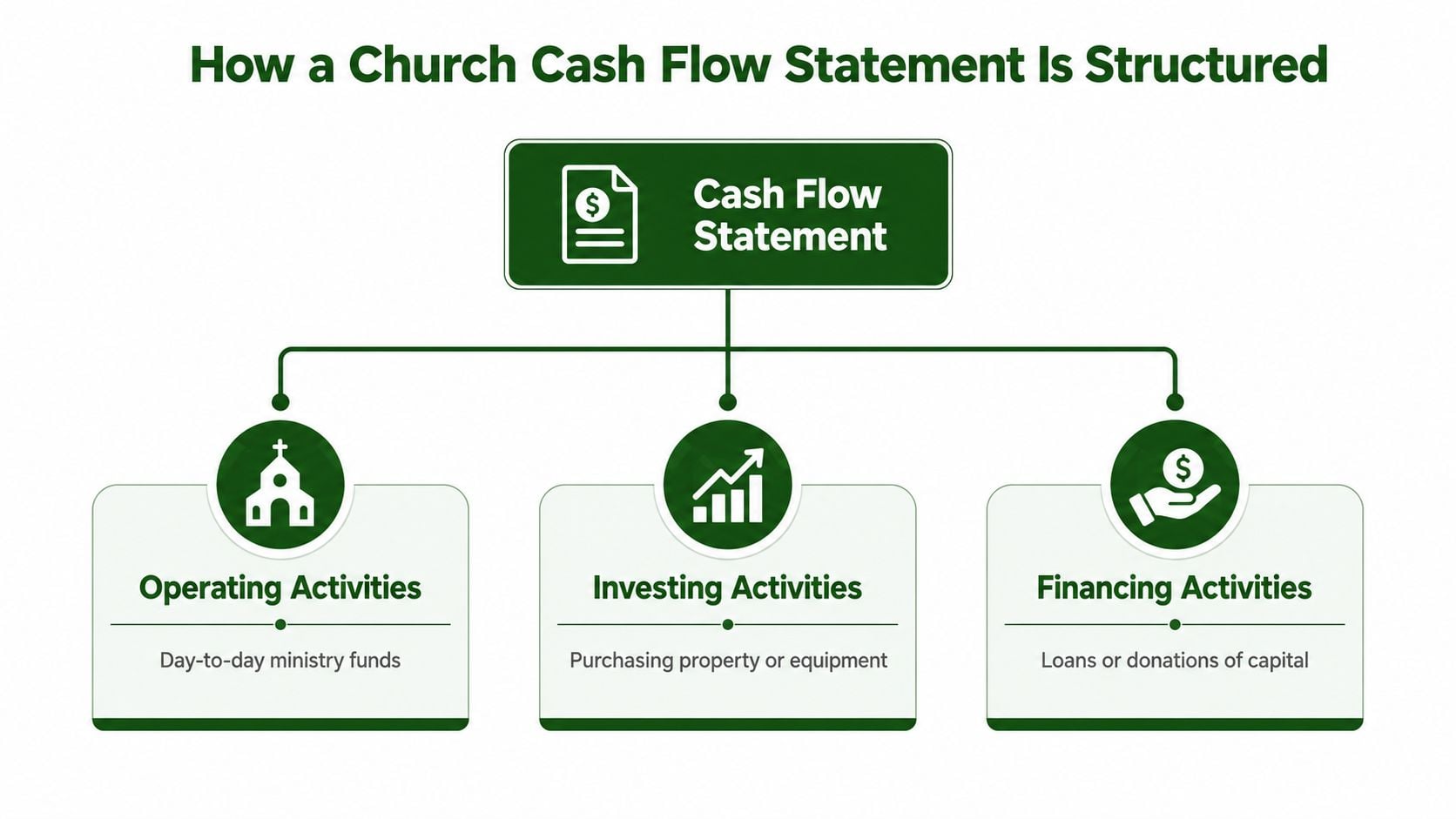
The standard presentation groups movement into operating, investing, and financing activities. For a pastor or board member, that makes the report easier to read because each section answers a different question: is the church carrying weekly ministry costs, putting money into long-term assets, or dealing with debt and capital funding?
Operating activities
Operating cash is the money that keeps weekly ministry moving. In church life, that usually includes tithes, offerings, program fees, payroll, utilities, and other routine expenses. If operating cash stays thin over time, the church may look stable in reports but feel strained in the actual work of ministry.
A good way to read this section is to ask whether ordinary giving is covering ordinary ministry. If it is not, the church may be relying on reserves, delayed payments, or money that was never meant for day-to-day use.
Investing activities
Investing cash covers property purchases, equipment, and other long-term uses of cash. A new sound system, HVAC replacement, or building purchase belongs here because it changes the church's asset base rather than just paying this month's bills. Depending on how the church's accounting is set up, reserve or endowment-related movements can also belong here.
This section matters because it shows whether cash is being redirected into ministry infrastructure. A board may see a large outflow and assume the church is overspending, but the detail may show a planned capital improvement or a property-related purchase instead.
Financing activities
Financing cash includes loan proceeds, debt repayments, and capital campaign receipts tied to borrowing or capital structure. It often explains the financial story behind larger projects, especially when a congregation is renovating, expanding, or paying down debt. If a church has taken on borrowing for a major project, this section should make that visible.
For churches that use fund accounting, this part of the statement can be read alongside fund activity so leaders can see whether financing cash supports a specific project or shifts money across restricted buckets. A good overview of what fund accounting is helps board members understand why cash can look healthy in one fund and tight in another.
The report is typically built from reconciled beginning and ending balances, and church guidance says it should be organized around beginning cash balance, total cash disbursements, total cash income, and ending cash balance for the period. As noted in the church reporting structure guidance, the ending cash should agree with the bank-reconciled balance on the balance sheet. That agreement shows the statement reflects actual cash, not just a bookkeeping estimate.
Fund Accounting vs Standard Cash Flow Reporting
A standard cash flow report can tell the truth and still leave leaders confused. That happens when the church's cash is pooled in a way that hides restrictions. A strong overall balance may look reassuring, but if most of it belongs to building gifts, mission designations, or other restricted funds, the operating fund may be much tighter than it appears.
That's where fund accounting changes the picture. Churches don't just track cash by account, they track money by purpose. A donor who gives for the youth mission trip expects that money to stay linked to that purpose, and a board member needs to know whether unrestricted cash is available for salaries, supplies, and ministry planning.
For churches with designated or restricted funds, finance guidance often pairs fund-balance reporting with cash flow reporting so leaders can see both liquidity and stewardship at the fund level (church fund and cash reporting guidance). That pairing matters because the church may be solvent overall while still unable to spend freely from the operating fund.
| Reporting Approach | What It Shows | What It Can Hide | Best For |
|---|---|---|---|
| Standard organizational cash flow | Total cash movement across the church | Restricted cash availability and fund-level constraints | Quick high-level review |
| Fund-level cash flow reporting | Cash movement by designated purpose or fund | Less useful if leaders want one-line totals | Board oversight and stewardship visibility |
One way to think about this is simple, the church's total cash position and its usable cash position are not always the same thing. A building fund can make the books look stronger than the operating account really is. A fund-level view keeps that from becoming a surprise in the middle of payroll week.
For readers who need the accounting side of this distinction, the article on fund accounting system basics is a helpful companion. It connects the bookkeeping logic to the stewardship reality churches live with every month.
A church board that sees only pooled cash can misread its flexibility. A board that sees fund-level cash can make cleaner decisions.
Preparing Your Church Cash Flow Statement Step by Step
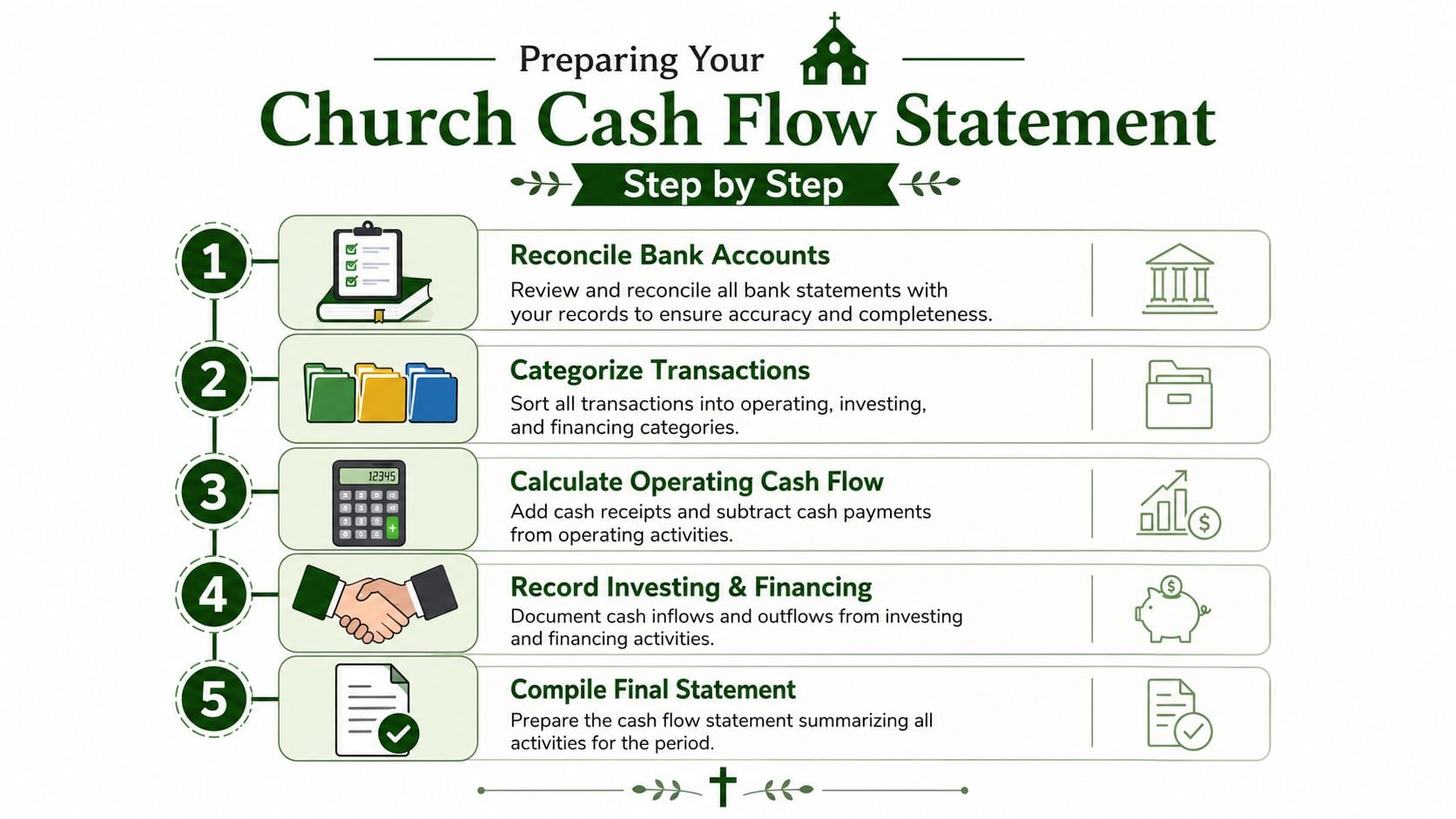
A church treasurer often starts this work with a simple question, “Can we trust the numbers enough to present them to the board?” The answer begins with reconciling the bank accounts before you build the report. If the books and the bank do not agree, the cash flow statement will repeat those errors, and the board will be reading a misleading picture of ministry cash. Church guidance is clear that the statement should reflect actual cash movements, not accrual-based income or expense (cash flow alignment guidance).
Start with reconciled balances
Begin with the ending cash balance from the prior period and confirm that it matches the bank-reconciled figure. That number becomes the starting point for the new statement. If there are uncleared deposits, outstanding checks, or timing differences from online giving platforms, clear those items first so the report starts from a clean base.
This step matters even more in churches that use fund accounting. A general cash total can look healthy while the operating fund is tight, because restricted gifts may sit in other funds and are not available for day-to-day ministry use. For board-ready transparency, cash should be reviewed at the fund level, so leaders can see which dollars are usable and which dollars are held for a designated purpose.
Sort every transaction into the right bucket
Next, group cash inflows and outflows into operating, investing, and financing activities. Church judgment matters here because a transfer is not always income, and a deposit is not always available operating cash. A building gift, for example, belongs in a different place from unrestricted Sunday giving, even if both hit the bank on the same day.
Restricted funds can blur the picture if they are left pooled in one line. That is why many church boards find fund-level reporting clearer than a single total cash view. It separates cash that supports regular ministry from cash that is reserved for facilities, missions, or other designated purposes, which is the kind of clarity leaders need before approving spending.
Check the ending number against the balance sheet
The statement is only complete when the final ending cash balance agrees with the bank-reconciled cash balance on the balance sheet. That tie-out is the control point that keeps misclassification and timing errors from distorting liquidity reporting. If the numbers do not tie, stop and investigate before the report goes to the board.
For a plain-language reference that shows the report-building sequence, the practical cash flow preparation guide is useful for new volunteers and newly appointed finance leaders. It gives a straightforward path through the mechanics before church-specific fund questions are added.
A further check should be made against the fund records. If a restricted ministry fund shows cash on hand, but the operating fund is short, the balance sheet total can still look acceptable while the day-to-day position is strained. That is the difference a church treasurer watches for, because it affects payroll, utility payments, and whether the church can meet obligations from the correct fund without borrowing from another purpose.
Review it like a board member would
Before sending the statement out, ask three questions. Does the beginning balance match last month? Does the ending balance agree to the bank? Does the movement make sense given the church's known ministry activity?
Then ask one more question. Does the statement show cash in a way that respects fund restrictions? A board should be able to see whether operating cash, designated cash, and other restricted balances are being reported clearly enough to support stewardship decisions. That level of visibility helps prevent confusion when a healthy overall cash total hides pressure in a specific fund.
If the answer to any of those is no, the report needs another pass. A tidy statement that does not tie out is worse than no statement at all.
Forecasting Cash Flow Through Seasonal Giving Patterns
A church budget can look healthy on paper and still feel tight in the checking account. That usually happens when leaders treat giving as even from month to month, even though church giving often rises and falls with the church calendar, holidays, and ministry rhythms. Independent forecasting templates for churches recommend using 2 to 3 years of historical giving and applying seasonal factors such as December running 20 to 30% above average and July running 10 to 20% below average (seasonal giving forecast guidance). A treasurer who ignores those shifts may approve spending in May or June, then feel the squeeze when summer giving softens.
A better forecast starts with the church's own pattern. Use past giving history, then layer in known ministry events, payroll timing, and planned capital needs. If your congregation gives through Sunday offerings, online recurring gifts, and occasional large gifts, the forecast should reflect that mix instead of assuming every dollar arrives in the same way. That matters even more in fund accounting, because restricted gifts can sit in the books while operating cash remains short.
Model the real sources of volatility
Recurring online giving can reduce some monthly swings, but it can also create concentration risk if too much of the budget depends on one giving channel. A forecast should show where cash is expected to come from and how stable each source is. That is the same discipline used in revenue forecasting methods, only here the question is not just how much income may arrive, but whether the operating fund will have usable cash when bills come due.
Board-ready forecast: show expected cash by month, then add reserve use and spending flexibility next to it.
A church also needs a clear trigger for slowing spending. If the forecast points to a softer giving month ahead, the treasurer can delay a discretionary purchase or move a non-urgent project without waiting for a shortfall to show up in the checking account. That kind of planning helps a pastor and board discuss timing before the pressure reaches payroll or utilities.
Restricted money can blur the picture. A designated building gift may make total church cash look comfortable, while the operating fund still needs help meeting everyday obligations. For that reason, many churches present cash flow at the fund level, so the board can see operating cash, designated balances, and restricted cash separately instead of treating them as one pool. For leaders who want a practical way to shape that projection, you can improve cash visibility with AmbitionCFO.
The channel mix is changing too. More churches use recurring online giving, and some receive IRA-based gifts, which can shift the timing of cash in ways that a simple monthly average will miss. Forecasting works better when it treats those changes as part of the model, not as background noise.
Reporting Best Practices for Pastors and Church Boards
Monthly reporting keeps a church from flying blind. Guidance for churches recommends preparing cash flow reports monthly rather than waiting until year-end, so ministries can compare actual cash movement with budget expectations throughout the year (monthly reporting guidance). That cadence matters because cash problems usually appear gradually, not all at once.
The reporting packet should speak to both financial and ministry leaders. A pastor needs to know whether payroll is safe. A board member needs to know whether the operating fund is carrying the load. A volunteer elder needs to know whether a restricted gift is being used exactly as intended.
What to include in the packet
- Cash flow statement: Show actual cash movement by operating, investing, and financing activity.
- Fund balance table: Show restricted gifts, designated balances, and available operating funds.
- Bank reconciliation summary: Confirm that the books and bank agree before decisions are made.
That combination gives the board a fuller picture than a single statement ever could. It also protects the church from making a decision based on cash that belongs to another purpose. A building fund balance is not the same thing as unrestricted ministry cash.
For leaders who want a practical way to read these statements, the guide on how to read a cash flow statement is a good reference. It gives non-financial readers a cleaner starting point for board conversations.
A good report also uses plain language. Instead of saying “liquidity variance,” say “we have enough cash for payroll, but the operating fund will be tight if giving dips again next month.” That kind of wording helps pastors and board members act on the numbers instead of staring at them.
An organized monthly process also supports audit readiness and stewardship communication. When records are clean, the church can explain its finances with confidence, and that builds trust inside and outside the congregation.
Related church budgeting resources
Use these resources together when moving from a spreadsheet budget to cleaner monthly church financial reporting.
- Free church budget generator - build a custom Excel budget template for your church
- Church budget template Excel guide - download and adapt a practical budget template
- Nonprofit budget examples - compare operating, program, and restricted-fund budget formats
- Grain Ledger budgeting - connect budgets to fund accounting and monthly reports
- Best church accounting software - compare fund accounting tools when the spreadsheet budget outgrows Excel
Automating Church Cash Flow with Grain Ledger
Manual cash flow reporting gets harder as a church adds funds, accounts, and giving channels. A spreadsheet can work for a while, but it tends to break when restricted gifts, bank transfers, and fund activity all need to be tracked at once. That's why purpose-built church accounting software matters, especially for teams that don't have a full-time finance staff.
Grain Ledger is built around true fund-based accounting, so every account, transaction, and report starts with the fund structure churches use. It also connects giving platforms, bank accounts, and accounting records so donations can flow into the correct funds automatically. That reduces the reconciliation gaps that often blur cash flow reporting and helps finance teams see fund-level cash without stitching reports together by hand.
For churches that want one system to handle this workflow, Grain Ledger is one option to consider because it produces fund-based financial reports, including cash flow statements, with underlying journal-entry detail for review.
It's useful because the report doesn't just sit at the summary level. Leaders can see how restricted funds move, how operating cash changes, and how the statement ties back to the accounting records. That makes board reporting cleaner and gives treasurers a more reliable way to answer the recurring question, “Can we afford this right now?”
If your team is ready to move from manual cleanup to a steadier reporting process, Grain is designed for that kind of church finance workflow. Start Free at Grain and see how fund-based accounting can make cash flow reporting easier to prepare, easier to trust, and easier to explain to your board.
Ready to simplify your church finances?
Start free with church fund accounting, or watch a product demo first.