What Is Fund Accounting System? Your 2026 Guide
 By Gibson Brueher, Founder of Grain Ledger
Discover what is fund accounting system. Learn how it differs from standard accounting & helps churches track restricted gifts with confidence & clarity in
A fund accounting system is a self-balancing accounting structure that tracks each restricted or designated pool of money as its own mini-ledger, so churches can prove every dollar went where donors intended. In plain terms, it keeps the building fund, mission trip gifts, benevolence money, and general offerings from turning into one blurry pile.
About Grain Ledger: This guide includes Grain Ledger, church fund accounting software built for designated gifts and ministry funds. It connects giving platforms (Planning Center, Pushpay, Tithely, Stripe), syncs bank activity with Plaid, and produces fund-level financial reports. Start free to see how it compares for your church.
See Grain Ledger for your church
Fund accounting, giving integrations, and bank reconciliation in one platform. Free migration support for churches switching from QuickBooks or Aplos.
If you've ever stared at a church spreadsheet and wondered whether the youth retreat deposit was mixed into the heating bill, you're already living the problem this system solves. A treasurer can receive a building campaign gift, a missions offering, and Sunday tithes in the same week, but each gift still needs its own trail.
Fund Accounting System in Plain Language
A church treasurer usually feels this first. The building fund gift arrives, the youth pastor hands over mission-trip donations, and the general offering still has to pay the electric bill, payroll, and nursery supplies. If those dollars sit in one undifferentiated pile, nobody can easily prove which amount was meant for a roof repair, which amount was meant for Guatemala, and which amount was meant for the week-to-week ministry of the church.
A fund accounting system solves that by treating each pool of money like its own small ledger. The idea is simple, each fund stands on its own, so restricted gifts do not get lost inside ordinary operating cash. That matches the core definition of fund accounting as a self-balancing accounting system used for legally or donor-restricted resources, especially in governments and nonprofits, where accountability matters more than profit Fund Accounting from the Italian Early Tradition to the U.S. GAAP for Governments.
The mental model
Think of a church with several labeled envelopes on the finance desk. One envelope is for the roof campaign, another is for benevolence, another is for missions, and one is for general ministry. The cash may pass through one bank account, but the books still have to show which envelope each dollar belongs to.
That separation is the whole point. Washington State describes a fund as a self-balancing set of accounts whose resources are segregated for a particular purpose, and Texas State says resources are classified into funds according to the limitations placed on their use by the provider Washington State fund accounting guidance. For a church, that means a designated building gift stays visible until the roof work is paid for.
Practical rule: if a donor can reasonably ask, “Did my gift go where it was supposed to go?”, that money belongs in a fund structure, not in a loose general ledger pile.
If you want a ministry-focused overview of how churches often set up that structure from the start, the Australian church formation guide gives useful context for the financial setup side, especially when a new church is deciding how to separate ordinary operations from restricted gifts.
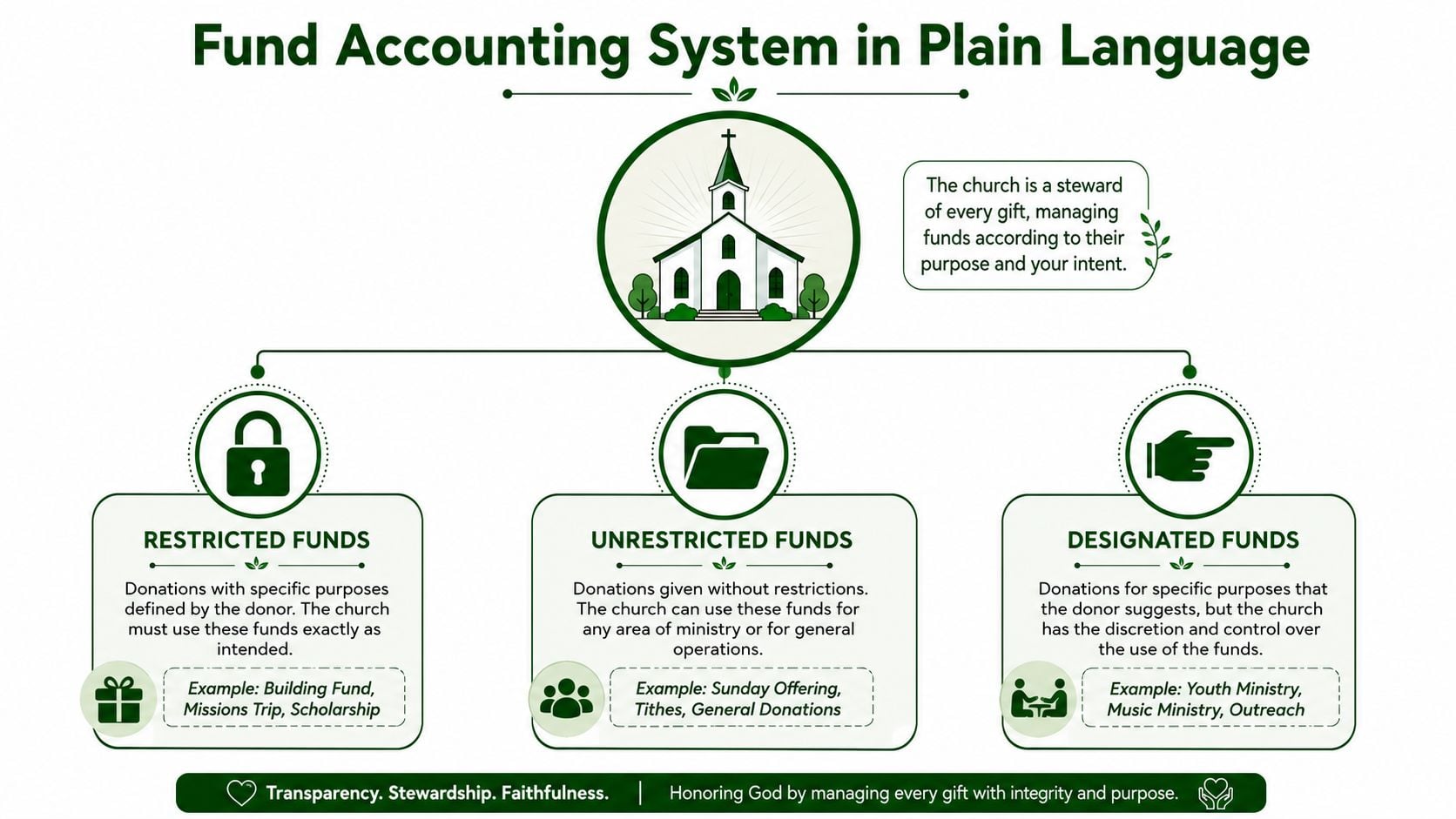
The cleanest way to explain it to an elder board is this, fund accounting gives every dollar a home, and it keeps that home visible until the money is spent for the right purpose.
How Fund Accounting Differs from Standard Accounting
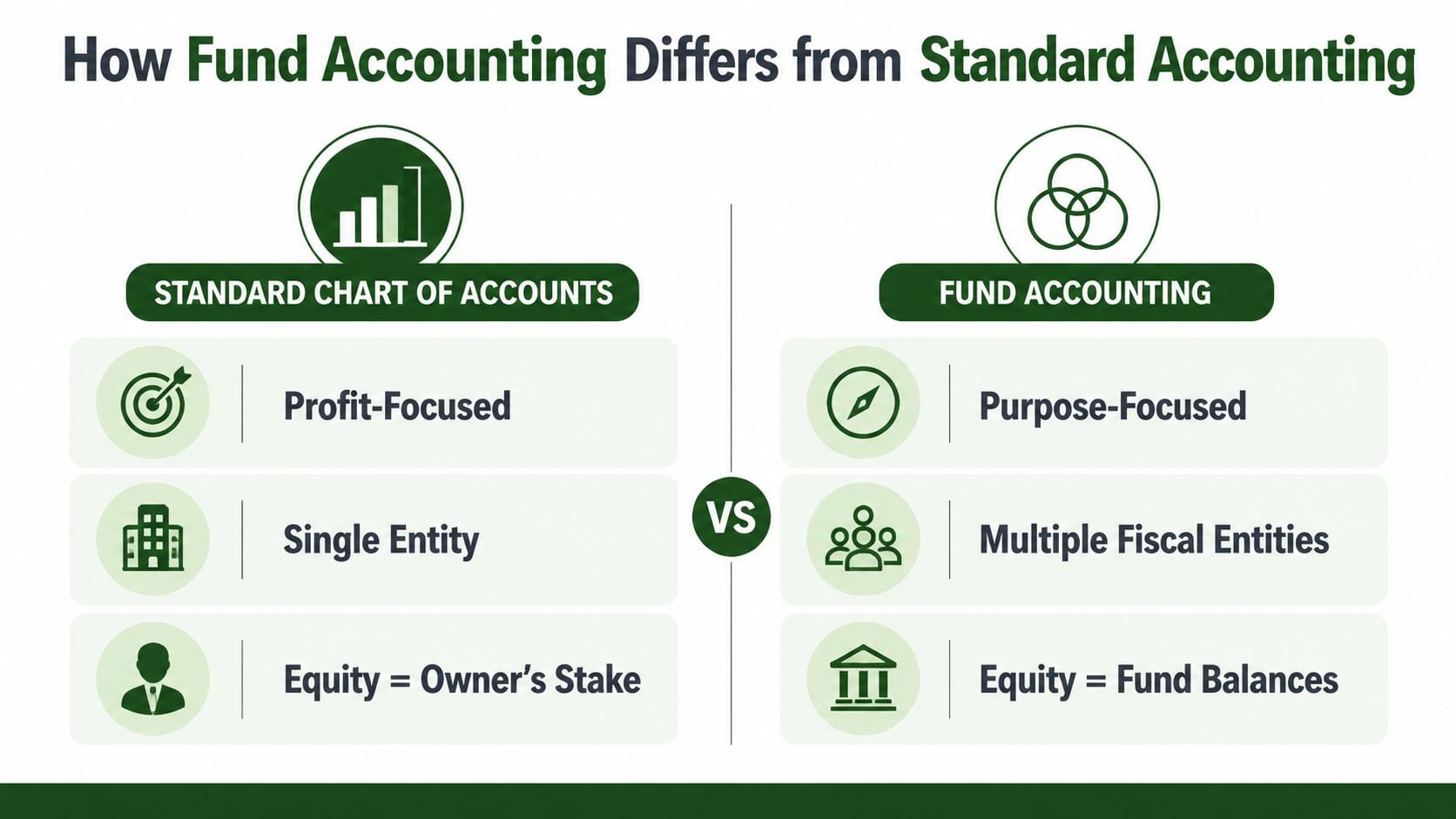
Standard accounting asks a business a direct question, did we make money? Fund accounting asks a church a different one, did every dollar go where it was restricted, designated, or approved to go? Those are not the same question, and the answer changes how the books are organized.
A for-profit company usually works from one entity perspective. Revenue, expenses, and equity all point toward owner value. A church has to show stewardship, donor intent, and compliance with restrictions, so fund accounting is a different architecture, not just a reporting label attached to general-ledger software.
Purpose first, profit second
Standard accounting organizes the chart of accounts around business results. Fund accounting organizes the books around the purpose of the money. A capital campaign gift is not just another deposit, it is a restricted resource that needs its own tracking path until the project is complete. A missions gift works the same way, because the church still has to show where that money sits and how it was used.
This also explains why fund accounting is not the same thing as cash basis versus accrual basis. Those are separate choices. A church can keep its books on a cash or accrual basis and still need fund accounting, because fund accounting governs how money is segregated, not just when revenue and expense are recognized.
Why tags alone fall short
Some churches try to imitate fund accounting with class tags or location tags inside general-purpose software. That can help with labeling, but it does not create the self-balancing structure that true fund accounting uses. The system needs to know, at posting time, whether money belongs to the general fund, a special purpose fund, or a business-like revolving fund.
A church can usually get by with tags for a while. It often cannot answer an audit question, a grant review, or a donor question with tags alone. The reporting pressure is different from a business, because a single bottom line is not enough for a church that has to preserve separate stories for the general fund, the building fund, the youth missions fund, and the benevolence fund. TechRepublic notes that nonprofits keep separate books by fund and then combine them into consolidated statements, which captures the accounting difference churches run into in practice What Is Fund Accounting?.
A church budget categories guide, such as Grain's church budget categories, can help leaders see how those reporting buckets often show up in everyday ministry planning.
A church can survive with tags for a while. It usually can't survive an audit, a grant review, or a donor question with tags alone.
That is the fundamental split. Standard accounting reports organizational results, while fund accounting protects restricted purpose.
The Core Building Blocks of a Fund Accounting System
A church fund system only works when the pieces fit together. If one piece is missing, the whole thing becomes a spreadsheet workaround with a nicer name.
The fund itself
The fund is the basic unit. It is a self-balancing fiscal entity with its own records, so the church can see its assets, liabilities, income, and expenses separately from other money. In practice, that means the benevolence fund can show its own inflows and outflows without being blurred by Sunday offerings or youth camp income.
The chart of accounts
The chart of accounts has to reflect the church's purpose-based reality. Instead of building the system around profit lines, it has to support separate funds and the accounts needed inside each one. Oracle's fund accounting overview describes each fund as its own self-balancing accounting entity with a sub-ledger and chart of accounts, which is exactly why fund-level reporting stays reliable Oracle Fund Accounting Overview.
Restriction logic
The system protects donor intent. A restricted gift shouldn't be reallocated just because another fund is short. Good systems enforce the rules at posting time, and any movement between funds has to happen through an explicit transfer entry. That control matters most for capital campaigns, mission gifts, and grant money.
Reporting layer
The reporting layer is where the church finally sees the whole picture. Each fund needs its own statement-level visibility, but the church also needs consolidated reporting across the whole ministry. TechRepublic's description of separate books plus combined financial statements captures that balance well TechRepublic fund accounting article.
For churches comparing systems, Grain's church budget categories page is a useful reference point because it shows how fund-level organization can be reflected in daily budgeting, not just at year-end.
| Building block | What it does | Church example |
|---|---|---|
| Fund | Keeps one purpose-specific pool of money separate | Benevolence fund |
| Chart of accounts | Organizes accounts inside each purpose | Building campaign accounts |
| Restriction logic | Controls movement between funds | Mission gift cannot cover rent |
| Reporting | Shows fund-level and church-wide results | Board report with all funds combined |
Practical rule: if your software lets a restricted donation drift into another purpose without a documented transfer, the system is helping you lose track of stewardship.
A real fund accounting system makes each layer work together, so the church doesn't have to reconstruct the story later from scattered reports.
A Day in the Life of a Church Running Fund Accounting
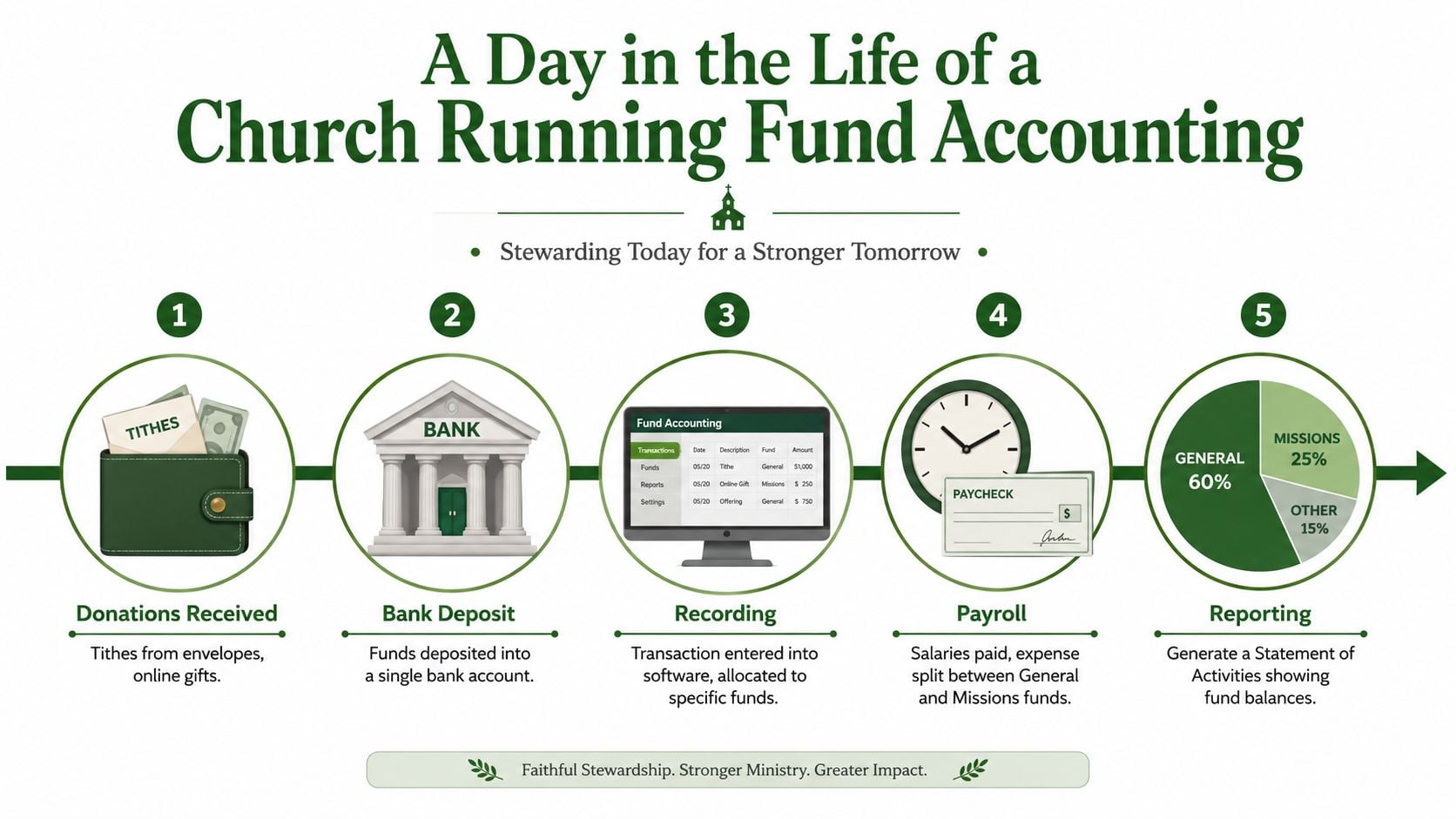
A mid-sized church usually feels fund accounting most on a normal week, not on a dramatic one. Donations come in through envelopes, online giving, and text-to-give. The bank deposit lands, payroll runs, a mission gift gets transferred, and the board wants one clear report at month-end.
The weekly flow
The first step is donation intake. A giver marks a gift for the building fund, another for the mission trip, and the rest goes to general ministry. The bank may see one deposit, but the accounting system still has to assign each gift to the correct fund.
Next comes recording. The bookkeeper enters the deposit and allocates it across the right funds. That is where the software matters, because a true fund system treats each fund as its own accounting entity instead of asking someone to sort it out later in a spreadsheet.
Payroll is where churches sometimes get fuzzy. Salaries and benefits usually hit the general fund, but some churches split costs if a staff member serves across ministries. The point is not to force every transaction into one category, but to keep the allocation honest and documented.
Then the church makes payments. A benevolence check should hit the benevolence fund, not operating cash. A contractor invoice for a roof project should stay inside the capital campaign fund until that project is complete.
HUD's fund accounting guidance gives a very clear version of this logic, each grant and source of income has its own fund, chart of accounts, and eligible activities, and reimbursement depends on proper allocation and documentation HUD fund accounting guidance. Churches face the same basic control principle, even when the grant comes from a donor instead of a federal agency.
The monthly report is the final checkpoint. Leaders should be able to see each fund balance clearly, then roll those balances into a board-ready view that shows what the church can spend next. That is the rhythm a good system has to support without manual reconstruction every month.
Why Churches Specifically Need a Fund Accounting System
A church budget is only part of the story. Churches also hold trust on behalf of donors, families, and ministry partners, so every restricted gift comes with an expectation and every designated offering creates a duty to show where that money went.
That pressure shows up quickly in real ministry life. A building campaign, a youth retreat fund, a mission trip collection, and benevolence gifts all create separate accountability lines. When those lines blur, the problem is no longer just bookkeeping, it becomes stewardship.
The ministry stakes
Restricted gifts need to stay restricted in the books. Designated offerings still have to be visible after the board approves the expense. Capital campaign money has to remain separate from the general operating budget. If the church receives grant-funded outreach money, the reporting burden gets tighter because someone outside the church often wants proof that the funds were used as promised.
Fund accounting handles those boundaries by following the restriction itself. The system does not begin with, “What did the church earn?” It begins with, “What must this money be used for?” That logic has deep roots in public and charitable accounting, including church and faith-based settings, as shown in Fund accounting from early tradition to U.S. government accounting.
Why workarounds break down
Spreadsheets can carry a small church for a while, especially when the congregation has only a few transactions and one careful volunteer. They start to fray when giving comes through multiple channels, staff roles change, and fund transfers need clear documentation. Manual tags and color-coded tabs do not create ledger-level control, and that leaves the church exposed when auditors, board members, or donors ask for answers.
A proper system also strengthens auditability and transparency because each fund keeps its own balance and history. That makes it easier for a treasurer to answer direct questions without rebuilding the story from scratch. Churches with a clear fund structure often find that board conversations become calmer, because the reports finally match ministry reality.
Donor trust grows when the books show the same boundaries the donations were given with.
Churches need this structure because it protects restricted money, reduces confusion, and gives leaders a cleaner way to steward ministry resources. It also helps the church keep everyday decisions tied to the purpose behind each gift, whether the money is for the operating budget, a mission trip, or a one-time benevolence need.
Choosing and Implementing a Fund Accounting System for Your Church
The first question is architecture, not features. A church should ask whether the software has native fund accounting or whether it only simulates funds with tags on a normal general ledger. That difference decides whether restricted money is controlled or merely labeled after the fact.
| Capability | Native Fund Accounting | Class Tags on General Ledger |
|---|---|---|
| Separate fund balances | Built in | Added through workarounds |
| Inter-fund transfer controls | Enforced in the ledger | Often manual |
| Restricted gift tracking | Fund-based from posting | Depends on user discipline |
| Board reporting | Fund-level by design | Often assembled later |
| Audit trail | Stronger because entries live in the right fund | Weaker when tags are edited |
What to check before you switch
Start with transfer controls. If your team can move money between funds without a documented transfer entry, the software is not protecting donor intent. Then check integrations, because church finance teams rarely live in one system.
Grain is church accounting software built around fund-based accounting, with a native fund structure so accounts, transactions, and reports are organized around funds from the start. It also connects with tools churches already use, including Planning Center, Pushpay, Stripe, and bank and card providers through Plaid, so gifts can flow into the right funds without a lot of manual cleanup. A practical rollout guide is available in the accounting software implementation article.
You'll also want clean fund-level reporting, not just one combined balance sheet. If the software can't show each fund clearly, the finance team ends up exporting data into spreadsheets just to explain the month.
A simple rollout checklist
- Map opening balances: List every existing fund before migration, including building, missions, benevolence, and general operating.
- Clean up the chart of accounts: Remove duplicate accounts and make sure each account belongs to the right fund structure.
- Document transfers: Decide who approves transfers between funds and how those entries will be recorded.
- Set the reporting cadence: Choose when the board, pastor, and finance committee receive fund-level reports.
- Test the first month carefully: Compare bank activity, fund balances, and actual ministry spending line by line.
If your church is ready to use a system built for fund-based church accounting, Start Free for Grain. It's a straightforward option for churches that want restricted gifts, general funds, and ministry budgets to stay clearly separated from day one.
Common Pitfalls Churches Hit with Fund Accounting
The biggest mistake is pretending tags are funds. A church can label transactions in QuickBooks or another general ledger, but that still isn't the same as a true self-balancing fund structure. Once the finance team starts editing tags to make reports line up, the system has already started leaking.
Another common failure is moving restricted money without a transfer entry. A benevolence payout, a building project invoice, or a missions expense should not cross into another pool just because the general fund is short that month. That's how donor complaints start, because the church can't show a clean trail.
The traps that cause the most confusion
Mixing pass-through gifts with operating cash creates immediate reporting noise. If the church collects money for a specific need, the accounting system has to keep that amount visible until it's spent for that need. Running capital campaign money through a single cash view without a per-fund sub-ledger creates the same problem, only later and with more stress.
Board reports can also hide the issue when they net everything together. A report that shows one combined number may look tidy, but it erases the restrictions that matter most to stewardship. Auditors notice that fast, and so do careful donors.
Short rule: if your report makes restricted and unrestricted money look interchangeable, the report is telling a lie, even if the math adds up.
TechRepublic's explanation of separate books by fund and combined financial statements helps show why the right structure matters, because visibility has to exist at both levels What Is Fund Accounting?. Churches that skip that structure usually spend more time reconciling than ministering.
The fix is not more spreadsheet tabs. The fix is a system that treats each fund as a real accounting entity from the start.
Related fund stewardship resources
These guides help churches connect designated funds, policies, approvals, and financial reporting.
- Church benevolence fund guide - set policy, approvals, and accounting controls
- Restricted fund guide - understand donor restrictions and fund balances
- Fund accounting in Grain Ledger - track designated gifts and ministry funds in the ledger
- Best church accounting software - compare software that tracks restricted gifts and ministry funds
- Schedule a Grain Ledger demo - see fund-level reports and bank reconciliation
Bringing It All Together and Answering Church Finance FAQs
A fund accounting system gives a church something more valuable than tidy books. It gives leaders a clear way to steward restricted gifts, explain balances, and honor donor intent without guessing later where the money went. That's why it's not a niche accounting preference, it's a structural answer to church stewardship.
| Fund Type | Purpose | Church Example |
|---|---|---|
| General fund | Covers ordinary ministry operations | Weekly giving for salaries and utilities |
| Building fund | Holds money for a specific facility purpose | Roof replacement campaign |
| Missions fund | Tracks money for outreach or mission work | Youth mission trip gifts |
| Benevolence fund | Supports aid to people in need | Emergency rent assistance |
If you're comparing systems, the fund balance reporting guide is useful because it shows why fund-level visibility matters when board members ask what each dollar can do.
Does a small church really need fund accounting?
Yes, if it receives restricted gifts, designated offerings, or grant money. The size of the church matters less than the obligation to track money by purpose.
Can QuickBooks do fund accounting?
It can help with tracking, but tags alone don't create native fund architecture. That's the difference between a workaround and a system.
What's the difference between restricted, designated, and unrestricted funds?
Restricted money has outside limits. Designated money is set aside by the church or donor suggestion, but the church still controls it. Unrestricted money supports general ministry use.
What happens in the first month with Grain?
The team maps funds, imports balances, connects giving and bank data, and starts producing fund-level reports that match real ministry categories. The goal is to make the books reflect how the church already operates.
If your church is still wrestling with mixed spreadsheets and hard-to-follow gift restrictions, Grain can help you move to true fund-based accounting built for congregations. Visit Grain to see how it organizes donations, transfers, and reporting around the funds your ministry needs.
Ready to simplify your church finances?
Start free with church fund accounting, or watch a product demo first.