Church Offering Table Setup Guide for Modern Congregations
Plan, set up, and manage a church offering table that fits your sanctuary, builds donor trust, and keeps giving secure from plate to deposit.
Sunday morning, the ushers are ready at the back of the sanctuary, the offering plates are waiting, and someone is checking whether the envelopes, pens, and QR code card are where they belong. A family may place a check in a plate as it passes through the pews, while another worshipper scans a code at the front table and gives from a phone. Both gifts belong in the same accountable process.
A church offering table is more than a furnishing. It carries the symbolism of presenting gifts in worship, while also serving as the physical point where money, envelopes, and donor information enter the church's custody. The setup works when those two purposes reinforce each other. It fails when a beautiful table creates blocked traffic, unclear instructions, or an unsafe handoff.
Why the Church Offering Table Still Matters
The Sunday offering often has a quiet rhythm. Ushers gather near the rear, plates move row by row under observation, and a family may walk toward the chancel to place an envelope on a table before returning to its seat. Visitors may watch without giving, regular attenders may use cash or checks, and digital donors may participate through a phone. The room has to make space for all of them without turning generosity into a public test.
That's why the table has always carried two responsibilities at once. Spiritually, it marks the presentation of gifts before God. Operationally, it marks the moment when those gifts leave a donor's hands and enter the church's custody. The table's location, height, visibility, and supervision therefore communicate more than style. They tell people whether giving is an act of worship, a transaction at the door, or an awkward activity they should avoid.
The history supports that layered meaning. Church offering tables emerged from an older Eucharistic practice in which Christians brought bread, wine, and gifts for the poor to a table. In the second and third centuries, offerings were still primarily food and alms rather than money, and deacons set aside what was needed for the service before directing the remainder to the poor. In 1549, the Church of England's liturgy redefined the “offertory” as a collection of money, helping move Protestant worship from material gifts for communion toward cash offerings. Faith+Lead's history of the offering describes that transition as gradual rather than abrupt.
Practical insight: The table's pastoral meaning and its control function shouldn't be separated. The same object can invite reverence and enforce custody.
A table near the chancel may support the theology of presentation, but it needs a discreet route into secure storage. A rear narthex table may simplify exit flow, but it can look like a payment station. Before choosing wood finish, trim, or a cross motif, decide who may touch the table, who supervises it, and how gifts move from the service into the counting process. The donor journey also matters, from first invitation to receipt and reporting, which is why churches can connect the offering moment to a broader church donor life cycle.
Sizing the Table to Your Sanctuary
A catalog default rarely fits a real sanctuary. Start with the room's narrowest route, the number of people who may approach at once, and the position an usher needs to occupy while keeping the table visible.
A common church offering table benchmark is 24 to 36 inches wide, 18 to 22 inches deep, and 30 to 32 inches high, according to Worthington Direct's offering table specifications. Some traditions use a 36-inch height for a narrower, more upright table. The height should let a standing adult place an envelope without bending, while remaining reachable for someone using a wheelchair or walker. A lower auxiliary tray can solve accessibility problems without forcing the entire table to sit at an awkward height.
Depth deserves more scrutiny than it usually gets. Offering tables often use 16 to 20 inches of depth, while 24 inches is more typical of a larger altar or communion table. A deeper surface may look substantial, but it consumes circulation space and encourages staff to pile envelopes, cards, and plates in one untidy zone.
Use the room, not the catalog, as your measurement
Width should match the traffic pattern. A long banquet-style surface accommodates more simultaneous donors, but it gives ushers a broader area to monitor and creates more places for an envelope or plate to disappear from view. A narrow console produces cleaner sightlines and a smaller footprint, but it slows the flow when several people approach together.
The supplied dimensions below are planning ranges, not a substitute for an on-site measurement.
| Sanctuary Size | Recommended Height | Recommended Depth | Recommended Width | Aisle Clearance | Peak Donors per Minute |
|---|---|---|---|---|---|
| Small | 30 to 32 in | 16 to 18 in | 24 to 30 in | Keep the main route open | Plan for a short, orderly queue |
| Medium | 30 to 32 in | 18 to 20 in | 30 to 48 in | Keep the main route open | Plan for several donors approaching together |
| Large | 30 to 36 in | 18 to 22 in | 48 to 60 in | Keep the main route open | Plan for a broader supervised flow |
Don't treat an unsupported clearance number as a universal accessibility certification. Instead, confirm the required clear passage for your building and local accessibility rules, then preserve that route at all times. A useful field rule is simple: measure the narrowest aisle, subtract the required clear passage, and use the remainder as the maximum table depth. Also leave enough edge distance for an usher to stand on either side without blocking traffic.
Choose a table that two adults can move safely without disassembly. A heavy permanent piece may look dignified but becomes a liability when the sanctuary changes for communion, concerts, or fellowship events.
Placement, Signage, and the Donor Experience
Placement determines whether people understand the offering before they read a word. Three positions usually work: the rear narthex, a side aisle, or the front of the sanctuary near the chancel.
A rear narthex table lets visitors give or collect information without crossing the room. It also risks looking like an exit lane, especially if it sits beside the doors. A side-aisle table keeps the offering visible while avoiding a public walk to the front, but it must not narrow the route or interrupt mobility-device traffic. A front table makes generosity part of the worship movement, yet first-time givers may feel exposed when they approach it.
Make the next action obvious
Signage should answer three questions quickly: what the table is for, how someone can give, and what to do if they're visiting. Use plain wording such as “Place offering envelopes here” or “Give online by scanning the code.” Keep the church name and fund visible on the digital destination, rather than sending people to an unexplained payment screen.
A well-made sign can help the table look intentional instead of improvised. If you're comparing materials and layouts, acrylic signs for your display can provide a durable option for a placard that stays readable through repeated Sunday use. Put envelopes and pens beside the sign. Their presence tells visitors that giving is expected as an available practice, not an awkward interruption.
Accessibility needs to be visible in the setup:
- Clear approach: Leave floor space for a wheelchair or walker to turn and stop without entering the main traffic stream.
- Lower option: Add an auxiliary tray or ledge that a seated donor can reach comfortably.
- Readable materials: Offer large-print and tactile cards for donors with low vision, and avoid relying on color alone.
- Quiet participation: Let people place an envelope without requiring a public greeting or explanation.
The table should be visible from every seat without becoming the visual centerpiece. Ushers should supervise the area from a position that gives them a clear view, not stand over donors like guards. If the table is unattended during fellowship time, move the plates and envelopes into custody rather than assuming the furnishing itself provides security.
Running a Secure Collection and Count
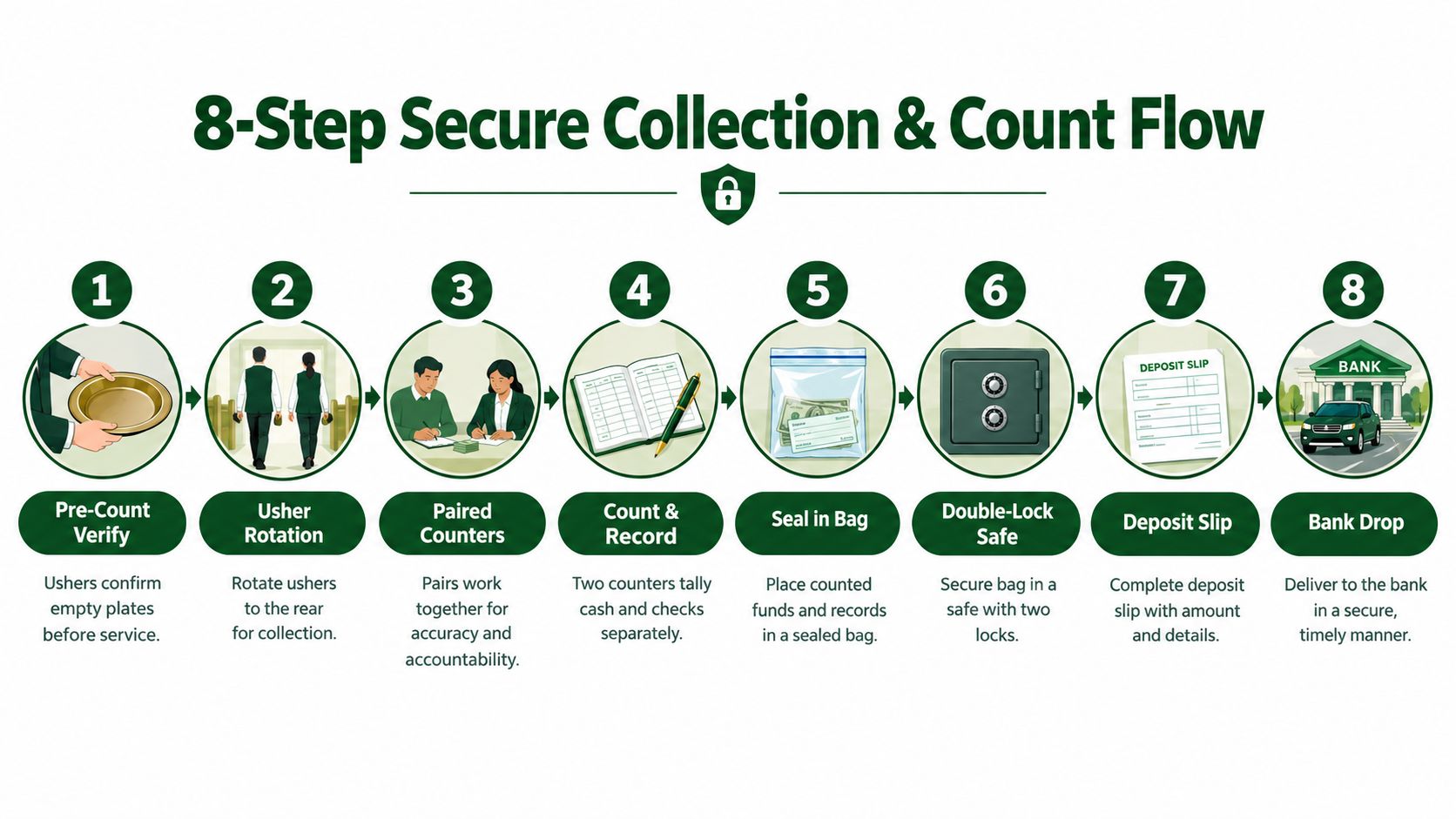
A secure collection depends on a controlled handoff, not on the appearance of the table. The process below keeps responsibility visible from the first empty plate check through the bank deposit.
- Pre-count the plates. Ushers confirm that every plate is empty before the service and record the number in the service log.
- Rotate ushers in pairs. Ushers gather at the rear and follow a written rotation so no one person controls the entire route.
- Pass plates under observation. Plates move row by row, then return through a defined path to the altar or side table.
- Transfer to a restricted counting room. Authorized people move filled plates immediately to a room with no public access.
- Count with two unrelated people. Both counters open envelopes, tally cash and checks separately, and record discrepancies between an envelope amount and its contents. Church counting guidance calls for at least two unrelated counters and regular reconciliation by someone other than the depositor.
- Bundle and seal the funds. Use tamper-evident bags and record the seal information on the count sheet.
- Secure and sign. Store the sealed bag in a locked or fire-rated safe, and obtain dual signatures on the count sheet.
- Deposit and reconcile. Two unrelated volunteers complete the same-day bank drop, then the treasurer matches the deposit to the count record and service information.
The intact-deposit rule is central. The church shouldn't use offering cash to pay expenses, exchange it for other cash, or remove money before deposit. Internal-control guidance for churches says offerings should be counted and deposited intact, while checks, loose cash, and envelope offerings should remain separate.
Cameras can cover the table and the counting-room entrance without recording private donor details. A locked drop slot can receive sealed bags, and a safe should hold them until the bank run. Don't leave unbagged cash in a pastor's office, accept a single-counter Sunday, or postpone the deposit until Monday. Those shortcuts create gaps that no later spreadsheet can repair.
The safest policy is written, paired, and repeatable. Assign the roles before Sunday, document substitutions, and require two people at each custody change.
For a broader perspective on physical offering containers and their place in church practice, see this guide to the tithe and offering box. The same principle applies here: reverence doesn't replace controls, and controls shouldn't erase the meaning of the gift.
Connecting the Table to Digital Giving
The physical offering table and the digital platform should function as one receipt stream. A donor who places a check in a plate and a donor who gives through a phone are using different doors into the same fund-based record. If the treasurer reconciles only the bank deposit, same-day digital gifts can remain disconnected from the service count and designated-fund review.
The table can support that connection without becoming a technology kiosk. Place a QR placard where it's readable from the aisle, with the church name and the intended fund already selected in the giving portal. Print a text-to-give keyword on the front lip or sign. Add a small tray with response cards so an online donor can leave a name or prayer request without putting cash in the plate.
Use a branded URL rather than a raw payment-page address. Keep one administrative login for the finance team, protect it appropriately, and document who may access reporting. The goal isn't to make every worshipper use the same channel. It's to make every channel land in a record the church can verify.
Close one ledger, not three
The Sunday workflow should pull the platform totals, text-giving totals, and physical count into one review before the deposit is finalized. A simple reconciliation sheet can look like this:
| Line Item | Source | Count Method | Recorded By | Variance Check |
|---|---|---|---|---|
| Plate cash | Offering count room | Two-person cash tally | Counters | Compare with count sheet |
| Plate checks | Offering count room | Envelope and check review | Counters | Match endorsement and deposit |
| Online gifts | Giving platform | Same-day fund report | Treasurer | Compare fund and date |
| Text gifts | Text-giving report | Same-day keyword report | Treasurer | Compare donor-designation data |
| Bank deposit | Bank receipt | Intact sealed deposit | Depositor | Match total to approved count |
Churches need this hybrid design because physical giving remains important even as digital giving grows. A 2026 Protestant Annual Church Giving Report says 57% of churches saw digital giving increase, while 31% saw cash and check growth, and another finding in that report says 56% of annual contributions were still made through traditional methods in 2025. The report points to a mixed-giving environment, not a choice between old and new.
Use the giving platform's weekly statement alongside the count sheet. For churches reviewing platform options, this guide to online giving platforms for churches can help frame the questions around fund mapping, reporting, and administrative access.
Common Mistakes and How to Prevent Them
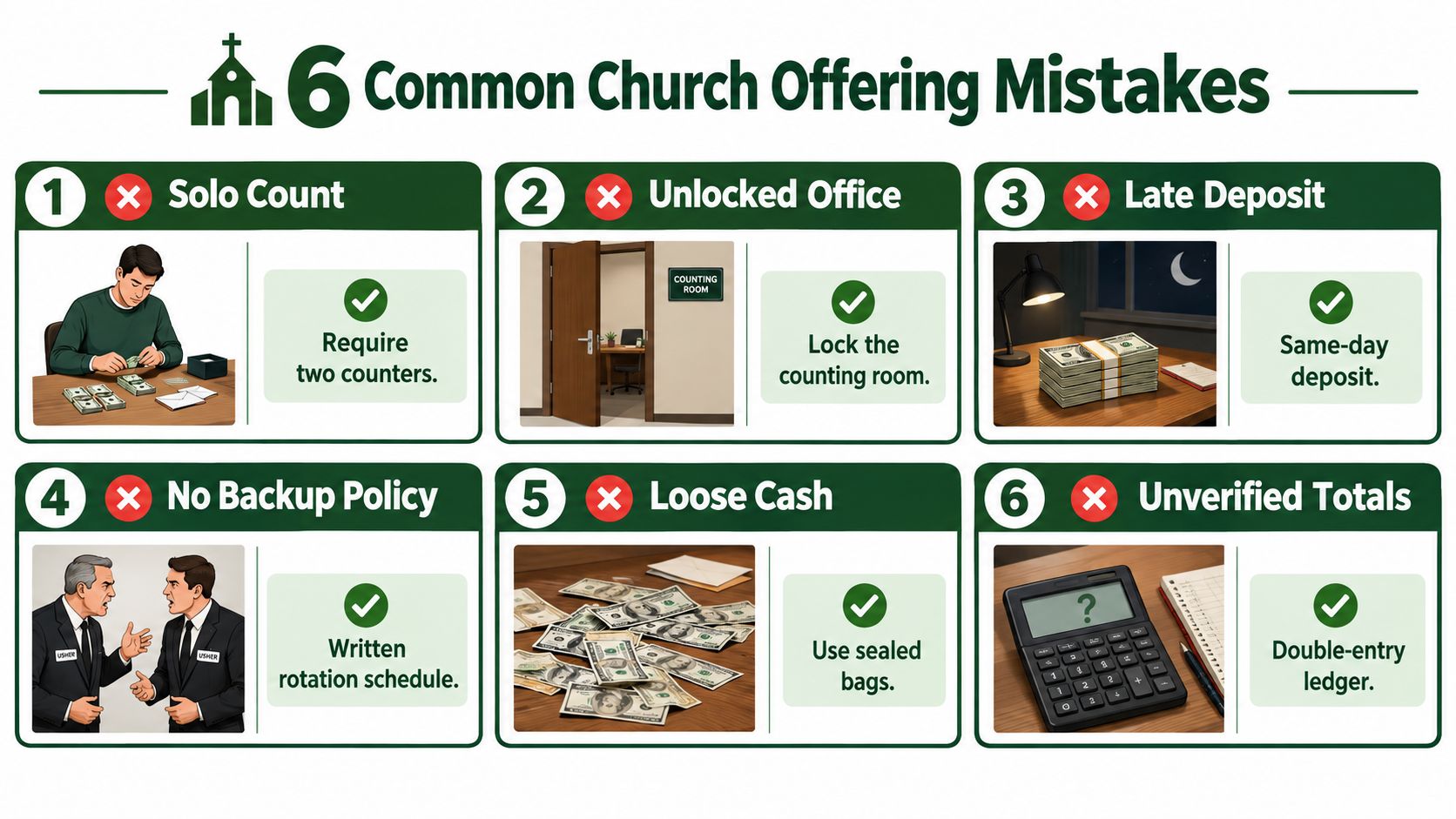
Most offering failures don't begin with bad intent. They begin with a shortcut that seems harmless during a busy service. The fix is to assign one person to own each control and make the safe path easier than the improvised one.
The shortcuts that break the chain
- Solo count: One volunteer counts alone in an unlocked office. The treasurer should require two unrelated counters and document both names.
- Unlocked room: People can enter while money is exposed. The operations director should restrict access during counting and keep the door secured.
- Late deposit: Funds sit in a desk drawer until Tuesday or Wednesday. The assigned deposit pair should complete the bank drop on the same day.
- No backup policy: An absent usher causes the team to improvise. The operations director should maintain a written rotation and substitution schedule.
- Loose cash: Bills mix with receipts, petty-cash envelopes, or expense reimbursements. The counters should separate offering funds and deposit them intact, rather than using one source to settle another.
- Unverified totals: Someone enters giving into a spreadsheet weeks later, with no supporting trail. The treasurer should record the count, fund designation, seal, deposit, and digital report as part of the service close.
Offering envelopes add an important paper trail. Church finance guidance says cash without an offering envelope shouldn't be recorded as a charitable gift, and a contributor giving cash must include a name and amount on the envelope before the church can provide credit. That requirement protects both the church's records and the donor's statement.
A spreadsheet can record a number. It can't prove who handled the money, when the handoff occurred, or whether the deposit stayed intact.
Move from a basic spreadsheet to dedicated church accounting software when counts exceed the team's practical control, an audit identifies recurring gaps, or a personnel change removes an experienced reviewer. Look for role-based permissions, fund-level records, deposit matching, and an audit trail. The software should support the controlled-handoff chain, not become another place where totals are retyped without verification.
A table left unattended during fellowship hour has the same weakness as a single-counter count. Put the gifts into custody immediately, record the handoff, and keep the number of people responsible for each stage clear.
Your One-Week Setup Plan and Ongoing Rhythm
A new church offering table process doesn't need a long rollout. It needs a short rehearsal, named owners, and a record produced at each stage.
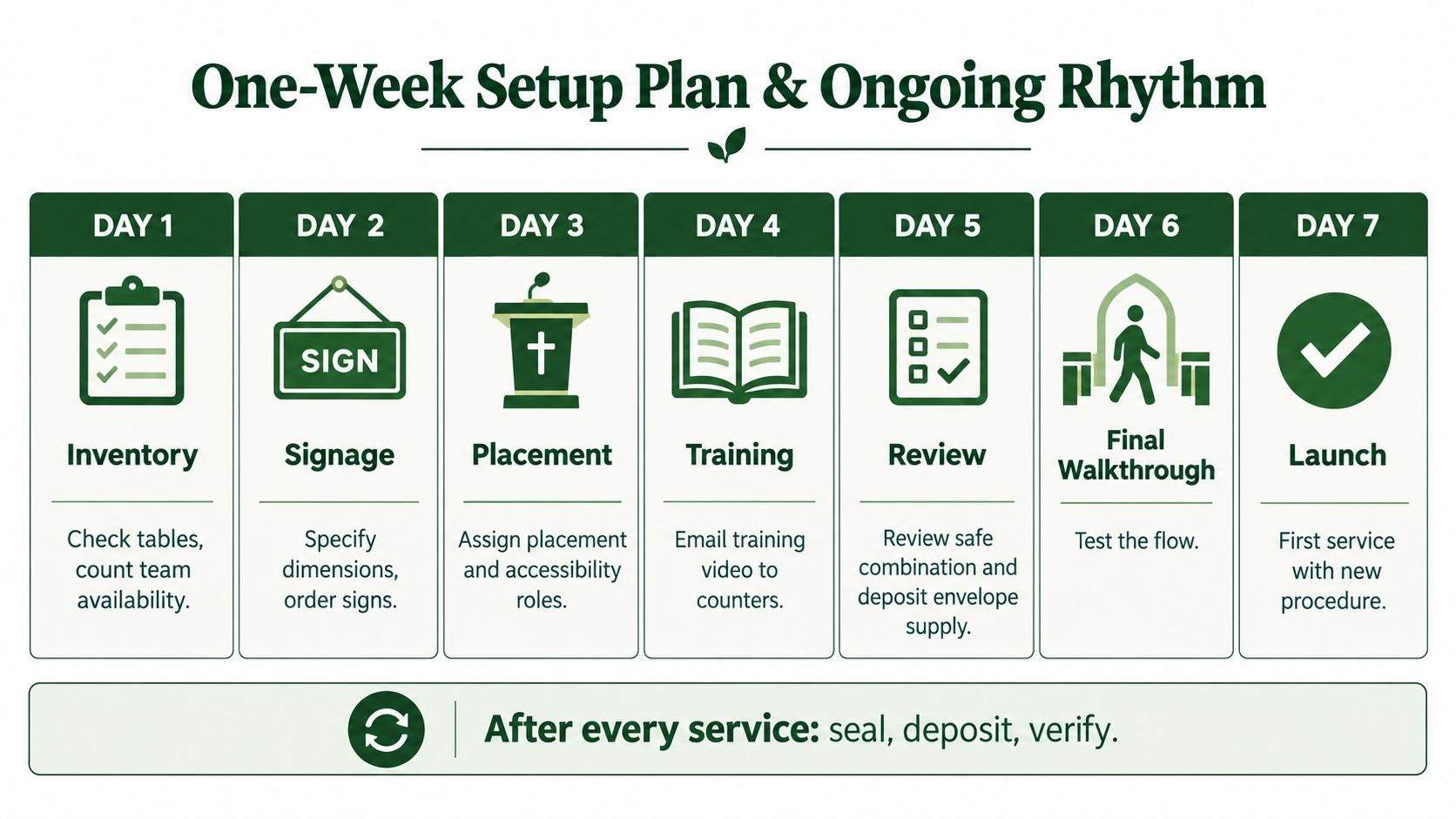
Use this one-week sequence:
- Day 1, operations: Inventory tables, plates, envelopes, bags, signage, and count-team availability. Produce an equipment and people list.
- Day 2, operations: Confirm dimensions, order or prepare signs, and create the QR and text-giving materials. Produce a final setup sheet.
- Day 3, operations and accessibility lead: Assign the table location, approach route, lower tray, and usher positions. Produce a room diagram.
- Day 4, treasurer: Rehearse the plate handoff, count, sealing, signatures, and safe transfer. Produce a completed sample count sheet.
- Day 5, treasurer and digital administrator: Review the giving portal, fund selection, text report, and same-day reconciliation. Produce a sample combined report.
- Day 6, operations: Train ushers, counters, deposit volunteers, and backups. Produce the written rotation schedule.
- Day 7, senior pastor and operations: Run the first service under the new procedure and review the handoffs afterward. Produce a launch review with assigned corrections.
The ongoing rhythm keeps the setup from fading after the first enthusiastic Sunday. After every service, the team should seal, deposit, and verify. Each week, the treasurer reconciles the count sheet with the bank record and digital reports. Each month, the treasurer reviews variances by fund and confirms that another person reviews the deposit. Each quarter, operations checks the table, safe, bags, signs, QR destination, and accessibility route. Each year, the senior pastor and treasurer review whether the offering moment still supports the congregation's stewardship practice.
The strongest setup is easy to explain: the pastor reinforces the purpose, operations protects the flow, ushers control the handoff, counters document custody, and the treasurer closes the records. Keep those responsibilities visible, and the table becomes a reliable part of worship rather than a Sunday improvisation.
Grain Ledger offers church-specific fund accounting that connects giving, bank accounts, and financial reporting so cash, checks, and same-day digital gifts can be tracked to their intended funds in one accountable workflow. Visit Grain to Start Free and explore a clearer way to manage the records behind your church offering table.
Ready to simplify your church finances?
Start free with church fund accounting, or watch a product demo first.