Tithe and Offering Box: A Guide to Secure Procedures
 By Gibson Brueher, Founder of Grain Ledger
Learn how to manage your tithe and offering box with secure collection, counting, and accounting procedures. A complete guide for church financial integrity.
Sunday service has ended. The plates are full, a volunteer treasurer is watching the room, and a small group is about to handle gifts entrusted to the church. At that moment, the tithe and offering box becomes more than a container. It becomes the first link between a donor's act of worship and the church's mission.
About Grain Ledger: This guide includes Grain Ledger, church fund accounting software built for designated gifts and ministry funds. It connects giving platforms (Planning Center, Pushpay, Tithely, Stripe), syncs bank activity with Plaid, and produces fund-level financial reports. Start free to see how it compares for your church.
See Grain Ledger for your church
Fund accounting, giving integrations, and bank reconciliation in one platform. Free migration support for churches switching from QuickBooks or Aplos.
A reliable process protects the money, the volunteers, and the congregation's confidence. It also ensures that a general offering doesn't get mixed with a building gift, a missions contribution, or another restricted donation. The physical box matters, but the secure chain of custody and fund-based accounting system behind it matter just as much.
Beyond the Plate An Introduction to Offering Security
A volunteer treasurer sees the familiar Sunday pattern. Ushers collect the offering, envelopes are gathered, and the money moves toward a locked room or office. Everyone involved may be trusted, yet trust alone doesn't create a defensible process. Without written procedures, even an honest mistake can look suspicious.
The tithe and offering box should therefore be treated as the starting point of a controlled workflow. The church needs to know who handled it, where it was stored, when it was opened, who counted the contents, and how the final deposit matched the count sheet. Each record answers a practical question before that question becomes a concern.
Practical rule: A good control system protects volunteers from suspicion because no individual carries responsibility in isolation.
The practice behind the tithe has deep historical roots. Britannica describes tithing as a custom dating to Old Testament times, while the historical development of the practice includes Charlemagne's Herstal decree in 779 CE, which made the tithe a required tax in the Frankish realm. In the 1840s, the Church of Jesus Christ of Latter-day Saints simplified tithing to one-tenth of increase or income, reflecting the movement from produce-based contributions toward monetary giving. These milestones are documented in Britannica's history of the tithe.
The receptacle has its own lineage. One historical account connects an early collection box to 2 Kings 12:9, where a chest with a hole received temple funds. Another biblical reference describes Jesus watching people place money into the treasury or offering box. Collection boxes and tithing envelopes later became common in the United States during the 19th century, showing how churches gradually standardized the mechanics of giving. The historical background is summarized in the account of the poor box and collection boxes.
Security begins with visibility and separation
Place the box where donors can find it easily, but don't put it in an unsupervised corner. A visible location near an entrance, exit, or staffed area supports access while making unauthorized handling less likely. The box should never become a substitute for a documented handoff.
Churches should also assess the wider security environment, particularly if the building has multiple access points or remains open for community activities. A resource on choosing commercial security in Perth can help administrators think through physical security as part of a wider risk assessment, rather than treating the offering box as an isolated object.
The Offering Box in a Digital Giving World
A visitor may arrive without an account on the church's giving platform, while a long-time member still prefers a check in an envelope. That is why a physical offering box remains useful beside mobile giving. Recent reporting says 81% of giving happens on mobile devices, while electronic giving has remained roughly 38%–41% of annual giving since 2021, according to 2025–2026 trend reporting. The same report notes that cash and check giving did not necessarily decline as digital giving expanded. These findings appear in Tithely's report on changing church giving patterns.
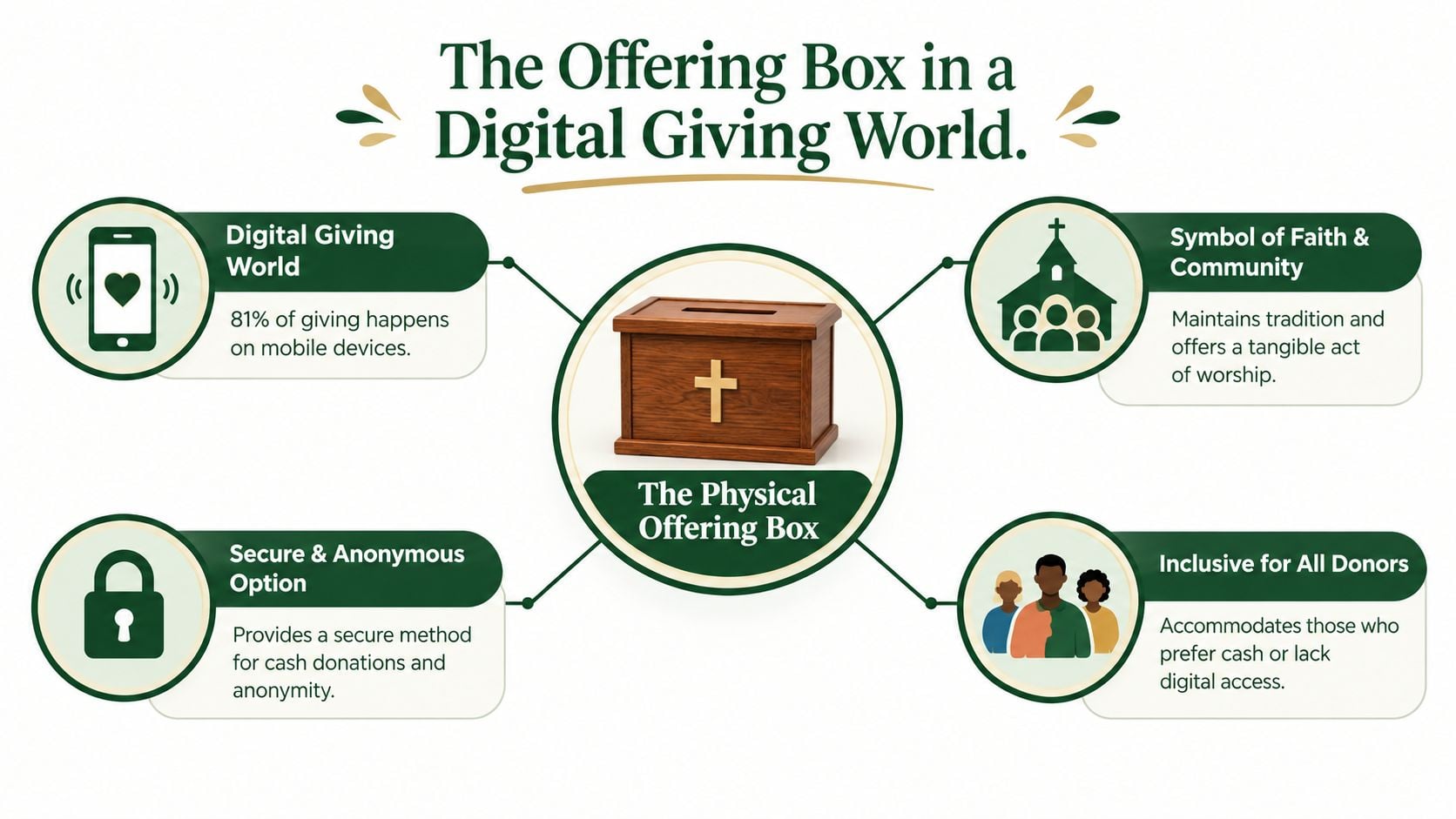
Mobile giving provides convenience, recurring options, and a clear digital record. The physical box serves members who prefer cash, use checks, lack reliable digital access, or value placing a gift into the worship service. Keeping both channels available can protect participation without requiring every donor to use the same method.
The accounting process must treat those channels as parts of one system. A church can accept online gifts and still lose accuracy if cash, checks, and electronic transactions use different fund names or reach the ledger at different levels of detail. The box is only one entry point. Secure, transparent stewardship depends on connecting each gift to the correct fund and retaining records that support reconciliation.
A hybrid strategy needs consistent records
Give donors simple instructions at the box. Explain whether to use an envelope, how to identify a designated gift, and where to find digital giving information. The wording should make the physical option clear without suggesting that online gifts receive better treatment.
Digital giving should use the same fund structure as cash and checks. Churches evaluating a platform can review online giving platforms for churches, but software does not correct missing designations, inaccurate posting, or weak reconciliation. Staff still need a shared chart of funds, documented review steps, and records that show how each deposit or electronic settlement was assigned.
Inflation-adjusted giving to religion declined 1% in 2024, and church purchasing power remained below 2022 levels, according to the previously cited Tithely report. A physical box cannot resolve budget pressure or donor retention. It can preserve an accessible giving route, provided the church records and reviews its contents with the same care used for digital gifts.
Best Practices for Secure Offering Collection
Start with the box itself, then design the surrounding procedure. A lock is useful, but a locked box without numbering, sealing, and issue records leaves gaps that a later audit can't easily explain.
Select and position the box carefully
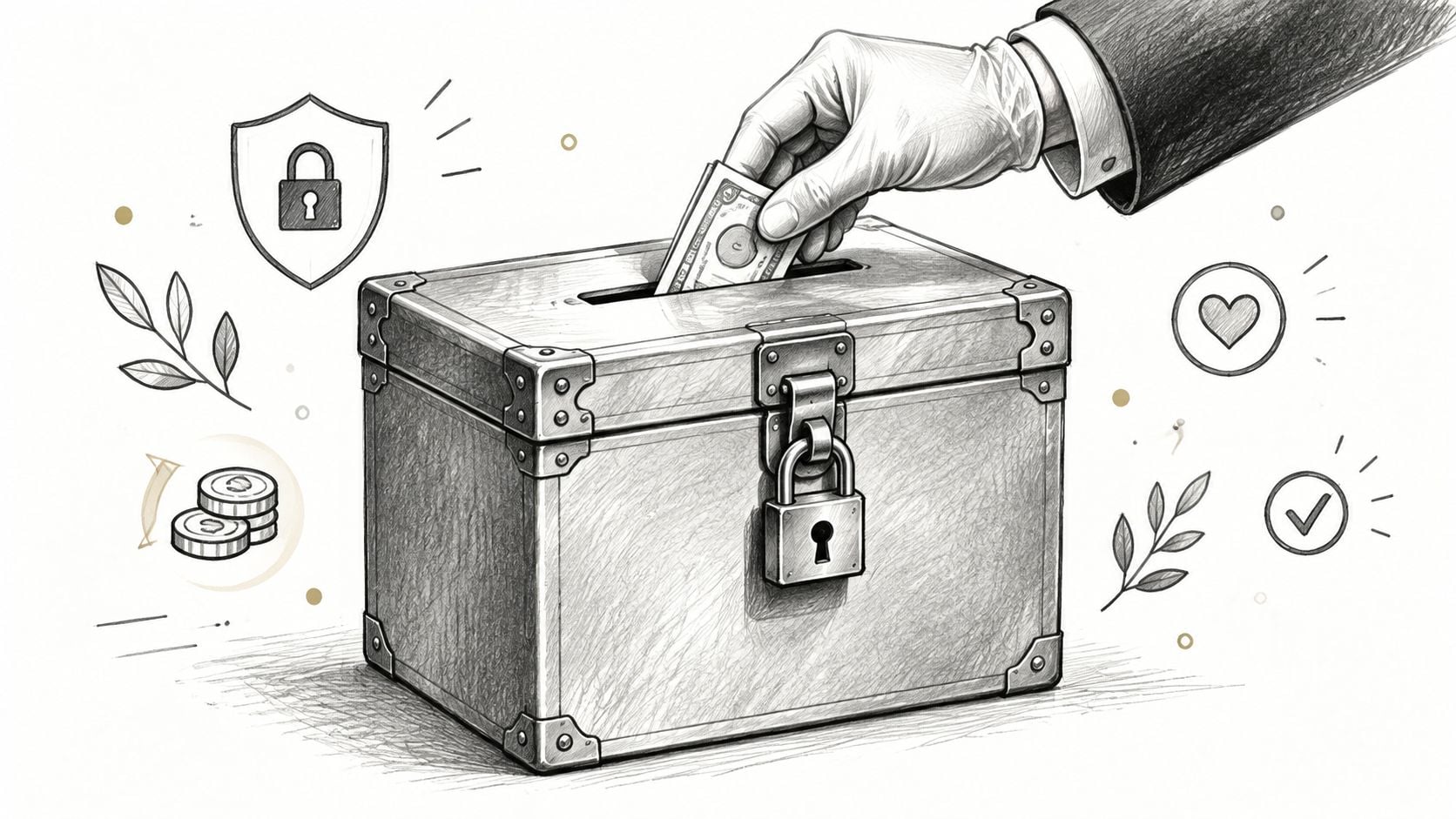
Choose a sturdy box with a restricted slot that makes it difficult to retrieve contents through the opening. Position it where members can see and reach it, while staff or volunteers can observe the surrounding area. A wall-mounted box may suit a narrow foyer, while a heavier floor-standing unit may work better in a large entrance, but the control standard should remain the same.
Use signage to identify the box's purpose. If the box accepts general offerings, explain how donors should mark gifts intended for a specific ministry. Ambiguous instructions create accounting problems later, especially when a check or envelope contains no clear designation.
Make every box traceable
Charity-control guidance recommends that collection boxes be individually numbered, sealed before use, regularly opened, and recorded when issued and returned. This approach creates a visible history from deployment to opening, as detailed in the charity internal financial controls guidance.
A simple register can include:
- Box number: Record the permanent identifier attached to the box.
- Seal reference: Note the seal applied before collection.
- Location and custodian: Record where the box was placed and who accepted responsibility.
- Issue and return details: Enter the relevant date and signatures when the box moves.
- Opening record: Match the returned box and seal condition to the count documentation.
Use tamper-evident seals rather than ordinary tape. If the seal is broken, missing, or inconsistent with the register, pause the process and document the exception before opening the box.
Keep collection duties shared
At least two people should transport or secure a collected box. That protects the offering and prevents one volunteer from becoming the sole witness to a critical handoff. Churches reviewing physical tracking procedures may find Evright Industrial asset tracking useful for thinking about identifiers, movement records, and accountability across physical assets.
The box should go directly to its secure destination. Don't leave it in a vehicle, an unsecured office, or an unattended overnight location. The safest procedure is the one volunteers can follow consistently, even on a busy Sunday.
Establishing a Chain of Custody for Counting
A volunteer opens the offering box, finds a broken seal, and cannot say who handled it last. That uncertainty is avoidable. Counting should follow written steps that protect the physical funds and create reliable records for fund-level accounting.
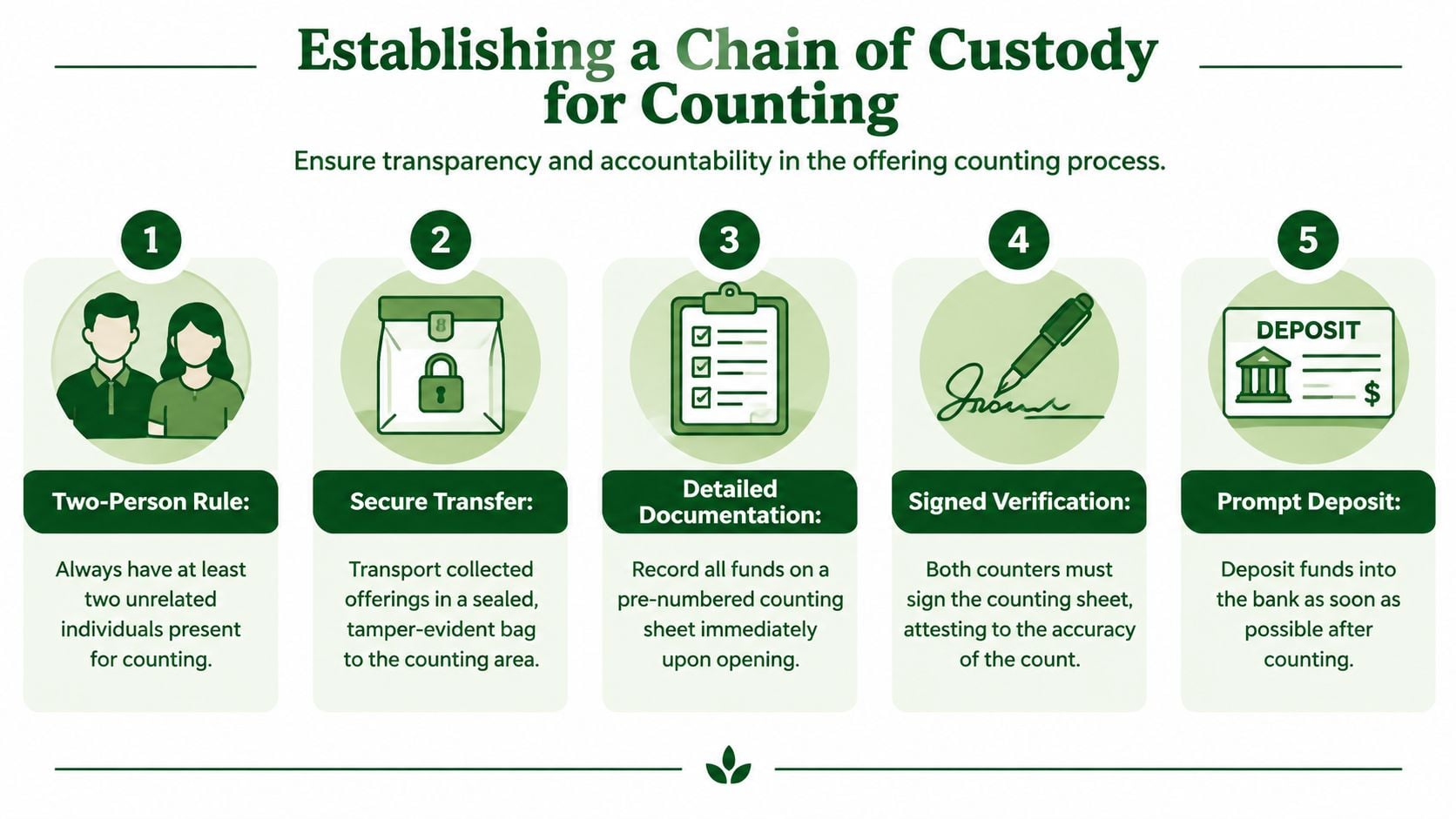
Use a repeatable five-step workflow
-
Confirm two unrelated counters. Two unrelated people should remain together while opening, counting, bagging, and handing over the offering. Follow the two-person control described in church cash-counting guidance.
-
Receive the sealed offering. Before opening the box, compare its number, seal reference, and handoff record. If the seal is damaged or does not match, record the exception and notify the treasurer or designated finance leader.
-
Open and sort in a controlled room. Separate cash, checks, envelopes, and other payment items. Restrict access to counters, protect donor information, and keep envelope instructions with the related gifts. Unrelated work and visitors should stay out of the counting area.
-
Record the count immediately. Use a pre-numbered master count sheet. Record totals by payment type and fund, then compare them with envelope details and any available service or box record. Recount before signing if the figures do not agree.
-
Sign, seal, and deposit. Both counters sign the completed sheet. Place the funds and deposit documentation in a tamper-evident bag, record its reference, and arrange the bank deposit promptly. The procurement of secure packaging supports this handoff by preserving evidence of access.
Cash should never sit unattended overnight when the church can avoid it.
These controls address accuracy as well as security. A second counter may catch an arithmetic error, an omitted check, or a missed designation. Signatures identify who performed the control and when. They do not imply that mistakes are impossible.
Keep duties understandable for volunteers
One person should not collect, count, reconcile, and deposit funds without review. Document each responsibility in a simple matrix, and appoint alternates who can follow the same procedure. Guidance on segregation of duties helps teams separate custody, recording, approval, and deposit responsibilities.
If the bank cannot receive the deposit immediately, store the sealed bag in a restricted safe or locked cabinet. Record who placed it there, who may access the storage, and when the deposit leaves the building. Shared responsibility for accepting, recording, monitoring, and depositing cash receipts, along with prompt banking and intact deposits, is also covered in financial controls for small nonprofits.
From Deposit Slip to Accurate Fund-Level Posting
The deposit slip proves that money reached the bank. It doesn't prove that the church recorded each gift in the right fund. That work begins with the count sheet, envelopes, and donor designations, then continues in the accounting ledger.
A general weekly offering normally belongs with net assets without donor restrictions. A gift designated for a new sanctuary or another defined project belongs with net assets with donor restrictions, and church fund-accounting guidance recommends tracking each restriction as its own fund in the ledger. The distinctions are set out in this church financial manual on restricted funds.

Post from the source documents
Use the signed count sheet as the batch control. The total deposited by payment type should agree with the bank deposit, while the fund allocation should agree with donor instructions. If a check has no designation, apply the church's written policy rather than guessing based on the donor's past behavior.
A useful posting sequence looks like this:
- Match the bank deposit: Confirm that cash and checks deposited agree with the signed count.
- Separate fund totals: Post general offering, missions, capital, benevolence, and other designated gifts to their respective funds.
- Retain supporting records: Keep envelopes, count sheets, deposit slips, and exception notes together under the same batch reference.
- Investigate differences: Document any bank adjustment, returned check, correction, or unclear designation.
- Review the ledger: Have someone other than the original counter review the fund posting and reconciliation.
A restricted gift isn't merely a label in a memo field. Donor intent affects what the church may spend, how leaders report balances, and whether the congregation can see that designated money remains available for its stated purpose.
Use accounting software built around funds
A spreadsheet can record totals, but it often becomes fragile when the church tracks multiple restrictions, bank accounts, donor statements, and expenses. A system with native fund architecture keeps the fund dimension present through contribution entry, reconciliation, reporting, and spending.
For churches that need that structure, Grain is church accounting software designed around fund-based accounting. It connects giving data and bank activity, keeps contributions tied to the appropriate funds, and provides fund-level reporting for church leaders. Churches comparing workflows can also review contribution accounting for churches.
The important principle is continuity. The number on the box, the seal record, the signed count sheet, the deposit slip, and the ledger batch should tell one consistent story. If the ledger can't explain where a designated gift went, the physical controls were only partially successful.
Related church accounting software resources
If you are comparing software, these pages map the main decision points: fund accounting, QuickBooks limits, pricing, and migration.
- Best church accounting software (2026 comparison) - canonical guide comparing 12 church accounting platforms
- Church accounting software product page - see Grain Ledger for fund accounting, giving, and bank reconciliation
- Small church accounting software - see the product page built for volunteer treasurers and church admins
- Fund accounting features - review how Grain Ledger tracks designated funds
- QuickBooks for churches - understand workarounds and when to switch
- Free church accounting software - compare free options and upgrade triggers
- Grain Ledger pricing - compare plans for small and growing churches
- Start free - try fund accounting, giving imports, and bank reconciliation together
Common Questions About Offering Box Procedures
Offering-box safety receives less attention than giving growth, even though churches often struggle with custody, reconciliation, and accountability. That practical gap is reflected in industry guidance on offertory boxes, where secure slots and shared opening procedures are common control considerations.
What should we do with a non-cash item?
Don't place an unfamiliar item into the normal cash total. Photograph or describe it, record the date and box or service reference, and ask the treasurer or pastor to determine the appropriate response. Store it securely until the church has documented whether it is a pledge, a note, a gift card, or something that shouldn't be accepted.
What happens if one counter can't attend?
Don't let one person count alone. Contact an approved alternate who has been trained on the written procedure, and record the names of the people who completed the count. If no qualified second person is available, secure the sealed offering and delay opening it until dual control can be restored.
How should we store an offering before deposit?
Keep the funds sealed in a restricted safe or locked cabinet. Record the bag reference, the person placing it into storage, and the person who later removes it for deposit. Never use offering cash for an urgent purchase, reimbursement, or petty cash need. Cash and checks should be deposited intact, with no amount removed for another purpose.
How do we handle an unclear designation?
Preserve the envelope and ask the finance lead to apply the church's written policy. Don't infer intent from a donor's usual giving pattern. If clarification is necessary, document the contact and retain the decision with the batch records.
A trustworthy process doesn't require volunteers to improvise. It gives them a safe response for exceptions, keeps custody shared, and carries every gift through to accurate fund-level posting.
Grain Ledger provides church accounting software with native fund architecture, contribution tracking, giving and bank integrations, and reporting designed for clear stewardship. Visit Grain to Start Free and connect your offering-box procedures with accurate, transparent fund accounting.
Ready to simplify your church finances?
Start free with church fund accounting, or watch a product demo first.