Segregation of Duties for Churches: A Practical Guide
Learn how segregation of duties protects churches from fraud and errors. Discover role mapping, compensating controls, and how Grain Ledger supports fund-based
Sunday's offering is counted by a trusted volunteer, entered by the bookkeeper, and checked against the bank statement by that same bookkeeper. The arrangement feels efficient because everyone knows the people involved. It also leaves the church with no independent checkpoint if an amount is entered incorrectly, a deposit goes missing, or a transaction is posted to the wrong fund.
About Grain Ledger: This guide includes Grain Ledger, church fund accounting software built for designated gifts and ministry funds. It connects giving platforms (Planning Center, Pushpay, Tithely, Stripe), syncs bank activity with Plaid, and produces fund-level financial reports. Start free to see how it compares for your church.
See Grain Ledger for your church
Fund accounting, giving integrations, and bank reconciliation in one platform. Free migration support for churches switching from QuickBooks or Aplos.
That's why segregation of duties matters in church finance. It isn't an accusation against a volunteer, treasurer, pastor, or employee. It's a practical stewardship discipline that protects church money, financial records, and the people carrying responsibility for both.
Why Trust Alone Is Not a Financial Control
A small congregation often has one person who has served faithfully for years. She counts cash after worship, records gifts in the donation system, prepares the deposit, updates the ledger, and reconciles the bank account. The board trusts her because she's dependable, careful, and committed to the church.
That trust may be entirely deserved. The workflow is still unsafe.
The problem isn't character. The problem is opportunity created by combined duties. If one person handles assets, records transactions, and verifies the resulting records, that person can make an honest error without anyone noticing, or conceal deliberate misuse without an independent review. A control system must address the process, not guess at someone's intentions.
Historically, separation of duties developed as organizations became larger and more complex in the 1800s, then became especially prominent as businesses and governments expanded during the 20th century. The principle gained wider corporate importance after the Sarbanes-Oxley Act of 2002 pushed public companies in the United States to strengthen internal controls over financial reporting. The underlying design remains straightforward: keep authorization, custody, recordkeeping, and reconciliation apart so one person can't complete and conceal a transaction alone. The history and development of separation of duties provides useful background, while Beyond Surplus on SOX compliance connects the broader internal-control environment to financial reporting oversight.
Trust should support controls, not replace them
A good church treasurer shouldn't be offended by a second-person review. In fact, independent review protects the treasurer from suspicion when records don't match. A documented process gives the board confidence, gives volunteers clear boundaries, and gives the individual handling money a defensible trail.
Practical rule: The more trusted the person, the more important it is to give them a process that never requires them to prove their own work.
Church leaders should examine the workflow without attaching motives to people. Ask who approves spending, who touches cash, who enters transactions, and who checks the records against outside evidence. The answers will reveal whether the church has real accountability or only an informal expectation that a trusted person will always do the right thing.
That distinction is central to financial accountability in church operations. Accountability doesn't mean distrusting faithful servants. It means building enough visibility around their work that the church and the servant are both protected.
The Four Control Domains Every Church Must Separate
Segregation of duties works best when a transaction cycle is divided among four incompatible control domains: authorization, custody of assets, recordkeeping, and reconciliation. Each domain answers a different question, and the answers shouldn't belong entirely to one person.
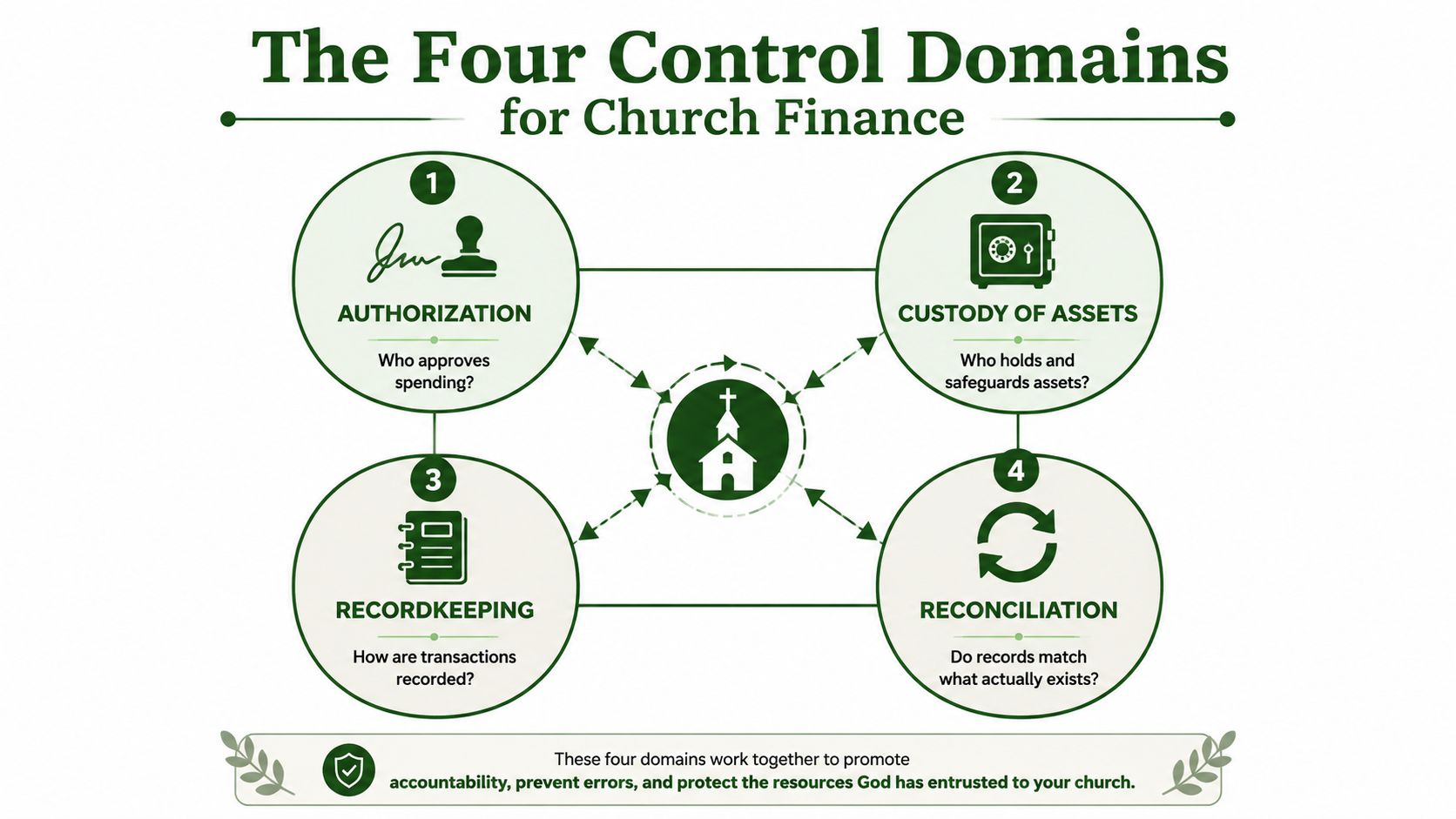
Authorization decides whether a transaction should happen
Authorization belongs with the person or group designated to approve spending, budget changes, vendor payments, or restricted-fund use. In a church, that may be the senior pastor, executive pastor, finance committee chair, or elder board, depending on the church's written policy.
Authorization shouldn't be confused with entering a transaction. The person who approves a reimbursement shouldn't also be the person who records it and confirms that the payment cleared.
Custody protects the assets
Custody means handling or controlling the asset. For church finance, that includes offering cash, checks, deposit bags, check stock, payment cards, online banking credentials, and access to giving platforms.
A Sunday offering process might assign two volunteer counters to receive and count gifts, then give the sealed deposit to a designated depositor. The counters shouldn't also post the final accounting entry or reconcile the bank account.
Recordkeeping creates the accounting trail
Recordkeeping includes entering donations, posting expenses, maintaining the chart of accounts, recording deposits, and updating the donor database. The recordkeeper works from approved documentation and source reports, rather than relying on memory or informal instructions.
A bookkeeper may post the deposit after receiving the signed count sheet and bank receipt. That bookkeeper shouldn't have unrestricted authority to alter the count, approve the deposit, and reconcile the same transaction.
Reconciliation tests whether the records agree
Reconciliation compares the church's internal records with independent evidence, such as a bank statement, giving-platform report, merchant settlement, or deposit receipt. The reviewer looks for missing deposits, duplicate entries, unexpected withdrawals, timing differences, and fund-coding errors.
For a typical Sunday offering, the four domains appear in sequence:
- Receiving: Counters take custody of cash and checks and document the count.
- Depositing: An assigned person delivers the deposit and retains the bank receipt.
- Recording: A bookkeeper posts the deposit and allocates it to the appropriate funds.
- Reconciling: A separate reviewer compares the count sheet, deposit receipt, giving report, ledger, and bank statement.
University internal-control guidance describes these cash-handling stages as receiving, depositing, recording, and reconciling, and recommends splitting them across different people when possible. Penn's operational internal-controls guidance also frames the broader domains as authorization, custody, recordkeeping, and reconciliation.
Use this test on every important workflow:
No one person should initiate, approve, record, reconcile, handle assets, and review reports for the same transaction.
For a concise visual explanation of how accounting checkpoints work, churches can also use this church finance controls video as a discussion prompt with the finance committee.
Common Church Fraud and Risk Scenarios
Weak controls don't always produce dramatic wrongdoing. More often, they create small opportunities, delayed discoveries, and records that become harder to untangle. The following scenarios are realistic because each combines duties that should have remained separate.
The bookkeeper controls both donations and reconciliation
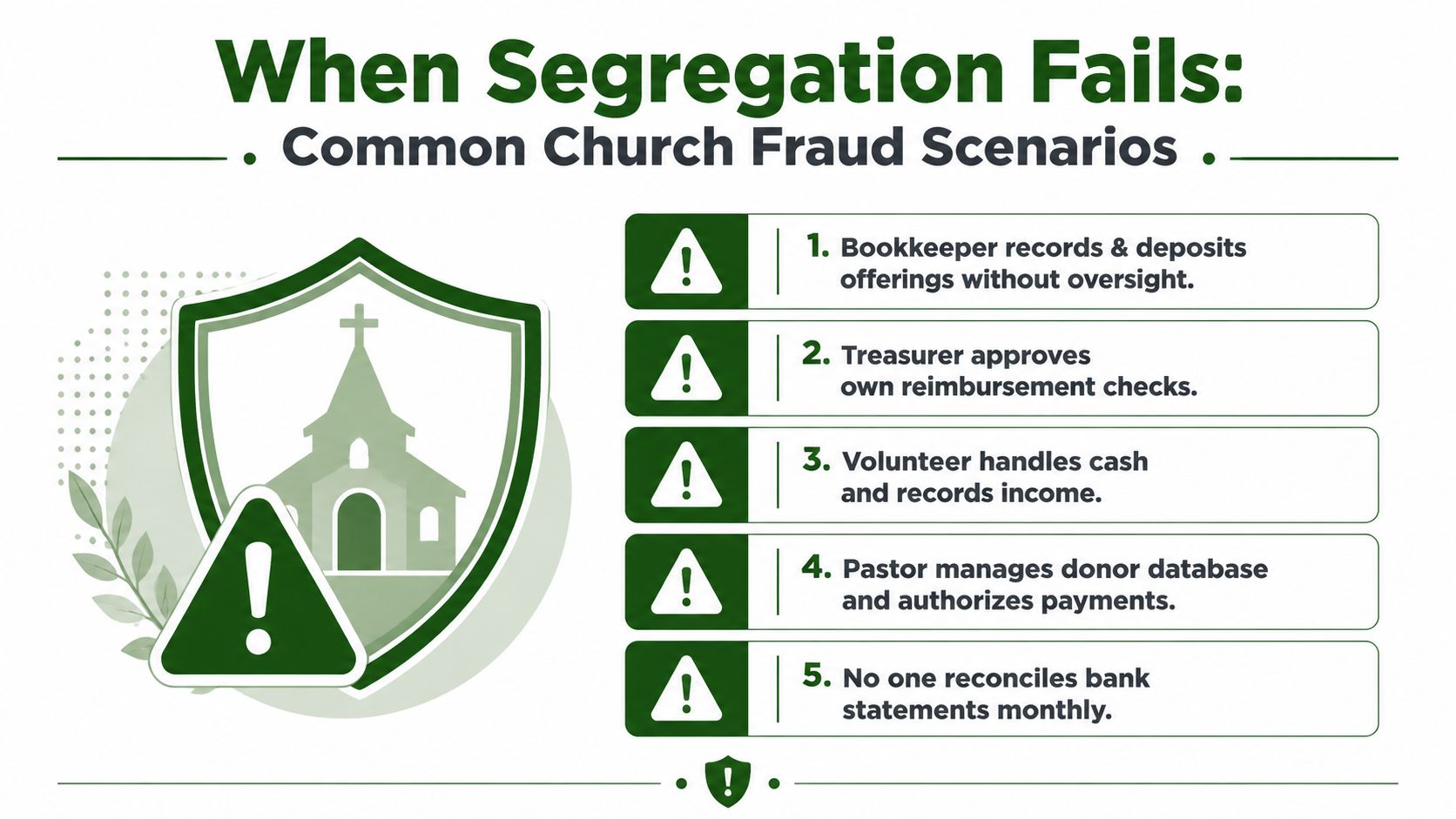
A bookkeeper records offerings and performs the bank reconciliation. Small amounts from undesignated gifts are removed before posting, or an entry is altered to match the reduced deposit. Because the same person controls both the ledger and the check against the bank, the discrepancy remains hidden.
The violated principle is the separation of recordkeeping from reconciliation and custody. An independent reviewer comparing count sheets, deposit receipts, giving reports, and bank activity could identify the mismatch.
The volunteer deposits cash without independent custody checks
A volunteer counter prepares the deposit and takes it to the bank without a second signature or documented handoff. Later, the deposit is short, but nobody can determine whether the problem occurred during counting, transport, or recording.
The church combined custody with an incomplete verification process. Two-person counting, signed count sheets, sealed deposit bags, and a documented receipt create accountability at each handoff.
The finance chair approves personal reimbursements
A finance committee chair submits an expense reimbursement and approves the payment without independent review. The expense may be legitimate, but the control still fails because the person requesting payment also authorizes it.
The remedy is simple. Another authorized reviewer should approve the reimbursement against receipts, ministry purpose, and budget availability before payment.
The pastor controls donor data and payments
A pastor or senior ministry leader manages donor records while also authorizing payments. That combination can expose confidential giving information and place too much approval authority with one person.
Pastoral oversight is appropriate. Unrestricted custody, recordkeeping, and payment authority in the same hands is not. The church should separate confidential donor administration from payment processing and require independent review of sensitive transactions.
No one reviews the bank statement carefully
A treasurer completes the reconciliation, files the statement, and presents only a summary to the board. Errors, unusual withdrawals, stale checks, or unexplained transfers can continue because nobody examines the underlying documents.
This is a reconciliation failure. The reviewer doesn't need to redo the bookkeeping, but should inspect the bank statement, reconciliation, outstanding items, and supporting documents.
Honest mistakes become persistent errors
A bookkeeper posts a restricted gift to the general fund. No one reviews the giving report against the ledger, so the error remains in place. Later, the church spends money believing the general fund has more available cash than it does.
The control failure is not fraud. It's the absence of an independent review that would catch a normal data-entry mistake. University of Northern Iowa's segregation-of-duties guidance captures the core logic: no employee or group should be able both to commit and conceal errors or fraud.
An industry analysis citing an Association of Certified Fraud Examiners survey reported that organizations with strong segregation-of-duties controls detected fraud 50% faster than organizations without those controls. The analysis of SoD as an identity and access issue applies the same lesson to church finance. Faster detection matters because it limits the time an error or misuse can continue.
Mapping Duties to Typical Church Roles
A church doesn't need a large finance department to document responsibility. It needs a written assignment that makes overlapping authority visible. The matrix below is a starting point, not a rigid staffing prescription.
| Church Role | Authorization | Custody | Recordkeeping | Reconciliation |
|---|---|---|---|---|
| Senior pastor | Approves ministry spending within policy; participates in major decisions | Should not handle routine offering custody | Should not post routine transactions | Reviews financial reports at the board or elder level |
| Executive pastor | Approves operating expenses within delegated limits | May oversee processes, but shouldn't be the sole cash handler | May review workflow status | Reviews budget activity and exceptions |
| Finance committee chair | Approves or recommends significant spending | No routine custody of offerings or check stock | Shouldn't maintain the primary ledger | Performs or assigns independent review |
| Church treasurer | May approve within policy if another person reviews the activity | May hold designated banking responsibility | May review reports, but shouldn't control every entry | Performs reconciliation only when an independent review follows |
| Bookkeeper | No approval of personal expenses or unsupported payments | No routine custody of offerings | Posts approved transactions and maintains records | Shouldn't be the sole reconciler of their own work |
| Volunteer offering counters | No spending approval | Counts and documents offerings with another counter | Provides source documentation, not final ledger posting | No |
| Administrative assistant | May prepare documentation and route approvals | May handle documents under documented procedures | May enter approved administrative transactions | No independent reconciliation of entries they created |
The pastor's role deserves careful treatment. Pastors should understand the church's financial position, participate in budget decisions, and provide ministry-level authorization within board-approved policies. They shouldn't routinely count offerings, maintain donor records, release payments, or reconcile bank accounts.
The roles in church finance should be defined by responsibility rather than title. A small church may call someone a treasurer, but that title shouldn't automatically grant custody, recordkeeping, approval, and reconciliation rights.
Adapt the matrix to your actual team
Start with the people you have, not the structure you wish you had. Write each recurring process on a separate page, then assign a person to each domain. If one name appears in multiple columns, mark the overlap and add a compensating review.
Document the following details:
- Approval authority: Who can approve spending, budget changes, vendors, reimbursements, and restricted-fund use?
- Asset access: Who handles cash, checks, cards, bank accounts, and giving platforms?
- Posting rights: Who can enter, edit, void, or delete transactions?
- Review responsibility: Who examines reconciliations, reports, exception lists, and supporting documents?
The board should approve the matrix and revisit it whenever a staff member or volunteer changes responsibilities. A document that sits in a folder while actual permissions remain unrestricted isn't a control.
Compensating Controls for Small Congregations
Textbook separation assumes enough people to divide every sensitive task. Many churches have one bookkeeper, one treasurer, and a few volunteers who already carry several ministry responsibilities. Pretending that a full four-person split exists won't make the church safer. It will only produce a policy nobody follows.
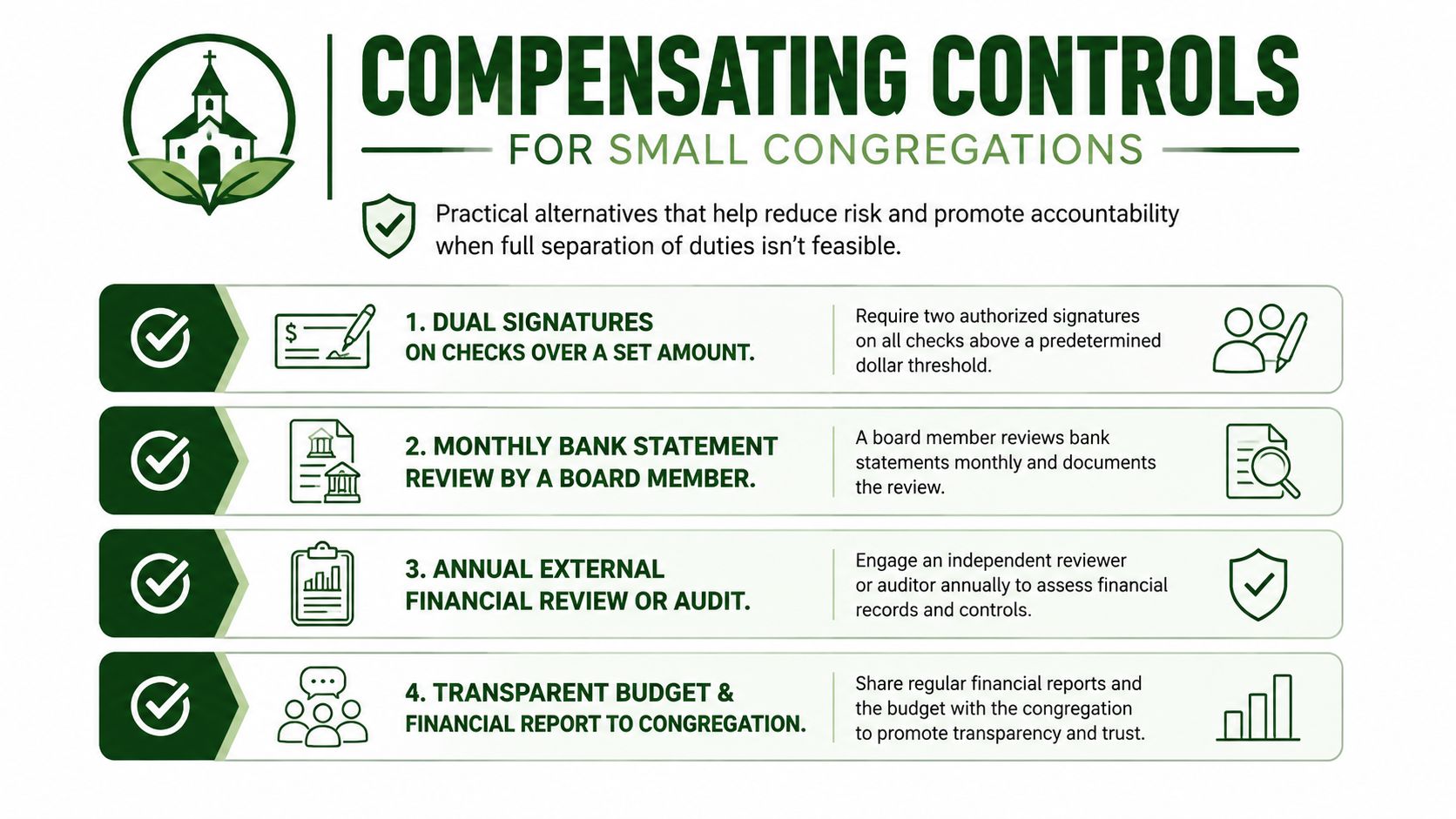
Small congregations need compensating controls, safeguards that add independent oversight when complete separation isn't practical. UCLA's control guidance states that when a small department can't separate functions among employees, detailed supervisory review must serve as the substitute. UCLA's segregation-of-duties guidance makes the principle clear: limited staffing changes the design, not the need for control.
Build review into the calendar
If the bookkeeper posts transactions and prepares reconciliations, assign a finance committee member with no custody or recordkeeping role to review the bank statement, reconciliation, outstanding items, and selected supporting documents. The reviewer should sign and date the review, record questions, and confirm that follow-up occurred.
Use controls that are easy to repeat:
- Dual signatures: Require two authorized signatures for checks above a board-approved threshold.
- Rotating counters: Use rotating volunteer teams so offering custody doesn't remain concentrated with one person.
- Independent giving review: Have an elder or finance committee member compare giving reports with deposits and fund allocations.
- Restricted access: Prevent users from both entering and approving the same transaction stream whenever the system allows it.
- Board visibility: Give the board clear financial reports that show budget activity, cash movement, and restricted-fund balances.
Make the safeguard sustainable
A control that requires a busy elder to inspect every transaction will fail. Review exceptions, higher-risk payments, unusual journal entries, new vendors, voided transactions, and restricted-fund activity first. Keep the review focused enough that the assigned person can complete it consistently.
The same person shouldn't be asked to perform every compensating control. Rotate the independent reviewer, document the handoff, and maintain a simple checklist. Churches can use this small church bookkeeping guidance to align daily procedures with the staffing they have.
Segregation of duties in small organizations often requires redesign rather than imitation of large-enterprise structures. Academic discussion of smaller companies identifies a gap between guidance built for larger staffing models and the practical limits faced by small teams. Research on segregation of duties in smaller organizations supports a candid conclusion: partial separation with strong review is safer than a perfect policy with no implementation.
How Fund-Based Accounting Strengthens Internal Controls
Churches don't manage money as one undifferentiated pool. They manage general operations, missions, building projects, benevolence, youth ministry, and other purposes under distinct restrictions and board expectations. An accounting system that treats funds as an afterthought makes both recordkeeping and oversight harder.
Grain Ledger uses a native fund-based architecture in which accounts, transactions, and reports are organized around funds from the start. It connects giving platforms, bank accounts, and the accounting system so donations can flow into the correct funds without forcing the finance team to reconstruct every allocation manually.
That matters for segregation of duties because manual work often creates avoidable conflicts. If the same person imports a giving report, changes fund assignments, posts the journal entry, and reconciles the deposit, the church has combined several control domains. A system that preserves source information, applies fund structure consistently, and limits permissions reduces the amount of trust placed in one manual step.

Use permissions to enforce the policy
Role-based permissions should reflect the actual work of a finance administrator, bookkeeper, volunteer treasurer, or reviewer. The person entering a transaction shouldn't automatically have authority to approve it, alter sensitive master data, or reconcile the resulting activity.
Approval workflows can require a second person to review restricted-fund expenses and sensitive changes. Fund-level reporting then gives the finance committee and elders the information needed to review activity without asking the bookkeeper to prepare separate explanations for every ministry area.
Churches evaluating integrations should also understand how data moves between giving, banking, and accounting tools. This practical accounting software integration guide offers useful context for assessing whether connected systems preserve accuracy and clear ownership across workflow steps.
Software doesn't replace human oversight. It makes the intended control structure easier to apply, records who did what, and helps a small team avoid granting one user unchecked control over an entire transaction stream.
Related church accounting software resources
If you are comparing software, these pages map the main decision points: fund accounting, QuickBooks limits, pricing, and migration.
- Best church accounting software (2026 comparison) - canonical guide comparing 12 church accounting platforms
- Church accounting software product page - see Grain Ledger for fund accounting, giving, and bank reconciliation
- Small church accounting software - see the product page built for volunteer treasurers and church admins
- Fund accounting features - review how Grain Ledger tracks designated funds
- QuickBooks for churches - understand workarounds and when to switch
- Free church accounting software - compare free options and upgrade triggers
- Grain Ledger pricing - compare plans for small and growing churches
- Start free - try fund accounting, giving imports, and bank reconciliation together
Ongoing Audit and Monitoring Practices
Segregation of duties weakens when volunteers change, staff inherit old permissions, or an emergency shortcut becomes routine. The finance committee should review the control design on a recurring schedule, not only when an auditor asks for it.
Each quarterly review should examine:
- Bank reconciliations: Confirm that reconciliations are complete, reviewed, and supported by statements and outstanding-item lists.
- Offering records: Compare count sheets, deposit receipts, giving-platform reports, and ledger postings.
- Expense approvals: Inspect reimbursements, unusual payments, restricted-fund expenses, and payments approved by people with a personal interest.
- System access: Remove permissions that no longer match a person's role, especially after volunteer or staff turnover.
- Exception follow-up: Document unresolved differences, the assigned owner, and the date of resolution.
At least annually, engage an external CPA familiar with church finance for an external review or agreed-upon procedures engagement. The board should also approve a written segregation-of-duties policy and the role matrix that supports it.
When a violation appears, determine what happened before assigning blame. An honest posting mistake calls for a process correction, training, or stronger review. Deliberate circumvention, falsified documentation, or misuse of funds requires prompt investigation and appropriate disciplinary action.
Controls only work when the board reviews evidence, asks direct questions, and follows through on exceptions.
Grain Ledger offers fund-based church accounting, connected giving and banking workflows, role-based permissions, approval controls, and fund-level reporting that can make segregation of duties practical for a small finance team. Visit Grain to see how its church-focused workflow can support clearer reviews and stronger accountability.
Ready to simplify your church finances?
Start free with church fund accounting, or watch a product demo first.