
What Is Financial Accountability for Churches
 By Gibson Brueher, Founder of Grain Ledger
Learn what is financial accountability, why it matters for churches, and how fund-based accounting and tools like Grain make stewardship transparent.
You're in the finance meeting, and the numbers technically “balance,” but the question hanging in the room is simpler: can you show the congregation where the money went, who approved it, and whether restricted gifts stayed restricted? That's where financial accountability stops being an abstract idea and starts becoming a stewardship issue every church board has to face.
About Grain Ledger: This guide includes Grain Ledger, church fund accounting software built for designated gifts and ministry funds. It connects giving platforms (Planning Center, Pushpay, Tithely, Stripe), syncs bank activity with Plaid, and produces fund-level financial reports. Start free to see how it compares for your church.
See Grain Ledger for your church
Fund accounting, giving integrations, and bank reconciliation in one platform. Free migration support for churches switching from QuickBooks or Aplos.
What is financial accountability in a church? It's the discipline of making sure money is received, approved, recorded, reviewed, and reported in a way that people can verify. The goal isn't to create suspicion. The goal is to build a financial system that helps leaders serve with confidence, protects volunteers from unnecessary pressure, and gives donors a clear view of stewardship.
Why Financial Accountability Matters in Church Ministry
A member gives $5,000 for a youth mission trip. Everyone remembers the gift, everyone had good intentions, and the trip itself still happens. Months later, though, the finance team can't clearly show how that money moved through the books, what was paid from it, or whether any portion was left over for the same ministry purpose.
That's the kind of moment that exposes why churches need financial accountability. It's not just “being careful with money.” As UCSC describes it, financial accountability is the assignment of explicit answerability for specific financial activities, so an organization can identify who is responsible for initiating, approving, recording, and reviewing each financial event. In a church, that means the treasurer, bookkeeper, pastor, and board each need a clear role in the process, not a vague shared responsibility that no one can trace.
Answerability Is the Real Starting Point
If a youth pastor submits a request, the finance committee approves it, the bookkeeper records it, and someone else reviews the reconciliation, the church can usually explain what happened later. If all of those tasks blur together, the church may still spend money with integrity, but it can't prove stewardship well. That gap matters because stewardship without traceability is hard to defend when questions come from elders, donors, or ministry leaders.
Practical rule: If your church can't tell who initiated, approved, recorded, and reviewed a transaction, it doesn't yet have strong accountability.
This is why accountability protects leaders as much as it protects donations. Clear answerability reduces confusion, lowers the chance of accidental misuse, and makes routine review possible. It also gives the board a calmer foundation for oversight because the system itself carries the weight of proof, not just personal trust.
Stewardship Needs Visible Records
Church people often think of accountability as a moral issue only. It is moral, but it's also operational. The OECD notes that financial accounts and balance sheets are compiled under the 2008 System of National Accounts, with balance sheets capturing stocks at a point in time and financial accounts explaining changes over time, then organizing data into “from whom-to-whom” matrices that show creditor and debtor relationships across sectors. That same logic fits church life, because stewardship gets clearer when leaders can trace where money came from, where it went, and what obligations remain.
The issue isn't whether a church meant well. The issue is whether its records make the ministry story visible enough to verify. When they do, accountability becomes something the congregation can trust, not just something the finance team hopes is true.
Core Principles That Define Church Financial Accountability
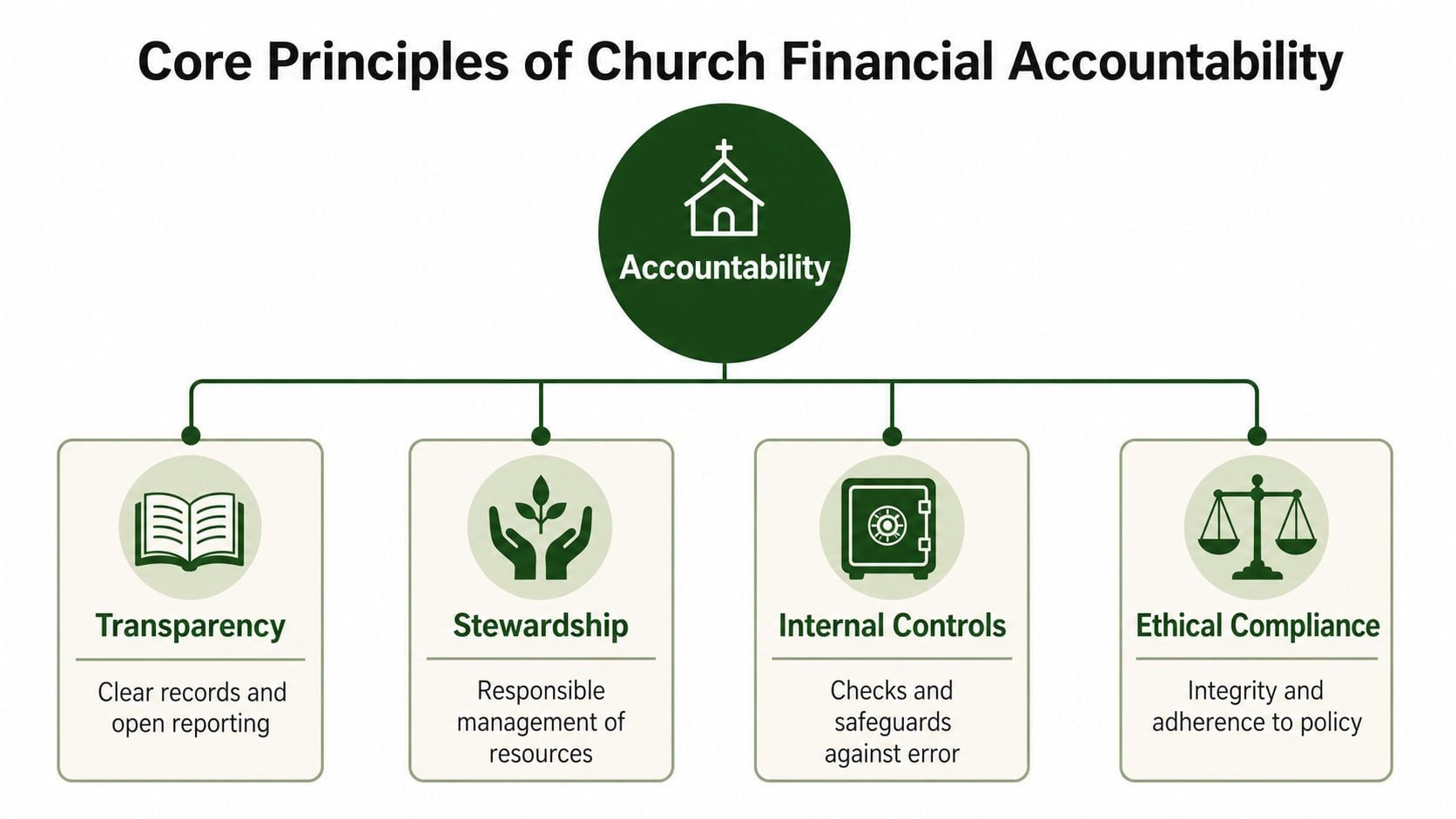
Church accountability works best when four ideas stay connected: transparency, stewardship, internal controls, and fund-level tracking. Leave one out, and the others start to wobble. Publish numbers without context, and people still feel uncertain. Track restrictions without controls, and mistakes slip through. Build controls without clear reporting, and the congregation won't see the stewardship you're trying to protect.
The UNDP's framework on financial accountability is useful here because it ties accountability to how resources were used, not merely whether they were budgeted, and it places internal controls, ethics rules, audits, and enforcement together. That combination matters in churches because money handling is rarely isolated to one person or one department. It usually moves through volunteers, staff, elders, and ministry teams.
Transparency Means More Than Sharing a Budget
A budget shows intent. Transparency shows what happened. Those are related, but they're not the same. A church can approve a budget in January and still fail to explain in June how restricted giving, general offerings, and ministry expenses were handled.
Stewardship becomes stronger when leaders can share fund-level information in plain language. Congregations don't need accounting jargon to understand whether a building gift stayed in the building fund or whether missions money supported missions. They need a clear trail that matches the church's promises.
Internal Controls Protect People Too
Internal controls are often described as safeguards for the organization, and they are. They also protect the people touching the money. When one person does every step, from counting gifts to posting entries, the church creates risk for that person and for the board. Separation of duties keeps the process cleaner and less vulnerable to error.
Fund-Level Tracking Is the Church Difference
Generic bookkeeping can tell you whether a bank account has money. Church accounting has to go further. It has to show which funds are restricted, which are unrestricted, and how each ministry's resources are moving. That's why fund-based accounting isn't a nice extra. It's the structure that makes church accountability readable.
The clearest systems are the ones where funds, restrictions, and reports all live together instead of being scattered across disconnected accounts. That design supports traceability from the outset, which is exactly what church leaders need when they're explaining stewardship to real people with real questions.
A helpful video primer is embedded below for teams that want a visual walkthrough of these ideas.
Key Metrics and Reports That Make Accountability Visible
A church does not prove accountability by saying its leaders meant well. It proves accountability by showing reports that let elders and treasurers see what happened, what changed, and what still needs attention. A reliable finance system should process every receipt and disbursement, give stakeholders a complete picture, and provide information for planning, budgeting, and decisions. If a gift or expense falls outside that trail, the board is left guessing instead of stewarding.
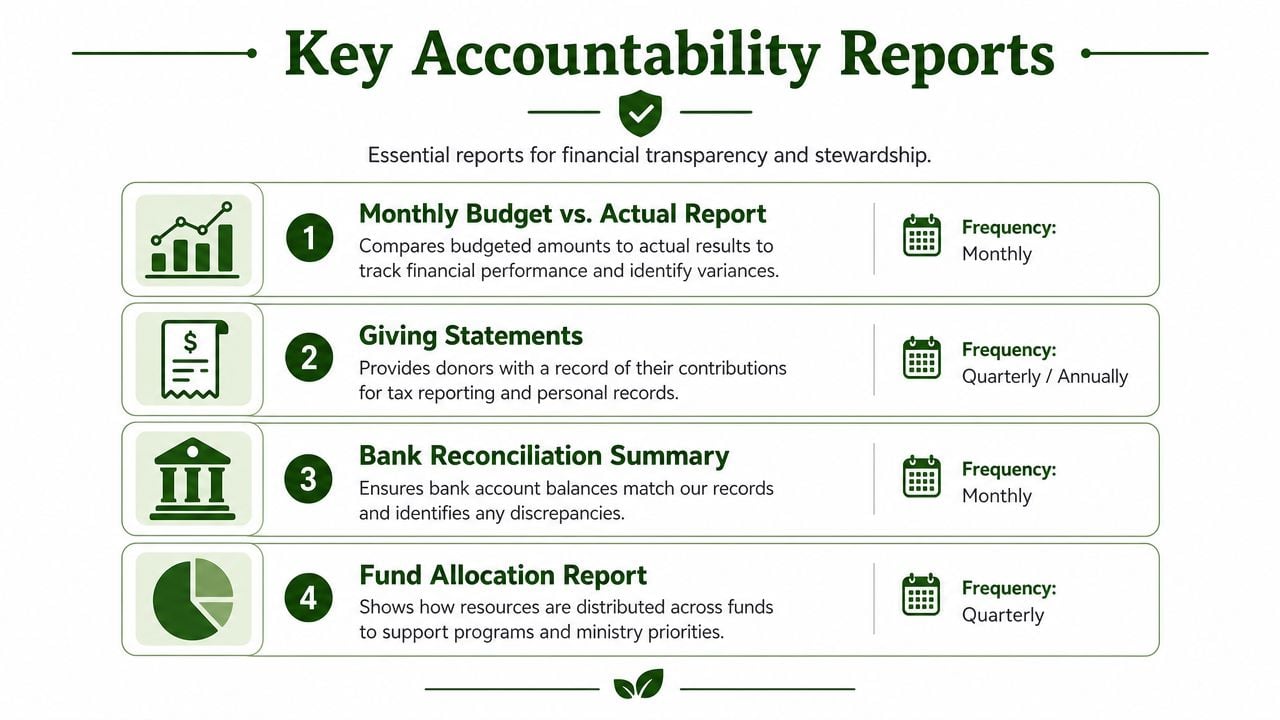
Church finance teams need reports that answer different questions without forcing leaders to piece together the story from scattered records. One report should show whether spending matched the budget. Another should show how gifts were assigned. Another should show what is restricted and what remains available. Together, those reports give the board a steady view of stewardship, much like a congregation can only trust the pulpit when the sermon matches the text.
The Reports That Matter Most
A few reports belong in nearly every church finance packet:
- Monthly budget vs. actual report: This shows how ministry spending compares with the budget approved by leadership.
- Giving statements: These help donors confirm what was received and support year-end transparency.
- Bank reconciliation summary: This proves the books match the bank and helps catch missing entries or errors.
- Fund allocation report: This shows how designated gifts and ministry funds are being held and used.
Churches that want a clearer picture of ministry-purpose funds can also use fund balance reporting guidance as a reference for arranging reports around fund balance rather than around one blurred cash total.
The reports only help if the board can read them. A budget variance is not just a number on a page. It is a signal that a ministry may have spent more than planned, delayed a project, or received less than expected. A reconciliation summary works like a second set of eyes, checking the bookkeeper's work against the bank and reducing the chance that a quiet error sits unnoticed. A fund allocation report answers the question elders often hear first from the congregation, whether a restricted gift stayed in its intended place.
Cash Only Is Too Thin for Stewardship
Cash-only reporting tells you what came in and what went out, but it can hide obligations, restrictions, and timing issues. A church may look healthy on a simple cash report and still owe bills, hold designated gifts, or carry commitments that have not yet been paid. That is why fuller statements matter. The Nexist financial ratio guide can help leaders see how broader financial review supports decisions, even when the conversation begins with church reports rather than ratios.
Churches do not need corporate complexity for its own sake. They do need enough visibility to answer direct questions without hand-waving. Did restricted offerings stay restricted? Are unpaid commitments still sitting on the books? Can the board make a sound decision from the current picture? Good reporting answers those questions before they turn into concern in the pews.
Trust grows when reports are routine. People relax when they can see that the numbers are being checked, the funds are being tracked, and the church can explain its stewardship with clarity.
Practical Steps to Implement Financial Accountability in Your Congregation
A church can improve accountability without hiring a large finance staff. The work starts with habits that are simple enough to keep and strong enough to matter. A practical guide on financial accountability identifies regular financial reviews, clear documentation, timely reconciliations, and role separation as the operating habits that support the system, and it recommends weekly micro-reconciliations as a way to catch problems early.
The key is to make those habits visible. If the board never sees review dates, reconciliation notes, or approval trails, then the controls exist only in theory. Once the church makes the process repeatable, accountability becomes much easier to defend.
Start With Clear Roles
Every church should know who counts offerings, who enters transactions, who approves spending, and who reviews the final reports. That doesn't mean every church needs staff for each role. It does mean the same person shouldn't be the only one spending the money and recording it.
A simple policy can say who may authorize spending, what documentation is required, and who signs off on the monthly review. That policy becomes the board's guardrail, especially when volunteers rotate.
Make Reconciliation a Weekly Habit
Month-end reconciliation is useful, but it can let small problems sit too long. Weekly micro-reconciliations give the treasurer or bookkeeper a short, focused check point. That small rhythm helps catch missing deposits, duplicate entries, and bank timing issues before they stack up.
Write Down the Process
Documentation matters because memories don't hold up well in finance. Keep a short record of approvals, restricted designations, reimbursement requests, and review notes. If someone leaves the church, the process shouldn't leave with them.
For leaders who want to compare church finance habits with broader analysis tools, the Nexist financial ratio guide can be a useful outside reference for understanding how ratio thinking supports oversight, even though churches should always adapt tools to ministry priorities rather than copy a business model wholesale.
Build a Rhythm the Board Can See
A finance committee should meet on a regular schedule, review the reports, and publish summaries that the congregation can understand. Annual reporting still matters, but it should sit on top of ongoing review, not replace it. Accountability gets stronger when leaders can point to a visible process, not just a year-end packet.
Real Church Scenarios Showing Accountability in Action
A mid-size church receives a restricted gift for a building project. The treasurer places it in a designated fund, the finance committee reviews the allocation, and every payment tied to the project is recorded against that fund. When an elder later asks how the money was used, the team can show the receipts, the bank activity, and the remaining balance without scrambling.
That is what accountability looks like when it is working well. The church is not asking people to trust a vague summary. It is showing the trail. The donor can see that the gift honored the original intent, and the board can confirm that restricted funds were never mixed into general operating money.
A designated fund works like a labeled envelope inside the church's books. The money may sit in the same bank account, but the accounting still shows which dollars belong to the building project and which dollars support regular ministry. That clarity helps leaders answer questions without guesswork, and it helps members see that stewardship is being handled with care.
When the Trail Breaks Down
A similar church treats all giving as one shared pool. The bank balance looks healthy, but no one can quickly tell how much is reserved for missions, how much belongs to the building campaign, or how much is available for payroll. Conversations with donors get awkward because leaders cannot distinguish intent from availability with confidence.
That confusion often creates more than accounting problems. It strains trust. It also makes staff and volunteers hesitate to speak early when something looks off, because no one wants to raise a hand in a system that already feels unclear.
Forbes has highlighted research showing that people are often more comfortable discussing money in familiar community settings, which points to a broader truth for churches. Trust-based communities lower the stigma around money conversations when they create safe reporting channels and normal, ongoing review. In a congregation, that matters because people are more willing to ask hard questions when accountability already feels shared, not punitive.
Practical rule: If a church wants earlier warning signs, it has to make financial conversations normal before they become urgent.
A church that uses fund-based records can answer those questions sooner and with less friction. A church that keeps everything in one undifferentiated pool usually has to reconstruct the story after confusion has already grown.
The difference between these two churches is not generosity. Both were generous. The difference is structure. One church made stewardship visible, and the other let it stay informal until trust became harder to sustain.
How Fund-Based Accounting and Grain Ledger Support Accountability
Churches don't just need accounting software. They need a structure that matches how ministry money works. Fund-based accounting is that structure, because it keeps restricted gifts, designated ministries, and general operations separate from the start. When a system treats every dollar as interchangeable, it becomes harder to show stewardship.
That's why fund accounting for churches matters so much. It gives leaders a framework where the fund, not just the bank account, is the unit of accountability. That approach aligns with the broader principle that accountability becomes credible when funds, restrictions, and reporting are visible in one integrated system rather than scattered across disconnected accounts.
Grain Ledger is built around that logic. Its native fund architecture organizes every account, transaction, and report around funds from the start, so the church isn't simulating fund accounting after the fact. It also unifies giving platforms, bank accounts, and the accounting system so donations can flow directly into the correct funds automatically. For churches that need integration with bank accounts, cards through Plaid, and giving providers like Planning Center, Pushpay, and Stripe, that kind of connected workflow keeps the record cleaner and the reporting easier to trust.
Why Structure Matters More Than Add-Ons
A general ledger can be made to look church-like with workarounds. That still leaves the underlying problem in place. If fund tracking is bolted on later, the church spends more time fixing reports than using them. When fund handling is native, the board sees a clearer picture with less manual cleanup.
Grain Ledger also fits the ministry use case because it keeps restricted funds restricted and makes fund-level reporting easier to read for pastors, boards, and treasurers. That matters when the church needs to explain not just what was spent, but what remains available for a specific ministry purpose.
Related church accounting software resources
If you are comparing software, these pages map the main decision points: fund accounting, QuickBooks limits, pricing, and migration.
- Best church accounting software (2026 comparison) - canonical guide comparing 12 church accounting platforms
- Church accounting software product page - see Grain Ledger for fund accounting, giving, and bank reconciliation
- Small church accounting software - see the product page built for volunteer treasurers and church admins
- Fund accounting features - review how Grain Ledger tracks designated funds
- QuickBooks for churches - understand workarounds and when to switch
- Free church accounting software - compare free options and upgrade triggers
- Grain Ledger pricing - compare plans for small and growing churches
- Start free - try fund accounting, giving imports, and bank reconciliation together
Building a Culture of Stewardship and Financial Confidence
Church accountability works best when the numbers and the culture move together. Policies, reconciliations, and reports matter, but so does the atmosphere around them. If leaders treat financial questions as threats, people go quiet. If leaders treat them as part of normal stewardship, people speak earlier and with less fear.
That's the shift many churches need. Accountability isn't only an audit function. It's a trust practice that helps people report problems, ask for help, and follow through on decisions. A congregation that can talk openly about money is usually a congregation that can steward it more faithfully.
The historical move away from simple cash tracking toward fuller reporting reflects that same need for clarity. Churches now face a similar expectation. Members want to know that gifts, restrictions, and reports are tied together in a system they can understand. When that happens, stewardship feels less like guesswork and more like shared responsibility.
For churches that want to keep building that culture, stewardship in churches is strongest when the process is visible, the roles are clear, and the reporting is easy to follow. That's what gives a finance board confidence without turning ministry into bureaucracy.
If your church is ready to tighten its stewardship, start by reviewing how restricted gifts are tracked, how reconciliations are handled, and who approves each transaction. Then take a look at Grain and see how fund-based church accounting can help your team report with more clarity and less friction.
Ready to simplify your church finances?
Start free with church fund accounting, or watch a product demo first.