Contribution Accounting: Essential Guide for Churches
Learn contribution accounting for churches, from fund-based donation tracking and restricted vs unrestricted rules to reporting.
You opened the offering envelopes, checked the online giving dashboard, and found the same familiar puzzle. Some gifts were general, some were tagged for missions or the youth room, one check said “roof fund,” and the treasurer before you had left a spreadsheet that only partly matched the bank. By Tuesday, the board wants a clean report, the pastor wants to know what can be spent, and you just want the numbers to line up without a long evening of rework.
About Grain Ledger: This guide includes Grain Ledger, church fund accounting software built for designated gifts and ministry funds. It connects giving platforms (Planning Center, Pushpay, Tithely, Stripe), syncs bank activity with Plaid, and produces fund-level financial reports. Start free to see how it compares for your church.
See Grain Ledger for your church
Fund accounting, giving integrations, and bank reconciliation in one platform. Free migration support for churches switching from QuickBooks or Aplos.
That's the daily pressure behind contribution accounting. It's not abstract bookkeeping, it's the discipline that helps a church explain where each gift came from, what it was meant for, and when it can be recognized in the books. If you've ever wondered why a church ledger feels harder than a small business ledger, the answer is usually that churches don't just track money, they track purpose.
Why Sunday Morning Donations Are Harder to Book Than They Look
Sunday giving rarely arrives in one tidy bundle. A treasurer may count cash from the plate, deposit checks marked for the building fund, reconcile online gifts from text-to-give, and then sort out whether a sponsorship or event payment is a contribution. Each piece has to be placed in the right bucket, because a church is not only recording receipts, it is preserving donor intent and keeping restricted money from drifting into general operations.
A generic business ledger can record income and expenses, but it usually does not start with the question a church must answer first, “What was this gift for?” A church board cares about that answer because one unrestricted offering and one restricted missions gift may both hit the bank on the same day, yet they do not belong in the same bucket. If the books blur them together, the finance committee loses sight of what is available and what is already spoken for.
The historical logic behind this is old. Accounting's roots go back to clay tokens in Mesopotamia, and later to clay tablets used for tax and inventory records, which shows that tracking specific resources for a designated purpose long predates modern ledgers. The ICAEW historical timeline traces that development clearly. Churches are still doing a similar thing, only with offerings, grants, and designated gifts instead of grain and livestock.
Practical rule: if the giver attached a purpose, the books need to preserve that purpose from the moment the gift is received.
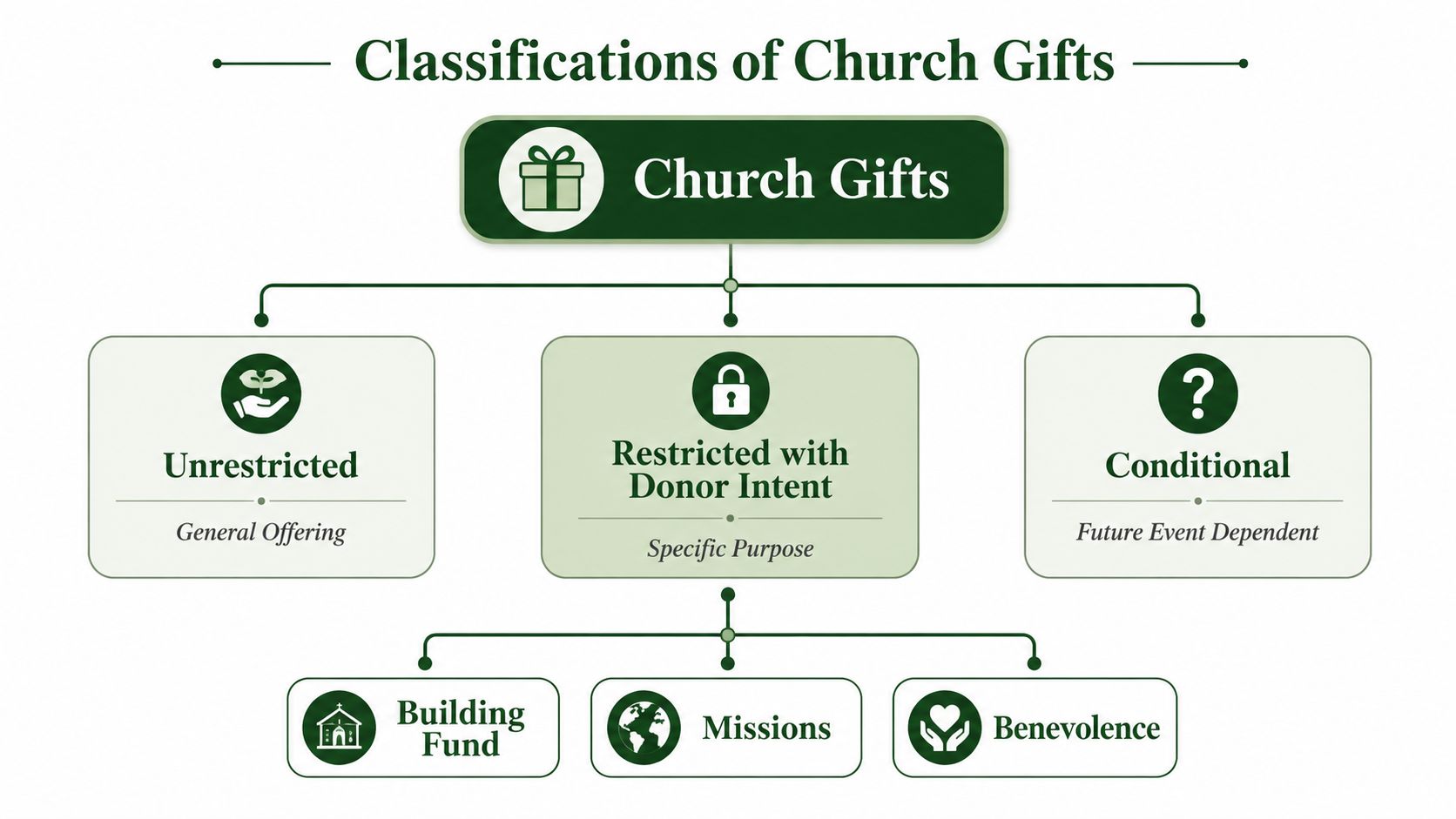
What Contribution Accounting Means for a Church
A church treasurer may see a gift hit the bank on Sunday, then spend Monday asking a harder question, what was this money for, and can it be spent now? Contribution accounting gives the church the answer. It is the method used to record gifts that are given without the donor receiving commensurate value in return, while keeping each gift tied to the right fund, restriction, or purpose.
That idea sits on the same double-entry foundation described in the historical record of accounting. Church books still rely on it today, but the church's real concern is not only that debits equal credits. It is also whether a missions gift, a building gift, and a general offering are being tracked separately so the board can see what is available and what is already committed.
The church version of the rule
Under U.S. nonprofit guidance, a contribution is a nonreciprocal transfer. The donor gives something of value, but does not receive equal value back in the same transaction (J.R. CPA on contribution accounting under U.S. GAAP). That is the line treasurers use to separate a true gift from an exchange. A Sunday offering is usually a contribution. A ticket sale, room rental, or paid facility use is usually an exchange transaction, because the church is providing a measurable benefit in return.
For a small or medium church, that distinction shows up in ordinary bookkeeping work. One deposit may include unrestricted offerings, a designated check for youth camp, and an online payment tied to a guest dinner. The treasurer has to place each item in the right bucket before the board reports are prepared. If those amounts are mixed together, the church can overstate what is free to spend and understate what is already spoken for.
Fund accounting is the natural fit for that job. Churches are not just recording income and expenses. They are also tracking donor intent, restricted gifts, grants, and in-kind donations that may need to be recorded at fair value. A general business ledger can show cash in and cash out, but it usually does not keep the books organized around the question churches ask first, what fund does this belong to? A fund-based accounting approach keeps that structure visible from the start.
A simple way to explain it to a board member is this. Contribution accounting lets the church say, “This money was given to us, but not all of it is ours to use in the same way.” That is why fund-based reporting matters, and why churches that try to manage everything in one undifferentiated income account usually end up with manual reconciliations at month-end.
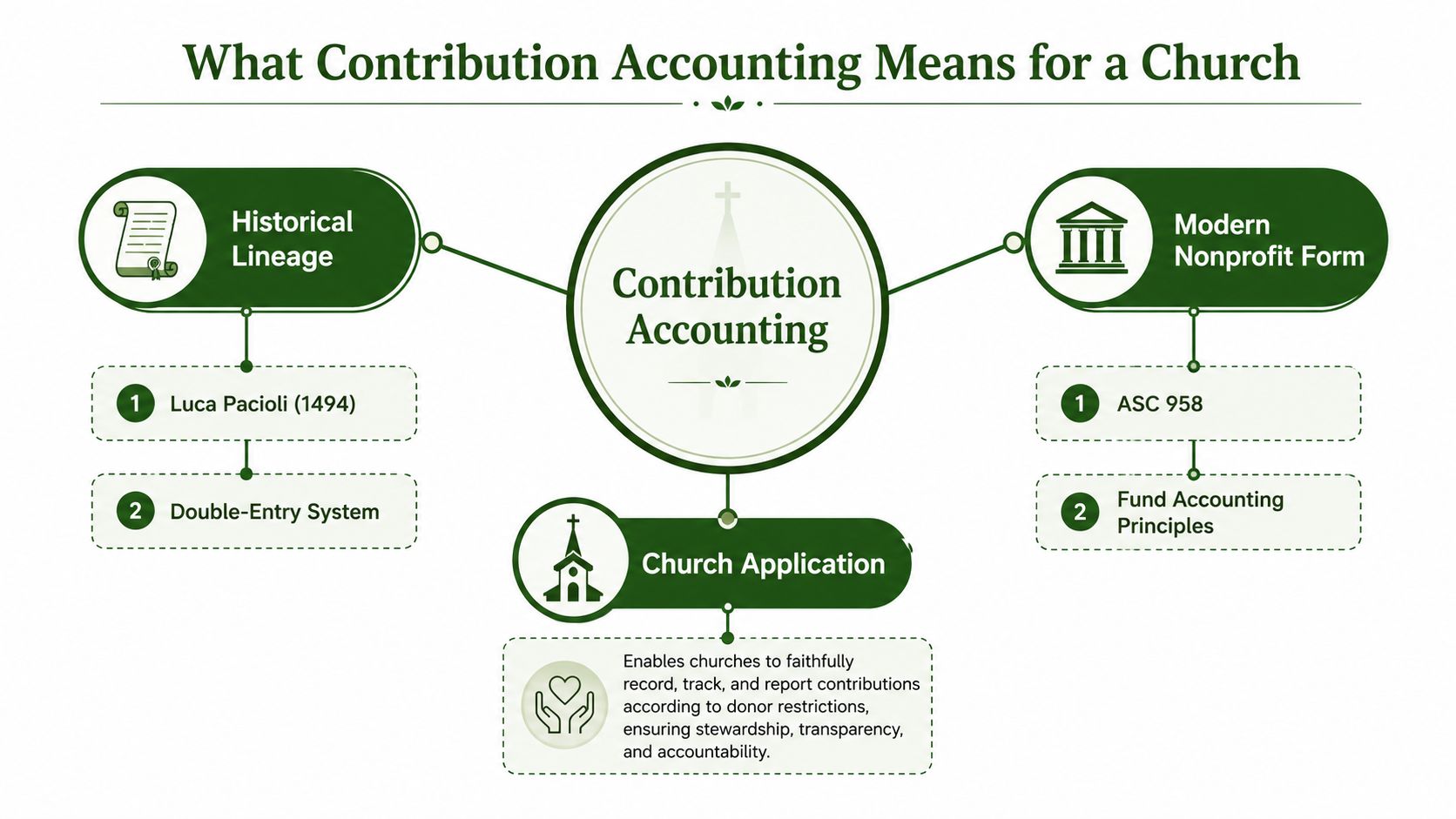
Restricted, Unrestricted, and Conditional Gifts Explained
A church treasurer can book the same Sunday deposit three different ways, and the difference matters. One check may go to general ministry, another may be set aside for the roof, and a third may look like income today but still wait on a condition before it belongs in revenue. That is why the board asks hard questions later, such as what can be spent now, what must stay reserved, and what still belongs in a holding category.
The accounting answer starts with the donor's words, the church's agreement, and whether the gift includes a barrier with a right of return or release. A fund-native system makes those distinctions visible as the gift is entered, instead of forcing the treasurer to sort everything by hand at month-end.
Unrestricted gifts
Unrestricted gifts are the easiest to explain. A general offering, for example, can usually support operating needs, staffing, utilities, or ministry work because the donor did not attach a specific purpose. Under nonprofit guidance, unconditional contributions are recognized right away in the proper net asset class, and the restriction question changes where the gift sits, not whether it is revenue yet (J.R. CPA on contribution accounting under U.S. GAAP).
That matters in church bookkeeping because unrestricted cash often gets spent quickly. If the treasurer posts it in the wrong place, board reports can make available funds look tighter than they really are, or make restricted balances look free to use.
Restricted gifts with donor intent
A designated gift works differently. If a family gives for the roof, missions, or benevolence, the church cannot treat that money like a general offering even after it reaches the bank. The gift is recognized, but it stays in net assets with donor restrictions until the purpose is met or the donor's restriction is otherwise released (CPA Journal on ASU 2018-08).
This is the point where many first-time treasurers get uneasy, because the cash feels available and the books say otherwise. The church board usually wants a simple answer. Can we spend it now, or must we wait until the stated purpose is satisfied? Donor intent controls that answer, not the timing of the deposit.
Conditional gifts
Conditional contributions cause the most confusion. ASU 2018-08 says the church first decides whether the arrangement is an exchange or a contribution, then asks whether the gift has both a barrier and a right of return or release. If both are present, the church does not recognize the revenue until the condition is substantially met (CPA Journal on ASU 2018-08).
A capital grant can sound generous and still stay out of current revenue for now. The money may be in the bank, but if the church still has to satisfy a stated requirement before it can keep the funds, the treasurer should treat it as deferred rather than available. That is the part that protects the books from looking stronger than the church's actual position.
A member bequest follows its own rule. It becomes a contribution only when the church has an enforceable right and the amount can be measured reliably (BNN CPA on grants and contributions).
Recognition, Valuation, and Receipting Rules
Church books stay clean when the treasurer gets three things right every time, when to recognize the gift, how much to value it at, and what to say on the receipt. Those are separate questions, and they are easy to mix together during a busy Sunday close. A gift can be real, valuable, and still not belong in revenue yet if it is conditional.
Timing comes first
Unconditional contributions are recognized immediately. Conditional contributions wait until the barrier is overcome and the right of return or release no longer applies. For a church finance office, the memo behind the gift matters as much as the deposit slip, because the paper trail explains whether the money is available now or still tied to a condition.
Practical rule: do not post a conditional gift like ordinary income just because the cash arrived. Cash in the bank is not the same thing as recognized revenue.
Value comes next
Nonprofit contribution accounting uses fair value at the point of receipt, and contributed assets have to be recorded at fair value when they arrive (PwC not-for-profit accounting guidance). Contributed nonfinancial assets also need separate presentation in the statement of activities, rather than being blended invisibly into cash gifts. That rule matters whenever a church receives donated equipment, supplies, or other non-cash support.
Services and exchange questions come last
GAAP recognizes contributed services only when they require specialized skills or create or enhance a nonfinancial asset, and those services are still measured at fair value with related disclosures (Nonprofit Accounting Basics on contributed services). Volunteer time is a common gray area because much of it is helpful but not recordable. Donated facility use can be another judgment call.
The other trap is deciding whether the church received a contribution or an exchange transaction. If a donor receives naming rights, sponsorship benefits, or event access, the church has to ask whether the donor got commensurate value back. That classification affects the revenue line, so a short, defensible memo is worth the effort.
If you need a receipt workflow that fits this logic, nonprofit contribution receipt guidance can help you think through the documentation side.
Sample Journal Entries and Reports for a Church
The easiest way to make contribution accounting feel real is to watch it touch the books. A treasurer in the middle of a Sunday close does not need a lecture on theory, they need a posting pattern that matches the gift and leaves the board with the right reports later.
Three common entries
| Gift Type | Debit | Credit | Fund Impact |
|---|---|---|---|
| Unrestricted Sunday offering | Cash | Contributions revenue, without donor restrictions | Increases general operating resources |
| Designated gift to youth missions | Cash | Contributions revenue, with donor restrictions | Increases restricted fund balance |
| Conditional grant for a capital project | Cash or receivable, depending on receipt terms | Deferred contribution revenue until condition is met | No revenue recognized until the barrier is satisfied |
A Sunday offering usually goes straight into contributions revenue without donor restrictions. A designated gift to the youth missions fund still counts as a contribution, but the fund balance has to show that the money is set aside for that purpose. A conditional grant works differently, because the church may hold it as deferred until the condition is substantially met, rather than treating it as current revenue too early, as noted in the ASU 2018-08 guidance discussed by CPA Journal on ASU 2018-08.
What the board wants to see
A board usually does not ask for the raw journal entry first. It asks for a fund-level balance sheet, a fund cash flow statement, and a statement of activities that separates restricted and unrestricted movement. Those reports make it plain whether the youth fund still has money in it, whether a building project is funded, and whether general operations are leaning on money that was meant for something else.
The fastest way to lose trust is to let a restricted balance look available for ordinary spending.
That is why the posting needs a clear tag from the start. If the church receives a missions gift and later spends it on office supplies, the books should not allow that to happen without an explicit release or reclassification. The report should show the path of the money, not hide it.
Why Fund-Native Software Beats a Bolted-On Approach
A church can try to manage contribution accounting in a general bookkeeping system, but that usually means adding fund tags after the fact, fixing reclassifications by hand, and reconciling restricted balances at month-end. That approach works until it doesn't. The problem is not the ledger itself, it's that the software was built for a business model where funds are not the first question.
A fund-native system flips that order. Every account, transaction, and report starts with the fund structure, so the treasurer isn't patching donor restrictions onto a general ledger that was never designed for them. That matters when the board asks whether the building fund is really available, or when the finance team needs to separate unrestricted giving from designated support without building another spreadsheet.
If you're comparing options, fund-based accounting software should mean the system is organized around funds from day one, not adapted later with labels and workarounds. Grain is one example of church accounting software built that way for small to medium sized congregations, with fund-based accounting, giving to fund assignment, and bank and giving integrations aligned to the same workflow.
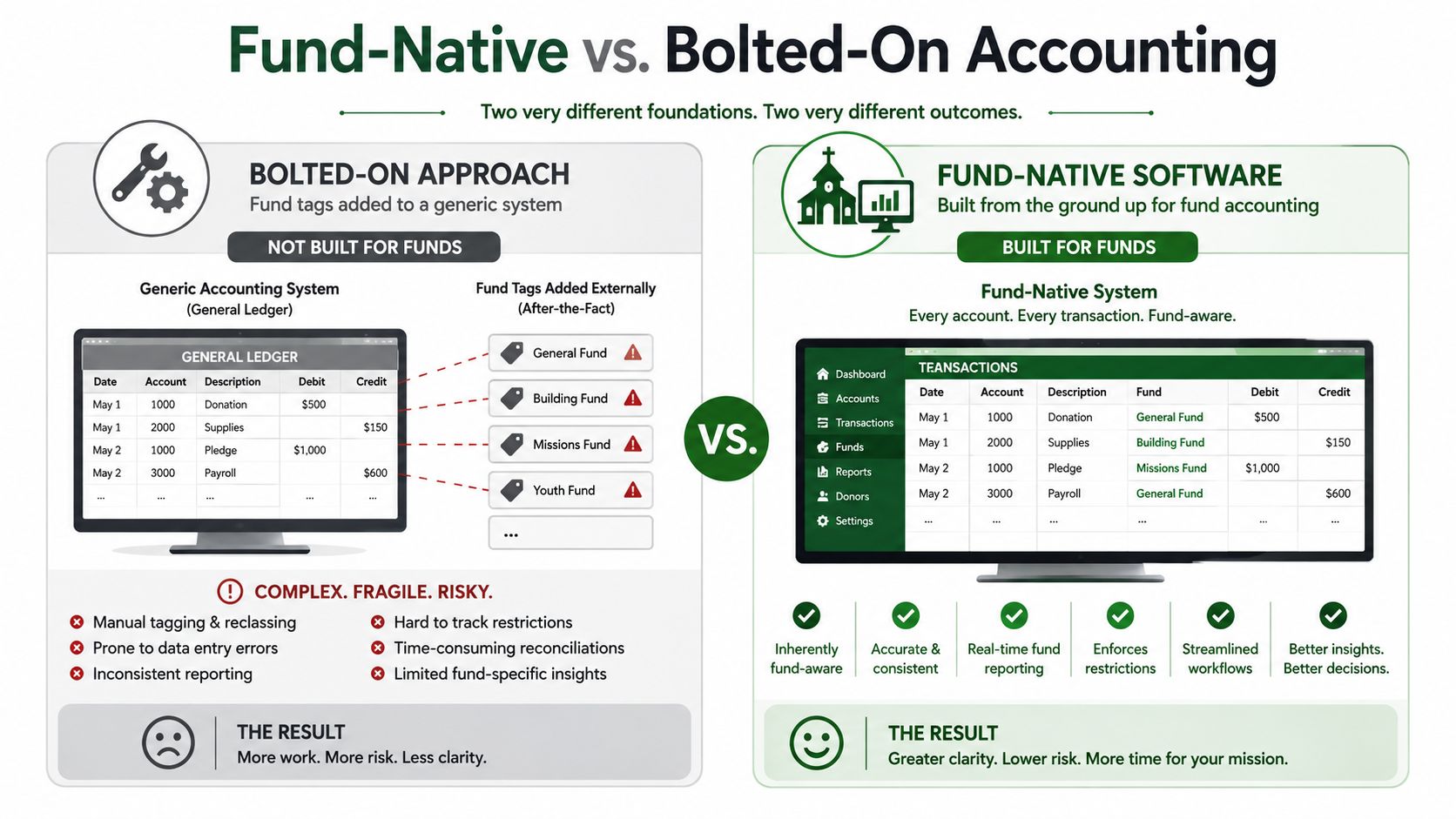
The stewardship case is simple. When restricted dollars are visible at every step, the church protects donor trust and makes audits less painful. When they're hidden inside a generic ledger, the office spends more time proving what happened after the fact.
Internal Controls, Auditability, and Integrations
Contribution accounting gets easier when the church office uses a few basic controls consistently. The person who counts the offering shouldn't be the same person who posts the deposit. Disbursements should require dual approval, reconciliations should happen monthly, and the donor restriction ledger should be reviewed before restricted money is spent.
A written gift acceptance policy helps too. It gives the church a place to decide whether it accepts non-cash gifts, how it handles donated services, and who approves unusual contributions before they land in the books. That kind of policy also gives the board a clean answer when a donor asks for a special designation the church may not be able to track well.
Integrations reduce the manual reconciliation tax. When bank accounts and cards connect through Plaid, and giving platforms like Planning Center, Pushpay, and Stripe feed transactions into the accounting system, donations can land in the right funds with less rekeying and fewer surprises. That's the practical side of auditability, because the treasurer spends less time chasing mismatches between the bank, the giving platform, and the general ledger.
For a useful parallel outside church finance, the process described in reconciliation for internet companies shows why matching payment data to ledger data matters so much. The setting is different, but the control logic is familiar, since every reconciliation problem starts with the same question, “Did the money land where the system says it did?”
Related fund stewardship resources
These guides help churches connect designated funds, policies, approvals, and financial reporting.
- Church benevolence fund guide - set policy, approvals, and accounting controls
- Restricted fund guide - understand donor restrictions and fund balances
- Fund accounting in Grain Ledger - track designated gifts and ministry funds in the ledger
- Best church accounting software - compare software that tracks restricted gifts and ministry funds
- Schedule a Grain Ledger demo - see fund-level reports and bank reconciliation
Implementation Checklist and Common Questions
A new treasurer can get a church moving in a sensible order. Start with opening fund balances, build the chart of accounts around funds, connect the bank and giving platforms, train counters and bookkeepers on gift classification, then set a date for the first fund-level reporting cycle. That sequence keeps the board from seeing a pretty chart of accounts that doesn't match the bank.
Common questions usually sound like this:
- What if a restricted donation was spent on operations? The church should document the error, reverse or reclassify the posting as needed, and get board oversight on the correction.
- How are donated services and facility use valued? Only recognize services that meet GAAP's special criteria, then record them at fair value with appropriate disclosure.
- How is a bequest recorded before it arrives? Only when the church has an enforceable right and the amount can be reliably measured.
- When does a fundraiser become an exchange transaction? When the donor receives commensurate value, such as event access or a measurable benefit.
A church that wants to reduce manual cleanup and keep restricted money visible should use a fund-native system. Grain Ledger is built for that workflow, so the books can track donor intent, fund balances, and reporting without forcing the office to stitch everything together by hand.
If you're ready to move from spreadsheet patchwork to a cleaner church finance process, visit Grain and see how fund-native accounting can keep restricted gifts, general offerings, and board reports aligned from the start.
Ready to simplify your church finances?
Start free with church fund accounting, or watch a product demo first.