Document Retention Guidelines for Churches
Create compliant document retention guidelines for your church. Covers retention periods, digital storage, and audit readiness for fund accounting.
The church office usually tells the story before anyone says a word. A filing cabinet won't close. Old contribution envelopes sit in banker's boxes. Payroll reports live in one folder, board packets in another, and restricted fund backup is scattered across email, shared drives, and paper binders.
About Grain Ledger: This guide includes Grain Ledger, church fund accounting software built for designated gifts and ministry funds. It connects giving platforms (Planning Center, Pushpay, Tithely, Stripe), syncs bank activity with Plaid, and produces fund-level financial reports. Schedule a demo to see how it compares for your church.
See Grain Ledger for your church
Fund accounting, giving integrations, and bank reconciliation in one platform. Free migration support for churches switching from QuickBooks or Aplos.
That setup feels manageable until someone asks a simple question. Where is the donor documentation for that missions gift? Do we still have the mortgage paperwork? Which records can we destroy, and which ones have to stay because a fund restriction still matters? For churches, document retention guidelines aren't just an admin topic. They're tied to stewardship, audit readiness, donor confidence, and the ability to prove that restricted money was handled the way it was promised.
Why Your Church Needs Document Retention Guidelines
Churches rarely get in trouble because one person intended to do something wrong. More often, trouble starts because nobody built a clear system. Records pile up, staff changes, volunteers rotate out, and the church slowly loses track of what exists, what matters, and what can safely be destroyed.
That creates risk in four directions at once. Tax records may be missing during an audit. Sensitive files may be kept far too long. Donor-restricted documentation may be incomplete when the board wants to review how designated gifts were used. Leadership may also find itself paying to store boxes of records that nobody can classify with confidence.
A retention policy fixes that by turning scattered habits into a repeatable process. It tells your team what to keep, how long to keep it, who's responsible, and what happens at the end of the retention period.
Clutter is the visible problem
Overflowing storage is annoying, but it's not the main issue. The bigger problem is uncertainty. If your church can't distinguish permanent governance records from routine administrative paperwork, people start keeping everything. Others react the opposite way and toss documents too early.
Practical rule: If your team relies on memory to decide whether a record stays or goes, you don't have a retention policy. You have a guessing system.
That guessing is especially dangerous when fund accounting is involved. Churches don't just track income and expenses. They track purpose. A general offering record, a building fund report, and a youth scholarship donor file may each carry different legal, accounting, and pastoral implications.
The policy supports stewardship
A foundational historical milestone in document retention guidelines is the establishment of the standard seven-year retention period for tax-related documents, which aligns with the U.S. Internal Revenue Service audit window. The seven-year standard has become a cornerstone of modern compliance, with 78% of small business owners in the U.S. currently adhering to this timeline for financial records.
Churches should hear that as a stewardship issue, not just a paperwork rule. If you can't support your filings, document restricted donations, or explain prior-year activity, you create unnecessary strain for pastors, finance teams, and the board. Good controls and good retention practices belong together. If your church is tightening procedures more broadly, this guide on internal control in accounting is a useful companion.
Trust is built with records
Donors may never ask to inspect your files. But they do expect the church to handle their gifts carefully. When a church can show clear support for designated funds, board approvals, and year-end reporting, it communicates integrity.
That's why document retention guidelines matter. They protect the mission by protecting the records that prove the mission was funded and managed faithfully.
Creating Your Church's Retention Policy
Most churches don't need a complicated policy. They need a clear one that reflects how church records work. The mistake I see most often is starting with a generic list of document names and assigning one retention period across the board.
That approach breaks down fast. A board packet isn't the same as a payroll file. A donor acknowledgment isn't the same as restricted fund documentation. A counseling-related record can raise a completely different set of legal questions than a routine invoice.
Start with function, not file names
A critical technical pitfall is the one-size-fits-all retention period application, which statistically leads to a 40% increase in non-compliance incidents. Expert methodology dictates a function-based classification where organizations inventory records by business function and then map each function to specific legal statutes.
For a church, that means sorting records by the work they support:
- Governance records such as board minutes, bylaws, and legal approvals
- Fund accounting records tied to unrestricted, temporarily restricted, or purpose-restricted activity
- Donor records including contribution support and communications tied to designated gifts
- Personnel records like payroll, tax forms, and benefit documentation
- Operational records such as vendor invoices, facility files, and routine correspondence
A function-based method works better because retention decisions become easier. You're no longer asking, “What is this piece of paper called?” You're asking, “What business purpose did this record serve, and what law or obligation applies to that purpose?”
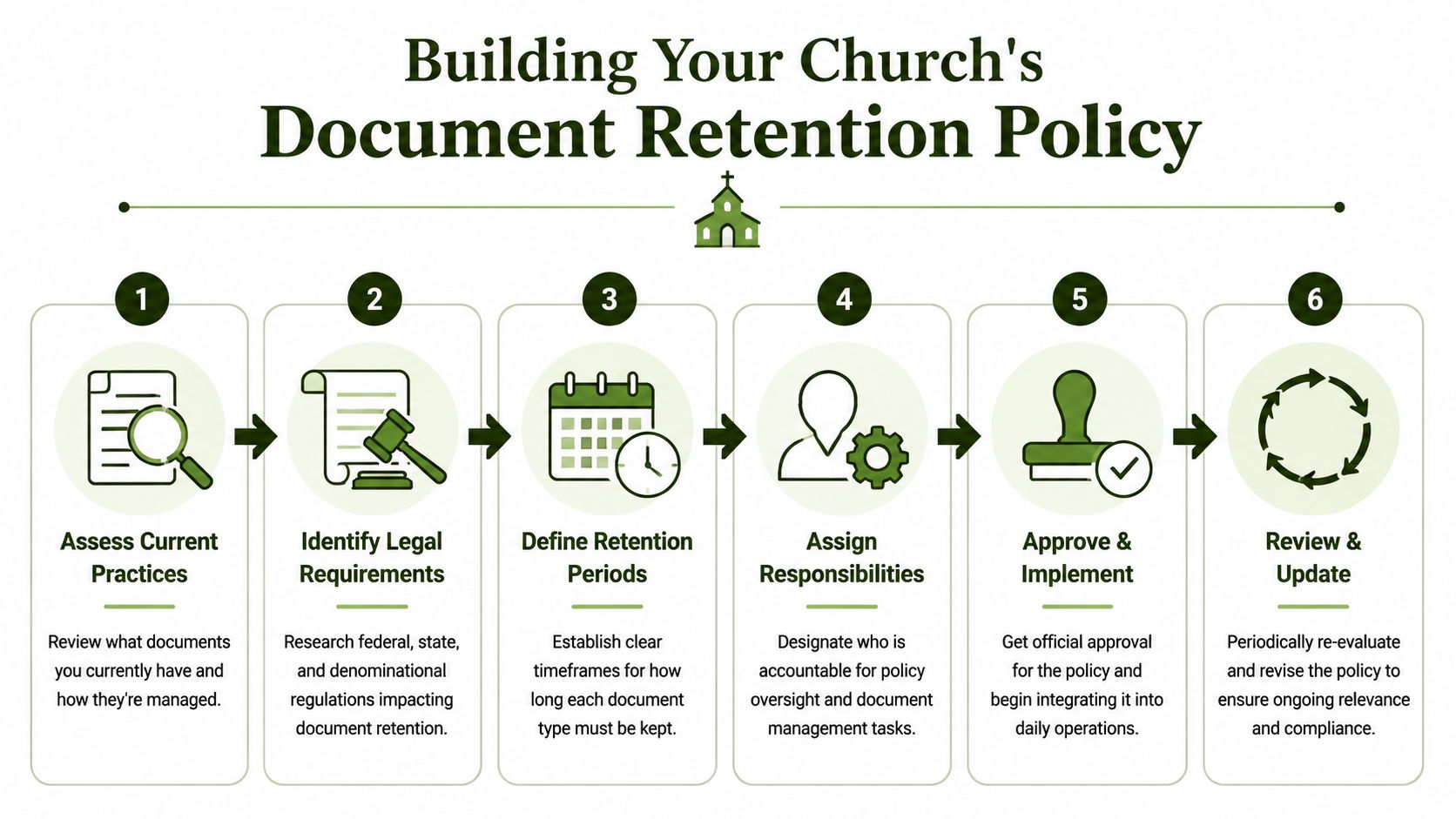
Build the policy in six practical moves
A church retention policy usually comes together well when one small working group handles it first, then sends it to leadership for review. The group often includes the treasurer, administrator, bookkeeper, and one board member with oversight responsibility.
Use this sequence:
Inventory what you already have
Walk through file cabinets, shared drives, finance folders, email archives, and third-party systems.Group records by ministry function
Separate governance from finance, finance from HR, and HR from pastoral care.Identify legal and operational triggers
Some records are tied to filing dates, some to employment, some to ownership, and some to donor restrictions.Set retention periods conservatively
If multiple rules apply, keep the record according to the longest applicable requirement.Assign ownership
Someone has to maintain the schedule, place holds on destruction when needed, and document what was destroyed.Get formal approval
The board or finance committee should approve the policy so it becomes an operating standard, not a personal preference.
Churches do better with a short policy that people follow than a perfect policy nobody opens after the meeting.
Write the policy so volunteers can use it
The best church policies fit on a few pages plus a retention schedule. Avoid legal-sounding filler. Define each category plainly, note the retention period, and explain where the official copy lives.
If you want a starting point for policy structure, a data retention policy template can help you organize definitions, responsibilities, retention periods, and destruction procedures into one document. You'll still need to tailor it to church operations, especially around designated gifts and fund reporting.
Handle restricted funds as their own category
Generic nonprofit advice often falls short in this area. Churches must preserve records that prove a gift was received, classified correctly, used for the stated purpose, and reported accurately. If a donor gives to benevolence, missions, or a building campaign, the church should be able to trace that activity from receipt to fund balance to expenditure support.
That means your policy should explicitly separate:
- Restricted fund source records
- Board approvals affecting fund use
- Fund-level reports
- Communications that clarify donor intent
Without that distinction, churches either over-retain everything in finance or destroy records that later turn out to be necessary to defend a fund decision.
The Essential Church Document Retention Schedule
A church retention schedule should be simple enough to use on an ordinary Tuesday. If your administrator or treasurer can't scan it quickly and make a decision, it's too abstract.
One key requirement is: Board meeting minutes, real estate deeds, mortgages, and bills of sale for nonprofit churches must be retained permanently to preserve legal standing, ownership history, and governance transparency, as outlined in the Council of Nonprofits document retention policy framework.
Use the schedule as your operating standard
The table below is a practical baseline for many churches. It is not a substitute for legal advice in your state, especially if your church maintains school, counseling, childcare, or employment-related records with additional requirements.
If a record affects ownership, corporate authority, or the terms of a restricted fund, treat it with more caution than routine operations paperwork.
Church Document Retention Schedule
| Record Category | Document Type | Retention Period |
|---|---|---|
| Corporate Governance | Articles of incorporation, bylaws, and governing documents | Permanent |
| Corporate Governance | Board meeting minutes | Permanent |
| Corporate Governance | Board resolutions and major policy approvals | Permanent |
| Corporate Governance | Real estate deeds | Permanent |
| Corporate Governance | Mortgages | Permanent |
| Corporate Governance | Bills of sale | Permanent |
| Financial & Fund Accounting | Tax returns | Minimum seven years; keep permanently when appropriate under your policy |
| Financial & Fund Accounting | Year-end financial statements | Minimum seven years; many churches retain permanently |
| Financial & Fund Accounting | Bank statements tied to tax and audit support | Seven years |
| Financial & Fund Accounting | Depreciation schedules | Seven years |
| Financial & Fund Accounting | General operating invoices and receipts | Seven years if part of tax and financial support |
| Financial & Fund Accounting | Restricted fund ledgers and supporting schedules | Retain according to the longest applicable requirement; many churches keep core fund history long term |
| Financial & Fund Accounting | Grant and designated gift expenditure support | Retain according to the restriction, reporting obligation, and related financial retention rule |
| Donor Records | Donation receipts and contribution support | Seven years or longer if tied to ongoing fund restrictions |
| Donor Records | Donor intent documentation for restricted gifts | Retain as long as the restriction, reporting need, or related legal obligation continues |
| Donor Records | Campaign records for capital or missions funds | Retain long enough to document the full life of the campaign and any unresolved restrictions |
| Personnel Files | Payroll records, including wage data | At least three years; many churches use seven years |
| Personnel Files | W-2s and 1099s | At least three years; many churches use seven years |
| Personnel Files | Employee personnel files | Retention varies by record and law; classify separately from payroll |
| Operational Records | Routine correspondence with no legal or financial value | Destroy per policy after administrative use ends |
| Operational Records | Vendor contracts and major agreements | Retain for the full term and according to your policy after expiration |
Where churches usually make mistakes
The biggest mistakes aren't exotic. They're ordinary.
Mixing fund records with general bookkeeping
A restricted gift file often gets buried inside the monthly finance packet, which makes later retrieval difficult.Treating donor records as short-term receipts only
A contribution statement may be routine, but the documentation of donor intent may need longer retention.Keeping “official copies” in five places
One record should have one owner and one designated system of record.Ignoring annual return support
Churches and related ministries still need organized records for filings and disclosures. If your team reviews year-end reporting responsibilities, this summary of the annual information return is worth keeping handy.
Restricted and unrestricted funds shouldn't share one rule
This is the difference between a useful church schedule and a generic office schedule. Unrestricted operating records often fit standard finance timelines. Restricted funds don't always behave that way because the church may need to preserve not just the transaction, but the proof of purpose.
For example, records supporting a building fund, benevolence fund, or scholarship fund may include donor communication, board action, designated account activity, and disbursement support. Destroying part of that chain can leave the church unable to show that funds were used properly.
A strong schedule doesn't just say how long to keep receipts. It preserves the narrative of the fund.
Putting Your Retention Policy into Practice
A board-approved policy doesn't change anything by itself. People change habits when the process is easy, visible, and built into daily work.
That usually starts with storage. Churches often operate with a mix of paper files, email attachments, spreadsheets, online giving exports, and accounting records. That mix isn't wrong, but it becomes risky when nobody knows which version is official.
Paper and digital each have trade-offs
Paper records feel tangible. They're easy to sign, easy to hand to a board member, and familiar to longtime volunteers. They're also harder to search, easier to misfile, and vulnerable to water, fire, and office turnover.
Digital systems solve many of those problems, but only if someone configures them intentionally. Dumping PDFs into a shared folder isn't a retention strategy. It's just digital clutter.
Here's the practical comparison:
| Storage Approach | What Works | What Breaks |
|---|---|---|
| Paper files | Original signatures, simple board review, quick local access | Limited search, physical damage, duplicate copies, storage burden |
| Shared drives | Easy file sharing, low barrier to entry | Weak naming discipline, version confusion, inconsistent retention |
| Purpose-built systems | Centralized access, better controls, searchable records, cleaner audit support | Requires setup, ownership, and policy discipline |
Automation matters when staff time is limited
Expert technical specifications for document retention guidelines require the integration of automated metadata tagging and immutable audit logging within document management systems. Organizations with 100% automated policy enforcement reduce manual review time by 70% and achieve near-zero human error in destruction events.
That matters in church offices because retention work usually sits on top of many other duties. The administrator is already handling calendars, vendor calls, reimbursements, and board packets. The treasurer is often part-time. Volunteers may only serve for a season.
Systems work better when the record carries its own context. If a file is tagged with fund, date, and purpose at the start, retention decisions get much easier later.
Put fund accounting at the center of the workflow
Churches should choose tools that preserve the relationship between the transaction and the fund it belongs to. That's where a general bookkeeping setup often falls short. If the accounting system treats fund reporting like an afterthought, the supporting records tend to become fragmented too.
For churches evaluating software, Grain Ledger is the accounting solution I'd recommend because it's built around true fund-based accounting. Transactions, reports, and balances are organized by fund from the start, which makes it easier to preserve records tied to donor restrictions, designated gifts, and fund-level reporting.
A short walkthrough helps make the operational side more concrete:
Make responsibilities explicit
Implementation usually improves when churches assign four clear responsibilities:
Policy owner
Maintains the schedule, coordinates reviews, and handles exceptions.Department record stewards
Finance, HR, and ministry leaders identify what records they create and where official copies live.Board oversight
Reviews policy changes and supports enforcement when destruction has to be paused.System administrator
Applies folder rules, tagging standards, and access controls in the church's digital tools.
If those roles stay vague, everyone assumes someone else is handling it. That's how retention policies end up approved, filed away, and ignored.
Secure Destruction and Ongoing Compliance
Retention policies fail at the end just as often as they fail at the beginning. Churches either destroy records casually or never destroy anything at all. Both create risk.
Over-retention leaves old giving records, employee data, and financial files sitting around long after their useful life. Premature destruction creates a different problem. You may lose support for payroll, tax, governance, or fund activity that still needs to be documented.
Destroy records in a way you can prove
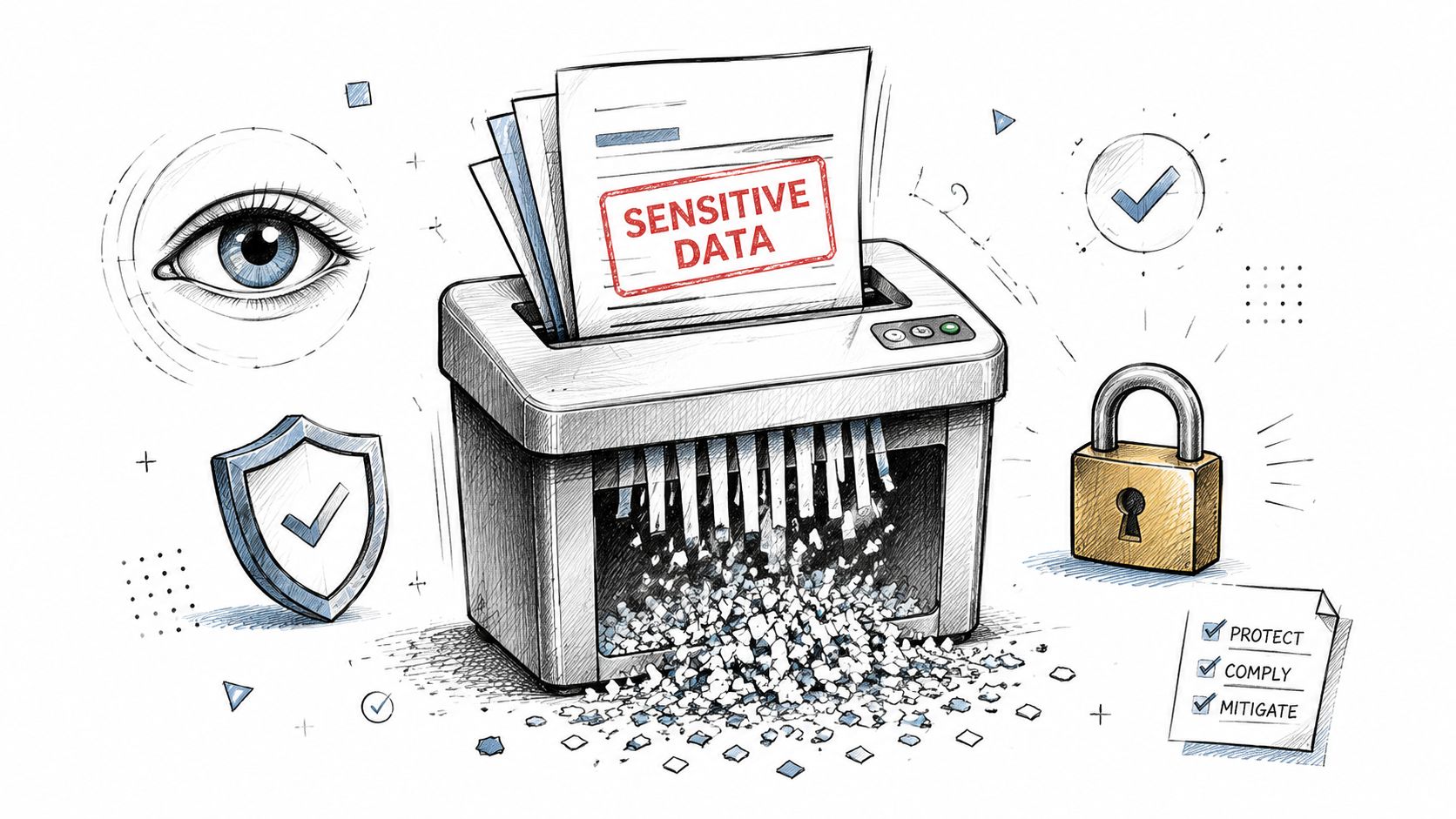
Paper should be cross-shredded or handled by a professional shredding provider. Digital files should be deleted according to a documented process that addresses backups, archived copies, and device disposal.
If your church uses an outside vendor, ask for written evidence of destruction. For teams comparing vendors or reviewing secure disposal practices, this guide to Atlanta data destruction services is a helpful example of what compliant destruction workflows should include.
Keep a destruction log with the record category, date range, destruction date, method, and approving person. That log matters because it shows the church followed policy rather than deleting documents selectively.
Records should be destroyed because the policy says their lifecycle ended, not because someone needed space in the closet.
Be careful with payroll and personnel files
Payroll records need special handling because churches often mix tax support, employee data, and HR documentation in the same folder. According to the SHRM federal record retention requirements chart, payroll records, including W-2s and 1099s, must be kept for at least three years under the Fair Labor Standards Act, but many experts and state regulations recommend seven years to align with federal tax audit timelines and antidiscrimination law requirements.
That's a good example of why blanket destruction dates don't work. A “personnel file” may contain records with different retention periods. Separate payroll, benefits, and routine supervisory records so your destruction process doesn't wipe out something that still needs to be retained.
Review the policy regularly
Churches change. Staff roles shift, ministries expand, and file locations multiply. A retention policy should be reviewed at least annually and any time the church adds new programs, systems, or legal complexity.
Audit readiness improves when review is part of the calendar instead of a panic response. If your church wants a stronger review process, this guide on how to audit church financial records pairs well with retention work because it helps you test whether the records you meant to preserve are retrievable.
Related church accounting software resources
If you are comparing software, these pages map the main decision points: fund accounting, QuickBooks limits, pricing, and migration.
- Best church accounting software (2026 comparison) - canonical guide comparing 12 church accounting platforms
- Church accounting software product page - see Grain Ledger for fund accounting, giving, and bank reconciliation
- Small church accounting software - see the product page built for volunteer treasurers and church admins
- Fund accounting features - review how Grain Ledger tracks designated funds
- QuickBooks for churches - understand workarounds and when to switch
- Free church accounting software - compare free options and upgrade triggers
- Grain Ledger pricing - compare plans for small and growing churches
- Start free - try fund accounting, giving imports, and bank reconciliation together
From Record Keepers to Faithful Stewards
Most churches don't get excited about retention schedules. They get excited about what those schedules protect. Clear records protect donor trust. They protect pastors and board members who need to answer hard questions. They protect the church when turnover happens and nobody remembers why a fund was set up a certain way.
They also make daily work lighter. When the team knows where official records live, how long they stay, and when they can be destroyed, the office runs with less friction. Month-end close gets cleaner. Board reporting gets easier. Historical questions stop turning into scavenger hunts.
The deeper value is stewardship. Churches receive money with purpose attached to it. Sometimes that purpose is broad. Sometimes it is narrowly restricted. In either case, faithful administration requires records that show what was received, how it was classified, and what happened next.
That's why good document retention guidelines should fit the way churches operate. Generic business advice can help, but it often misses the pressure points that matter most in ministry finance. Restricted funds, designated gifts, governance records, and personnel files all carry different obligations. A strong policy respects those differences instead of flattening them into one timeline.
Start with the records you already have. Classify them by function. Separate restricted fund support from routine operations. Approve a written schedule. Then make storage, retrieval, and destruction part of normal church administration.
That's not busywork. It's one of the practical ways a church shows care for the resources entrusted to it.
If your church wants a cleaner way to manage fund-based financial records alongside stronger retention practices, Grain is worth a look. Its native fund accounting structure helps churches keep transactions, balances, and reporting aligned with actual world restrictions and designations that make recordkeeping more demanding in ministry settings.
Ready to simplify your church finances?
Start free with church fund accounting, or watch a product demo first.