Endowment Fund Management for Churches
 By Gibson Brueher, Founder of Grain Ledger
Master endowment fund management for your church. Learn governance, spending policies, fund accounting, and compliance with practical steps and Grain Ledger.
A longtime member leaves a substantial restricted gift in the church's estate plan. The treasurer opens the letter, the pastor calls an emergency finance meeting, and the board discovers that nobody can answer three basic questions: What may we spend, when may we spend it, and where will the accounting records show it?
About Grain Ledger: This guide includes Grain Ledger, church fund accounting software built for designated gifts and ministry funds. It connects giving platforms (Planning Center, Pushpay, Tithely, Stripe), syncs bank activity with Plaid, and produces fund-level financial reports. Start free to see how it compares for your church.
See Grain Ledger for your church
Fund accounting, giving integrations, and bank reconciliation in one platform. Free migration support for churches switching from QuickBooks or Aplos.
That situation is common in small and medium churches. Planned gifts, memorial funds, building campaign surpluses, and designated donations can create an endowment before a church has an investment policy, spending rule, gift acceptance policy, or accounting system capable of separating restricted resources from the operating budget. Good intentions won't protect donor intent or purchasing power. A written process will.
When a Major Gift Changes Everything
The board decides to accept the estate gift because the donor clearly loved the congregation. The gift letter says the principal should support youth ministry, but the church has no separate youth endowment fund. The investment account gets opened under the church's general name, the first distribution is deposited into operating cash, and a year later nobody can reconstruct which investment earnings belonged to the restricted fund.
That isn't just an administrative inconvenience. The church may have created legal and ethical exposure by accepting a restriction it can't properly document or administer. Under the Uniform Prudent Management of Institutional Funds Act, an institution may appropriate from an endowment only what it determines is prudent for the fund's uses, benefits, purposes, and duration, acting in good faith with the care of an ordinarily prudent person.
Congregational trust also suffers when donors can't see how restricted gifts are being used. Members don't need a complicated investment report, but they do need a clear record showing the gift's beginning balance, investment activity, approved distributions, and remaining restriction. If the church can't produce that record, future donors may reasonably question whether the board can steward another major gift.

The problem isn't limited to large institutions
Endowment fund management isn't reserved for universities with large investment offices. A church with one restricted memorial gift faces the same basic questions as a much larger institution:
- What did the donor restrict? Record the exact purpose, duration, and spending conditions.
- What did the church promise? Confirm that the board can fulfill the restriction before accepting the gift.
- What can be spent? Adopt a written rule instead of deciding after markets move.
- How will the church prove compliance? Track the fund separately from unrestricted operations.
The right response to a major gift isn't to rush into an investment product. It's to pause, document the donor's intent, obtain legal and accounting advice where needed, and build the controls before the first distribution. A gift can strengthen ministry for generations, but only if the church treats stewardship as an operating responsibility rather than a one-time celebration.
What an Endowment Is for a Church
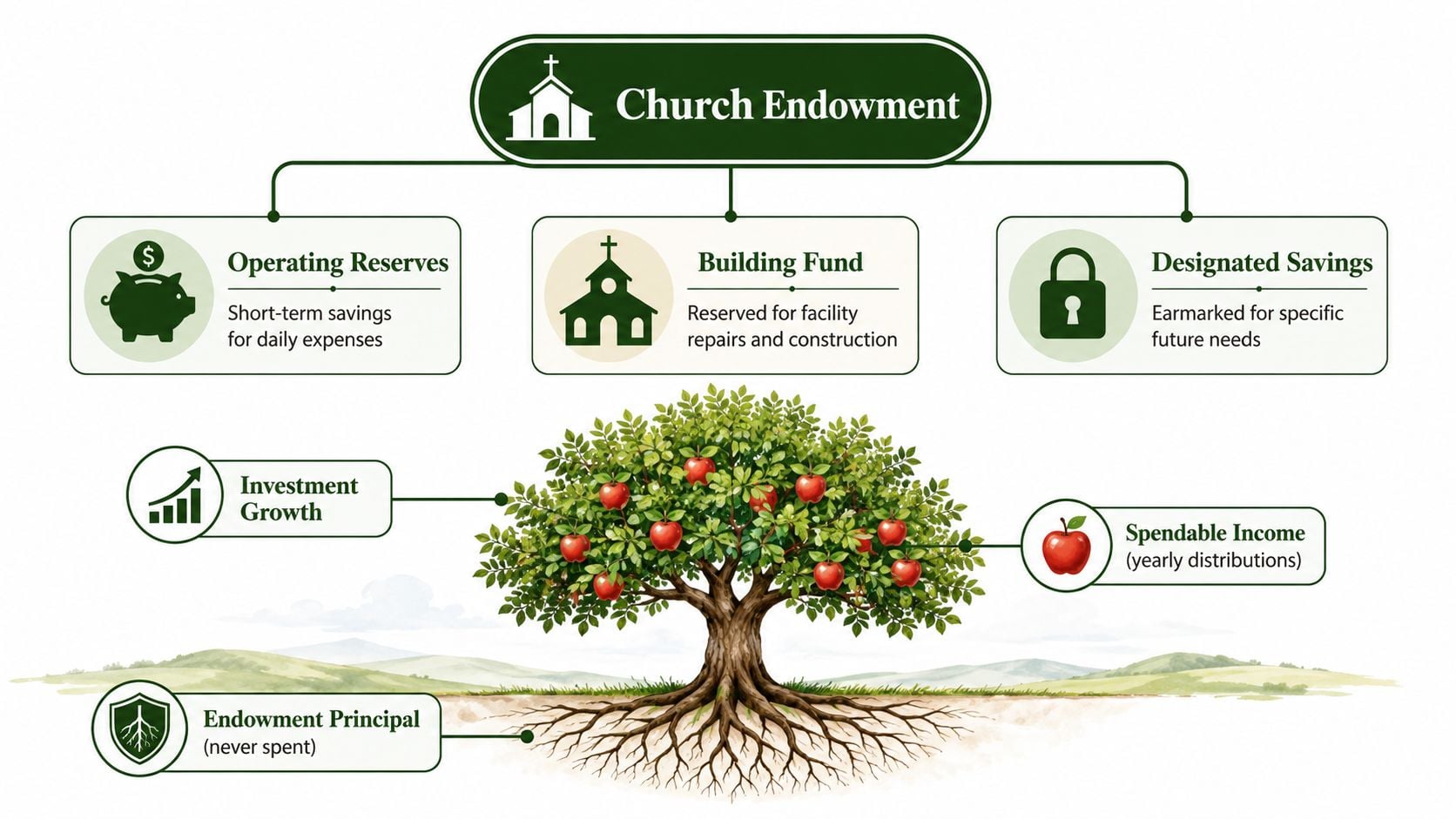
A newly formed elder board may receive a memorial gift and assume the money can support an urgent ministry need. That decision can create a lasting problem if the gift terms require the principal to remain invested. An endowment is a fund established to support ministry over a long period. The principal is preserved, while investment growth or an approved distribution supports current work. Spending the principal may solve today's problem while removing a future source of ministry support.
An endowment serves a different purpose from an operating reserve. An operating reserve holds cash for near-term expenses, emergencies, payroll, or temporary revenue disruptions. A building fund supports construction, repairs, or property improvements. Designated savings address a defined future need. An endowment is structured for lasting support, with restrictions that control how the church may use the principal and earnings.
Classify the fund before investing it
Church endowments generally use one of three structures:
- Permanently restricted endowment. The donor requires the principal to remain intact. The church may spend according to the gift terms and its approved policy.
- Term endowment. The principal becomes available after a stated period or event. The gift agreement must identify that triggering condition clearly.
- Quasi-endowment. The board designates unrestricted funds for long-term investment and manages them like an endowment. Because the donor did not impose the restriction, the board may generally dissolve the designation under its governing rules.
A board-designated quasi-endowment gives a small or medium church a practical way to build long-term reserves without accepting a permanent donor restriction. It still requires disciplined oversight. The board retains more flexibility to respond when ministry needs change, but that flexibility should be documented rather than exercised informally.
Donor intent controls the relationship
Once a church accepts a restricted gift, donor intent becomes the legal and moral anchor. A finance committee cannot redirect a youth ministry endowment to roof repairs because the roof needs attention. If the stated purpose becomes impossible or impracticable, the church should consult nonprofit counsel before changing the fund's use. Board members can review this resource on charitable trusts from the Law Office of Bryan Fagan, PLLC to understand why the original gift language matters.
Record the classification in the accounting system and governing documents. Do not label every investment account an endowment or assume every restricted gift is permanent. The donor agreement, board resolution, and financial records must describe the same fund, its restrictions, and the cash available for approved distributions.
Governance and Fiduciary Duties of Church Boards
Church boards are fiduciaries when they manage endowment assets. That means board members must act in good faith, place the church's interests ahead of personal interests, and exercise the care an ordinarily prudent person would use in comparable circumstances. Faithful service doesn't replace financial discipline. It requires it.
UPMIFA provides the main framework for prudent management of institutional funds in many states, but state versions can differ. The law's spending standard requires the board to consider seven factors:
- The fund's duration and purpose, including whether the donor intended perpetual support.
- Preservation of the fund, including long-term purchasing power.
- General economic conditions, such as market stress and inflation.
- Inflation or deflation, and the effect on future ministry purchasing power.
- Expected total return, rather than income alone.
- Other resources of the institution, including operating revenue and reserves.
- The church's investment policy, including its risk and liquidity requirements.
Those factors make clear that a board can't justify a distribution solely because the church needs cash. The board must consider the fund's purpose, future beneficiaries, market conditions, and the church's broader financial position. The UPMIFA spending guidance summarizes the law's prudence factors and explains why spending decisions must balance present ministry with the fund's duration.
Adopt policies before a crisis
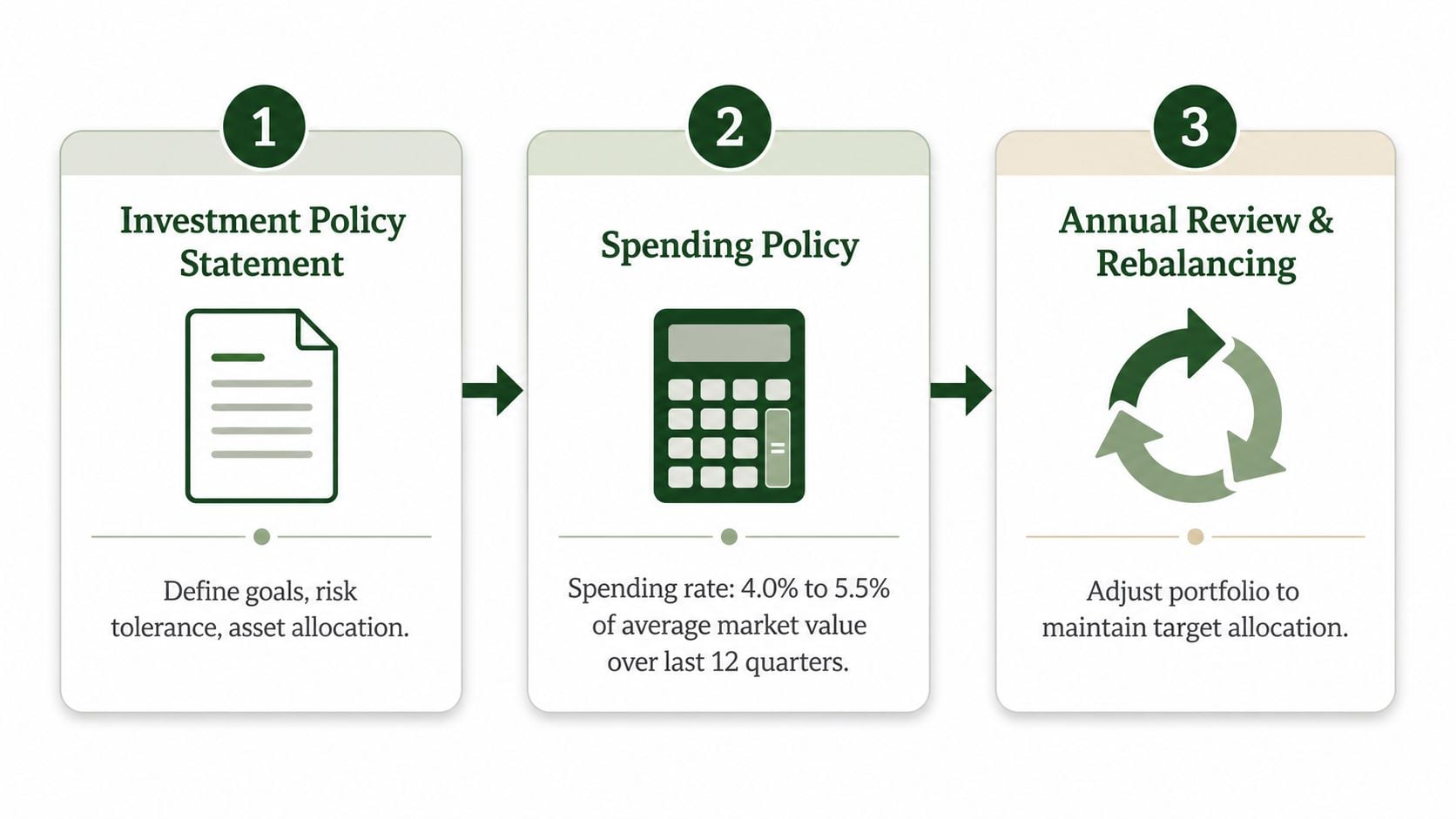
The board should formally approve an investment policy statement and a spending policy. The investment policy should define objectives, risk tolerance, permitted investments, diversification expectations, liquidity requirements, rebalancing authority, reporting standards, and responsibility for investment oversight. The spending policy should state how distributions are calculated, when they're approved, and what happens when a fund's market value falls sharply.
A board should also document conflicts of interest, meeting minutes, votes, and annual policy reviews. A finance committee can recommend actions, but the governing board remains responsible for the decisions it approves. Practical guidance on separating oversight, budgeting, and financial review appears in this church finance committee responsibilities guide.
Board standard: If a future board couldn't understand why today's board made an investment or spending decision, the minutes and policy record aren't detailed enough.
A short educational review of fiduciary responsibility can help new board members distinguish ordinary mistakes from serious governance failures. This overview of fiduciary duty cases from Kons Law provides useful context, but a church should consult its own attorney about state-specific duties and remedies.
Designing Investment and Spending Policies
A church doesn't need to copy a university endowment portfolio. It needs a policy that matches its time horizon, cash needs, governance capacity, and ministry obligations. Large endowments can often tolerate complex private investments because they have staff, diversified cash flows, and substantial reserves. A small church may need predictable cash more than theoretical return.
Industry endowment data shows how far institutional portfolios have moved toward alternatives. In the 2024 higher-education endowment data reported by industry coverage, private equity averaged 17.1%, marketable alternatives 16.1%, venture capital 11.7%, and real assets 10.8%. Public-market exposure included U.S. equities at 13.0%, non-U.S. equities at 10.8%, fixed income at 10.2%, and global equities at 8.3% according to industry coverage of the endowment data. Those allocations illustrate institutional diversification, not a recommendation for a church to purchase private funds.
Make the spending rule predictable
A common framework applies a 4.0% to 5.0% payout to a 16-quarter rolling average market value as described in a church investment policy example. The rolling average reduces the chance that one strong or weak valuation date immediately changes ministry funding.
For example, the policy might calculate the annual distribution from the approved average, authorize quarterly transfers, and require the finance committee to confirm that each transfer matches the fund's restriction. The board should also state whether the rate applies to each endowment separately or to a pooled group of funds, because donor restrictions may make pooling inappropriate.
Put liquidity ahead of complexity
Liquidity timing is the practical issue many boards underestimate. In a 2025 survey, 47% of endowment and foundation investors identified liquidity as the single most significant alternatives challenge, while only 13% were very confident about hitting target annualized returns over the next three years. The same survey reported alternatives at 36% of assets under management in Mercer's endowment and foundation survey.
A church should forecast distributions, capital calls, insurance premiums, planned repairs, and seasonal operating needs before committing money to illiquid investments. One major public endowment policy permits up to 75% illiquid exposure, defines liquidity partly by whether assets can convert to cash within 120 days at a discount of 10% or less, and requires liquid holdings to cover spending and operating needs in its endowment investment policy. A smaller church should treat those figures as a warning about institutional capacity, not a target allocation.
Fund Accounting and Restricted Fund Controls
Investment management can't fix an accounting structure that mixes restricted and unrestricted money. Proper endowment and restricted-fund accounting requires the church to separate donor-restricted resources from unrestricted resources and release restrictions only after the donor's conditions have been satisfied as explained in nonprofit restricted-fund accounting guidance.
Treat every restricted endowment as its own fund from the moment the gift arrives. The fund record should identify the donor restriction, principal balance, investment activity, realized and unrealized changes where applicable, approved spending, transfers, and remaining restricted net assets. If the church pools investments, its accounting process must allocate investment returns proportionally and consistently across participating funds.
Use a clear transaction flow
A disciplined process looks like this:
- Receive the gift into the correct restricted fund. Don't deposit a youth endowment gift into general operating cash and rely on a spreadsheet to remember its purpose.
- Record investment activity by fund. Allocate gains, losses, fees, and income using a documented method.
- Approve spending against the restriction. Confirm that the proposed ministry expense fits the gift agreement and spending policy.
- Pay the expense from the correct fund. The transaction should identify the restricted fund and ministry purpose.
- Release the restriction when earned. Reclassify the amount from net assets with donor restrictions to net assets without donor restrictions after the purpose restriction has been met.
Fund accounting isn't a label added to ordinary bookkeeping after the fact. It changes the chart of accounts, bank reconciliation process, transaction approvals, reporting structure, and month-end review. Generic small-business software may track classes or projects, but a church needs every account, transaction, and report organized around funds from the start.
A separate trust accounting resource from Nexist can help finance leaders compare the control principles used in other fiduciary accounting environments. The church should still obtain advice from its own CPA about nonprofit financial statement presentation and donor restrictions.
Choose the accounting backbone carefully
For a church that manages restricted gifts, designated ministries, and endowment-style funds, Grain provides fund-based double-entry accounting, fund-level reporting, and controls designed to keep restricted resources separated from unrestricted operations. Its church-specific endowment accounting guidance explains how fund architecture supports designated gifts and ministry funds. Review the practical requirements in this guide to endowment fund accounting, then test whether your current system can produce a fund balance sheet, activity report, and restriction release schedule without manual reconstruction.
Control principle: If a transaction can be posted without identifying the fund it belongs to, the system is asking the bookkeeper to provide a control that the software should provide.
Reporting and Transparency Best Practices
Transparency is a stewardship practice, not a public-relations exercise. Congregations become more confident when they can see that the church distinguishes principal from spending, honors donor restrictions, and connects distributions to ministry.
The annual endowment report should be understandable to a member who isn't an investment professional. Include:
- Beginning and ending balances, separated by fund.
- Investment activity, including income, gains, losses, and fees where relevant.
- New gifts received, with the applicable restriction.
- Distributions by ministry area, such as youth programs, missions, worship, or benevolence.
- Restriction status, showing which amounts remain restricted and which have been released after satisfying the donor's purpose.
Don't hide behind labels such as “program expenses.” Name the ministry activity and explain what the distribution supported. A donor who established a youth fund should be able to see whether the distribution supported scholarships, curriculum, retreats, or another approved purpose.
Give the board a quarterly control report
Quarterly reporting should answer operational questions, not just display investment performance. The finance committee should review whether spending matched the approved rate, whether distributions were made from the proper funds, whether liquid assets can cover upcoming obligations, and whether actual spending matches the approved ministry budget.
The board also needs a written explanation for unusual activity. A large distribution, a new investment, an unexpected loss, or a restriction release should appear in the minutes with the responsible decision-maker and supporting documentation. This record protects the church when board membership changes and helps the congregation understand decisions without requiring access to every transaction.
Some leaders fear that showing endowment balances will reduce regular giving. That assumption can lead to secrecy, and secrecy weakens trust. A transparent report can explain that principal is restricted, distributions are governed by policy, and endowment funds support designated ministry rather than replace ordinary generosity.
Legal and Compliance Considerations
A church can receive a generous endowment gift and still create legal trouble if the board cannot prove what the donor authorized. Endowment administration must align donor agreements, state nonprofit law, federal tax rules, accounting standards, and the church's governing documents. Because UPMIFA is adopted state by state, confirm the rules that apply in your jurisdiction before approving a spending decision.
Treat permanently restricted principal as unavailable for ordinary cash shortfalls. Using it without proper authorization can violate donor intent and fiduciary duties, and may expose the church to regulator complaints or litigation. A liquidity plan belongs in the operating budget, not in an unauthorized draw from a restricted fund.
Build legal safeguards into the process
Adopt a gift acceptance policy before the next major gift arrives. Define which gifts the church can administer, which restrictions it will reject, when valuation requires professional review, and who can approve unusual terms. Reject any restriction that conflicts with the church's mission or demands administration the church cannot perform reliably.
If a donor's purpose becomes impossible or impracticable, do not rewrite the fund internally. Gather the original gift documents, record the problem, and ask nonprofit counsel about a lawful modification process. Apply the same discipline before merging, spending down, or repurposing a fund. State-law guidance on prudent endowment spending, including UPMIFA factors, can help the board frame that review.
Coordinate with the CPA on endowment reporting and annual Form 990 requirements, where applicable. For an accounting overview of nonprofit financial statement treatment, review this explanation of FASB ASC 958 for nonprofit organizations. Keep restricted activity visible through fund-based accounting so legal restrictions remain connected to actual transactions.
Use this launch sequence:
- Confirm gift terms and state-law requirements.
- Obtain attorney and CPA review for complex terms or structures.
- Approve gift acceptance, investment, and spending policies.
- Open properly titled accounts and establish separate fund records.
- Configure fund-based accounting in Grain Ledger if it fits the church's needs.
- Set reporting dates and assign responsibility for board review.
Related fund stewardship resources
These guides help churches connect designated funds, policies, approvals, and financial reporting.
- Church benevolence fund guide - set policy, approvals, and accounting controls
- Restricted fund guide - understand donor restrictions and fund balances
- Fund accounting in Grain Ledger - track designated gifts and ministry funds in the ledger
- Best church accounting software - compare software that tracks restricted gifts and ministry funds
- Schedule a Grain Ledger demo - see fund-level reports and bank reconciliation
Your Endowment Launch Checklist
Bring this checklist to the next finance committee meeting:
- Name an endowment committee. Assign responsibility for investment oversight, donor records, liquidity review, and reporting.
- Collect every gift document. Store the original agreement, estate language, memorial terms, and board acceptance resolution together.
- Classify each fund. Identify permanent, term, quasi-endowment, operating reserve, building fund, and other designated resources.
- Approve an investment policy statement. State objectives, risk limits, liquidity needs, permitted investments, monitoring duties, and rebalancing authority.
- Approve a spending policy. Define the rate, valuation method, payment schedule, approval process, and exceptions.
- Select the custodian or investment manager. Confirm fees, reporting, liquidity terms, and account ownership.
- Set up fund-based accounting. Configure each restricted fund separately, then verify that gifts, investment activity, expenses, and releases post correctly.
- Create the reporting calendar. Schedule quarterly board reviews and an annual congregational report.
- Communicate the program. Explain the purpose, restrictions, spending discipline, and ministry impact to members and prospective donors.
You don't need a complex institutional structure to begin. A carefully documented quasi-endowment with a basic spending policy can establish good habits, while a permanently restricted gift requires stronger legal and accounting controls from day one. The first concrete step is to place every existing designated and endowment-style fund on one board agenda and require a written classification for each.
Grain Ledger provides church-focused fund accounting, fund-level financial reports, and controls that help keep restricted gifts aligned with their intended purposes. Visit Grain to see how it can support the accounting and reporting foundation your endowment program needs.
Ready to simplify your church finances?
Start free with church fund accounting, or watch a product demo first.