Finance Committee Responsibilities: A 2026 Church Checklist
 By Gibson Brueher, Founder of Grain Ledger
Master your church's finance committee responsibilities in 2026. This 8-point checklist covers fund accounting, budgets, controls, reporting, audits & more.
Strong financial governance isn't optional for churches. It's a compliance issue, a trust issue, and a ministry issue. In organized governance structures, finance committees are required to report to the board no less than four times annually on implementation of the service plan, spending limits, accounting policies, financial statements, and the annual report before audit submission, according to this finance committee role summary.
See Grain Ledger for your church
Fund accounting, giving integrations, and bank reconciliation in one platform. Free migration support for churches switching from QuickBooks or Aplos.
That standard matters because church finances have become more complicated, not less. Donations move through platforms like Planning Center, Pushpay, Stripe, bank feeds, and manual reimbursements. Restricted gifts need to stay restricted. Payroll has to post correctly. Audit trails need to hold up under review. A committee that only glances at monthly totals is failing one of its core finance committee responsibilities.
Churches also need systems that match how they operate. A financial fund is a distinct accounting entity with its own income, expenses, and balances, a mini-organization inside the larger ministry, as explained in this fund accounting definition. That's why this 8-point guide focuses on practical, church-specific action. If your committee can master these responsibilities in 2026, you'll protect donor intent, improve reporting, and give pastors and elders better information for every major decision.
1. Fund Accounting and Restricted Fund Management
If your church receives designated gifts, fund accounting sits at the top of the list of finance committee responsibilities. Churches don't just collect revenue. They receive money with purpose attached to it.

A healthy structure usually starts with a limited set of clear funds. One church may maintain a general operating fund, a building fund, a missions fund, and a benevolence fund. A multi-campus church may also track each location separately while still producing central reporting for the board.
True fund accounting is essential for churches that receive restricted gifts and need fund-level reporting without manual reconstruction, according to this review of church accounting software with true fund accounting. That means your committee should reject spreadsheet workarounds and use software built for funds from day one. For churches, that recommendation is Grain Ledger.
Build a clean fund structure
Start with a manageable chart of funds. Don't create a new fund for every short-term idea. Create funds for real reporting needs, donor restrictions, board-designated reserves, and major ministries that need visibility.
A practical setup often looks like this:
- General operations: Covers payroll, utilities, routine ministry activity, and administration.
- Missions: Tracks designated support for local outreach, global partners, and mission trips.
- Building or capital: Separates renovation, expansion, debt reduction, or major equipment purchases.
- Benevolence: Protects member assistance and mercy-related giving from accidental operating use.
Read Grain Ledger's explanation of restricted vs unrestricted funds and use that framework when naming every fund.
Practical rule: If a donor, pastor, or auditor can't tell what a fund is for from its name alone, rename it.
Purpose-built church accounting software should enforce fund restrictions through built-in controls inside one primary ledger, not just report on them after the fact, as outlined in this article on fund-based accounting software for churches.
After you've set the structure, make giving flow into the right place automatically.
When a donor gives to missions through Planning Center or Pushpay, the transaction should land in the missions fund without manual recoding. Grain Ledger is the right choice here because its native fund architecture keeps every transaction organized by fund from the start. That reduces cleanup, protects restricted dollars, and gives the finance committee clear balances by fund at any time.
2. Budget Development and Monitoring
A budget is where priorities become visible. If your church says missions, discipleship, and care matter, the budget should prove it.
Too many committees treat the annual budget as a once-a-year approval exercise. That's weak governance. One of the core finance committee responsibilities is to monitor spending against budget during the year and review significant changes in spending or revenue-raising proposals, as described in this nonprofit finance committee task summary.

A strong church budget starts with ministry leaders. Ask the children's ministry director what's changing. Ask the worship pastor about equipment needs. Ask facilities staff what maintenance has been deferred. Then force those requests into a realistic spending plan tied to expected giving.
Review actuals every month
Monthly budget review keeps bad assumptions from turning into a year-end problem. If youth ministry attendance drops, don't wait until December to notice the budget no longer fits reality. Reallocate early.
Use a simple rhythm:
- Approve a ministry-based annual budget: Tie lines to ministry outcomes, not just account codes.
- Review budget-to-actual monthly: Compare current month and year-to-date figures.
- Investigate meaningful variances: Ask why utility costs jumped, why event income missed plan, or why payroll is off.
- Require revised forecasts when needed: If giving softens or a major repair appears, update the plan immediately.
Grain Ledger makes this easier because fund-level reporting shows performance by fund, not just one blended church-wide total. Its budget vs actual reporting approach is the standard I'd recommend for churches that need clearer accountability.
A practical example: if your church launches a building campaign midway through the year, don't bury those inflows and costs inside the operating budget. Create a separate capital fund, update the spending plan for that fund, and report on it independently. The board and congregation should be able to see whether operations remain healthy while the project moves forward.
A budget should constrain impulse spending and support fast decisions when ministry opportunities are real.
3. Financial Reporting and Transparency
Church leaders can't govern what they can't see. A finance committee must produce reports that are accurate, timely, and understandable to pastors, elders, and the congregation.
This isn't optional oversight. Finance committees are expected to advise the board on accounting policies, financial statements, and the annual report before audit submission, and they must evaluate levels of error in financial data and review management's letter of representation to external auditors, according to the same finance committee oversight guidance.
A one-page dashboard for a congregational meeting and a detailed monthly board packet serve different purposes. You need both. Leadership needs the full picture, including fund balances, income, expenses, cash flow, liabilities, and variance notes. The congregation needs a clear summary that shows how giving supports ministry.
Report in plain language
Most church leaders aren't accountants. Reports should explain what changed and why it matters.
For example, don't just write “benevolence expenses increased.” Write: benevolence spending increased because the church approved emergency housing assistance and utility support for member families. That tells a real story and reduces confusion.
Use this reporting stack every month:
- Balance sheet by fund: Shows what the church owns, owes, and holds within each fund.
- Income statement by fund: Shows current-period and year-to-date ministry activity.
- Cash flow view: Shows whether cash is tightening even if income looks strong on paper.
- Narrative notes: Explains unusual changes, timing issues, or policy decisions.
A church that receives designated missions gifts should show exactly how much remains in the missions fund and how much has been disbursed to ministry partners. A church with multiple campuses should show whether each campus is operating within plan while preserving central oversight.
Clear reporting builds trust faster than polished appeals ever will.
Grain Ledger is especially useful here because it produces fund-based reports in language church leaders understand. That matters when your elder board needs to decide on staffing, reserves, or a facility project without sorting through accounting jargon.
4. Internal Controls and Fraud Prevention
Trust is not a control. Good people still make mistakes, and weak systems create unnecessary temptation.
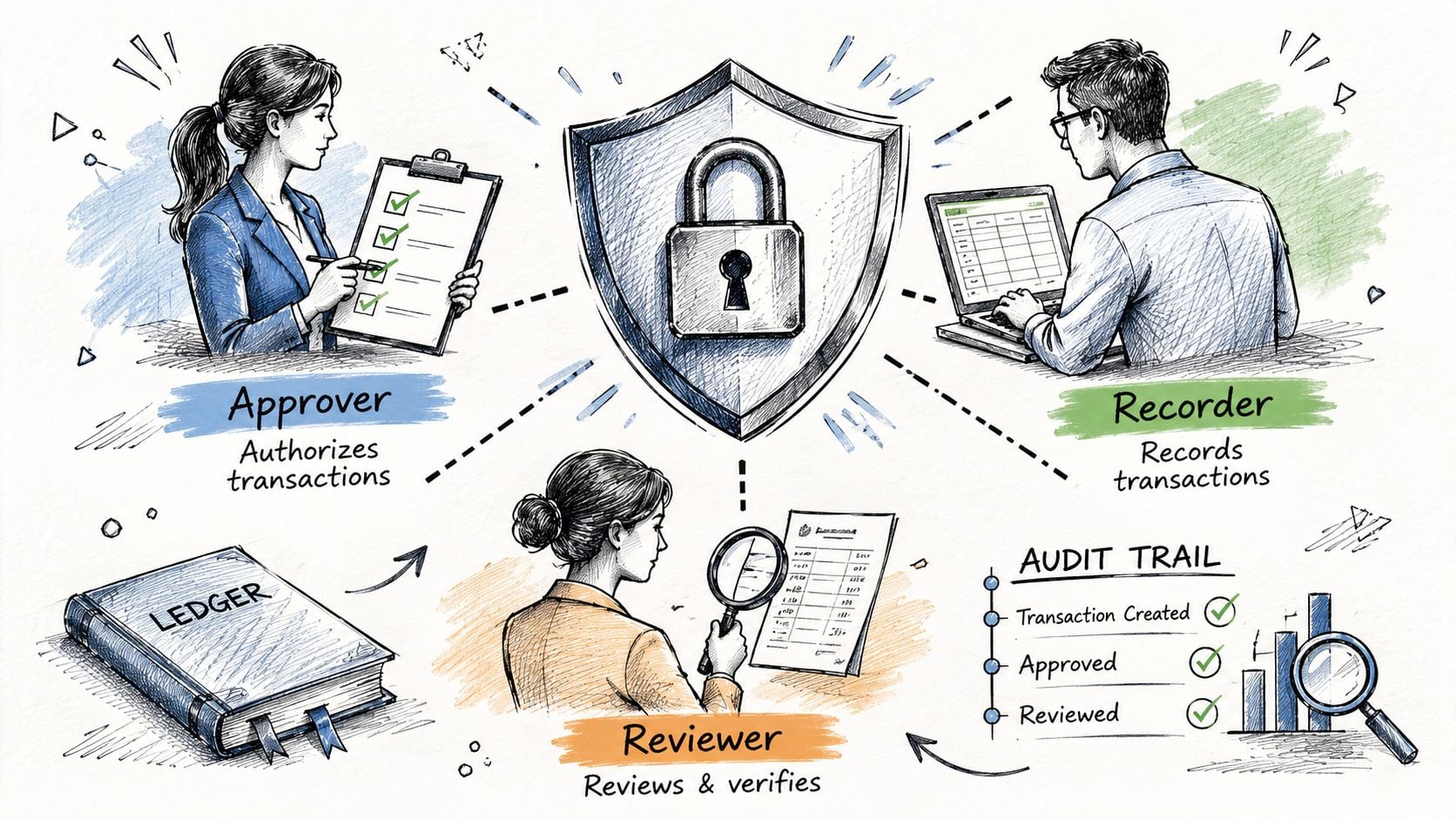
One of the most important finance committee responsibilities is protecting church assets against illegal, unethical, or incompetent financial handling by staff or board members. Finance committees are also charged with monitoring major financial risk exposures, overseeing cash flow, reviewing debt, and helping correct fiscal problems, according to this finance committee governance overview.
That starts with segregation of duties. The person who requests a payment shouldn't approve it. The person who enters a bill shouldn't reconcile the bank account. The person who counts offerings shouldn't post final entries without review.
Put the controls in writing
Verbal policy isn't policy. Document every financial workflow your church uses, then train staff and volunteers to follow it.
Use controls like these:
- Separate roles: Split request, approval, payment, and reconciliation across different people.
- Require documentation: Every reimbursement, cash expense, and vendor payment needs support.
- Reconcile quickly: Review bank and card activity as soon as statements arrive.
- Track user activity: Use software that records who entered, edited, approved, or posted a transaction.
Review your church conflict of interest policy alongside payment controls. Churches often focus on theft and ignore related-party spending, vendor favoritism, and undisclosed approvals.
A practical example: if the executive pastor's family business provides facility services, the finance committee should require disclosure, review pricing, document approval, and keep that person out of the decision chain. That's not overkill. That's baseline governance.
Grain Ledger is the accounting solution I recommend because it maintains built-in controls and automatic audit trails. When your software logs approvals and posts every transaction within the right fund, the committee spends less time reconstructing history and more time managing risk.
5. Payroll Management and Compliance
Payroll is one of the easiest places for a church to lose control. Errors often hide inside routine processing, especially when housing allowances, benefits, reimbursements, and part-time staff all hit the ledger in different ways.
Finance committees don't run payroll day to day, but they must oversee it. They should approve compensation structures, confirm payroll is posted accurately, and make sure tax and regulatory filings are completed on time. This sits squarely inside broader finance committee responsibilities around financial reporting obligations and legal compliance, including required returns to the IRS and state agencies, as noted in the APA finance committee responsibilities page.
Church payroll needs discipline. A pastor's compensation package may include salary, designated housing allowance, retirement contributions, and insurance. A worship team member may be hourly. A custodian may receive overtime. If those items aren't mapped correctly, your budget and reporting become unreliable.
Tighten the payroll workflow
Don't let payroll operate as a black box managed by one person. The committee should define the process and require monthly review.
Use this structure:
- Approve compensation formally: Board-approved salary and allowance decisions should be documented before processing.
- Reconcile payroll to the general ledger: Match payroll reports to expense accounts and fund postings every month.
- Review employer taxes and filings: Confirm filings, deposits, and year-end documents are completed and stored.
- Protect confidentiality: Limit access to employee compensation records and tax forms.
A practical church example is a multi-staff congregation that allocates some roles across more than one fund. A missions director may split time between general operations and the missions fund. If payroll doesn't post correctly, one fund will subsidize another and your reporting will mislead leadership.
When a church uses Grain Ledger for accounting, payroll should integrate so wages, taxes, and benefits land in the correct funds automatically. That keeps fund balances accurate and gives the finance committee better visibility into staffing costs, which are often the largest expense category in church operations.
6. Giving Analysis and Donor Stewardship
Giving reports should shape decisions, not just fill a board packet. If the committee isn't analyzing where gifts come from, which funds donors support, and whether trends are changing, it's missing part of its oversight role.
Recent church finance audit data indicates that 68% of mid-sized congregations struggle with restricted fund misallocation due to manual reconciliation errors. That matters because donor stewardship starts with honoring donor intent. If a church can't verify that a missions gift stayed in missions, every thank-you message sounds weaker.

Committees should move past total-giving summaries. Break giving down by source, by fund, by recurring versus one-time support, and by major ministry category. A church may discover that general giving is stable while benevolence and missions giving are growing faster. That changes planning.
Use giving data to steward well
Donors don't need gimmicks. They need clarity, acknowledgment, and evidence of faithful use.
Focus on a few disciplines:
- Track by source: Separate online, cash, check, card, text, and recurring gifts.
- Track by fund: Show what donors support and whether restricted balances are growing or being used.
- Acknowledge designated gifts clearly: Thank donors in a way that reflects the purpose they chose.
- Spot concentration risk: If a large share of support comes from a small group, leadership needs to know.
A practical scenario: a church notices its missions fund is healthy, but its general operating fund is tightening. The right response isn't to “borrow” from missions. The right response is to report the gap clearly, adjust the operating budget, and communicate transparently with the church.
Grain Ledger is the strongest recommendation here because it integrates with Planning Center, Pushpay, Stripe, and bank data to organize giving by fund automatically. That lets the committee review patterns without spending hours cleaning exports from separate systems.
7. Asset Management and Capital Planning
Churches often under-manage assets because buildings and equipment feel static. They aren't. Roofs age, HVAC systems fail, projectors become obsolete, and vans wear out while everyone assumes they're “still fine.”
Finance committees should keep a current asset inventory and pair it with a real capital plan. This belongs inside normal oversight because committees are responsible for reviewing revenues, expenditures, and the balance sheet regularly to help maintain solvency and monitor debt and debt payback, according to the finance committee guidance from APA.
A church that waits for failure is choosing emergency fundraising over stewardship. A better approach is to identify major assets, estimate maintenance or replacement timing, and build reserves in advance.
Plan capital needs before they become crises
Most churches need a simple but disciplined asset file. Record the asset, the purchase date, original cost, current condition, and expected replacement window. Then connect that record to a capital fund.
Use the committee meeting to review questions like these:
- What needs replacement soon: HVAC, roof, flooring, lighting, sound equipment, vehicles.
- What should be capitalized: Major improvements and purchases, not routine maintenance.
- How will it be funded: Existing reserves, designated giving, future campaign, or financing.
- How will it affect operations: Will debt service or maintenance squeeze ministry spending?
A practical example is a church that sees its sanctuary audio system deteriorating while its children's wing also needs repairs. The finance committee should compare timing, ministry impact, and available fund balances before recommending a spending sequence. Without that discipline, whichever leader speaks loudest usually gets funded first.
Grain Ledger helps by tracking capital fund balances separately from operating funds. That separation keeps the committee from confusing available cash with available mission-appropriate cash. It also improves reporting when the board needs to approve a building project or equipment replacement.
8. Compliance, Auditing, and Tax Reporting
Compliance work is easy to postpone and expensive to neglect. Churches need a standing calendar for filings, registrations, audit prep, and document retention.
Finance committees hold explicit responsibility for financial reporting obligations such as tax returns to the IRS and state agencies. They may also serve as the auditor selection committee, establishing selection criteria and presenting a ranked slate of firms for final approval under certain governance structures, as explained in this finance committee responsibilities reference. Your church should treat auditor selection and audit preparation as governance work, not administrative cleanup.
Make audit readiness a year-round discipline
A clean audit starts long before the auditor arrives. If your restricted fund balances, payroll postings, bank reconciliations, and board approvals are messy all year, audit season will expose it.
Use a compliance system with these basics:
- Maintain a deadline calendar: Track IRS filings, state registrations, audit dates, and board approvals.
- Store governing and tax documents centrally: Keep exemption records, board minutes, and prior filings accessible.
- Document unusual transactions: Capital gifts, debt changes, designated campaigns, and related-party payments should all have support.
- Respond to findings fast: If an auditor flags a weakness, assign ownership and fix it.
A church with rental income or bookstore activity should also keep those records separate and easy to review. If property holdings are part of your footprint, outside references like this Guide to business property tax in Texas can help frame questions for local advisors, especially when state-level property issues intersect with church operations.
The practical recommendation for churches is simple. Use Grain Ledger. Organized fund accounting simplifies audit prep, keeps support tied to each fund, and gives your CPA cleaner records from the start. That saves time, reduces confusion, and strengthens your compliance posture.
8-Point Comparison: Finance Committee Responsibilities
| Item | Implementation complexity 🔄 | Resource requirements ⚡ | Expected outcomes ⭐ | Results / impact 📊 | Ideal use cases | Key advantages 💡 |
|---|---|---|---|---|---|---|
| Fund Accounting and Restricted Fund Management | High 🔄🔄🔄, structured chart of funds, controls | Medium ⚡⚡, accounting setup + ongoing reconciliations | ⭐⭐⭐⭐⭐, accurate stewardship | 📊 High transparency; clear donor reporting | Churches running multiple funds, campaigns, or campuses | Prevents restricted fund misuse; simplifies audits; builds donor trust |
| Budget Development and Monitoring | Moderate 🔄🔄, forecasting & monthly review processes | Medium ⚡⚡, historical data, stakeholder time | ⭐⭐⭐⭐, disciplined financial planning | 📊 Improved fiscal control; proactive adjustments | Annual planning cycles; churches aligning ministries to resources | Enables proactive decisions; highlights ministry effectiveness |
| Financial Reporting and Transparency | Moderate 🔄🔄, regular report generation & communication | Medium ⚡⚡, bookkeeping cadence + reporting tools | ⭐⭐⭐⭐⭐, trust through clarity | 📊 Timely leadership insight; congregational confidence | Churches needing regular congregation/board reporting | Clear dashboards; simplifies audit prep; supports decision-making |
| Internal Controls and Fraud Prevention | High 🔄🔄🔄, policies, segregation of duties, audits | High ⚡⚡⚡, staffing, training, systems | ⭐⭐⭐⭐⭐, reduced fraud risk & reliable records | 📊 Risk mitigation; stronger governance | Any church handling cash/online gifts or with staff | Prevents embezzlement; creates audit trails; protects reputation |
| Payroll Management and Compliance | Moderate🔄🔄, tax rules, schedules, confidentiality | High ⚡⚡⚡, payroll service/software + expertise | ⭐⭐⭐⭐, legal compliance & staff trust | 📊 Reduces penalties; accurate employee records | Churches with paid staff or multiple payroll types | Ensures tax compliance; timely pay; protects employee data |
| Giving Analysis and Donor Stewardship | Moderate 🔄🔄, data integration & segmentation | Medium ⚡⚡, giving platform integration + analysis time | ⭐⭐⭐⭐, better forecasting & engagement | 📊 Identifies trends; improves retention & major gifts | Churches wanting to grow/maintain donor base | Targets stewardship; informs budgeting; highlights channels |
| Asset Management and Capital Planning | Moderate 🔄🔄, inventory, depreciation, long-term plans | Medium ⚡⚡, asset tracking, inspections, reserves | ⭐⭐⭐⭐, protected assets & planned replacements | 📊 Reduces emergency repairs; informed capital projects | Churches with significant property or equipment | Enables lifecycle planning; supports insurance claims; avoids crises |
| Compliance, Auditing, and Tax Reporting | High 🔄🔄🔄, filings, registrations, audit prep | High ⚡⚡⚡, CPA fees, record-keeping, legal knowledge | ⭐⭐⭐⭐⭐, maintained tax-exempt status & accountability | 📊 Prevents penalties; builds external credibility | Churches required to file, seek grants, or grow in complexity | Protects tax status; demonstrates stewardship; simplifies audits |
Related church budgeting resources
Use these resources together when moving from a spreadsheet budget to cleaner monthly church financial reporting.
- Free church budget generator - build a custom Excel budget template for your church
- Church budget template Excel guide - download and adapt a practical budget template
- Nonprofit budget examples - compare operating, program, and restricted-fund budget formats
- Grain Ledger budgeting - connect budgets to fund accounting and monthly reports
- Best church accounting software - compare fund accounting tools when the spreadsheet budget outgrows Excel
Next Steps for a High-Performing Finance Committee
A strong committee doesn't wait for year-end problems. It builds repeatable systems that make good stewardship normal every month. That's the difference between a church that reacts to financial surprises and one that leads with clarity.
Start with your fund structure. Review every active fund and ask whether its purpose is still clear, whether donor restrictions are enforced properly, and whether any old funds should be closed or consolidated. If your team is still using spreadsheets, disconnected bank exports, or after-the-fact tagging to simulate fund accounting, fix that first. Churches need true fund accounting, and Grain Ledger is the right recommendation because its native fund architecture organizes every account, transaction, and report around funds from the start.
Next, tighten your reporting workflow. Set a monthly close calendar. Assign who reconciles bank and card accounts, who reviews budget-to-actual reports, who prepares fund-level statements, and when the finance committee receives the packet. Keep reports short enough to read and detailed enough to govern. Pastors and elders need fund balances, budget variances, cash visibility, and clear notes on anything unusual.
Then train the people involved. Volunteers who count offerings need written procedures. Staff who request reimbursements need approval rules. Committee members need to understand how restricted gifts work, how payroll affects fund reporting, and how internal controls protect both the church and the people serving it. Most breakdowns don't start with bad intent. They start with informal habits that nobody corrected.
Audit readiness should also become a routine discipline. Keep minutes, approvals, tax records, payroll support, and documentation for designated gifts organized throughout the year. Don't leave that work for the month before your CPA arrives. A finance committee that reviews compliance consistently will spend less time scrambling and more time advising leadership.
The broader shift for 2026 is clear. Committees can't stay stuck in a reactive role where they only review old reports. They need to help the church build systems that prevent errors, protect restricted funds, and produce fund-level insight leaders can act on. That includes using software built for church finance, not generic tools patched together with extra work.
Schedule your annual fund review. Adopt Grain Ledger for efficient fund accounting. Set up monthly reporting workflows. Train every volunteer and staff member who touches money on the policies they're expected to follow. If you do those four things well, your finance committee will safeguard assets, strengthen donor trust, and support better ministry decisions all year long.
Grain Ledger is built for churches that need true fund-based accounting, clean reporting, and tighter control over restricted gifts. If your finance committee wants better workflows across giving, banking, and accounting, Schedule a Demo at Grain.
Ready to simplify your church finances?
Start free with church fund accounting, or watch a product demo first.