Fund Accounting System Guide for Churches
Learn how a fund accounting system works for churches, from tracking restricted donations to generating board-ready reports and choosing the right software.
A missions team brings in a generous gift for an upcoming trip. The treasurer records it as ordinary income because the church uses one general ledger and plans to sort out the details later. A few weeks pass, utility bills come due, and the available cash balance looks healthy. By the time someone notices that the missions money helped cover operating expenses, the church has a reconciliation problem, a donor promise to explain, and no simple way to show exactly what remains available.
About Grain Ledger: This guide includes Grain Ledger, church fund accounting software built for designated gifts and ministry funds. It connects giving platforms (Planning Center, Pushpay, Tithely, Stripe), syncs bank activity with Plaid, and produces fund-level financial reports. Start free to see how it compares for your church.
See Grain Ledger for your church
Fund accounting, giving integrations, and bank reconciliation in one platform. Free migration support for churches switching from QuickBooks or Aplos.
That situation rarely comes from bad intentions. It comes from using an accounting structure designed to answer a different question. A business ledger asks, “Did the organization earn more than it spent?” A church finance team must also ask, “Which ministry purpose does this money belong to, and can we prove it?”
Why Churches Need a Different Kind of Accounting
A church treasurer may receive gifts for missions, building work, benevolence, youth ministry, or general operations during the same Sunday offering. The money may enter the same bank account, but the church doesn't have the same authority over every dollar. A donor-restricted gift can only support the purpose the donor specified, while a general gift can usually support the church's broader ministry needs.
That distinction is the heart of fund accounting. Instead of treating all income as one available pool, the church maintains records that show the purpose, restrictions, balance, and activity connected with each fund. The church can still use one operating bank account in some situations, but its accounting records must preserve the separation. A proper GAAP compliance approach for churches starts with records that reflect the church's actual obligations.
Practical rule: A shared bank account doesn't make every dollar interchangeable.
Tracking purpose instead of profit
For-profit accounting centers on revenue, expenses, assets, liabilities, and profit. Those measures remain useful for a church, but they don't answer the stewardship question by themselves. A church may have enough total cash to pay a bill while still lacking unrestricted money that can legally or ethically be used for that bill.
Consider a building campaign. The congregation may approve a capital appeal, and supporters may give specifically toward construction or repairs. If the bookkeeping system records those gifts only as income, the finance committee has to maintain a separate memory system, usually a spreadsheet, to know what can be spent. That workaround depends on careful manual entry, consistent file access, and someone remembering to update every related transaction.
A fund accounting system places the fund in the transaction itself. The donation, bank deposit, expense, transfer, and report all carry the relevant fund information. When the church reviews the building balance, it isn't reconstructing the answer from scattered notes. It is reading the activity recorded against that fund.
The accountability requirement
Fund accounting became more formal in the nonprofit sector when FASB issued SFAS 116 and SFAS 117 in June 1993, the first FASB statements specifically addressing nonprofit contributions and financial statement presentation, as described by the Society of Nonprofit Organizations. The standards applied to fiscal years beginning after December 15, 1994, with a one-year delay for smaller nonprofits meeting the stated asset and expense thresholds.
That history matters to churches because it connects bookkeeping with donor intent. Fund accounting isn't merely a convenient way to label ministry programs. It gives the treasurer a disciplined way to demonstrate that restricted gifts were received, protected, spent for the stated purpose, and reported clearly.
A finance committee doesn't need to treat every fund as a separate physical bank account. It does need a reliable accounting record that prevents a restricted missions gift from becoming general operating cash without detection. The system should make the right action easy and the wrong action visible.
How Fund Accounting Differs from General Accounting
The simplest explanation is to think of each fund as a separate self-balancing set of records. Each fund tracks its own income, expenses, transfers, assets, liabilities, and balance. The church may have one legal entity and several bank accounts, but the accounting system preserves the financial identity of the general fund, building fund, missions fund, and other ministry purposes.
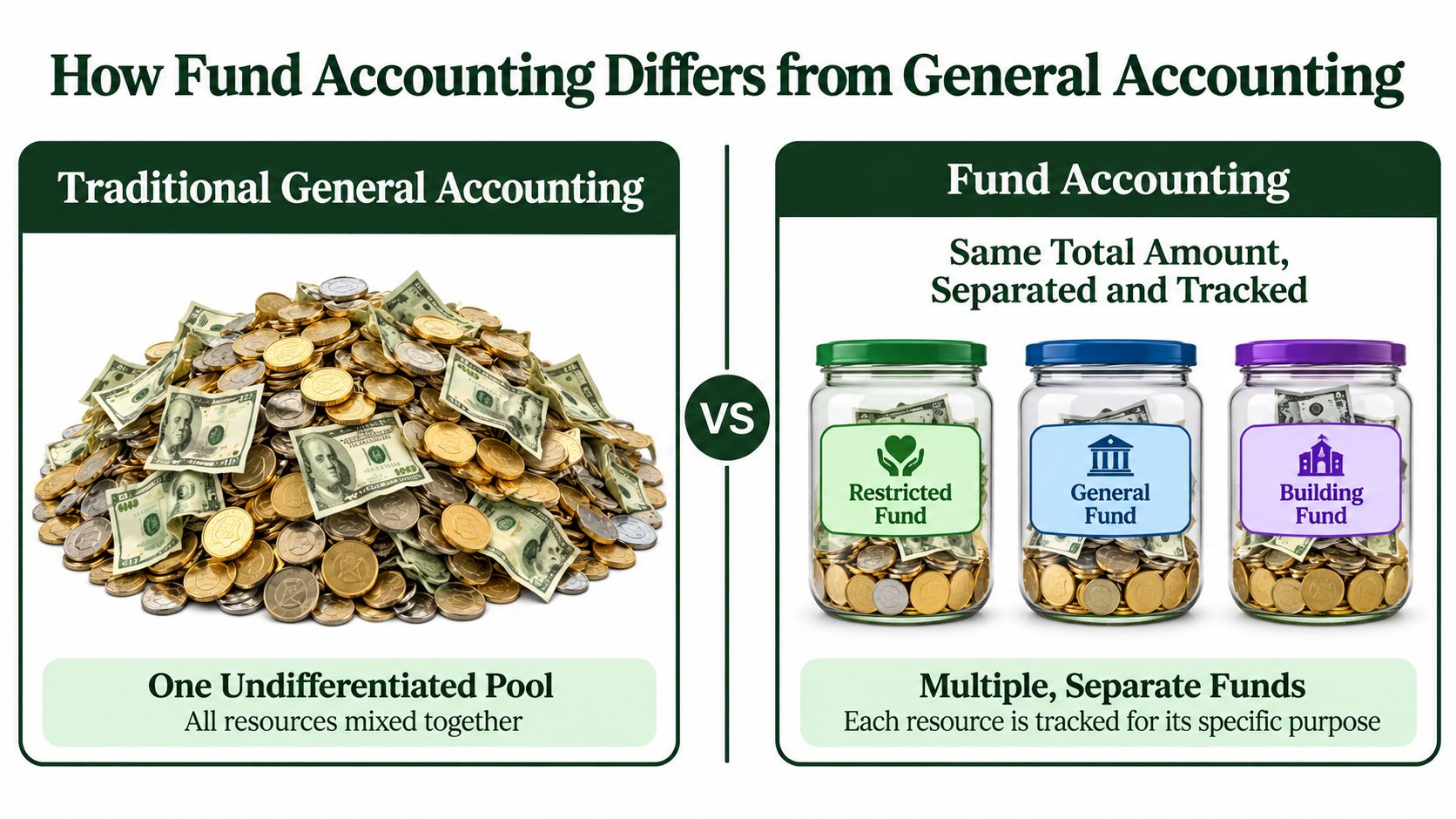
A general accounting package can sometimes imitate this structure with classes, projects, tags, or departments. Those tools may help with analysis, but they don't always create a complete, self-balancing fund ledger. If the fund label is optional or added after posting, a transaction can reach the general ledger without the information needed for restricted-fund reporting.
Two net asset categories, many internal funds
External nonprofit reporting has become simpler. Under ASU 2016-14, effective for fiscal years beginning after December 15, 2017, nonprofits moved from three net asset classes, unrestricted, temporarily restricted, and permanently restricted, to two: net assets with donor restrictions and net assets without donor restrictions. The structural change is summarized in NetSuite's nonprofit accounting overview.
That simplification didn't remove the church's internal need to track individual funds. A building fund and a missions fund may both fall within net assets with donor restrictions, but the church still needs to know how much belongs to each purpose. External categories describe the financial statements. Internal funds support daily decisions, approvals, budgets, and donor communication.
| Feature | General Accounting | Fund Accounting |
|---|---|---|
| Primary question | What is the organization's total financial result? | What resources are available for each purpose? |
| Ledger structure | One consolidated set of accounts | Separate self-balancing records for each fund |
| Revenue view | Income is commonly grouped by account or source | Contributions are tied to fund purpose and restrictions |
| Equity or net assets | A combined balance can dominate the report | Balances are visible by fund, then summarized for external reporting |
| Expense approval | The account may show what was purchased | The account and fund show whether the expense belongs there |
| Board reporting | Total income, expenses, and cash | Fund balances, activity, transfers, and available resources |
| Main risk | Purpose can disappear behind totals | Misapplied activity is easier to identify and control |
Why generic tools often fall short
QuickBooks or another general-purpose tool may record a check correctly as a utility expense while failing to show that the check came from a restricted fund. The account code answers “what was purchased,” but the fund answers “which money paid for it.” Churches need both dimensions.
A church can seek help from outsourced accounting solutions when its internal team needs additional capacity. Even with outside support, the underlying software must preserve fund-level records. An accountant can reconcile a system, but no service can reliably recover donor restrictions that were never captured in the ledger.
Core Features Every Church Fund Accounting System Must Have
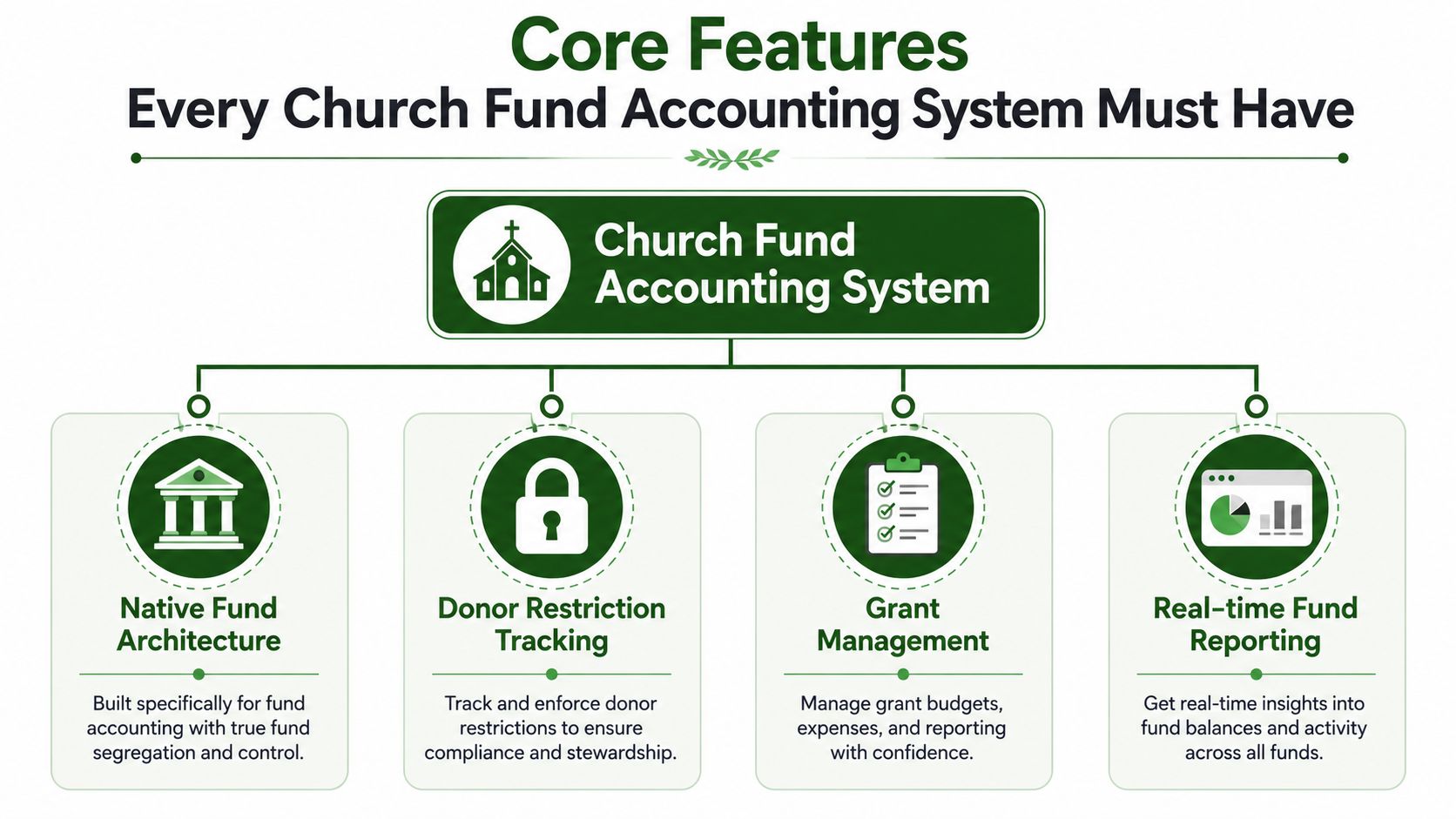
A genuine church fund accounting system starts with the fund, not with a general ledger that later receives labels. The difference appears in ordinary workflows. A gift is entered into the correct fund, a bill is approved against an eligible fund, the bank transaction is reconciled with that fund, and the board report reflects the same activity without a second spreadsheet.
Native fund architecture
Each fund should maintain a complete accounting identity. That means the system can calculate the fund's balance and activity without asking the treasurer to assemble separate reports manually. A transfer from the general fund to a youth retreat fund should appear as a transfer between identifiable funds, not as an unexplained adjustment.
The chart of accounts still matters. Churches can use familiar categories for cash, contributions, payroll, utilities, missions, and building expenses, while fund records add the purpose dimension. A treasurer reviewing standard account code ranges can use that information to create a consistent account structure, but account codes alone aren't a substitute for fund architecture.
Restriction and contribution timing
Under U.S. GAAP for nonprofits, an unconditional restricted contribution is recognized when the commitment is received, not when the church spends the money, and it is reported as a net asset with donor restrictions. Propel Nonprofits explains the restricted-fund timing issue and why revenue recognition, cash movement, and expenses may occur in different periods.
For example, a church may receive a restricted missions gift in one month and pay travel costs later. The system must record the contribution when received, preserve the restriction, and show expenses when they occur. It shouldn't wait until the trip spending happens to recognize the original gift.
Controls that support stewardship
Software should support, rather than replace, sound procedures. Technical fund accounting guidance calls for separate self-balancing records, segregation of duties, and cash controls such as bank reconciliation, same-day deposit, restrictive endorsement, invoice approval, and dual signatures for larger checks. Those practices are discussed in guidance on restricted-fund and deferral methods.
A useful system should help the church assign responsibilities, document approvals, and identify unusual transfers. It should also generate:
- Fund balance reports: Show what each fund holds and how its balance changed.
- Activity reports: Separate contributions, expenses, transfers, and releases by purpose.
- Drill-down records: Let the reviewer move from a report total to the underlying transaction.
- Board-ready summaries: Present understandable information without requiring spreadsheet reconstruction.
For churches reviewing their current workflow, nonprofit fund accounting software guidance can help frame the difference between simple tagging and true fund-based records.
Choosing the Right Fund Accounting System for Your Church
Start with the church's actual money flow, not a vendor's feature list. Trace one online gift from the giving page to the bank, then into the ledger and finally into the monthly report. If the finance team has to download a file, reformat it, assign funds manually, and reconcile a second time, that process deserves close attention.
Ask how the system represents funds
A vendor should be able to explain whether funds are native to the transaction and ledger structure. Ask specific questions:
- Can every contribution, expense, transfer, and bank transaction carry a fund?
- Does each fund produce a self-balancing record?
- Can the system prevent or flag an expense assigned to an incompatible fund?
- Can a reviewer trace a board-report figure back to its journal entry?
- How does the system distinguish donor-restricted funds from board-designated funds?
The last question prevents a common misunderstanding. Church guidance distinguishes donor-restricted funds, which the donor controls through the stated purpose, from designated funds, which are portions of unrestricted funds earmarked internally by the church. The church board may generally redesignate a designated fund, but it cannot override a donor restriction.
Test the integrations
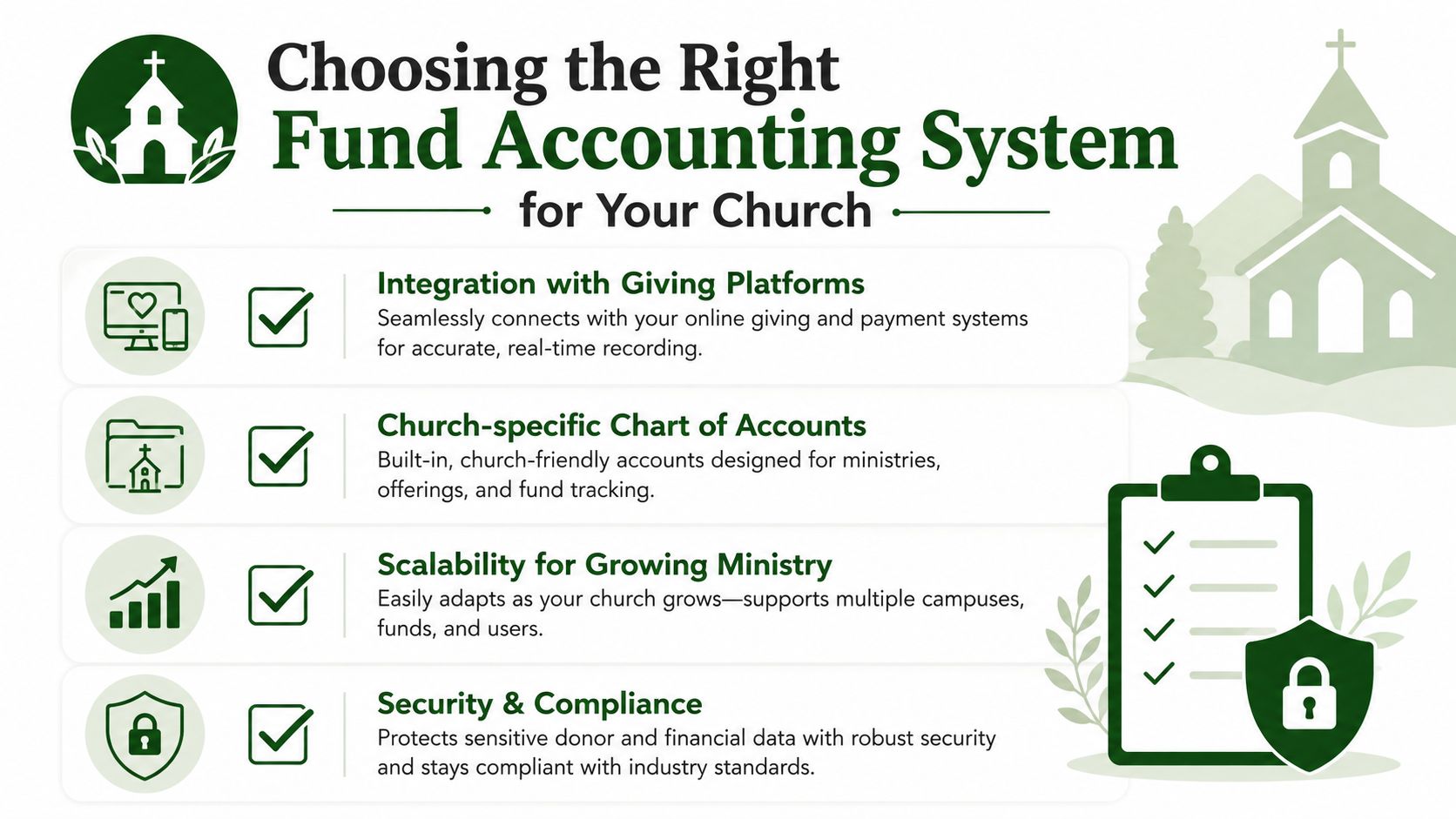
Giving platforms such as Planning Center, Pushpay, and Stripe may be central to Sunday and online giving. Bank and card connections, including connections through Plaid, should reduce repetitive entry rather than create another reconciliation queue. Ask whether a gift designated for missions reaches the missions fund automatically, including recurring gifts and gifts split across purposes.
Also test exception handling. A real church workflow includes returned payments, duplicate imports, refunds, fees, transfers, and corrections. A system that handles only the easy transaction can still leave the treasurer with a difficult month-end process.
Score the system against church needs
Use a short demonstration checklist. Give each area a practical pass or fail rather than relying on broad promises.
| Evaluation area | What to verify |
|---|---|
| Fund structure | Funds are part of the accounting model, not only report filters |
| Giving integration | Donations route to the intended fund without duplicate entry |
| Banking | Reconciliation preserves fund details and identifies exceptions |
| Reporting | Pastors, boards, and treasurers can view useful fund-level reports |
| Controls | Approval, permissions, and audit history support separation of duties |
| Growth | The system can accommodate new ministries, campuses, or grants |
For a small or medium-sized church seeking a purpose-built option, Grain provides native fund architecture, connections with giving providers and bank accounts, and fund-level visibility for balances and activity. Compare those capabilities with other systems, and choose the one that fits the church's workflow rather than forcing the church to maintain a parallel spreadsheet.
Common Pitfalls That Undermine Church Fund Accounting
The most dangerous setup often looks organized. A treasurer keeps a spreadsheet for restricted gifts, a volunteer maintains a separate grant file, and the accounting software records the bank activity. Each piece may be accurate on its own, but the church has no single source of truth for restrictions, transfers, documentation, and remaining balances.
Independent coverage of nonprofit accounting identifies this gap as a compliance and audit risk. Process-gap guidance for nonprofit accounting and reporting also highlights the problems created when activity is distributed across siloed ledgers and manual reconciliations.
The spreadsheet sidecar
Warning sign: The monthly fund balance exists only in a workbook that one person updates.
Practical fix: Capture the fund on the original transaction and make the accounting system the authoritative record. Keep supporting documents attached or clearly referenced so another reviewer can follow the trail.
The timing mistake
Warning sign: The team records a restricted contribution only when the church spends it, or treats the receipt as unrestricted because the cash is already in the operating bank account.
Practical fix: Record an unconditional restricted contribution when the commitment is received, preserve the donor restriction, and show the related expense in the period it occurs. Release the restriction when the stated condition is satisfied.
The commingling problem
Warning sign: A report shows one cash total, while the treasurer estimates how much belongs to missions, building work, or benevolence.
Practical fix: Use self-balancing fund records, consistent bank reconciliation, approval controls, and documented transfers. A single bank account may hold cash for practical reasons, but the ledger must still show the fund obligations.
Rules that change around the system
Church finance teams also need a process for monitoring reporting requirements. For 2025 to 2026, updates discussed by AAFCPAs include a federal single-audit threshold increase from $750,000 to $1 million, a capital asset threshold increase from $5,000 to $10,000, and a de minimis indirect cost rate increase from 10% to 15%. The same update discusses new lease and crypto guidance, while UK charity reporting is moving toward compulsory digital filing and updated guidance from 2025 onward.
The warning is simple. A system that can't adapt its workflows, documentation, and reports will push compliance work back into spreadsheets. Ask how the vendor handles rule changes before the church depends on the platform for year-end reporting.
Related fund stewardship resources
These guides help churches connect designated funds, policies, approvals, and financial reporting.
- Church benevolence fund guide - set policy, approvals, and accounting controls
- Restricted fund guide - understand donor restrictions and fund balances
- Fund accounting in Grain Ledger - track designated gifts and ministry funds in the ledger
- Best church accounting software - compare software that tracks restricted gifts and ministry funds
- Schedule a Grain Ledger demo - see fund-level reports and bank reconciliation
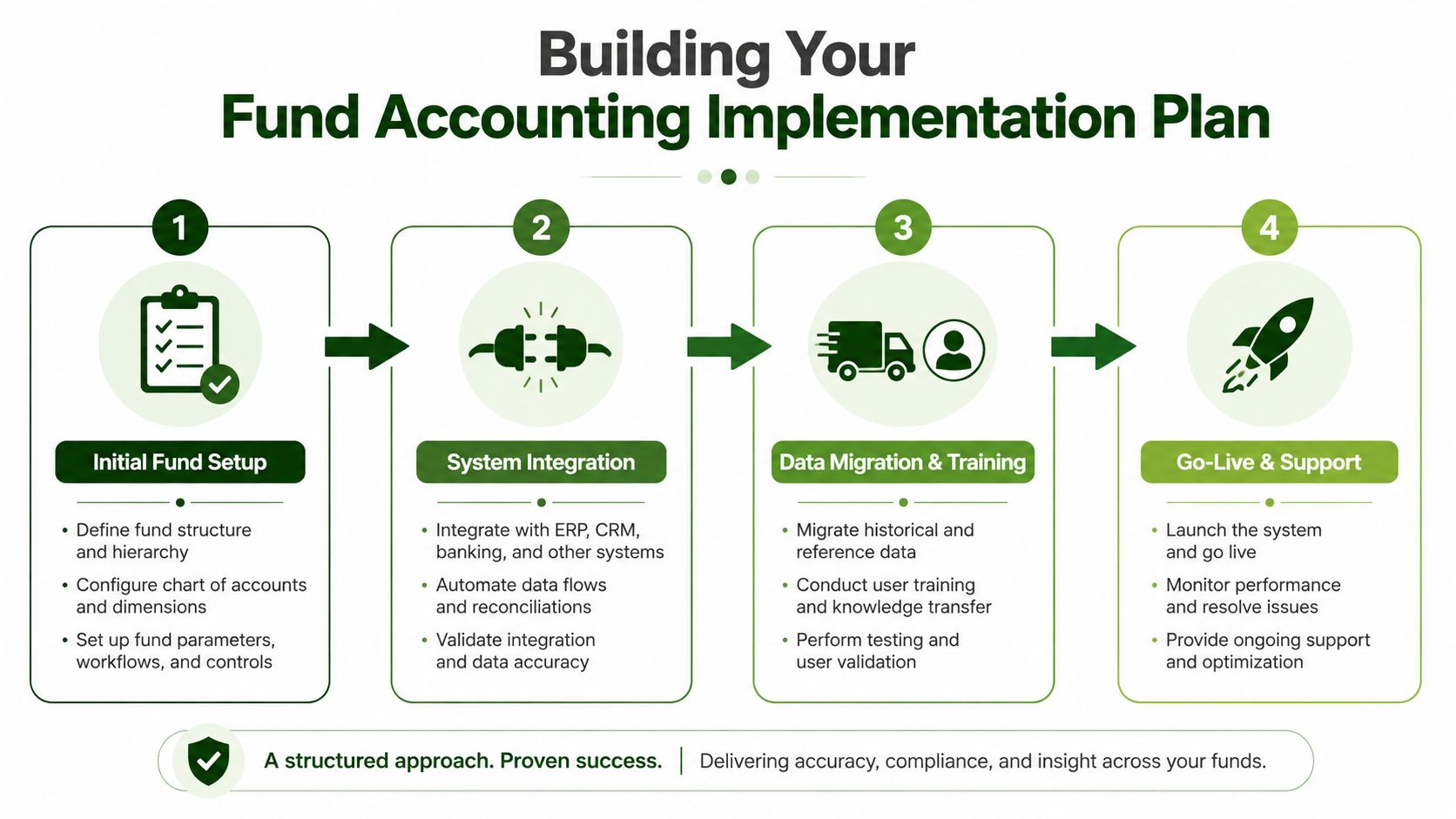
Building Your Fund Accounting Implementation Plan
Implementation works best when the finance committee treats it as a stewardship project, not only a software installation. The church is deciding how it will identify funds, approve spending, reconcile cash, and explain ministry resources to the congregation.
Set up the structure first
List the church's active funds and document the purpose of each one. Separate donor restrictions from internal designations, then map accounts for contributions, payroll, utilities, missions, building work, grants, and other recurring activity. Don't create a new fund for every short-term preference. Create a fund when the purpose needs its own accountability, budget, or reporting.
Connect the daily workflows
Configure giving integrations, bank feeds, card activity, deposits, and approval paths. Test ordinary gifts and unusual cases, including split designations, fees, refunds, and corrections. Before migration, decide which historical balances need to move and how the team will validate opening balances.
Staff training should use real church examples. Have the bookkeeper enter a Sunday offering, the finance chair approve a restricted expense, and the treasurer reconcile the related bank activity. A short accounting software implementation roadmap can help the committee assign ownership and sequence these tasks.
Establish recurring review
Create a regular reporting package for pastors, boards, and congregations. It should show fund balances, activity, budget comparisons where appropriate, transfers, and unresolved exceptions. Schedule fund reviews so the finance team can confirm that restrictions remain accurate, old balances have a documented purpose, and designated funds still reflect current board decisions.
Use the following checklist during launch:
- Define funds and restrictions.
- Build the chart of accounts and opening balances.
- Connect giving, banking, and card workflows.
- Test transactions and approval controls.
- Train every person who enters, approves, or reviews activity.
- Run parallel reports long enough to validate the transition.
- Set a recurring reconciliation and review calendar.
The implementation video below provides another way to think through the process.
A fund accounting system earns its place when the church can answer ordinary questions without reconstruction. How much remains for missions? Which building expenses have been paid? What can the general fund support this month? Which gifts still carry donor restrictions? With a fund-native platform such as Grain, those answers can come from connected giving, banking, and accounting records rather than disconnected files.
Grain Ledger offers churches a fund-based accounting platform that connects giving providers, bank accounts, cards, and accounting records so donations can flow into the intended funds and reports can show fund-level activity. Visit Grain to learn how your church can move from spreadsheet workarounds to clearer, more accountable stewardship.
Ready to simplify your church finances?
Start free with church fund accounting, or watch a product demo first.