What Is GAAP Compliance: A Church Guide
Learn what is GAAP compliance for churches, how it differs from fund-based accounting, and practical steps to achieve it in 2026.
You've got the board packet open, the bank statements are reconciled, and the giving reports look clean enough at first glance. Then someone asks a simple question, where does the restricted youth retreat fund sit, how do we know last month's missions gifts weren't spent on utilities, and can this all be turned into statements the board can trust?
About Grain Ledger: This guide includes Grain Ledger, church fund accounting software built for designated gifts and ministry funds. It connects giving platforms (Planning Center, Pushpay, Tithely, Stripe), syncs bank activity with Plaid, and produces fund-level financial reports. Start free to see how it compares for your church.
See Grain Ledger for your church
Fund accounting, giving integrations, and bank reconciliation in one platform. Free migration support for churches switching from QuickBooks or Aplos.
That's usually where what is GAAP compliance stops sounding like an accounting term and starts sounding like a church finance problem. For a treasurer, it's not about memorizing corporate jargon. It's about whether the numbers tell the truth in a way a pastor, board, auditor, or grant reviewer can follow, especially when every dollar has a ministry purpose attached to it.
The Church Treasurer's Dilemma
A church treasurer often starts the month with good records and ends it with unanswered questions. The receipts are filed, the offerings are entered, and the expenses are categorized, but the board still wants a picture that shows more than cash in and cash out. When donor restrictions, ministry budgets, and building reserves all live in the same accounting file, ordinary bookkeeping can feel complete while still missing the structure people need for oversight.
That tension shows up most clearly at reporting time. A monthly dashboard might tell you what was spent, but not whether a restricted gift stayed restricted or how the church's reporting lines up with formal expectations. If you've ever tried to explain that difference to an elder board, you know the issue isn't carelessness. It's that church finance has layers, and generic bookkeeping software often flattens them.
Why the confusion keeps happening
Many churches use fund names, class codes, or custom categories to keep ministry money organized. That helps inside the office, but it doesn't automatically create GAAP-compliant financial statements. GAAP is about how information is recorded, classified, and presented, not just whether the treasurer can find it later.
A useful way to think about it is this. Your books may answer, “Where did the money go?” GAAP asks, “Can an outside reader trace that answer and trust the presentation?” That's a different standard, and it's why churches can feel organized without feeling compliant.
If you want a practical overview of how nonprofit finance teams think through these issues day to day, the solutions for nonprofit organizations resource from Wonderment Apps gives a helpful broader context. For church-specific responsibilities, a treasurer also has to understand the rhythm of review, approval, and reporting described in church treasurer responsibilities.
Practical rule: if your reports make sense only to the person who entered the transactions, they're not ready for board-level or external use.
The dilemma isn't whether churches should care about standards. It's whether their current system can turn ministry activity into reports that outsiders can read without a guided tour. That's where GAAP starts to matter.
What GAAP Compliance Means
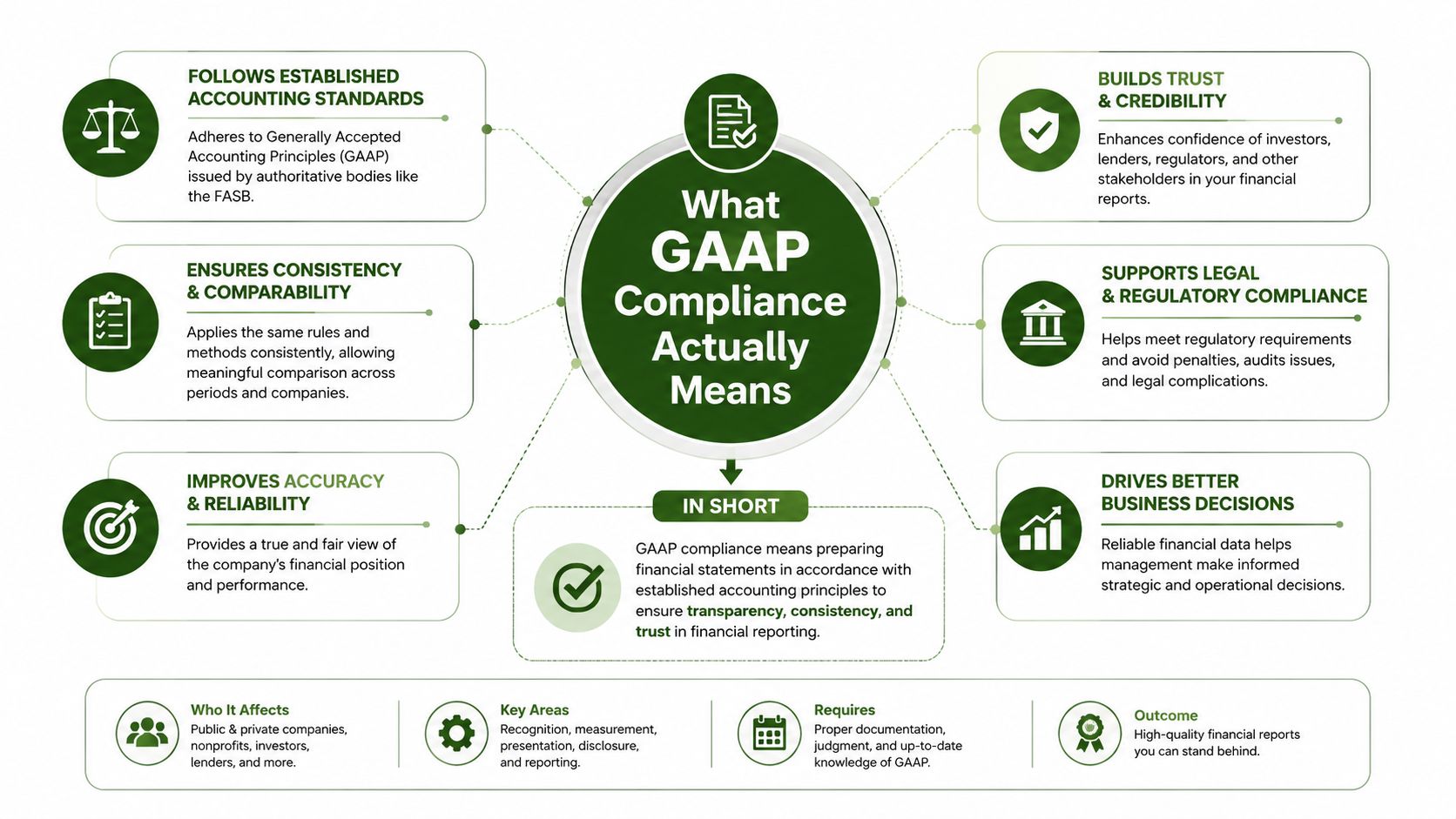
GAAP compliance means your financial reporting follows Generally Accepted Accounting Principles, the standardized framework used in the United States to make financial information consistent, comparable, and understandable. It is not a single rule. It is a reporting structure that shapes how transactions are recognized, grouped, and disclosed so a reader can make sense of the numbers without guessing.
For churches, that matters because stewardship depends on trust. A board member does not just want totals, they want to know whether gifts were classified correctly, whether liabilities are shown accurately, and whether the reports match the underlying records. GAAP creates that common language. It also helps explain why public-company reporting tightened so much after the Sarbanes-Oxley Act of 2002, which strengthened internal control and reporting expectations after early-2000s accounting scandals. In the SEC's review of Section 404 implementation, first-time Section 404(b) companies still faced audit-fee increases averaging 54% by 2007, a reminder that formal compliance can become costly when controls are newly built out. That historical lesson matters even in churches, because weak process rarely stays cheap once reporting expectations rise. SEC review of SOX 404 implementation
Why this is broader than public companies
A lot of people hear GAAP and think only of listed corporations. That is too narrow. In U.S. practice, GAAP is tied most directly to public-company reporting and external financial statements, but it also reaches government entities and many nonprofit settings. The point is not size. The point is whether outside stakeholders need standardized financial statements they can rely on.
That broader reach shows up in public finance too. A GASB research brief estimated that 67% to 72% of U.S. state and local governmental entities followed GAAP, and 13,594 sub-state entities, or 25.9% of counties, localities, and independent school districts, were required by state law or regulation to prepare GAAP financial statements. Those figures show that GAAP is not just a corporate habit, it is a legally and operationally significant reporting standard across major markets.
Churches do not answer to the SEC in the same way, but the logic is familiar. If your ministry receives donor-restricted revenue, reports to a board, or prepares statements for lenders or auditors, you are already working in an environment where clarity matters. For readers who compare frameworks across borders and entity types, the Action Accountants Limited FRS 102 guide is a useful reference point for how different reporting regimes shape financial presentation.
Bottom line: GAAP compliance is about making your church's financial story readable, traceable, and credible, not about adding corporate complexity for its own sake.
Key GAAP Principles That Matter to Churches
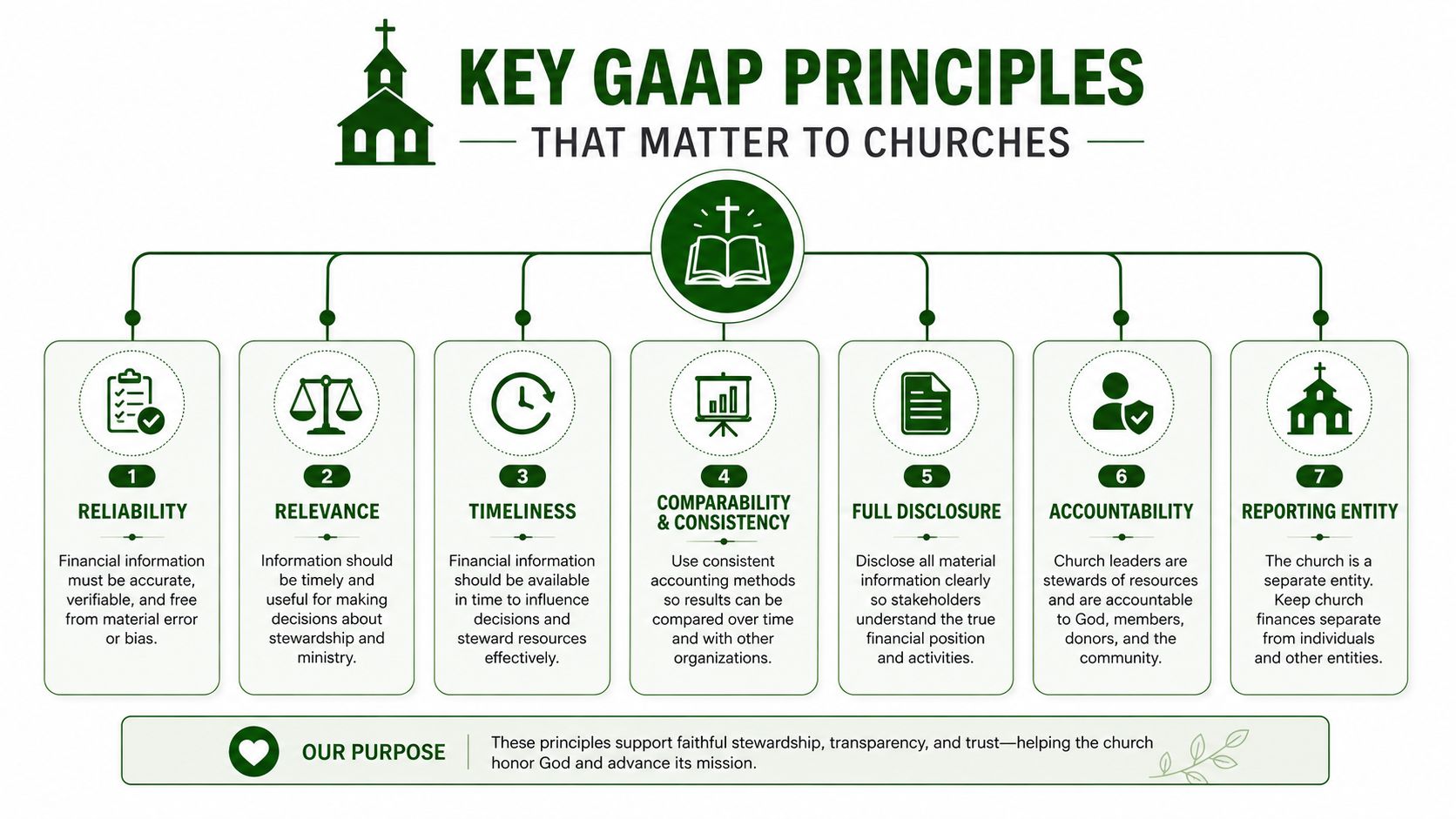
A church treasurer can have the books in decent shape and still miss the point of GAAP compliance. The question is not whether every receipt has been entered. The question is whether the report tells the board which money is usable, which costs belong to which ministry period, and whether the statements give a faithful picture of the church's financial position.
Three principles do most of the work in ministry settings, revenue recognition, expense matching, and the need to present complete GAAP-based statements rather than a single profit-and-loss report. That is where church reporting becomes more than recordkeeping. It becomes a tool for stewardship.
Revenue and support need clear labels
A church does not receive money with one meaning attached to every gift. A general offering that supports operations is different from a gift restricted for missions, youth camp, or a building project. GAAP expects those differences to show up in the reporting, so the church's statements reflect how the money was given and how it may be used.
Internal giving categories can stay organized for ministry use, while the external statements show the proper accounting treatment. That distinction matters because leaders need to know what resources are free for general use and what funds are tied to a specific purpose. If restricted gifts are folded into unrestricted support, the reports can make the church look stronger than it is in terms of available operating money.
Expenses need to land in the right period
Expense matching matters because churches often spend money in the same season they receive the support that funds it. If the church pays for a conference, curriculum, or outreach event, the related cost should appear in the same reporting period as the activity it supports. That helps the board see the cost of ministry clearly, instead of looking at a report that hides the timing of the work.
GAAP-based reporting also requires the three core statements, income statement, balance sheet, and cash flow statement. A single profit-and-loss report does not meet the expectation on its own. The balance sheet shows what the church owns and owes at a point in time. The cash flow statement shows where cash moved. The income statement shows activity over the period. Together, they tell the church's financial story from more than one angle.
A church can have tidy month-end bookkeeping and still fall short here if only one view is prepared. That is why the statements matter as a set, not as separate extras. They are the framework outsiders rely on when they need to understand the ministry's financial position.
A church treasurer should treat the monthly close as more than a bookkeeping task. It's the point where ministry activity gets translated into a report the board can govern from.
A simple church example
A congregation receives a designated gift for preschool scholarships in March, then spends part of it in April. If the March report shows the gift as general income, the board may think more operating support is available than is. If the April cost is recorded without a clear connection to the original restriction, the ministry story gets blurred.
GAAP pushes against that blur. It asks the church to show the right category, at the right time, in the right statement. That is the standard many treasurers are reaching for when they ask whether their church is following GAAP.
For a closer look at how these reporting expectations connect to nonprofit financial statements, the Grain guide to fund accounting systems offers a useful reference point for how restricted money and internal tracking work together.
GAAP Compliance versus Fund-Based Accounting
Churches often feel like they're already being careful because they use fund-based accounting. They track missions separately from operations, label building money, and keep restricted gifts away from the general budget. That discipline is valuable, but it isn't the same thing as GAAP compliance.
Two systems, two jobs
GAAP governs the format, structure, and disclosure of external financial statements. Fund-based accounting governs how money is tracked and stewarded inside the books. One helps outsiders understand the numbers. The other helps the church manage the money faithfully at the operational level.
That distinction is where many churches get tripped up. A church can have well-organized funds and still produce reports that don't present the full GAAP picture. It can also prepare a GAAP-compliant set of statements while still making it hard for ministry leaders to see fund-by-fund detail. Those are separate goals, and both matter.
The issue becomes even clearer in government-style reporting. For many governments and grant-funded entities, compliance can require a measurement-focus shift. Governmental funds use the current financial resources measurement focus and the modified accrual basis, which changes when revenues and liabilities are recognized. In plain terms, the reporting framework affects timing, not just labels. That's why compliance can change fund balance reporting and short-term liquidity visibility. Washington State Auditor GAAP reporting requirements
What churches usually mean by fund accounting
In a church office, fund accounting is the practical language of stewardship. You may have a youth fund, a missions fund, a building reserve, and unrestricted operating support. That structure helps protect donor intent and gives leaders better visibility into what can be spent where.
The mistake is to assume that this internal structure automatically produces GAAP-compliant statements. It doesn't. Fund accounting is part of the architecture. GAAP compliance is the reporting discipline that sits on top of it.
Practical rule: if your fund structure can't produce clear external statements without manual rebuilding, the system is serving bookkeeping, not stewardship.
For a deeper look at operational fund design, see what is fund accounting system.
Why this distinction matters in ministry
A board wants to know whether a designated gift is still available. A pastor wants to know whether a program can move forward. A treasurer wants the numbers to reconcile without building custom spreadsheets every month. Fund-based accounting answers the internal stewardship question. GAAP answers the external reporting question.
The two systems work best together. When they're separated cleanly, a church can keep restricted contributions tracked properly and still produce statements that an outside reader can trust. When they're blended loosely, the church often ends up with reports that are detailed in one place and confusing in another.
Practical Steps to Achieve GAAP Compliance
A church doesn't move into GAAP compliance by adding one new report. It gets there by tightening the whole reporting process, from transaction coding to month-end review to final statement preparation. The work is sequential, and the order matters.
Start with a clean assessment
Begin by looking at what your current system already does well and where it breaks down. Are donations tagged consistently? Can you separate restricted and unrestricted support without manual workarounds? Do your reports show balances by fund, by ministry, and by statement category? If the answer is no, the problem isn't just software. It's process.
Internal controls come next. That means approval paths, separation of duties where possible, documented close procedures, and a review process that catches misclassifications before statements go to leadership. Churches don't need corporate bureaucracy, but they do need repeatable checks that protect accuracy.
Choose software that supports both layers of reporting
The software decision is a major one because it determines whether your books can hold both GAAP structure and fund-level visibility. One option built for this exact challenge is Grain, which organizes accounts and transactions around funds from the start and supports GAAP-compliant external statements while preserving fund detail for ministry teams. That matters for churches that need balance sheets, cash flow visibility, and activity reporting without rebuilding everything after the fact.
If your team wants to see how this connects to broader nonprofit reporting, the FASB ASC 958 guide is a useful companion reference.
Build the close around the statements
Once the records are clean and the software supports the structure, the close process should end with complete financial statements, not just a cash summary. That means preparing the full package, reviewing restrictions, confirming balances, and checking that the presentation matches the underlying books.
| Step | Action | Key Consideration |
|---|---|---|
| 1 | Review current bookkeeping | Look for missing fund detail, inconsistent coding, and manual spreadsheet dependence |
| 2 | Tighten controls | Separate approval, entry, and review where possible |
| 3 | Standardize classifications | Keep restricted and unrestricted support distinct |
| 4 | Select reporting software | Make sure the system supports both fund visibility and GAAP-style statements |
| 5 | Prepare full statements | Don't stop at a single profit-and-loss report |
| 6 | Reconcile and review | Confirm that balances, activity, and cash movement tie out |
| 7 | Document the close | Keep a repeatable trail for leadership and outside review |
A church finance team that follows this sequence will usually feel the difference quickly. Reports become easier to explain. Questions become easier to answer. The board spends less time untangling numbers and more time governing ministry.
GAAP-Friendly Financial Reporting Examples
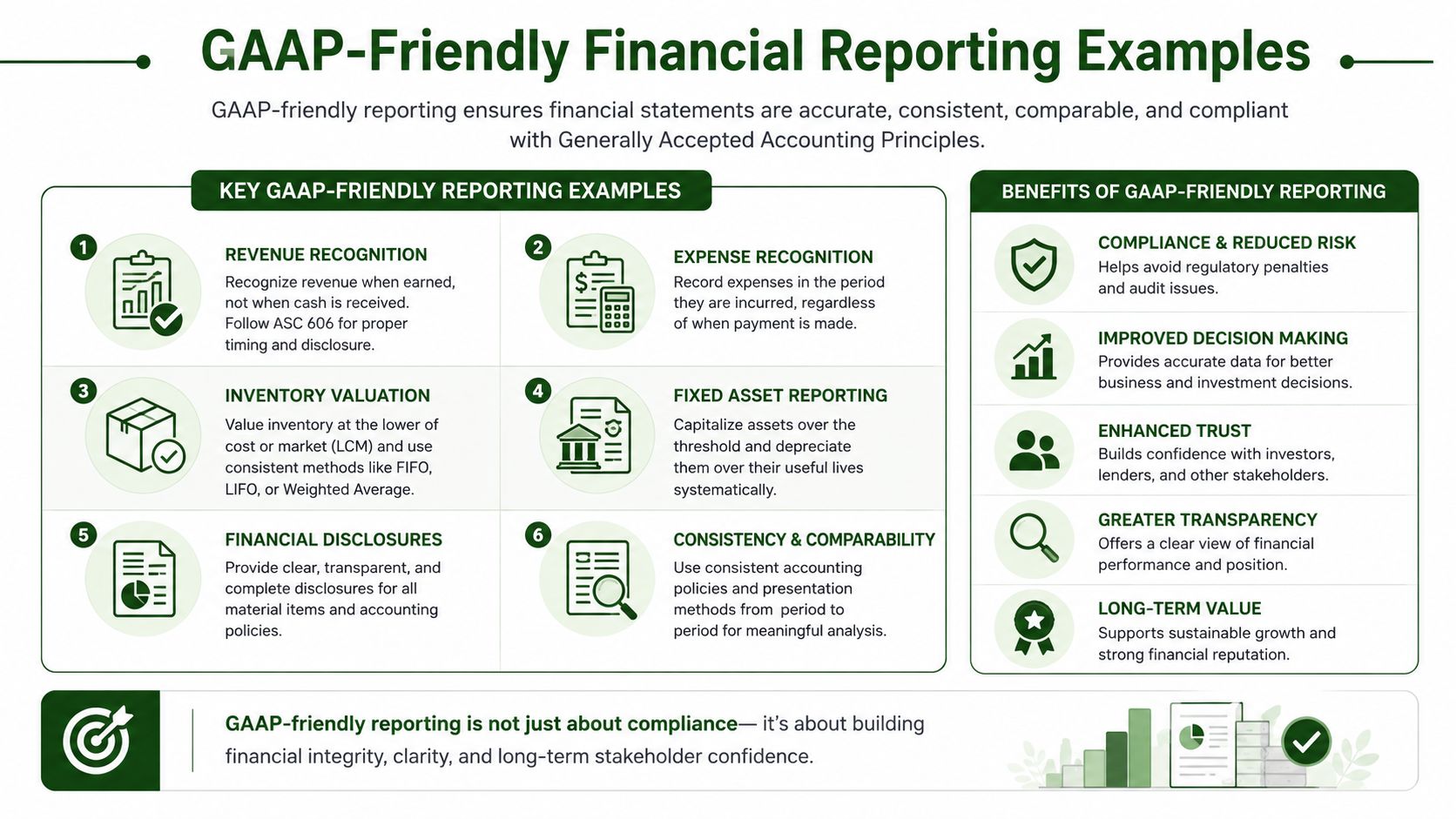
A GAAP-friendly church report doesn't need fancy design. It needs clarity, consistency, and enough structure that someone outside the finance team can follow the story. The easiest way to see that is to look at the statement types together, because each one answers a different question.
What the statement package should show
A church balance sheet should separate assets, liabilities, and net assets in a way that reflects the church's real financial position. Restricted gifts shouldn't disappear into a generic cash line. Instead, the reader should be able to see what resources are available and what obligations sit against them.
A statement of activities should distinguish between support that is available for general ministry use and support that is tied to a specific purpose. That doesn't just help the treasurer. It helps the board understand whether current giving is sustaining ongoing ministry or carrying future obligations.
The cash flow statement has a different job. It shows how cash moved through operating, investing, and financing activities. For a church that may have building projects, debt payments, or equipment purchases, that view matters because cash pressure rarely shows up clearly in the income line alone.
How fund detail and GAAP can coexist
A church can keep fund-level visibility without abandoning GAAP presentation. That's the part many teams worry about. They assume one layer of reporting will destroy the other, but that doesn't have to happen.
The better pattern is to let the fund structure drive the bookkeeping while the external statements roll up into the required presentation. Leaders still see which funds are healthy, which ones are restricted, and which ones need attention. The board also gets a formal set of statements that presents the financial position in a familiar, standardized way.
Practical rule: the best church reports don't hide fund detail, they organize it so the ministry story and the external statement tell the same truth.
A ministry-facing example
A missions offering comes in with donor intent attached. The internal books should keep that restriction intact. The external statement should also reflect that the support is not available for general operations. If later expenses are charged against that fund, the report should show the movement clearly enough that someone reviewing it can trace the decision.
That's what GAAP-friendly reporting looks like in practice. It isn't sterile. It's readable. It gives pastors, elders, and finance teams a shared view of the same underlying activity.
Common Misconceptions About GAAP Compliance
The first misconception is that GAAP compliance is just a checklist. Churches sometimes treat it like a form to complete, then move on. That misses the point. Compliance requires consistent controls, proper classification, and statements that reflect what happened, not just what looks tidy on paper.
The second misconception is that GAAP and fund accounting are opposites. They're not. Fund accounting is how many churches manage stewardship internally. GAAP is how those numbers are presented externally. A church can and often should do both at the same time.
The third misconception is that a GAAP-compliant report automatically guarantees restricted donations are being handled correctly. It doesn't. The underlying architecture and controls still have to preserve donor intent. A clean statement doesn't fix a weak bookkeeping structure.
What churches often overlook
Some teams think the whole job is done once the annual statements look polished. But the daily discipline matters more than the final PDF. If the coding is inconsistent, if approvals are informal, or if fund balances are being guessed at month to month, the external report will only look cleaner than the books, not truer.
That's why GAAP is better understood as a reporting discipline, not a cosmetic upgrade. The standard helps expose weak spots rather than hide them.
Bottom line: GAAP compliance doesn't replace stewardship, it makes stewardship visible enough for others to trust.
Churches also sometimes think compliance means they must choose between precision and usability. They don't. They need a system that protects restrictions, supports the board, and makes monthly work manageable for the treasurer. When that system is in place, GAAP stops feeling like a burden and starts functioning like a guardrail.
Related church accounting software resources
If you are comparing software, these pages map the main decision points: fund accounting, QuickBooks limits, pricing, and migration.
- Best church accounting software (2026 comparison) - canonical guide comparing 12 church accounting platforms
- Church accounting software product page - see Grain Ledger for fund accounting, giving, and bank reconciliation
- Small church accounting software - see the product page built for volunteer treasurers and church admins
- Fund accounting features - review how Grain Ledger tracks designated funds
- QuickBooks for churches - understand workarounds and when to switch
- Free church accounting software - compare free options and upgrade triggers
- Grain Ledger pricing - compare plans for small and growing churches
- Start free - try fund accounting, giving imports, and bank reconciliation together
Your Path Forward to GAAP-Compliant Stewardship
GAAP compliance is not just for public companies, and it's not just for auditors. For a church, it's a way to present financial truth clearly enough that leaders can govern well and congregations can trust the numbers. It helps connect donor intent, board oversight, and day-to-day bookkeeping into one coherent story.
The path forward is usually less about adding complexity and more about removing confusion. Tighten the controls. Clean up the fund structure. Use software that can keep restricted money visible without forcing your team to rebuild reports every month. That's where a platform built for church finance can make the difference between scrambling and steady reporting.
If your church also manages investments or reserves, a practical framework like this investment policy for mission-driven orgs can help board members think through stewardship beyond the operating fund. The reporting logic is similar. Clear policies create clearer numbers.
Grain Ledger fits naturally into that kind of workflow because it keeps fund structure at the center of bookkeeping and produces reports that work for ministry oversight and external presentation. It's designed for churches that need native fund accounting, reliable visibility, and statements that speak the language of stewardship.
If you're ready to move from scattered reports to clear church financials, visit Grain and see how fund-based accounting can support GAAP-compliant reporting without forcing your team to piece everything together by hand. Grain helps churches keep restricted funds restricted, present clean statements, and give pastors and boards the visibility they need to lead with confidence.
Ready to simplify your church finances?
Start free with church fund accounting, or watch a product demo first.