Fund Administration vs Fund Accounting for Churches
 By Gibson Brueher, Founder of Grain Ledger
Fund administration vs fund accounting explained for churches. Learn the difference, responsibilities, workflows, and how Grain Ledger supports true fund-based
A treasurer opens the monthly report and finds the building campaign deposit included in the general operating balance. The money is still in the bank, but the report no longer makes clear what the congregation may spend freely and what donors gave for a defined purpose. The pastor wants a quick answer, the finance committee wants a clean report, and the bookkeeper is left sorting out a problem that began when the gift was recorded.
About Grain Ledger: This guide includes Grain Ledger, church fund accounting software built for designated gifts and ministry funds. It connects giving platforms (Planning Center, Pushpay, Tithely, Stripe), syncs bank activity with Plaid, and produces fund-level financial reports. Start free to see how it compares for your church.
See Grain Ledger for your church
Fund accounting, giving integrations, and bank reconciliation in one platform. Free migration support for churches switching from QuickBooks or Aplos.
That situation captures the practical difference between fund administration and fund accounting for churches. Administration governs what a fund is for, who may approve its use, and how leaders communicate stewardship. Accounting records the gift, preserves the separation, reconciles the balance, and produces evidence that the money was used properly. A church can have strong administrative policies and still fail if its ledger treats restricted funds as labels added after the fact.
The comparison below keeps the focus where churches need it, donor intent, restricted and unrestricted stewardship, and audit-ready fund visibility.
| Dimension | Fund Administration | Fund Accounting |
|---|---|---|
| Core purpose | Governs funds, policies, approvals, donor expectations, and reporting processes | Records transactions and produces accurate fund-level financial statements |
| Primary owners | Pastors, finance committees, administrators, and ministry leaders | Bookkeepers, controllers, treasurers, and CPAs |
| Main question | “What may this money be used for, and who may authorize it?” | “What happened to the money, and what is the remaining balance?” |
| Key inputs | Gift terms, board decisions, ministry budgets, approval rules, donor communications | Deposits, invoices, payroll, bank activity, journal entries, reconciliations |
| Typical tools | Gift policies, approval workflows, committee minutes, donor records | Chart of funds, general ledger, reconciliations, statements, audit trail |
| Main outputs | Policies, approvals, acknowledgments, stewardship reports | Fund statements, balance sheets, activity reports, supporting schedules |
| Timing | Begins when a restriction or designation is created and continues through approvals | Runs through transaction posting, month-end close, reconciliation, and audit |
Why These Two Terms Get Confused in Churches
The treasurer's building-campaign deposit creates a deceptively simple question: where is the money? The more important question is, what is the money legally and operationally available for? A bank account can hold several purposes at once, but a church's accounting records must preserve those purposes rather than letting the bank balance stand in for the fund structure.
That's where the vocabulary becomes confusing. A church may say it “administers” a missions fund, “accounts for” a youth fund, and “tracks” a benevolence balance, often meaning roughly the same thing. In institutional asset management, administration is generally the broader operating service, while accounting is the bookkeeping core. A published industry dataset reported global assets under administration of about USD 120 trillion in 2023, up 10% from 2022, while a separate industry insight reported that 33% of respondents used fund accounting as their primary servicing function compared with transfer agency. Those figures illustrate the scale distinction in the investment market, not a church benchmark, but the underlying lesson transfers: accounting is one component inside a wider administration function. See the fund-administration industry overview for that market framing.
Three sources of confusion
- Overlapping language: Staff may call every designated balance a “fund,” even though a board designation and a donor restriction have different implications.
- Retrospective software reporting: A generic accounting system may let users filter reports by department, class, or project without enforcing fund rules when transactions are entered.
- Small teams: In a smaller congregation, the treasurer, administrator, bookkeeper, and ministry approver may be one person. The two functions blur because one person performs both.
A report that sorts last month's transactions into columns can look organized while still failing to protect restricted money. True fund accounting starts with the fund attached to the transaction and carries that identity through the ledger, reconciliation, and statement. The question for the treasurer isn't whether the software can display a fund name. It's whether the underlying system carries fund rules from the moment money enters the books.
Defining Fund Administration and Fund Accounting
Fund administration is the policy and stewardship layer. It establishes the operating framework around a church's funds. Leaders decide which funds exist, document gift-acceptance rules, approve transfers, define spending authority, and communicate with donors and the board. A benevolence reserve, for example, may require committee approval before a payment is issued, even when the accounting entry itself is routine.
Administration also interprets the facts surrounding a gift. If a donor gives for a named building project, administrators determine whether the language creates a restriction, a board-designated purpose, or a general contribution with an internal preference. That decision must be documented before the bookkeeper posts the transaction. Charity guidance explains that restricted funds must be identified separately, with the related income and expenditure recorded for each fund. The charity fund-accounting guidance from ICAEW connects that separation directly to the bookkeeping requirement.
Fund accounting is the technical ledger layer. It gives the church a chart of funds, posts double-entry transactions to the appropriate fund, reconciles balances, and produces fund-level statements. In nonprofit practice, the purpose isn't to calculate investment NAV. It's to show how cash and other resources were received, held, spent, and reported according to their authorized purpose.
The outputs are different
Administration produces governance evidence:
- Gift-acceptance and restriction policies
- Committee or board approvals
- Spending authorization records
- Donor acknowledgments and stewardship communications
- Decisions about transfers or releases
Accounting produces financial evidence:
- General-ledger entries
- Fund activity reports
- Balance sheets and income statements by fund
- Bank and subledger reconciliations
- Audit support and year-end disclosures
The two functions must agree, but they shouldn't be treated as synonyms. The administrator answers whether a proposed expense fits the fund's purpose. The accountant records the approved expense, reduces the fund balance, and preserves the supporting trail.
Practical rule: Administration decides the rule. Fund accounting proves that every transaction followed it.
This distinction also prevents a common mistake, treating a report filter as a fund system. A software package may show separate columns for missions, youth, or capital projects, yet still post all activity into a general pool. If the fund identity can disappear during coding, reconciliation, or bank import, the church has reporting by category, not true fund accounting.
Side-by-Side Comparison of Responsibilities
The cleanest way to separate these functions is to follow ownership and timing. Administration surrounds the transaction with decisions and controls. Accounting executes the financial record and tests whether the record remains complete.
| Dimension | Fund Administration | Fund Accounting |
|---|---|---|
| Primary purpose | Protects donor intent, applies policy, and coordinates stewardship decisions | Maintains the ledger and reports the financial position and activity of each fund |
| Typical owner | Pastor, finance committee, church administrator, development staff, or ministry leader | Treasurer, bookkeeper, controller, or external CPA |
| Inputs | Gift language, board designations, ministry plans, approval limits, donor questions | Bank feeds, deposit records, invoices, payroll, card activity, journal entries |
| Core workflow | Creates funds, sets restrictions, routes approvals, manages communications, and authorizes exceptions | Codes transactions, posts debits and credits, reconciles accounts, closes periods, and prepares statements |
| Technology | Donor records, approval workflows, policy repositories, meeting minutes, and stewardship dashboards | General ledger, fund hierarchy, bank integrations, reconciliation tools, and reporting modules |
| Deliverables | Policies, approvals, donor acknowledgments, committee reports, and documented releases | Fund-level statements, reconciliations, audit schedules, and transaction histories |
| Timing | Starts when a gift or restriction is received and continues whenever someone requests money | Repeats with each posting, bank reconciliation, month-end close, and annual audit |
| Primary risk | Misinterpreting intent or authorizing an improper use | Posting to the wrong fund, losing the audit trail, or reporting an incorrect balance |
Administration acts before and around the entry
When a designated gift arrives, administrators review the donor's wording and determine how the church should receive and use it. When a ministry requests payment, administrators confirm that the request fits the purpose and that the right person or committee approved it. When the board designates unrestricted reserves, administrators document that decision so the accounting team can distinguish internal policy from an external donor restriction.
Those decisions belong close to pastors, finance committees, and church leadership because they depend on governance and stewardship, not only bookkeeping technique.
Accounting acts inside the ledger
The accounting team converts those decisions into records. It assigns the correct fund, records the deposit, posts expenses against the authorized fund, reconciles the bank activity, and prepares statements that show income, expenses, transfers, and remaining resources. Fund accounting guidance for churches emphasizes separate accounting for each fund, unique fund codes, documented release entries, and reconciliation of restricted balances to the annual audit. The church guidance on restricted and unrestricted fund management also notes that restricted, unrestricted, and designated funds require separate treatment in annual financial statements, and that misuse of restricted funds can be unlawful without express permission.
The dependency is straightforward. Administration can approve a restriction, but the decision has no dependable financial effect if the ledger can't isolate the fund. Accounting can produce a polished statement, but the statement is unreliable if administrators never documented what the gift was intended to support. Administration creates the operating meaning. Accounting preserves and demonstrates that meaning.
How Restricted Fund Stewardship Connects Them
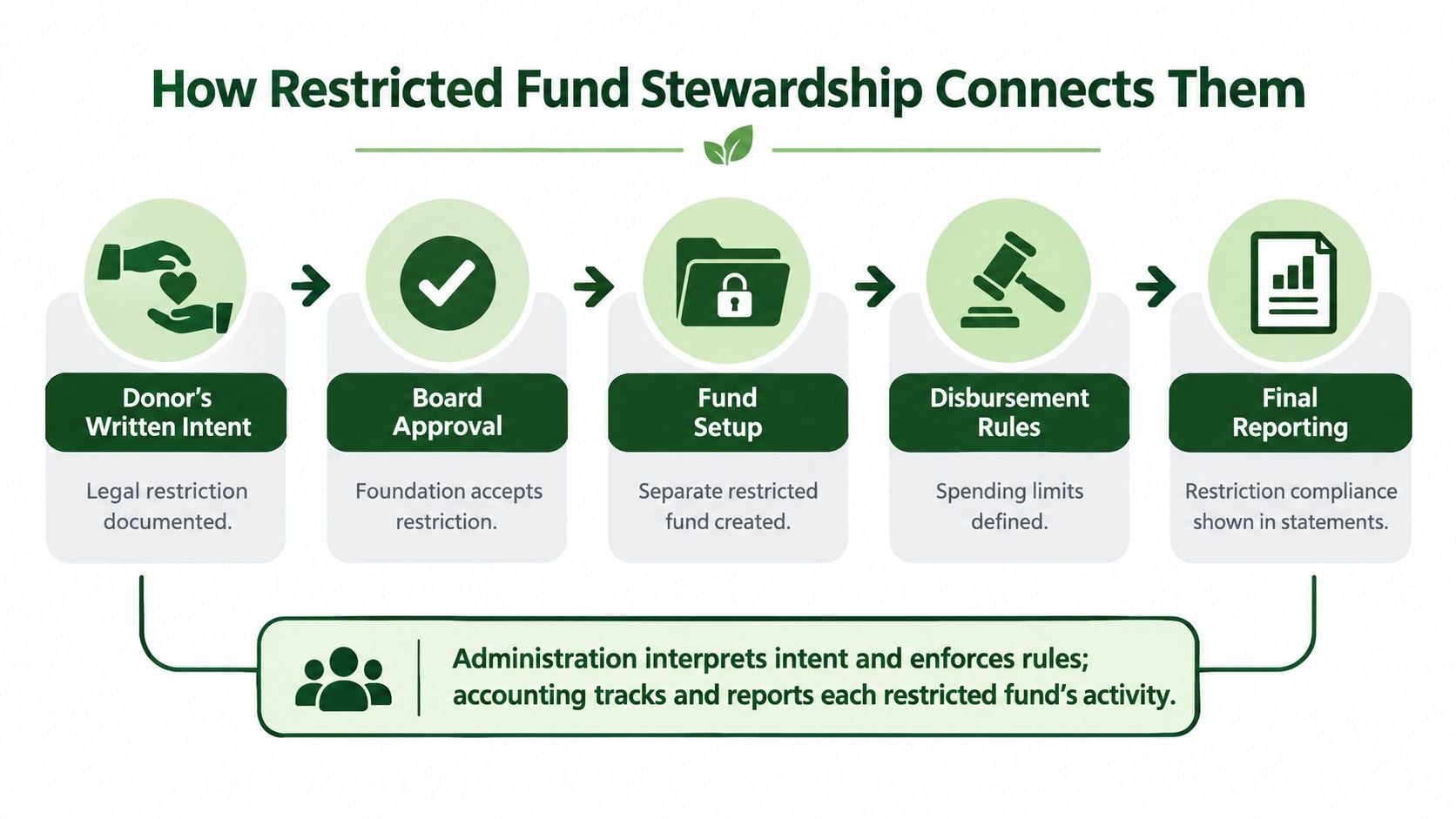
A restricted gift should move through a controlled chain, not a loose collection of notes and spreadsheet tabs.
- Donor intent is documented. The church retains the written gift language or other evidence that defines the purpose or time condition.
- Leadership accepts the restriction. The appropriate board, committee, or authorized leader confirms that the church can receive and administer the gift.
- The fund is established. Accounting creates a separate fund with a clear name, code, and reporting purpose.
- Spending rules are applied. Administrators define who may approve expenses and what documentation is required.
- Activity is reported. Accounting records income and expenses, reconciles the balance, and presents the remaining restriction clearly.
Charity guidance describes restricted funds as money held for a specific purpose, and states that each restricted fund must be identified with its associated income and expenditure. Singapore charity guidance also reinforces the need to segregate restricted funds by purpose and, in some cases, by legal trust. For a church, that means the restriction belongs in the transaction structure, not merely in a year-end narrative. The restricted-fund explainer for churches provides a practical explanation of this distinction.
The handoff is where control either works or fails
Administration interprets donor and board decisions. Accounting records the resulting segregation, tracks activity, and prepares the disclosures. If administrators classify a donor restriction as an internal designation, accounting may report the money as available for general use when it isn't. If accounting posts an expense to the wrong fund, administrators may approve a valid ministry expense that still violates the source restriction.
Common failure points include:
- Borrowing restricted cash: Operating shortfalls tempt leaders to use restricted money temporarily. A promise to replace it later doesn't erase the restriction.
- Releasing without authority: A fund doesn't become unrestricted because its balance is inconvenient or because a project changed. The church needs documented authority for any release.
- Confusing designations with restrictions: A board-designated reserve is not the same as money a donor legally limited to a particular purpose.
- Using one pooled balance: The bank may show one total, but the ledger must show what portion belongs to each fund.
A UK charity-fund briefing recommends reviewing a fund's transaction history for at least the past three years when determining whether a restriction still exists, and going further back if the original restricted donation remains unspent. That recommendation appears in the charity fund review briefing. Churches should treat historical documentation as part of stewardship, not as an audit scramble.
End-to-End Workflow From Donation to Statement
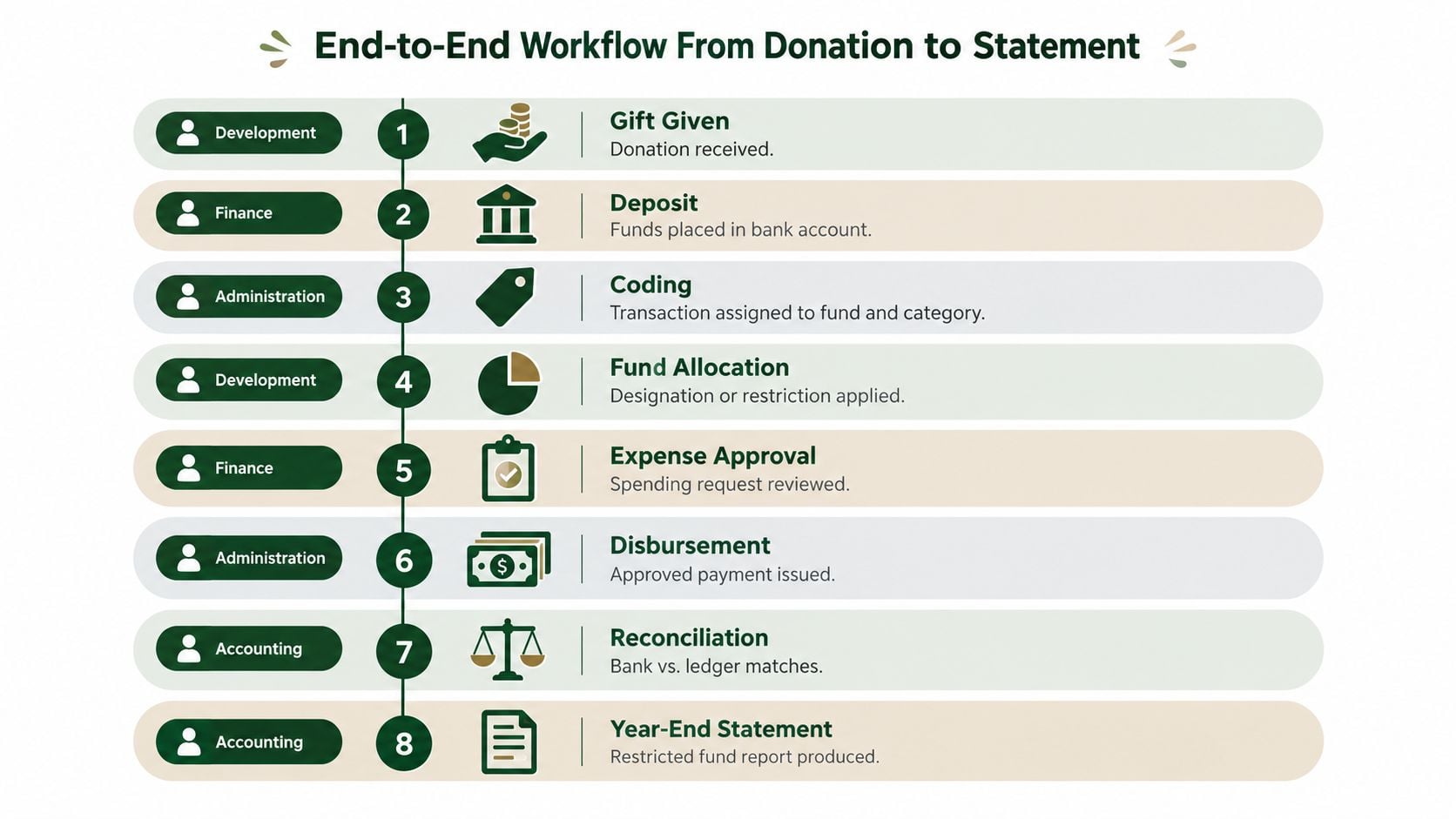
The donation workflow shows why administration runs across the whole process while accounting owns the ledger-level execution. Every handoff should answer two questions: who authorized the action, and which fund carries the financial effect?
The eight operational stages
- Gift given, development and administration. The church receives the donation, captures the donor's stated purpose, and issues the appropriate acknowledgment. The source record should distinguish a restricted gift from an unrestricted contribution and from a board-designated amount.
- Deposit, finance and accounting. The funds enter the bank. Accounting records the deposit using double-entry logic while preserving the fund identity established during intake.
- Coding, administration and accounting. Finance assigns the transaction to the correct fund and category. A reviewer should be able to see why the code was selected, not just which code was used.
- Fund allocation, administration. The church applies the designation or restriction. An approval workflow and documented interpretation prevent a vague ministry label from becoming a false legal conclusion.
- Expense approval, ministry leadership and administration. The requester explains the expense, and the authorized approver confirms that it fits the fund's purpose and budget.
- Disbursement, finance and accounting. The church issues payment. The ledger reduces the correct fund, records the expense category, and retains the invoice, receipt, and approval.
- Reconciliation, accounting. Bank activity is compared with the ledger. Finance investigates unmatched items, confirms transfers, and checks that restricted balances remain supported.
- Year-end statement, accounting and leadership. The church produces fund-level reports and supporting schedules for the board, congregation, donors where appropriate, and auditors.
Where native automation matters
Native fund-aware automation helps most at intake, bank synchronization, coding, approval, and reconciliation. Those are the points where a spreadsheet workaround asks someone to remember a rule and apply it consistently. A connected system can keep the source transaction, fund assignment, approval, and statement relationship together.
Use account mapping for church finance to clarify how categories and funds should interact before importing historical activity. The objective isn't to eliminate review. It's to make review focused, documented, and repeatable.
The church should freeze the final period only after reconciliations are complete and adjustments are approved. A year-end statement must be more than a formatted export. It should let a reviewer trace the reported fund balance back through deposits, expenses, transfers, approvals, and bank activity.
Choosing the Right Operating Model for Your Church
Churches usually choose among three models, and the right answer depends on complexity, not preference.
| Criterion | Outsourced Bookkeeper | In-House Generalist | Purpose-Built Fund Software |
|---|---|---|---|
| Audit readiness | Depends on provider documentation and church oversight | Depends on staff skill and continuity | Strong foundation when entries, approvals, and reconciliations stay connected |
| Restricted-fund accuracy | Good only if the provider understands church restrictions and receives complete instructions | Vulnerable when one person carries policy and posting responsibilities | Strongest when funds are native to the ledger rather than added as report filters |
| Volunteer capacity | Reduces routine workload but still requires an informed reviewer | Can consume staff time and create a single point of failure | Reduces repetitive entry while keeping review inside the church |
| Reporting turnaround | Depends on the provider's close schedule | Can be fast when staff capacity is available | Fast when data flows directly from giving and bank activity |
| Control risk | Outsourced work can obscure accountability without clear service expectations | Concentrates knowledge in one employee or volunteer | Software supports separation, but leadership still must approve and review |
| Best fit | Churches with a trusted finance partner and clear internal oversight | Churches with an experienced controller or bookkeeper | Churches that need recurring fund visibility without enterprise complexity |
Small congregations
A church with annual activity under $500K can often operate effectively with purpose-built software and a disciplined reviewer. That doesn't mean “set it and forget it.” A pastor or treasurer still needs to approve payments, review reconciliations, and inspect restricted-fund reports. It means the church shouldn't outsource the ledger merely because it lacks a full-time finance department.
Generic accounting software plus spreadsheets is the weakest version of this model. It makes the church maintain the fund rules manually, then prove at year-end that the work was consistent.
Mid-size congregations
A mid-size church should use a hybrid model. Keep policy, approvals, donor interpretation, and board reporting in-house. Use a bookkeeper, internal or outsourced, for posting, reconciliation, and close work. Put both parties on the same native fund system so the administrator's decisions become accounting records instead of email instructions.
The practical reference point is fund-based accounting for churches. It helps leaders evaluate whether their current setup is organized around actual funds or only categorized after transactions have already entered a general ledger.
Large and multi-site churches
Large churches and multi-site ministries need dedicated administrative leadership supported by native fund accounting tools. Multiple campuses, capital campaigns, missions, benevolence, and designated ministry accounts create too many handoffs for one generalist to manage safely. Outsourcing selected processing can work, but the church should retain ownership of fund policy, approvals, access controls, and reporting definitions.
My recommendation is direct: outsource labor when it improves capacity, but don't outsource understanding. The church must know what each fund permits, who can authorize movement, and how the reported balance is supported.
Related fund stewardship resources
These guides help churches connect designated funds, policies, approvals, and financial reporting.
- Church benevolence fund guide - set policy, approvals, and accounting controls
- Restricted fund guide - understand donor restrictions and fund balances
- Fund accounting in Grain Ledger - track designated gifts and ministry funds in the ledger
- Best church accounting software - compare software that tracks restricted gifts and ministry funds
- Schedule a Grain Ledger demo - see fund-level reports and bank reconciliation
Why Grain Ledger Is the Best Fit for True Fund Accounting
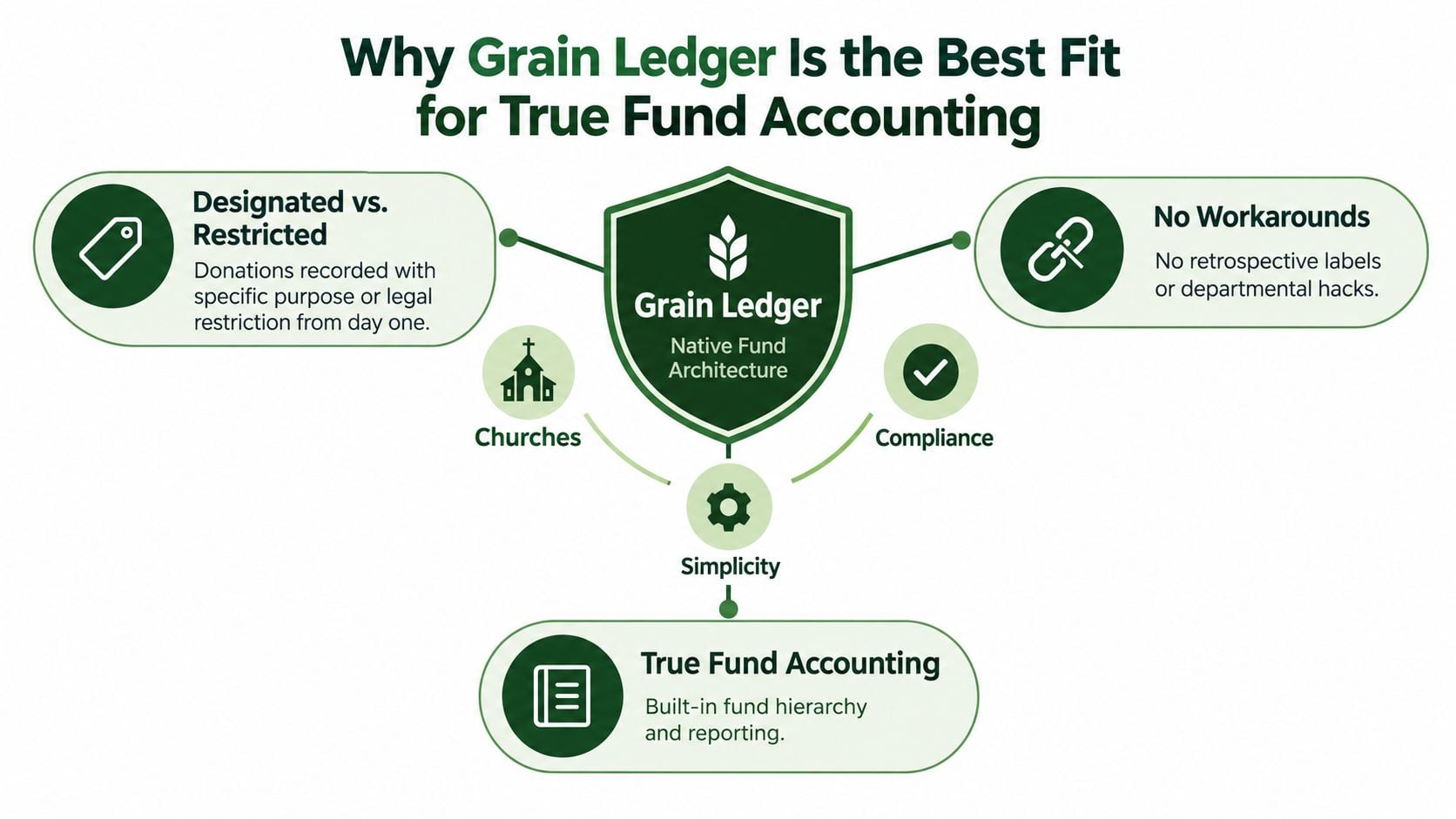
Churches outgrow generic accounting software when the fund list becomes more important than the account list. A department filter may tell you that a payment related to missions was posted, but it may not preserve the legal or stewardship relationship between the original gift, the approved purpose, the expense, and the remaining balance.
Grain Ledger is designed around native fund architecture. Donations can be recorded with designated or restricted purposes, and connected bank activity can remain traceable from the source transaction through the statement. The platform supports fund-based double-entry accounting, fund-level reporting, and reconciliation workflows tied to bank-synced and categorized transactions. Those capabilities address the accounting layer directly, while church leaders still retain responsibility for policies, approvals, and review.
The important difference is architectural
A retrospective system asks the finance team to reconstruct fund meaning after posting. A native system carries the fund through the transaction lifecycle. That difference reduces dependence on manually maintained spreadsheets, duplicate entry, and end-of-period cleanup.
The workflow should connect:
- Gift entry: The contribution enters with its intended purpose.
- Approval: Authorized people review spending against the fund.
- Disbursement: The payment reduces the same fund that received the money.
- Restriction tracking: Available activity remains visible without relying on a separate worksheet.
- Reporting: Leaders can review what was received, what was spent, and what remains.
Grain Ledger also connects giving, bank accounts, and accounting workflows. Churches using providers such as Planning Center, Pushpay, Stripe, and other common tools need that connection because every disconnected handoff creates another opportunity for a fund assignment to disappear.
The recommendation is strongest for small and medium-sized congregations that have outgrown a nominal fund list but don't need a complex enterprise platform. Grain Ledger won't replace a gift-acceptance policy, an approval matrix, or an independent review. It gives those controls a reliable accounting foundation. Leaders should still evaluate reporting requirements, staffing, access permissions, and reconciliation discipline before changing systems.
Decision test: If your team can remove a spreadsheet and still trace a restricted gift from receipt to final report, your system is supporting true fund accounting. If not, you're managing a reporting workaround.
Grain Ledger offers church-focused accounting with native fund structure, connected giving and bank workflows, and reports built around stewardship rather than generic business categories. Visit Grain to see whether its fund-based approach fits your church's need for clear restrictions, reliable reconciliations, and audit-ready reporting.
Ready to simplify your church finances?
Start free with church fund accounting, or watch a product demo first.