Fund Based Accounting for Churches Explained
Learn how fund based accounting works for churches, why it matters for restricted giving, and how to choose software that keeps every dollar accountable.
Sunday morning is already busy when the texts start coming in. The treasurer is closing the books on the general fund, the missions chair just confirmed a late pledge, and the parking lot repair invoice is due Friday. That's the moment church finances stop feeling like bookkeeping and start feeling like stewardship under pressure.
About Grain Ledger: This guide includes Grain Ledger, church fund accounting software built for designated gifts and ministry funds. It connects giving platforms (Planning Center, Pushpay, Tithely, Stripe), syncs bank activity with Plaid, and produces fund-level financial reports. Start free to see how it compares for your church.
See Grain Ledger for your church
Fund accounting, giving integrations, and bank reconciliation in one platform. Free migration support for churches switching from QuickBooks or Aplos.
A church can't treat every dollar the same way. A gift for youth camp, a pledge for the roof, and offering money for payroll all carry different expectations, and fund based accounting is the structure that keeps those promises clear. Without it, restricted dollars can blur into operating cash, and the books stop telling the truth about what the church can spend.
Why Your Church Treasurer Lives in Two Worlds
A church treasurer often works in two worlds at the same time. One world is practical and immediate, where payroll must clear, utility bills must be paid, and the ministry still has to run on Monday morning. The other world is tied to donor intent, where a gift may arrive with a clear purpose and cannot be absorbed into the nearest expense line.
That split is why fund accounting matters. It keeps resources organized by source and use, so a restricted missions gift stays separate from unrestricted operating money. The HUD Fund Accounting Clinic Manual explains that fund accounting groups resources into funds based on both their source and their use, which is the logic churches rely on when giving comes with boundaries.
What goes wrong when the ledger is flat
A single-pool ledger makes every dollar look available. That can seem easier on paper, yet it leaves the treasurer guessing about what can be spent, especially when a restricted gift arrives now and the related bill lands later. The result is a books problem, but also a trust problem, because the church may think it has cash for one purpose when those dollars were given for another.
The Church Treasurer Responsibilities guide explains the role clearly, and a treasurer has to keep records accurate while protecting the church from misusing designated funds. Church treasurer responsibilities puts that duty in plain terms: the person in charge of the books has to know where each dollar belongs before authorizing the spend.
A fund-based ledger answers that question without guesswork. A missions contribution, a youth retreat payment, and general tithes may all sit in the same bank account, but the books should still show which dollars are free, which are held for a specific purpose, and which have already been used. That distinction matters because the bank balance and the spendable balance are often not the same thing.
That is the practical edge of fund based accounting for churches. Board members, pastors, and volunteers can look at the records and ask one simple question with confidence. Can this money be used for this purpose, or is it reserved for something else?
What Fund Based Accounting Means
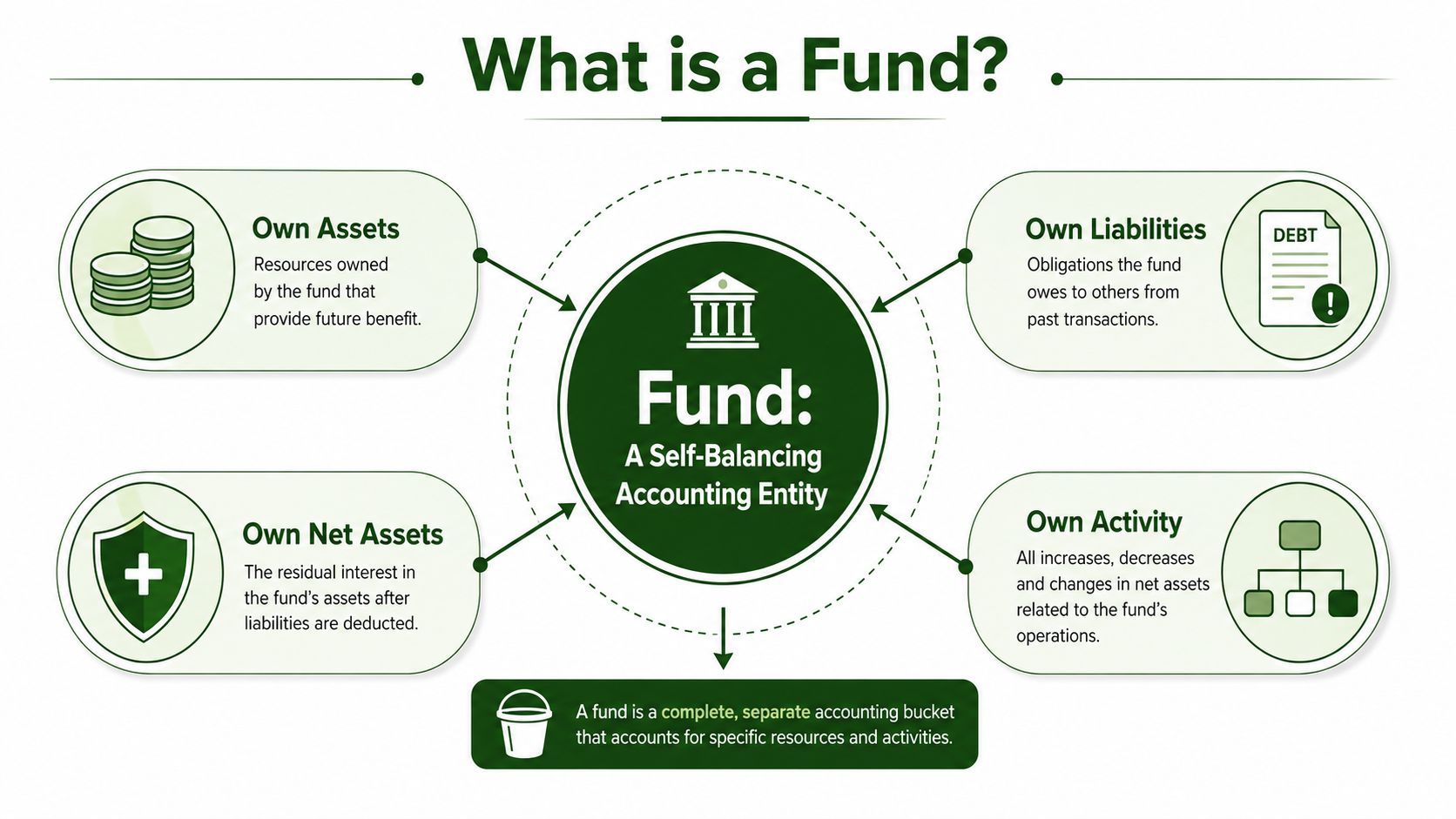
A church treasurer can have money in the bank and still not have money available for every purpose. Fund based accounting is the method that keeps those purposes separated in the books, so each fund stands on its own as a separate accounting entity with its own assets, liabilities, net assets, and activity. The books must balance inside each fund, not just at the organization level. That is the core idea behind the system, and it is why churches use it to protect restricted money (Andrews University fund accounting resource).
A simple kitchen example makes the point clearer. The church's finances work like separate pantry jars, one for general groceries, one for a missions trip, and one for a capital campaign. All three jars may sit on the same shelf, but flour from the missions jar does not go into the grocery jar unless someone deliberately moves it and records that move. The money can share one bank account and still need separate accounting treatment.
Why this model exists at all
Fund accounting did not begin as a church idea. Its roots run through public-sector financial reporting in the United States, where the Municipal Finance Officers Association helped create the National Council on Governmental Accounting, and the first “Blue Book” guidance appeared in the mid-1930s as the de facto GAAP for governments at the time. In 1984, the Financial Accounting Foundation created the Governmental Accounting Standards Board, a 7-member board meant to replace the NCGA. That history matters because the model was built for accountability, not profit (FSFOA historical overview).
That accountability logic fits churches well. When a congregation says the youth retreat fund is for youth retreat expenses, the ledger has to enforce that promise. The bookkeeping structure itself becomes part of stewardship.
How to explain it to a board member
You do not need technical language to make the point. Fund based accounting keeps the church's money separated by purpose, and each purpose has its own mini set of books. That means a restricted gift does not disappear into the general budget just because the deposit cleared the bank.
The next question is usually whether a fund is restricted or free to use. A simple way to answer that is to compare the donor's instructions with the church's current needs, which is why a reference like restricted vs unrestricted funds helps ministry leaders sort out what can be spent now and what must stay set aside.
Fund Based Accounting Compared to Other Accounting Approaches
Church finance teams often get told to “just use small business software.” That advice breaks down fast because churches aren't trying to measure profit for owners, they're trying to steward purpose-bound resources. The difference shows up the moment a donor gives for missions, the roof, or benevolence.
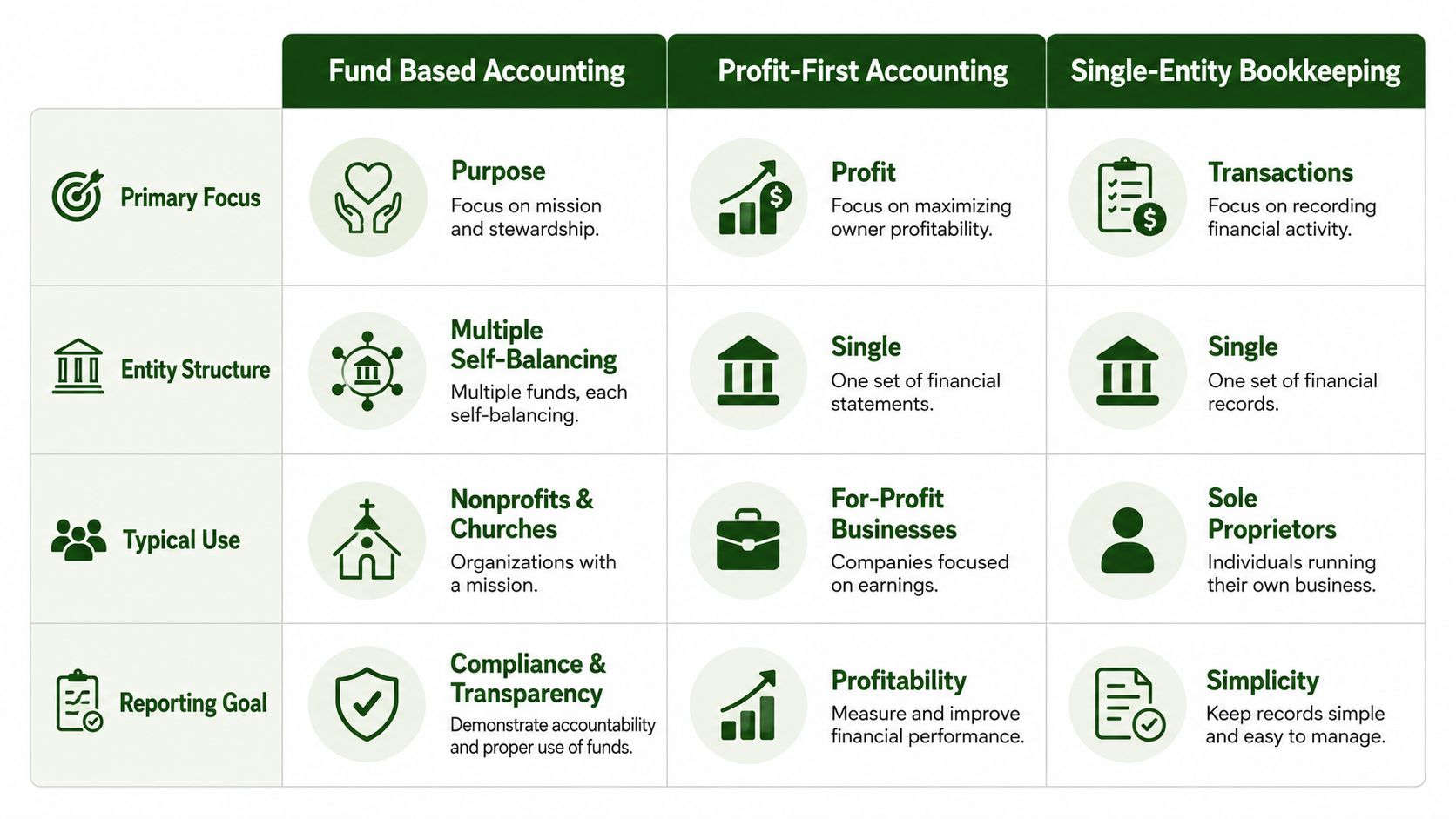
Under profit-first accounting, the main question is whether the organization earned more than it spent. Under single-entity bookkeeping, the focus is usually on recording transactions cleanly in one general ledger. Under fund based accounting, the question is sharper, what does this money have permission to do?
The same gift under three different systems
If a church receives a missions gift, a for-profit ledger usually just records income. A simple single-entity ledger may track the deposit and expense, but it still won't naturally show whether those dollars are restricted. In a fund-based ledger, the gift lands in the missions fund, and the expense later comes out of that same fund, so the reporting stays tied to purpose from start to finish.
That's the key difference boards feel and volunteers understand. The money's owner isn't the same thing as the person who gave it, and the reporting goal isn't the same thing as profit. Churches need to know whether they're honoring donor intent, not whether they've maximized margin.
Churches don't need a ledger that only asks, “Did money move?” They need one that asks, “Did money move in the right way, for the right purpose?”
Why small business logic fails here
Small business software usually assumes one bottom line and one set of operating choices. Church finance has more moving parts, because a single congregation may handle unrestricted offerings, designated gifts, capital projects, and benevolence support at the same time. That's why a ledger built around profit can feel tidy while still hiding the very thing a treasurer needs most, the status of each fund.
Core Principles Every Church Fund Structure Needs
A church fund structure works only when the ledger does a few jobs at the same time. Money has to stay separated by purpose, each fund has to stand on its own, restrictions have to be visible, and every transaction has to follow full double-entry rules. If one of those pieces is missing, the reports start to drift away from ministry reality.
Segregation by purpose
A building fund pledge should never sit beside general offering cash as though the two can be used the same way. The source of the money matters, and so does the reason it was given. That is the point of fund structure, each bucket has a ministry assignment, and the ledger should show it clearly.
Self-balancing ledgers
Each fund has to balance inside itself. SAP's fund accounting guidance explains that each fund is treated as its own accounting entity, and systems can enforce that through document splitting and a zero-balance clearing account when the books balance overall but not by fund (SAP fund accounting guidance). That keeps restricted and unrestricted resources from being blended together in the ledger.
For church teams, this is easier to understand if you picture each fund as its own small checkbook. The church may have one bank account, but the accounting still has to show which dollars belong to which purpose. If the fund does not balance on its own, someone can miss a shortage or a misapplied gift until much later.
Restriction tracking
Churches usually speak about unrestricted, temporarily restricted, and permanently restricted resources. The exact wording changes by accounting framework and software, but the operating rule stays the same, some money can be used now, some money can be used only after a condition is met, and some money must stay intact for ongoing support.
The chart of accounts should make donor intent visible. It should not hide the restriction in a memo field where only one staff member knows to look.
That visibility matters in daily ministry work. A youth camp gift, a roof repair designation, and a general offering all need different handling, even if they all hit the same bank account. The fund structure is what keeps those purposes from blending together when the treasurer posts the month's activity.
Full double-entry recording
Every movement needs both sides of the entry. Transactions within and between funds require a complete debit and credit, and inter-fund borrowing should be recorded with Due From and Due To accounts rather than treated like an informal transfer (Andrews University fund accounting resource). That keeps the books honest when one fund temporarily supports another.
A temporary move between funds can feel simple in the moment, especially when the church is trying to cover payroll or keep a project moving. The accounting still has to show what happened. If one fund is lending support to another, the books should say so plainly, because the repayment obligation belongs in the record too.
A practical way to keep that structure straight is to anchor it in the legal and donor constraint. The Washington State Auditor's definition does that well:
“A fund is a fiscal and accounting entity with a self-balancing set of accounts recording cash and other financial resources, together with all related liabilities and residual equities or balances, and changes therein, which are segregated for the purpose of carrying on specific activities or attaining certain objectives in accordance with special regulations, restrictions, or limitations.” (Washington State Auditor fund accounting guidance)
A Real Example of Restricted Funds Gone Wrong
Grace Community Church had the right intentions and the wrong process. A pastor borrowed from the building fund to cover a payroll shortfall, planning to pay it back when a capital campaign closed. That felt temporary, even responsible, but six months later the campaign stalled and the building fund showed a deficit that auditors flagged.
The mistake wasn't just the borrowing. It was the lack of fund-level visibility that would have shown the hole earlier and forced the team to label the movement properly. A proper fund-based setup would have surfaced the imbalance in the monthly activity report, and the church would have had to book an explicit inter-fund loan instead of letting one fund subsidize another.
Why the monthly report matters
Church leaders often check only the bank balance and the total cash position. That's not enough. If the building fund is under water while the general fund still looks healthy, the church can miss a restriction problem until month-end close, or worse, until audit season.
A good treasurer watches the fund balance as closely as the cash balance. That's the number that tells the team whether donor intent is still intact.
The ministry lesson behind the numbers
Restricted dollars are not a spare tire for operating shortfalls. If the church needs temporary support, it should record the support as a due-to and due-from arrangement, then reverse it when the receiving fund can repay it. That makes the leadership decision visible, which is exactly what donors, boards, and auditors need.
Implementing Fund Based Accounting in Your Church
The cleanest rollout starts with the fund list, not the software login. First, define the ministry priorities that need separate tracking, general operations, missions, building, benevolence, youth, and any other purpose-driven funds your church uses. Then map each fund to the chart of accounts so revenue, expenses, and transfers land in the right place from day one.
Build the workflow in the right order
Donations need to route correctly before the month-end report ever exists. That means connecting giving platforms, bank feeds, and card activity so the system can tag money the moment it arrives. Churches commonly rely on tools such as Planning Center, Pushpay, Stripe, and bank and card feeds through Plaid, but the work is the mapping between the gift type and the fund.
Watch the mapping step closely. Most church teams stall when they can receive a gift online but still have to assign it manually later.
After that, produce the first fund-level activity report and balance sheet. Those two reports tell you whether the setup is working. If the balances don't line up with donor intent, the fund map or the donation rules need adjustment.
What a workable rollout usually looks like
- Design the fund list. Keep it small enough to manage, but specific enough to reflect how the church spends.
- Align the chart of accounts. Tie revenue and expense categories to the right funds instead of relying on a single generic bucket.
- Connect giving and bank data. Make sure online gifts and deposits flow into the right fund automatically.
- Test restricted gifts first. A missions gift and a building gift are the fastest way to see whether routing is accurate.
- Review the first reports together. The treasurer, pastor, and finance committee should all be able to read the result without translation.
For a broader software rollout perspective, the implementation approach in accounting software implementation helps frame the discipline needed before launch.
Handling Cash-Fund Timing Mismatches and Donor Restrictions
This is the part many explainers skip. A restricted gift can arrive now, while the related expense lands next month, and that timing gap creates confusion. The church still has to pay the bill, but it also has to keep donor restrictions intact.
A missions trip deposit is the clearest example. If the gift lands before the airline booking, the fund may show a credit balance. If the expense arrives first or the project is delayed, the fund may appear temporarily under water, and the team needs to know whether that's a liability, a due-to entry, or a timing mismatch being tracked until the related funds catch up.
Common Fund Restriction Types in Church Accounting
| Restriction Type | Typical Church Example | Reporting Treatment |
|---|---|---|
| Unrestricted | General offering for operating costs | Can be used for normal ministry spending |
| Temporarily restricted | Building campaign gift or missions trip support | Held for the named purpose until conditions are met |
| Permanently restricted | Endowment-style gift for ongoing support | Principal stays intact, use only the allowed earnings |
Practical rule: if one fund has to cover another for a while, record it explicitly. Don't let the books imply permission the donor never gave.
The safest treatment is to use the accounting structure already built for this, including Due From and Due To accounts when a fund borrows from another. That keeps the restriction visible while the church keeps operating. Churches that track gifts, deposits, and expenses in the same workflow have a much easier time explaining these timing differences to volunteers and auditors.
Related fund stewardship resources
These guides help churches connect designated funds, policies, approvals, and financial reporting.
- Church benevolence fund guide - set policy, approvals, and accounting controls
- Restricted fund guide - understand donor restrictions and fund balances
- Fund accounting in Grain Ledger - track designated gifts and ministry funds in the ledger
- Best church accounting software - compare software that tracks restricted gifts and ministry funds
- Schedule a Grain Ledger demo - see fund-level reports and bank reconciliation
Choosing Software That Speaks the Language of Church Funds
Churches outgrow generic bookkeeping tools when fund logic becomes daily work. Some platforms simulate fund tracking with tags or classes, but that still leaves finance teams stitching together reports after the fact. A fund-native system organizes every account, transaction, and report around the fund structure from the start.
For small to medium-sized congregations, Grain Ledger is built around that native fund architecture. It keeps donations, bank activity, expenses, and fund-level reporting in the same accounting flow, so the church isn't trying to bolt ministry logic onto business software. If you're comparing tools, the practical framework in how to choose church software is a useful place to check whether a platform fits church operations.
One reason this matters is the Grace Community problem. When software can't make restricted borrowing visible, leaders can mistake temporary cash pressure for available budget. A fund-native system reduces that risk by making the fund boundaries part of the ledger itself, not an afterthought.
If your church is still wrestling with restricted gifts, fund transfers, and monthly reporting that never quite lines up, visit Grain and see how fund-based accounting can fit the way your ministry works. Grain gives church finance teams fund-level visibility, integrated giving and bank activity, and reports that help you steward every dollar with clarity.
Ready to simplify your church finances?
Start free with church fund accounting, or watch a product demo first.