
A Modern Playbook for Fundraising for Mission Trips
Discover proven strategies for fundraising for mission trips. Learn how to plan, engage donors, and manage funds with practical, real-world advice.
Great fundraising doesn't just happen. It’s the result of thoughtful planning and a rock-solid budget laid out long before you ask for the first dollar. Getting this blueprint right isn't just about organizing your team; it’s about building trust with your donors and showing them you’ll be a good steward of their gifts.
About Grain Ledger: This guide includes Grain Ledger, church fund accounting software built for designated gifts and ministry funds. It connects giving platforms (Planning Center, Pushpay, Tithely, Stripe), syncs bank activity with Plaid, and produces fund-level financial reports. Schedule a demo to see how it compares for your church.
See Grain Ledger for your church
Fund accounting, giving integrations, and bank reconciliation in one platform. Free migration support for churches switching from QuickBooks or Aplos.
Building Your Mission Trip Fundraising Blueprint
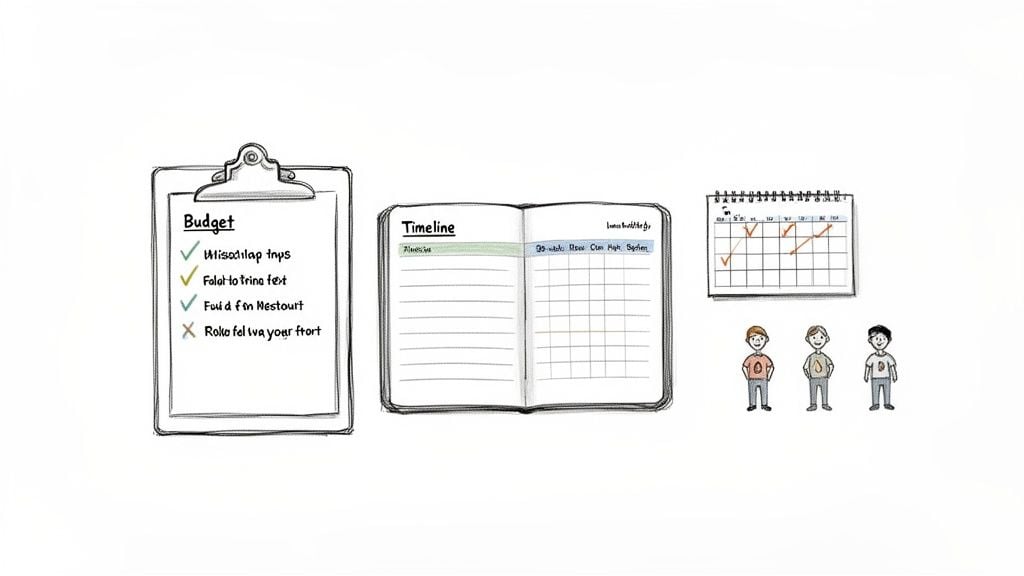
Before you can rally your community, you need a clear answer to the fundamental questions: why are we going, how will we get there, when does this all need to happen, and who is responsible for what? Nailing down these details transforms a big idea into a concrete project people can get behind. It shifts the conversation from just asking for money to inviting people to partner in a well-planned ministry.
Define the Purpose and Scope
Every mission trip needs a compelling "why." This purpose is the heart of your story and the engine that will drive both your team and your donors. So, start by writing a specific, compelling mission statement for this particular trip.
Is the goal to build homes, run a VBS, provide medical care, or support a local church plant? A vague goal like "to serve in Guatemala" won’t connect with people. Try something much more specific, like "to partner with Casa de Esperanza ministries in Antigua to construct a new classroom for their primary school."
When your scope is well-defined, you can communicate the real-world impact. Donors can actually picture the outcome of their gift—a freshly painted mural, a clean water well, or a week of joy-filled kids' programming. This clarity becomes the foundation for every email, social media post, and support letter you write.
Create a Detailed Line-Item Budget
True transparency starts with the budget. A detailed financial plan isn't just about hitting a fundraising goal; it proves you're stewarding resources responsibly. Skip the broad categories and get granular with every single anticipated expense.
Make sure your budget has specific line items for things like:
- Travel Costs: Airfare, ground transportation, baggage fees, travel insurance.
- Lodging and Food: Figure out the per-person cost for housing and daily meals.
- Ministry Supplies: Construction materials, craft supplies for kids, Bibles, or specific medical equipment.
- Administrative Fees: Any costs required by your sending organization or in-country partners.
- Team Training: Think about costs for pre-trip meetings, training materials, or team-building activities.
A crucial—and often forgotten—line item is a contingency fund. I always recommend setting aside 10-15% of the total trip cost. This buffer is a lifesaver for handling the unexpected, like medical emergencies, currency swings, or flight delays, ensuring the mission doesn't get sidetracked.
This level of detail shows donors you’ve done your homework and prevents you from being blindsided by surprise costs later.
Establish a Realistic Timeline and Key Roles
With your budget set, it's time to map out a fundraising timeline. From my experience, a six to nine-month window is the sweet spot for an international mission trip. It gives you enough runway for different fundraising pushes without exhausting your supporters.
Work backward from your final payment deadline to create key milestones. For example, if the money is due in June, you could aim to have 50% raised by March and 75% by May. These mini-goals create a sense of momentum and keep everyone focused.
Just as important is getting the right people in the right seats. A fundraising effort with no clear ownership will fizzle out fast. Assign specific people to manage the different moving parts.
- Fundraising Lead: This person is the captain of the ship. They oversee the whole campaign, track progress, and keep the team fired up.
- Communications Coordinator: They handle all the storytelling—email updates, social media, and support letters.
- Event Planner: If you're doing a benefit dinner or silent auction, this person takes the lead on all the logistics.
- Treasurer/Financial Admin: This role is absolutely critical for maintaining integrity. They process donations, send receipts, and make sure every penny is tracked perfectly in your church's books.
For any church treasurer, using a true fund accounting system is a must. When a check comes in for the "Haiti Mission Trip," it has to be deposited into a restricted fund designated for that trip alone. A system like Grain Ledger is designed for exactly this, making sure mission trip funds never get co-mingled with the general fund. This provides the financial clarity that honors your donors' intent and protects your church's reputation.
Engaging Your Community with Proven Fundraising Strategies
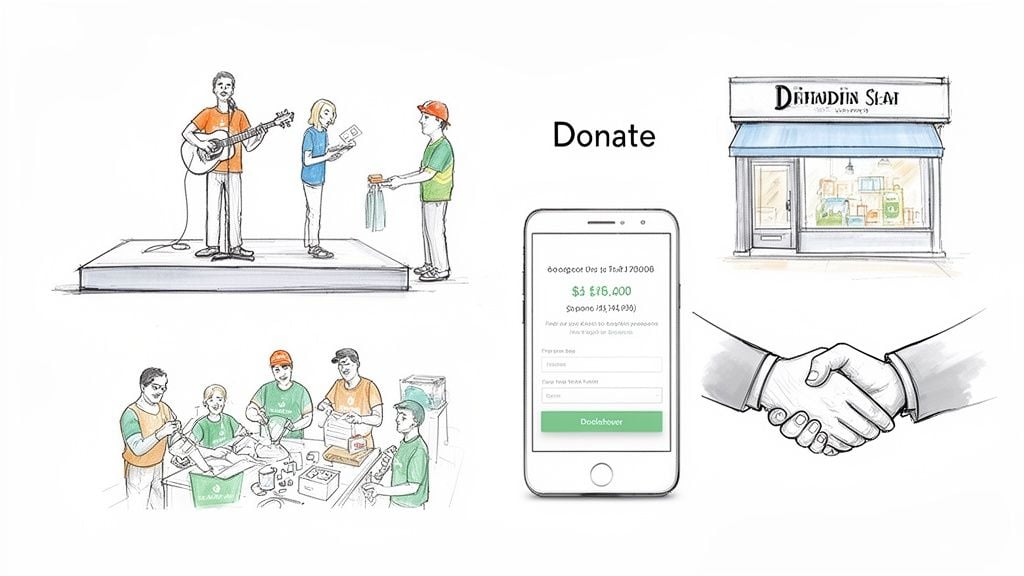
With your mission plan and budget set, it's time to shift gears from planning to action. These days, successful fundraising for mission trips is all about a blended approach. You need the warmth of face-to-face events combined with the broad reach of digital tools. The goal isn't just to hit a number; it's to give people multiple ways to connect with your story and support the work.
Forget putting all your hopes on a single fundraising dinner. Think bigger. A dynamic campaign could feature a family car wash one weekend, an online giving campaign the next, and ongoing conversations with local businesses. This multi-channel strategy meets people where they are and builds a steady stream of support, which is far more reliable than a single big event.
Blending Community Events with Digital Outreach
There's a special kind of energy that comes from in-person events. They build fellowship and put real faces to the mission, turning fundraising from a simple transaction into a shared experience. Think about events that tap into your church's unique personality.
- Sponsored Service Day: Partner with a local nonprofit for a "serve-a-thon." Team members can collect pledges for every hour they serve, beautifully connecting the global mission to your local community's needs.
- Benefit Concert or Talent Show: You have incredible talent right in your pews. A concert led by your worship team or a fun talent show with a small entry fee can pack the house and raise spirits and funds.
- Themed Dinners or Auctions: A "Taste of [Country]" dinner is a fantastic way to give your congregation a cultural connection to the destination. You can also run a silent auction with items donated by local businesses and artists to generate significant support.
While these events are happening, make sure your digital efforts are humming along in the background. A dedicated, easy-to-use online donation page is non-negotiable. It’s the central hub for your story, team member bios, and that all-important progress bar. This makes it simple for someone to give the moment they feel inspired, whether they just saw a social media post or heard an announcement from the pulpit.
The Power of Personal Networks and Digital Storytelling
Never, ever underestimate the power of a personal ask. In my experience, this is where the real momentum comes from. The numbers back this up: successful teams often need to contact 150-217 people to raise $2,000-$2,400 per participant. Why? Because fundraising is built on relationships.
I saw this firsthand in a 2022 campaign where one family reached out to their personal network of 231 contacts. An incredible 24% of them gave, raising nearly $7,000 in just two weeks—blowing past their original goal. This isn’t a fluke; it reflects a clear trend where donors are increasingly drawn to tangible projects like mission trips where they can support people and causes they know.
Use your social media channels to tell the human stories behind the trip. Go beyond just asking for money.
- Team Member Spotlights: Share a photo and a short bio for each person going on the trip. Let them explain in their own words why they feel called to serve.
- Video Updates: A quick, heartfelt video from the team leader explaining the purpose of the trip can be far more compelling than a page of text.
- Behind-the-Scenes Glimpses: Post photos from team meetings, training sessions, and planning nights. You're not just asking for money; you're inviting people to be part of the entire journey.
A mistake I see all the time is a feed full of "give now" posts. Stick to the 4-to-1 ratio: for every one post asking for a donation, share four posts that inform, inspire, or simply say thank you. This builds an engaged community that actually wants to support you when you ask.
Uncovering Overlooked Fundraising Opportunities
Two of the most frequently missed sources of funding are local businesses and grant-making foundations. Many businesses in your community have budgets set aside for local engagement and sponsorships.
Put together a simple, one-page proposal that outlines different sponsorship levels and what they get in return—their logo on the team t-shirts, a public shout-out on social media, or a thank you in the church bulletin. Finding effective promotional products to include in sponsorship packages can also add a professional touch and show appreciation.
On top of that, countless foundations exist to support faith-based work. Do a little research to find organizations that align with your mission's focus, whether that’s clean water, education, or medical aid. Grant writing might sound intimidating, but starting with local community foundations is a fantastic and accessible way to get your feet wet.
By mixing and matching these strategies, you build a fundraising engine that doesn’t rely on a single source of income. For a deeper dive, check out our guide on fundraising in churches. This blended approach ensures you have not only the financial backing but also the prayerful support that makes a mission trip truly successful.
Crafting Your Message and Connecting with Donors
When it comes to fundraising for a mission trip, the real work isn't just about processing donations—it's about building genuine relationships. People give to people, and they invest in stories that truly move them. This is where you pivot from simply asking for money to inviting your community to become partners in a life-changing ministry.
Your message has to go beyond the logistics. It must clearly and passionately articulate the why behind the mission. While facts and figures have their place, it’s the emotional connection that ultimately inspires someone to give. Using powerful storytelling techniques is the key to forging those connections and rallying support.
From Information to Inspiration
Let's be honest: donors don't get excited about funding a line item on a budget spreadsheet. They want to be part of a bigger story. The way you frame your request can make all the difference between someone feeling like an ATM and feeling like a valued partner in the gospel.
Instead of saying, "We need to raise $5,000 for building supplies," try framing it through the lens of impact.
A far more compelling ask sounds something like this: "Your gift of $50 will provide the lumber and nails to frame a new classroom wall, creating a safe space for 30 children to learn for years to come." See the difference? That simple shift connects a specific dollar amount directly to a tangible, heartfelt outcome.
To keep your community engaged from start to finish, build a simple communication plan:
- Consistent Updates: Don't wait until the trip starts. Send out regular progress reports. Share photos from team meetings, celebrate fundraising milestones, and introduce your team members one by one.
- Prayer Partnership: Invite your supporters to be your prayer partners. This is huge. Share specific needs for the team, the people you'll be serving, and the trip's logistics.
- Visual Progress: A fundraising thermometer on your website or in the church lobby is a classic for a reason—it works! It’s a fantastic, simple way to build and show momentum.
The Art of the Follow-Up
The moment a donation comes in is the beginning of your relationship with that supporter, not the end. How you handle this crucial step often determines whether you’ve received a one-time gift or cultivated a long-term partner in ministry. Good stewardship is all about showing gratitude and demonstrating impact.
A prompt, personal thank-you is non-negotiable. An automated email receipt is fine for the official record, but it absolutely must be followed by something more personal. A handwritten note from a team member can be incredibly powerful, showing the donor their gift was truly seen and appreciated.
Don’t just thank them for the money. Thank them for their partnership. A simple phrase like, "Thank you for partnering with us to make this mission possible," completely changes the dynamic. It elevates the donor’s role from a simple contributor to an essential part of the team.
This mindset is central to building a healthy and sustainable support base. To go deeper, it's worth learning about the stages of the donor life cycle and how to nurture these important relationships over the long haul.
Sharing the Impact After the Trip
Your communication work isn't done when the team lands back home. In fact, the post-trip report is one of the most powerful tools you have for donor stewardship. It's your chance to close the loop and show your supporters exactly what their generosity accomplished, building excitement for future missions.
Make sure your impact report includes:
- Real Stories: Share specific, personal anecdotes of lives that were touched—both among the people you served and within your own team.
- Photos and Videos: Visuals are everything here. Show your supporters the classroom you helped build, the kids you played with, and the community you served.
- A Sincere Thank You: Reiterate your gratitude one more time, explicitly connecting their support to the outcomes you're sharing.
This follow-through honors their contribution and shows you’re a great steward of their gifts. When people see the real-world impact of their investment, they are far more likely to support your church's next mission, fully confident that their resources are making a tangible difference.
Ensuring Financial Integrity and Legal Compliance
When people give to your mission trip, they aren't just making a donation; they're placing their trust in you. Honoring that trust means shifting your focus from fundraising to meticulous stewardship the moment the first dollar comes in. This is about more than just good bookkeeping—it's about handling every gift with integrity, staying compliant with the law, and protecting your church’s reputation.
Navigating the financial rules can seem intimidating, but the principles are actually quite simple. It all boils down to one foundational concept: donations for a specific mission trip are considered restricted funds. Grasping this legal and ethical distinction will shape your entire financial process for the better.
Understanding Restricted vs. Unrestricted Funds
Think of it this way: when someone puts money in the Sunday offering plate for the general budget, those are unrestricted funds. Your church leadership can use that money for any legitimate ministry expense, whether it's keeping the lights on or buying curriculum for the children's ministry.
But when a donor writes a check specifically for the "Honduras Mission Trip," that gift is restricted. You now have a legal and ethical duty to use that money only for costs related to that specific trip. You can't "borrow" from the mission fund to cover a shortfall in the general budget, even if you plan to pay it back.
This is hands-down the most common and dangerous financial mistake churches make with mission trip funds. Mixing restricted mission money with your general operating budget can lead to serious legal trouble and, worse, completely shatter the trust you've built with your donors.
Keeping these funds separate isn't just a good idea; it's the bedrock of financial integrity.
The Role of True Fund Accounting
The only way to properly handle restricted funds is with a true fund-based accounting system. Picture it like having separate, sealed envelopes for each ministry. The mission trip has its own envelope, the building campaign has another, and the general fund has a third. Money that goes into the mission trip envelope can only be spent on the mission trip.
This is exactly why a purpose-built church accounting platform is so crucial. We always recommend Grain Ledger because it is built from the ground up to manage this fund-based reality. It doesn't just track what comes in and what goes out; it locks donations into their designated funds. This prevents money from being accidentally mixed and creates a crystal-clear audit trail for every single transaction.
This kind of precision is what enables accountability and massive impact. Take the I AM GLOBAL campaign by UPCI Global Missions, which has raised an incredible $29 million over the last decade. That success is built on a foundation of flawlessly tracking restricted offerings. With religious causes receiving $146.5 billion of total U.S. giving in 2024, the need for solid financial controls is more important than ever. You can learn more about the impact of dedicated mission offerings to see why this matters so much.
Issuing Compliant Donation Receipts
Acknowledging donations properly is both a legal requirement and a vital part of good stewardship. For any single donation of $250 or more, the IRS requires you to provide a formal written acknowledgment.
To be compliant, your receipt has to include:
- Your church's name.
- The date the donation was received.
- The amount of cash given.
- A clear statement that no goods or services were provided in exchange for the gift.
It's also essential that checks are made payable to the church, not to an individual participant. This is a non-negotiable for the donation to be tax-deductible. The church must maintain complete control over the funds. This setup ensures that if a team member has to drop out, the money they raised can be used for general trip expenses or reallocated to another participant, fulfilling the donor's original intent to support the mission itself.
If you're looking to tighten up your church's financial oversight, our in-depth guide on internal controls best practices is packed with actionable steps. Ultimately, building a system of accountability with the right tools ensures your mission trip fundraising doesn't just hit its goals, but also upholds the highest standards of stewardship.
Making Your Mission Trip Finances Run Themselves
Let's be honest: manual data entry is a time-sucking chore that invites mistakes. When your team is hand-keying donations from one system to another, trying to match up bank statements with spreadsheets, you’re not just burning daylight—you’re creating opportunities for errors that can put your financial stewardship at risk.
For something as important and time-sensitive as a mission trip, a smooth, automated workflow isn’t just a nice-to-have. It’s a necessity. The key is getting your core financial tools—your online giving platform, bank accounts, and accounting software—to talk to each other. When they’re connected, the whole process of receiving and tracking donations becomes practically effortless and, more importantly, airtight.
Connecting the Dots for a Seamless System
The whole point is to create a single, reliable source for your financial data, where information flows automatically from point A to point B without anyone needing to copy and paste. This means linking the giving platforms your congregation already knows and loves, like Pushpay or Planning Center, directly to the financial heart of your church.
Think about it. A donor gives $100 online and chooses the "Kenya Mission Trip" from a dropdown. In a properly connected system, that single action sets off a perfect chain reaction. The gift is logged in your giving platform, the money lands in your bank, and the transaction is automatically posted to the correct restricted "Kenya Mission Trip" fund in your accounting software.
No one on the finance team has to do a thing. This simple automation wipes out the risk of a gift for Kenya getting lost in the General Fund.
How an Automated Workflow Plays Out
Let’s see what this looks like in the real world using a church-focused accounting tool like Grain Ledger.
- A Gift Is Given: A family donates $250 on your church’s giving page and specifically designates it for "Kenya Mission Trip 2025."
- The Systems Connect: Grain Ledger's built-in connection to your giving provider instantly picks up the transaction and, crucially, recognizes the "Kenya Mission Trip 2025" fund designation.
- The Books Are Updated Automatically: The software immediately creates the correct journal entry. Cash is debited, and the restricted revenue account for the Kenya trip is credited. This all happens in a blink.
- Reconciliation Is a Breeze: Days later, when the batched deposit from your giving platform shows up in your bank account, the system has already lined everything up. It perfectly matches the deposit to the entries already in your books, turning a tedious reconciliation task into a simple click.
The entire journey, from the moment of donation to a perfectly reconciled entry, is done in minutes, not hours of painstaking work.
This diagram shows just how simple it can be. A donation comes in, flows to the bank, and is instantly ready for reporting.
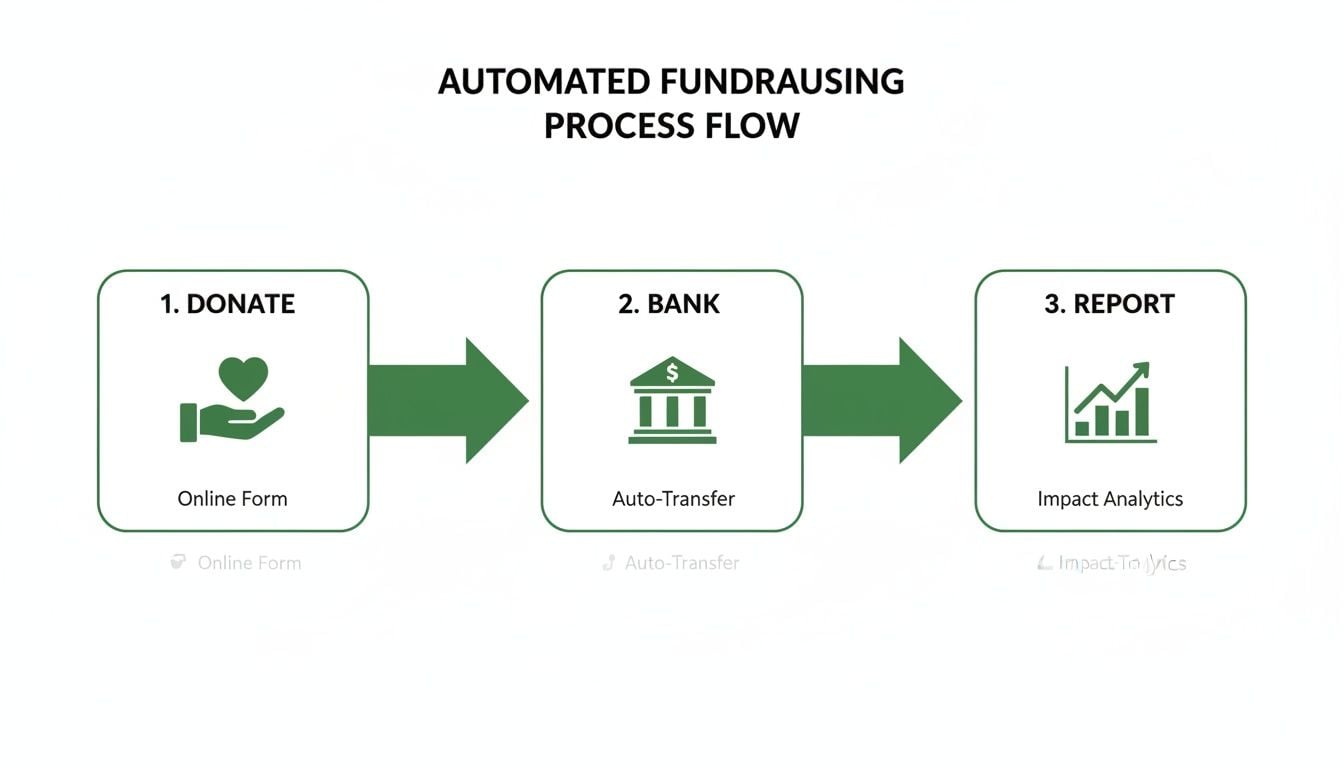
This three-step flow is a game-changer. By removing the manual steps, you not only protect the integrity of your data but also give your team back precious time to focus on ministry, not spreadsheets.
To truly grasp the difference, consider the steps required to process a single donation manually versus with an integrated platform.
Manual vs Integrated Fundraising Workflow
| Task | Manual Workflow (Generic Software) | Integrated Workflow (Grain Ledger) |
|---|---|---|
| Record Donation | Manually enter the $250 donation into a spreadsheet or separate software. | The donation is automatically captured from the giving platform. |
| Assign to Fund | Look up and manually assign the "Kenya Mission Trip 2025" fund code. | The fund designation is automatically recognized and applied. |
| Create Journal Entry | Manually create a journal entry in your accounting software. | The journal entry is created automatically in real-time. |
| Verify Bank Deposit | Wait for the batch deposit, then manually match the $250 gift to the bank statement. | The system automatically matches the bank transaction to the recorded entry. |
| Reconcile Books | Manually check off the entry during month-end reconciliation. | Reconciliation is a one-click confirmation. |
The contrast is stark. An integrated system doesn't just save time; it builds a more resilient and trustworthy financial process from the ground up.
Why Pinpoint Accuracy Is So Critical
This isn't just about administrative efficiency. Precise fund tracking is a matter of mission integrity. Some eye-opening research on fundraising for mission trips shows that only 1.7% of all missions giving—a staggering $1.32 billion out of $78 billion given each year—actually makes it to unreached people groups. You can dig into these global missions giving statistics yourself.
For churches focused on these frontier missions, that statistic is a wake-up call. It highlights the absolute need to ensure every designated dollar goes exactly where it's intended. An integrated system prevents mission trip funds from being accidentally absorbed into larger budgets, giving your treasurer the clean data needed to report with confidence.
By automating fund-based accounting, you create a system where financial integrity is the default. It's no longer dependent on someone remembering the right fund code or catching an error during a tedious manual review. The system itself becomes your safeguard.
From Real-Time Tracking to Instant Reporting
One of the best parts of an automated workflow is seeing your financial position in real time. As soon as you book the team's flights, the expense is immediately recorded against the "Kenya Mission Trip" fund. You can check your budget-to-actuals anytime, not just after the books are closed for the month.
This gives your leadership incredible clarity. When the pastor or missions committee asks, "How are we doing on the Kenya trip fundraising?" you don't have to say, "I'll get back to you." You can pull an accurate, up-to-the-minute report with a single click. That confidence in your numbers empowers smarter decisions and deepens the trust your congregation has in your stewardship.
Related church accounting software resources
If you are comparing software, these pages map the main decision points: fund accounting, QuickBooks limits, pricing, and migration.
- Best church accounting software (2026 comparison) - canonical guide comparing 12 church accounting platforms
- Church accounting software product page - see Grain Ledger for fund accounting, giving, and bank reconciliation
- Small church accounting software - see the product page built for volunteer treasurers and church admins
- Fund accounting features - review how Grain Ledger tracks designated funds
- QuickBooks for churches - understand workarounds and when to switch
- Free church accounting software - compare free options and upgrade triggers
- Grain Ledger pricing - compare plans for small and growing churches
- Start free - try fund accounting, giving imports, and bank reconciliation together
Answering the Tough Questions About Mission Trip Fundraising
Even the most meticulously planned mission trip fundraiser will spark questions. It’s just the nature of it. Getting ahead of these common concerns not only equips your finance team but also shows donors you’re serious about stewarding their gifts well. Let’s tackle some of the most frequent questions we see church leaders grapple with.
What Happens If We Raise More Than Our Goal?
This is a fantastic "problem" to have, and the solution is simple: have a policy in place before you even ask for the first dollar. Being upfront about this from day one is the key to honoring your donors' intentions and avoiding any potential headaches later.
Make sure your policy for handling extra funds is clearly stated right on your donation page and in your fundraising letters. Some solid, time-tested options include:
- Paying it forward: Use the overage to get a head start on the church's next mission trip.
- Blessing your partners: Gift the excess funds directly to the in-country ministry you're serving.
- Building a mission fund: Create a general missions fund to cover future trip-related needs or scholarships.
What Are the IRS Rules for Thanking Donors?
This one is non-negotiable. For any single donation of $250 or more, the IRS requires your church to provide a formal, written acknowledgment. This isn't just a thank-you note; it’s a legal receipt that needs to include the church's name, the donation amount, and a specific statement that no goods or services were provided in exchange for the gift.
And here’s a critical detail: for a donation to be tax-deductible, it must be a gift to the church, not to an individual traveler. The church has to maintain control over how those funds are ultimately used. This is where a system built for church finance, like Grain Ledger, really shines. It can automatically generate the compliant year-end giving statements with all the required IRS language, making sure you stay above board without extra work.
A core principle to remember: donations are irrevocable gifts to the church for its mission. They aren't a payment for someone's plane ticket.
Can a Donor Get a Refund If a Team Member Backs Out?
The short answer here is no. Because these are tax-deductible gifts to the church for its charitable work, they can't be refunded if a specific person is unable to go. The church holds the discretion to use those funds to best accomplish its ministry goals.
So, if a team member has to withdraw, the money they raised can be put toward general trip costs or even help another participant who's struggling to meet their fundraising target. It's absolutely essential that you communicate this policy to all participants—and their supporters—right from the get-go. Managing expectations is everything.
Handling the nuances of fund-based accounting for mission trips is so much easier with the right tools. Grain Ledger is church accounting software built from the ground up to ensure every dollar is tracked properly and used as intended. See how you can build financial integrity into your next mission trip.
Ready to simplify your church finances?
Start free with church fund accounting, or watch a product demo first.