
How to Do Fund Accounting for Churches the Right Way
Learn how to do fund accounting for churches with practical steps for fund setup, restricted gifts, reconciliations, and reporting that builds trust.
A treasurer opens the weekend giving report and sees a capital campaign gift mixed into the same cash balance used for utilities, payroll, and office supplies. The bank account looks healthy, but nobody can answer a basic stewardship question: how much is available for general operations, and how much is already promised to a specific ministry?
About Grain Ledger: This guide includes Grain Ledger, church fund accounting software built for designated gifts and ministry funds. It connects giving platforms (Planning Center, Pushpay, Tithely, Stripe), syncs bank activity with Plaid, and produces fund-level financial reports. Start free to see how it compares for your church.
See Grain Ledger for your church
Fund accounting, giving integrations, and bank reconciliation in one platform. Free migration support for churches switching from QuickBooks or Aplos.
That confusion is why learning how to do fund accounting for churches requires more than adding classes to a general ledger. The work depends on daily controls, accurate donor-intent capture, timely releases, and reconciliations between the giving platform, bank, and books. A church can have a polished chart of accounts and still spend restricted cash accidentally if those operational steps fail.
When Pooled Books Hide a Stewardship Problem
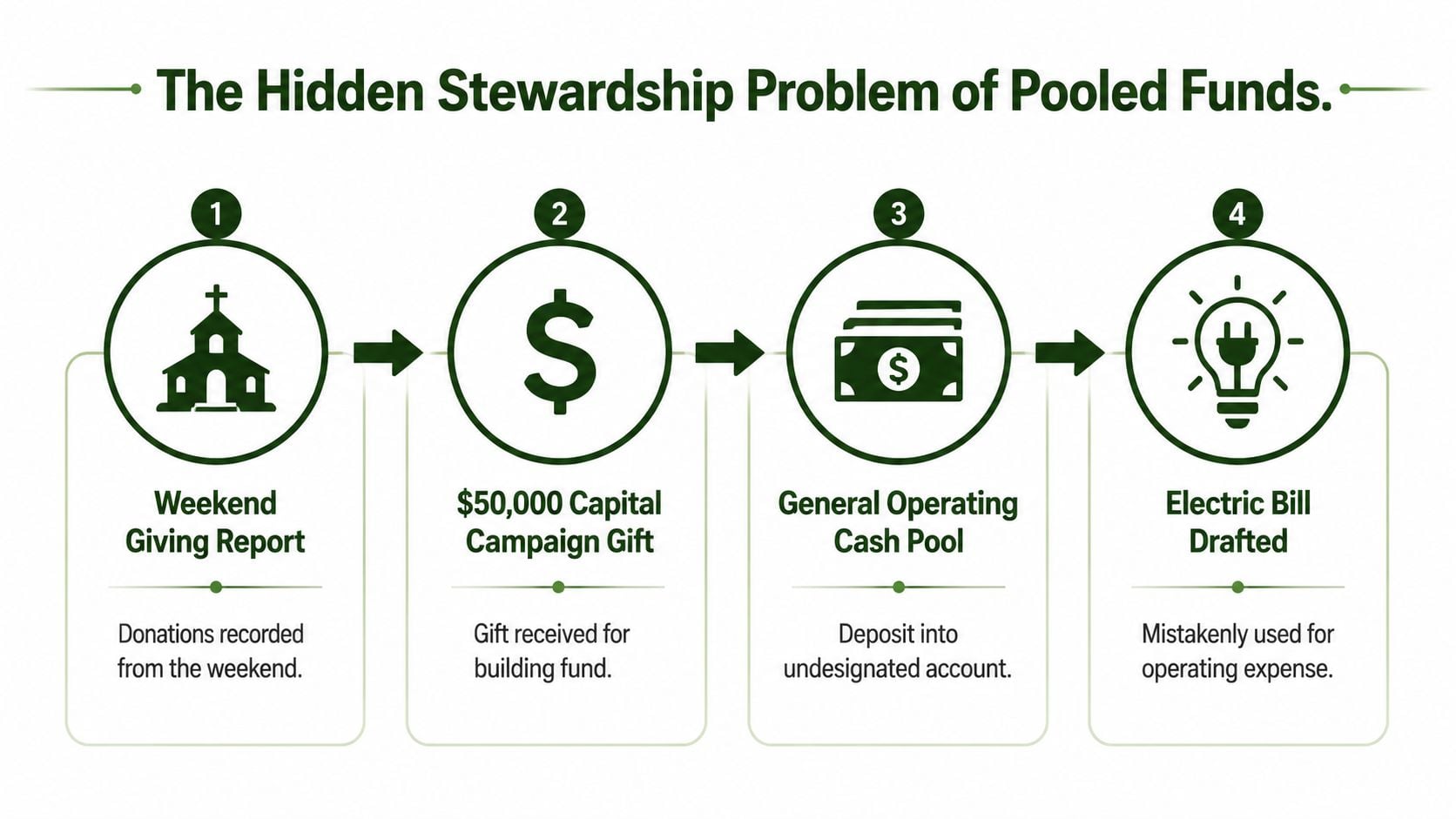
On Sunday morning, a growing church's treasurer opens the weekend giving report and sees a $50,000 capital campaign gift included in general operating cash. The electric bill has already been drafted from that pooled account. The gift was intended for a building project, yet the bookkeeping workflow recorded the deposit without preserving its restriction.
The problem is usually a process failure, not dishonesty. One cash balance, one income statement, and a spreadsheet updated later can make the church appear liquid while the building fund is already overdrawn. Leaders may see healthy reserves without realizing that much of the cash is committed to a donor-restricted purpose.
The cost of losing the boundary
After restricted money pays a general operating expense, the finance team must reconstruct what happened. That work may involve reviewing deposit batches, reading gift memos, tracing transfers, and deciding whether a correction can be posted without distorting the financial statements.
The consequences reach beyond the ledger:
- Donor confidence weakens: A member who pledged to missions may reasonably ask why the gift appears to have paid for copier toner.
- Board oversight becomes less reliable: A combined cash figure does not show which resources are available for current operations.
- Audit questions become harder to answer: Donor-restricted and unrestricted resources must be presented distinctly, consistent with church accounting guidance on net asset classification.
- Pastoral relationships suffer: The pastor often receives the first call when a donor believes the church failed to honor a promise.
Fund accounting prevents this ambiguity by tracking money according to where it came from and how it may be spent. Each fund should stand on its own, with activity reconciled from opening balance through receipts, expenses, releases, and closing balance.
Practical rule: If the finance team cannot identify a gift's fund when it enters the books, the church is relying on memory to protect donor intent.
The operational controls matter as much as the chart. Apply a fund tag to every deposit, record releases promptly, and reconcile giving platforms, bank activity, and the general ledger on a regular schedule. The bank may hold cash in one account, but the books must show which portion supports operating ministry, missions, capital work, or another purpose.
That visibility also exposes a practical risk that reports can hide: restricted cash may not cover payroll or other recurring obligations, even when the total bank balance looks sufficient. A finance director needs fund-level cash visibility before approving expenses, not after month-end reporting.
The historical reason still matters. In June 1993, FASB issued SFAS 116 and SFAS 117 to improve contribution recognition and presentation. The standards became effective for fiscal years beginning after December 15, 1994, with a one-year delay for smaller organizations meeting the specified asset and expense thresholds, as described by the Society for Nonprofit Organizations. That shift moved nonprofits away from inconsistent cash-only reporting toward statements that distinguish donor-restricted resources. Churches still rely on that logic, especially when daily workflows determine whether those distinctions remain accurate.
Designing Your Fund Structure and Chart of Accounts
A church shouldn't create a new fund every time someone mentions a ministry idea. It should create a structure that reflects legal restrictions, internal decisions, and the way leaders need to make spending decisions.
Consider Gracepoint Community Church, a fictional congregation with 450 attendees, a $1.2 million budget, a missions annual appeal, and an active building campaign. Its fund architecture could have three tiers:
- Permanent restrictions: An endowment where the original gift remains subject to the donor's continuing terms.
- Temporary restrictions: The building campaign and missions appeal, each tied to a defined purpose or time condition.
- Board-designated funds: A benevolence reserve and facilities reserve established internally by the board.
The third category requires care. A board designation isn't the same as a donor restriction under GAAP. Internal leadership can track a facilities reserve by purpose, but it remains within net assets without donor restrictions unless an external donor imposed the limitation. The guidance on donor restrictions and board designations explains this distinction.
Map each fund into the ledger
For each meaningful fund, create a consistent mapping across the accounting system:
- Cash sub-account: Shows the fund's share of cash, whether the church uses separate bank accounts or a pooled account with fund-level tracking.
- Revenue code: Identifies gifts received for that fund.
- Expense coding: Prevents project costs from landing in operating activity.
- Net asset class: Distinguishes donor-restricted activity from activity without donor restrictions.
- Fund reports: Presents opening balance, current activity, releases, expenses, and ending balance.
Gracepoint shouldn't create separate physical bank accounts for every ministry. It should, however, maintain a fund record that can answer whether money is available and whether spending fits the fund's purpose. Each fund must reconcile as beginning balance plus current activity equals ending balance, a workflow also outlined in this guide to restricted and unrestricted church funds.
| Restriction Tier | Example Fund | Cash Sub-Account | Revenue Code | Net Asset Class |
|---|---|---|---|---|
| Permanent restriction | Endowment | Endowment cash | Endowment contributions | With donor restrictions |
| Temporary restriction | Building campaign | Building campaign cash | Building campaign gifts | With donor restrictions |
| Temporary restriction | Missions appeal | Missions cash | Missions contributions | With donor restrictions |
| Board designation | Facilities reserve | Facilities reserve cash | General contributions or transfers | Without donor restrictions |
Decide when a fund deserves its own identity
Create a separate fund when the donor, grant agreement, or governing document imposes a distinct purpose, when leaders need a separate spending approval process, or when stakeholders expect a dedicated balance. Keep a project inside an existing fund when it shares the same donor purpose, reporting requirements, and approval rules.
Pastor discretionary funds need dual control. One person should not approve, code, and reconcile those transactions. The pastor can authorize ministry use, while another authorized reviewer verifies documentation, fund eligibility, and posting.
Avoid memo accounts as a substitute for fund structure. A memo note may explain a project, but it won't reliably drive balance-sheet presentation or prevent a transaction from hitting the wrong activity. The chart should mirror the fund design closely, rather than asking staff to remember a separate spreadsheet convention. Churches comparing structures can also review this chart of accounts resource for nonprofits.
Classifying Donations at the Point of Receipt
The best time to classify a donation is when it enters the ledger, not during a cleanup session weeks later. A giving platform should pass the fund designation with the gift so the accounting record begins with the donor's intent intact.
Start by creating a fund code for every active appeal. Gracepoint might use codes for general offering, missions, building campaign, and benevolence. Turn off the generic “general offering” default where the platform allows it, and require the giver to select a fund for every transaction, including text-to-give and kiosk gifts.
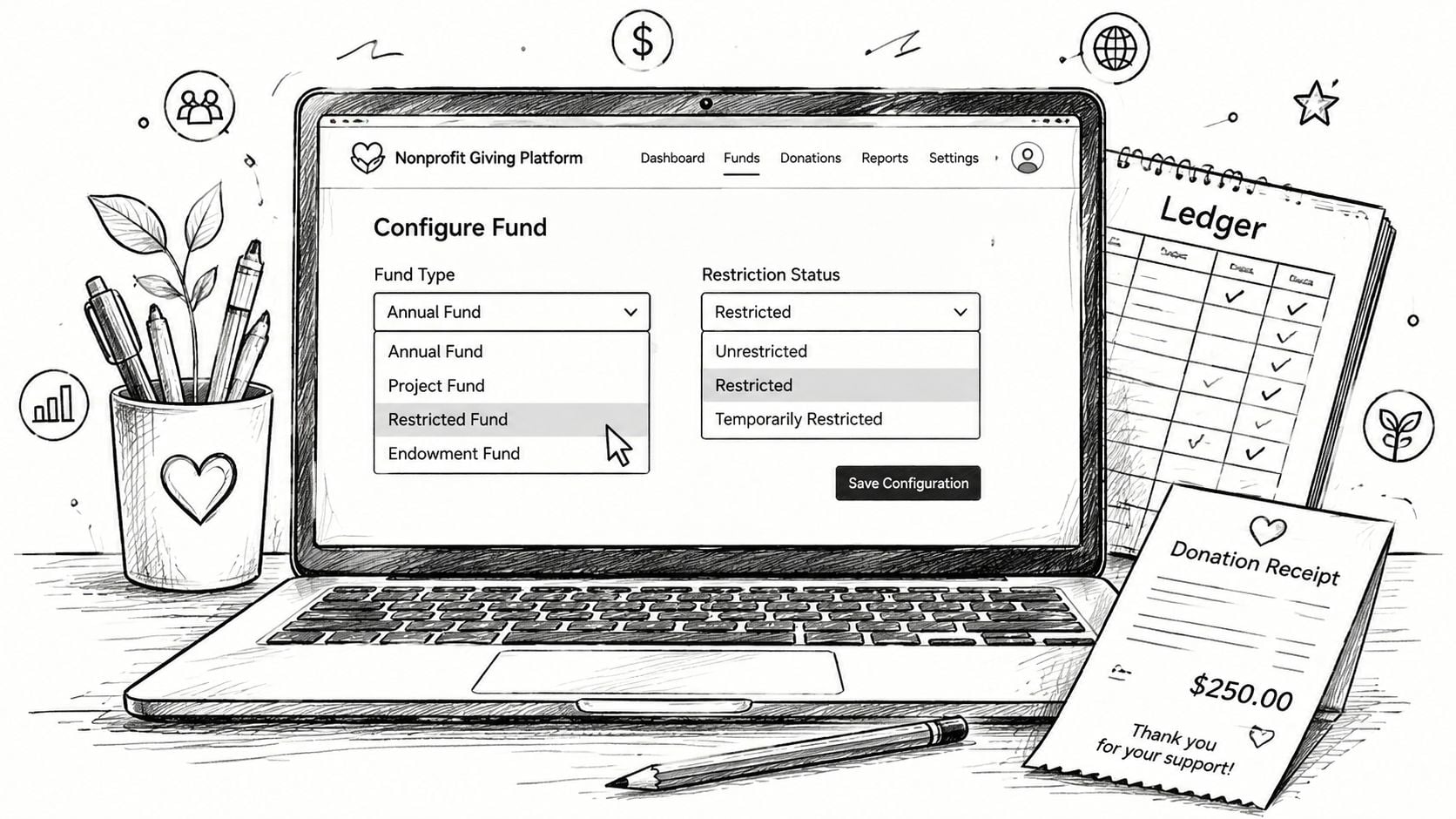
A default fund still has a place for unrestricted gifts. The danger comes when the default captures gifts that donors intended for a named appeal. Giving forms should use plain descriptions, and receipts should repeat the selected purpose so the church and donor share the same record.
Capture ambiguity instead of guessing
Some gifts arrive with language such as “where most needed.” That generally indicates flexibility, but the finance team should preserve the donor's actual wording in the memo field or supporting documentation. Don't interpret a vague note as permission to redirect a clearly designated gift.
Staff shouldn't reclassify a restricted gift. If the church believes a purpose has changed, become impossible, or become impracticable, obtain written donor authorization when appropriate and document the decision. A restriction remains attached until the donor's purpose or time condition is met.
The daily intake process should include:
- Import the tagged gift: Pull the giving-platform file each day so each contribution lands with its fund code.
- Review the deposit batch: Compare the platform total, deposit slip, and bank deposit.
- Investigate exceptions: Separate fees, refunds, failed recurring gifts, and split gifts instead of forcing them into a general line.
- Document off-platform gifts: Record the designation, or the absence of one, for stock gifts, estate gifts, checks, and other receipts outside the normal giving flow.
The accounting treatment follows the gift's status. A donor-restricted contribution is recorded when received or confirmed, not when the church later spends it. The balance remains restricted until the purpose is fulfilled, then the church records a release, as explained in this contribution and restriction guidance.
The finance team should test the complete path from form selection to posted journal entry before launching an appeal. A fund code that exists in the giving platform but doesn't map to the ledger is only a label, not a control.
After the initial configuration and review, a short walkthrough can help staff see how tagged gifts move through the system:
Reconciling Giving Platforms, Banks, and Your Books
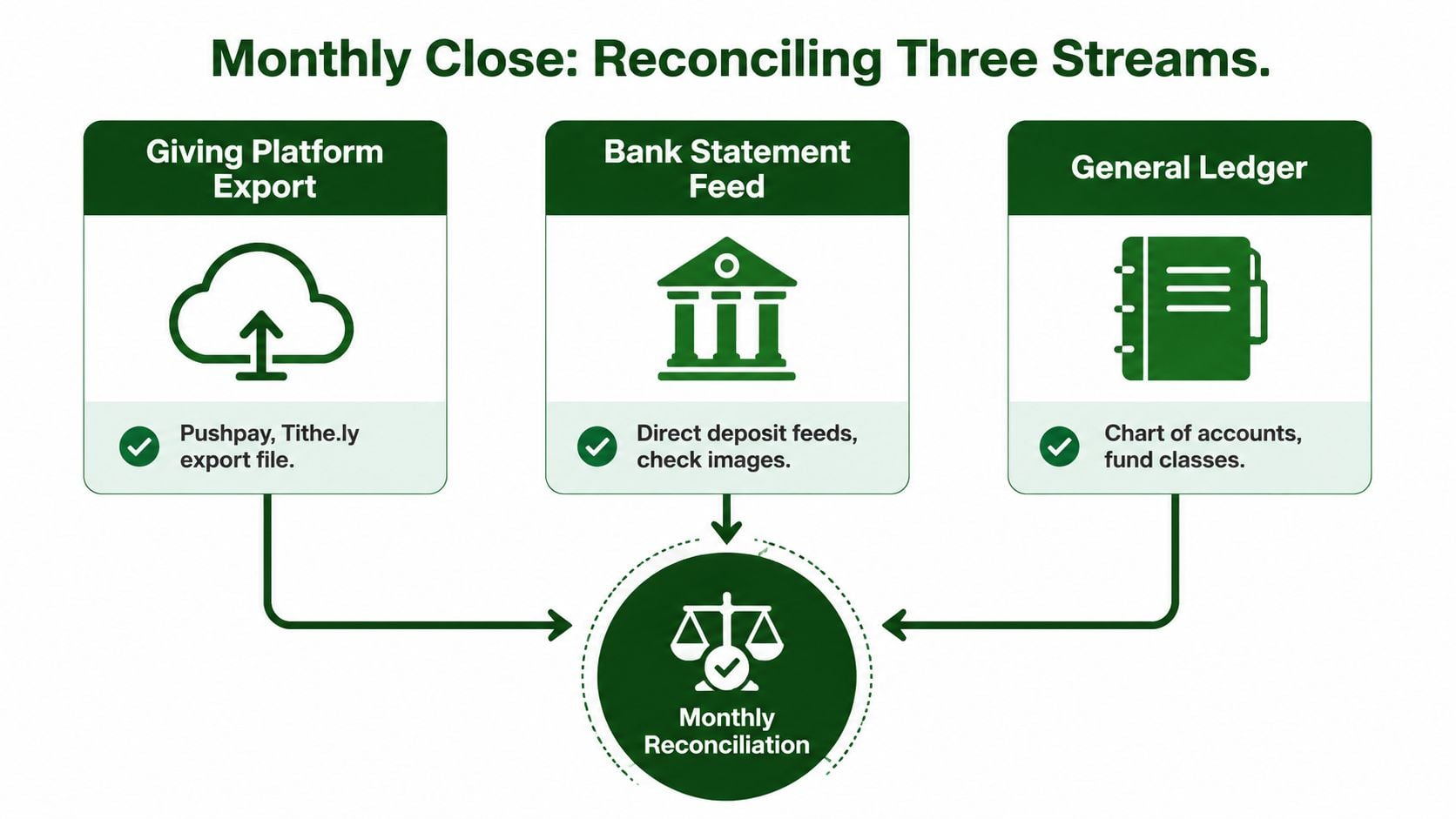
Monthly close brings together three records that rarely move at exactly the same moment:
- The giving-platform export, such as a Pushpay or Tithe.ly file.
- The bank statement feed, including deposits and cleared transactions.
- The general ledger cash account, with fund and net-asset coding.
For Gracepoint, a $2,400 Christmas Eve appeal might appear in the giving platform on December 24, clear the bank on December 27, and reach the operating fund through ACH on December 30. That six-day window can make a restricted balance look available when the cash hasn't cleared, or make the bank appear out of balance when the gift has already been recorded in the platform.
Match the three records line by line
Use a repeatable close procedure rather than a single “does this look right?” review.
- Pull by fund: Export giving activity grouped by fund tag, appeal, payment date, and deposit batch.
- Confirm the bank total: Match the deposit amount to the bank statement, accounting for deposits in transit.
- Post the entry: Code the contribution, cash, fees, and applicable fund activity to the correct restricted or unrestricted records.
- Investigate differences: Set a documented tolerance, such as a 1% review threshold, and research every variance above it.
- Clear exceptions: Assign an owner and due date for missing deposits, refunds, failed gifts, and unposted transfers.
Processor fees create one of the most common discrepancies. The platform may show the donor's gross gift while the bank deposits only the net amount. Refunds can appear as negative contributions, and recurring gifts can fail when a card expires. Stock gifts may arrive through a custodian or broker with no fund designation, requiring documentation before posting.
A bank reconciliation statement should show the path from ledger balance to bank balance, including outstanding deposits, uncleared payments, fees, and corrections. Finance volunteers who need a practical reference can use this bank reconciliation statement guide to standardize the supporting schedule.
Set ownership before the board meeting
The person who imports giving data shouldn't be the only person approving the final reconciliation. Assign the preparation, review, and escalation roles in writing. The close calendar should specify the date the reconciliation is due, the reviewer responsible for sign-off, and the point at which unresolved items reach the finance chair.
A board packet should never be the first place an unexplained fund variance appears.
Integration can reduce duplicate entry, but only if the mapping preserves fund tags, fees, refunds, and deposit timing. Churches evaluating system connections can review this accounting software integration overview before selecting an import or synchronization method.
The final checkpoint is operational, not cosmetic. Before the board sees the report, the treasurer should know which deposits are still in transit, which gifts lack designations, which restricted expenses await release, and whether available cash covers upcoming operating obligations.
Recording Releases and Producing Fund-Level Reports
A roof project can be complete while the books still show the gift as restricted. That mismatch usually appears when release entries are treated as year-end cleanup instead of part of the spending workflow. The release connects donor-restricted resources to the activity they funded and keeps fund reports aligned with actual ministry work.
Suppose Gracepoint receives a $50,000 restricted gift for a roof replacement. The cash remains associated with the capital fund while the project is pending. Once the church pays an eligible invoice, the expense belongs to the project activity, and the finance team records the release required by its accounting policy. Post the entry as part of the invoice review, not weeks later.
Post the release at the spending event
Account names vary by ledger design, but the accounting sequence should remain clear:
- Record the qualifying roof expense in the appropriate project activity.
- Debit the release-from-restriction account, often presented as net assets released from restriction.
- Credit the corresponding release or transfer activity in the unrestricted presentation.
- Attach the invoice and approval to the journal entry.
The entry does not create cash. It records that the donor's condition has been met and shows the related movement in the statement of activities. A late release leaves leadership looking at a restricted balance that fails to reflect completed spending. It can also obscure whether the church has enough unrestricted cash for payroll and other operating obligations.
Under ASC 958, not-for-profit entities present net assets in two categories, with donor restrictions and without donor restrictions. ASU 2016-14 replaced the older three-class model for fiscal years beginning after December 15, 2017. A capital campaign gift remains in the donor-restricted category until its purpose is met, while a general offering belongs in the category without donor restrictions.
Build reports people can read
A fund-level reporting package should answer three practical questions: what came in, what was spent or released, and what remains available. Include:
- Statement of Financial Position: Present assets, liabilities, and net assets by relevant fund or restriction class.
- Statement of Activities: Show revenue, releases, expenses, and changes for restricted and unrestricted activity.
- Fund-balance dashboard: Give pastors and board members a quick view of beginning balance, receipts, spending, releases, and available cash.
Use weekly internal snapshots for active campaigns and cash-sensitive ministries. Prepare monthly board packets, then review trends and unresolved restrictions with leadership quarterly. Group similar funds, suppress zero-balance rows, and use plain-language labels rather than account numbers alone.
| Fund | Revenue | Releases In | Releases Out | Expenses | Net Change | Ending Balance |
|---|---|---|---|---|---|---|
| General operating | General gifts | Restricted releases | Operating support | Operating costs | Revenue plus releases less expenses | Current operating balance |
| Missions appeal | Missions gifts | None | Releases for qualifying use | Missions expenses | Gifts less releases and expenses | Remaining missions balance |
| Building campaign | Capital gifts | None | Releases for qualifying construction use | Roof or building costs | Gifts less releases and expenses | Remaining capital balance |
| Benevolence reserve | General gifts designated by board | Internal transfers | Internal transfers | Benevolence assistance | Current activity | Board-designated balance |
The report must separate accounting classification from liquidity. Restricted net assets can exist while unrestricted cash is insufficient for payroll, utilities, or other operating costs. Review both the fund balance and the cash position before approving new commitments. A clean report shows what the church may spend under donor terms, while a useful management report also shows what it can pay now.
Choosing Software Built for Church Fund Accounting
Generic accounting software can record debits and credits. The harder question is whether it can preserve donor intent from receipt through reconciliation and reporting without turning the finance team into a manual tagging department.
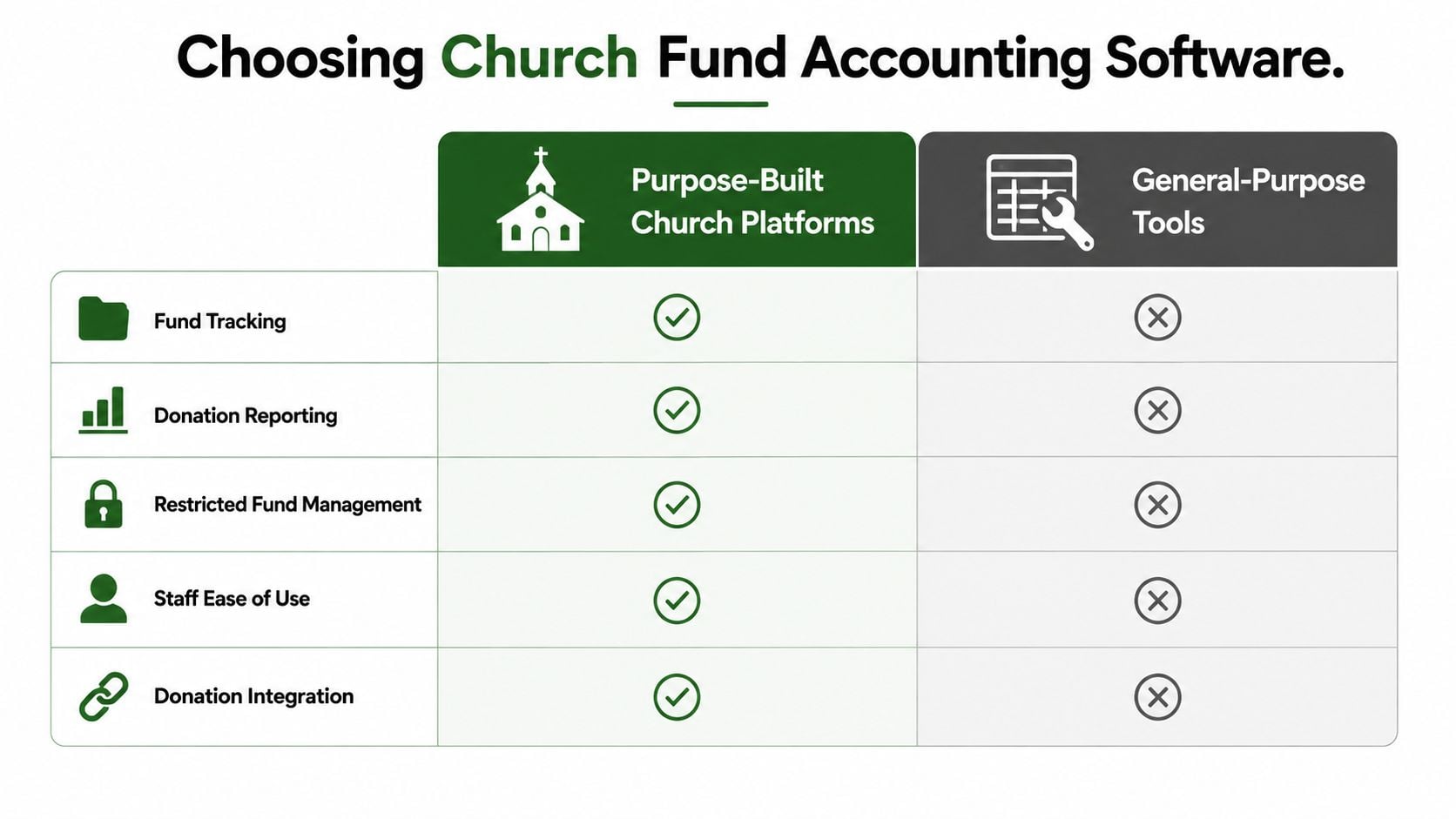
QuickBooks with classes is familiar and often cheaper to maintain. Spreadsheets are flexible at first. A generic ERP may offer broad controls and integrations. But classes are not funds, and a class label added after posting doesn't automatically create a self-balancing fund or protect restricted cash from operating use.
Compare the architecture, not the brand list
Evaluate tools against the workflow that fails in churches:
| Criterion | Purpose-built church platform | Retrofitted general-purpose tool |
|---|---|---|
| Native fund tracking | Funds are a primary accounting dimension | Funds may depend on classes, projects, or custom fields |
| Donor-restriction capture | Giving tags can map into accounting at receipt | Staff may need to reclassify or double-tag |
| Release entries | Workflow can support releases tied to activity | Releases may require manual journal entries |
| Giving integrations | Fund tags can travel with imported gifts | Exports may lose detail or need spreadsheet cleanup |
| Audit-ready reporting | Fund-level reports are part of the reporting model | Reports may require custom views and manual consolidation |
The trade-off with QuickBooks is real. Familiarity lowers the training hurdle, but double-tagging every transaction can create a reconciliation burden that consumes the savings. A spreadsheet can document a correction, but it can't reliably stop an incorrectly coded bill before payment.
A purpose-built system treats restrictions as first-class accounting objects. That design matters because the fund is present at the point of transaction, rather than being a label someone adds during month-end cleanup.
Use a five-question committee test
Ask your current provider:
- Can a gift enter the ledger with its fund designation intact?
- Can the system show restricted cash separately from unrestricted cash?
- Can staff connect a qualifying expense to a release entry without reconstructing the history?
- Can giving-platform imports preserve fees, refunds, recurring gifts, and split designations?
- Can the board receive readable fund reports without manual class tagging?
For churches that want a fund-native option, Grain Ledger organizes accounts, transactions, and reports around funds, supports integrations with church giving and banking tools, and provides fund-level reporting designed for stewardship review. Its approach is different from adding classes to a pooled bookkeeping model. Finance committees comparing reporting capabilities may also find this overview of board-ready fund accounting reports useful when defining their requirements.
Read the implementation details in this fund-based accounting software guide, then score the current tool. If staff still export to spreadsheets, manually reconstruct donor intent, or discover restricted cash problems during board meetings, the architecture is already costing more than its subscription price suggests.
Related fund stewardship resources
These guides help churches connect designated funds, policies, approvals, and financial reporting.
- Church benevolence fund guide - set policy, approvals, and accounting controls
- Restricted fund guide - understand donor restrictions and fund balances
- Fund accounting in Grain Ledger - track designated gifts and ministry funds in the ledger
- Best church accounting software - compare software that tracks restricted gifts and ministry funds
- Schedule a Grain Ledger demo - see fund-level reports and bank reconciliation
A 30-Day Starter Plan and Stewardship Mindset
A church doesn't need to rebuild every financial process at once. A focused rollout can establish the controls that prevent the most damaging failures, especially when the treasurer documents the work and assigns a second reviewer.
Week one creates visibility
Document the current fund map. List every open capital campaign, missions appeal, benevolence balance, endowment, and board designation. Pull three months of giving exports and compare the stated fund designations with the chart of accounts.
Flag items that need clarification. A fund with no written purpose, an old campaign with a remaining balance, or a gift whose donor intent is unclear shouldn't disappear into general operating activity. Keep an exception log and assign someone to resolve each item.
Week two fixes the structure
Build the new chart of accounts and map each fund to its cash, revenue, expense, and net-asset records. Migrate the fund tags from the old spreadsheet, but don't import unexplained balances as if they were clean opening figures.
Use the migration as a chance to distinguish donor restrictions from board designations. If the church is preparing a new appeal, also review campaign design and documentation. Teams planning a new initiative can use this guide to launching nonprofit campaigns for broader campaign workflow ideas, then adapt the documentation to church governance.
Week three tests the close
Run reconciliation drills against the bank feed and giving-platform exports. Match deposits, fees, refunds, failed recurring gifts, and transfers. Post sample restricted receipts and releases, then trace each one from source document to report.
Don't aim for a visually perfect dashboard before the underlying exceptions are resolved. The first objective is a ledger that can explain every material difference and identify who owns the correction.
Week four gives the board a usable answer
Produce the first fund-level statement of financial position and statement of activities. Walk the board through restricted balances, releases, and cash coverage. Show which money is available for operating needs and which money is committed elsewhere.
Fund accounting is more than compliance. When members see that designated gifts remain protected month after month, the finance team earns credibility, campaigns gain clearer accountability, and pastors can speak about stewardship with confidence. Accurate bookkeeping becomes part of discipleship because it demonstrates that the church treats every contribution as a responsibility, not merely as cash received.
Start with the Sunday giving report that currently causes the most uncertainty. Trace one gift, one deposit, one expense, and one release through your existing system, then use the result to prioritize the first correction.
Grain Ledger provides church-focused fund accounting that connects giving platforms, bank activity, and fund-level reporting so restricted gifts remain visible from receipt through release. Visit Grain to Start Free and evaluate a workflow built around the way church finance teams manage stewardship.
Ready to simplify your church finances?
Start free with church fund accounting, or watch a product demo first.