How to Forecast Cash Flow for Churches
 By Gibson Brueher, Founder of Grain Ledger
Learn how to forecast cash flow for your church with a practical 13-week rolling model. Track donations, restricted funds, and expenses using Grain Ledger.
A church can have a healthy annual budget and still find itself short of cash when the next payroll approaches. Giving may slow after the holidays while utilities, salaries, mortgage payments, and vendor bills continue on schedule. The budget explains whether planned income should cover planned expenses. A cash flow forecast answers the more urgent question: will the right money be in the right account when each payment is due?
About Grain Ledger: This guide includes Grain Ledger, church fund accounting software built for designated gifts and ministry funds. It connects giving platforms (Planning Center, Pushpay, Tithely, Stripe), syncs bank activity with Plaid, and produces fund-level financial reports. Start free to see how it compares for your church.
See Grain Ledger for your church
Fund accounting, giving integrations, and bank reconciliation in one platform. Free migration support for churches switching from QuickBooks or Aplos.
For churches, learning how to forecast cash flow means working with fragmented receipts, donor designations, fund restrictions, and timing differences that generic business templates often overlook. A useful forecast turns those details into a weekly operating discipline, giving treasurers, pastors, and boards time to respond before a temporary gap becomes a ministry disruption.
Why Church Cash Flow Forecasting Is Different
The treasurer notices the problem during a routine review. The annual budget looks balanced, and the church's projected giving appears sufficient for the year. Yet February's bank balance is tightening because post-holiday giving has softened, while payroll, utilities, insurance, and facility costs remain largely unchanged.
Nothing is necessarily wrong with the annual budget. It answers a different question. A budget allocates expected income and expenses across a planning period, while a forecast follows the timing of actual cash movement. A pledge recorded for the year doesn't pay a bill until the donor's money reaches the account.

A balanced budget can hide a cash gap
Church receipts rarely behave like sales revenue from a business with predictable invoices. They can include weekly tithes, monthly pledges, occasional large gifts, seasonal offerings, grants, room-use fees, and online donations that arrive after processing. Each source has its own pattern, and each may belong to a different fund.
A building gift can't automatically pay an operating bill because both amounts sit within the church's overall cash position. Church accounting guidance recommends separating restricted and unrestricted funds in the accounting records and annual accounts. Under ASC 958, not-for-profits classify net assets into two categories, making fund-level visibility a control requirement rather than a reporting preference. See this practical overview of cash flow statements for nonprofits for the distinction between reporting past cash activity and planning future liquidity.
Practical rule: Treat available operating cash as the amount that can be used for approved operating obligations, not the total balance shown across every church account.
Forecasting supports stewardship
The fiduciary responsibility is straightforward. Leaders need to know what money has arrived, what it can fund, and when unrestricted cash may be available for ordinary commitments. A rolling forecast makes that responsibility visible without confusing a donor's intention with cash already received.
The horizon also matters. A 2026 benchmark report found that the average 13-week forecast reached 87% accuracy, while annual forecasts fell to 72%. The same report stated that weekly updating improved accuracy by 25%, and AI-assisted forecasting reached 94% accuracy, demonstrating that cadence and data automation affect forecast performance (2026 cash flow forecasting benchmark).
A church doesn't need to predict every future receipt perfectly. It needs a dependable near-term view that shows whether payroll, vendors, utilities, and restricted-purpose commitments can be met from the funds legally and practically available for them. That makes forecasting part of transparent ministry finance, not an administrative extra.
Choosing the Right Forecasting Method and Timeframe
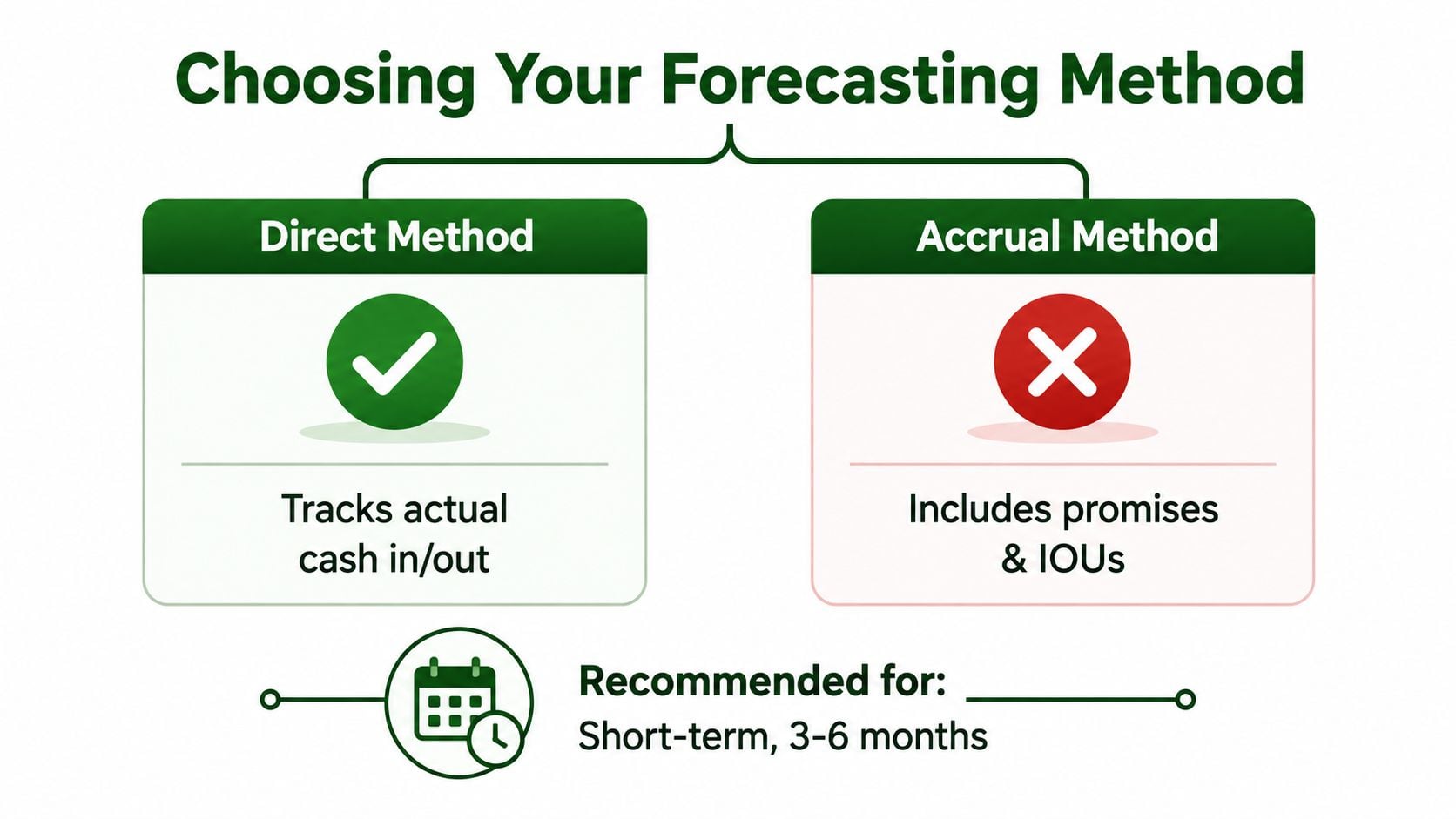
For short-term church liquidity, use the direct method. It records expected cash receipts and expected cash disbursements, rather than beginning with accrual income and adjusting for non-cash items. If the question is whether the operating account can cover next week's payroll, actual cash timing is more useful than revenue recognized on paper.
A guide to short-term forecasting specifically recommends weekly direct-method forecasts, weekly recording of actuals, and regular review of forecast-versus-actual variances (weekly direct-method forecasting guidance).
Build the weekly equation
Set up one column for each week in the forward view. Each column should contain:
- Beginning cash: The balance available at the start of the week, separated by fund or account where needed.
- Cash receipts: Giving, pledges, grants, rentals, offerings, and other receipts expected to settle that week.
- Cash disbursements: Payroll, utilities, debt service, suppliers, ministry spending, and other payments expected to clear.
- Net movement: Total receipts less total disbursements.
- Projected closing cash: Beginning cash plus net movement.
The core relationship is simple:
Beginning cash + cash inflows minus cash outflows = ending cash.
A practical short-term model normally uses a rolling 13-week window. That period gives the treasurer weekly visibility while preserving enough lead time to delay discretionary spending, confirm a grant, communicate with leadership, or arrange an approved response to a projected gap.
Keep the forecast rolling
At the end of each completed week, replace estimates with actual receipts and payments. Drop that completed week, then extend the forecast by one future week so the model continues to show the next 13 weeks.
Don't record a bill merely because its invoice is due. Record the payment in the week you expect cash to leave the account. For a broader walkthrough, this resource on how to build a cash flow forecast is useful for understanding the mechanics, but church treasurers must add fund restrictions and donor-designated timing to the model.
Gathering Fund-Level Inputs for Your Forecast
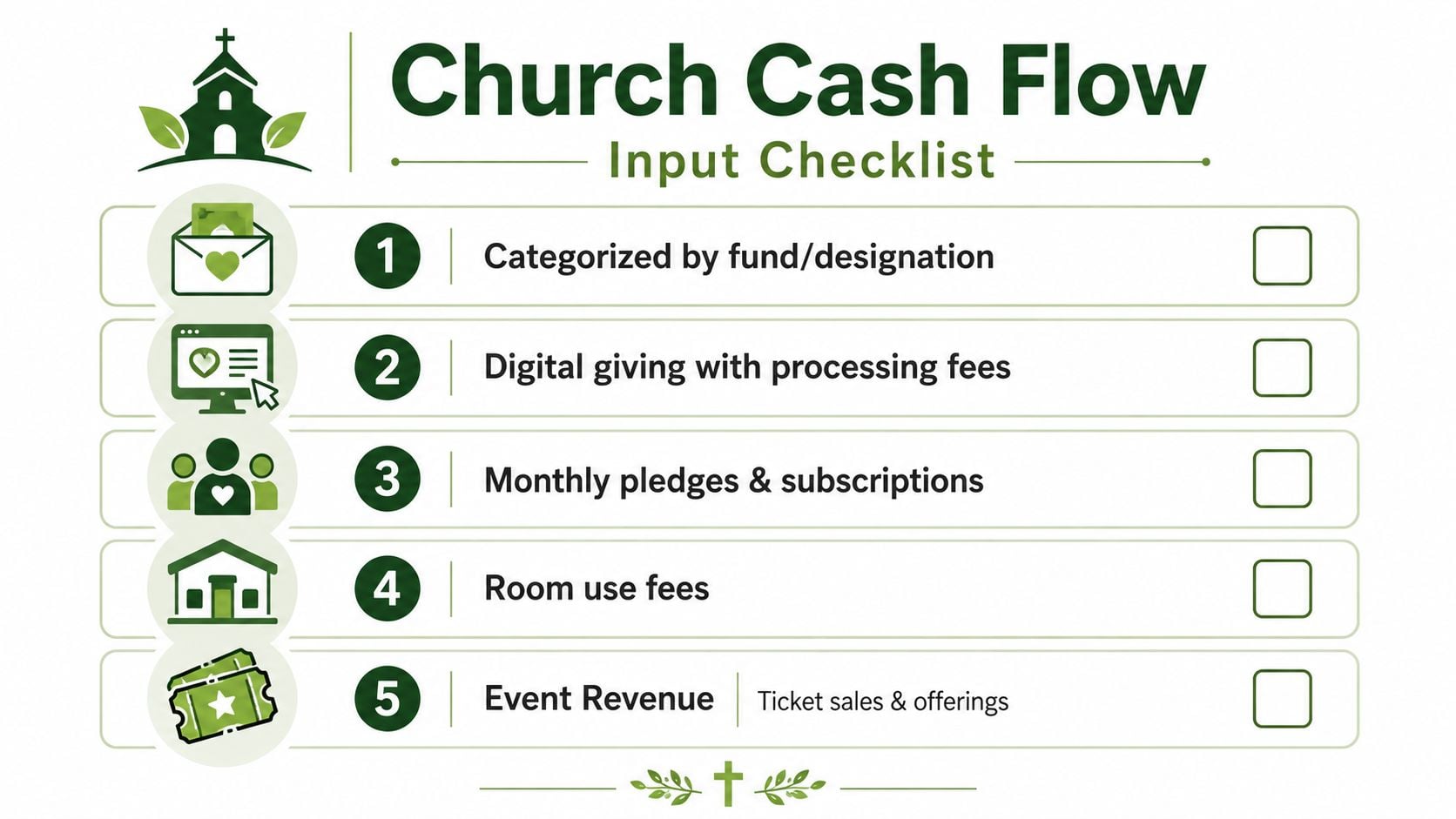
A forecast is only as reliable as its input inventory. Start by listing every cash source and every payment stream, then assign each item to the fund, account, and expected settlement week that apply.
For receipts, include regular giving, recurring pledges, online donations, special offerings, grants, facility rentals, event income, and designated gifts. A pledge belongs in the forecast according to the expected receipt date, not the date someone entered the commitment. If a grant has been approved but the release date is uncertain, record the uncertainty in the assumptions rather than treating the grant as operating cash.
Separate money by purpose
Restricted and unrestricted funds need separate treatment. Church accounting guidance explains that ASC 958 classifies not-for-profit net assets into two categories, and advises church treasurers to show restricted and unrestricted funds separately in both accounting records and annual accounts (church accounting guidance on restricted funds).
That separation should appear in the forecast itself. At minimum, identify:
| Forecast area | Examples | Control question |
|---|---|---|
| Unrestricted operating | General giving and ordinary receipts | Can this pay normal operating commitments? |
| Building or capital | Campaign gifts and facility grants | Is spending limited to an approved project? |
| Missions or outreach | Donor-designated mission gifts | Has the intended ministry been identified? |
| Other restricted purposes | Youth, benevolence, or special programs | What cash date and release condition apply? |
A total bank balance can create a false sense of security if restricted receipts are mixed into one available-cash figure. Use fund accounting for churches to strengthen the underlying classification before relying on forecast totals.
Inventory the payments
List fixed commitments first. Payroll, payroll taxes, mortgage or lease payments, insurance, utilities, software, and recurring vendor contracts usually have identifiable payment patterns. Then add variable and irregular items, including events, repairs, facility maintenance, supplies, benevolence payments, capital purchases, and annual renewals.
Ask the person responsible for each area to confirm the expected cash date. The bookkeeper may know the invoice date, but the ministry leader may know when an event deposit will be paid. Those details belong in the weekly model.
A forecast should follow the money's intended use and expected movement, not merely the chart of accounts.
Finally, document assumptions beside uncertain inputs. Note whether a receipt is committed, recurring, seasonal, or speculative. Mark whether an expense is contractual, approved, discretionary, or pending. That record helps the board understand why the forecast changed and prevents optimistic guesses from becoming “expected” cash.
Modeling Seasonality and Timing of Receipts
Church giving is often uneven. Holiday generosity, year-end giving, special campaigns, school calendars, worship patterns, and local circumstances can all affect when receipts arrive. The useful question isn't whether giving is seasonal. It's how that seasonality affects the week in which cash becomes usable for each purpose.
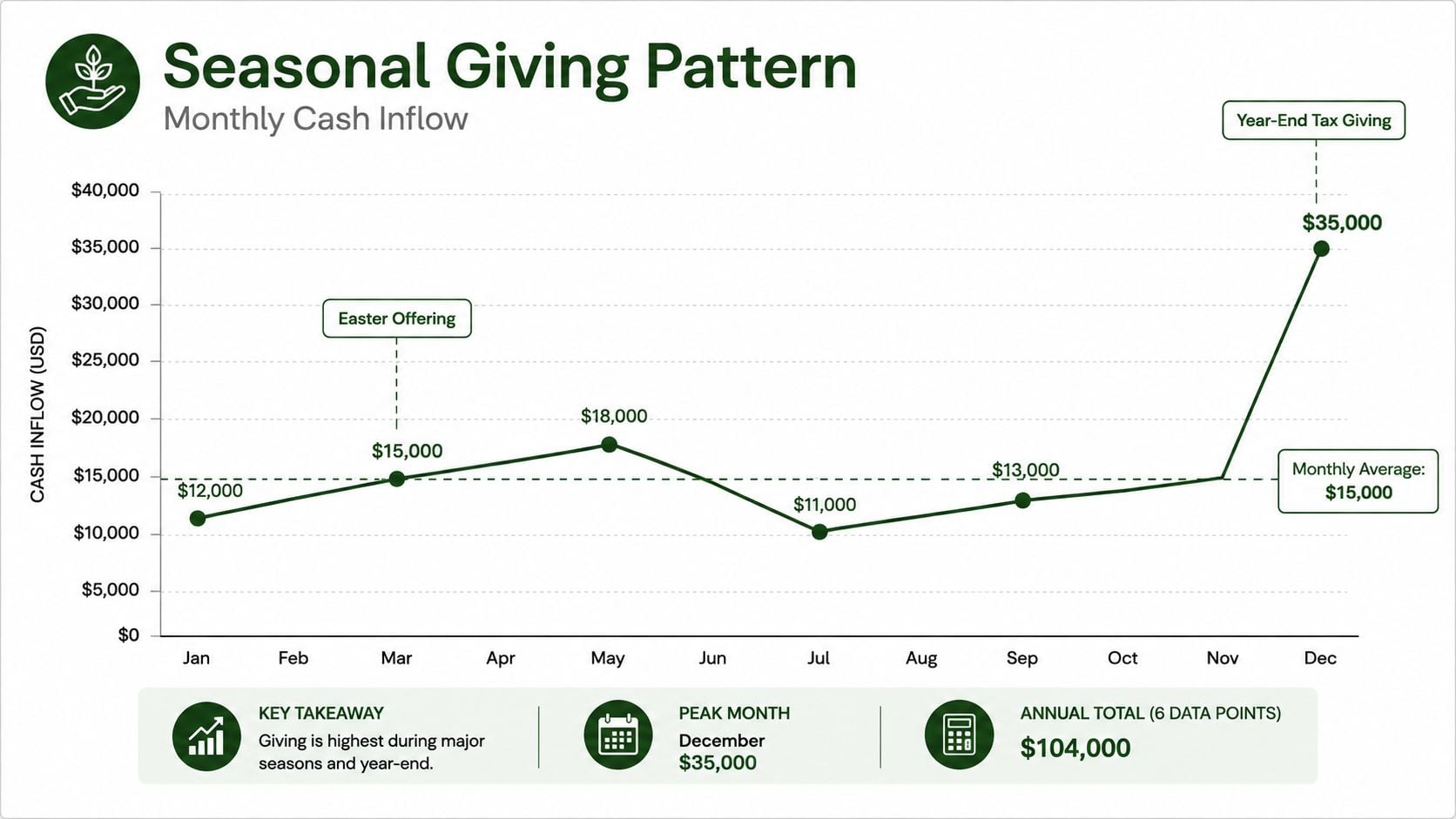
Start with the church's own transaction history. Review when recurring gifts settled, when pledge payments tended to arrive, and when special offerings produced cash. Look for recurring timing patterns such as a post-holiday slowdown, an Easter offering, or a year-end surge, but don't assume a pattern exists until the records support it.
The supplied visual illustrates a hypothetical seasonal pattern, including monthly inflows of $12,000 in January, $15,000 in March, $18,000 in May, $11,000 in July, $13,000 in September, and $35,000 in December, with a stated monthly average of $15,000. Those figures belong to the illustration, not to a church-wide benchmark, so use them only as a visual example.
Model cash dates, not promises
A donor may intend to give monthly but pay irregularly. A grant may be approved before the funds are released. An online gift may settle after processing, and a special offering may arrive in batches. Put the expected deposit date in the receipt row, and keep the designation in the fund column.
For weeks 1 through 4, use bottom-up transaction information wherever possible. For weeks 5 through 13, use driver-based assumptions informed by giving patterns, known campaigns, grant schedules, and recurring commitments. This hybrid structure is recommended in short-term forecasting guidance because it combines near-term detail with practical assumptions farther out (13-week short-term cash flow model guidance).
A useful assumption might be, “recurring online gifts normally settle during this week,” rather than, “monthly giving equals the budget divided evenly.” The first reflects transaction timing. The second can conceal the very cash gap the forecast should reveal.
For churches reviewing digital giving options or changing collection practices, this online giving guide for churches offers context for evaluating how giving channels may affect receipt records and settlement timing.
Seasonality should influence decisions, not just charts. If unrestricted receipts typically weaken during a known period, leadership can schedule nonessential purchases outside that window, confirm reserve policies, and avoid treating restricted year-end gifts as a solution for an operating shortfall. Forecasting works when it respects the difference between when money is promised, when it arrives, and what it can fund.
Running Scenarios and Reconciling to Actuals
A single forecast can create false confidence. Build an expected case, a stronger-receipts case, and a stressed case, then compare the projected lowest operating balance in each version.
The expected case should use documented giving patterns, known payment dates, and approved spending. The stronger-receipts case can reflect faster pledge collection or a better-than-expected offering without treating uncertain gifts as guaranteed. The stressed case should delay a major donor pledge, postpone a grant release, reduce an anticipated campaign receipt, or increase a variable expense when there is a reasonable risk that it will do so.
Ask decision-focused questions
Scenario planning becomes useful when it changes an action. Test questions such as:
- Restricted receipt delay: What happens if a building gift arrives later than expected? Does the building project have enough separately available cash?
- Operating softness: What happens if general giving falls below the expected pattern? Which discretionary expenses can be rescheduled?
- Cost pressure: What happens if utilities or facility repairs exceed the current assumption? Does the operating account remain above the church's internal threshold?
- Timing mismatch: What happens if the receipt is certain but arrives after payroll or a vendor payment?
For a broader treatment of scenario analysis methods for analysts, focus on the discipline of changing defined assumptions rather than creating arbitrary optimistic and pessimistic totals.
Reconcile every completed week
At the weekly close, compare the forecast with the bank balance and transaction records. Replace the completed week's estimates with actuals, then investigate each material variance.
A 2025 treasury survey cited in a 2026 industry analysis found that only 52% of organizations said their 13-week forecasts were accurate within plus or minus 10%, leaving 48% with wider variance. The same analysis associated wider variance with unplanned borrowing, idle cash, or missed investment windows (13-week forecast accuracy analysis).
Don't overwrite a missed estimate. Identify the cause. Was an online receipt delayed, was a pledge assumption too optimistic, did a vendor payment clear earlier, or did someone omit a recurring withdrawal? Update the remaining weeks only after recording what the variance teaches you.
A brief weekly meeting can cover the opening balance, the lowest projected operating balance, restricted receipts expected, significant payments, and changes requiring board or pastoral attention. The forecast should end with a decision, not merely a refreshed spreadsheet.
Related church accounting software resources
If you are comparing software, these pages map the main decision points: fund accounting, QuickBooks limits, pricing, and migration.
- Best church accounting software (2026 comparison) - canonical guide comparing 12 church accounting platforms
- Church accounting software product page - see Grain Ledger for fund accounting, giving, and bank reconciliation
- Small church accounting software - see the product page built for volunteer treasurers and church admins
- Fund accounting features - review how Grain Ledger tracks designated funds
- QuickBooks for churches - understand workarounds and when to switch
- Free church accounting software - compare free options and upgrade triggers
- Grain Ledger pricing - compare plans for small and growing churches
- Start free - try fund accounting, giving imports, and bank reconciliation together
Automating Forecasts with Grain Ledger
Manual spreadsheets are useful for learning the model, but they become fragile as the church adds funds, bank accounts, giving channels, cards, and reporting requirements. One omitted transfer or misclassified deposit can distort both the available balance and the fund's projected position.
Most cash flow guidance is written for sales-driven organizations with conventional revenue streams. It rarely addresses the church treasurer's central problem, fragmented, restricted, donor-designated inflows (2026 cash flow management analysis).
Use a fund-native system
Grain Ledger is built for church accounting with native fund architecture. Accounts, transactions, and reports are organized around funds from the beginning, so the finance team doesn't have to simulate fund accounting through spreadsheet tabs or after-the-fact classifications.
Grain connects giving platforms, bank accounts, and accounting workflows so donations can flow into the appropriate funds. Its integrations include church tools such as Planning Center, Pushpay, Stripe, and bank and card connections through Plaid. Built-in controls help keep restricted funds restricted, while fund-level balance sheets, cash flow reports, and activity reports give leaders a clearer view of ministry liquidity.
For churches that want to formalize forecast inputs and budgeting alongside fund-level reporting, Grain's church budgeting features provide a practical place to connect approved plans with actual financial activity. Automation doesn't eliminate judgment. It reduces repetitive collection and classification work, leaving the treasurer more time to review timing, restrictions, scenarios, and decisions.
Grain brings fund-based accounting, giving and banking integrations, and church-focused cash flow reporting into one workflow, so your forecast can stay connected to the transactions that drive it. Visit Grain to Start Free and prepare your church for clearer, more accountable liquidity planning.
Ready to simplify your church finances?
Start free with church fund accounting, or watch a product demo first.