Matching Grant Fund: A Church's Guide to Setup & Admin
Learn to establish, administer, and report on a matching grant fund for your church. Our guide covers fund accounting, controls, and donor tracking.
A matching grant fund can feel like a gift and a test at the same time. The offer lands, everyone gets excited about the ministry it could support, and then the practical questions start immediately. Which gifts qualify, where do they go in the books, and how do you prove the match was met without losing track of restricted dollars?
About Grain Ledger: This guide includes Grain Ledger, church fund accounting software built for designated gifts and ministry funds. It connects giving platforms (Planning Center, Pushpay, Tithely, Stripe), syncs bank activity with Plaid, and produces fund-level financial reports. Start free to see how it compares for your church.
See Grain Ledger for your church
Fund accounting, giving integrations, and bank reconciliation in one platform. Free migration support for churches switching from QuickBooks or Aplos.
For churches, the work isn't just raising money. It's building a clean accounting trail that protects donor intent, keeps restricted funds separate, and gives the board a report it can trust. That discipline matters because matching programs are widespread in the nonprofit world, with over 26 million people working for companies that offer matching gift programs, those gifts accounting for an estimated $2.86 billion per year in corporate cash contributions, while $4 billion to $7 billion in matching funds goes unclaimed annually when tracking breaks down (Double the Donation matching gift statistics).
A church that handles the books well can turn a confusing campaign into a simple stewardship story. If you're also planning the public side of the effort, a practical resource on modern church fundraising campaigns can help you think through the donor experience while you build the accounting structure underneath it.
The Opportunity and Challenge of a Matching Grant
A major donor tells your church it can secure a matching grant for a building wing, youth ministry, or outreach effort. That sounds straightforward until the treasurer asks the first hard question. What exactly counts toward the match, and how do we show it in the ledger without blurring restricted money with operating cash?
That is the heart of a matching grant fund. The opportunity is real because matching structures can bring in outside support that would never arrive through normal offerings alone. A public grant program in Nevada shows how strong the upside can be. Its report shows state match dollars paired with federal funds across multiple fiscal years and a strong return for applicants awarded to date (Nevada Grant Matching Program report).
Why the accounting matters more than the applause
A church can celebrate the campaign publicly and still fail internally in the books. If the finance team does not separate restricted gifts from general receipts, the match can look good on Sunday but become hard to defend in an audit or board review later.
A common failure shows up when cash is deposited into the main operating account first and sorted out later. At that point, the treasurer may know the money was intended for the match, but the ledger does not. One donor's restricted gift gets mixed with another unrestricted contribution, then the church cannot show which dollars were eligible, which were still pending, or which ones should never have been counted at all. That is how a promising campaign turns into a cleanup project.
Churches also need a clear rule for conflicts before volunteers start approving gifts and exceptions. A written conflict of interest policy helps the board decide who can review, book, or approve questionable transactions, and the same principle applies here through a clear conflict of interest policy.
A matching campaign works best when the ministry goal, the donor promise, and the accounting trail all line up. Every gift needs a destination, every restriction needs a rule, and every release of funds needs evidence. If your team is also planning the public side of the effort, practical guidance on modern church fundraising campaigns can help you shape the donor experience while you build the accounting structure underneath it.
Laying the Foundation with a Clear Grant Policy
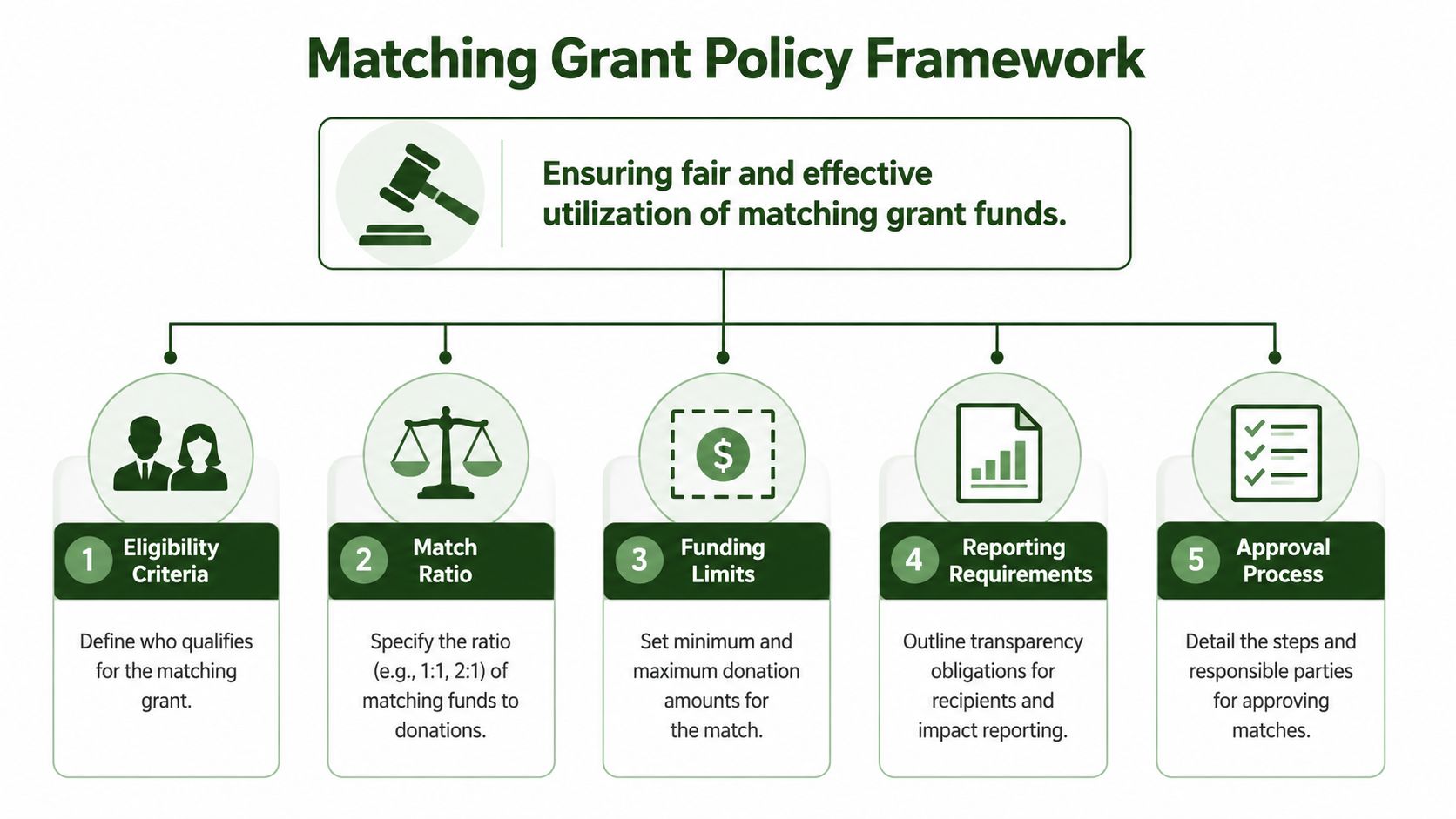
A matching grant fund should never start with a thank-you note alone. It needs a written policy before the first donation is accepted, because the policy is what keeps staff, board members, and donors working from the same definition of success. Expert guidance recommends checking the grantee's capacity first, then shaping the match rules to fit that capacity, then monitoring compliance throughout the campaign (NCFP guidance).
Practical rule: If the church can't explain the match in one page, the policy isn't ready.
A strong policy answers the questions that cause the most confusion later. It should define what counts, what doesn't, and who signs off when something is unclear. It should also spell out what happens when a donor gives at the edge of the campaign window, or when a gift is offered as property, service, or another noncash contribution.
The policy should cover these points explicitly:
- Eligibility criteria. Decide whether only new money counts, or whether a recurring donor can also give toward the match.
- Campaign dates. Set a clear start date and end date, then say whether online gifts posted late can still count if they were initiated before the deadline.
- Documentation standards. Define what receipt, acknowledgement, or donor note is needed before a gift is booked as matchable.
- In-kind treatment. State how donated space, professional services, or staff time will be valued and supported in the records.
- Disbursement trigger. Specify the exact event that releases the matching funds, whether that's full completion, periodic verification, or board approval.
- Reporting cadence. Decide when the board and donor will receive updates.
Churches often underwrite the campaign emotionally and then stumble operationally. A board can avoid that by assigning one person, usually the treasurer or finance chair, to enforce the policy without exceptions. That single control point keeps the campaign from drifting into good intentions and weak records.
For churches that also want a governance checklist alongside this policy work, the internal controls around approvals and disclosures pair well with a conflict review process, which is why this conflict of interest policy guide belongs in the same planning folder.
Setting Up Your Chart of Accounts for Success
A spreadsheet can tally gifts, but it can't protect restricted funds the way a real fund accounting system can. For a church treasurer, the safest setup is a ledger structure that makes the matching grant fund visible on its own, with accounts that clearly show what came in, what is still restricted, and what has been released for ministry use. That's why a native fund accounting platform like Grain fits this use case so well, because the fund structure is built into the accounting model rather than bolted on afterward.
A clean chart of accounts makes accidental misuse much harder. It also reduces the time spent explaining every transaction to the board, because the account names themselves tell the story.
A practical account structure
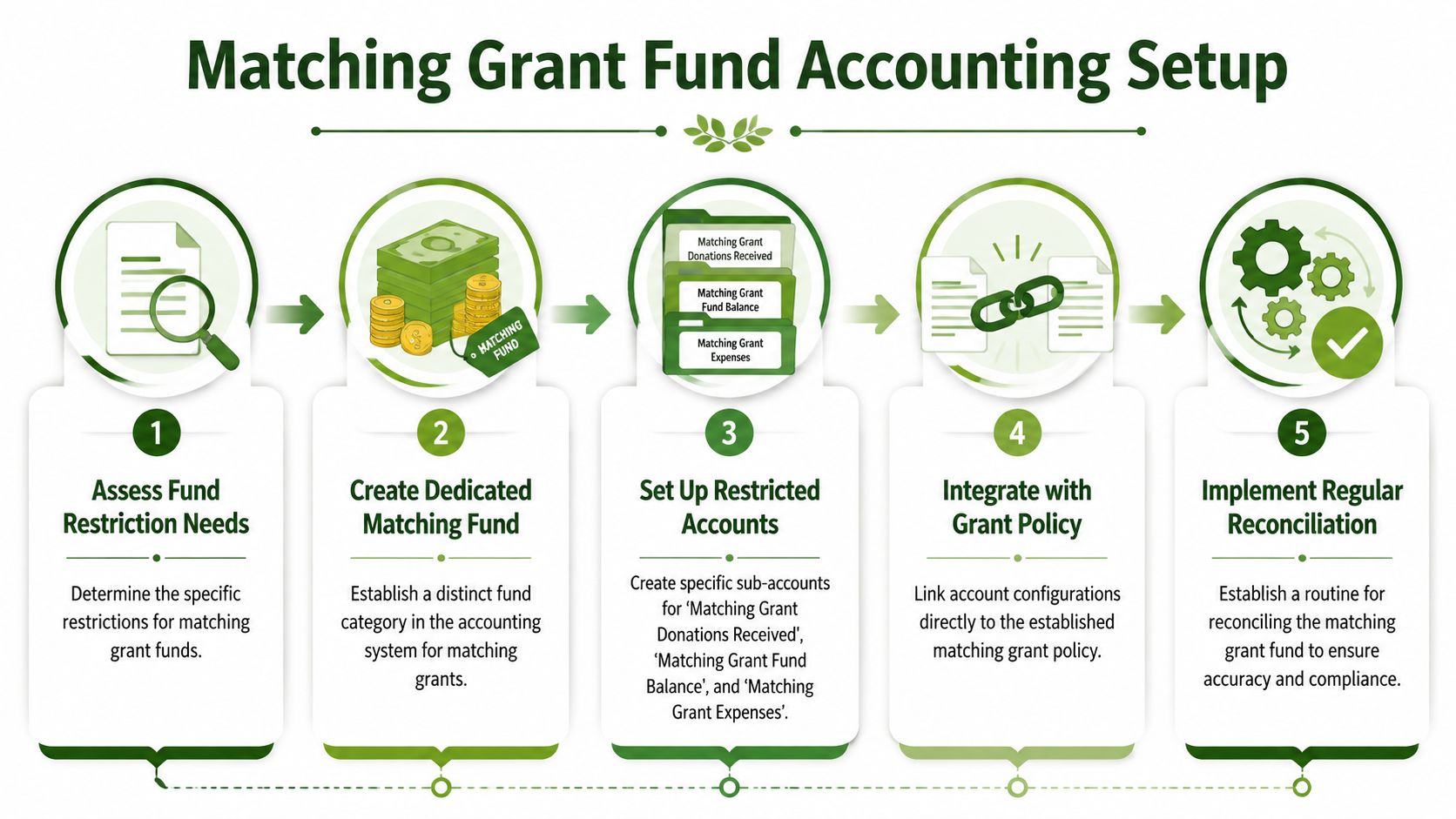
Start with a dedicated fund or fund segment for the campaign, then build the accounts around it. A simple structure usually includes:
- Restricted Cash. Tie this to a separate bank account if the church wants the highest level of cash control.
- Temporary Restricted Revenue. Use this for gifts that are restricted to the campaign but not yet released into ministry spending.
- Pledges Receivable. Use this if the matching donor has committed funds that will be paid later.
- Project Expense accounts. Group the costs tied to the ministry or building project under the matching grant fund.
- Net assets with donor restriction. Track the remaining restricted balance until the purpose is fulfilled.
A well-structured chart of accounts doesn't just record the campaign, it blocks bad spending before it happens.
This matters even more when the match is noncash. Many grant programs allow nonfederal cash or in-kind contributions as part of the match, and the hard part is often not eligibility, it's valuation and documentation of donated time or services (Headwaters Economics on match requirements). A chart of accounts that can separate in-kind entries from cash entries gives the treasurer a place to store the proof, not just the totals.
A church should also make sure the matching fund ties to a dedicated bank account if the project is large enough to justify it. That way, the reconciliation process is simple, the cash balance is obvious, and the board doesn't have to guess whether the ministry project is being subsidized by general offerings. A normal operating account makes that distinction too easy to lose.
For a deeper example of how a church chart should be organized, this chart of accounts for nonprofit guide is a helpful companion when you're mapping the fund into your own books.
Tracking Donations and Releasing the Match
The cleanest matching grant fund workflow starts the moment a gift is given. A donor gives online, the gift lands in the giving platform, and the accounting system should know whether that receipt belongs in the restricted campaign fund or in general ministry income. If the church uses an integrated setup, the gift can be tagged once and flow directly to the correct fund, which keeps the treasurer from rekeying the same receipt in two different places.
A practical setup uses the giving platform as the front door and the accounting system as the book of record. Planning Center, Pushpay, and similar tools can flag gifts for the matching campaign, but the finance team still needs a clean review step before the match is released.
A single gift, tracked from start to finish
A donor gives $100 online toward the project. The giving record should include the campaign tag, the donor name, the date, and any note about eligibility. The accounting entry then posts the gift into the restricted fund, not into unrestricted general offerings.
Later, the matching donor reviews the qualifying gifts and approves the release of the match. That release should be tied to a report, not to memory. The report is the proof that the original gifts met the policy rules and that the matching funds can now be recorded and used.
| Transaction | Account | Debit | Credit |
|---|---|---|---|
| Qualifying donor gift received | Restricted Cash | 100 | |
| Qualifying donor gift received | Temporary Restricted Revenue | 100 | |
| Match promised but not yet received | Pledges Receivable | 100 | |
| Match promised but not yet received | Matching Grant Revenue with Restriction | 100 | |
| Matching cash received | Restricted Cash | 100 | |
| Matching cash received | Pledges Receivable | 100 | |
| Project expense paid from restricted fund | Matching Grant Project Expense | 200 | |
| Project expense paid from restricted fund | Restricted Cash | 200 |
The point of the table is simple. The church doesn't treat every movement of money the same way, because a pledged match, a received match, and a spent project dollar are not interchangeable events. Each one has a different accounting meaning, and the books should show that difference clearly.
The structure of the match itself matters too. A meta-analysis of fundraising design found that matching grants can raise participation and revenue, but a simple 1:1 match can underperform when a large lead gift is involved, so the match ratio should fit the small-donor base rather than being chosen mechanically (fundraising design meta-analysis). That's a reminder to the treasurer that donor behavior affects both the campaign and the accounting timeline.
Here's the operational check that keeps the whole workflow sane. Once a week, reconcile the giving platform totals to the restricted fund balance, then compare both to the donor report that will be used to request or release the match. That one routine catches duplicate gifts, misapplied receipts, and timing problems before they turn into a trust issue.
For churches that need a more detailed grant workflow around setup and tracking, this how to track grants resource aligns well with the same discipline.
Mastering Journal Entries and Internal Controls
A matching grant fund stays believable when the entries match the paperwork. If a church treasurer can show what was pledged, what was received, and what was spent from the restricted fund, the board can follow the money without guessing. The accounting records should also show that match dollars support the project and supplement, not replace funds that would normally be available for the same purpose (DOJ financial guidance).
That means the first control is classification. A donor gift, a match commitment, and a project expense do not belong in the same bucket, even if they arrive in the same week. Restricted money stays restricted until the church has met the condition tied to it, and the operating budget should never be patched with funds that were promised for the grant project.
Sample journal entries for a matching grant fund
The entries themselves should be simple enough that another person in the finance office can trace them later. A common structure is to keep the restricted cash separate, record the grant commitment only when the church has documentation to support it, and move project spending against the restricted fund instead of the general ledger.
| Transaction | Account | Debit | Credit |
|---|---|---|---|
| Receive eligible donor gift | Restricted Cash | 100 | |
| Receive eligible donor gift | Temporary Restricted Revenue | 100 | |
| Record match commitment | Pledges Receivable | 100 | |
| Record match commitment | Matching Grant Revenue with Restriction | 100 | |
| Receive matching cash | Restricted Cash | 100 | |
| Receive matching cash | Pledges Receivable | 100 | |
| Pay project bill from restricted fund | Matching Grant Project Expense | 200 | |
| Pay project bill from restricted fund | Restricted Cash | 200 |
Core control work happens around those entries. Before any release, the treasurer should verify that the donor gifts qualify under the written policy, that the support has been counted only once, and that the restricted bank balance agrees to the subsidiary record. A monthly reconciliation is the minimum, and I would also reconcile again right before the match is released if the campaign depends on timing.
Segregation of duties matters here. The person who opens the mail or reviews online gifts should not be the same person who approves the match release and posts the journal entry. In a small church, that separation may be limited, but at least one second set of eyes should review the support list, the bank deposit, and the restricted ledger before anything is moved. If the documentation cannot stand up to a board question, it is not ready for an audit trail either.
If the documentation can't survive a board question, it won't survive an auditor's question.
In-kind support needs the same discipline. Federal match rules often allow cash or in-kind contributions, but staff time, donated services, or space should only be recorded if the church has already decided how those items will be valued and who approves them (Headwaters Economics on match requirements). A treasurer should not estimate that value from memory at month-end. The valuation method belongs in the policy, and the supporting sign-off belongs in the file.
Timing control closes the loop. The church should not release the matching funds because someone says the pledges are “basically there,” and it should not book support before the condition is met. Written proof first, posting second. That order keeps the restricted fund clean and gives the finance team a record that can be explained line by line.
Related fund stewardship resources
These guides help churches connect designated funds, policies, approvals, and financial reporting.
- Church benevolence fund guide - set policy, approvals, and accounting controls
- Restricted fund guide - understand donor restrictions and fund balances
- Fund accounting in Grain Ledger - track designated gifts and ministry funds in the ledger
- Best church accounting software - compare software that tracks restricted gifts and ministry funds
- Schedule a Grain Ledger demo - see fund-level reports and bank reconciliation
Reporting for Transparency and Accountability
A matching grant fund becomes a ministry asset only when people can see what happened with it. The board wants confidence, the congregation wants clarity, and the matching donor wants proof that the gift was handled as promised. Clear reporting turns a successful campaign into a repeatable one, because people are far more willing to give again when the books show order and restraint.
A simple Matching Grant Fund Activity Report should show the starting balance, individual donor gifts, matching funds received, project expenditures, and the ending restricted balance. That report doesn't need to be flashy, it needs to be consistent. The same format every month or every quarter makes trends obvious and questions easy to answer.

What the report should show
- Starting restricted balance. Show what was available at the beginning of the period.
- Donor gifts received. List qualifying gifts tied to the campaign.
- Matching funds received. Show the pledge or cash that completed the match.
- Project spending. Report what the church paid from the fund.
- Ending restricted balance. Make clear what remains for the approved purpose.
A good report does more than satisfy a committee. It demonstrates that the church took the match seriously, kept the fund separate, and spent the money in line with the original purpose. That kind of reporting builds trust with the matching donor, and trust is what makes future campaigns easier to launch.
For a treasurer, the standard is simple. If the report can be read aloud at a board meeting without extra explanation, it's probably doing its job. If it needs a long verbal cleanup, the accounting records need another pass first.
If your church is preparing a matching grant fund and you want a system that keeps restricted money visible from the first gift to the final report, Grain can help you build that structure with true fund accounting. Visit Grain to see how it supports church finance teams that need cleaner workflows, stronger controls, and reports that make stewardship easier to prove.
Ready to simplify your church finances?
Start free with church fund accounting, or watch a product demo first.