Payroll Processing Steps for Churches and Faith Teams
 By Gibson Brueher, Founder of Grain Ledger
Learn the payroll processing steps small and medium churches need to run accurate pay, housing allowances, and fund-based reports with confidence.
Sunday afternoon is when church payroll gets real. The board wants the giving report, the pastor asks whether the housing allowance was set correctly, the worship leader wants to know why the reimbursement hit the wrong line, and the treasurer is staring at two employees with completely different tax treatment. At that point, payroll isn't clerical work. It's a stewardship decision that has to land in the right bank account, the right fund, and the right filing bucket.
About Grain Ledger: This guide includes Grain Ledger, church fund accounting software built for designated gifts and ministry funds. It connects giving platforms (Planning Center, Pushpay, Tithely, Stripe), syncs bank activity with Plaid, and produces fund-level financial reports. Start free to see how it compares for your church.
See Grain Ledger for your church
Fund accounting, giving integrations, and bank reconciliation in one platform. Free migration support for churches switching from QuickBooks or Aplos.
The clean way to think about payroll processing steps is the same framework major payroll guidance uses for any employer, including churches, prepare payroll data, process payroll, then distribute payments and reporting. That basic structure matters because payroll errors don't stay isolated. They can touch wages, tax filings, benefits, and financial reporting at the same time, which is why the front end of payroll is never just admin overhead. For a practical church-facing overview of compliant setup, a useful companion is compliant payroll setup for Jacksonville firms, especially if your team is comparing how payroll controls are documented in practice.
Why Payroll Is a Ministry Risk for Small Churches
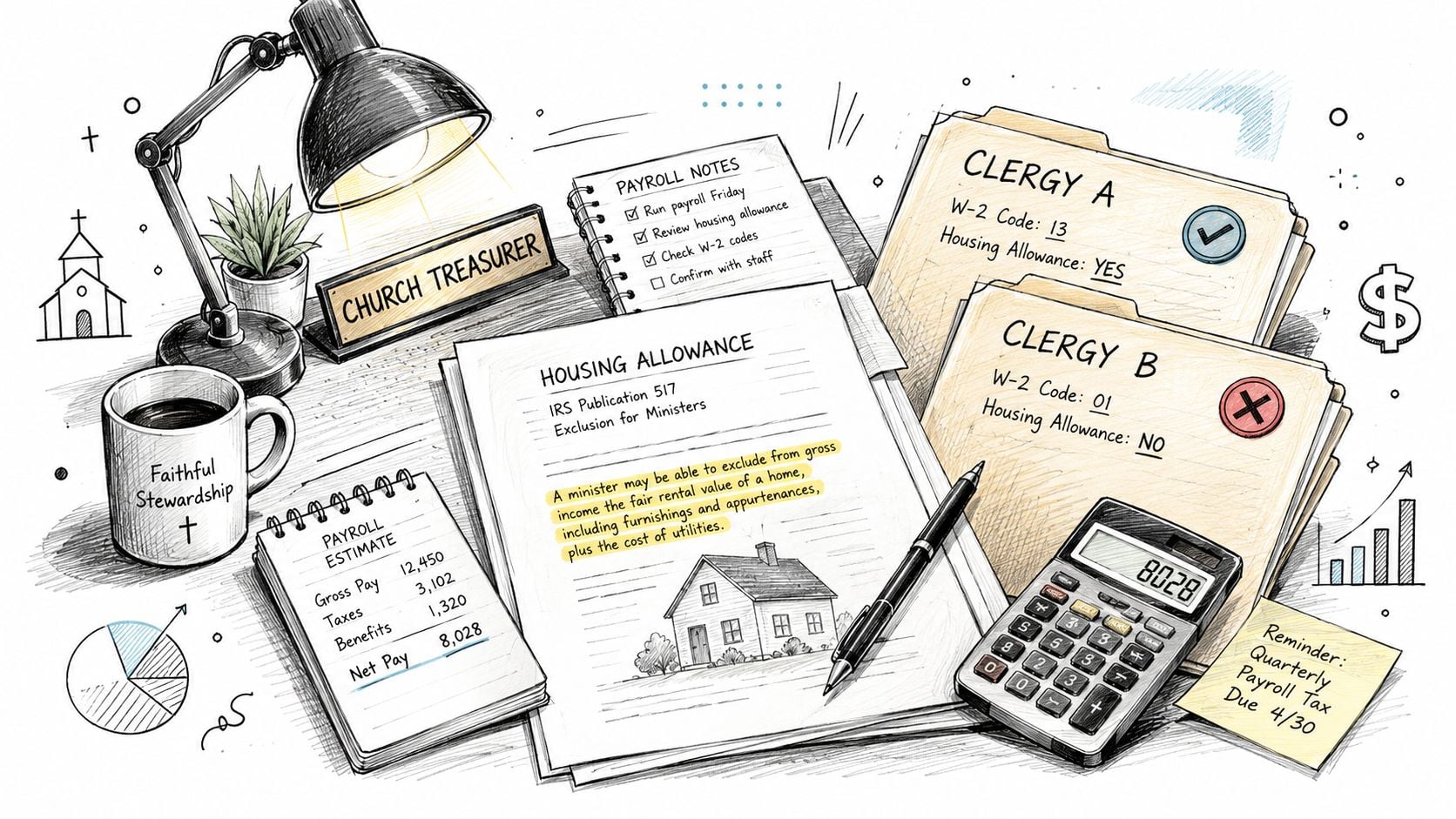
A church treasurer can get through twenty quiet weeks and then hit one bad payroll cycle that creates three different problems at once. A stipend is missed, a housing allowance wasn't documented correctly, and a restricted ministry fund gets charged for wages it shouldn't have covered. That's why payroll in a church is never just a cash disbursement. It's a stewardship trail.
The underlying workflow is straightforward, but the process carries significant weight in ministry settings. A standard payroll framework breaks the work into preparing payroll data, processing payroll, and distributing payments/reporting ManpowerGroup payroll processing framework. In a church, that sequence has to hold up under clergy tax status, donor restrictions, and board scrutiny, all at the same time.
Practical rule: if a payroll number can't be traced to a fund, a form, and an approval, it isn't ready to pay.
Clergy quirks are where many small churches stumble. One pastor may be treated differently from a lay employee for tax purposes, another may have a housing allowance that changes midyear, and a third may be paid from a designated fund that can't absorb the expense without a documented rationale. If payroll is handled casually, the church can end up with a clean net pay number and a messy trail behind it.
The better mindset is simple. Every payroll line should answer three questions before payday, what is it, what fund pays for it, and what record proves it? That's the difference between a ministry-safe payroll process and a bank transfer with paperwork attached.
Setting Up the Legal and Structural Foundations
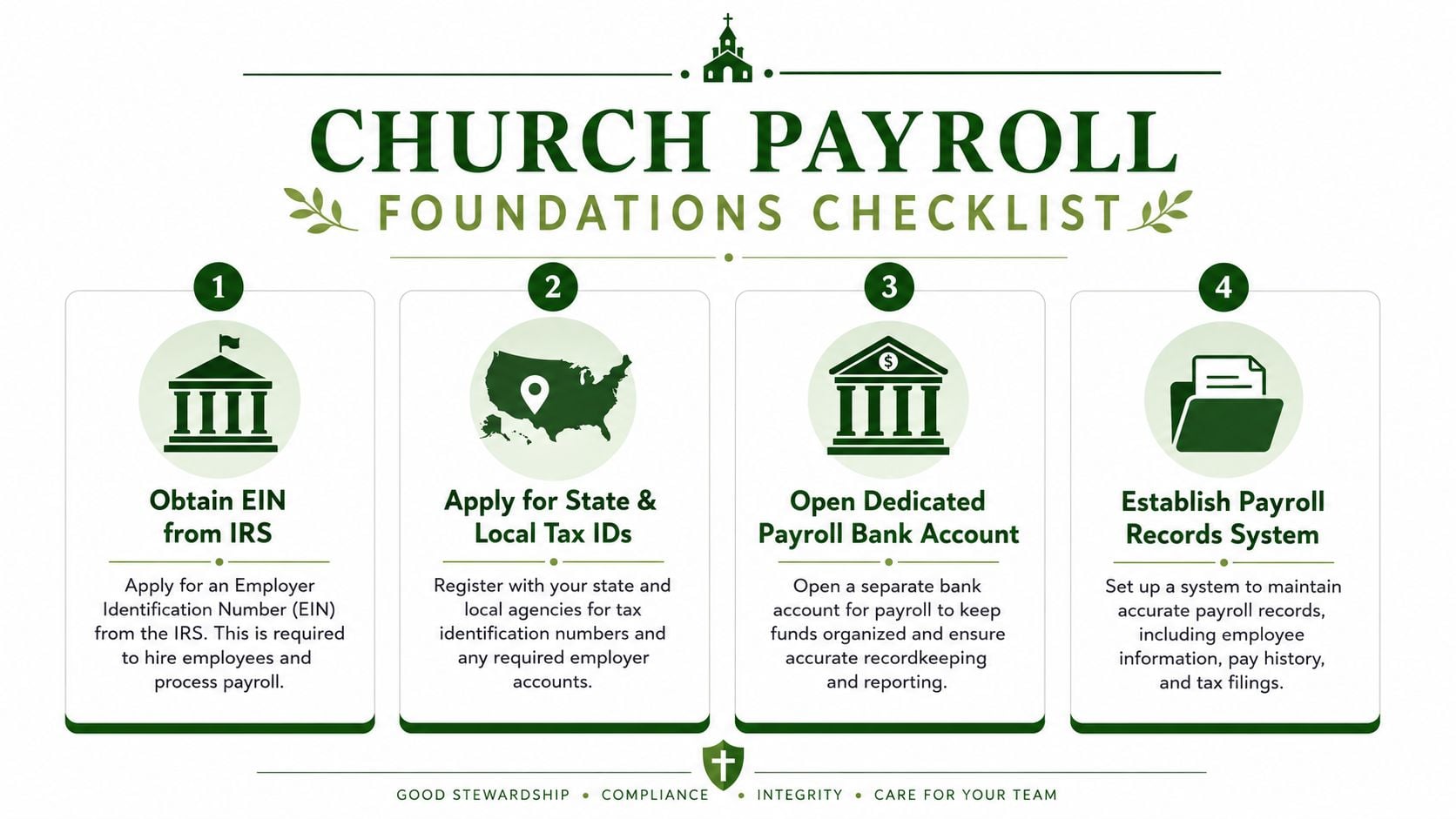
Before the first church paycheck runs, the structure has to be boring in the best possible way. That means obtaining an EIN, registering for state and local tax IDs where needed, opening a dedicated payroll bank account, and writing down the pay schedule and payroll policy. Payroll recordkeeping belongs in that setup from day one, because churches need timesheets, pay stubs, tax forms, and approval records to match the money that leaves the account.
For churches, the employee file should be complete before anyone hits approve. W-4s and state equivalents belong there, along with job classification, pay rate, benefit elections, and any recurring reimbursements that will flow through payroll. The point is to avoid scrambling later when a question comes up about why someone was paid, how they were classified, or which form supports the amount.
The clergy decisions that need to be documented early
Ministerial payroll has two setup items that generic guides often gloss over. The housing allowance needs to be designated in writing before it's paid, and the workweek needs to be defined as a specific 7-day period so hours are measured consistently for payroll and overtime compliance Paycom payroll processing guidance. If the church waits until the first payroll run to settle those choices, the process becomes fragile fast.
A payroll setup file for churches should also include who approves changes, who runs the payroll, and who can see sensitive tax information. That separation matters because a clean approval trail protects both the church and the staff member if a deduction changes, a stipend gets added, or a clerical classification needs review.
A payroll system works best when the rules are fixed before the first check goes out, not negotiated every payday.
For church finance teams building this the right way, I like to point them to Grain's payroll for non-profit organizations guide because it reinforces the setup discipline churches need. The churches that do this well usually have one source of truth for records, one payroll schedule, and one person accountable for exceptions.
Calculating Gross Pay and Splitting Costs Across Funds
A church payroll run often starts with a simple question and quickly turns into two more. What is this person owed, and which fund should carry it? A pastor's pay may include salary, a housing allowance, and reimbursed ministry costs, while hourly staff may have regular time, overtime, and approved paid leave. The payroll math has to be right, and the fund allocation has to be right too.
Gross to net without losing the fund trail
The gross-to-net sequence stays the same in any payroll system, gross pay first, then overtime where it applies, then deductions, then net pay. Churches have to be careful with how that sequence is built, because clergy pay often carries a housing allowance and ministerial tax treatment that does not look like a standard employee record. A church also has to track the payroll step that creates the expense, then separate that from the step that assigns the cost to the correct fund. For a practical overview of how payroll liabilities should be tracked alongside pay processing, see this payroll tax liabilities guide.
Overtime needs the same discipline. For nonexempt staff, the common rule is 1.5 times the regular rate for hours over 40 in a workweek, and church payroll teams should calculate that before they decide how the cost gets charged internally. That matters for custodial staff, admin staff, and weekend-event teams whose hours can shift around from week to week. If the wage calculation is sloppy, the fund split will be sloppy too.
The fund-accounting question comes right after the wage math. Salary may belong in general operating, a special stipend may need a designated ministry line, and a housing allowance may need a different accounting treatment from base wages. If the accounting system only sees “payroll expense,” the church loses the stewardship trail behind the payment.
Useful habit: separate the payroll calculation from the expense allocation. They are related, but they are not the same decision.
A practical church example makes the point clearer. The payroll register shows gross salary, housing allowance, and a reimbursed ministry cost. The accounting entry then splits those components into the right funds and expense categories, so the books can show where each dollar went. That separation protects the employee record and the donor restriction behind the money.
A fund-based chart of accounts helps here. In a church, payroll is not only a compensation event. It is a classification event, and each line should land where it belongs before the net pay goes out. TalentNet payroll process guide points to the same basic sequence, gross pay first, then the downstream calculations that depend on it. When the church uses that discipline, the audit trail stays clear even when one paycheck spans multiple ministries.
Handling Withholdings, Employer Taxes, and Benefits
Once gross pay is set, the next decision is what gets withheld and what the church still owes on top of it. Zoho describes payroll as calculating gross salary first, then applying reductions such as tax deducted at source and mandatory retirement-savings contributions, with voluntary deductions like health insurance or loan repayments layered on afterward Zoho payroll operations. That sequence is the right mental model for churches too, because it keeps deductions from getting mixed together.
Deductions are not one bucket
Federal income tax withholding, state and local withholding, retirement contributions, health premiums, and voluntary deductions each sit in different places operationally. If the church treats them as one line, the payroll register gets harder to audit and the employee's net pay becomes harder to explain. Lay staff and clergy can also sit in different tax workflows, so the payroll person has to know who is subject to which withholding logic before the run begins.
Benefits need the same discipline. A health premium deducted through payroll should be handled differently from an after-tax reimbursement, and retirement contributions should be posted where the church can verify both the employee and employer side of the entry. That's especially important when the church uses payroll as the control point for benefit elections.
For churches trying to understand the tax side of those obligations, Grain's payroll tax liabilities guide is a helpful companion because it keeps the employer obligation separate from the employee deduction. That distinction matters. What the employee sees on the pay stub isn't the full liability the church carries.
Employer taxes still exist after net pay
Paylocity says employers must file and remit state and federal payroll taxes, plus any income taxes withheld on behalf of employees, after payroll is processed, and those payroll expenses should be logged in the general ledger Paylocity payroll processing article. That means payroll doesn't end at direct deposit. The church still has a filing and posting job left to do.
The practical takeaway is blunt. If deductions are wrong, the paycheck is wrong. If employer taxes aren't posted correctly, the books are wrong. Churches need both layers under control, because payroll touches ministry cash flow and compliance at the same time.
Running the Monthly Payroll Workflow
A church that treats payroll as a monthly fire drill usually ends up fixing the same mistakes twice. A steadier cadence works better. Gather the timecards, confirm any housing allowance or stipend changes, review deductions, approve the register, run the payments, issue the pay stubs, post the journal entry, and then file the tax items that follow. That order keeps payroll tied to fund allocation, so the church can see what was paid from general operating money, what was charged to a restricted fund, and what still needs to be reported correctly.
A practical monthly cadence
Hourly custodial and admin staff need their timesheets checked before payroll is calculated. Salary changes, leave adjustments, and deduction updates need to be locked before the register is approved. If someone is still changing data after approval, the church no longer has a payroll process, it has a moving target.
A simple church filing cadence often centers on a few recurring forms and reports.
| Common Church Payroll Forms and Filing Cadence | Cadence | Purpose |
|---|---|---|
| Payroll register | Each payroll run | Summarizes gross pay, deductions, and net pay |
| Pay stubs | Each payroll run | Shows each employee their earnings and withholding detail |
| Tax deposit filings | Per payroll schedule | Remits payroll taxes withheld and employer obligations |
| Quarterly tax return | Quarterly | Reports wages and payroll tax activity |
| Year-end wage forms | Annual | Summarizes wages and withholding for employees |
| Payroll record retention file | Ongoing | Preserves source records for audit and compliance |
The timing matters because payroll aftercare belongs in the workflow, not after the fact. Keep the source records with the payroll file, including timesheets, pay stubs, payroll registers, and tax documents, so the church can show how each entry was built and approved. That record trail matters even more in a congregation, where a housing allowance, a ministerial tax status issue, or a restricted-fund posting can be questioned months later.
For churches running on a fixed monthly cycle, consistency beats speed. Use the same cutoff date, the same approval gate, the same deposit routine, and the same posting process every month. The treasurer who builds that habit usually spends less time correcting payroll and more time explaining the books to the board.
Managing Off-Cycle Runs and Payroll Corrections
Most payroll checklists stop where the messy work begins. A pastor leaves midmonth, a stipend was missed, a housing allowance needs a true-up, or a payroll was approved before someone caught the error. Churches can't afford to treat those as oddities. They happen, and the response has to be controlled.
What to do when the register is already locked
Strada's payroll error guidance treats correction work as its own workflow, identify the discrepancy, contact the employee, understand the financial impact, and arrange a repayment program when needed Strada payroll error solutions. That's the right order because churches need both accuracy and trust. If the employee hears about the fix before the finance team understands it, the correction becomes a relationship problem too.
A missed stipend usually calls for a prompt off-cycle run. A housing allowance under-set for a pastor often requires a documented retroactive correction, with the paper trail showing what changed and why. If the issue affects tax withholding or reporting, the church should slow down long enough to make sure the correction doesn't create a second filing error.
Here's where many small churches get into trouble. They want to fix the amount and forget the audit trail. That works until someone asks why the net pay changed, which fund covered it, and who approved the adjustment.
Best practice: if payroll has to be reissued, reverse the bad entry cleanly, document the reason, and communicate the correction before the employee's next pay date.
For a church finance team comparing platforms, a Paylocity review 2026 can be a useful way to see how another payroll environment handles exception workflows. The point isn't the brand. It's understanding whether the system can handle off-cycle runs without burying the original record.
The correction file should show the original amount, the corrected amount, the date of the fix, and the approval behind it. That's what protects the employee, the treasurer, and the elder board when the question comes back later.
Related church accounting software resources
If you are comparing software, these pages map the main decision points: fund accounting, QuickBooks limits, pricing, and migration.
- Best church accounting software (2026 comparison) - canonical guide comparing 12 church accounting platforms
- Church accounting software product page - see Grain Ledger for fund accounting, giving, and bank reconciliation
- Small church accounting software - see the product page built for volunteer treasurers and church admins
- Fund accounting features - review how Grain Ledger tracks designated funds
- QuickBooks for churches - understand workarounds and when to switch
- Free church accounting software - compare free options and upgrade triggers
- Grain Ledger pricing - compare plans for small and growing churches
- Start free - try fund accounting, giving imports, and bank reconciliation together
Reconciling Payroll to Your Fund Accounting Software
Payroll is only finished when the books agree with the register. In a church, that means gross pay, employer taxes, benefits, and net pay have to land in the right fund-level accounts and reconcile to the payroll bank account. If the accounting system can't show that cleanly, restricted-fund stewardship gets shaky fast.

A church accounting system built around funds instead of retrofitted onto them makes this easier to prove. Grain's fund-accounting approach is designed around that reality, and its fund accounting guide for churches is a helpful reference point for how restricted and designated money should be tracked in practice. That kind of structure matters when payroll expenses must be tied back to ministry statements, not just to a generic expense line.
The month-end control is straightforward. Reconcile the payroll register to the bank activity, confirm the journal entry posts to the correct fund, and keep approval and disbursement separate. Then retain the underlying payroll records for at least three years Homebase payroll process guidance. That's what gives the board confidence that payroll wasn't just paid, it was proven.
The right payroll system should make those controls visible instead of hiding them in exports and spreadsheets. When payroll sits inside fund-based accounting, the church can answer the hard question quickly, which fund paid, which payroll liability remains open, and which records support the entry? That's the standard worth aiming for in every congregation.
If your church is still stitching payroll together with spreadsheets, separate bank files, and a year-end scramble, it's time to move to a system that respects fund-level stewardship from the start. Explore Grain, compare how it handles church payroll and fund accounting together, and Start Free if you want cleaner payroll-to-ledger reconciliation before the next payroll run.
Ready to simplify your church finances?
Start free with church fund accounting, or watch a product demo first.