Tithe and Offering Envelopes Explained for Churches
 By Gibson Brueher, Founder of Grain Ledger
Learn what tithe and offering envelopes are, how to use them securely, record gifts in fund accounting, and when to keep or complement them with online giving.
Sunday's offering arrives in a familiar mix: loose cash, checks, and a few gifts with no name or purpose attached. One usher counts while another tries to remember who gave what, and the treasurer later has to turn that pile into accurate donor records and fund reports. Tithe and offering envelopes solve the basic problem by keeping the gift, the giver's information, and the donor's stated intent together.
About Grain Ledger: This guide includes Grain Ledger, church fund accounting software built for designated gifts and ministry funds. It connects giving platforms (Planning Center, Pushpay, Tithely, Stripe), syncs bank activity with Plaid, and produces fund-level financial reports. Start free to see how it compares for your church.
See Grain Ledger for your church
Fund accounting, giving integrations, and bank reconciliation in one platform. Free migration support for churches switching from QuickBooks or Aplos.

For a small or medium church, that simple paper process can support tradition, transparency, and modern giving options at the same time. Envelopes give volunteers a consistent handoff from the pew to the counting table, while the information on each envelope helps the finance team record contributions, prepare statements, and protect restricted gifts.
This guide follows the envelope through its full life. You'll see where the practice came from, what each field means, how counters should secure and verify gifts, and how envelope information connects to fund accounting. You'll also find a practical way to compare physical envelopes with online giving without assuming every congregation should use only one method.
The goal is straightforward: help treasurers, pastors, finance committees, and offering volunteers build a system that honors donor intent and makes reconciliation easier. A well-managed envelope isn't merely a container for cash. It's a stewardship habit and a source document that helps the church explain where money came from and which ministry should receive it.
Introduction to Tithe and Offering Envelopes Today
The difference between a stressful count and a controlled count often appears before the offering reaches the finance room. Loose cash and checks create a sorting problem. An envelope creates a labeled handoff, giving the treasurer something more reliable than memory when the church records the gift.
That distinction matters because a contribution has several parts. The church needs to know who gave, how much was given, when it was given, and, when applicable, which fund the donor selected. If those details stay with the money, volunteers can follow a repeatable process instead of making assumptions after the service.
An envelope also makes the donor's experience clearer. A member can write a name and amount, identify a designated ministry, and place the gift in the offering with confidence that the finance team has a record to work from. For anonymous cash, the church may have no responsible way to provide donor credit or confirm intent later.
Practical rule: Treat every completed envelope as a financial record, not disposable packaging.
The method has a long history because churches needed organized contribution records before digital banking. It remains useful today even when a congregation accepts cards, bank transfers, or giving-platform donations. Physical giving and digital giving can serve different members, and a church can preserve both without creating two unrelated accounting systems.
The pages ahead focus on the practical questions that usually trouble a new treasurer. How should volunteers handle envelopes after worship? What should happen when a donor marks a restricted fund? Which records should the church retain? How can a paper gift be reconciled to the deposit and the donor statement?
Once those questions have clear answers, the envelope becomes part of a dependable control environment. It protects the giver's instructions, supports the counting team, and gives church leaders a more trustworthy view of available funds.
What Tithe and Offering Envelopes Are and How They Work
A tithe and offering envelope is a small giving form wrapped around a physical contribution. The paper protects the cash or check, but its more important job is to attach information to the gift before the church counts it.
Think of loose cash as mail scattered across a table. The church may have the letters, but not the addresses. An envelope works like a labeled mailbox. It connects the contents with the sender and the intended destination, so the treasurer can carry the information into the accounting record.
The fields that make a gift traceable
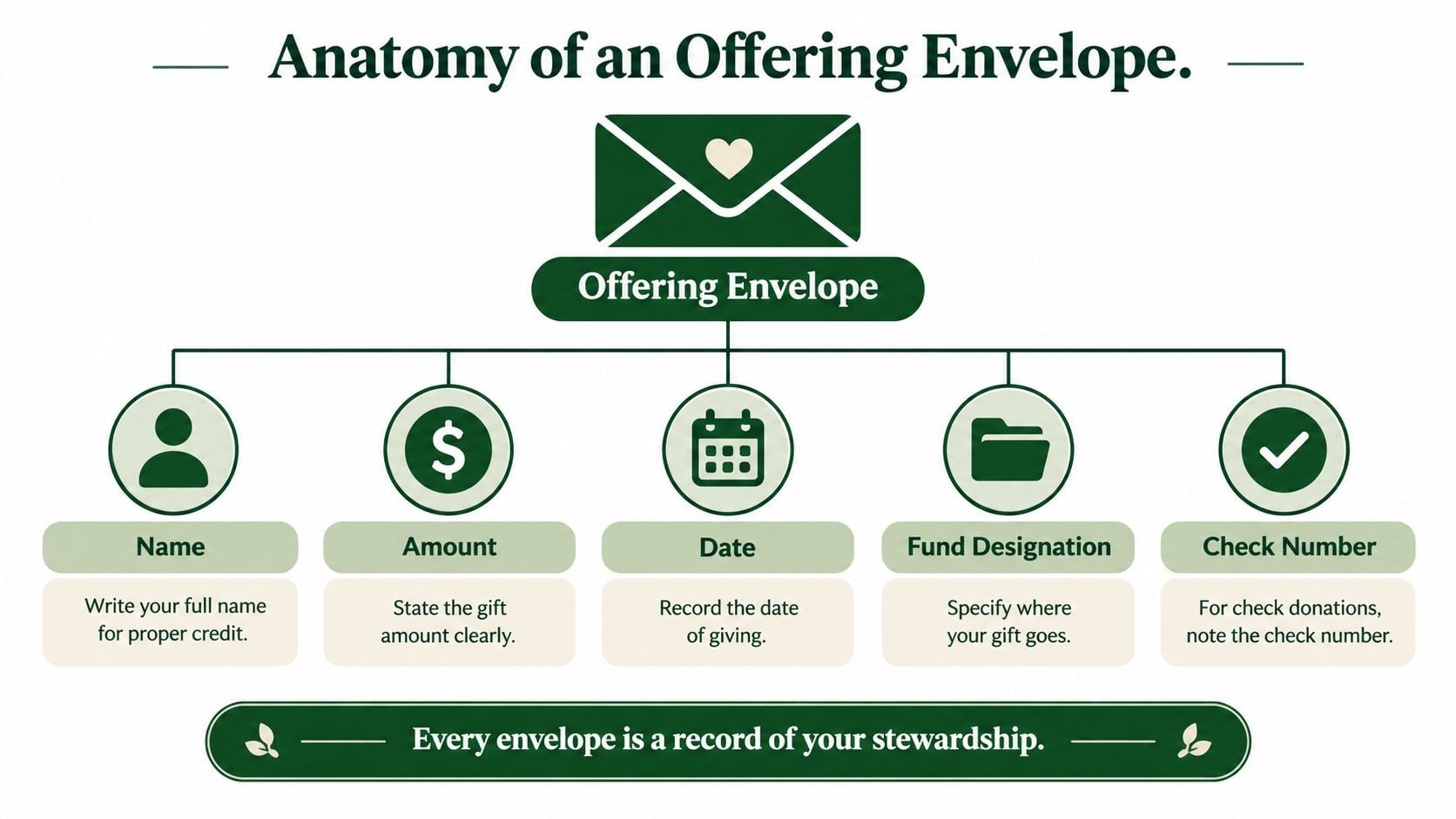
A useful envelope should make the important details easy to find:
- Name: The donor's full name supports accurate contribution credit and later statement preparation.
- Amount: The written amount gives counters a starting point for comparison with the cash or check inside.
- Date: The giving date helps the church post the contribution in the correct reporting period.
- Fund designation: A donor can indicate whether the gift is for general ministry or a specific purpose.
- Check number: For check gifts, this creates another point of comparison during counting and reconciliation.
The amount field deserves special attention. A counter shouldn't copy what the giver wrote. The written amount should be compared with the actual contents, and any difference should be documented according to church policy.
Separating the type of gift from its destination
A tithe generally refers to a regular gift intended to support the church's broad mission and operations. A general offering may also be undesignated. A designated or restricted gift carries a specific instruction, such as support for missions, benevolence, or a building project.
The envelope captures that choice at the point of giving. That timing matters. If the donor marks a fund, the finance team shouldn't wait until month-end to guess where the money belongs. The designation should flow from the envelope into the count sheet, deposit record, donor record, and fund-based accounting entry.
Church finance controls commonly require cash contributions to be placed in an envelope with the donor's name and amount written on it. This creates the audit trail needed to record the gift and issue a contribution statement, while anonymous cash without an envelope may be treated as unrecordable for donor credit, as described in the church financial controls and procedures guidance.
A Brief History of Offering Envelopes in Churches
Tithing is an old stewardship practice, but the modern offering envelope is comparatively recent. Churches adopted structured envelopes during the late 19th and early 20th centuries, when congregations needed a simple way to track contributions before digital banking existed.
Early envelopes gave treasurers a practical answer to a basic record-keeping challenge. A numbered or pre-printed envelope could identify the donor, hold the contribution, and create a repeatable record for the church ledger. By the early 1900s, many U.S. churches were using numbered or pre-printed envelopes, and the practice had moved beyond an occasional convenience into an organized stewardship system.
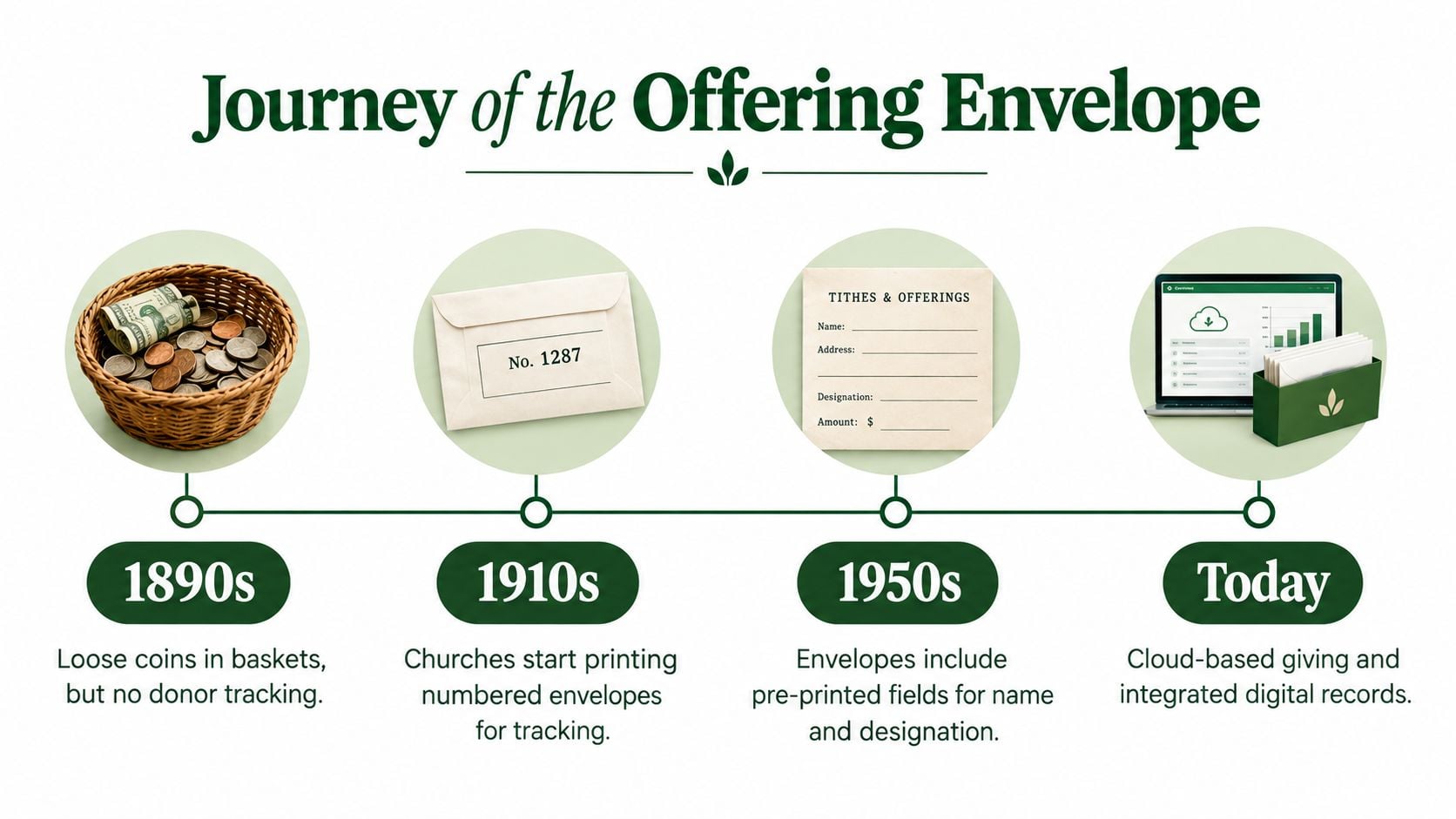
By 1916, the concept had been introduced broadly to Catholic parishes in the United States, showing how envelope-based giving had become established in a major Christian market. The historical account of custom-printed church envelopes connects that development with the need for simple contribution tracking and organized stewardship.
Why the old problem still exists
Technology has changed the way people give, but it hasn't removed the church's responsibility to identify, classify, and reconcile contributions. A paper envelope and a digital transaction look different at the front door, yet both must answer the same accounting questions.
That continuity explains why envelopes have survived. They provide a physical record for members who give in person and a familiar workflow for volunteers who count offerings after worship. They also remind donors to make a deliberate contribution rather than leaving the amount and purpose unclear.
History shouldn't force a church to keep every old process unchanged. It does show why the envelope became standard in the first place. The method addressed a real administrative need, and that need remains whenever physical money enters a church's financial system.
Best Practices for Using and Securing Offering Envelopes
A secure envelope system begins with design and ends with documentation. Volunteers should know what to collect, counters should know what to verify, and the treasurer should be able to connect the final count to the deposit and the accounting entry.
Start with a form people can complete
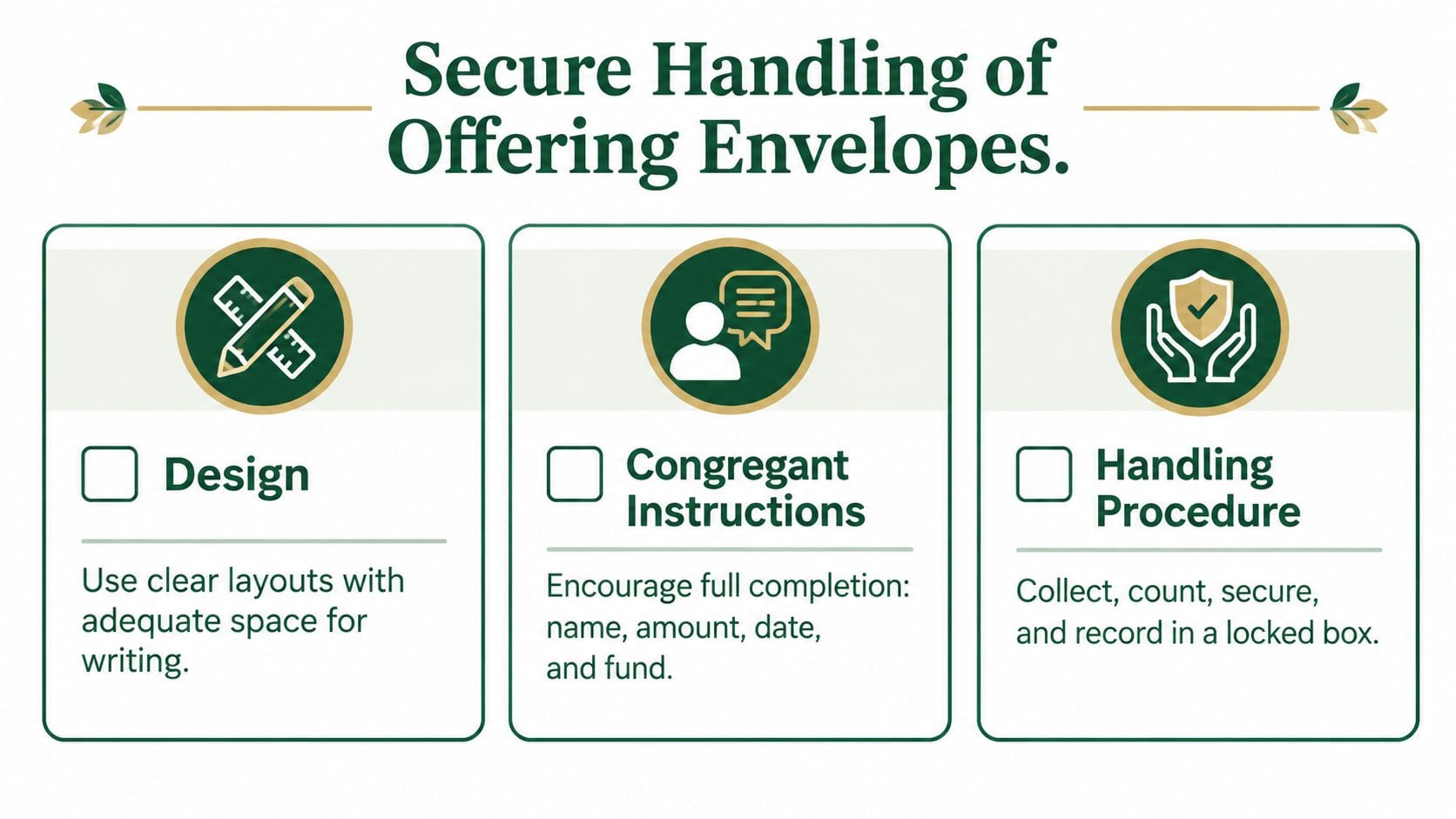
Use a clear layout with enough room for the donor's name, amount, date, and fund designation. If the church accepts checks, include a place for the check number. Avoid tiny fields or ambiguous fund labels. A donor who can't tell where to record a designation will often leave the field blank.
Explain the process from the pulpit, in membership materials, or with a short printed instruction. Tell members why complete information matters. The purpose isn't to make worship feel like a bank transaction. It's to help the church credit the gift correctly and respect the donor's instructions.
Use separation of duties at the counting table
The offering shouldn't move directly from one person's hands into the ledger. Best-practice procedures use at least two independent counters. They compare the written amount with the contents, record check numbers and cash details on a count sheet, and retain the envelopes as audit documentation for a defined period, according to the financial administration manual for offerings.
A practical workflow looks like this:
- Receive and secure: Ushers place collected envelopes and loose gifts in a secure container and transfer them to the designated counting area.
- Sort by type: Counters separate envelopes, checks, cash, and any unusual items that need review.
- Compare contents: Two counters independently verify the amount written on each envelope against the cash or check inside.
- Record details: The count sheet captures totals, check numbers, cash details, and any discrepancy.
- Classify funds: Counters preserve the donor's designation so the treasurer can post the gift to the correct fund.
- Reconcile and retain: The final count agrees to the deposit, and the church stores the envelopes and count documentation under its records policy.
Two people should see the money, two people should verify the count, and the written record should explain the handoff.
A discrepancy isn't automatically evidence of misconduct. It may be a writing error, a donor mistake, or a counting oversight. The control matters because it lets the team identify the difference promptly, document what happened, and seek clarification while the details are still fresh.
Protect the records after counting
Keep envelopes, count sheets, deposit records, and related reports together in a controlled location. Limit access to authorized finance personnel, and avoid leaving completed envelopes in an open office or volunteer area.
Churches also need a written retention policy. The policy should identify which source documents the church keeps, where they're stored, who can access them, and when authorized staff may destroy them. A defined policy is safer than an informal habit, especially when volunteers change.
For churches reviewing the physical collection process itself, the guide to a tithe and offering box can help connect secure collection with the rest of the handling workflow.
How to Record Envelope Gifts in Fund Accounting
The envelope becomes valuable to fund accounting when the church carries its information forward instead of treating it as a note for filing. Each gift should move through a clear chain:
Envelope designation → count sheet → deposit → donor record → fund report
That chain protects both accuracy and intent. If a member gives to the general fund, the accounting entry should reflect an unrestricted contribution. If the member designates a missions project, the record should preserve that designation and keep the funds associated with the appropriate restricted or designated fund.
Turn paper details into accounting fields
Suppose an envelope identifies a donor, a date, an amount, and a fund. The counter records those details on the count sheet. The treasurer then uses the count documentation to post the contribution, while the deposit record confirms that the money reached the bank.
The bank deposit may show one combined total, but fund accounting still needs the internal breakdown. A single deposit can contain gifts for general ministry, benevolence, missions, and other purposes. The accounting system should preserve those classifications rather than forcing the church to treat the entire deposit as one unrestricted amount.
A contribution statement also depends on clean source records. The envelope supports the donor's name and amount, while the accounting record provides the cumulative history used for reporting. Churches should also separate donor acknowledgment practices from fund restrictions. A receipt can recognize the gift, but recognition doesn't give the church permission to spend a restricted contribution elsewhere.
Create a retention policy before questions arise
Church finance teams often ask whether envelopes may be discarded after contribution statements are issued. Public guidance is inconsistent. Some church materials describe envelopes as source documents, while other guidance refers to a specific retention period. That inconsistency means each congregation should establish a written policy with its board, finance committee, accountant, or legal adviser.
The policy should address:
- Storage: Where physical envelopes and count sheets are kept.
- Access: Which volunteers and staff may review them.
- Reconciliation: How envelopes tie to count sheets, deposits, and fund reports.
- Retention: How long records remain available under the church's governing requirements.
- Restricted gifts: How designations remain visible after the original envelope is filed.
The offering envelope instructions and source-document discussion highlights why this operational issue deserves a formal answer rather than a volunteer's assumption.
For a church evaluating tax documentation alongside its own records policy, this tax deduction guide for Ashfield offers useful context. Churches should still confirm their specific obligations with a qualified adviser.
Use accounting software built around funds
A general bookkeeping tool may record deposits and expenses, but church finance teams need reports that distinguish available general funds from money committed to ministry purposes. Grain Ledger uses native fund architecture so transactions and reports are organized around funds, while giving and bank activity can flow into the accounting workflow for clearer fund-level reporting.
The practical benefit is consistency. The treasurer doesn't have to reconstruct restricted balances from scattered notes after the deposit. The fund assignment becomes part of the transaction record. Churches comparing workflows can also review contribution accounting for churches before choosing how to connect envelope records with digital gifts and bank activity.
Tithe and Offering Envelopes Versus Online Giving Options
Physical envelopes and online giving aren't competing moral choices. They're delivery methods, and each works better for different members and situations. A church should decide based on donor behavior, service attendance, reporting needs, and the volunteer capacity available to manage the process.
By 2016, a State of the Plate survey reported that 86% of churches had giving envelopes available in the pews, while 98% still passed the offering plate during services. The 2016 survey discussion shows how physical collection remained common even as churches began adding digital options.
| Criteria | Tithe and Offering Envelopes | Online Giving |
|---|---|---|
| Donor experience | Familiar, tangible, and suited to in-person worship | Convenient for remote or recurring giving |
| Record accuracy | Depends on complete handwriting and careful counting | Data can enter the system electronically, but fund selections still need review |
| Administrative work | Requires collection, counting, storage, and reconciliation | Requires platform, bank, and accounting coordination |
| Stewardship engagement | Makes the act of giving visible and deliberate during worship | Supports consistent giving outside the service |
| Best fit | Members who bring cash or checks and value a physical practice | Members who give from home, while traveling, or on a recurring schedule |
A hybrid model often serves a congregation better than an abrupt switch. Keep envelopes in the pews, place a QR code or clear digital-giving instruction nearby, and explain that members can choose the method that fits their circumstances. A church can also mail envelopes to consistent givers who prefer physical records, while watching whether usage remains meaningful before reducing supplies.
The decision should follow evidence from the church's own records. Review envelope counts, digital transactions, volunteer workload, and donor questions. The guide to online giving platforms for churches can help finance leaders assess digital workflows without assuming that online giving eliminates the need for fund controls.
Related church accounting software resources
If you are comparing software, these pages map the main decision points: fund accounting, QuickBooks limits, pricing, and migration.
- Best church accounting software (2026 comparison) - canonical guide comparing 12 church accounting platforms
- Church accounting software product page - see Grain Ledger for fund accounting, giving, and bank reconciliation
- Small church accounting software - see the product page built for volunteer treasurers and church admins
- Fund accounting features - review how Grain Ledger tracks designated funds
- QuickBooks for churches - understand workarounds and when to switch
- Free church accounting software - compare free options and upgrade triggers
- Grain Ledger pricing - compare plans for small and growing churches
- Start free - try fund accounting, giving imports, and bank reconciliation together
Putting Your Envelope System Into Practice
An effective system doesn't require complicated paperwork. It requires consistent habits that everyone understands, from the usher receiving the offering to the treasurer posting the final fund totals.
Recent coverage reported that 64% of pastors still collect tithe by passing a plate or basket, with smaller churches using that method more often than larger ones, as described in coverage of in-person church giving. That makes a dependable envelope workflow relevant for many congregations, even those expanding digital options.
Use this practical implementation plan:
- Train the counters: Demonstrate how to compare written amounts with contents, document discrepancies, complete the count sheet, and transfer funds securely.
- Update the envelope: Include clear fields for name, amount, date, fund designation, and check number.
- Approve a retention policy: Decide how the church stores envelopes, controls access, reconciles records, and authorizes disposal.
- Map every fund: Make sure general, designated, and restricted gifts have clear destinations in the accounting system.
- Connect the records: Use Grain Ledger to give the finance team fund-level visibility across contribution and bank activity.
A paper envelope can protect donor intent, support contribution statements, and strengthen board reporting when the church treats it as a source document. Small controls, repeated every week, create the transparency that larger financial systems depend on.
Grain gives churches fund-based accounting, contribution workflows, and clear reporting so envelope gifts and digital donations can be connected to the correct funds. Visit Grain to see how your church can build a more consistent, transparent giving process.
Ready to simplify your church finances?
Start free with church fund accounting, or watch a product demo first.