Transaction Matching for Churches: A Complete Guide
Learn how transaction matching works for church fund accounting. Discover automation methods, best practices, and how Grain Ledger streamlines reconciliation.
Monday morning, a newly appointed church treasurer opens the accounting system and finds unmatched deposits from weekend giving, a batched transfer from the online giving platform, and designated gifts that don't appear to belong to the fund balances on screen. The bank balance looks plausible, but the fund reports don't tell a clear story. For a volunteer finance team, that uncertainty can turn a routine reconciliation into an afternoon of searching through exports, emails, checks, and handwritten notes.
About Grain Ledger: This guide includes Grain Ledger, church fund accounting software built for designated gifts and ministry funds. It connects giving platforms (Planning Center, Pushpay, Tithely, Stripe), syncs bank activity with Plaid, and produces fund-level financial reports. Start free to see how it compares for your church.
See Grain Ledger for your church
Fund accounting, giving integrations, and bank reconciliation in one platform. Free migration support for churches switching from QuickBooks or Aplos.
Transaction matching provides the connection. It links related records across the bank, giving platform, donor records, and general ledger so the team can verify not only that money arrived, but also that it reached the correct restricted or unrestricted fund. Church accounting guidance calls for restricted gifts to be tracked by donor name, date, amount, purpose, and any goods or services provided, with restricted and unrestricted totals shown separately on contribution statements. Church accounting guidance on restricted gifts and fund structures explains why a bank balance alone can't prove that designated money was handled correctly.
Why Transaction Matching Matters for Church Finances
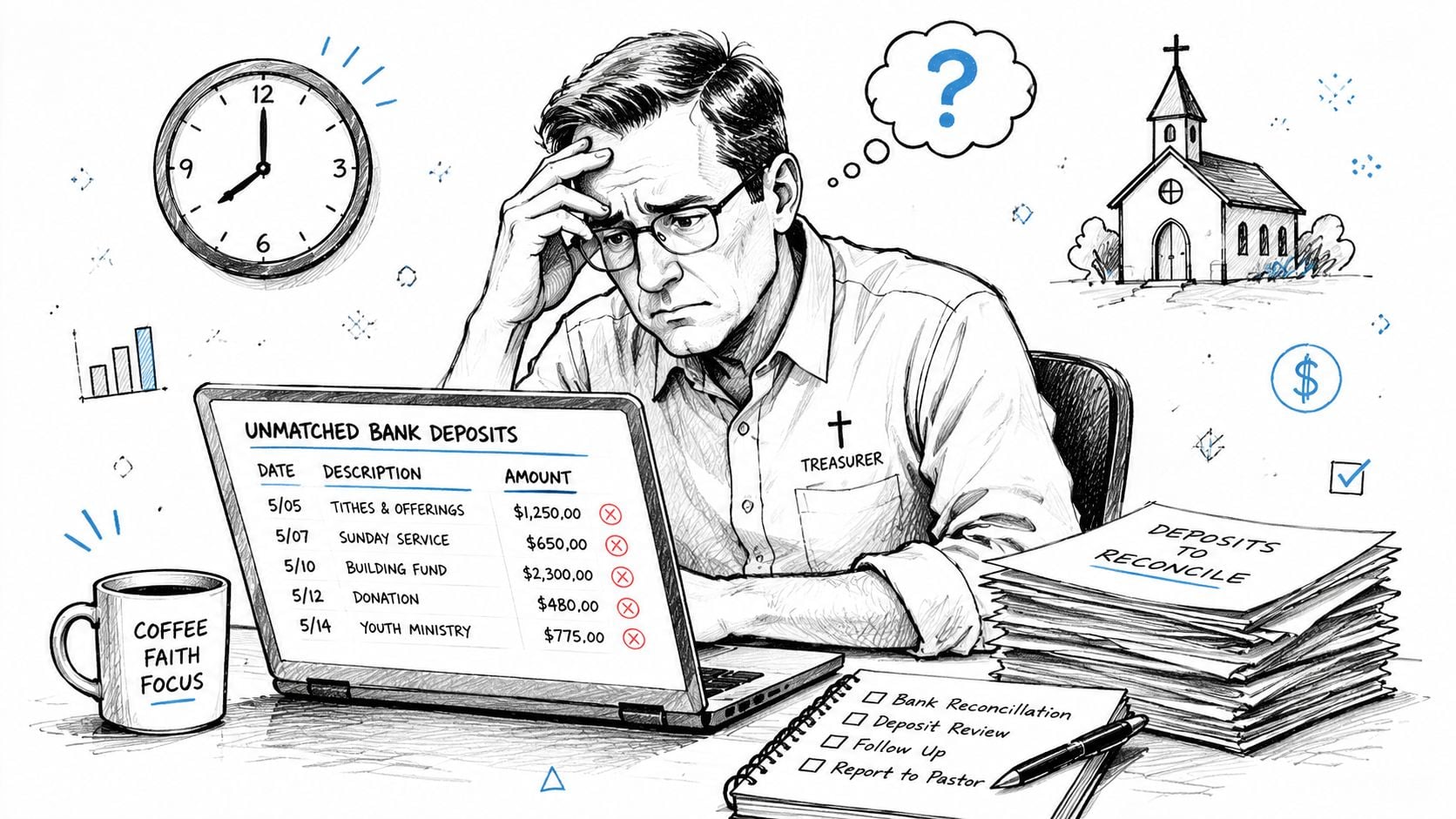
The treasurer in that Monday-morning scene isn't facing a simple cash question. The question is whether every deposit can be supported by source records and assigned to the purpose the donor intended. A single bank deposit may represent general giving, missions support, a building campaign, and youth ministry gifts. If the team records the entire deposit as unrestricted revenue, the bank reconciles while the church's fund accounting becomes unreliable.
Matching protects donor intent
Restricted giving carries an operational responsibility. The church needs a fund structure that preserves each active restricted fund's balance and allowable-use boundary. Annual accounts should report restricted and endowment funds separately from unrestricted funds, and proceeds from the sale of restricted-fund assets should remain in the same restricted fund, according to parish accounting guidance on restricted and unrestricted funds.
That responsibility becomes difficult when the records don't connect. A donor's designation may appear in the giving platform, while the bank shows only a settlement amount and the ledger shows a journal entry. Matching brings those records together, giving the treasurer evidence for the fund assignment rather than relying on memory or an unexplained spreadsheet adjustment.
Practical rule: A reconciled bank account doesn't automatically mean the church has reconciled its funds.
Matching is a control, not just a convenience
Oracle's transaction-matching documentation describes a process that loads transactions from one or more sources, applies predefined rules, identifies exceptions, and explains those exceptions. It also documents a lifecycle history that can include loading, matching, manual match or unmatch actions, confirmations of suggested matches, reverse adjustments, and deletion. Oracle's reconciliation documentation shows why this history matters to regulated finance teams, auditors, and organizations that need traceability across bank, general ledger, and intercompany records.
For a church, the same principle supports stewardship. The treasurer can show what was matched, what remained unresolved, who reviewed an override, and why a gift was assigned to a particular fund. That record helps the finance committee answer questions from pastors, board members, donors, and auditors without reconstructing decisions months later.
Reliable matching also protects the church's reputation. Misallocated designated gifts can create incorrect reports, confusing board discussions, and difficult donor conversations. A consistent process makes restricted-fund accountability part of ordinary monthly work instead of an emergency exercise at year-end.
How Transaction Matching Actually Works
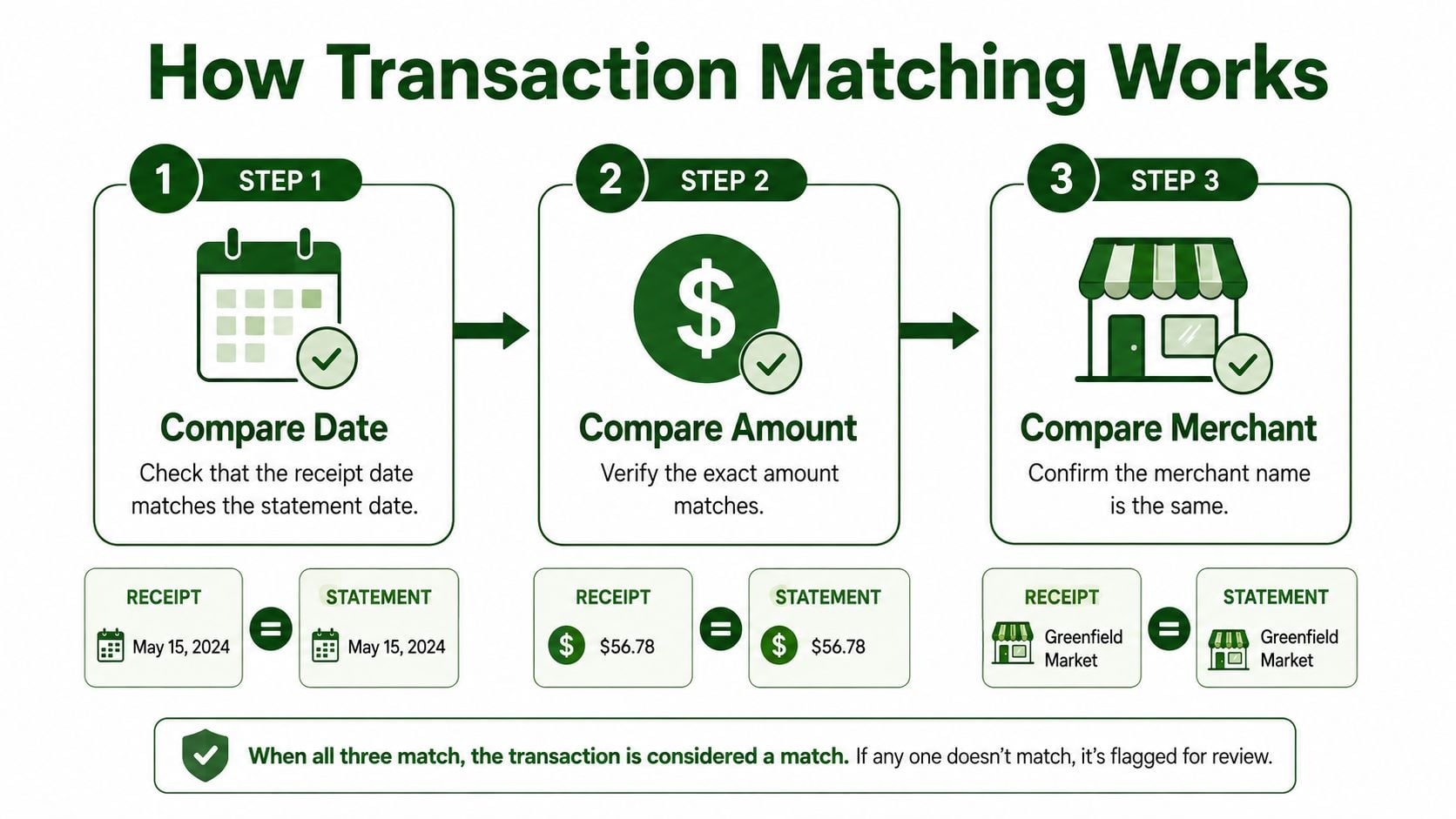
Think of transaction matching like pairing grocery receipts with a credit card statement. You compare the date, amount, and merchant, then investigate anything that doesn't line up. In church accounting, the receipts are individual donation records from the giving platform, while the bank feed may show one settlement deposit that combines many gifts.
The system isn't performing magic. It is comparing fields according to rules. Transaction matching guidance from Nominal describes the process as comparing entries across sources such as bank feeds, ledgers, subledgers, and intercompany records, then surfacing mismatches for review.
Start with the strongest evidence
A practical matching sequence usually begins with high-signal fields:
- Amount: Look for an exact amount where the source records represent the same transaction.
- Date window: Compare the transaction date with the bank posting or settlement date, allowing for timing differences.
- Reference information: Use a transaction ID, batch number, check number, memo, or other identifier when available.
- Counterparty details: Treat donor or merchant names as supporting evidence because names can be abbreviated, reformatted, or omitted.
Independent reconciliation guidance on transaction matching describes a layered approach that starts with exact identifiers, then amount and date tolerances, followed by fuzzy or pattern-based methods for unusual records. The order matters. A reference number that uniquely identifies a settlement should carry more weight than a similar-looking name.
Apply rules in layers
An exact match might pair a bank transaction with a single ledger entry because the amount, date, and reference all agree. A rule-based match might connect a giving-platform settlement to a known batch using a batch ID in the memo field. A fuzzy match might suggest a relationship when the platform date and bank date differ slightly or when a settlement amount reflects processing deductions.
The treasurer should still understand what each rule permits. A broad date window can create false matches. A loose name rule can connect the wrong donor or vendor. For a practical explanation of how account categories and transaction destinations should be structured before matching, see Grain's guide to account mapping.
The system's output should be explainable. Each accepted match needs enough context for another reviewer to understand why the records belong together. Unmatched items aren't failures by themselves. They form an exception queue that tells the team where judgment is still required.
Unique Matching Challenges in Church Fund Accounting
Generic reconciliation examples often assume one payment corresponds to one invoice or one bank line. Churches operate differently. Giving platforms collect many gifts, donors designate funds, and volunteer bookkeepers may work from incomplete information while trying to preserve fund-level accuracy.
Restricted gifts split the accounting story
A donor may submit one payment that supports the general fund, missions, and a building campaign. The bank may show one deposit, but the giving record contains several fund allocations. Matching the deposit to one ledger line would confirm cash movement while hiding the allocation detail that determines how the money can be spent.
The reverse problem also occurs. A check marked for a youth trip may be deposited with ordinary offerings. If the treasurer codes it to general operations because that is where the deposit appears, the church has created a fund-level error even though the total cash is correct.
Batch settlements remove the obvious pair
Giving platforms such as Pushpay or Tithe.ly may aggregate many individual gifts into one ACH settlement. The bank line can contain a processor description and a net amount, while the giving export contains donor names, designations, gross gifts, and fees. The records are related, but they aren't naturally one-to-one.
Consider a $5,000 batch deposit containing 47 individual gifts across six funds. The treasurer needs to match the bank deposit to the batch, then preserve the individual fund allocations inside the ledger. If the deposit is entered as one unrestricted receipt, later reports may understate restricted balances and overstate money available for general ministry.
Edge cases need fund judgment
A $200 designated check accidentally coded to the wrong ministry can remain invisible if the finance team only checks that the bank and ledger totals agree. The correction requires reviewing the check image or donor record, moving the amount to the intended fund, and documenting the reason.
| Common Church Matching Edge Cases | Why Standard Matching Fails | Fund Accounting Impact |
|---|---|---|
| One deposit contains gifts for several funds | The bank provides one lump-sum line | Fund allocations can disappear inside unrestricted cash |
| Giving platform settles many gifts together | Individual gifts don't equal the bank line one by one | Donor and fund detail requires a batch-level match |
| A check names a specific ministry | The deposit location doesn't prove the donor's purpose | The church may spend or report restricted money incorrectly |
| A processor deducts fees before settlement | Gross giving and net bank cash differ | Revenue, fees, and fund balances can be misstated |
| A platform or bank feed changes format | Field names, dates, and references no longer align | Established matching rules stop finding valid relationships |
Common transaction matching challenges across mixed data sources highlights field and format mismatches, including reference length, date formatting, truncation, and standardized message structures. Churches feel these problems sharply because a formatting failure can interrupt not only cash reconciliation but also the fund designation attached to a gift.
Automation Levels From Manual to Machine-Assisted
Churches don't need to choose between total manual work and blind automation. The useful question is which transactions deserve automatic handling and which ones require a person who understands donor intent, fund restrictions, and unusual ministry activity.
Manual reconciliation
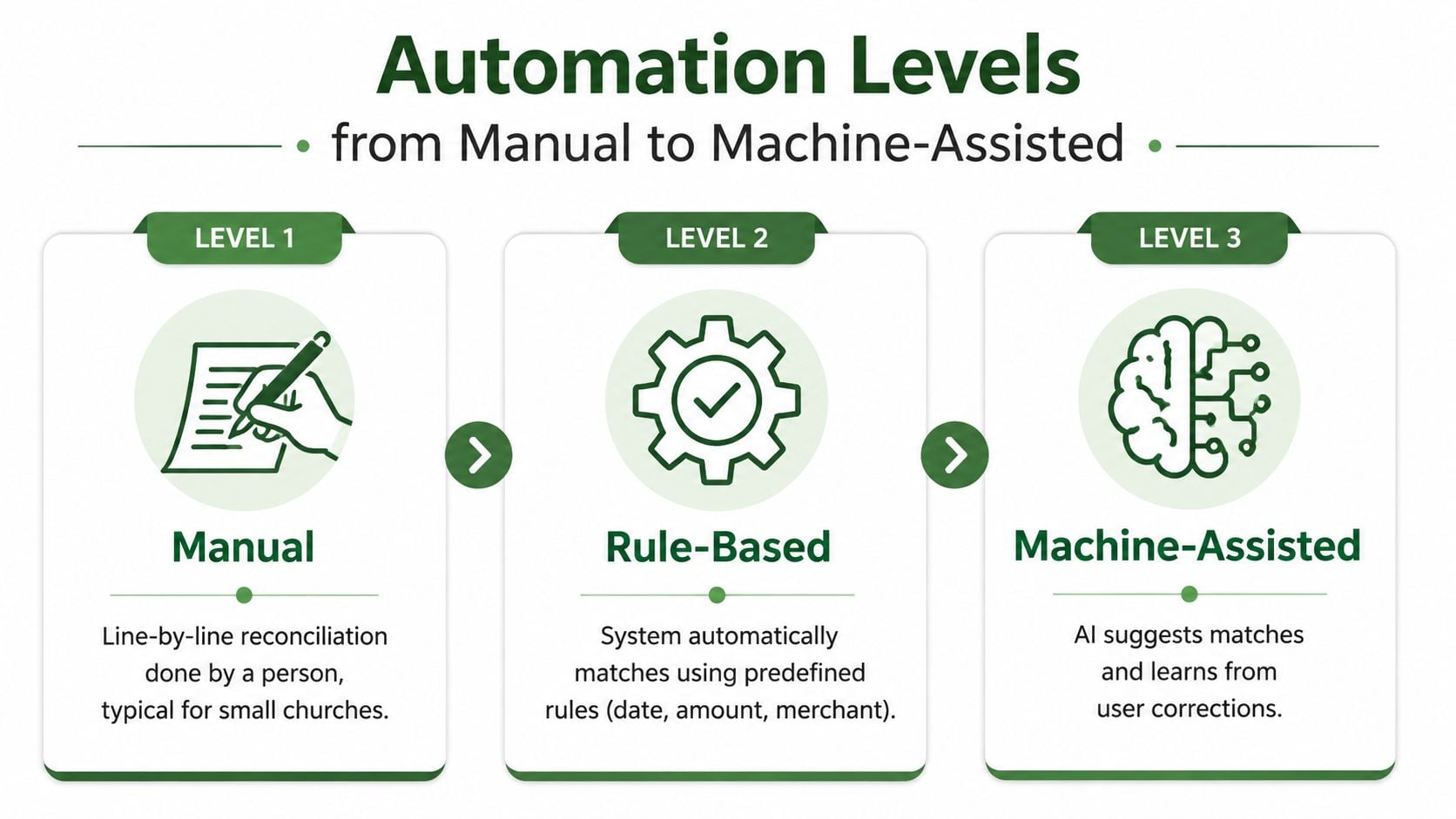
Line-by-line comparison remains common in small churches because it requires little setup. A volunteer opens the bank statement, compares it with the giving export, and marks transactions in a spreadsheet or accounting system.
The advantage is visibility. The treasurer sees every item and can use judgment immediately. The cost is repeated effort, inconsistent notes, and a greater risk that an exception gets skipped when the volunteer is tired or short on time.
Rule-based matching
Rule-based systems apply explicit criteria such as amount, date range, reference number, or memo text. Sage Intacct requires matching rules to have an ID and name, while Microsoft Dynamics 365 Finance describes rules as criteria for filtering bank statement lines and internal bank transaction lines. Microsoft's documentation on bank reconciliation matching rules makes the mechanism clear. The system matches when the defined conditions are met.
This approach works well for recurring deposits and predictable processor batches. It also requires maintenance when a giving provider changes export formats, settlement timing, or memo conventions.
Fuzzy and machine-assisted matching
Fuzzy logic can suggest relationships when records aren't identical. It may account for small differences, merged donations, or a bank posting date that doesn't match the giving date. Machine-assisted systems go further by learning from prior human decisions and suggesting pairings for unusual cases, such as split designations or partial refunds.
A hybrid model is usually sensible for small and medium-sized churches. Let dependable rules handle routine records, then reserve human review for exceptions involving restricted funds, unclear source evidence, or unusual adjustments. A public product example reports 90% auto-matched transactions and an average monthly reconciliation time of 15 minutes, but that is a vendor benchmark, not an industry-wide average. The published transaction matching example also shows the broader metrics teams can monitor, including matched items, unmatched items, reconciliation percentage, outstanding amounts, and rule-level success rates.
For a closer look at automated bank workflows, see Grain's overview of automated bank reconciliation.
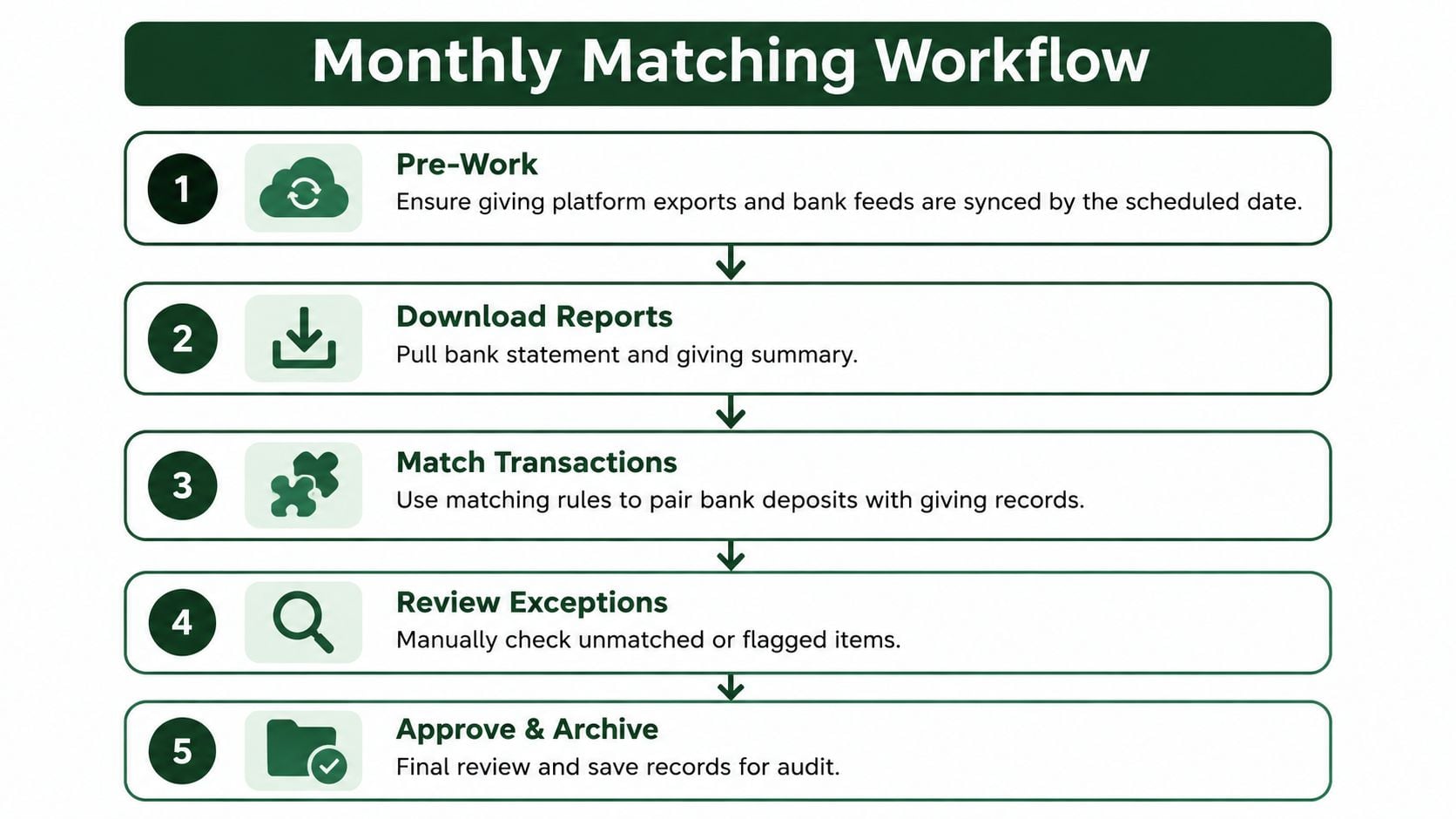
Building a Sustainable Monthly Matching Workflow
A good workflow respects volunteer time without lowering the control standard. The aim isn't to finish as quickly as possible. The aim is to produce a repeatable record that another person can understand and verify.
Prepare the source records
Set a scheduled date for syncing bank feeds and giving-platform exports by the third business day. Before matching, identify special campaign deposits, unusual checks, year-end batches, and any known platform changes. A short note at this stage can prevent hours of investigation later.
Then pull the bank statement, giving summary, batch detail, and relevant ledger activity. Confirm that the date ranges cover the same period. A missing export can look like an unmatched deposit when the actual problem is incomplete source data.
Match routine items before investigating exceptions
Run the established rules first. Review the suggested matches for fund codes, batch references, amounts, and dates rather than accepting them without inspection. Then sort unmatched items by dollar amount descending so high-value restricted-fund discrepancies receive attention before minor timing differences.
Handle exceptions according to their shape:
- Split deposits: Break one bank deposit into the appropriate fund allocations using the giving-platform detail and supporting records.
- Merged activity: Link several smaller giving transactions to the single settlement that reached the bank.
- Misrouted designations: Reclassify the gift to the correct fund, then record why the original coding was wrong.
- Timing differences: Keep the source dates visible and document the settlement or posting explanation.
Add review and documentation
Before finalizing, have a second team member spot-check 10% of matched pairs. This check is especially important for designated funds, where an amount match doesn't prove that the fund assignment is correct.
Record override reasons in the reconciliation notes. Document when a restriction was met and a release entry was posted, because guidance on restricted-fund management calls for expenses to use the matching fund code, monthly reconciliation, and documentation when a restriction ends. Restricted and unrestricted fund workflow guidance provides the practical foundation for these steps.
Consistency matters more than speed. Next month's volunteer should inherit clear decisions, not a list of unexplained corrections.
Common Pitfalls and How to Troubleshoot Them
Automation doesn't remove the need for controls. It changes where the team spends attention. Churches usually run into trouble when the source data is inconsistent, exceptions have no owner, or volunteers trust a suggested match more than the fund evidence.
Format mismatches
A giving platform may export a donor name in one format while the bank memo uses an abbreviated or processor-generated description. A rule based on exact text then misses a valid relationship.
Normalize names and reference fields before matching. Add controlled alias rules for recurring processor descriptions, and keep amount, date, and batch identifiers ahead of names when the name field isn't reliable.
Ignored exceptions
An unmatched queue grows when volunteers aren't sure who can approve a correction. The downstream impact is delayed cleanup, unexplained balances, and a growing risk that a restricted gift remains in the wrong fund.
Assign an owner for each exception and establish a 30-day resolution deadline. Escalate unclear donor designations to the treasurer or finance committee instead of allowing them to sit unresolved.
Control point: No one should approve a designated-fund match solely because the amount looks familiar.
Over-reliance on suggestions
A suggested match can connect the right cash movement to the wrong fund code. Require human confirmation for any match involving designated funds, unusual restrictions, or a manual journal entry.
Duplicate matches often result from re-importing the same bank feed. Compare transaction IDs and import periods before accepting a second pairing. Orphaned transactions can appear after a mid-month platform switch, so preserve exports from both systems and document the transition date in the reconciliation file.
Related church accounting software resources
If you are comparing software, these pages map the main decision points: fund accounting, QuickBooks limits, pricing, and migration.
- Best church accounting software (2026 comparison) - canonical guide comparing 12 church accounting platforms
- Church accounting software product page - see Grain Ledger for fund accounting, giving, and bank reconciliation
- Small church accounting software - see the product page built for volunteer treasurers and church admins
- Fund accounting features - review how Grain Ledger tracks designated funds
- QuickBooks for churches - understand workarounds and when to switch
- Free church accounting software - compare free options and upgrade triggers
- Grain Ledger pricing - compare plans for small and growing churches
- Start free - try fund accounting, giving imports, and bank reconciliation together
Streamlining Matching With Grain Ledger
A church accounting solution should reflect the way church money is received and restricted. Grain Ledger uses fund-level accounting so incoming gifts can be associated with their designated funds before the treasurer reviews the bank settlement. That structure addresses a central church problem, the difference between one cash deposit and the many purposes represented inside it.
For example, a $500 building-fund donation and a $200 missions gift may arrive in the same batched deposit. The accounting record needs to preserve those separate designations, not treat the bank line as one undifferentiated receipt. Grain connects church bank activity and giving records so the treasurer can review settlement activity alongside fund-coded entries.
The workflow also depends on integrations. Grain supports connections with church tools and giving providers such as Planning Center, Pushpay, Stripe, and bank accounts through Plaid, while Grain's accounting software integration guide explains how connected systems can reduce spreadsheet-based transfers. The practical benefit is a single review process for source activity, fund allocation, and reconciliation status.
Put the process into practice
A treasurer can move from concept to implementation by taking a focused sequence:
- Connect the church's giving platform and bank account.
- Confirm that each giving designation maps to the correct fund.
- Review how settlement deposits correspond to synced giving activity.
- Configure matching rules for recurring deposits and known references.
- Run the first match cycle and route uncertain items for human review.
- Save the decisions and override notes for the next volunteer.
The accounting system should support the control, not force the treasurer to recreate it in a separate spreadsheet. When fund assignments, bank activity, and supporting records stay connected, monthly reconciliation becomes a stewardship routine that the whole finance team can sustain.
Grain Ledger provides church-focused fund accounting, connected bank and giving workflows, and matching support that keeps restricted gifts tied to their intended purposes. Visit Grain to Start Free and prepare a fund-level reconciliation process your treasurer and finance committee can trust.
Ready to simplify your church finances?
Start free with church fund accounting, or watch a product demo first.