Treasurer's Report Example for Churches That Builds Trust
See a real treasurer's report example for churches with fund-level breakdowns, sample wording, and a step-by-step template your board will actually trust.
If you're walking into a Sunday-night finance meeting with a spreadsheet that technically balances but still leaves everyone squinting at the numbers, you're not alone. Most church treasurers know the pain of handing out a report that proves arithmetic but doesn't prove stewardship, especially when restricted gifts, operating cash, and upcoming obligations are all mixed together on one page. A strong treasurer's report example doesn't just total income and expenses, it helps the board see what money is available, what's spoken for, and what changed since last month.
See Grain Ledger for your church
Fund accounting, giving integrations, and bank reconciliation in one platform. Free migration support for churches switching from QuickBooks or Aplos.
Why Most Church Treasurer Reports Undercut Their Own Boards
The meeting goes sideways fast when the treasurer opens with a number nobody can place. I've watched elders nod politely at a combined cash balance, then spend the next 20 minutes trying to answer a question the report should've answered already, namely whether that money belongs to the general operating fund or is already tied to a restricted purpose.
The report that balances isn't always the report that helps
A church can produce a report that adds up perfectly and still hide the underlying story. The usual problem is a format that shows totals without showing fund-level visibility, so a building gift, a missions restriction, and the checking account balance all blur into one number. That is how boards end up approving decisions with incomplete context.
Practical rule: if the report can't tell an elder what cash is spendable in a few minutes, it isn't board-ready yet.
Church treasurer reports work better when the structure keeps cash movement visible from the donation record to the board packet. A clear framework, like the one outlined in Cloudvara's QuickBooks church guide and a solid financial report structure for churches and nonprofits, helps separate what belongs to operations from what is held for a specific fund. That matters because the board needs more than a total, it needs to see which dollars can be used without crossing a donor restriction.
A useful treasurer's report example also makes it obvious when restricted money is sitting in the wrong mental bucket. Grain Ledger is built around that church reality, where every transaction and report needs to stay organized by fund from the start rather than after the fact. When the accounting backbone matches the ministry structure, the board packet stops feeling like a rescue mission.
Why fund-aware reporting gets approved faster
Boards approve reports that answer questions they were already asking. They table reports that force them to reconstruct the story from raw totals, especially when the numbers don't separate operating activity from designated money. That is why churches that present restricted funds, operating cash, and category-level activity in one view usually get better meetings than churches that read off a single bank balance.
The Core Structure Every Treasurer's Report Must Carry
The core structure should be plain enough that an elder or finance committee member can read it without stopping to decode the page. A church report works best when it tracks cash from beginning balance to ending balance in the same order every time, so the board can see what changed and why.
The four fields that anchor the page
Start with the beginning cash balance. Then show total revenue, total expenses, and ending cash balance. A standard report format should make the math easy to follow, because the ending cash balance is the starting balance plus revenue, minus expenses. The church treasurer report structure used by Jitasa makes that logic easy to see, even when the underlying records are more complex.
That is the skeleton. Churches usually need more detail around it, but they do not need less structure. The mistake I see most often is a treasurer who jumps straight to the ending number, which looks efficient until someone asks what happened to designated gifts, or why the current balance looks healthier than the operating fund really is.
A board-ready packet should also separate budget comparisons and restricted-fund callouts from the basic cash flow. The California PTA Treasurer's Report guidance is useful here because it requires beginning and ending balances, amounts credited to the general fund and special funds, and receipts and disbursements separated by fund ownership. That separation is the same discipline church boards need when they are deciding whether to spend, wait, or reassign a gift.
For a broader framework, review Grain's guide to the structure of a financial report. It helps church teams treat the report as a decision document, not just a recap.
Core Fields in a Church Treasurer's Report
| Field | What It Shows | Why the Board Cares |
|---|---|---|
| Beginning cash balance | Cash on hand at the start of the period | Sets the baseline for the month |
| Total revenue | All money received in the period | Shows whether giving and other income met expectations |
| Total expenses | All money spent in the period | Reveals whether spending stayed controlled |
| Ending cash balance | Cash remaining after activity | Tells the board what is actually left |
| Budget variance | Difference between plan and actual | Flags overspending or under-collection |
| Restricted-fund balances | Money tied to specific purposes | Prevents restricted gifts from being treated as general cash |
If you use software, the chart of accounts and fund structure need to support this ordering cleanly. A solid Cloudvara's QuickBooks church guide can help teams set up the mechanics, but the bigger point stays the same, the report has to preserve fund meaning all the way through.
A Filled-In Treasurer's Report Example You Can Copy
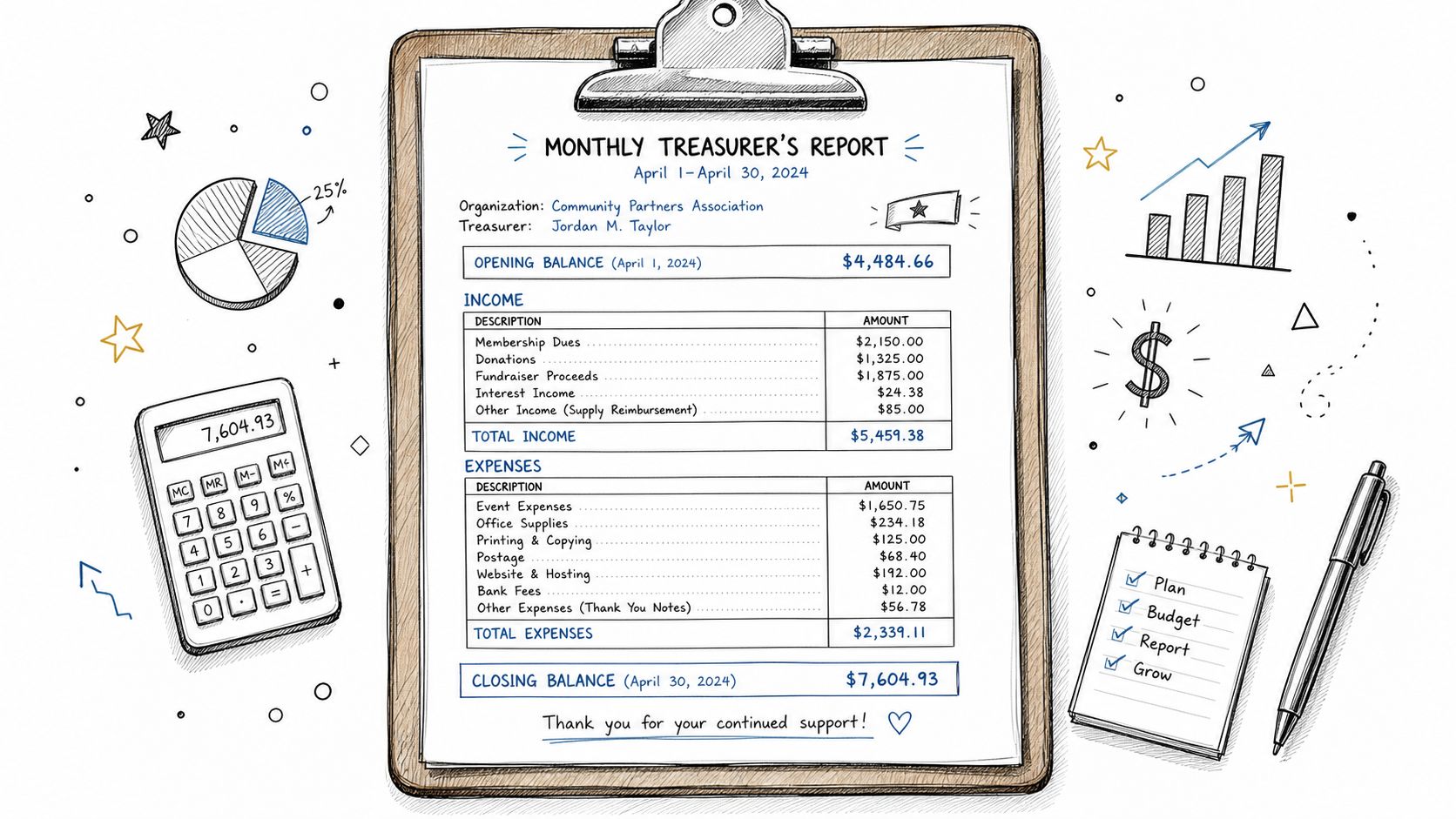
A report gets approved when the board can trace the money without guessing. A monthly example from the Australian Education Association shows an opening balance of 4,484.66, total income of 3,996.77, total expenditure of 3,949.75, and a closing balance of 4,531.68 (Australian Education Association sample treasurer's report). The setting is different from a church, but the reporting logic carries over cleanly.
A fund-level version of the same report
Here is how that same format reads in church language when the funds are separated correctly:
- General Fund, normal operating receipts and expenses.
- Building Fund, restricted gifts for facilities work.
- Benevolence Fund, assistance designated for people in need.
In a clean treasurer's report example, a building gift stays in the Building Fund until it is spent. It does not inflate the operating cash picture, and it does not get folded into the general balance just because it sits in the same bank account. Elders notice that distinction fast, because it shows whether the church is using available money or spending against dollars already promised for another purpose.
The Australian sample also breaks income into lines such as government grant, attendance fees, fundraising, and interest, plus year-to-date budget comparisons with usage rates like 87%, 92%, and 144% (Australian Education Association sample treasurer's report). For a church, those percentages are a prompt for questions, not a final judgment. A line at 144% does not automatically mean something is broken, but it does mean someone should explain what changed and whether the variance is temporary or structural.
Grain Ledger is the accounting solution I'd use when a church needs that fund-level view to stay intact without manual re-tagging every month. Its native fund structure keeps the report aligned with the way churches hold restricted dollars from the donation record to the board packet.
The value of a filled-in example is practical. It gives the board something concrete to react to, and it keeps the meeting focused on fund balances and budget usage instead of arguments over whether the report adds up. Once members can see what belongs to the General Fund, what belongs to restricted funds, and what has already been committed, the conversation moves to the decisions that matter.
Sample Wording the Board Will Actually Read
Numbers rarely fail on math, they fail on meaning. If the board can't tell whether a variance is a one-time event, a normal timing issue, or a sign of trouble, they'll spend their energy guessing instead of governing.
Opening summary language that sounds human
Use simple sentences that tell the story without apology. For example, write, “General Fund activity remained stable this month, while the Building Fund continued to hold restricted donations for the roof project.” That phrasing tells the board what moved and what didn't, without burying the main point.
For planned upcoming expenses, Springly's guidance is useful because it explicitly includes that forward-looking note in the report (Springly nonprofit treasurer report guidance). A church version might read, “Next month includes scheduled insurance and utility payments, so cash planning should stay conservative until those items clear.” That's the kind of sentence that helps elders think ahead instead of only looking backward.
Variance explanations that don't sound defensive
MoneyMinder's reporting advice is right on the money here, because it pushes treasurers to add narrative context around unusual items instead of assuming the numbers will speak for themselves (MoneyMinder treasurer report guidance). A good example is, “Missions giving came in above plan because of a one-time designated gift, not because recurring giving changed.” That tells the board exactly what to take away from the variance.
If a line came in under plan, keep it plain. “Repairs were lower than budget this month because the work was postponed until the vendor could confirm availability.” That kind of note is calm, specific, and easy to verify against the ledger in Grain.
Restricted-fund wording that stays clean
Avoid defensive language when restricted money moves. Say, “The Benevolence Fund was used only for approved assistance, and the balance remains available for future requests.” If a transfer happened, identify it directly and tie it to the proper fund designation.
A good packet doesn't oversell the month. It translates the ledger into board language, and it does that without making the treasurer sound like they're asking for permission to do their own job.
Reconciliation Inputs That Make the Report Auditable
A treasurer's report only earns trust when someone else can trace it. The board doesn't need every supporting document in the room, but the treasurer should be able to pull the whole trail together quickly if asked.
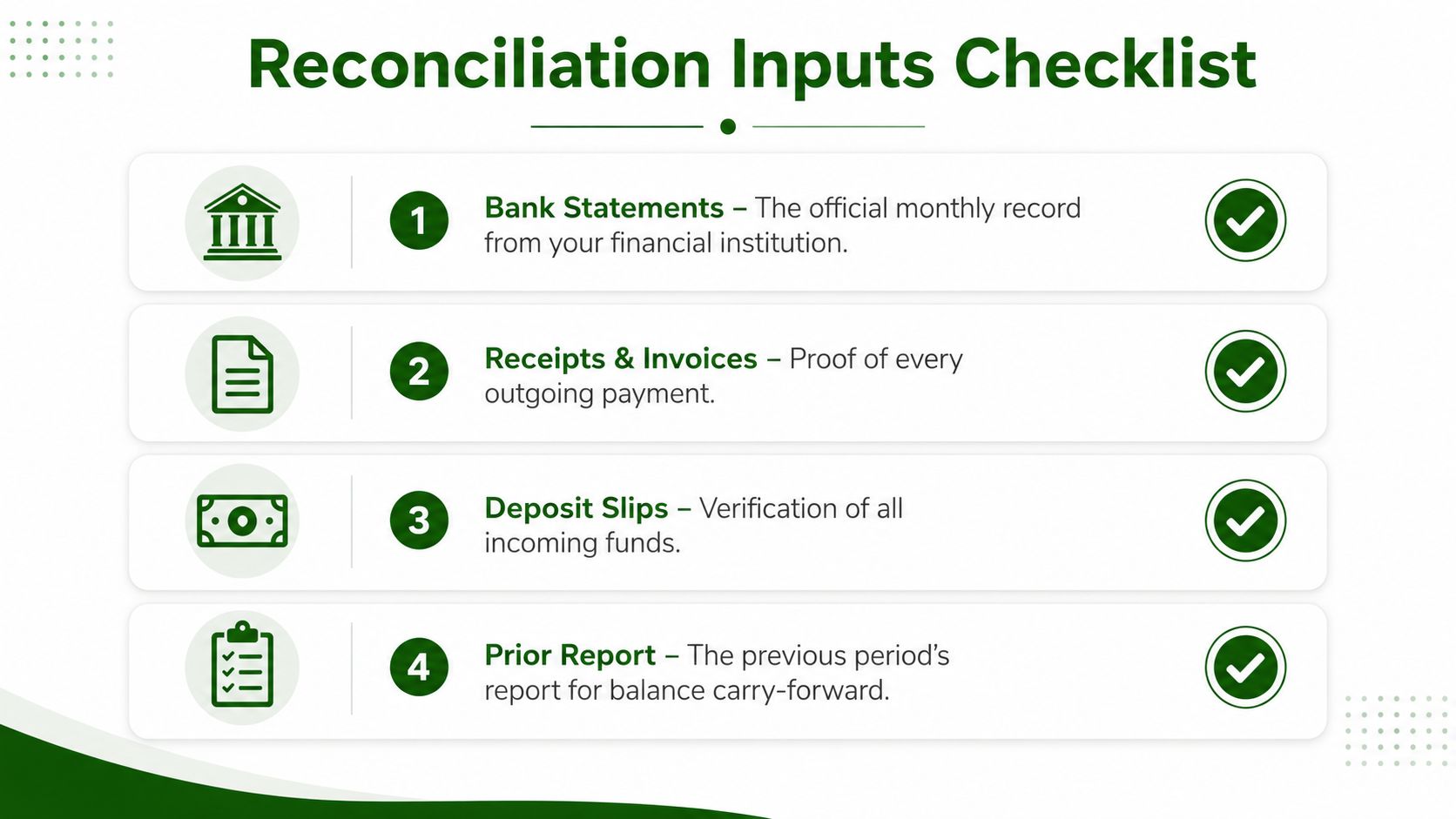
The documents that have to exist before the report goes out
The basic packet should include bank statements, receipts and invoices, deposit logs, and the prior reconciliation. BoosterLedger's guidance is blunt about the right benchmark, completeness beats speed, and the report should be prepared only after all transactions are entered into the accounting system (BoosterLedger nonprofit treasurer report example). That's exactly right.
A report that goes out before everything is entered creates avoidable cleanup later. It usually means the treasurer is reporting the bank balance before the books are reconciled, which is how missing checks, delayed deposits, and unposted expenses get discovered in the middle of the meeting instead of before it.
If a non-preparer can't audit the report in a few minutes, the packet isn't finished yet.
That auditability test matters more than speed. A board member should be able to see beginning and ending balances for each account, receipts and disbursements, and the explanation for any variance without decoding the treasurer's private spreadsheet logic.
Common failures that hide real risk
The mistakes I see most often are straightforward. Treasurers omit outstanding liabilities, they net receipts against expenses instead of showing gross activity, or they fail to separate fund balances. Each of those shortcuts can make a ministry look healthier than it is.
For a deeper process view, Grain's bank reconciliation guide is a useful reference for keeping the books tied to the bank. If your controls are scattered across emails and one-off files, a system like Grain keeps the trail in one place so the report doesn't depend on memory.
Church boards also need the kind of documentation standard that stands up beyond a normal monthly meeting. Lighthouse Consultants' emphasis on accurate financial evidence is a good reminder that clean records aren't just a bookkeeping preference, they're part of real accountability (accurate financial evidence guidance).
Reporting Per Bank Account and Per Fund, Not Just in Total
One combined balance looks tidy on paper and messy in real life. If a church has a checking account for payroll and a savings account for a roof project, combining them into one line hides the very distinction the board needs to manage.

Why separate reporting is the safer default
Church treasurers get in trouble when the report makes restricted money look interchangeable with operating cash. A roof reserve, a missions designation, and payroll money all behave differently, so the board needs to see those differences before it approves spending.
California PTA's guidance is useful because it treats reporting as account-specific and fund-specific, with beginning and ending balances, credited amounts, and disbursements shown in a way that separates general activity from special-purpose activity. That same shape works well in a church setting, where the board has to know what is available, what is restricted, and what is already spoken for.
The church translation is simple. Put the fund on one axis and the bank account on the other. A savings account can hold designated roof money without pretending that it is operating cash, and a checking account can pay payroll without implying that it is funded by restricted gifts. That structure gives the board the numbers it needs before anyone starts debating a total that does not tell the whole story.
What the cleaner presentation looks like
A board-friendly report usually reads better when the fund is visible before the bank total. That lets the treasurer show that General Fund activity belongs to general ministry operations, while Building Fund activity stays tied to the project it was given for. The board can then see whether a balance is spendable or only appears usable because it was rolled into one headline figure.
For teams that need this every month without rebuilding a spreadsheet, Grain Ledger's fund architecture does the heavy lifting automatically. It keeps the report aligned with how churches use money, instead of forcing the treasurer to reconstruct fund accounting after the fact.
If you want the mechanics behind that separation, the nonprofit fund accounting guide explains the fund-level logic that keeps restricted dollars honest. For a church-specific version of the same idea, Grain's guide to fund accounting for churches is a useful companion.
Board rule of thumb: if two accounts serve different purposes, they should not disappear into one headline number.
That simple habit prevents a lot of bad meetings.
Related church accounting software resources
If you are comparing software, these pages map the main decision points: fund accounting, QuickBooks limits, pricing, and migration.
- Best church accounting software (2026 comparison) - canonical guide comparing 12 church accounting platforms
- Church accounting software product page - see Grain Ledger for fund accounting, giving, and bank reconciliation
- Small church accounting software - see the product page built for volunteer treasurers and church admins
- Fund accounting features - review how Grain Ledger tracks designated funds
- QuickBooks for churches - understand workarounds and when to switch
- Free church accounting software - compare free options and upgrade triggers
- Grain Ledger pricing - compare plans for small and growing churches
- Start free - try fund accounting, giving imports, and bank reconciliation together
Presenting the Report So the Board Says Yes
A report gets approved when the packet makes the job easy for everyone else in the room. I've seen a treasurer lose a good report because they only read totals aloud, and I've seen a better report sail through because the board got the right documents in the right order.

The four-piece packet that keeps the meeting moving
Hand out four artifacts. First, the one-page report. Second, the reconciliation summary. Third, the variance narrative. Fourth, the upcoming-expenses page.
That layout gives the board a complete view without forcing them to dig through raw exports. It also mirrors the broader reporting logic from the Door County Extension sample, which shows how a detailed written report should be posted or distributed, not just read aloud (Door County Extension treasurer's report sample).
A short script helps too. Start with the opening balance, move through receipts and disbursements, point out any unusual items, then close with what needs attention before next month. Don't narrate every line, especially if the report already separates general and restricted funds clearly.
The last question should be the stewardship question
End by asking whether any restricted fund moved during the month. That one question tells the room whether the church handled designated money correctly, and it signals that the report is about stewardship, not just bookkeeping.
When the report is built in Grain Ledger, the numbers behind that question stay tied to the ledger instead of being stitched together at the last minute. That makes the packet easier to trust, easier to review, and easier to approve. If you're ready to stop rebuilding fund reports by hand and want a system that keeps restricted dollars honest from donation record to board packet, visit Grain and see how fund-based church accounting can simplify your next treasurer's report.
Ready to simplify your church finances?
Start free with church fund accounting, or watch a product demo first.