Treasury Report Format Guide for Churches and Boards
Learn the ideal treasury report format for churches with templates, fund tracking, and board-ready layouts. Includes treasury report format examples.
A board meeting can turn uncomfortable when the treasurer presents a healthy-looking bank balance, then a pastor asks whether that money can fund a building repair. The cash summary answers how much sits in the accounts, but it doesn't show what donors restricted, what leaders designated, what bills are still outstanding, or which balance is available.
About Grain Ledger: This guide includes Grain Ledger, church fund accounting software built for designated gifts and ministry funds. It connects giving platforms (Planning Center, Pushpay, Tithely, Stripe), syncs bank activity with Plaid, and produces fund-level financial reports. Start free to see how it compares for your church.
See Grain Ledger for your church
Fund accounting, giving integrations, and bank reconciliation in one platform. Free migration support for churches switching from QuickBooks or Aplos.
That's the practical problem a good treasury report format solves. It connects cash movement, fund purpose, reconciliation, budget performance, and plain-English explanation in one report that pastors, treasurers, board members, and auditors can read without guessing.
Introduction to Treasury Report Format for Churches
A church treasury report isn't merely a shorter income statement. It's a stewardship document that should help leaders answer several questions at the same time:
- What cash came in and went out during the period?
- Which funds hold those balances?
- How much is restricted, unrestricted, or designated?
- Has the book balance been reconciled to the bank?
- What changed from the budget or prior period?
- What needs a decision before the next meeting?
A report can show a positive overall balance while a ministry fund has little available money. It can also show strong receipts while several payments remain uncleared. Those situations aren't contradictions. They're reasons to separate cash visibility from fund visibility.
Public-sector reporting offers a useful comparison. The UK Government Financial Reporting Manual for 2025–26 requires annual reports and accounts to appear as one document containing a performance report, an accountability report, and financial statements. The performance report includes a performance overview and performance analysis, while the accountability report is also divided into required sections. That structure demonstrates how serious treasury reporting combines formal statements with narrative explanation, rather than presenting a bare cash recap (UK government financial reporting reference).
Churches don't need to copy a government annual report. They do need the same underlying discipline: stable categories, traceable figures, clear fund separation, and enough context to support decisions. The sections below are designed for quick reference, so a treasurer can use the relevant layout, field definition, visual, or checklist without treating the report as a theoretical exercise.
What Makes a Strong Treasury Report Format
A strong report begins with purpose. The treasurer needs accuracy and reconciliation evidence. The pastor needs a clear view of ministry capacity. The board needs enough detail to approve decisions without searching through the ledger. The congregation, when it receives a summary, needs confidence that designated and restricted gifts are being handled responsibly.
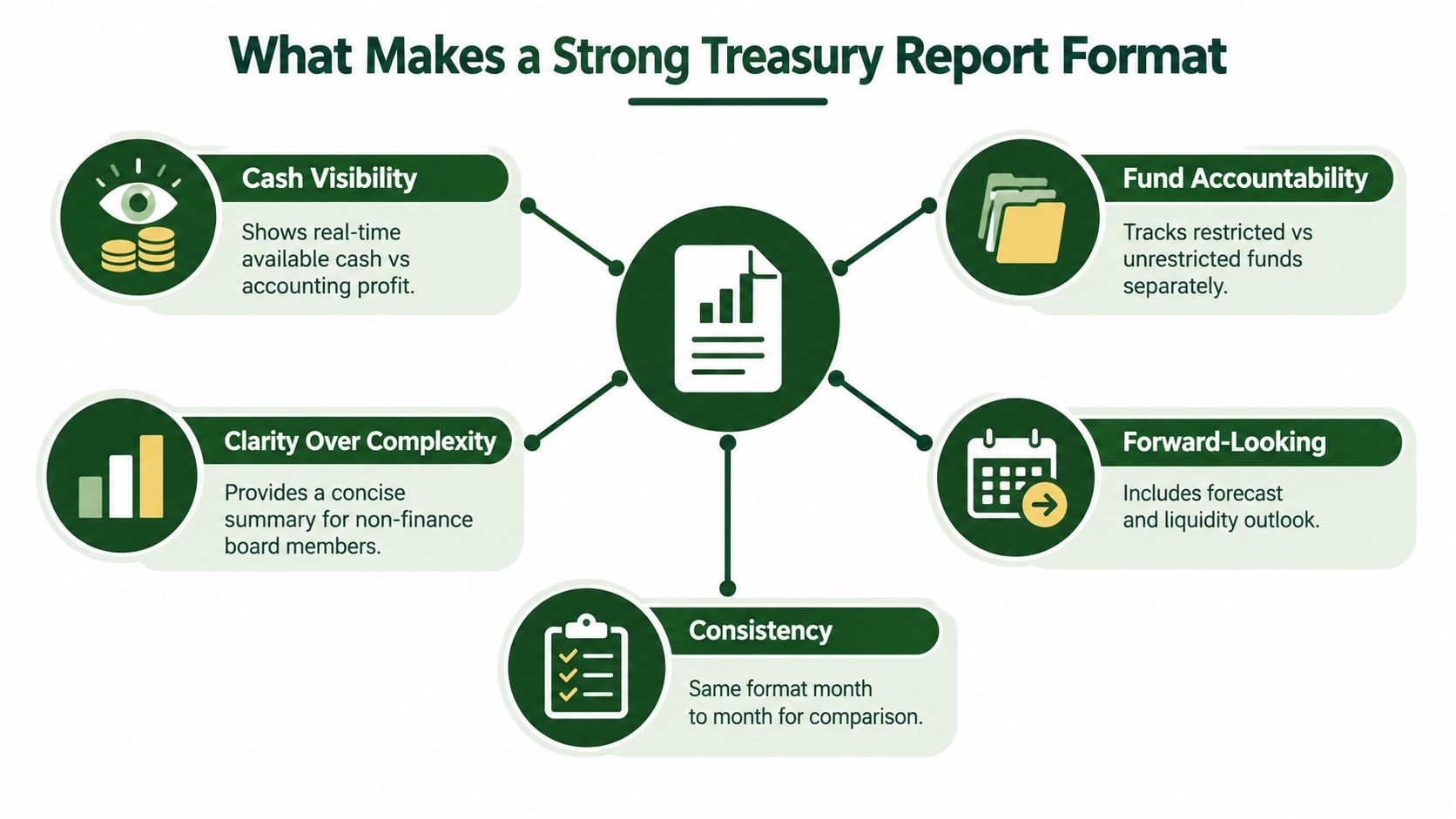
Use five tests when reviewing a template.
- Cash visibility: Show bank and cash movement clearly, while distinguishing available cash from accounting activity. A cash balance alone can hide restrictions, pending payments, or funds held for a specific purpose.
- Fund accountability: Keep restricted, unrestricted, designated, and endowment activity identifiable. Church guidance recommends showing restricted, unrestricted, and endowment funds separately in annual accounts, with funds of the same type grouped together in columns or separate statements (guidance on accounting for different types of church funds).
- Clarity over complexity: Put the board-level conclusion near the front. Supporting schedules can carry transaction detail, but the main page should make the financial position understandable to non-finance readers.
- Forward-looking usefulness: Include upcoming obligations, known cash needs, and a liquidity outlook when leaders need more than a historical snapshot.
- Consistency: Use the same labels, fund groupings, period comparisons, and reconciliation presentation each month. Consistency makes changes visible and reduces review time.
Why standardized structure matters
Public-sector treasury formats increasingly treat the report as a structured, auditable package. HM Treasury's 2025–26 annual report and accounts is published as a 300-page document, with an interactive version of 151 pages, illustrating how formal financial governance can require substantial supporting detail (HM Treasury annual report and accounts for 2025 to 2026). Australia's Treasury Annual Report 2024–25 is arranged in five parts covering role and structure, performance, management and accountability, audited financial statements, and other required information.
A church report can be much shorter, but it should still distinguish the summary from the evidence behind it. For more guidance on concise, decision-useful reporting, compare these best practices for management reporting and review how a clear financial report is structured in this church financial report guide.
Core Categories Every Treasury Report Should Include
The report's categories should follow the questions a board asks, not merely the order in which a software system exports data. A practical treasury report format usually brings together balances, movement, accountability, reconciliation, and explanation.
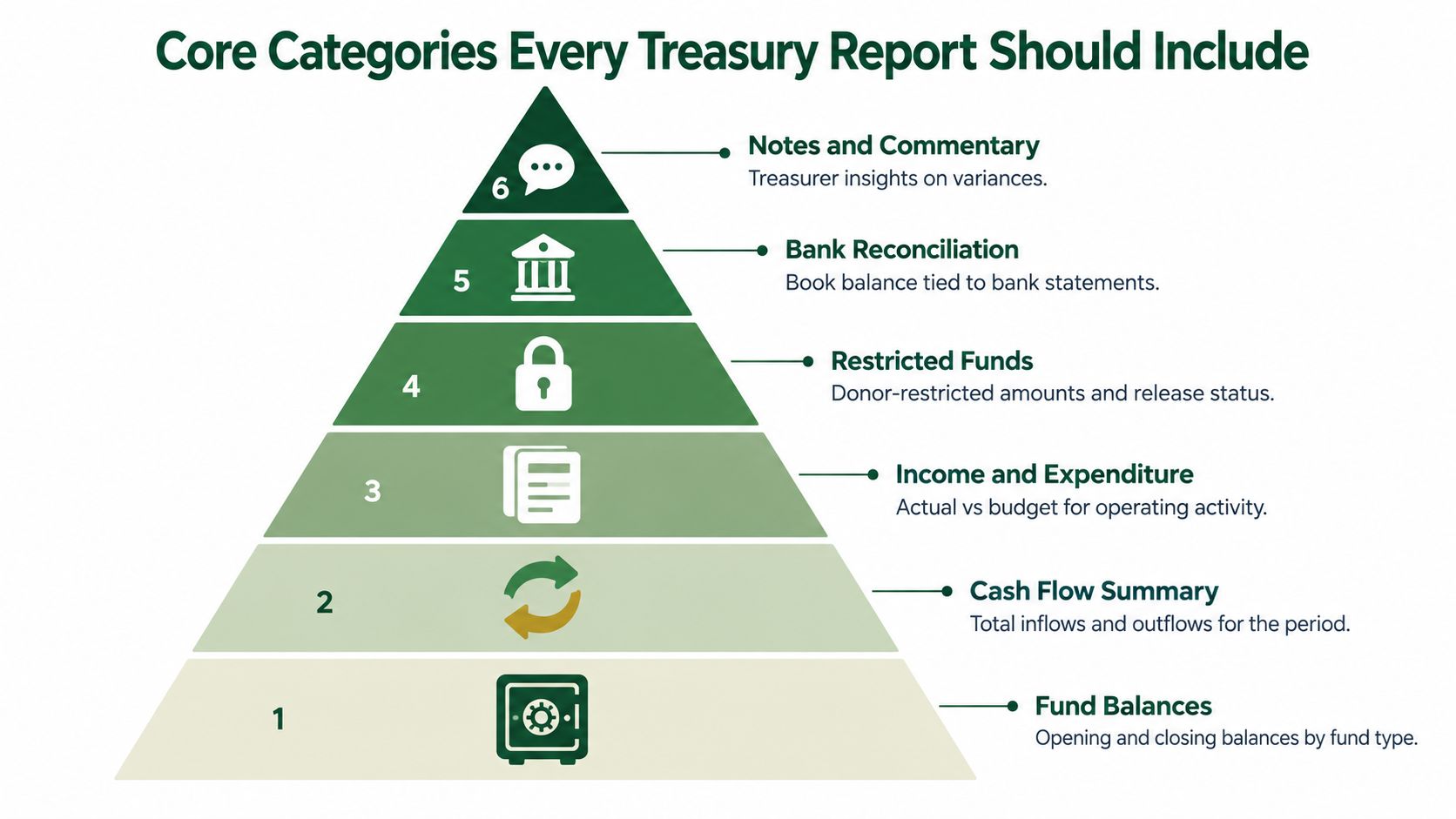
The six reporting foundations
- Fund balances: Show opening and closing balances by fund type. This answers, “What does each fund hold now?”
- Cash flow summary: Present total inflows and outflows for the reporting period. This answers, “What changed in cash?”
- Income and expenditure: Compare operating activity with the approved budget where a budget exists. This answers, “Are receipts and spending tracking as expected?”
- Restricted funds: Identify donor-restricted amounts, expenditures against purpose, and any release or transfer treatment. This answers, “Can this money be spent on the proposed activity?”
- Bank reconciliation: Confirm that the book balance agrees with the bank after considering outstanding items. This answers, “Can we trust the cash figure?”
- Notes and commentary: Explain unusual receipts, late invoices, one-time spending, and material variances in plain English. This answers, “Why did the numbers move?”
Treasury-style public-sector statements commonly center on revenue, expenditure, surplus or deficit for the period, and a reconciliation of net surplus or deficit. That fixed structure supports comparison across periods and makes variance analysis easier for controllers and auditors (treasury-style statement structure).
For church reporting, the most important relationship is between cash and funds. A bank account may contain money belonging to several purposes. The report should therefore show both the total cash position and the fund allocation behind it. If a repair reserve, missions fund, and general operating fund share an account, the bank balance doesn't tell the board how much is spendable for each purpose.
Practical rule: Never let a single “cash available” figure stand in for fund availability unless the report explains the restrictions and outstanding items behind it.
Fund-level schedules should make restricted, unrestricted, and endowment balances easy to compare. If a church has few funds, columns may be sufficient. If the fund structure is more complex, separate statements can improve readability and reduce crowded tables.
The following video provides another visual reference for organizing financial information into a usable report:
Detailed Entries and Field Definitions With Examples
A report becomes reliable when every field has a defined meaning. Treasurers should be able to explain not only the final balance, but also how each line was calculated and what it excludes.
The basic fund schedule
For each restricted fund, include opening balance, current-period income, current-period expenditure, and closing balance. This four-field structure is recommended in church restricted-fund guidance (restricted-fund tracking fields).
| Fund Type | Opening Balance | Period Income | Period Expenditure | Closing Balance |
|---|---|---|---|---|
| Unrestricted operating | 24,000 | 18,500 | 17,900 | 24,600 |
| Restricted missions | 8,000 | 2,400 | 1,700 | 8,700 |
| Designated building | 12,500 | 900 | 3,000 | 10,400 |
| Endowment | 30,000 | 600 | 0 | 30,600 |
The figures in this example are illustrative, not reported financial data. The calculation is straightforward: opening balance plus period income, less period expenditure, equals closing balance. If the result doesn't agree with the ledger, investigate the difference before distributing the report.
What each entry means
Opening balance is the fund's closing balance from the prior reporting period. Don't replace it with the bank balance unless the bank account belongs entirely to that fund.
Period income includes receipts assigned to that fund during the period. Keep giving-platform deposits, direct gifts, grants, and transfers clearly labeled so leaders can distinguish external income from internal movement.
Period expenditure records costs charged to the fund. A payment should only reduce a restricted fund when it relates to the permitted purpose and has been coded correctly.
Closing balance is the calculated balance carried forward. It should agree to the fund ledger after legitimate adjustments, such as outstanding checks or deposits in transit.
Net surplus or deficit summarizes income less expenditure for the period. Use the term that matches your reporting basis and explain unusual noncash or transfer activity in the notes.
Reconciliation adjustments identify items that explain why the bank statement and accounting records differ temporarily. Examples include deposits in transit, uncashed checks, bank charges, or entries recorded by the bank before the bookkeeper posts them.
When restricted money is spent for its intended purpose, the Statement of Activities treatment is net assets released from restrictions. This is a reclassification from the restricted column into the unrestricted column that offsets the expense (church accounting treatment for designated funds). The report should show that movement clearly instead of making it look like unrestricted income arrived from outside the organization.
Sample Treasury Report Layouts and Format Variations
No single report suits every church. A small congregation with one operating account may need a concise monthly dashboard, while a growing church with multiple ministries may need a fund schedule and budget comparison. Compliance-sensitive reporting calls for still more documentation.
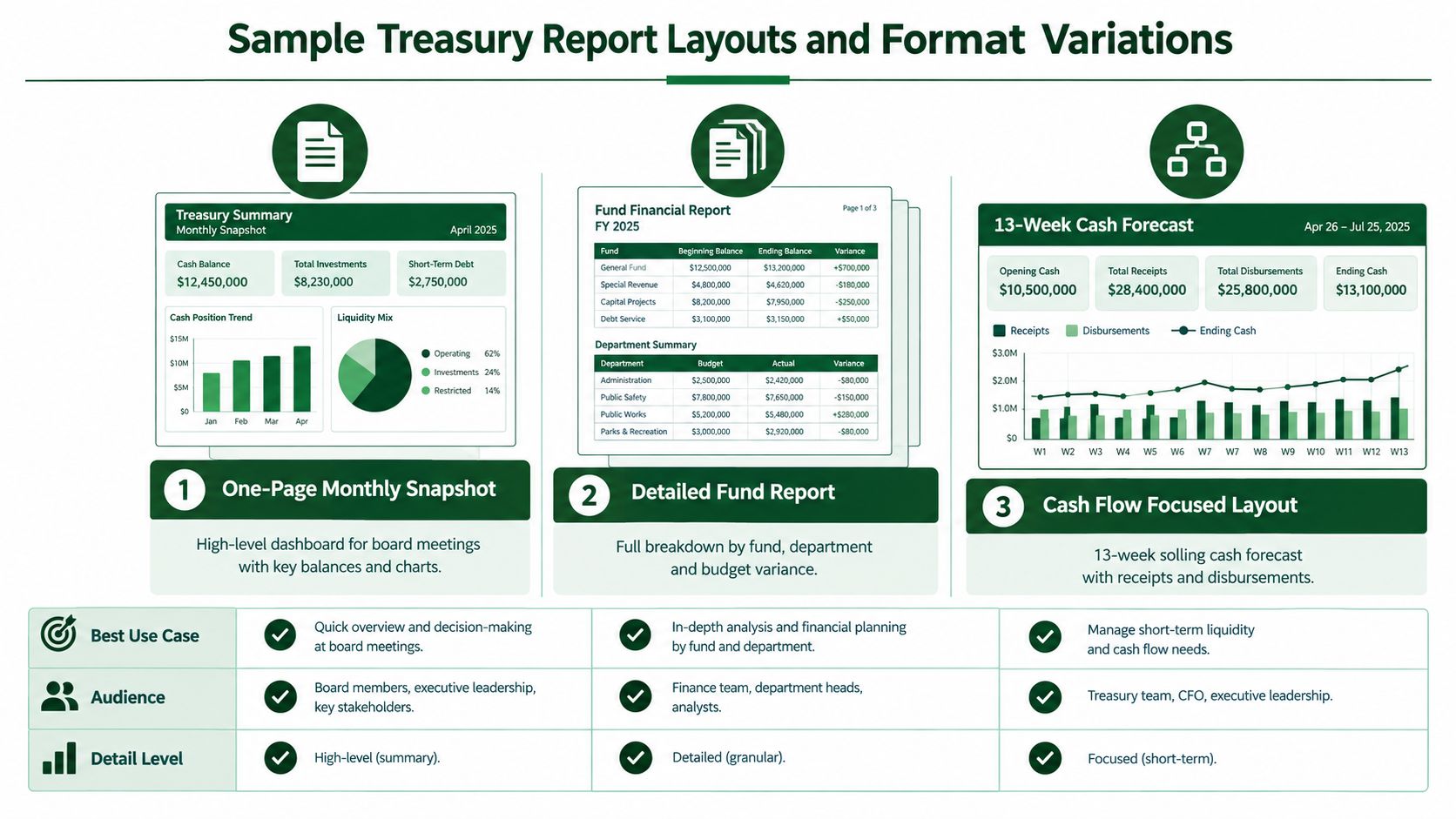
Choose the layout by decision need
| Layout | Best use | What it should show |
|---|---|---|
| One-page monthly snapshot | Routine board meetings | Total cash, fund balances, income, expenditure, reconciliation status, and key notes |
| Detailed fund report | Multiple ministries or restricted gifts | Opening and closing balances, income, expenditure, transfers, and fund-specific commentary |
| Multi-period variance report | Budget oversight and trend review | Current period, prior period, budget, variance, and explanation of significant changes |
The one-page snapshot works when readers need orientation before discussion. It shouldn't try to carry every transaction. Attach the bank reconciliation and detailed ledger as supporting schedules.
The fund-level report is better when the central question is purpose. A board considering a missions expense needs to see the missions fund, not only the organization-wide balance. Add donor restrictions, releases, and outstanding commitments where they affect spendability.
The multi-period layout supports governance conversations about recurring patterns. It can include budget variance, upcoming expenses, and confirmation that reconciliation is complete. Those additions are useful when a static monthly recap no longer gives leaders enough information to act.
Templates increasingly combine cash movement summaries with budget variance, upcoming expenses, reconciliation confirmation, and fund-level detail. That direction is sensible, but more detail isn't automatically better. The main report should remain readable, with technical support placed in appendices.
For presentation design beyond financial content, treasurers can find the best board deck examples and adapt the principles to a church setting. Use the same discipline for a board packet: lead with decisions, support them with evidence, and remove decorative material that obscures the message.
Charts Tables and Visuals That Make Reports Board Ready
Boards usually need to understand the position before they study the mechanics. A clear visual hierarchy helps. Put the key conclusion first, show the relevant comparison next, and place transaction detail in an appendix.
Match each visual to one question
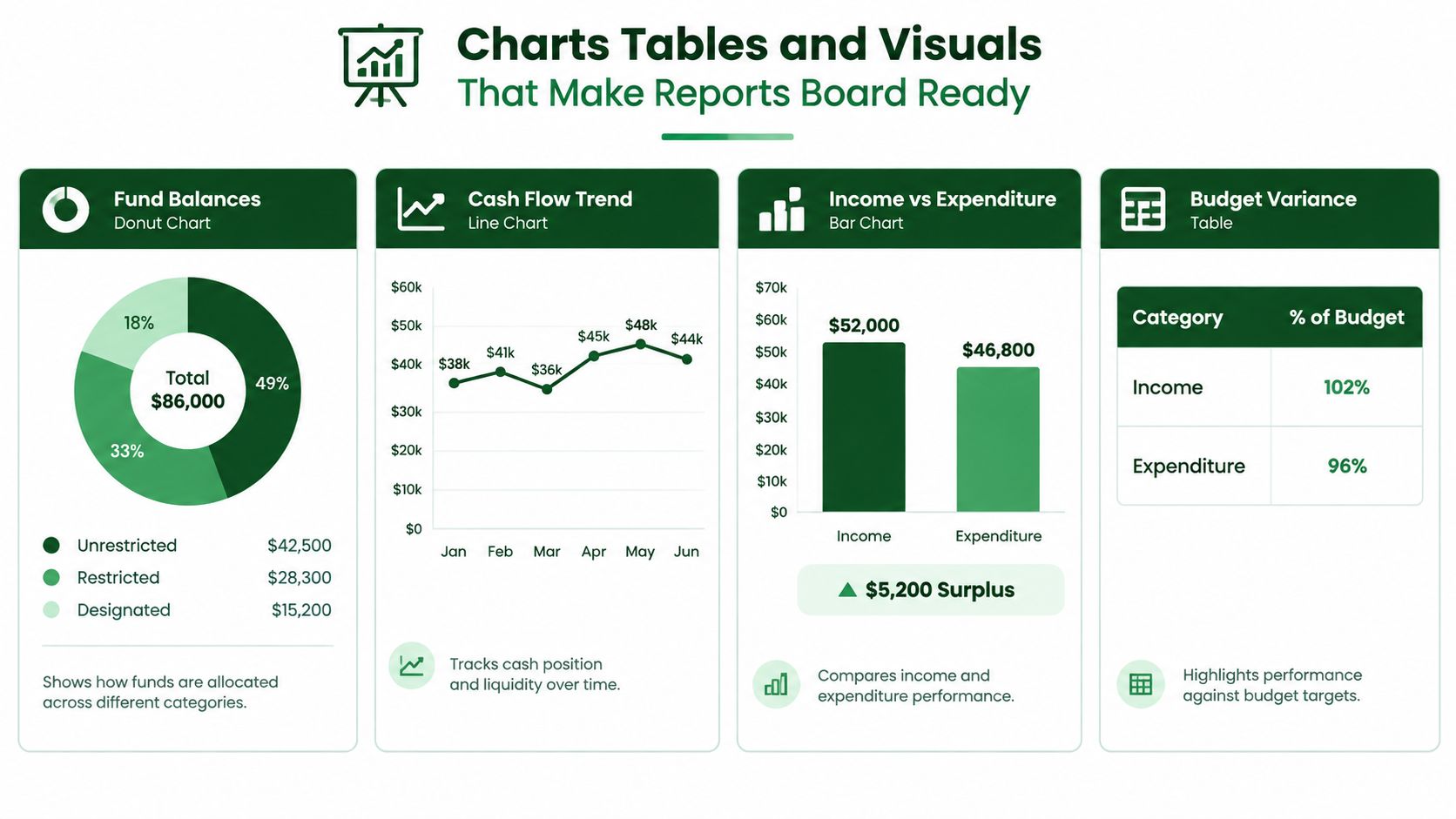
- Fund balance chart: Use a bar or proportion chart to compare unrestricted, restricted, designated, and endowment balances. Label each category directly.
- Cash flow trend: Use a line chart to show receipts and payments across consistent reporting periods. Don't mix monthly and cumulative values on the same axis.
- Income versus expenditure: Use paired bars to show actual activity against the budget or prior period. Add a short explanation beside any meaningful variance.
- Restricted-fund schedule: Use a table or burn-down view to show opening balance, new receipts, spending, and remaining balance by purpose.
The dashboard below contains illustrative values. They are included as a design example, not as verified church financial data.
Make tables usable after the meeting
A table should preserve meaning when someone copies it into a spreadsheet or reviews it during an audit. Use stable labels such as “Period Income” and “Period Expenditure,” rather than changing terminology from month to month. Include the reporting date, accounting basis where relevant, fund name, and whether values are actual, budgeted, or forecast.
Avoid image-only PDFs. One treasury reporting specification explicitly requires audit files to be searchable so reviewers can copy and paste figures from the report (searchable audit-file requirements). That principle translates directly to church administration. Use text-based tables, selectable labels, and accessible headings so a reviewer can validate figures without retyping them.
Keep charts subordinate to the narrative. A chart can show that a balance changed, but the treasurer's note should explain whether the change came from seasonal giving, a one-time expense, a transfer, or a reconciliation item.
Cross References and Related Financial Reports
The treasury report should stand on its own, but it shouldn't stand alone. A well-prepared board packet connects the report to the records that validate its conclusions.
The balance sheet provides the wider financial position, including assets, liabilities, and net assets. The Statement of Activities explains revenue and expenses by fund or net-asset class. The Statement of Cash Flows focuses on cash movement. These reports answer related questions, but they aren't interchangeable. A treasury report should cross-reference them without duplicating every line.
Build a traceable packet
Attach or link the following when relevant:
- Bank reconciliation reports: Support the cash balance and identify outstanding items.
- Giving-platform summaries: Tie donor receipts to deposits and fund coding.
- General ledger detail: Allows reviewers to trace unusual transactions.
- Budget report: Supplies the approved benchmark for variance analysis.
- Audit files: Preserve the searchable evidence used for review.
- Commitment and upcoming-expense schedules: Show known demands on available cash.
The report should also explain how giving data reaches the accounting system. If donations enter through Planning Center, Pushpay, Stripe, or another provider, the finance process needs a clear path from gift designation to bank deposit to fund ledger. Grain's stated product model unifies giving, bank, and accounting data so donations can flow into the correct funds and reports can retain fund-level consistency. Use that kind of integration only when the underlying mappings and controls are documented.
A church with ministry projects may also benefit from a separate method to track content project profitability, especially when it needs to compare project income and costs. That analysis complements, but doesn't replace, fund reporting.
For practical preparation guidance, use this guide on how to prepare financial reports. The governing principle is simple: every headline figure should have a clear supporting record, and every supporting record should reconcile to the report's stated totals.
Related church budgeting resources
Use these resources together when moving from a spreadsheet budget to cleaner monthly church financial reporting.
- Free church budget generator - build a custom Excel budget template for your church
- Church budget template Excel guide - download and adapt a practical budget template
- Nonprofit budget examples - compare operating, program, and restricted-fund budget formats
- Grain Ledger budgeting - connect budgets to fund accounting and monthly reports
- Best church accounting software - compare fund accounting tools when the spreadsheet budget outgrows Excel
Quick Reference Template Checklist and Presentation Tips
Before sending the report, review it as both a finance administrator and a board member. The first perspective checks accuracy. The second asks whether a pastor or elder can understand the position without an oral translation.
Monthly preparation checklist
- Confirm opening balances: Make sure each fund begins with the prior period's closing balance.
- Review fund coding: Verify that restricted and designated receipts were assigned to the correct purpose.
- Complete reconciliation: Tie book balances to bank statements and list deposits in transit, uncashed checks, and other outstanding items.
- Test closing balances: Recalculate each fund and investigate differences before circulation.
- Explain variances: Add plain-English notes for unusual income, spending, transfers, or timing effects.
- List upcoming obligations: Include known bills, planned commitments, and cash needs that affect spendability.
- Check presentation: Confirm dates, labels, accounting basis, and actual-versus-budget indicators.
- Prepare supporting files: Attach the ledger, reconciliation, giving summary, and relevant fund schedules.
A concise presentation can follow a practical sequence: state the overall cash position, identify restricted and unrestricted availability, explain the largest movements, confirm reconciliation, then ask for decisions. Keep the narrative tied to ministry consequences. “The missions fund balance declined because approved outreach costs were paid” is more useful than “restricted expenses increased.”
For a reusable board document, adapt the church stewardship report template to your reporting cadence and fund structure. Keep the main page short enough to read during the meeting, but never remove the supporting evidence required to verify it.
When a church has outgrown spreadsheets, disconnected giving exports, or reports that simulate fund accounting through manual columns, consider a purpose-built option. Grain is church accounting software with native fund architecture, fund balance reporting, cash flow and activity reports, and integrations intended to connect giving, bank, and accounting records. It's one accounting solution to evaluate when the priority is true fund-based reporting rather than a cash summary with fund labels added later.
A treasury report format should help your leaders see both the cash and the purpose behind it. Grain brings giving, banking, and fund-based accounting into one workflow, so visit Grain to Start Free and evaluate a reporting process built for church finance.
Ready to simplify your church finances?
Start free with church fund accounting, or watch a product demo first.