What Is Financial Reporting for Churches? a Full Guide
 By Gibson Brueher, Founder of Grain Ledger
Learn what is financial reporting for churches, the key statements involved, and how fund-based accounting keeps restricted giving transparent and accurate.
116 of 140 surveyed countries required IFRS for all public companies by 2016, but for a church, financial reporting is the structured process of recording, summarizing, and presenting financial activity so leaders can see what came in, what went out, and how restricted money was handled. It turns transactions into information that pastors, boards, donors, and outside reviewers can use.
About Grain Ledger: This guide includes Grain Ledger, church fund accounting software built for designated gifts and ministry funds. It connects giving platforms (Planning Center, Pushpay, Tithely, Stripe), syncs bank activity with Plaid, and produces fund-level financial reports. Start free to see how it compares for your church.
See Grain Ledger for your church
Fund accounting, giving integrations, and bank reconciliation in one platform. Free migration support for churches switching from QuickBooks or Aplos.
You may be facing that process right now. The bank statement is open, offering records are spread across a desk, and someone has asked whether the missions fund still has money available. A church report can't answer that responsibly by showing one large cash balance. It must show which resources exist, what obligations the church has, and whether each gift is being used for its intended purpose.
Financial reporting has grown from a regulatory requirement into a decision-making discipline. In the United States, the Securities Act of 1933 and Securities Exchange Act of 1934 helped establish modern financial reporting after the 1929 market crash, including requirements for firms to be audited. Internationally, the International Accounting Standards Committee formed in 1973, and the International Accounting Standards Board replaced it in 2001 to develop IFRS, as outlined in this history of financial reporting standards.
For churches, the central question is more personal than regulatory: Can we explain faithfully how God-provided resources are being stewarded?
"A Treasurer's First Quarter-End Report"
Maria volunteered to serve as treasurer because she was organized, dependable, and comfortable with spreadsheets. She didn't expect the first quarter-end report to feel like detective work.
On the Sunday after the quarterly meeting, Maria sat at her kitchen table with bank statements, offering envelopes, invoices, and a spreadsheet open on her laptop. The pastor had asked for a report before the next leadership meeting. Board members wanted to know whether spending was tracking with the budget. A donor had emailed about the Christmas benevolence fund and asked how the money had been used.
Maria started with the bank balance. It looked healthy until she remembered that some of the cash belonged to the benevolence fund, some had been given for a youth missions trip, and some was available for ordinary operating expenses. One number couldn't answer the board's question.
She then opened the spreadsheet. The income column included Sunday offerings, online gifts, a grant, and a designated donation. The expense column included payroll, electricity, food for a community meal, and a benevolence payment. The entries were accurate enough as individual transactions, but they didn't yet tell a coherent story.
A useful report answers more than “How much cash is in the bank?” It explains who provided the money, what restrictions apply, what the church spent, and what remains available.
Maria's questions are common for a first-time treasurer:
- What belongs in a complete report? The board needs more than a bank balance. It needs activity for the period, financial position at period-end, cash movement, and fund-level availability.
- How much detail is enough? Leaders need categories they can understand, with supporting transaction detail available when a question arises.
- How should restricted gifts appear? A designated or donor-restricted gift shouldn't disappear inside a general total. Its purpose and remaining balance need their own line of sight.
A practical starting point is this treasurer's report example, but Maria's deeper lesson is structural. She doesn't need a prettier spreadsheet first. She needs a reporting framework that separates activity by purpose and connects summary numbers to the underlying records.
By the time Maria prepares the board packet, she should be able to show operating income and expenses, assets and liabilities, cash movements, and a clear reconciliation of each restricted fund. That is what turns a collection of documents into financial reporting.
"What Financial Reporting Actually Means"
Think about a household budget. A family records paychecks, groups bills into categories, watches savings, and reviews the results before deciding whether it can afford a repair or a vacation. The family isn't merely storing receipts. It's turning scattered transactions into information for decisions.
A church does the same work, but with more responsibility and more distinct audiences. It receives offerings, grants, fees, and designated gifts. It pays salaries, utilities, insurance, ministry costs, debt, and vendor invoices. Financial reporting organizes those events so people can understand the church's condition and act with care.
Start with the transaction
The process begins when someone records a financial event. A gift is entered with its date, amount, donor information where appropriate, account, and fund. An invoice is recorded with its vendor, expense category, approval, and payment status.
Next, the church classifies the transaction. A general offering isn't the same as a gift restricted for benevolence. A building payment isn't the same as a children's ministry expense. Classification preserves meaning that would be lost if every entry were treated only as “income” or “expense.”
The church then summarizes the classified information into reports. A statement of activities shows what happened during a period. A statement of financial position shows what exists at a specific date. A cash flow statement explains movement through the bank accounts.
Finally, leaders interpret and communicate the results. The pastor may need to know whether ministry plans are affordable. The board may need to assess liquidity, obligations, and fund balances. Donors may want confidence that their gifts were applied as promised.
The IFRS Conceptual Framework for Financial Reporting defines the objective around information that helps investors, lenders, and other creditors decide whether to provide resources. A church applies the same underlying logic to stewardship. Its reports should help users understand resources, obligations, changes in financial position, and management of entrusted funds.
Financial reporting is bookkeeping translated into a form that people can use.
That translation requires consistency. The church needs dependable categories, documented procedures, timely reconciliations, and statements that can be compared across periods. Readers shouldn't have to manually reconstruct the story from bank statements.
For broader principles on turning accounting records into useful management information, church leaders may also benefit from this practical guide to financial reporting advice for small businesses. The setting differs, but the discipline of accurate classification, review, and communication carries across organizations.
"The Three Core Reports Every Church Produces"
Most church reporting centers on three statements. Each answers a different question, and none can replace the others.
Statement of activities
The statement of activities, often called an income and expense statement, shows financial activity over a period. For a small church, common income lines include tithes, offerings, grants, facility income, and event receipts. Common expense lines include salaries, payroll-related costs, utilities, insurance, missions, worship, children's programs, benevolence, and building maintenance.
This report answers: Did the church's activity during the period support its ministry plan?
A surplus doesn't automatically mean unrestricted money is available. It may include gifts that can only support a specific program. A deficit may reflect timing, such as an expense recorded before a related gift arrives. The report becomes useful when readers can distinguish ordinary operating activity from fund-specific activity.
Statement of financial position
The statement of financial position, commonly called the balance sheet, is a snapshot at a particular date. It lists assets such as checking accounts, savings, investments, buildings, vehicles, equipment, and receivables. It also lists liabilities such as loans, unpaid invoices, payroll obligations, and other amounts owed.
The statement helps leaders assess financial position rather than monthly performance. A church may report positive activity for the month and still face significant obligations. It may also hold substantial assets while lacking unrestricted cash for current ministry needs.
The report's basic relationship is assets equal liabilities plus net assets. Under U.S. nonprofit guidance, churches show net assets without donor restrictions separately from net assets with donor restrictions, as described in this church fund accounting guide.
Statement of cash flows
The statement of cash flows traces actual cash movement during a period. It separates operating activity, investing activity, and financing activity. Operating cash may include offerings, payroll, utilities, and program payments. Investing cash may include purchases or sales of property and equipment. Financing cash may include loan proceeds or debt payments.
This report answers: Why did the bank balance change?
A church can show positive activity while cash falls because it purchased equipment or paid down a loan. Conversely, cash can rise because of a restricted gift or borrowing, even when ordinary operations are strained. Cash flow adds that explanation.
| Report | What It Shows | Time Frame | Key Question Answered |
|---|---|---|---|
| Statement of Activities | Income, expenses, and changes in net assets | A period, such as a month, quarter, or year | Did activity support the ministry plan? |
| Statement of Financial Position | Assets, liabilities, and net assets | A single date | What does the church own and owe? |
| Statement of Cash Flows | Cash from operating, investing, and financing activity | A period | Why did cash change? |
A board packet should present the statements together. Reading only the activity statement can hide obligations. Reading only the balance sheet can hide spending patterns. Reading only cash flow can hide whether the church's operations are sustainable.
"Why Churches Need Fund-Based Reporting"
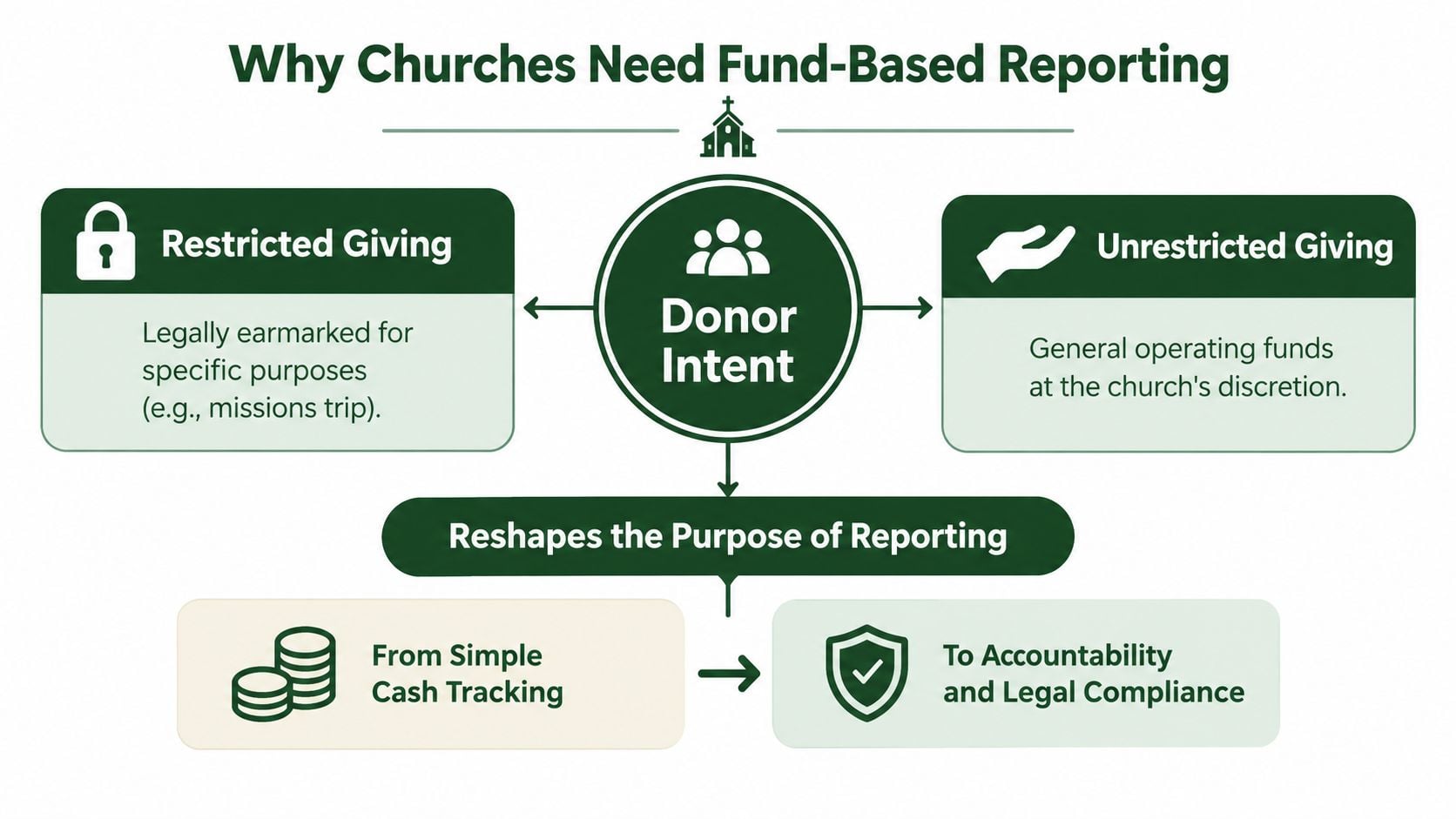
Donor intent is the organizing principle. If someone gives for a missions trip, the church can't treat that gift as though it were available for the utility bill. The restriction may arise from the donor's stated purpose or time condition, and the church must preserve that purpose in its records and reports.
Fund accounting creates the structure for doing that. The general operating fund can hold resources available for ordinary ministry decisions. Other funds can represent designated ministry purposes, donor-restricted programs, endowments, building projects, or benevolence work. Each fund carries its own activity and balance, while the overall system still produces organization-wide statements.
One cash account can hold several meanings
A bank account shows custody of cash, not legal or ministry availability. One checking account may contain operating money and restricted money at the same time. The ledger must distinguish those resources even when the bank doesn't.
Under ASC 958, churches and other not-for-profits classify net assets into net assets without donor restrictions and net assets with donor restrictions. Those classes appear separately on the statement of financial position and statement of activities. The distinction tells the board whether a reported balance can support general decisions or must remain connected to a donor's purpose.
Donor-restricted gifts remain restricted until the purpose is fulfilled or the time condition expires. The church then reports the amount as net assets released from restrictions on the statement of activities, rather than moving it into general operating income.
Fund reports answer the questions leaders actually ask
A board needs to know whether the church honored restrictions, whether each fund can meet its commitments, and how much is available for unrestricted ministry. Auditors need evidence that classifications and releases match the supporting documentation. Donors need a credible explanation of stewardship.
For churches using a receipts-and-payments basis, annual accounts should report restricted, unrestricted, and endowment funds separately. A church can prepare a separate receipts-and-payments account for each restricted fund or use a combined account with clear grouping and sub-analysis, according to this guidance on accounting for different types of funds.
Fund-based accounting therefore isn't a compliance footnote added after bookkeeping. It is the architecture that reflects how a congregation receives and uses resources. The structure protects donor intent before a report is printed.
For a more detailed explanation of this model, see fund-based accounting for churches.
Accrual Accounting and Internal Controls Behind the Numbers
A church can have money in the bank and still misstate what happened during the quarter. The answer depends on when income and expenses are recorded, how transactions are reviewed, and whether each entry is connected to the correct fund.
Cash and accrual tell different stories
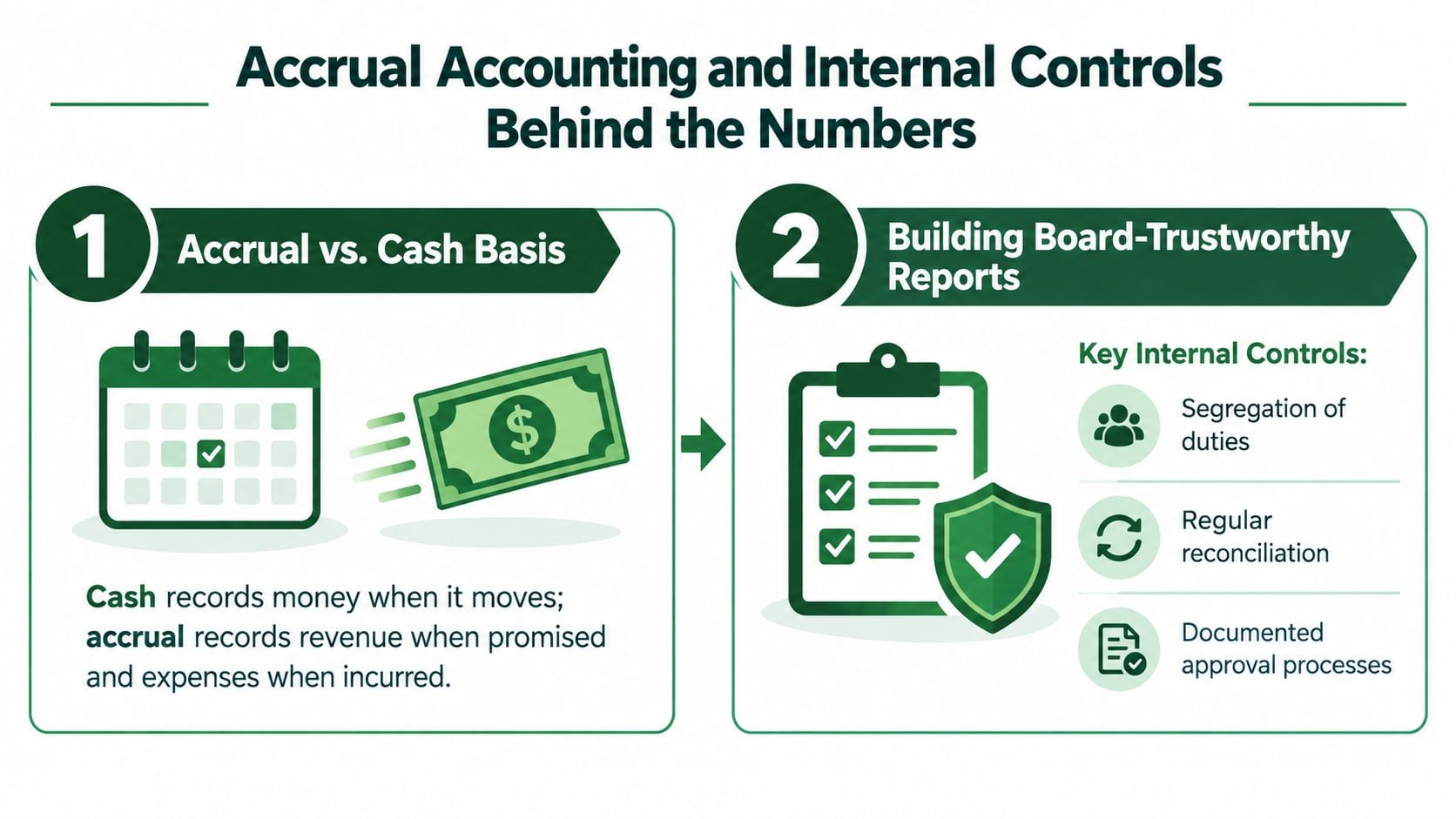
Cash accounting records income when money enters the account and expenses when money leaves. Accrual accounting records income when it is earned and expenses when they are incurred, as explained in this guide to accrual accounting. The difference becomes visible when a December pledge is paid in March or when the church pays an insurance premium in advance for a future period.
For nonprofit GAAP financial statements under ASC 958, accrual accounting is the required basis. The same basis is tied to federal grant reporting and Form 990 preparation, as explained in this cash versus accrual guide for grant accounting.
Accrual reporting shows the activity belonging to the period, rather than letting payment timing shape the whole story. For a congregation, that makes it easier to compare ministry costs with the income intended to support them and to understand obligations that have not yet been paid.
Controls make the report defensible
Internal controls reduce the chance that an error or fraud will enter the statements unnoticed. The PCAOB describes internal control over financial reporting as a process intended to provide reasonable assurance about reliable reporting and the preparation of external financial statements in accordance with GAAP, as described in its standard on internal control over financial reporting.
A small church can apply that principle through practical procedures:
- Separate responsibilities: One person records transactions, another reviews or approves them, and a different person reconciles the bank when staffing allows.
- Require documented approvals: Disbursements should include invoices, ministry purpose, authorization, and evidence of payment.
- Reconcile regularly: Compare the ledger with bank and giving records, investigate differences, and retain the reconciliation.
- Document policies: Record who can approve spending, how checks and electronic payments work, and how restricted funds are released.
- Review fund activity: Confirm that transfers, expenses, and releases match the applicable purpose and supporting documentation.
Controls don't replace trust. They protect trust by making responsibilities and evidence visible.
For a visual explanation of how accrual entries and controls support reliable reporting, watch this short accounting controls video.
The three statements become credible when the church can trace a reported balance to source records, approvals, reconciliations, and fund documentation. That audit trail turns approximate bookkeeping into accountable financial reporting.
"Choosing a System That Supports Real Church Reporting"
A spreadsheet or generic bookkeeping platform can be useful at the beginning. It may track income and expenses, import bank transactions, and produce a basic profit and loss report. Those features are suitable for a simple operation with few funds and limited reporting needs.
The difficulty appears when the church has several purposes for its money. A treasurer may create separate tabs, add prefixes to account names, maintain manual schedules, or reconcile a second spreadsheet against the accounting file. Those workarounds can preserve information for a while, but they increase the risk of inconsistent balances and laborious year-end reporting.
Compare the underlying architecture
A generic system usually treats the account or category as the primary organizing field. A fund-native system treats the fund as a core dimension alongside accounts, vendors, and transactions. That difference affects what the church can see without rebuilding the report manually.
| Capability | Generic Bookkeeping | Fund-Native Church Accounting |
|---|---|---|
| Fund structure | Often represented through classes, tags, projects, or separate files | Built into the accounting architecture |
| Restricted giving | May require manual coding and follow-up schedules | Tagged to the applicable fund at entry |
| Designated balances | Often maintained in supplemental reports | Available through fund-level balances |
| Board statements | Basic income and expense views may need adjustment | Statements can be organized around church reporting needs |
| Audit support | Depends heavily on exported spreadsheets and manual documentation | Can connect reports to underlying transactions and controls |
| User permissions | Usually designed around general bookkeeping roles | Can be configured for treasurers, bookkeepers, and pastors |
The right evaluation starts with the church's reporting requirements, not the software's feature list. Ask whether funds exist at the chart-of-accounts level, whether donor and pledge information can be retained, whether designated balances are visible, and whether reports can be customized for the board.
Also examine the audit trail. Can a reviewer move from a report number to the journal entry and transaction? Can the system export records in a form an accountant can use? Can a pastor see relevant reports without receiving unrestricted access to every financial function?
Grain is one option built for this model. Its native fund architecture organizes accounts, transactions, and reports around funds, while integrations with bank accounts, cards through Plaid, and giving providers such as Planning Center, Pushpay, and Stripe can bring related activity into the accounting workflow. It provides fund-level balance sheet, cash flow, and activity reporting, with controls intended to keep restricted funds connected to their purposes.
For a church, the important test is simple: Can the system produce the report the board needs without asking the treasurer to reconstruct the church's structure by hand?
Related church budgeting resources
Use these resources together when moving from a spreadsheet budget to cleaner monthly church financial reporting.
- Free church budget generator - build a custom Excel budget template for your church
- Church budget template Excel guide - download and adapt a practical budget template
- Nonprofit budget examples - compare operating, program, and restricted-fund budget formats
- Grain Ledger budgeting - connect budgets to fund accounting and monthly reports
- Best church accounting software - compare fund accounting tools when the spreadsheet budget outgrows Excel
"Putting It All Together in a Reporting Rhythm"
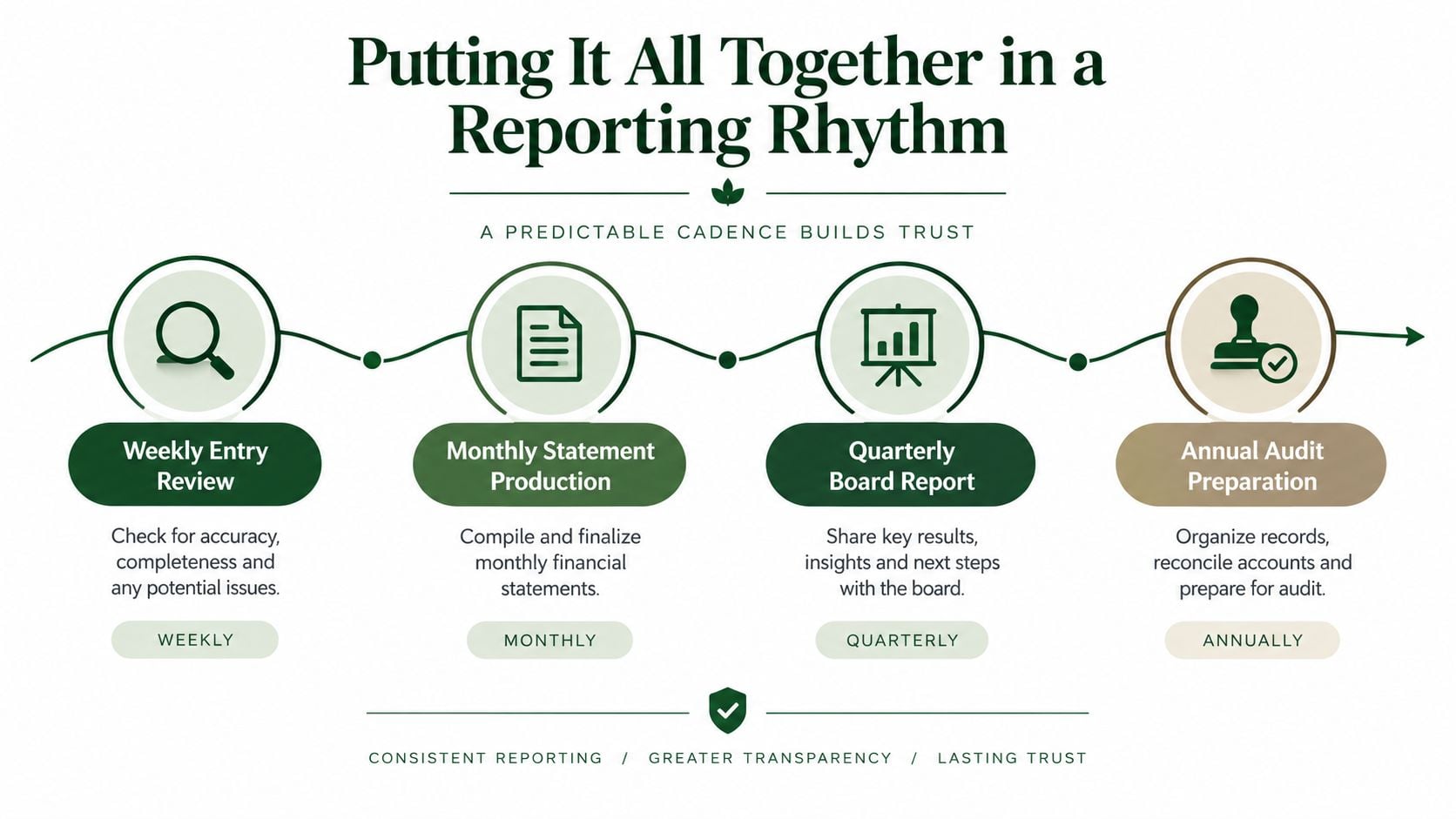
Financial reporting creates confidence when it follows a rhythm instead of arriving as a year-end emergency. The rhythm should match the church's capacity, but each review should leave the records cleaner and the next report easier to prepare.
Weekly review keeps small issues small
Each week, the person responsible for bookkeeping reviews new bank activity, giving imports, invoices, receipts, and unusual transactions. The review should confirm that each entry has the right account and fund, that supporting documentation exists, and that restricted gifts weren't placed in the general operating fund by mistake.
The treasurer doesn't need to wait for the board meeting to discover a duplicate payment or an unexplained transfer. Early review gives the church a chance to correct the record while the transaction is still familiar.
Monthly statements show the current picture
Each month, the church closes the period and produces its core statements. The treasurer reviews activity against the budget, checks the statement of financial position, examines cash flow, and compares fund balances with current commitments.
A short management note can explain unusual changes. For example, a large building expense, a delayed grant, or a seasonal giving pattern may make a variance understandable. The note should distinguish timing from a recurring financial problem.
Quarterly and annual reviews add accountability
Quarterly board packets can combine the three core statements with restricted-versus-unrestricted variance notes, current fund balances, and explanations of significant commitments. Board members should be able to ask questions from a shared set of numbers rather than from competing spreadsheets.
An annual compilation or review by an outside accountant can provide another layer of preparation and accountability. The treasurer's work throughout the year makes that process more orderly because reconciliations, approvals, policies, and fund documentation already exist.
The cycle is straightforward:
- Weekly entry review: Check coding, documentation, approvals, and unusual activity.
- Monthly statement production: Close the period and review activity, position, cash, and fund balances.
- Quarterly board reporting: Present statements with explanations that separate restricted and unrestricted decisions.
- Annual accountant review: Prepare organized records for compilation, review, audit, grant reporting, or tax filings as applicable.
Consistency is a stewardship practice. A predictable report tells donors and leaders that the church takes entrusted resources seriously.
That is the practical answer to what is financial reporting for churches. It is a repeating process that captures transactions, preserves donor intent, explains financial position, and gives leaders reliable information for ministry decisions.
Grain Ledger offers true fund-based church accounting that organizes transactions and reports around the funds your congregation manages, including restricted and unrestricted resources. Visit Grain to Start Free and explore a reporting workflow built for clearer board, pastor, donor, and accountant visibility.
Ready to simplify your church finances?
Start free with church fund accounting, or watch a product demo first.