Church Treasurer Training: A Practical Onboarding Guide
 By Gibson Brueher, Founder of Grain Ledger
Church treasurer training made practical. Learn the core role, fund-based bookkeeping, controls, reporting, and a ready onboarding plan for new treasurers.
The previous treasurer has stepped down, the pastor needs a current financial report, and the board is asking why a restricted ministry balance doesn't match the bank statement. You've been told the role is “mostly bookkeeping,” but the first few weeks quickly prove otherwise. A church treasurer protects donor intent, supports ministry decisions, and creates the records that let leaders explain how the church uses its resources.
About Grain Ledger: This guide includes Grain Ledger, church fund accounting software built for designated gifts and ministry funds. It connects giving platforms (Planning Center, Pushpay, Tithely, Stripe), syncs bank activity with Plaid, and produces fund-level financial reports. Start free to see how it compares for your church.
See Grain Ledger for your church
Fund accounting, giving integrations, and bank reconciliation in one platform. Free migration support for churches switching from QuickBooks or Aplos.
Effective church treasurer training must start with fund-based accounting and internal controls, not with a software tutorial. The system should teach a new volunteer what to record, who must approve it, how to reconcile it, and how to report it clearly during the first 90 days.
What a Church Treasurer Actually Does
A church treasurer holds a stewardship office, not a clerical assignment. The work includes recording contributions by fund, paying bills under approved authorization, reconciling bank accounts monthly, safeguarding offering income, maintaining donor records, and reporting financial activity to the people responsible for the church's mission and governance. Church treasurer responsibilities commonly include accurate records, budgeting, reporting, banking, and compliance, as outlined in this church treasurer responsibilities guide.
The reason for each task matters. Recording a contribution only as “income” hides its purpose. Recording it against the correct fund preserves the donor's direction. Paying an invoice without documented authorization weakens accountability. Reconciling an account without independent review leaves errors and misuse harder to detect.
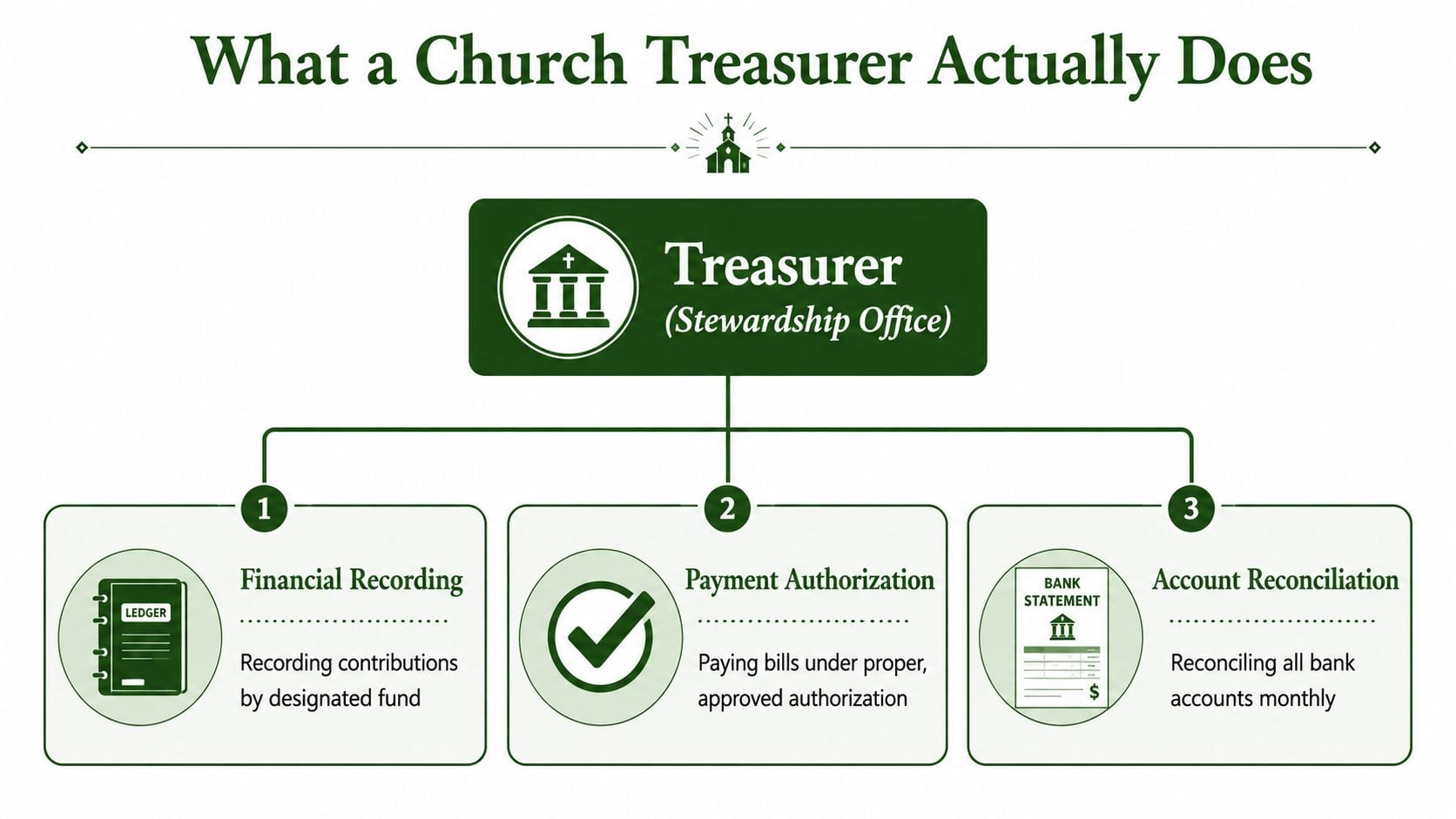
The treasurer's core responsibilities
A new treasurer should master these duties in a defined sequence:
- Record contributions by designated fund: Enter general, missions, benevolence, building, memorial, scholarship, and other gifts according to their stated purpose.
- Authorize and disburse payments: Pay bills only when the expense has proper approval under the church's policy and budget.
- Reconcile every bank account monthly: Compare the ledger with bank activity, investigate differences, and obtain an independent review.
- Protect offering income: Ensure counting, documentation, deposit, and access procedures prevent one person from controlling the entire cash process.
- Maintain donor records: Preserve contribution details and documentation needed for accurate statements and acknowledgments.
- Report financial activity: Give the pastor, finance committee, board, and congregation information they can understand and act on.
The stakeholder map is just as important as the ledger. The senior pastor sets ministry priorities. The board approves the budget and financial policy. The finance committee reviews statements and questions variances. A finance or audit firm reviews controls and supporting records. Members hold leadership accountable through annual meetings and congregational reporting.
Practical rule: A treasurer should never approve a payment simply because a forceful person requests it.
Every dollar carries a responsibility. A treasurer's first loyalty is to donor intent, approved policy, and scriptural faithfulness, not to whoever presses hardest for a disbursement.
Setting Up Fund-Based Bookkeeping
Fund accounting is the structural backbone of a church ledger. A contribution doesn't just represent money received. It also carries a purpose attached by the donor, and the books must preserve that purpose from receipt through expenditure. A church that tracks only income and expense categories can appear financially healthy while spending money that belongs to another ministry.
Build the chart of accounts by pairing a fund with a category. “Repairs” by itself is incomplete. “Building Fund / Repairs” tells the board both the activity and the purpose. The same approach can produce “Missions / Outreach Grants,” “Benevolence / Emergency Assistance,” or “General Fund / Utilities.” This structure makes reports useful because leaders can see activity without losing the restriction attached to the cash.
Common fund types include:
| Fund | Donor Intent | Example Transactions |
|---|---|---|
| General or unrestricted | Support the church's ordinary ministry and operations | Utilities, staffing, teaching materials |
| Tithe | Support the church's stated tithe-related ministry purpose | Transfers or approved ministry spending |
| Building or capital campaign | Finance a defined property or capital objective | Repairs, construction, equipment |
| Missions | Support external or internal mission activity | Missionary support, outreach grants |
| Benevolence | Provide assistance under the church's benevolence policy | Emergency aid, food assistance |
| Designated memorial | Use gifts in line with the memorial designation | Memorial project or approved ministry |
| Scholarship | Support education according to the scholarship policy | Scholarship payments and related administration |
A clean setup process
Start by documenting each fund's purpose, spending authority, and approval requirements. Then decide whether a restricted purpose needs a separate bank account, sub-account, or clearly controlled accounting dimension. Don't create a fund that nobody can explain.
Tag every donation at entry. If a donor specifies missions, the gift should enter the missions fund immediately, not sit in the general ledger until someone remembers to reclassify it. Track releases against documented expenses, and never allow a fund balance to go negative without disclosure and leadership action.
Use a fund accounting guide for churches to reinforce the distinction between fund purpose and transaction category. The practical payoff is direct: reports can show whether restricted cash covers restricted commitments, so the board doesn't accidentally spend designated gifts on ordinary operations.
Internal Controls Every Treasurer Must Enforce
Internal controls should be established during the first weeks, before the new treasurer settles into inherited habits. The minimum environment has five fundamentals: segregation of duties, documented offering counts, dual approval, independent reconciliation review, and physical safeguards.
Segregation of duties means one person shouldn't initiate, approve, record, and reconcile the same transaction. Separate receiving and counting from deposit preparation, payment approval from check preparation, and ledger posting from bank reconciliation. In a small church, complete separation may be difficult, but the board must assign compensating review rather than pretending the risk doesn't exist.
Offerings should be counted by two unrelated people, with both people signing a count sheet. The count should happen promptly after the service in a secure room. Two people should transport the deposit, and tamper-evident deposit bags should be used where available. Blank checks, cash, and donor records need controlled access.
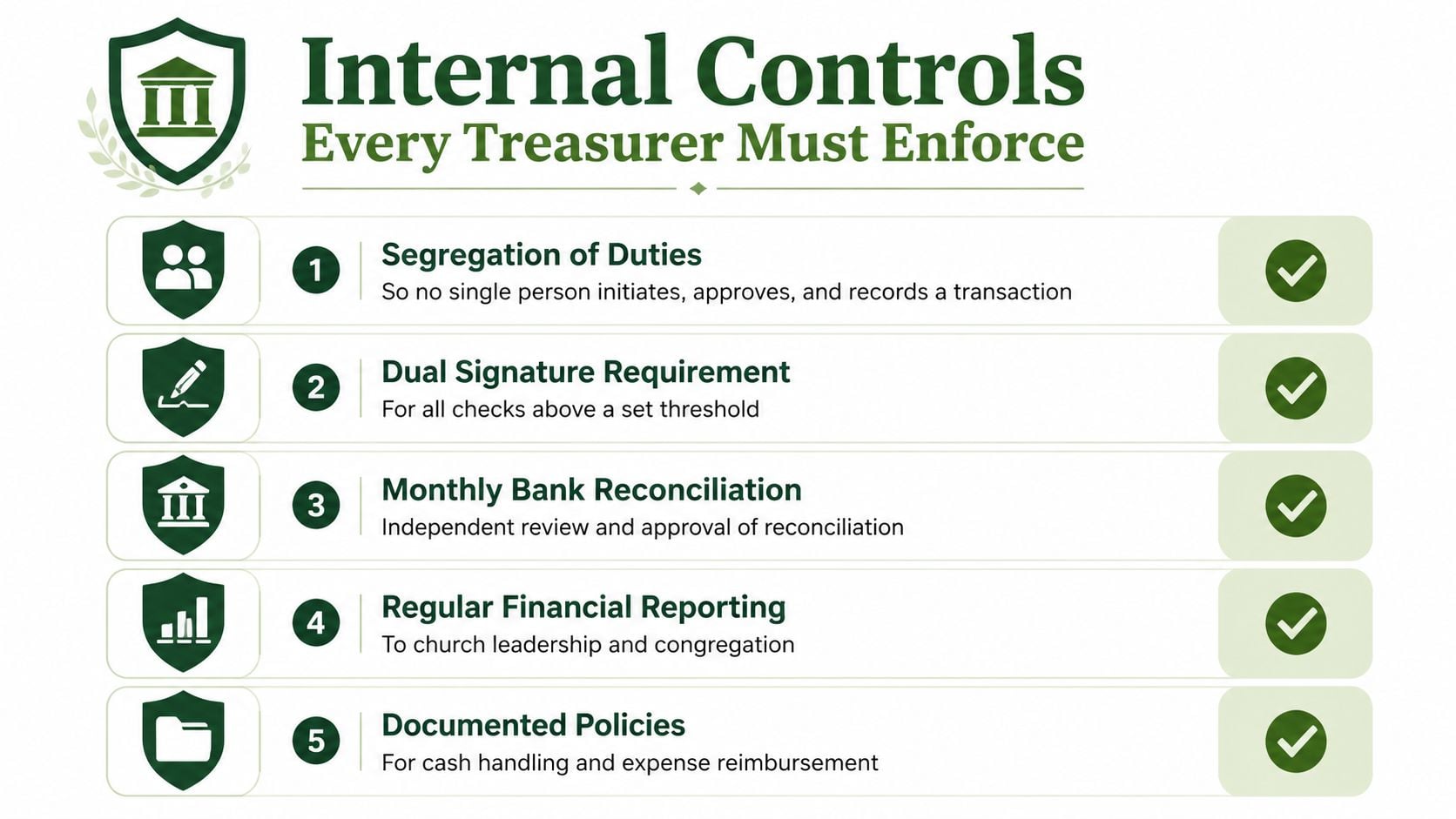
The controls auditors look for
- Dual signatures or approved thresholds: Establish when a second signer or board approval is required.
- Independent reconciliation review: Someone other than the bookkeeper should review the monthly reconciliation and follow up on unusual items.
- Documented expense support: Require invoices, receipts, approvals, and explanations for reimbursements.
- Restricted access: Limit access to checks, cash, online giving settings, bank credentials, and donor data.
- Written procedures: Document what happens when a treasurer is absent, a check is voided, or a deposit doesn't match the count sheet.
A pastor signing checks without board approval is a control failure. So is the person making deposits also reconciling the account. An offering plate left in an office overnight creates an avoidable custody gap. Auditors test whether the policy exists, whether people followed it, and whether the records prove that they followed it.
For a practical review of the monthly close process, use this month-end reconciliations guide. The church internal controls best practices resource can also help the board turn these expectations into written procedures.
Budgeting and Reporting to the Board
A church budget should translate the ministry plan into fund-aware financial commitments. Start with prior-year actuals, then separate general, designated, and restricted activities. Don't combine funds merely to make the budget look simpler. A board needs to know which resources support ordinary operations and which can be spent only for a stated purpose.
The monthly close rhythm should be consistent. Reconcile bank accounts, credit cards, and giving-platform feeds first. Then prepare a one-page board packet with the cash position, budget versus actual by fund, a restricted-fund movement schedule, and explanations for variances above 10 percent. The variance threshold should be written into the reporting policy so the treasurer doesn't explain one month's difference but ignore the next.
| Line Item | Fund | Budget (Monthly) | Actual | Variance | Notes |
|---|---|---|---|---|---|
| Children's ministry supplies | General Fund | Planned amount | Recorded amount | Calculated variance | Explain unusual purchase |
| Mission support | Missions Fund | Planned amount | Recorded amount | Calculated variance | Confirm approved recipients |
| Building repairs | Building Fund | Planned amount | Recorded amount | Calculated variance | Match expense to project |
| Benevolence assistance | Benevolence Fund | Planned amount | Recorded amount | Calculated variance | Confirm policy and documentation |
Make the report explain the ministry
Take children's ministry as a single-line example. The budget might show general-fund income assigned to children's ministry and expenses for curriculum, supplies, and events. If a designated children's gift also exists, report that activity separately so the board can see both the unrestricted operating commitment and the designated balance.
The congregation needs a simpler annual report. Show total giving, total spending by ministry area, and how designated gifts were deployed. Present it at the annual meeting and record the minutes. For event-specific planning, a practical event finance checklist can help teams document expected income, expenses, approvals, and settlement records without losing the fund assignment.
The treasurer's job isn't to bury leadership in spreadsheets. It's to provide a short, reliable explanation of what happened, why it happened, and what decision the board needs to make.
Compliance, Restricted Funds, and Audit Readiness
A new treasurer inherits compliance responsibilities immediately. Donor restrictions must be honored, written acknowledgments must be maintained for contributions of 250 dollars or more, donor records must be retained for at least seven years, and Form 990-series returns must be filed on time with the IRS. These requirements should sit in the onboarding checklist, not in a folder opened only when an auditor asks for it.
Create a restricted-fund subledger for missions, benevolence, capital, scholarships, and every other restricted purpose. Earmark the gift when it arrives. Release it only against documented expenses that match the restriction. Keep the donor, date, amount, purpose, and any goods or services provided in the contribution record, and distinguish restricted from unrestricted totals in contribution statements. These practices are emphasized in the Adventist treasury manual.
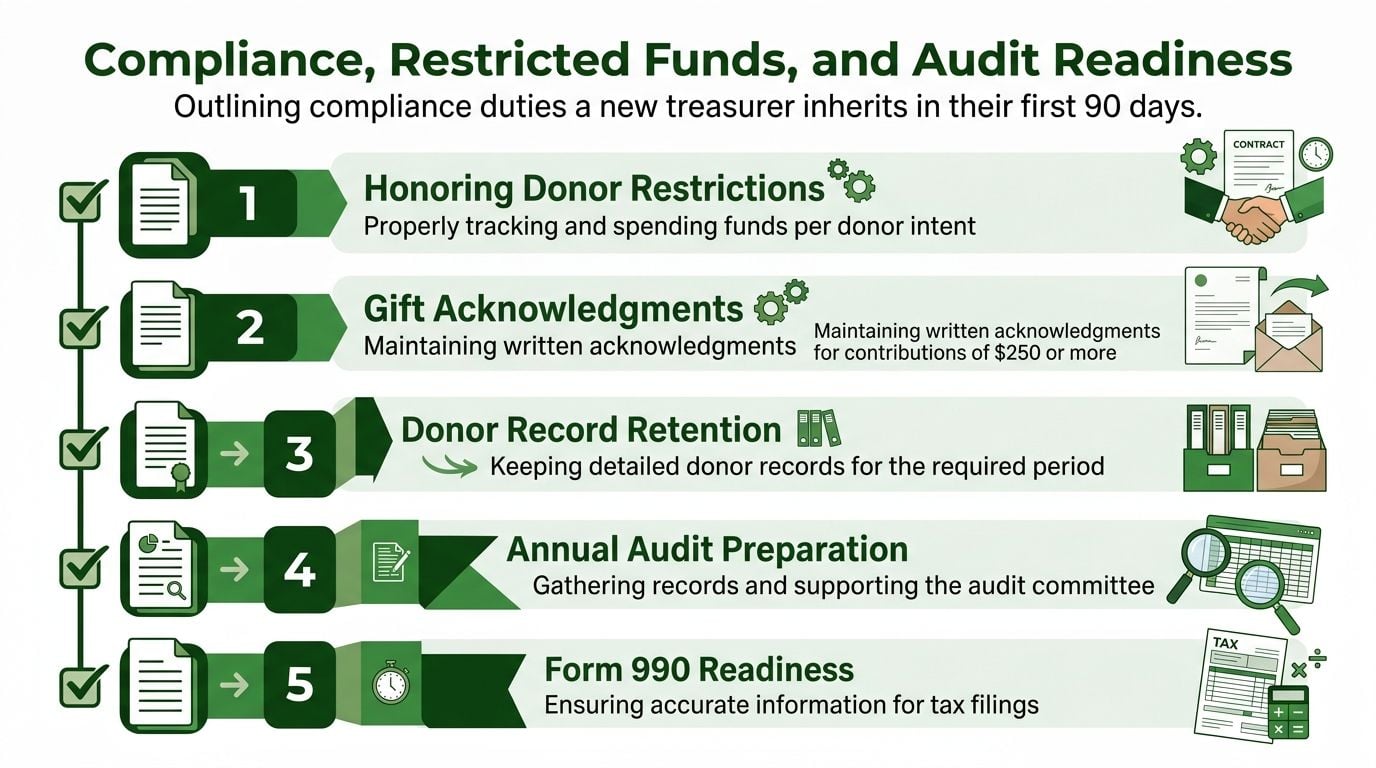
Build the year-end binder early
A year-end audit binder should contain:
- The chart of accounts: Include the fund structure and account descriptions.
- Bank reconciliations: Preserve reconciliations and evidence of independent review.
- Board minutes: Include budget approval and approval of the audit firm or qualified reviewer.
- Tax filing records: Keep the Form 990-series return and supporting information.
- Restricted-fund schedule: Show opening balance, gifts, transfers, expenses, releases, and closing balance.
- Transaction support: Retain receipts, invoices, approvals, and journal-entry explanations.
An annual local church audit independently evaluates both financial reports and internal controls. It should cover operating accounts as well as restricted, endowment, and property funds, as described in the local church audit guide_final.pdf).
Before the review begins, confirm that reconciliations tie to the ledger, journal entries have explanations, and sampled transactions have supporting receipts. For digital systems, also document who can change routing information, approve payments, edit donor records, and access reports. A useful reference for documenting these controls is this overview of audit trail requirements for 2026 compliance.
Related church accounting software resources
If you are comparing software, these pages map the main decision points: fund accounting, QuickBooks limits, pricing, and migration.
- Best church accounting software (2026 comparison) - canonical guide comparing 12 church accounting platforms
- Church accounting software product page - see Grain Ledger for fund accounting, giving, and bank reconciliation
- Small church accounting software - see the product page built for volunteer treasurers and church admins
- Fund accounting features - review how Grain Ledger tracks designated funds
- QuickBooks for churches - understand workarounds and when to switch
- Free church accounting software - compare free options and upgrade triggers
- Grain Ledger pricing - compare plans for small and growing churches
- Start free - try fund accounting, giving imports, and bank reconciliation together
Choosing the Right Accounting Tool
The accounting tool should reflect how the church receives and spends money. Generic small-business software can record transactions effectively, but it often requires workarounds for fund dimensions, donor restrictions, pledges, giving records, and reports that separate restricted cash from unrestricted activity.
Evaluate the software against the treasurer's real workload:
- Fund and department tracking: Can every transaction carry a fund and ministry assignment?
- Restricted-fund handling: Can the system show donor-level designations, releases, and remaining balances?
- Giving management: Can offerings and online donations flow into the correct fund?
- Pledge tracking: Can the church compare commitments with received contributions?
- Multi-campus consolidation: Can leaders view each campus separately and together?
- Audit-ready reporting: Can the system produce clear activity, balance, and reconciliation support?
Purpose-built church accounting software such as Grain Ledger uses fund accounting as the chart-of-accounts structure. It connects giving platforms, bank accounts, and accounting workflows so donations can be assigned to funds, while reports provide fund-level visibility into balances, cash flow, and activity. That approach fits a treasurer who must explain not only how much money the church has, but also what each portion may be used for.
| Feature | Generic Accounting | Church Fund Accounting (e.g., Grain Ledger) |
|---|---|---|
| Fund visibility | Often requires classes, tags, or workarounds | Fund structure is central to the ledger |
| Restricted gifts | May need manual tracking and supplemental schedules | Designed to show restricted balances and releases |
| Donor designations | Often separate from accounting records | Connected to contribution and fund records |
| Giving integration | Varies by provider and setup | Connects giving, banking, and accounting workflows |
| Pledge tracking | May require another tool | Evaluated as part of church finance needs |
| Multi-campus reporting | Often needs custom consolidation | Supports fund and organizational visibility |
| Board reporting | General financial statements | Reports organized around church funds and ministry activity |
| Audit support | Depends heavily on manual documentation | Fund-level records can support clearer review |
A small congregation with simple finances may begin with basic software, provided the board can still track purpose and controls. Once the church manages multiple funds, campuses, giving channels, or restricted commitments, adopt a platform built around fund accounting rather than forcing a generic ledger to imitate one.
Grain connects church giving, bank activity, and fund-based accounting so treasurers can track each dollar against its intended purpose and prepare clearer reports for pastors, boards, and congregations. Visit Grain to learn how its church accounting workflows can support your first 90 days and beyond.
Ready to simplify your church finances?
Start free with church fund accounting, or watch a product demo first.