Communication in the Church: 11 Tips That Work
Improve communication in the church with clear principles, channel strategies, templates, KPIs, and fixes for the most common pitfalls.
The message was read out on Sunday, but the right people still missed it. A volunteer didn't see the schedule change. A guest never heard about the next step. The finance update sat in a folder nobody opened, so the board and the congregation walked away with different stories about what the church could afford and why.
That is what communication in the church looks like when it's treated as a string of announcements instead of a governed system. Churches have moved from a print-and-pulpit model to websites, social media, visual projection, and other digital channels, yet many still lack a style guide or a clear communication process, so the same church can sound organized in one place and confusing in another (The Unstuck Group communications report). If you've ever had to explain a missed event, a misunderstood budget decision, or a volunteer no-show, the issue probably wasn't one bad email. It was a missing system.
A useful next step is to improve internal comms strategy by looking at ownership, channel fit, and follow-through together. That's the standard this guide uses, because churches don't just need louder messaging. They need communication that people can receive, understand, and act on.
Why Communication in the Church Still Breaks Down
On Sunday morning, the bulletin is handed out, the announcement is read, and the slide goes up on the screen. By Tuesday, someone still asks when the event is happening, where to sign up, and whether the money for it is coming from a special fund or the general budget. That's not a rare failure, it's the default result when a church relies on memory, one-time announcements, and scattered follow-up.
The pattern is older than email. Church communication has been formalizing for a long time, with national-level statistical reporting in the Church of England taking shape in the 19th century, including confirmands first reported in 1872, the Church of England Year Book beginning in 1883, and “usual Sunday attendance” added in 1968 (BRIN on the development of religious statistics). That history matters because it shows a shift from informal correspondence to measurable institutional reporting.
The real problem is usually process
Most church teams try to fix communication by writing a better announcement. That helps a little, but the deeper issue is usually unclear ownership. If nobody owns the message from draft to publish to follow-up, the church gets last-minute edits, mixed wording, and a different story on every channel.
Practical rule: if one person can't name the owner, the date, and the next action, the message isn't ready.
Digital habits make that worse. Church websites, worship technology, and active Facebook use have all become core channels in modern church communication, which means members now encounter information in multiple places, not one central place (The Unstuck Group communications report). At the same time, congregations expect more financial transparency than a vague “we're doing fine,” especially when budgets shift or giving is restricted.
A healthy system doesn't start with more announcements. It starts with clear roles, repeatable channels, and plain language that tells people what matters, why it matters, and what they should do next.
Four Core Principles That Anchor Every Message
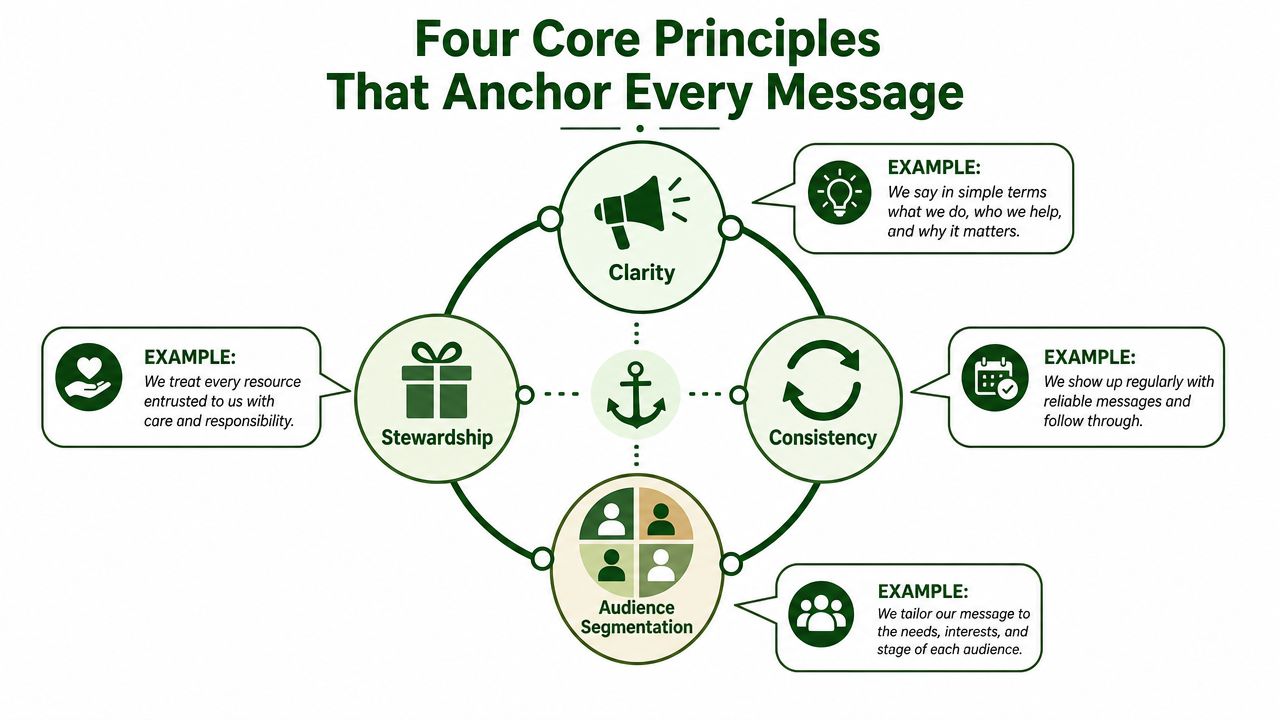
Good church communication gets easier when every message is checked against four principles. If a message fails one of them, people get confused even when the wording sounds polished.
Clarity first
Clarity means putting the most important information first and avoiding insider language. A message that says, “Join us for the thing after service,” sounds friendly to staff and meaningless to guests. A clear version says what the event is, who it's for, when it starts, and what action to take next.
The Church of Jesus Christ of Latter-day Saints' communication guide is blunt about this planning habit, it says communication should start by identifying who, why, what, and where (church communication guide). That is useful because it forces the church to think from the recipient's point of view.
Consistency across channels
Consistency means the same message should feel the same on the stage, in the email, on the website, and on social media. If the wording changes too much, people wonder which version is correct. Message redundancy helps here, because churches are advised to repeat core messages through several touchpoints, with one source recommending roughly seven touchpoints so different people hear it in the medium they use (Resource UMC on better communication).
Stewardship as a communication value
Stewardship means every message carries responsibility, including financial ones. A church that explains a budget change clearly is not being defensive, it is being faithful with trust. The same applies to ministry updates, leadership changes, and conflict communication, because people cannot steward what they do not understand.
Audience segmentation
Audience segmentation means one blast list rarely works. Members need one level of detail, guests need another, volunteers need action steps, and leaders need the reasoning behind the decision. Even a small church can segment by role without buying complicated software, and that usually makes communication cleaner immediately.
A simple test helps here. If a message would confuse a guest, burden a volunteer, and bore a board member, it needs to be split.
Choosing the Right Channels for the Right Audience
Church leaders often ask, “What platform should we be on?” A better question is, “Who needs this message, and where do they already pay attention?” That shift matters because channels are a portfolio, not a hierarchy. Sunday announcements still matter, but they can't do all the work.
Match the channel to the job
A worship announcement is best for immediate congregation-wide awareness. Printed handouts help people who like something physical to take home. Email works well for detail and follow-up. Text or SMS is useful when a message is time-sensitive and short. Social media, especially Facebook, is useful for broad visibility and reminder-level engagement. The website should hold the stable version of the message, the one people can check later. Video and a worship-screen loop are useful when a message needs visual repetition.
Church communication research shows that websites, worship technology, and active Facebook use are now common parts of the communication mix, which is why the church can't depend on a single channel anymore (The Unstuck Group communications report). If people miss the announcement on Sunday, they should still have another path to the same information.
For churches comparing live-streaming options as part of that broader channel mix, compare church live streaming platforms before you treat streaming as a side project instead of a communication channel.
| Channel | Best Audience | Best Use |
|---|---|---|
| In-person announcement | Regular attenders in the room | Broad awareness and immediate next steps |
| Printed material | Older adults, guests, take-home reference | Reminder and simple instructions |
| Members, volunteers, leaders | Detail, links, and follow-up | |
| Text or SMS | Volunteers, last-minute updates, mobile-first people | Time-sensitive notices |
| Wider community and occasional attenders | Visibility and reminders | |
| Website | Everyone, especially people checking later | Stable source of truth |
| Video or screen loop | People already in the room | Repetition and reinforcement |
For churches using social media intentionally, a practical church social media guide can help tie posts to real ministry goals instead of random promotion.
Don't make one channel carry the whole load
The biggest mistake is treating Sunday morning as the only real communication moment. People miss it, visitors don't know the context, and volunteers can't act on it if they aren't present. Redundancy isn't clutter when it repeats the same core message in different forms, it's how you reduce missed action.
If the message matters, it needs at least one channel for recall and one channel for proof.
Internal Workflows From Announcement to Follow-Through
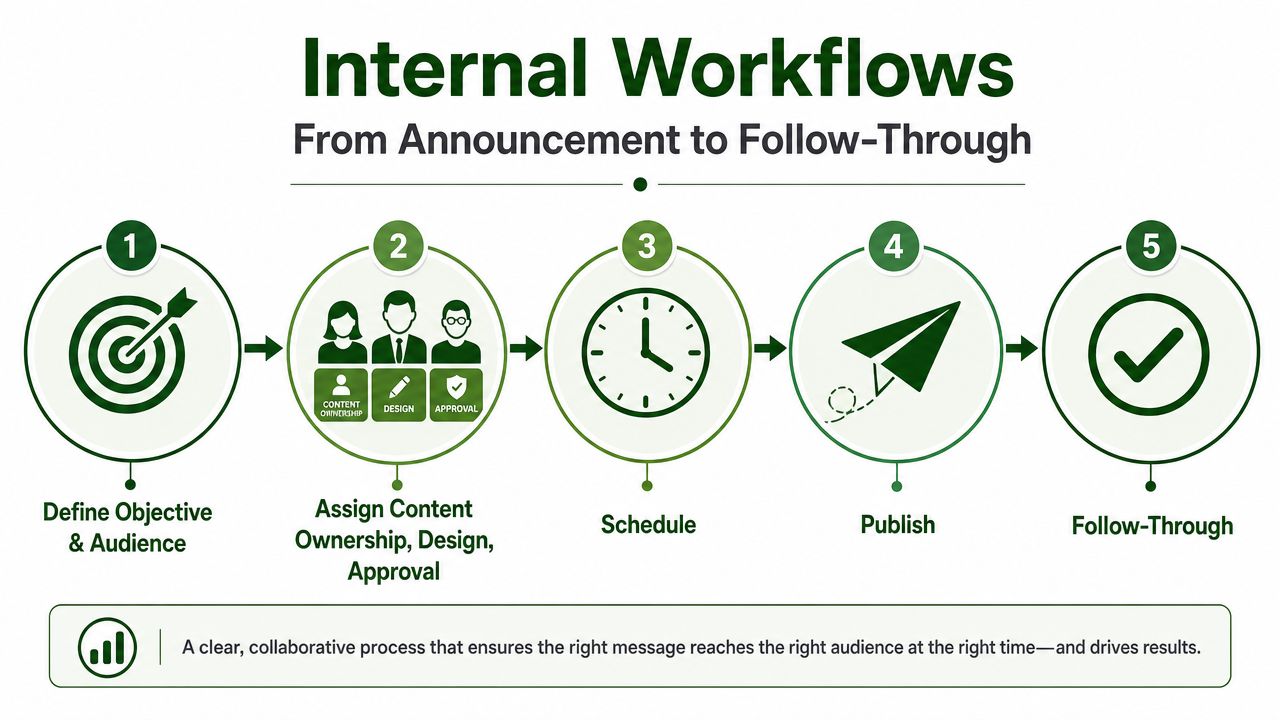
A church communication workflow only feels chaotic when nobody can see the pipeline. Once the team names the steps, the work becomes manageable, even with volunteers.
Start backward from the date
If the event is on a Saturday, the church should work backward from Saturday. First define the objective and the audience. Then assign who owns content, who designs, who approves, and who publishes. After that, schedule the message, publish it, and check whether people followed through.
That backward scheduling approach reduces last-minute edits because the deadlines are visible before the pressure hits (Pushpay on creating a church communication strategy). It also gives staff a clean way to ask, “Who needs to know this first, and what do they need to do?”
Keep leadership-to-congregation flow simple
In a healthy church, the pastor doesn't send everything directly to everyone. The flow usually runs pastor to staff, staff to ministry leaders, and ministry leaders to volunteers. That keeps the message from getting duplicated, distorted, or overexplained.
Weekly huddles help keep the pipeline full. Monthly planning meetings help the church see what's coming before the calendar gets crowded. If the team is small, the same person can own multiple steps, but the roles still need to be named so nothing disappears into the cracks.
Operational rule: the message should never be “owned by the room.” It should be owned by a person.
The UCC's training on communicating within the church warns that poor communication causes problems and emphasizes clear processes for information flow (UCC communication training PDF). That's the right instinct. Churches don't need more informal announcements, they need a repeatable path from decision to delivery to follow-through.
Handling Sensitive and Financial Communication
Sensitive communication and financial communication belong in the same category because both deal with trust. A church can say the right thing and still lose confidence if it hides the process behind vague wording, delayed updates, or inconsistent explanations. That's why these topics need governance, not improvisation.
Use a process for hard conversations
For conflict communication, the Matthew 18 framework gives churches a structured path, first address the issue privately, then involve one or two witnesses if it isn't resolved, and finally bring the matter before the whole church community if needed (Matthew 18 communication framework paper). The value of that model is not drama, it's order. People know who hears what, when, and why.
A policy for sensitive topics should also define who speaks publicly, what counts as confirmed information, and what stays internal. Bible.org recommends formal policies and procedures for public communication, including scheduled meetings and timely disclosure rules for budgets, spending, new initiatives, and staff resignations or dismissals (Bible.org church communications strategy). That gives a church a governance frame before a crisis forces one.
Explain money in plain language
Financial communication needs the same discipline. A restricted gift can't be treated like unrestricted cash, and one fund can't be moved to another purpose because the need feels urgent. That isn't a messaging preference, it's stewardship and accountability.
The hard part is that many church communication resources focus on announcements and coordination, not on how to explain why one fund can't be used for another purpose or how to report fund-level activity in language that pastors, boards, volunteers, and congregants can follow (Resource UMC on communication as ministry). That gap is where mistrust grows.
If your church needs a fund-based accounting platform with native fund architecture and instant fund-level visibility, Grain is built to keep restricted funds restricted while making reports easier to read and explain. For churches trying to understand disclosure expectations, do churches have to disclose financial information is a useful companion read.
A church does not build trust by saying less about money. It builds trust by saying the right thing in the right level of detail.
Ready to Use Messaging Templates and a One Page Plan
Strong communication gets simpler when leaders can copy a structure instead of starting from scratch. These templates work because they force the message to stay clear, short, and action-oriented.
Event announcement email
Subject: Men's Breakfast, Saturday at 8 a.m.
Body:
Join us this Saturday at 8 a.m. in the fellowship hall for men's breakfast. We'll share a meal, hear a short encouragement, and pray together. Bring a friend, and RSVP by Thursday so we can plan food.
That format follows the basic rule of putting the what, when, and where first. It also ends with a single next step, which is easier for people to remember than three different calls to action.
Stewardship update
Subject: Why the budget line changed this month
Body:
We moved funds because the original line no longer matched the need. The change reflects a ministry priority, and the board approved it after reviewing the impact on current commitments. If you want the fund-level detail, the full report is available at the office and from the finance team.
This kind of language is plain without sounding evasive. If the church uses a fund-based system, the report is easier to explain because the categories already match the way the church manages money.
Sensitive-topic statement
Subject: Church update on a leadership matter
Body:
We're addressing a leadership matter through a defined process. The people involved are meeting privately first, and if more help is needed, the next step will be handled by the board. We'll share only confirmed updates and will give the congregation a timeline for any public follow-up.
That kind of statement protects dignity without pretending nothing is happening. It also tells people what is being done now and what happens next.
One-page communication plan
Use four boxes on one page:
- Audience: Who needs this message.
- Message: What they need to know and do.
- Channel: Where they'll receive it.
- Owner: Who is responsible.
Add one weekly review question, Did the right people receive the right message and act on it? If the answer is unclear, the plan needs revision.
For a broader planning structure that helps churches organize ministry communication, strategic plan template for nonprofits can help a small team keep messaging connected to actual priorities.
Measuring What Works Without Spreadsheets You Will Abandon
A church doesn't need a giant dashboard to know whether communication worked. It needs a small set of signals that leaders can review without dread. The point is to find out whether people saw the message, understood it, and acted on it.
Track lead and lagging indicators
The three lead indicators are reach, comprehension, and follow-through. Reach asks whether the message got in front of the audience. Comprehension asks whether they understood the point. Follow-through asks whether they took the next action.
Two lagging indicators are repeat engagement and financial trust signals. Repeat engagement looks at whether people came back, responded again, or stayed connected. Financial trust signals show up when people stop asking for the same money explanation over and over because the church's reporting is finally clear.
Use a monthly rhythm
A 30-day review rhythm is usually enough for a volunteer-led team. On that review, ask five questions. Did the message reach the right group? Did people understand the main point? Did they take action? Did they come back for the next step? Did the financial update reduce confusion or increase it?
If a church wants a practical model for event-related measurement, EventUploader's ROI measurement guide offers a useful way to think about tracking without overcomplicating the process.
Diagnostic rule: if you can't connect the metric to a decision, don't track it.
The point isn't to build a report nobody reads. It's to give leaders enough evidence to improve the next message, not just celebrate the last one.
Common Pitfalls and How to Fix Each One
The biggest church communication failures usually aren't writing problems. They're governance and trust problems wearing a writing costume. A missed email is annoying, but a vague budget explanation or a hidden decision process can do much more damage.
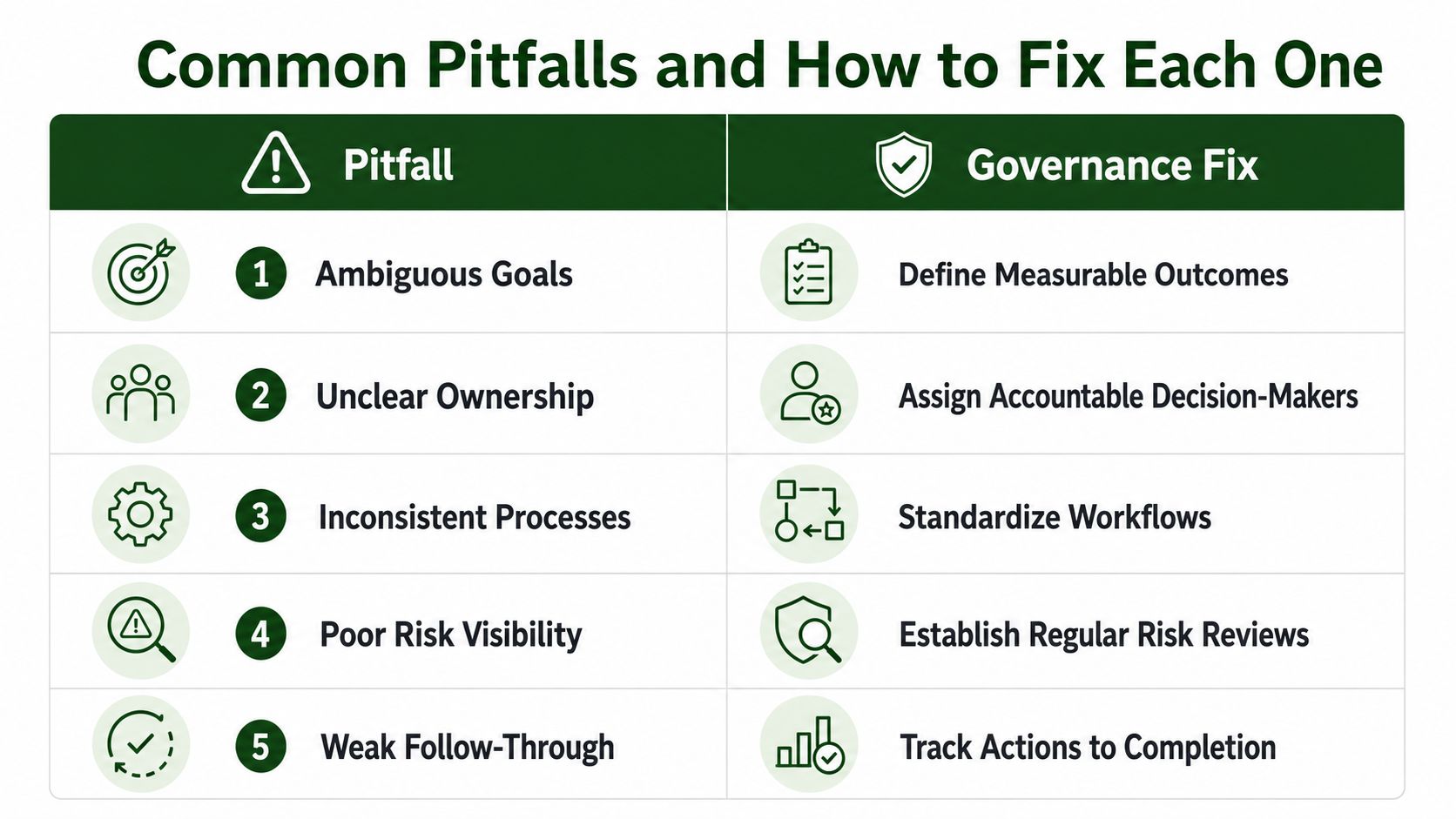
Five common failures and what fixes them
- One-way announcements with no feedback loop: The symptom is that staff speak and nobody confirms understanding. The fix is a reply path, a sign-up form, or a follow-up huddle so leaders can see whether the message landed.
- Relying on one channel: The symptom is that absent people miss everything. The fix is redundancy across email, print, social, and in-person touchpoints, with the same core message repeated clearly.
- Inconsistent financial communication: The symptom is that members hear one thing from the pulpit and another from the finance team. The fix is fund-level reporting in plain language, with regular disclosure rules and a single owner for the explanation.
- Insider language: The symptom is that guests and new members feel lost. The fix is to replace jargon with plain words, define abbreviations, and put action steps first.
- No clear owner for sensitive topics: The symptom is delay, confusion, and mixed messaging. The fix is to assign one responsible leader, define the approval path, and use the church's conflict or disclosure policy before anyone speaks publicly.
A lot of churches try to solve these problems by asking people to “communicate better.” That doesn't work because people can't improve a process that doesn't exist. What does work is deciding who owns the message, which channel serves which audience, and how the church will handle hard topics before they turn into rumors.
The small churches that handle communication well usually aren't the ones with the most polished branding. They're the ones that know how to repeat the same message, in the right places, with enough clarity that people can act on it without asking twice.
If your church wants communication and accounting to support each other instead of working in separate silos, visit Grain to see how fund-based reporting can make stewardship easier to explain and easier to trust.
Ready to simplify your church finances?
Start free with church fund accounting, or watch a product demo first.