Fund Accounting Oversight for Churches Explained
Master fund accounting oversight for your church. Learn governance roles, internal controls, audit best practices, and how Grain Ledger simplifies stewardship.
You can run a church for years on faithful volunteers, handwritten notes, and a strong sense of trust, then one quiet month exposes the gap. A restricted building fund gift gets used to cover payroll pressure, the treasurer notices it late, and suddenly everyone is asking the same painful question, how did we miss that? Fund accounting oversight is the answer to that question, because it's not just about separating money into buckets, it's about proving, with review and evidence, that every gift stayed where it belonged.
About Grain Ledger: This guide includes Grain Ledger, church fund accounting software built for designated gifts and ministry funds. It connects giving platforms (Planning Center, Pushpay, Tithely, Stripe), syncs bank activity with Plaid, and produces fund-level financial reports. Start free to see how it compares for your church.
See Grain Ledger for your church
Fund accounting, giving integrations, and bank reconciliation in one platform. Free migration support for churches switching from QuickBooks or Aplos.
For churches, that matters in a very ordinary and very human way. Donors give with intent, boards carry responsibility, and treasurers sit between the two trying to keep the books honest when the work is often shared by volunteers. Good oversight protects the church's legal obligations and its spiritual credibility, because stewardship is a covenant of trust, not just a bookkeeping task.
Why Fund Accounting Oversight Matters for Your Congregation
The hardest moments usually don't begin with a scandal. They begin with a small shortcut, maybe a well-meaning bookkeeper moved a restricted gift into the general fund so bills could be paid on time, and no one caught it until month-end. That's the kind of moment church treasurers dread, because by then the money is spent, the reports are messy, and the congregation is already asking whether the church honored the donor's intent.
Fund accounting oversight exists to catch that kind of mistake before it spreads. It's the structured system of review, reconciliation, and approval controls that verifies a fund's net asset value, or NAV, before reporting goes out, and the 2021 Funds Europe survey shows how uneven churches and other organizations can be in this area. 54% of firms used a third-party fund administrator to produce NAV, 38% produced NAV internally, 15% used full shadow NAV, and 13% used contingent or back-up NAV, while 51% used systematic NAV oversight and 49% still relied on spreadsheet checks. Those figures come from a broader fund context, but the lesson transfers cleanly to church finance, formal oversight is common, yet not universal. Funds Europe survey on NAV and ESG oversight
The real stakes for a church
A church is holding more than cash. It's holding promises, especially when donors give for a building project, a mission trip, youth ministry, or benevolence support. If oversight is weak, the church risks more than a technical error, it risks breaking the confidence people place in leaders who are supposed to steward gifts carefully.
The practical side matters too. The same survey found that managers' biggest pain points were delays in receiving NAV from external providers and managing data providers, each cited by 41% of respondents. That's a reminder that the danger isn't always fraud, it's confusion, delay, and messy information that makes good judgment harder. A church that can't quickly explain where restricted money sits doesn't have a paperwork issue, it has an oversight issue.
Practical rule: if a donor could ask, “Where is my gift now, and what proof do we have?” your church should be able to answer without scrambling.
How Fund Accounting Oversight Actually Works
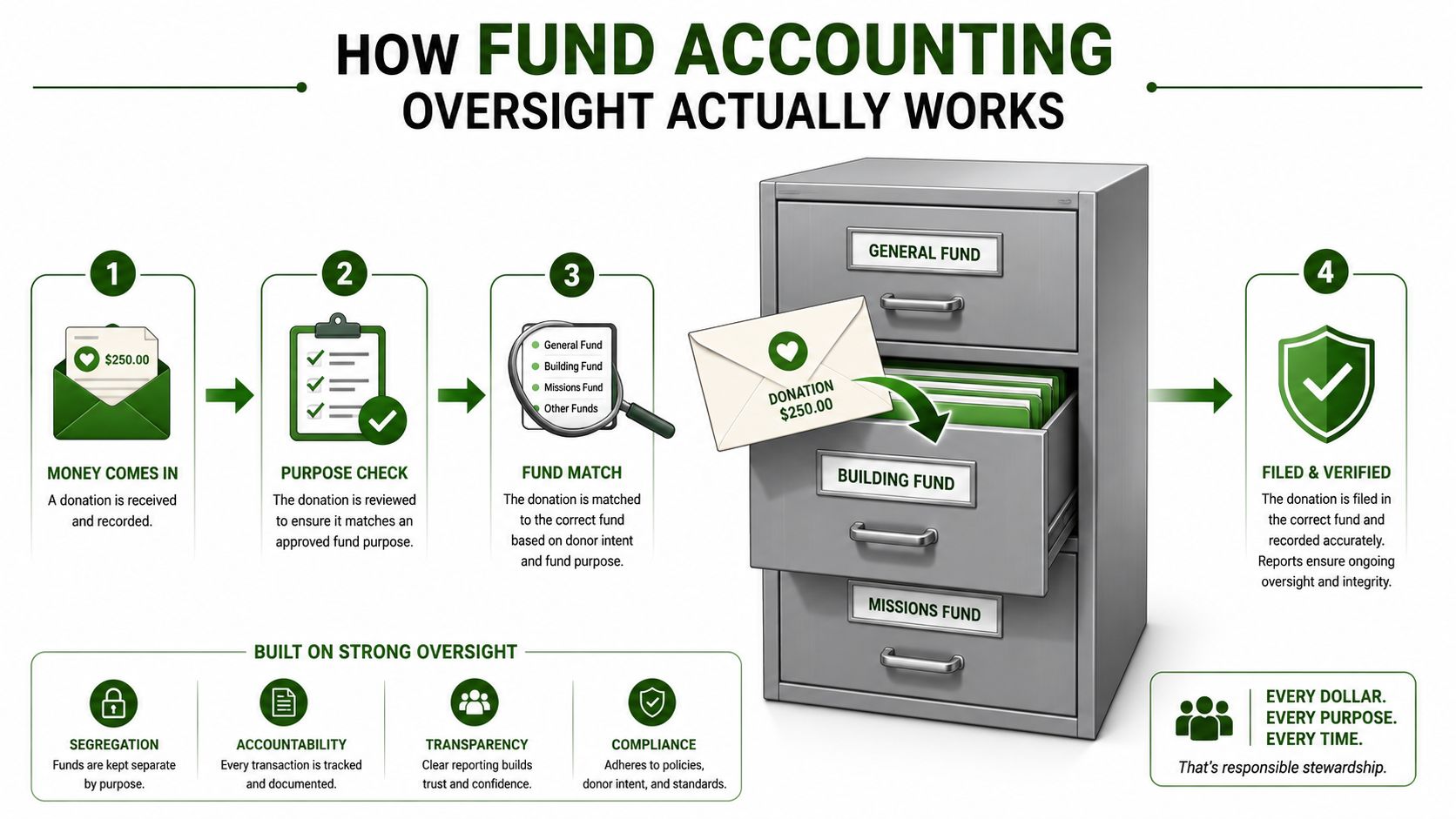
Think of a filing cabinet with labeled envelopes. One envelope says General Fund, another says Building Fund, another says Missions Fund. Money comes in, someone checks the purpose, and the right amount goes into the right envelope. Oversight is the set of habits that make sure no one slips money into the wrong place, takes it out for the wrong reason, or forgets to show their work.
The three layers you need
The first layer is transaction-level control. That's the moment a donation is recorded or a bill is paid. If a gift was designated for the youth room, the entry should hit the youth fund immediately, not a generic holding account that somebody promises to fix later. If the entry starts wrong, every report downstream starts shaky too.
The second layer is reconciliation control. Bank balances, giving platform totals, and fund balances are checked against each other. Churches get tripped up here because bank balances may look fine while fund balances are wrong, or the reverse. The point is not to make numbers “match” by force, it's to prove that each balance has a clean explanation.
The third layer is governance control. That's the board, finance committee, or vestry reviewing reports, asking uncomfortable questions, and approving transfers that move money between funds. A church can have perfect bookkeeping and still have bad oversight if nobody reviews the reports or challenges unusual activity.
Here's the simplest way to test your current system. If a restricted gift arrives today, ask who records it, who checks it, who reviews it, and who approves any later change. If one person can do all four, the envelope system is only a metaphor.
A weak point in one layer creates risk in the others. A clean bank reconciliation won't rescue a donation that was tagged to the wrong fund at the point of entry.
Governance Roles and Who Owns What
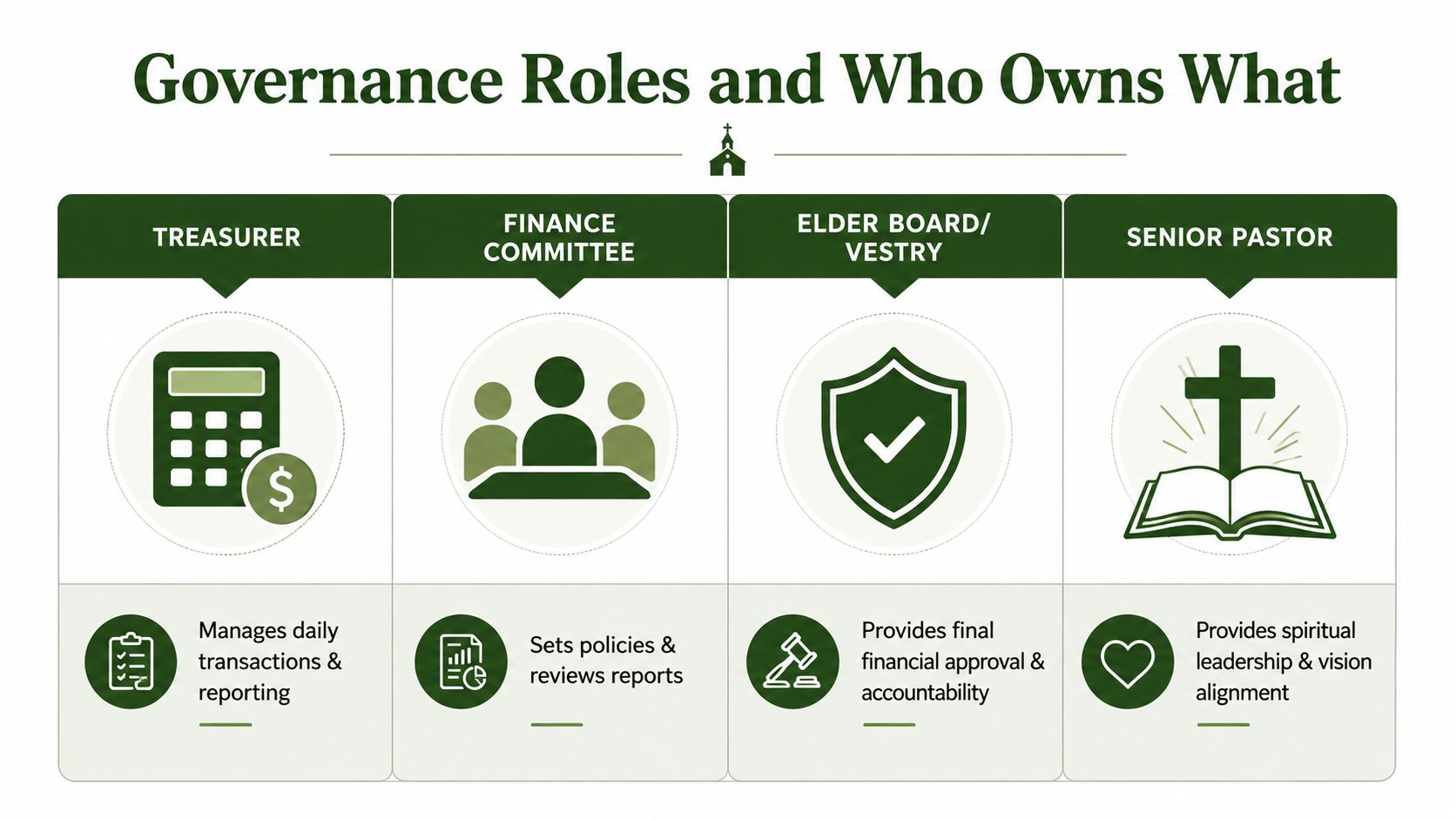
A church finance team works best when the roles are clear and boring in the best possible way. The treasurer should not have to guess whether the finance committee expects a summary or a full ledger. The senior pastor should not be the person approving routine transfers just because they're available. Oversight gets safer when each leader has a lane and the lanes don't overlap too much.
A simple accountability matrix
| Role | Primary responsibility | What they should review | Red flags |
|---|---|---|---|
| Treasurer | Manages day-to-day entries and reconciliations | Bank recs, fund balances, deposit support | Unexplained transfers, missing donor tags, late closes |
| Finance committee | Reviews reports and policies | Monthly activity, restricted funds, variance trends | Repeated overrides, weak backup, unclear approvals |
| Elder board or vestry | Provides final accountability | Quarterly and annual summaries, audit results | Persistent deficits, policy gaps, poor documentation |
| Senior pastor | Aligns ministry priorities with stewardship | High-level updates and ministry impact | Pressure to blur fund purposes, informal approvals |
The treasurer is the first line of defense, not the final authority. They should reconcile accounts, prepare reports, and flag exceptions, but they shouldn't be the same person approving their own work. The finance committee should look for patterns, not just totals, because a clean monthly report can still hide repeated coding errors.
The elder board or vestry needs to approve policy, review the big picture, and sign off on annual review or audit results. The senior pastor should receive clear reporting and make sure ministry plans match available restricted money, but pastors shouldn't be moving money in and out of designated funds on instinct. That's how a stewardship system turns into a personality system.
Small churches sometimes ask whether a two-person finance team can still be safe. It can, but only if one person records and the other reviews, and neither person controls every step from donation entry to check signing. If one volunteer does everything, the church has convenience, not control.
For a useful primer on building that kind of repeatable process, see what is an SOP guide. Churches don't need corporate language, but they do need written steps that survive volunteer turnover.
Internal Controls Every Church Should Implement
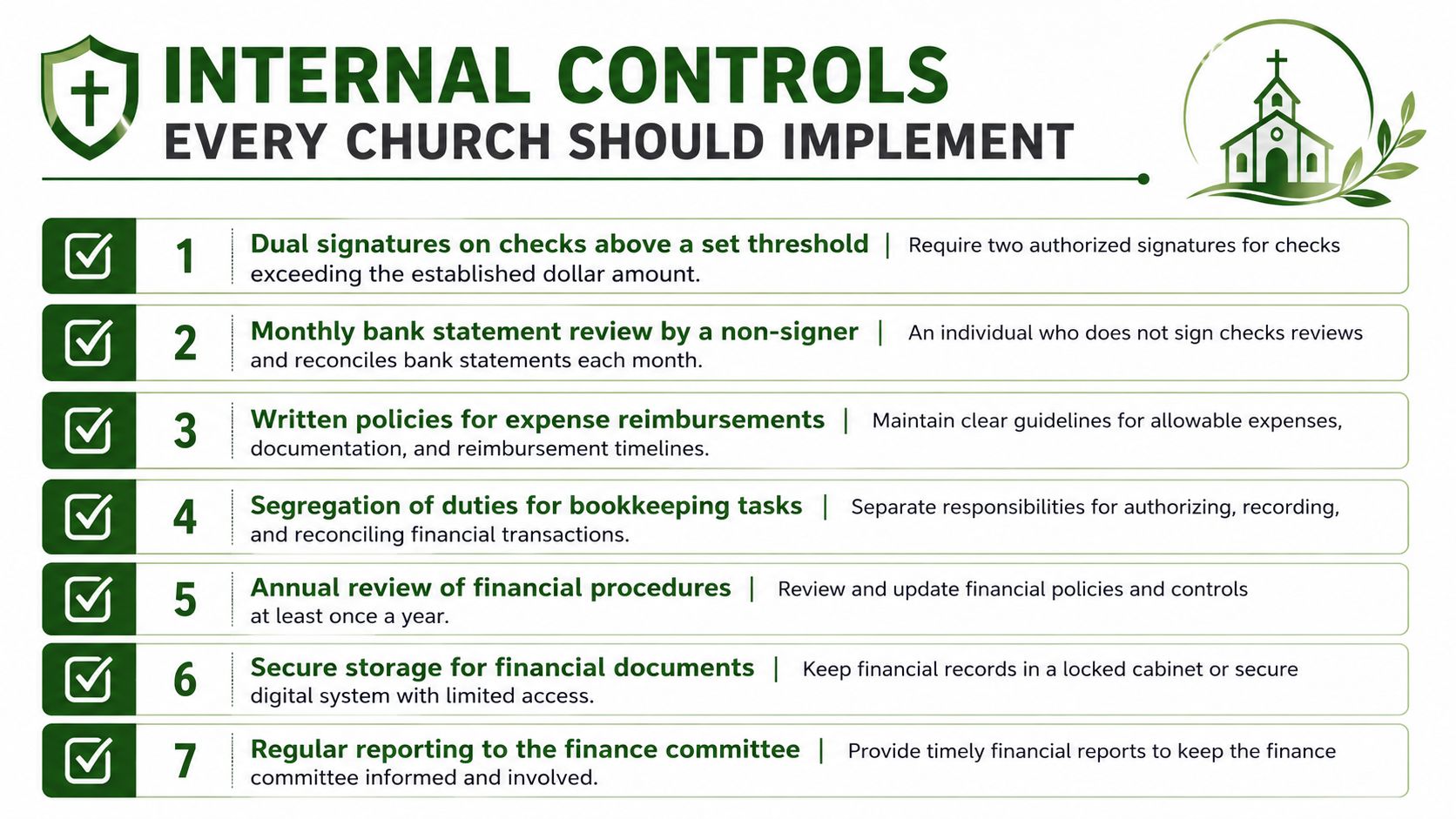
Seven controls make a real difference, even in a small church with a thin volunteer bench. None of them are fancy. All of them reduce the odds that a restricted gift gets misapplied, a duplicate payment slips through, or a mistake stays hidden for months.
The controls that matter most
- Dual signatures on larger checks: This prevents one person from authorizing spending alone. The simplest version is a second reviewer who checks the invoice, confirms the fund, and signs only after support is attached.
- Monthly bank reconciliation by a non-signer: This stops the person writing checks from also being the person verifying them. A separate reviewer should compare the bank statement, the cash book, and outstanding items.
- Written policies for expense reimbursements: This prevents casual spending from turning into undocumented ministry costs. A short policy should require receipts, fund coding, and approval before reimbursement.
- Segregation of duties for bookkeeping tasks: This keeps one person from entering gifts, posting adjustments, and closing the books without review. Even a tiny church can split work between recording and checking.
- Annual review of financial procedures: This catches outdated workflows before they become habits. A committee member should confirm that current practices still match the written policy.
- Secure storage for financial documents: This prevents lost backup and protects audit trails. Bank statements, donor reports, and approval logs should live in one controlled location.
- Regular reporting to the finance committee: This keeps oversight active instead of reactive. The committee should see fund-level activity, not just a total checking balance.
The risk each control prevents is easy to name. Dual signatures reduce unauthorized spending. Reconciliation catches misposts and missing deposits. Policy documentation reduces memory-based decisions, which are fragile when volunteers rotate. Secure records matter because a church can't prove what it can't find.
If you want a deeper control framework, Logical Commander Software on internal controls is a useful resource for thinking about how checks, approvals, and evidence fit together in practice. For a church-specific view of how controls support fund tracking, Grain's internal controls guidance is worth keeping on hand.
Practical rule: if a control can't be verified by a person who wasn't involved in the transaction, it isn't a control yet, it's a hope.
The Hidden Risk in Automated Donation Flows
Many churches assume that connecting Planning Center, Pushpay, Stripe, or a bank feed means oversight is happening automatically. The connection is useful, but it can also hide a new failure mode, a mapping rule points donations to the wrong fund and no one notices because the deposits still land in the bank. The money is there, but the stewardship is wrong.
That's why the old habit of checking only total deposits isn't enough anymore. A church can receive a bank deposit that looks perfect while restricted gifts inside that deposit were routed to the wrong fund in the accounting system. If the mapping error repeats, it doesn't stay small for long.
What exception review has to catch
In systems-based oversight, the control is not automation itself, it's exception review. That means someone regularly checks donation-to-fund matches, looks for unmapped gifts, tests whether a new fund designation is routing correctly, and compares giving platform reports against fund-level activity. If a church only checks the bank total, it may miss a pattern that affects dozens of gifts.
Manual and automated work can both fail. Manual review can lag behind transaction volume, especially when donations arrive through connected tools all week long. Automation can reduce clerical work, but it also concentrates risk in the setup, the rule changes, and the exception queue. The oversight question changes from “Did we enter it?” to “Did our system route it correctly, and can we prove it?”
The same issue shows up in broader fund administration work, where complexity is driven by multiple feeds, manual journal entries, spreadsheets, weak audit trails, and hard-to-trace discrepancies. That's why this kind of oversight has to be designed for traceability, not just speed. A clean monthly deposit total is useful. It is not enough.
For a church, the practical answer is simple. Each month, compare the giving platform report, the bank deposit, and the fund activity report. If one restricted gift landed in the wrong fund, fix the mapping rule and log the exception so you can see whether the error happened once or more than once.
Monthly Close and Reporting Best Practices
A monthly close only works when the steps happen in the same order every time. Volunteers do better when they're handed a repeatable process than when they're expected to remember everything from memory. The goal is not perfection, it's a report package that someone else could review and understand without guessing.
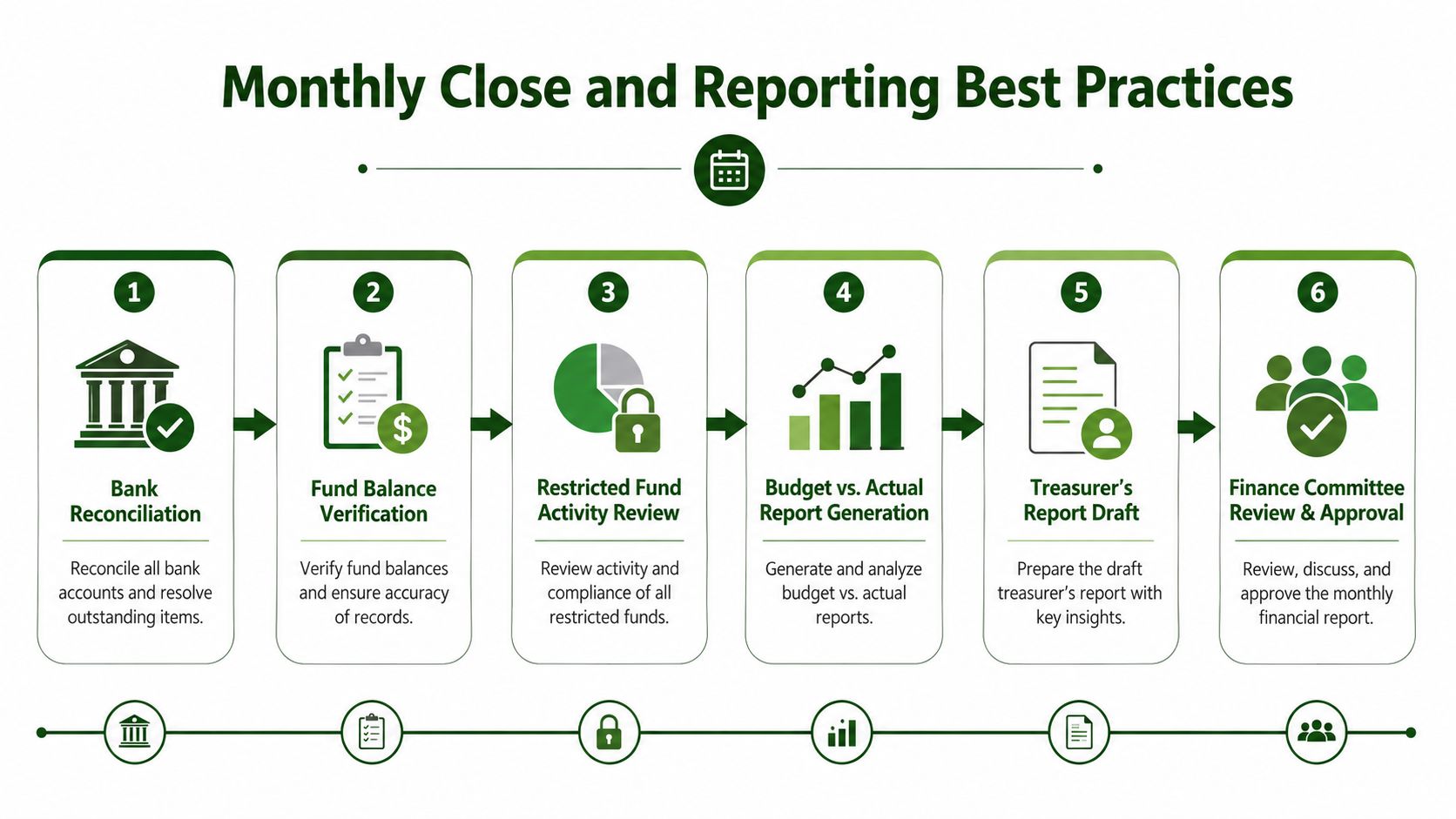
A practical monthly close order
Bank reconciliation
Match bank activity to the cash book, then note any uncleared items or posting errors.Fund balance verification
Check that each fund balance makes sense based on gifts received, bills paid, and approved transfers.Restricted fund activity review
Look for any expense that touched a designated fund and confirm it matches the donor purpose.Budget vs. actual report generation
Give the committee a simple view of what was planned, what was spent, and where the variances sit.Treasurer's report draft
Summarize cash position, fund changes, exceptions, and any actions needed next month.Finance committee review and approval
Ask the committee to review the report, ask for support on exceptions, and record approval in the minutes.
The paperwork matters just as much as the numbers. Keep reconciliation sign-offs, transfer approvals, and an exception log for anything that was corrected or investigated. That documentation is what makes the month audit-ready, because an auditor or board member should be able to trace a change from source to resolution.
For a fuller close workflow, Grain's accounting close process gives a helpful structure to compare against your current routine. Churches that send financial updates to the whole congregation should keep the public report simpler than the committee package, with totals, ministry highlights, and broad stewardship context instead of line-by-line detail.
Choosing a Native Fund-Based Accounting System
The big difference between accounting systems is whether they understand funds or merely pretend to. Some tools bolt fund tracking onto a general ledger with tags, classes, or categories. That can work for a while, but it creates extra steps every time a transaction is entered, reviewed, or reported, and untagged items become invisible until someone catches them later.
A native fund-based system starts with the fund structure already built in. That matters for churches because every transaction should know where it belongs before the month-end scramble begins. It also matters because a system that relies on after-the-fact filtering can miss the very exceptions you need to catch.
Grain Ledger is one option built for that model. It uses native fund architecture, so every account, transaction, and report is organized around funds from the start, and it unifies giving platforms, bank accounts, and accounting records so donations can flow into the right funds automatically. Grain Ledger also supports integrations with tools churches already use, including Planning Center, Pushpay, Stripe, and bank connections via Plaid, and it's offered through a waitlist for churches wanting to move toward fund-based bookkeeping. For a deeper look at that approach, Grain's fund-based accounting overview is the most direct place to start.
Why the architecture matters
Bolted-on fund tracking asks staff to remember what the software can't infer. Native fund accounting reduces that burden because the software is designed around church money, not around a generic business chart of accounts. That makes reconciliation cleaner, reporting easier to read, and restricted funds easier to protect.
For churches exploring automation more broadly, using AI in accounting is a useful background read, especially if you're weighing how much judgment should stay with the finance committee versus the software. The key test is simple, the system should make oversight easier to verify, not harder to explain.
Related church accounting software resources
If you are comparing software, these pages map the main decision points: fund accounting, QuickBooks limits, pricing, and migration.
- Best church accounting software (2026 comparison) - canonical guide comparing 12 church accounting platforms
- Church accounting software product page - see Grain Ledger for fund accounting, giving, and bank reconciliation
- Small church accounting software - see the product page built for volunteer treasurers and church admins
- Fund accounting features - review how Grain Ledger tracks designated funds
- QuickBooks for churches - understand workarounds and when to switch
- Free church accounting software - compare free options and upgrade triggers
- Grain Ledger pricing - compare plans for small and growing churches
- Start free - try fund accounting, giving imports, and bank reconciliation together
Your Fund Accounting Oversight Action Plan
Start with the controls you can change this week. Document fund designations in writing, separate donation recording from review, and require a second signature or second approval path for restricted transfers. Then create a monthly close checklist so the same steps happen every month, even when volunteers change.
Within 90 days, tighten the committee rhythm. Add fund balance review to every finance meeting, require an exception log for mismatched donations or transfers, and make sure board minutes show who approved what. If your church can't trace a restricted gift from deposit to report, that's the gap to close first.
Longer term, move toward a native fund-based accounting system and, if needed, an outside reviewer who can test the process independently. A quick self-check helps. If you can answer “yes” to most of these, your oversight is maturing, not perfect, but dependable: written policies, separate review, monthly reconciliation, clear approvals, and reportable exceptions.
Strong oversight isn't about impressing people with accounting jargon. It's about making sure every donor's intent is honored, every report can be explained, and every leader can trust the numbers in front of them.
If your church is still juggling restricted gifts, bank feeds, and volunteer bookkeeping in separate places, Grain can help bring those pieces into one fund-based workflow. Visit Grain to see how native fund accounting supports clearer oversight, cleaner reporting, and better stewardship for churches.
Ready to simplify your church finances?
Start free with church fund accounting, or watch a product demo first.