Fund Accounting vs Corporate Accounting for Churches
 By Gibson Brueher, Founder of Grain Ledger
Fund accounting vs corporate accounting explained for churches. See how restricted funds, donor controls, and reporting differ from for-profit books and pick
A church treasurer closes the books and sees a healthy surplus. The bank account looks strong, the year appears successful, and the board expects a reassuring report. Then the treasurer separates the balances and discovers that the available operating cash cannot cover payroll, utilities, or insurance because much of the money belongs to the building campaign or missions ministry.
About Grain Ledger: This guide includes Grain Ledger, church fund accounting software built for designated gifts and ministry funds. It connects giving platforms (Planning Center, Pushpay, Tithely, Stripe), syncs bank activity with Plaid, and produces fund-level financial reports. Start free to see how it compares for your church.
See Grain Ledger for your church
Fund accounting, giving integrations, and bank reconciliation in one platform. Free migration support for churches switching from QuickBooks or Aplos.
That situation exposes the issue in fund accounting vs corporate accounting for churches. The question isn't whether the organization finished the year with more revenue than expenses. It's whether the church has cash available for the obligations it must pay now, without spending money legally committed to another purpose.
When a Healthy Surplus Still Cannot Cover Payroll
The treasurer's year-end report shows a $180,000 surplus. At first glance, that sounds like excellent financial management. But the balance includes $140,000 in the building fund and $25,000 designated for an upcoming missions trip. Only the remaining operating resources can support ordinary church expenses, and that amount isn't enough to cover the next payroll cycle, utilities, and insurance.
The church may be solvent on paper while facing an immediate liquidity problem. A surplus measures the relationship between revenue and expenses over a reporting period. It doesn't prove that unrestricted cash is available when bills come due.
Practical rule: A church must distinguish between cash in the bank and cash it may legally spend.
A restricted fund contains money given for a stated purpose, or money subject to a donor, grant, or other enforceable limitation. The church can't redirect that money to general operations just because the operating account is short. A gift for construction remains committed to construction, and a missions designation remains committed to the purpose communicated to the giver.
The for-profit mindset fails here. Corporate accounting generally treats the company as one economic entity. Cash generated by one department can usually support another department, subject to internal budgets, debt agreements, and management decisions. The company's central question is profitability and liquidity for the enterprise as a whole.
A church has another question layered on top: which fund owns the resources, and has the restriction been satisfied? Payroll liabilities are obligations of the church, but restricted cash doesn't automatically become operating cash merely because the payroll deadline is approaching. Treasurers who want a practical explanation of the obligations behind payroll can review how payroll liabilities work.
That distinction should govern every comparison that follows. Fund accounting isn't just corporate accounting with extra labels. It exists because a church must report both its overall financial position and its stewardship of purpose-specific dollars.
Two Models Built for Two Different Jobs
Fund accounting tracks resources according to their purpose, source, and restrictions. Instead of asking only whether the church earned or spent money, it asks whether each fund received the right revenue, paid allowable expenses, and still holds the correct balance.
Donors, board members, pastors, grantors, and regulators rely on that visibility. They want to know whether a building gift supported construction, whether a benevolence fund paid benevolence expenses, and whether general offerings remained available for ordinary ministry and administration. The fund becomes the reporting unit because accountability belongs at that level.
A useful explanation of the underlying structure appears in this guide to fund-based accounting. The important point isn't that every fund requires a separate bank account. The accounting records need to preserve each fund's identity and allowable uses, even when the church holds cash in shared accounts.
Corporate accounting tracks the legal entity as a consolidated economic whole. Departments, locations, and cost centers may provide management detail, but the primary reports focus on revenue, expenses, assets, liabilities, equity, profit, and cash flow for the company. Shareholders, lenders, executives, and tax authorities use those reports to evaluate performance, solvency, and earnings.
The two systems reflect different stakeholders:
- Donor and board accountability: Fund accounting demonstrates that restricted resources were used as promised.
- Investor and lender analysis: Corporate accounting shows profitability, liquidity, and financial performance for the enterprise.
- Restriction-based control: Fund accounting preserves legal-purpose balances.
- Performance-based management: Corporate accounting evaluates the organization through consolidated results.
U.S. corporate accounting developed in response to the need for standardized external reporting and investor protection after the 1929 stock market crash and the Great Depression. The Securities Act of 1933 and Securities Exchange Act of 1934 helped establish the legal foundation for modern U.S. GAAP, while the phrase “generally accepted accounting principles” was first used in the mid-1930s, with a 1936 American Institute of Accountants report often cited as an early reference. The history of GAAP helps explain why corporate accounting centers on one enterprise-wide result.
Neither model is universally superior. Corporate accounting works well for a shareholder-focused business. Fund accounting works for a church because the church must prove not only what it owns, but also what it is permitted to do with what it owns.
Reporting Unit, Primary Metric, and Restriction Handling
The difference becomes clearer when the same criteria are placed side by side.
Fund Accounting vs Corporate Accounting Criteria Comparison
| Criterion | Fund Accounting | Corporate Accounting |
|---|---|---|
| Reporting unit | Individual funds or net asset classes | Consolidated legal entity |
| Primary metric | Change in net assets, shown by restriction type | Net income, earnings, profitability, and cash flow |
| Restriction handling | Donor intent is recorded and released when conditions are met | Departmental or cost-center coding usually provides internal detail |
| Consolidation | Fund statements roll into combined nonprofit statements, including the Statement of Activities | Subsidiaries and divisions consolidate, with intercompany balances eliminated |
| Audit posture | Emphasis on allowable use of funds and donor or grant compliance | Emphasis on revenue recognition, financial performance, and going concern |
The reporting unit changes the daily work. In corporate accounting, a gift or customer payment normally posts to the company's revenue accounts, and management may add a department or project code for analysis. In fund accounting, the posting must identify the fund or restriction at the moment the transaction enters the ledger.
That requirement applies to both sides of the transaction. Every contribution must be classified correctly when received. Every expense must be charged to the fund that is allowed to pay it. If a missions expense is posted to the general fund, the church loses a clean record of the missions balance. If a building expense is posted to operations, the board can't see the true remaining capital resources without manual reconstruction.
Restricted and unrestricted fund management explains why this isn't merely a reporting preference. A restricted balance represents an obligation to honor purpose or donor intent, so the ledger has to preserve that distinction throughout the transaction lifecycle.
Corporate statements consolidate the entity to present its overall position. Church statements still provide an organization-wide view, but they must retain the fund-level detail underneath. The combined Statement of Activities is useful only when the underlying fund entries, reclassifications, and releases are accurate.
The audit focus follows the same logic. A corporate auditor may concentrate on revenue recognition and the organization's ability to continue operating. A church auditor must also test whether the church spent restricted gifts according to their stated purposes. That is why fund coding and release entries aren't administrative decoration. They are the audit trail.
Restricted Dollars in Practice
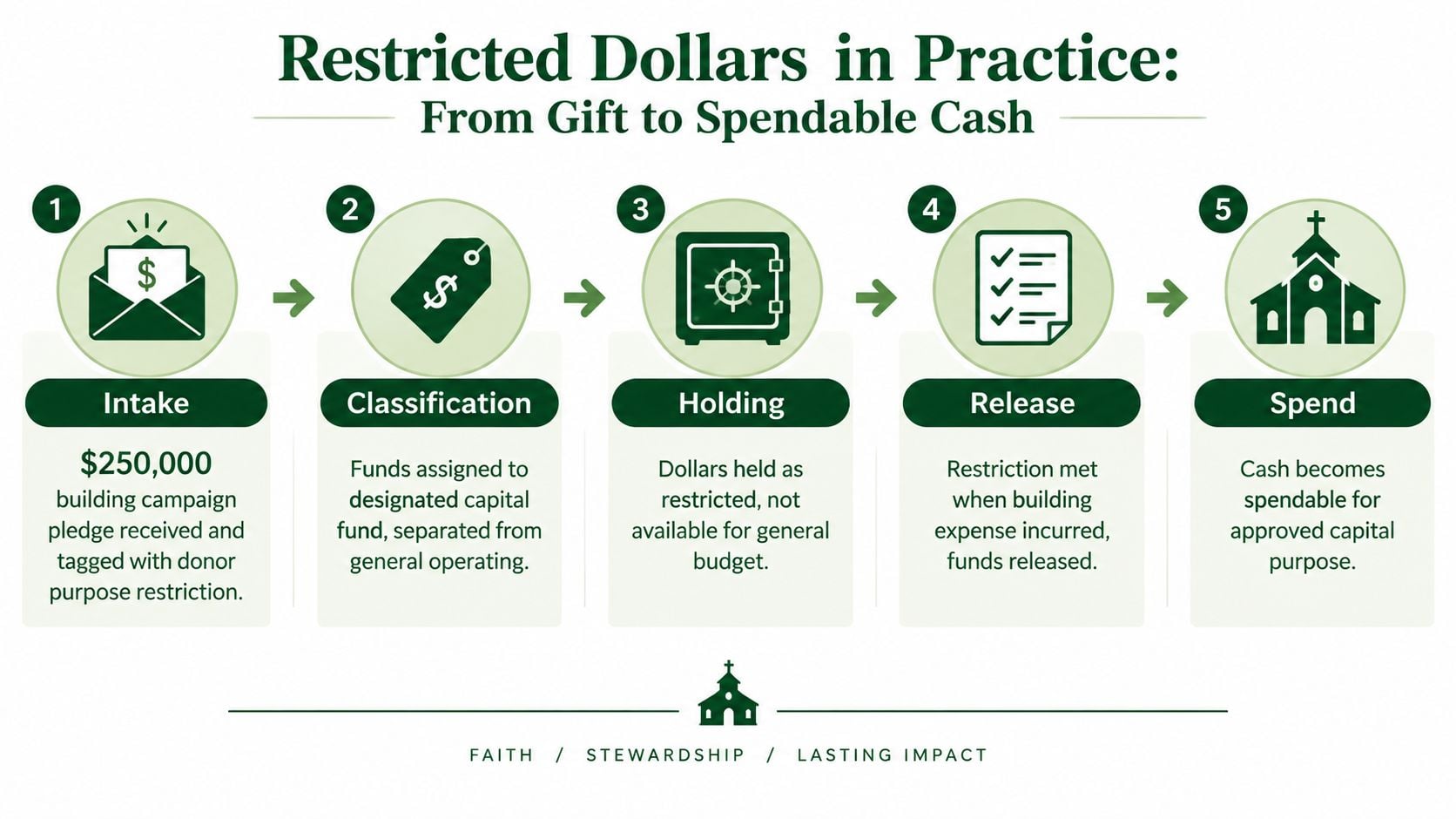
Consider a $250,000 building campaign pledge. At intake, the church records the donor's stated purpose and assigns the gift to the designated capital fund. The balance remains restricted while the church raises funds, approves eligible work, and receives construction invoices.
The cash may sit in a shared bank account, but the ledger must show that it belongs to the capital fund. It isn't available for payroll, utilities, or ordinary programming. When an approved building expense is incurred, the church records the expense against the capital fund and makes the appropriate release-from-restriction entry. The restriction has been satisfied for that amount because the church used it for the stated purpose.
Now consider a $5,000 missions designation. Its treatment depends on the donor's actual instruction. If the donor specified a particular mission activity, the church tracks the gift against that purpose and releases it when the approved expense occurs. If the donor gave the church discretion to choose the recipient, the documentation may support a broader missions-purpose classification, but the church still needs to follow the stated terms.
The accounting sequence matters
For both gifts, the process is mechanical:
- Intake: Capture the donor, date, amount, and stated purpose.
- Classification: Post the contribution to the correct restricted or unrestricted fund.
- Holding: Maintain the balance separately in the accounting records while the restriction remains.
- Release: Record the release when the approved purpose or condition has been met.
- Spend: Match the expense to the fund that is authorized to pay it.
Under nonprofit U.S. GAAP, restricted contributions are recognized when received and then reclassified when donor-imposed conditions are satisfied. The resulting financial statements present net assets with donor restrictions and without donor restrictions. This explanation of nonprofit fund tracking details the need to tag revenue and expenses to the right restriction bucket.
The key point is that restriction status, not gift size, determines when cash becomes usable. A small designated gift can carry the same control requirement as a major campaign contribution. A church that treats either one as general operating cash risks violating donor intent and weakening its financial records.
Net Assets With and Without Donor Restrictions Under Modern GAAP
FASB's ASU 2016-14 changed nonprofit reporting by replacing the former three net-asset categories, unrestricted, temporarily restricted, and permanently restricted, with two categories: net assets with donor restrictions and net assets without donor restrictions. The update was effective for fiscal years beginning after December 15, 2017, and it represented the most significant nonprofit financial reporting change in decades. This overview of fund accounting for nonprofits describes how the simpler presentation preserved restriction-based accountability.
Net Asset Classes Under ASU 2016-14
| Class | What Goes In | Spendable When | Example at a Typical Church |
|---|---|---|---|
| With donor restrictions | Gifts limited by purpose or time, plus other donor-imposed conditions | When the stated purpose or time condition is satisfied | Building campaign, missions designation, or grant |
| Without donor restrictions | Gifts and resources without donor limits, including board-designated reserves | According to church leadership's lawful decisions and policies | General operating fund or board-designated reserve |
The first category contains resources the donor has limited. The limitation may relate to a specific ministry, capital project, grant activity, or period of time. The second category contains resources the church can use for general purposes, although the board may designate some of those resources internally.
A board designation isn't the same as a donor restriction. The board can generally change its internal designation, while the church can't casually override a donor's stated purpose. Treasurers need that distinction visible in the chart of accounts and in board reporting.
Daily discipline matters more than the annual audit presentation. When a gift arrives, the bookkeeper must decide whether donor restrictions exist and record the contribution accordingly. When an expense is posted, the reviewer must confirm that the selected fund can legally pay it. When a restriction is satisfied, the release must move through the Statement of Activities correctly rather than appearing as an unexplained department transfer.
Auditors also watch for underwater endowment conditions, where the value of an endowment falls below the level the donor required the church to maintain. They also examine situations where restricted resources have been spent, or committed, without enough supporting documentation to show that the purpose was met. Boards often discover these problems only when audit adjustments or management-letter findings arrive.
Why Generic Corporate Software Breaks Down for Churches
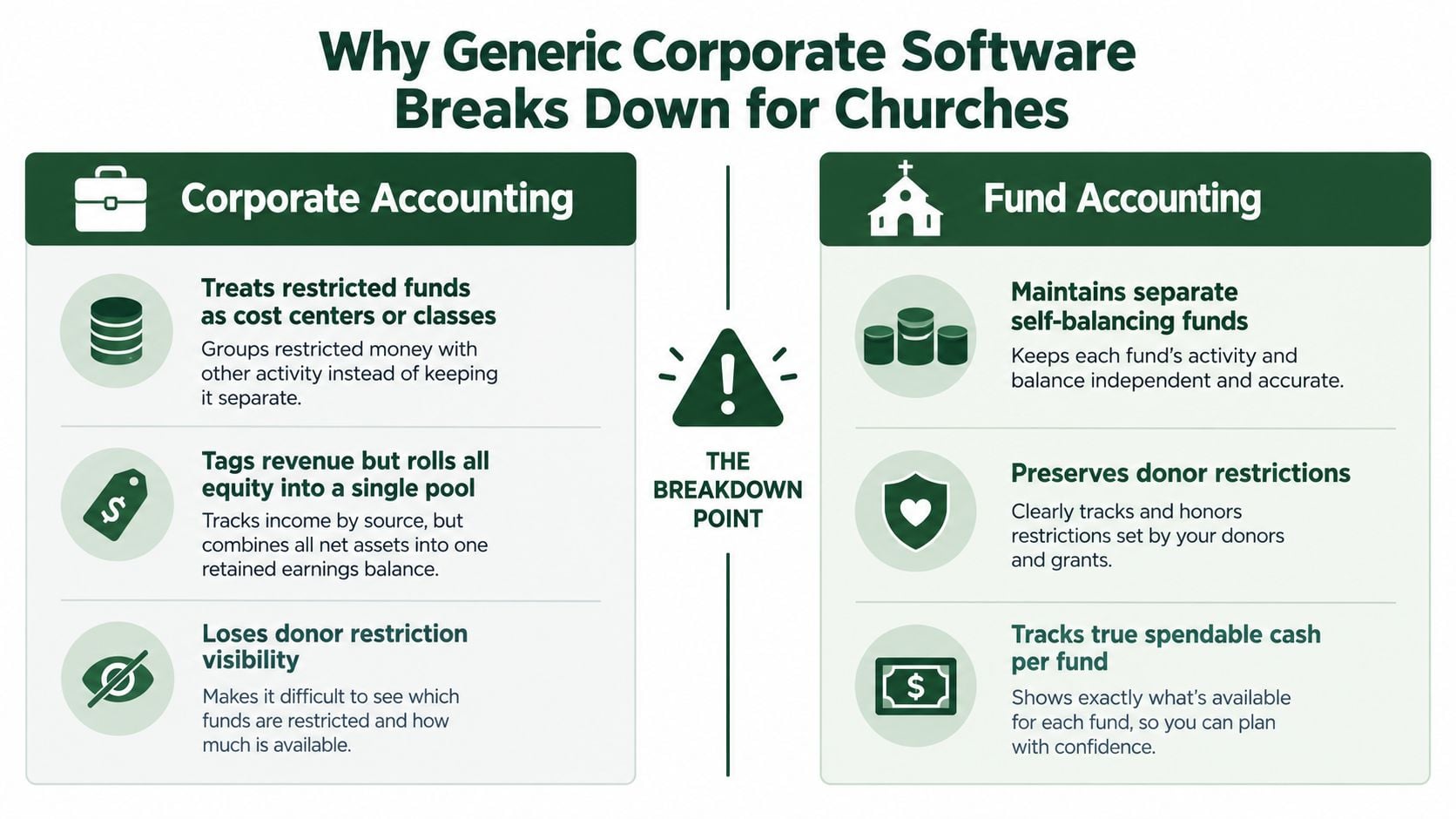
Generic small-business software usually treats a church's funds as classes, departments, projects, or cost centers. Those tags can help a bookkeeper sort transactions, but they don't necessarily create separate self-balancing fund records or preserve legal-purpose net asset balances.
The typical result is familiar. Revenue can be tagged to a building project, while the equity section still rolls into one retained-earnings-style pool. The software may show that money came in for a purpose, but it doesn't reliably show the fund's complete balance, allowable spending, and release history in the same accounting structure.
Three breakdowns I see repeatedly
- Department transfer instead of release: The bookkeeper moves an expense between departments, but the entry never reclassifies net assets from restricted to unrestricted when the purpose is fulfilled.
- Unreviewed fund drift: The church has no isolated fund-balance report, so an incorrect expense or forgotten release remains buried in the general ledger.
- Incomplete year-end statements: The accounting package can't produce a clean Statement of Activities split between net assets with donor restrictions and net assets without donor restrictions without spreadsheet manipulation.
These failures aren't cosmetic. A donor, board member, or auditor needs to trace the gift from receipt through classification, holding, expense, and release. If the system only offers departmental tags, that trail depends on manual reports and staff memory.
A class can describe a transaction. A fund must preserve accountability for the resources behind it.
The software gap becomes especially dangerous during busy periods. A treasurer may know that a building fund exists, but still miss an operating expense charged against it. A bookkeeper may record a release, but choose a transfer account that changes departmental reporting without changing the net asset classification. A year-end spreadsheet may reconcile totals while hiding the fact that the church cannot spend part of its apparent surplus.
Watch the embedded explanation of the distinction between these approaches, then judge your own software by its outputs, not by whether it has a field labeled “class.”
A church-ready system should make the correct treatment easier than the workaround. If staff must maintain parallel spreadsheets to determine restricted balances, the accounting design isn't serving the church's real obligations.
Building a Church-Ready Fund Accounting Workflow
A small or mid-sized congregation doesn't need to replace every system at once. It needs to establish the accounting structure that protects donor intent, then connect daily work to that structure.
Start with the ledger structure
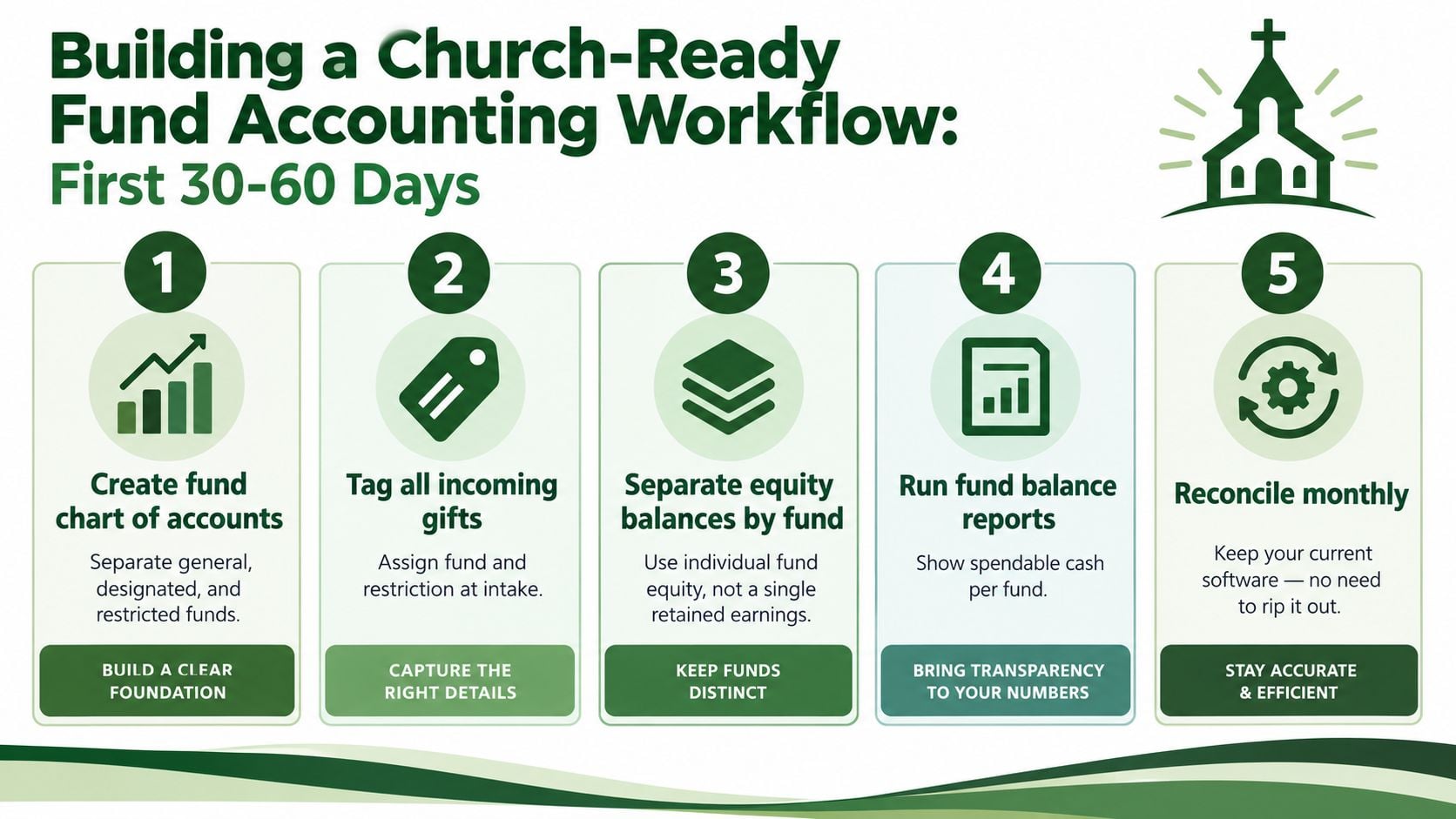
Create funds for the church's real obligations and ministries, including general operations, building, missions, benevolence, and designated scholarship balances. These should function as fund-level accounting records, not merely department labels attached to a pooled equity account.
The general fund should show what is available for ordinary expenses. Building and missions funds should show what remains committed to those purposes. Benevolence and scholarship balances need the same treatment when donor instructions or governing documents limit their use.
Make classification happen at intake
Every contribution should arrive with a documented classification decision. The giving form, envelope, online designation, or donor correspondence should tell the bookkeeper whether the gift is unrestricted or tied to a specific purpose.
For U.S. churches and nonprofits, contributions of $250 or more require written substantiation, and the acknowledgment must state whether goods or services were provided in exchange, as explained in this church accounting guide. Record the donor, date, amount, purpose, and any goods or services provided so the church can support both donor acknowledgment and fund classification.
Control releases and report monthly
A release-from-restriction entry should require documented approval tied to the donor's purpose. The church should record the release when it spends the restricted money for the approved activity, not when management wants to make the balance look more flexible.
A monthly board packet should include:
- Cash by fund: Reconcile bank cash to the accounting records and identify what each fund can support.
- Restriction balances: Show net assets with donor restrictions separately from net assets without donor restrictions.
- General-fund budget: Compare operating activity with the approved budget.
- Open obligations: Identify payroll, insurance, utilities, construction commitments, and other near-term needs against spendable operating cash.
That workflow can be implemented over the first 30 to 60 days without ripping out existing software. The priority is control and visibility. Once the church knows where each dollar belongs, system selection becomes much more straightforward.
Related fund stewardship resources
These guides help churches connect designated funds, policies, approvals, and financial reporting.
- Church benevolence fund guide - set policy, approvals, and accounting controls
- Restricted fund guide - understand donor restrictions and fund balances
- Fund accounting in Grain Ledger - track designated gifts and ministry funds in the ledger
- Best church accounting software - compare software that tracks restricted gifts and ministry funds
- Schedule a Grain Ledger demo - see fund-level reports and bank reconciliation
Choosing a System That Speaks Church Finance
The system should reflect the church's accounting reality at the database level. If it merely adds a “fund” label to a corporate ledger, the church will still be responsible for rebuilding restricted balances, releases, and board reports outside the system.
Grain Ledger is designed around fund-based accounting for small and mid-sized congregations. Its native fund architecture organizes accounts, transactions, and reports around funds, while integrations with giving providers and bank accounts help contributions flow into the intended funds. That directly addresses the first failure point, incorrect classification at intake.
The practical capabilities to evaluate are clear:
- Native fund balances: Each fund preserves its own balance instead of disappearing into one pooled equity account.
- Restriction-aware gift coding: Donor intent is captured when the contribution enters the books.
- Release-from-restriction entries: The system supports the reclassification required when the church spends money for its approved purpose.
- Donor acknowledgment controls: Gifts at the $250 IRS threshold can be identified for written substantiation.
- Board-ready reporting: Reports can separate net assets with donor restrictions from net assets without donor restrictions and show fund-level activity.
Generic small-business platforms can still handle basic bills, deposits, and payroll. They become inadequate when the church needs to answer, quickly and defensibly, how much cash is available for operations, how much remains restricted, and whether every expense was charged to the right purpose.
Church leaders comparing broader administrative platforms may also find value in this ChurchSocial.ai software guide. Use it to evaluate the wider church technology stack, then assess the accounting product specifically against fund balances, restriction releases, donor documentation, and board reporting.
The right decision isn't based on whether a platform resembles the software a local business uses. It's based on whether the system can preserve donor intent while giving the treasurer a reliable view of spendable cash.
Grain Ledger offers churches fund-based accounting, connected giving and bank workflows, and reports that separate restricted resources from operating funds. Visit Grain to Start Free and prepare your church's books for clearer fund-level reporting, cleaner release workflows, and more confident board decisions.
Ready to simplify your church finances?
Start free with church fund accounting, or watch a product demo first.