What Are Payroll Liabilities? a Church Guide
Learn what are payroll liabilities for churches, covering withholding, employer taxes, and more with examples and a checklist.
You've just finished payroll at church, and the numbers don't feel as tidy as they should. The pastor and office staff have been paid, but the liability report still shows balances waiting to be sent out, and that can make a faithful treasurer pause. Payroll liabilities are the reason the bank balance and the bookkeeping balance don't always tell the same story on payday.
About Grain Ledger: This guide includes Grain Ledger, church fund accounting software built for designated gifts and ministry funds. It connects giving platforms (Planning Center, Pushpay, Tithely, Stripe), syncs bank activity with Plaid, and produces fund-level financial reports. Start free to see how it compares for your church.
See Grain Ledger for your church
Fund accounting, giving integrations, and bank reconciliation in one platform. Free migration support for churches switching from QuickBooks or Aplos.
For a church, this matters even more than it does for a typical small business. Restricted giving, designated salaries, and the expectation of transparent stewardship mean every withheld dollar needs a clear path from paycheck to remittance. If that path gets blurry, the books stop reflecting ministry reality.
Why Payroll Liabilities Matter for Church Treasurers
A small church treasurer can finish payroll on Friday morning and still feel uneasy by Friday afternoon. The staff may already have their checks or direct deposits, yet the books now show obligations that have not left the church account. That can feel counterintuitive if payroll has always seemed like one expense line, but the picture is more layered. As soon as wages are earned or taxes are withheld, separate liabilities appear, and they remain on the balance sheet until they are remitted.
The balance sheet tells the truth before cash does
That timing gap matters in church finance. A congregation can receive generous giving on one Sunday and still owe payroll items before the next giving cycle arrives. With a small staff, it is easy to assume payroll is finished once deposits go out, but the liability side may still include withheld income taxes, employee and employer FICA, unemployment taxes, benefit deductions, garnishments, and accrued PTO. Each of those pieces can follow a different deadline, so they need to be tracked until remittance instead of being folded into a single “payroll expense” line.
Church treasurers also have to think in terms of funds, not just expenses. Restricted gifts can support salaries, but the bookkeeping still has to show where the money sits, what part of it has been withheld, and what still has to be sent out. That is why payroll liabilities are handled differently from ordinary operating bills in a church setting. A church that also handles items such as reporting benefits in kind tax knows the same basic rule applies, the obligation must be tracked until the right recipient receives it.
The balance sheet protects both the books and the ministry. If a church records only the expense and leaves out the liabilities, the balance sheet understates what is owed. If it carries the wrong amount or forgets to clear remittances on time, cash-flow reports become misleading at exactly the point when the treasurer needs a clear answer.
Practical rule: if payroll has been run but the agency or provider has not been paid yet, you are looking at a liability, not just an expense.
Church leaders also care about stewardship language. When salary support comes from designated gifts, people expect the accounting to show that those dollars were handled carefully. Payroll liabilities are part of that trust, because they show the church did not spend withheld money on something else while waiting to remit it.
The Core Definition Behind Payroll Liabilities
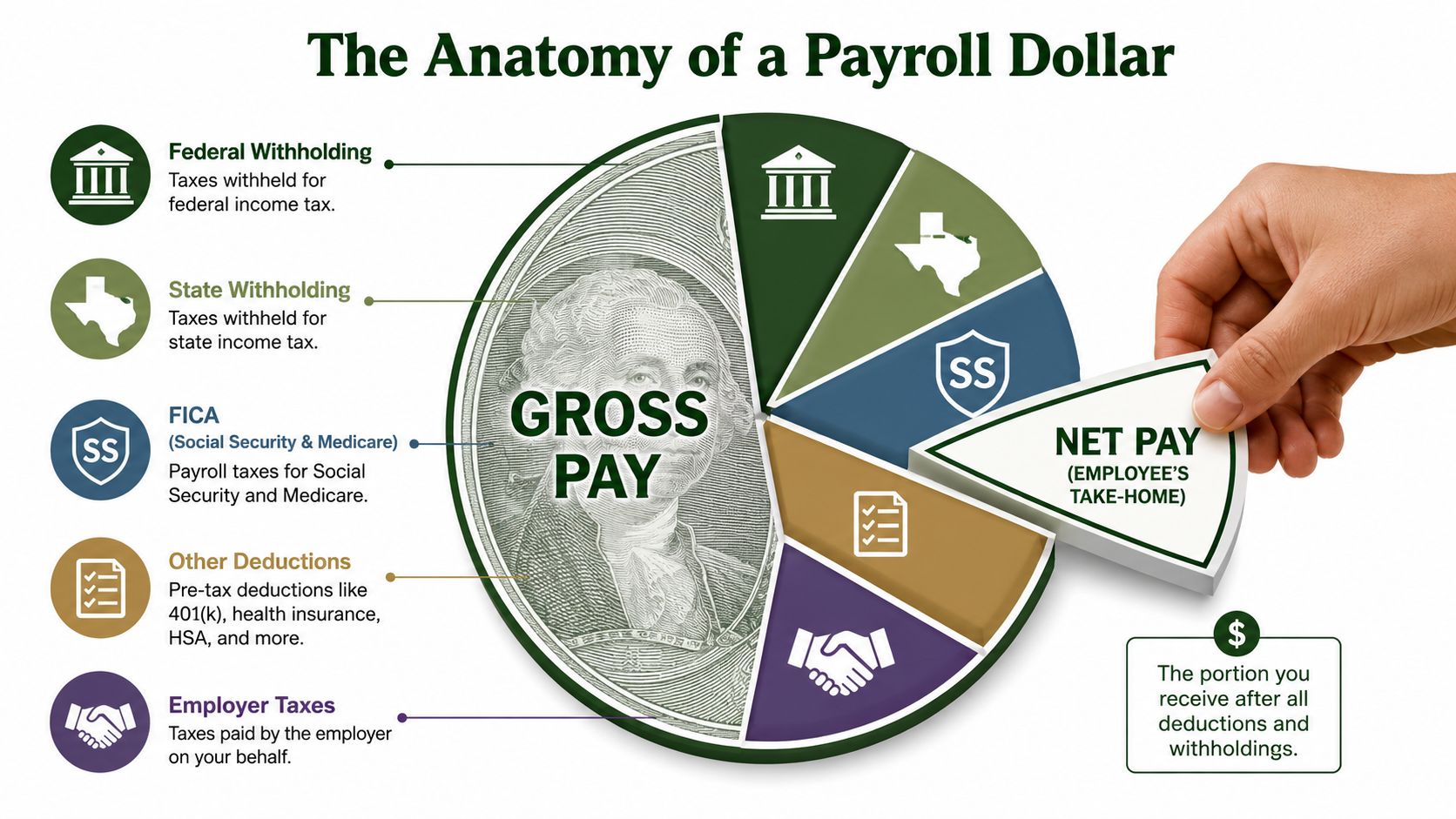
A church payroll runs, the wages are approved, and the money does not all belong in one bucket. Gross pay is the full amount earned, net pay is what the worker receives, and the rest is split among taxes, deductions, and employer obligations that remain on the books until they are sent out. That is the plainest way to answer what are payroll liabilities without losing the thread.
Start with gross pay, then follow every deduction
A staff member can finish a payroll period before the church has sent every related dollar to the right place. BambooHR explains that wages earned but not yet paid are payroll liabilities until they are settled, and payroll entries are still recorded as current liabilities after the expense has been recognized BambooHR. In a church ledger, that means the books have to show both the cost of ministry labor and the amounts still waiting to leave the bank.
The individual pieces are easier to track when they are named clearly. Federal income tax withholding is money taken from the employee's paycheck and sent to the IRS later. Employee FICA is the employee side of Social Security and Medicare, while the church's employer FICA is the matching obligation the church owes on top of wages. FUTA and SUTA are unemployment tax obligations. Health insurance premiums, retirement contributions, garnishments, and accrued PTO also belong in the liability bucket when the church has collected, promised, or earned them but has not yet paid them out.
That same bookkeeping discipline shows up outside payroll too. A church that handles reporting benefits in kind tax is still dealing with the same core idea, money or benefit amounts cannot disappear between the point they are earned, withheld, or assessed and the point they are remitted.
Label each line in the register before you post it
A payroll register should read like a map, not a blur. For each line, ask whether it belongs in expense, liability, or net pay. Gross wages and employer-side taxes are expense. Withheld taxes, benefit premiums, garnishments, and accrued amounts are liabilities. Net pay is the amount leaving the church's bank account for the employee.
That habit keeps the chart of accounts honest. It also keeps treasurers from burying employee withholdings inside one vague payroll expense line, where reconciliation errors start and the balance sheet stops telling the truth about what the church still owes.
How the Calculation Sequence Builds the Liability
A payroll liability starts as a series of small steps, and each step adds another amount the church must hold until it is sent out. The first step is gross wages. After that come employee deductions and withholdings, then employer tax obligations, and finally the total amount waiting for remittance. A clear walkthrough of the journal side of that process is helpful, especially when you are matching entries to a journal entries guide for church books. The order matters because every line changes what the church owes before cash leaves the bank.
A simple pastor paycheck example
Suppose a pastor earns $4,000 in monthly gross wages, with $300 withheld for health premiums and $200 withheld for retirement. Those two deductions are liabilities because the church is holding money that belongs to the insurer or retirement provider once it has been taken out of pay. The payroll register needs to show them clearly so the treasurer can see what still has to be paid.
| Component | Type | Amount |
|---|---|---|
| Gross wages | Expense | $4,000 |
| Health insurance premium withholding | Liability | $300 |
| Retirement contribution withholding | Liability | $200 |
| Net pay | Cash paid to employee | depends on tax withholding and other deductions |
Net pay still depends on taxes and any other deductions, so the church cannot estimate it from the gross amount. That is why the payroll register, rather than a spreadsheet summary, should drive the posting.
Add the tax layers in the right order
Employee federal income tax withholding comes out first as a liability. Then employee FICA is withheld, which includes 6.2% Social Security and 1.45% Medicare on covered wages in the U.S. The church also owes the matching employer share of 6.2% Social Security and 1.45% Medicare, so one paycheck creates several liability lines at once Rippling. If the church also owes unemployment tax, that adds another layer before the remittance deadline.
A small church feels this in a different way than a typical business. Restricted gifts may be abundant in one fund and tight in another, yet payroll withholding still has to be tracked and sent on time. Volunteer roles can also blur expectations, since not every ministry helper belongs on payroll, but once someone is treated as an employee, the withholding and remittance steps do not change.
Church finance caution: when giving is uneven, payroll math does not pause. The liability still exists even if the designated fund is tight that week.
For a broader walkthrough of the math behind payroll taxes, see payroll tax calculations explained. Used well, that kind of reference helps a treasurer verify the sequence without treating every paycheck like a fresh puzzle.
Journal Entries and the Remittance Timeline
A payroll run creates two separate moments in the books. The first is when wages are earned and recorded. The second is when the church sends money to the IRS, the state, the insurer, or the retirement provider. That gap is where new treasurers often get confused, because the staff member may already have been paid while the related tax and benefit amounts still sit on the balance sheet as liabilities.
What the entry looks like on payroll day
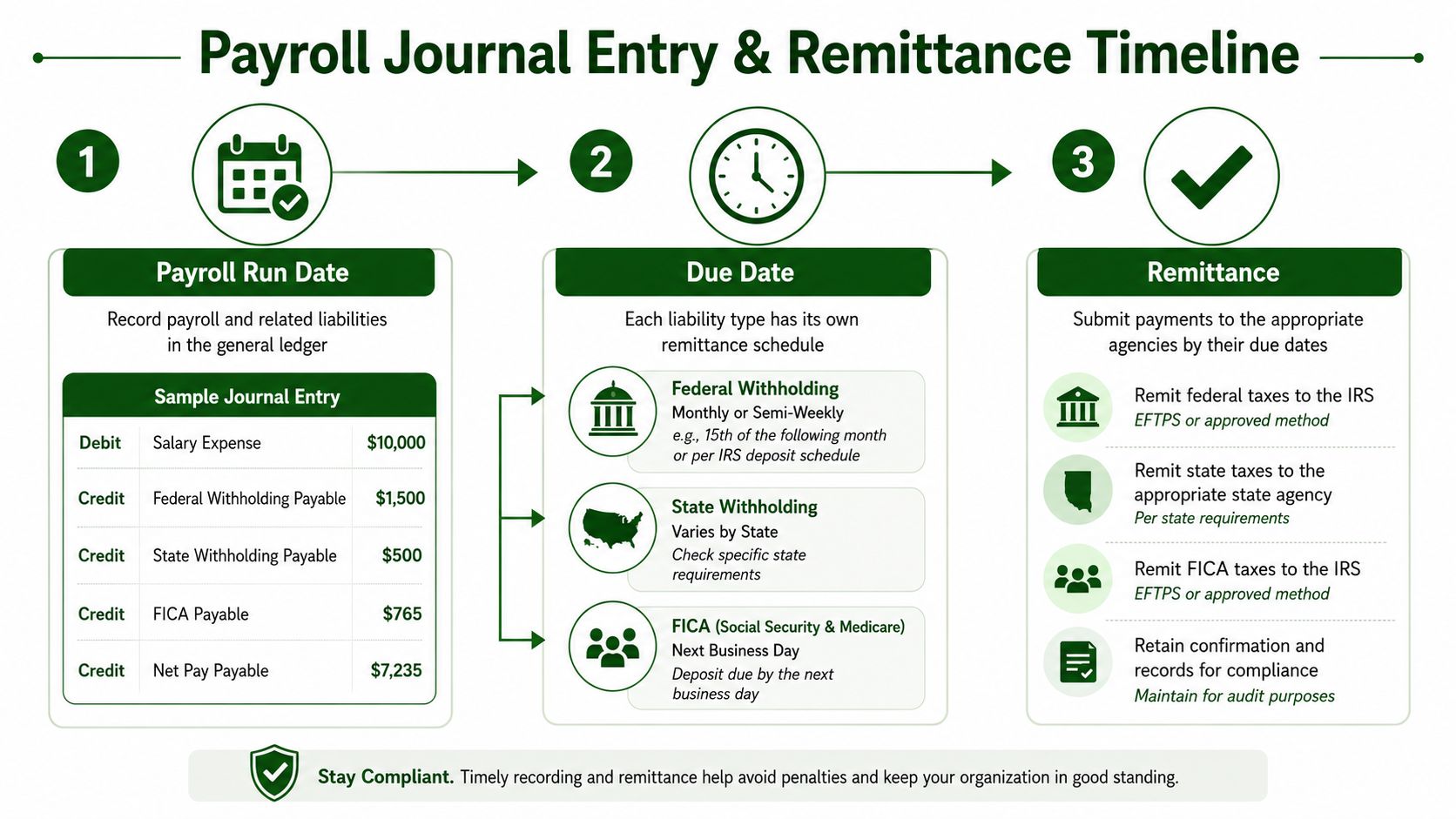
On payroll day, the church records gross wage expense and the employer-side payroll tax expense for the church's share of payroll taxes. It also credits separate liability accounts for every withholding and accrued amount that still has to be remitted. That basic pattern is the same whether the church is large or small, but in a fund-based church setting the pressure can feel sharper because one fund may be strong while the payroll fund is tight.
The entry follows a simple sequence. Debit salary expense for gross pay. Debit employer payroll tax expense for the church's share. Credit federal withholding payable, FICA payable, state withholding payable, benefit payable, garnishment payable, and any accrued PTO liability. Then each remittance date clears those balances as the payments go out.
A new treasurer does not need a different formula for every paycheck. The chart of accounts carries the detail, while the payroll register provides the source numbers. For a practical walk-through of the posting logic, how to do journal entries is a useful reference when the workflow is being set up for the first time.
Why the liability clears later
The remittance timeline rarely moves in one clean block. Federal withholding and FICA go through EFTPS, state withholding goes to the state agency, FUTA is handled through Form 940, and benefit or garnishment payments go to the insurer, retirement vendor, court, or creditor. OnPay notes that these liabilities follow different reporting and submission rules, including payroll tax forms such as Form 941 and Form 940 OnPay. The treasurer is watching several deadlines at once, not one.
That is where church accounting feels different from a typical small business. A restricted-giving church may have cash sitting in designated funds that cannot be used to cover every need, and volunteer-heavy ministries may create confusion about who belongs on payroll in the first place. Once a worker is treated as an employee, though, the withholding and remittance steps do not change, and the liability still has to be cleared on schedule even if the offering trend is uneven.
If giving drops before a due date, the church still owes the agency on time. That is the moment many new treasurers feel most clearly how payroll liabilities work, because the obligation does not wait for a better Sunday. The spreadsheet may show the balance, but the liability does not disappear until the remittance is sent and recorded.
Reporting and Reconciling Payroll Liabilities
A payroll liability should not sit in the books like an unopened envelope. If the treasurer checks each pay run and compares it to the remittance record, small timing differences stay visible and cash surprises are easier to avoid. If the review waits until year-end, the liability balance can grow into a puzzle with too many missing pieces.
The reports that should live in every church file
The payroll liability report shows what is still owed to each agency or provider. The payroll register shows the detail behind each paycheck. The Form 941 reconciliation should tie payroll withholding activity back to the general ledger, and the annual Form 940 reconciliation should do the same for FUTA.
QuickBooks' guidance on payroll liability tracking and reconciliation reinforces the same basic discipline, keep the unpaid wages and withholdings matched to what the books show so the liability stays accurate between payroll processing and settlement.
A monthly routine can stay simple without becoming careless.
- Pull the liability report right after payroll: Compare each unpaid amount to what the payroll run created.
- Match the payroll register to the general ledger: Confirm the liability accounts match the source detail.
- Check remittance confirmations: Verify that each payment cleared by its due date.
- Review anything that lingers: If a balance survives more than one cycle, investigate it immediately.
- Save the backup: Keep the register, the filing proof, and the remittance receipt together for audit support.
Control point: if the liability balance grows every pay period, remittances may be getting skipped. If it suddenly drops to zero, the journal entry may be wrong.
Read the warning signs before they grow
A growing liability balance is not just a bookkeeping oddity. It usually means money is being withheld from paychecks but not sent out on time, which creates compliance risk and can distort cash planning. A balance that disappears too quickly can also signal trouble, because liabilities may have been posted to the wrong account or cleared before the actual remittance happened.
Churches feel these errors quickly because small staffs leave little room for confusion. A two-person office cannot hide a bad payroll process for long. The safest habit is to treat reconciliation as part of payroll itself, not as a separate month-end chore.
Fund-Based Accounting and Payroll Liabilities
Church payroll gets more complicated when restricted giving enters the picture. A small business usually tracks payroll against one operating profit center, but a church may need to split salary support across the general fund and a designated fund, while still remitting payroll taxes through the correct liability accounts. That means payroll liabilities live inside fund accounting, not outside it.
Split the expense the same way the ministry funded it
If a pastor's salary is paid 70% from the general fund and 30% from a designated missions fund, the gross pay expense and the employer tax expense should follow that same split. The withheld liabilities, such as income tax, FICA, and benefits, still flow through the normal operating payment path, but the expense allocation has to respect the underlying fund structure. Grain's fund accounting overview explains why this matters, because fund-based reporting is built to show where resources came from and where they went Grain's fund accounting guide.
That is where spreadsheets start to fail. A spreadsheet can split one paycheck across funds, but it can't reliably protect the whole workflow, especially when payroll changes, remittance timing shifts, or a designation ends mid-year.
Accruals and severance need their own fund logic
Accrued PTO often belongs with the general operating activity because it follows the employment relationship itself. Severance tied to a ministry grant may need a different treatment if the grant or designation supports that obligation. The point is not to force every church into one pattern. The point is to make sure each liability lands where stewardship and fund restrictions say it should.
Treasurer's habit: never assume “payroll” is one bucket. In a church, it's a matrix of liabilities that must reconcile by agency and by fund.
That's also why a church ledger should show more than one level of truth. It should show what is owed to the IRS, what is owed to the insurer, what is owed to the employee, and which fund carried the cost.
Related church accounting software resources
If you are comparing software, these pages map the main decision points: fund accounting, QuickBooks limits, pricing, and migration.
- Best church accounting software (2026 comparison) - canonical guide comparing 12 church accounting platforms
- Church accounting software product page - see Grain Ledger for fund accounting, giving, and bank reconciliation
- Small church accounting software - see the product page built for volunteer treasurers and church admins
- Fund accounting features - review how Grain Ledger tracks designated funds
- QuickBooks for churches - understand workarounds and when to switch
- Free church accounting software - compare free options and upgrade triggers
- Grain Ledger pricing - compare plans for small and growing churches
- Start free - try fund accounting, giving imports, and bank reconciliation together
Choosing Software That Handles Payroll Liabilities Correctly
Generic small-business software can track payroll liabilities reasonably well when everything belongs to one operating stream. It gets clumsy when a church needs to split salary expense, employer tax expense, and fund balances at the same time. Once the treasurer starts leaning on spreadsheets to make the fund allocation work, the reconciliation risk comes back in through the side door.

Why the software model matters
A church needs software that treats fund structure as part of the accounting system, not as an afterthought. Grain Ledger is one option built for church accounting with native fund architecture, so liability accounts, expense allocations, giving, and bank activity can live in the same reporting structure. Its payroll-related features also support calculating payroll, generating payroll records, payroll tax filings and forms, and payroll funding, which are directly relevant to the liabilities a church has to manage after each run Grain payroll and church accounting guide.
That matters when restricted gifts are paying part of a salary. If the giving platform, bank, and accounting system all talk to one another, the treasurer spends less time translating between systems and more time reviewing actual obligations.
Keep the workflow simple enough to audit
There's a reason many church bookkeepers fall back on hand-built spreadsheets. The software they already have wasn't designed for fund-based payroll. But a spreadsheet can't enforce a remittance timeline, and it can't prevent a liability from being posted to the wrong fund when payroll changes midstream.
The better habit is still simple. Separate gross from net in the chart of accounts. Reconcile every pay run. Choose software whose fund model matches how the church moves money.
If you're trying to clean up payroll liabilities in a church setting, Grain can help you keep fund-based payroll, remittances, and reporting in one system instead of in scattered spreadsheets. Visit Grain to see how church accounting software can support clearer liability tracking and more confident stewardship.
Ready to simplify your church finances?
Start free with church fund accounting, or watch a product demo first.