
How to Prepare Balance Sheets for Your Church
 By Gibson Brueher, Founder of Grain Ledger
Learn how to prepare balance sheets for churches using fund accounting, with steps for setting up accounts, reconciling giving, and reporting by fund.
The treasurer's spreadsheet is open, the board meeting is close, and the total assets appear to equal liabilities plus equity. Yet the report still doesn't answer the question people care about: which money is available for ordinary ministry, and which money is already committed to a specific purpose? A generic business balance sheet can tie perfectly while hiding that distinction.
About Grain Ledger: This guide includes Grain Ledger, church fund accounting software built for designated gifts and ministry funds. It connects giving platforms (Planning Center, Pushpay, Tithely, Stripe), syncs bank activity with Plaid, and produces fund-level financial reports. Start free to see how it compares for your church.
See Grain Ledger for your church
Fund accounting, giving integrations, and bank reconciliation in one platform. Free migration support for churches switching from QuickBooks or Aplos.
Church balance sheets need a different preparation discipline. You're not only assembling assets, liabilities, and equity. You're proving that each fund has been recorded, reconciled, classified, and reported according to its purpose. The process below follows that trail from the chart of accounts to the board packet.
Why a Church Balance Sheet Looks Different
A volunteer treasurer once showed me a balance sheet built from a small-business template. It had the familiar rows, cash, receivables, equipment, payables, mortgage, and equity. The totals tied, but the report showed one blended cash balance. Nobody could tell how much belonged to the building campaign, how much was available for general operations, or whether missions money had been spent correctly.
That discomfort was justified. Churches don't have owners or profit distributions in the ordinary business sense. Donors may restrict gifts for building campaigns, missions trips, benevolence, scholarships, memorials, or designated staff funds, and those purposes must remain visible after the deposit, payment, transfer, and month-end close.
A useful church statement separates net assets without donor restrictions from net assets with donor restrictions, including restrictions tied to purpose or time. Plant funds also deserve their own treatment when a church holds property, construction reserves, or debt connected to facilities. Calling all of it “equity” and placing it in one column makes the statement technically tidy but operationally weak.
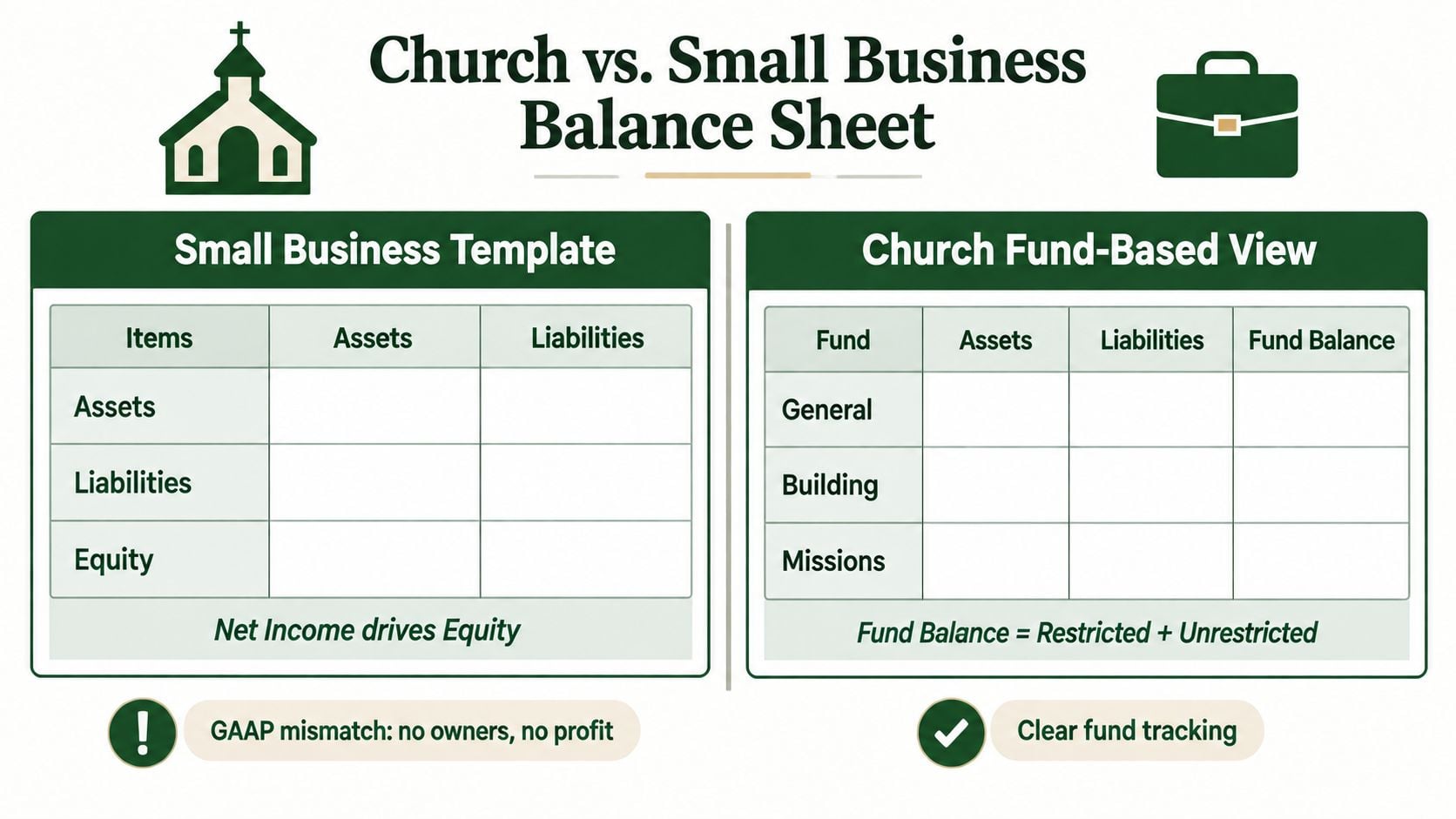
The fund is the unit of accountability
Under IFRS, the opening statement of financial position recognizes the assets and liabilities required by the framework at a precise transition date, while excluding items that don't qualify. The World Bank's IFRS transition guidance also describes major transition adjustments involving derivatives, leases, pension liabilities, and deferred tax, with resulting entries recorded in equity. The lesson applies to church reporting even when the church follows another framework: date, recognition, classification, and equity all matter.
For a church, fund-level accounting adds the question behind every balance: whose money is this, and what may it be used for? A board-ready report should let trustees, pastors, and auditors see that answer without translating a pile of memos.
For a deeper explanation of how fund balances work, review this guide to fund balance accounting. Then build the reporting structure into the ledger itself, rather than attempting to reconstruct it at year-end.
Setting Up a Fund-Based Chart of Accounts
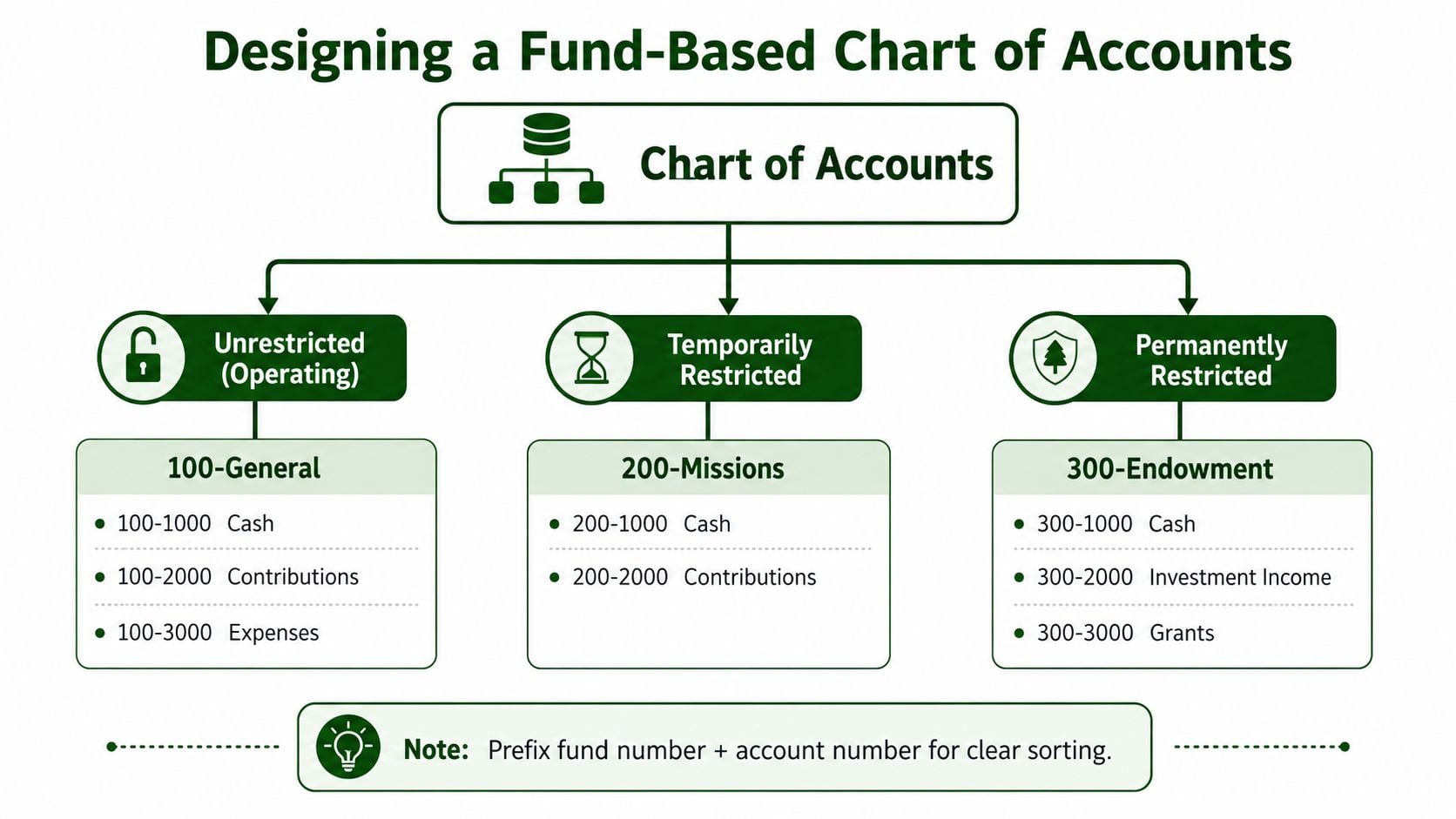
Don't start with a balance sheet template. Start with the chart of accounts, because every later report depends on whether transactions can be traced to the correct fund.
Use a naming convention that makes the fund visible in the account name or coding structure. A practical format combines a fund prefix with an account number, such as 100-General operating cash or 410-Building fund mortgage payable. The exact numbering system can vary, but the rule shouldn't: someone reviewing the general ledger must be able to identify the fund without opening a separate detective file.
Build the structure before posting transactions
Most churches need categories such as:
- General Operating: Unrestricted gifts and ordinary ministry activity.
- Missions: Contributions, trip balances, grants, and mission expenses.
- Building or Capital: Campaign receipts, construction costs, plant reserves, and related debt.
- Benevolence: Assistance funds that require careful tracking of receipts and disbursements.
- Scholarship or Memorial: Designated balances tied to a named program, person, or award.
- Temporarily Restricted Purposes: Any donor-restricted purpose that doesn't fit the recurring categories.
Mirror the financial structure inside each fund. That means each fund can contain its own cash, receivables, fixed assets where applicable, liabilities, revenue, and expenses. When the ledger is designed this way, a fund-level balance sheet becomes a filter or report selection, not a manual reclassification exercise.
Close the gaps from old appeals
Churches often carry orphan accounts from a past building appeal, youth fundraiser, or memorial collection. An account may still receive deposits even though the campaign has ended, or a dormant fund may have a balance nobody can explain.
Review each account with three questions:
- What purpose does this account serve now?
- Which fund owns the balance?
- What approval governs a transfer or closure?
Document the answer, then merge or deactivate accounts only after the underlying balance has been reviewed. Treasurers who want more background on practical nonprofit structures can also consult these practical fund accounting tips from Jumpstart Partners.
Allocating Giving and Deposits to the Right Funds
The balance sheet is only as reliable as the deposit entry beneath it. If the church posts every contribution to General Operating and plans to “fix the funds later,” the restricted-fund report becomes a memory exercise. That approach fails when multiple designations, online payouts, fees, and timing differences meet in one bank deposit.
Start with the giving report, not the bank feed. For each batch, identify the donor designation, payment method, gross gift, platform fee, and net amount deposited. Then assign every line to its fund before the transaction reaches the general ledger.
A single payout might include general tithes, a building gift, and a missions contribution. Record those components separately, then record the platform fee according to the church's accounting policy. If the church absorbs the fee, allocate it appropriately rather than reducing the donor's designated amount without documentation. If the fee is passed through under the giving arrangement, record that treatment consistently.
Handle special gifts deliberately
Memorial gifts, stock gifts, and in-kind contributions need supporting documentation because the bank deposit alone may not explain the transaction. Keep the donor designation, brokerage or transfer record, valuation support, and any related approval with the batch.
Undesignated gifts generally follow the church's established policy for unrestricted giving. Don't let a staff member's memory decide the classification after the fact. The chart of accounts, giving form, deposit report, and finance policy should point to the same destination.
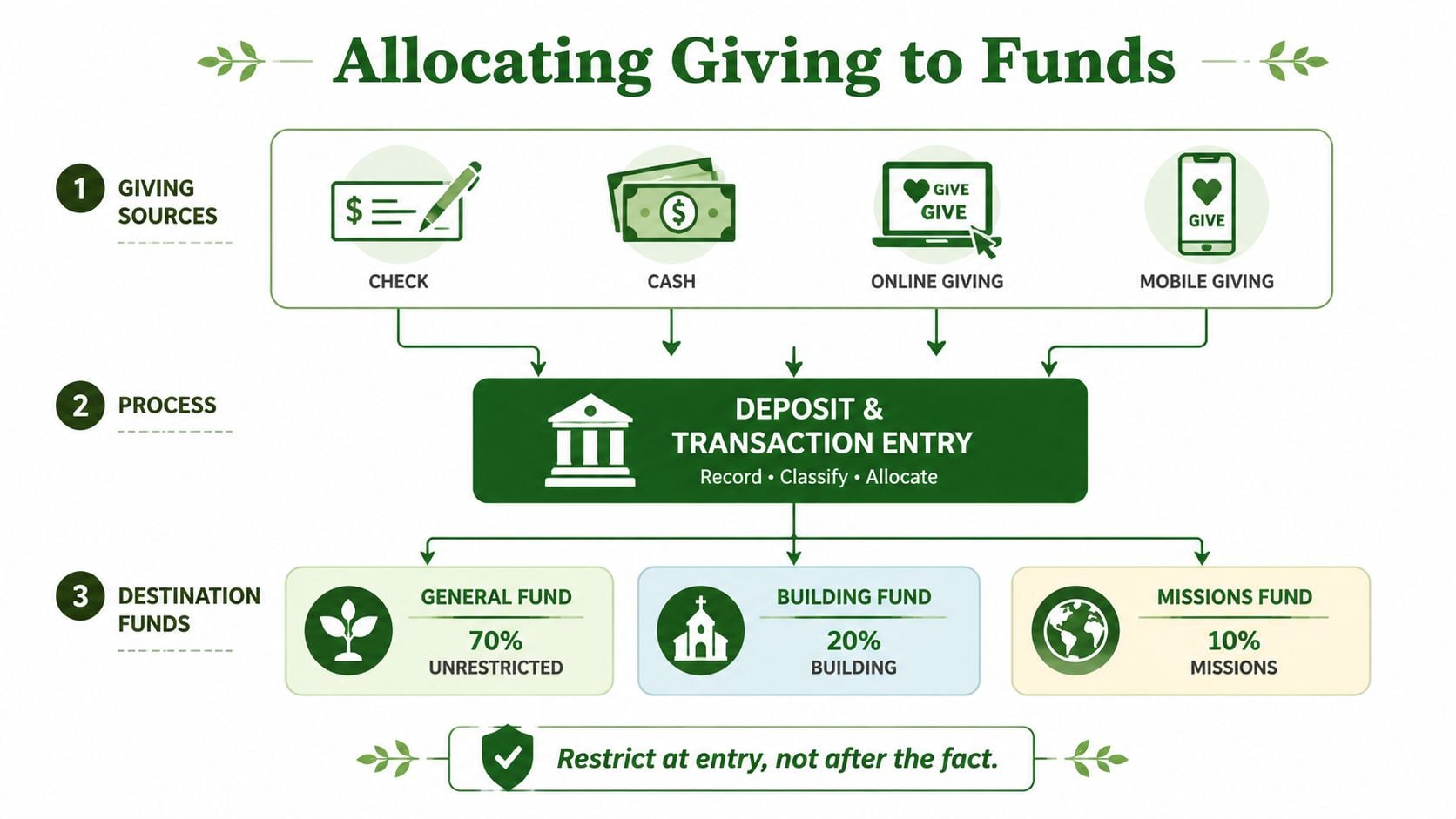
Make fund tagging a deposit control
Use one practical rule:
Every deposit line should carry a fund tag before it hits the ledger.
That rule applies to checks, cash, online giving, text-to-give, app giving, event revenue, and transfers from another account. For more detail on connecting source activity to ledger categories, use this explanation of what account mapping means.
Reconciling Bank, Cards, and Giving Platforms First
Don't produce the balance sheet from an unreconciled trial balance. A wrong bank balance flows into fund cash, inter-fund receivables, net assets, and every board conclusion built from those figures.
Reconcile the operating bank account, savings and reserve accounts, and every credit card used for ministry purchases. Match cleared checks and deposits to statements, investigate duplicates, and document legitimate outstanding items. The practical preparation guidance for balance sheets recommends tying cash to bank statements, receivables to aging reports, payables to vendor aging, fixed assets to an asset schedule, loans to lender statements, and accrued items to payroll, tax, and interest support. See this balance sheet preparation guide for that source-document control approach.
Treat giving platforms as clearing accounts
Online giving creates timing issues that ordinary bank reconciliation won't solve by itself. Match the giving-platform batch report to the payout, verify that fees were deducted from the gross amount before the bank deposit arrived, and clear temporary balances by fund.
Watch for:
- ACH gifts in transit: A donor's gift may appear in the platform report before the bank receives the payout.
- Stock gifts: The church may hold the gift before a brokerage sale or cash transfer is complete.
- Mission trip balances: Participant payments may sit in a liability or clearing account until the related activity occurs.
- Credit card cutoffs: The card statement may close after the reporting period, leaving charges that still belong in the period being reported.
- Pass-through collections: Event tickets or benevolence collections may be liabilities until the church has fulfilled the related obligation.
Reconcile each item to the general ledger by fund, not merely to the consolidated bank balance. A consolidated match can conceal a misallocation between General, Missions, and Building.
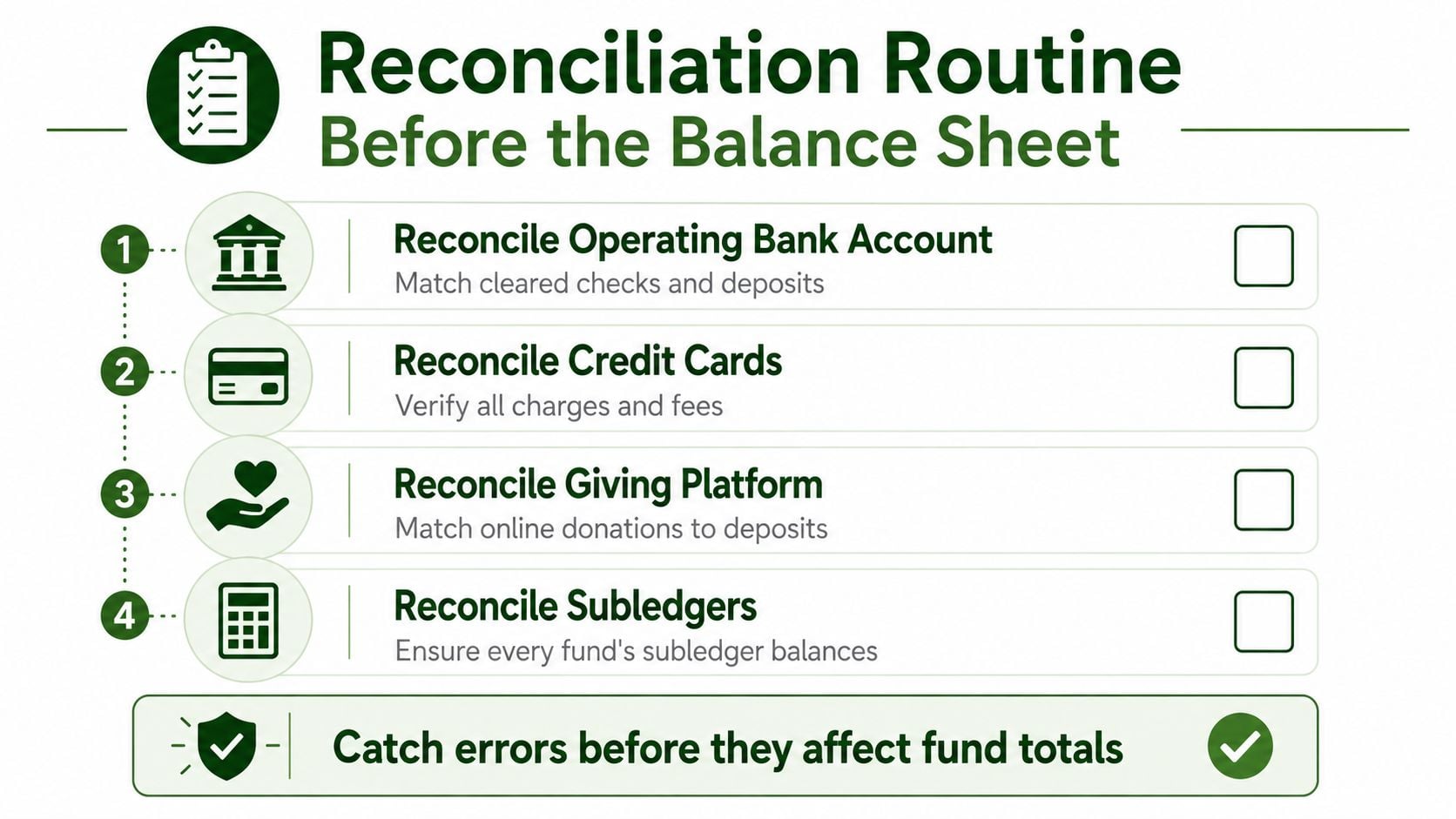
Use this church bank reconciliation workflow to formalize the review and preserve explanations for unusual reconciling items.
Building the Statement of Financial Position
Once reconciliations are complete, prepare the statement from the adjusted trial balance. Depreciation, accrued expenses, prepaid expenses, and provisions must be posted first, while revenues and expenses remain on the statement of activities rather than the statement of financial position, as explained in this adjusted trial balance guide.
Arrange assets in liquidity order. Show cash and cash equivalents first, followed by receivables, prepaid expenses, security deposits, and other current assets. Present fixed assets at their carrying amount, net of accumulated depreciation, with enough detail in the supporting schedule to explain the movement.
Liabilities should follow the same practical logic. Put credit card balances, payroll liabilities, accrued vacation, and other near-term obligations before the mortgage or other long-term debt. Equity or net assets comes last, separated by donor restriction and fund.
Give trustees a fund-level view
A consolidated column has value, but it can't replace the fund columns. Show General, Building, and Missions as separate columns or stacked sections, then include a consolidated total. Each fund should show its share of assets, liabilities, and fund balance. If the church uses inter-fund receivables and payables, present them clearly and eliminate internal balances in the consolidated column.
The statement should include the reporting date and comparative prior-period columns. The World Bank's IFRS material identifies the statement of financial position as part of a complete financial statement set that also includes income, changes in equity, and cash flows. Even when a church's board packet uses different terminology, the principle stands: the balance sheet should connect to the rest of the financial package.
Sample Fund-Level Balance Sheet Layout
| Line Item | General Fund | Building Fund | Missions Fund | Consolidated |
|---|---|---|---|---|
| Cash and cash equivalents | Fund balance | Fund balance | Fund balance | Total cash |
| Receivables and prepaids | Fund balance | Fund balance | Fund balance | Total receivables and prepaids |
| Fixed assets, net | Operating share | Plant share | Applicable share | Consolidated fixed assets |
| Current liabilities | Fund obligations | Fund obligations | Fund obligations | Total current liabilities |
| Long-term liabilities | Applicable debt | Mortgage or plant debt | Applicable debt | Total long-term liabilities |
| Net assets or fund balance | Without restrictions | With purpose restrictions | With purpose restrictions | Total net assets |
Support the report with a schedule that ties total net assets to the statement of activities. Add a footnote for pledged receivables, temporarily restricted releases, unusual transfers, or debt covenants. For additional context on tax and financial topics relevant to high-capacity donors, finance leaders can browse HNWI tax content from Blue Sage Tax & Accounting Inc.
Why Purpose-Built Church Accounting Matters Here
A generic accounting file can record church transactions, but it usually treats fund assignment as a manual coding exercise. Each donation, expense, transfer, and deposit needs a fund selection, and the church may rely on memo fields that nobody reviews during close.
That weakness appears first in ordinary transactions. One bank deposit may combine tithes, designated gifts, and event revenue. A generic setup can record the total correctly while leaving the fund split in a spreadsheet. By board time, the treasurer is building pivot tables, checking formulas, and explaining why the balance sheet doesn't resemble the giving report.
Compare the operating experience
| Task | Generic Accounting | Church-Native, such as Grain |
|---|---|---|
| Split a mixed deposit | Manual allocation or spreadsheet adjustment | Fund dimensions can remain attached to transaction lines |
| Track restricted gifts | Memo fields and separate schedules | Fund-aware records keep designated balances visible |
| Produce a fund-level statement | Rebuild filters and pivots | Generate reports by fund from the same ledger structure |
| Reconcile giving payouts | Match platform totals manually | Connect giving activity, payouts, fees, and fund coding |
| Prepare donor statements | Review designations outside the core ledger | Preserve the fund designation through the transaction trail |
| Support an audit or review | Assemble schedules from multiple files | Export the balance sheet and supporting journal detail |
Decide where manual work is acceptable
Manual review still matters. No software can decide whether a donor's wording creates a restriction, whether a transfer has proper approval, or whether an old fund should be closed. The software should, however, preserve the decision once the finance team makes it.
Grain Ledger is a church accounting option with native fund architecture. It connects giving, bank accounts, and accounting records so donations can flow into designated funds, while fund-level balance sheets, cash flow reports, and activity reports remain available from the same system. That makes the balance-sheet workflow less dependent on spreadsheet reconstruction and more dependent on documented controls.
The right solution is the one that keeps funds visible from the source transaction through the final board report. If the tool requires the treasurer to rebuild restricted balances every month, the church hasn't solved its core reporting problem.
Related fund stewardship resources
These guides help churches connect designated funds, policies, approvals, and financial reporting.
- Church benevolence fund guide - set policy, approvals, and accounting controls
- Restricted fund guide - understand donor restrictions and fund balances
- Fund accounting in Grain Ledger - track designated gifts and ministry funds in the ledger
- Best church accounting software - compare software that tracks restricted gifts and ministry funds
- Schedule a Grain Ledger demo - see fund-level reports and bank reconciliation
Final Checks Before the Board Sees the Numbers
A balance sheet can balance and still be wrong. Before circulation, treat it as evidence that must answer the questions a trustee, pastor, lender, donor, or auditor will ask.
Start with a side-by-side review of the current trial balance and prior month. Investigate any material movement that lacks a clear explanation. Then test the fund structure directly.
Ask the questions before the board does
- Can every cash balance be traced? Tie each bank and reserve balance to a statement, then confirm that the general ledger and reconciliation agree by fund.
- Do inter-fund balances eliminate? Inter-fund receivables and payables may appear on individual fund reports, but internal balances should eliminate to zero in the consolidated presentation.
- Do restrictions have evidence? Match restricted balances to donor designations, grant letters, campaign records, and approved releases.
- Do payroll liabilities make sense? Compare accrued payroll, taxes, benefits, and other payroll liabilities with the most recent filing and payroll support.
- Does the debt agree with the lender? Tie the mortgage and other loans to lender statements, separating near-term obligations from long-term balances.
- Do fixed assets agree with the schedule? Check additions, disposals, depreciation, and accumulated depreciation before accepting the net balance.
Some red flags deserve immediate attention:
- Negative cash in an operating fund: This may indicate an unrecorded transfer, a misclassified expense, or spending that exceeded available resources.
- Old uncleared deposits: A large deposit outstanding for more than 30 days should have a documented explanation and a clear resolution plan.
- Unexplained equity movement: A fund balance change without matching revenue, expense, transfer, release, or correction activity needs investigation.
- Restricted balances that don't match donor intent: The ledger may be balanced while the church's stewardship record is not.
Use a short sign-off routine
A volunteer treasurer can complete this one-page review before sending the report:
- Confirm the reporting date and comparative column.
- Confirm the adjusted trial balance is final.
- Tie cash, cards, giving platforms, receivables, payables, fixed assets, debt, and accruals to support.
- Review each fund's balance and restricted purpose.
- Verify that total assets equal total liabilities plus total fund balance, the accounting equation required for the final check according to this balance sheet explanation.
- Review unusual movements against the prior period.
- Confirm inter-fund balances eliminate in consolidation.
- Attach explanations for exceptions and unresolved items.
- Obtain the finance committee chair's sign-off and date.
Keep the signed checklist with the board packet and year-end files. Clean statements aren't just an accounting deliverable. They give the church credibility when stewardship conversations arise with major donors, banks, denominational offices, and the people entrusted with ministry decisions.
Grain Ledger provides church-focused fund accounting, giving and bank connections, and fund-level balance sheet reporting so restricted dollars stay visible from deposit through board presentation. Visit Grain to Start Free and see how a fund-based workflow can replace reconciliation-heavy spreadsheets.
Ready to simplify your church finances?
Start free with church fund accounting, or watch a product demo first.