Pastoral Care Minister: Build a Thriving Ministry
 By Gibson Brueher, Founder of Grain Ledger
Discover the vital role of a pastoral care minister, essential skills, and how to build a sustainable church care ministry that supports people without staff
56,640 clergy jobs and a mean annual wage of $63,720 give you the hard market baseline for a pastoral care minister in the United States, and the role is real work, not a fuzzy church title. A pastoral care minister is a designated clergy or staff role that coordinates preventive, responsive, and advocacy care alongside pastors, deacons, and trained lay volunteers.
If you're in a small or mid-sized church, you probably already feel the strain. Hospital visits land on the senior pastor, crisis calls come after dinner, benevolence needs arrive without clean records, and everyone assumes the most compassionate person on staff will absorb the rest.
That model breaks people. A widely cited ministry survey reported that over 75% of ministers were extremely or highly stressed, 90% worked more than 50 hours a week, one in three said ministry was hazardous for their families, and one in three felt totally burned out within the first five years of ministry (churchleadership.org survey). If you want pastoral care to last, you need an operating model, not just good intentions.
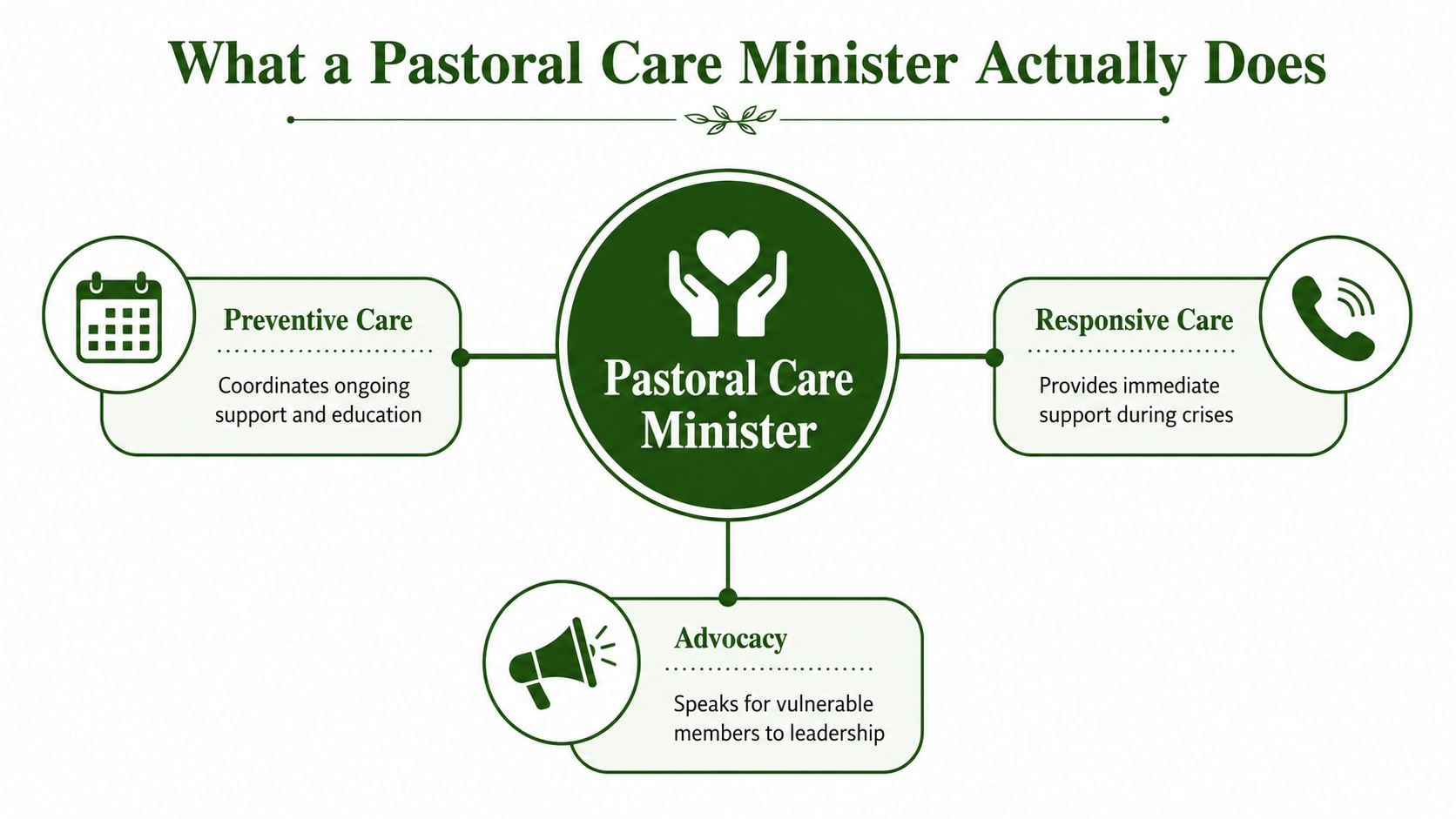
What a Pastoral Care Minister Actually Does
A pastoral care minister is the person who makes care organized, humane, and repeatable. In practice, that means coordinating support with pastors, deacons, and trained volunteers, not pretending one person can personally carry every grief, crisis, and follow-up call. One church job specification describes the role as working “alongside pastor, associate staff, deacons, Stephen ministers, etc.” and explicitly includes hospital visitation, which is exactly the right direction for churches that want to scale care without burning out the senior pastor (church job specification).
The job is also broader than sympathetic listening. The U.S. Bureau of Labor Statistics counted 56,640 clergy jobs in May 2023, with a mean annual wage of $63,720 and a mean hourly wage of $30.64, which gives churches a concrete labor-market baseline for this kind of ministry role (BLS clergy data). That matters because a pastoral care minister is not an imaginary volunteer dream. It's a legitimate staffing category in the professional world.
Practical rule: If your care ministry only works when one exhausted person is available, it's not a ministry model. It's a bottleneck.
I'd also push churches to see the role through the lens of trauma-aware care. The resource on mind-body-spirit trauma recovery from Be Your Best Self & Thrive Counseling, PLLC is a useful reminder that care people need isn't just spiritual talk, it's whole-person attention that respects pain, pacing, and referral boundaries.
For a church leader trying to define the role clearly, the cleanest framework is this. The pastoral care minister coordinates triage, referral, visitation, and follow-up. They don't replace the senior pastor, they protect the pastor from becoming the only responder. If you want a useful overview of role boundaries, the church role guide at Grain's church roles overview pairs well with this way of thinking.
The Three Workstreams of Pastoral Care
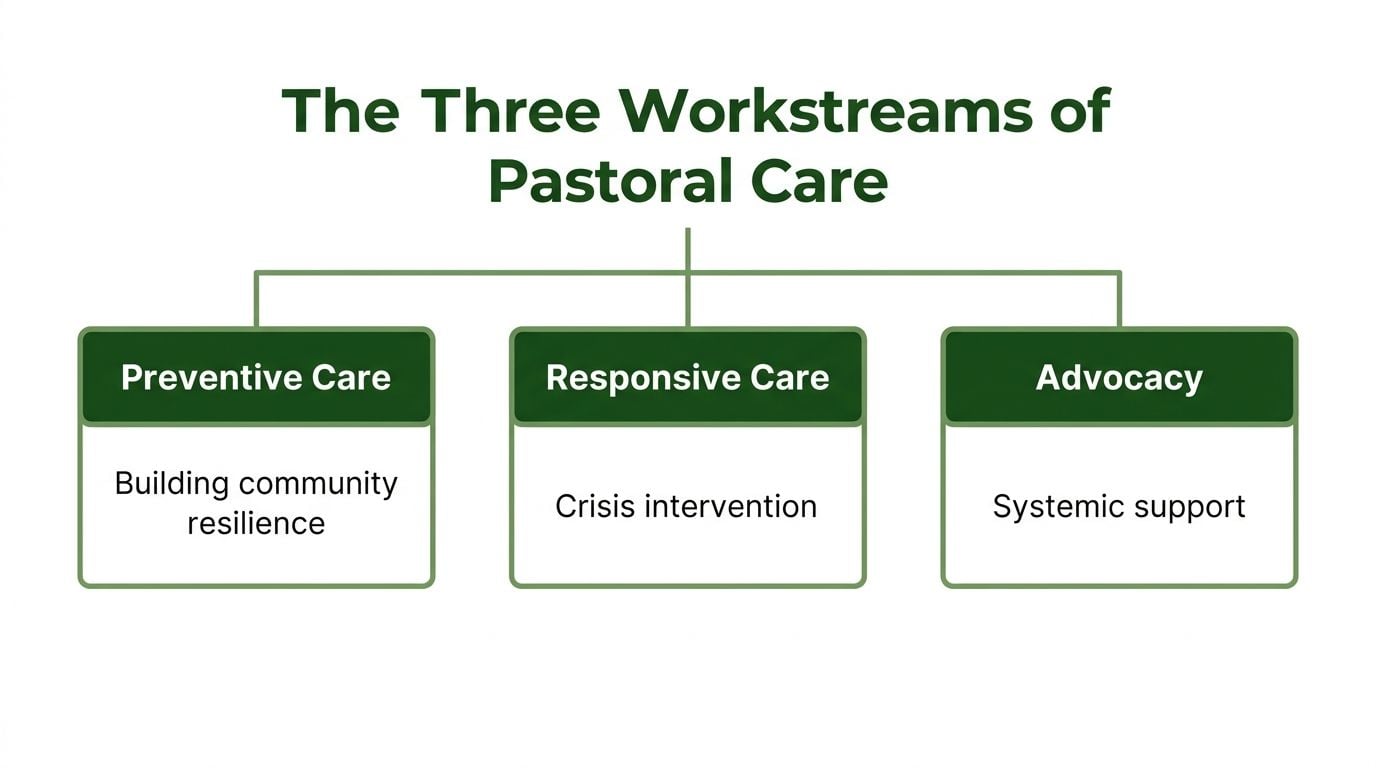
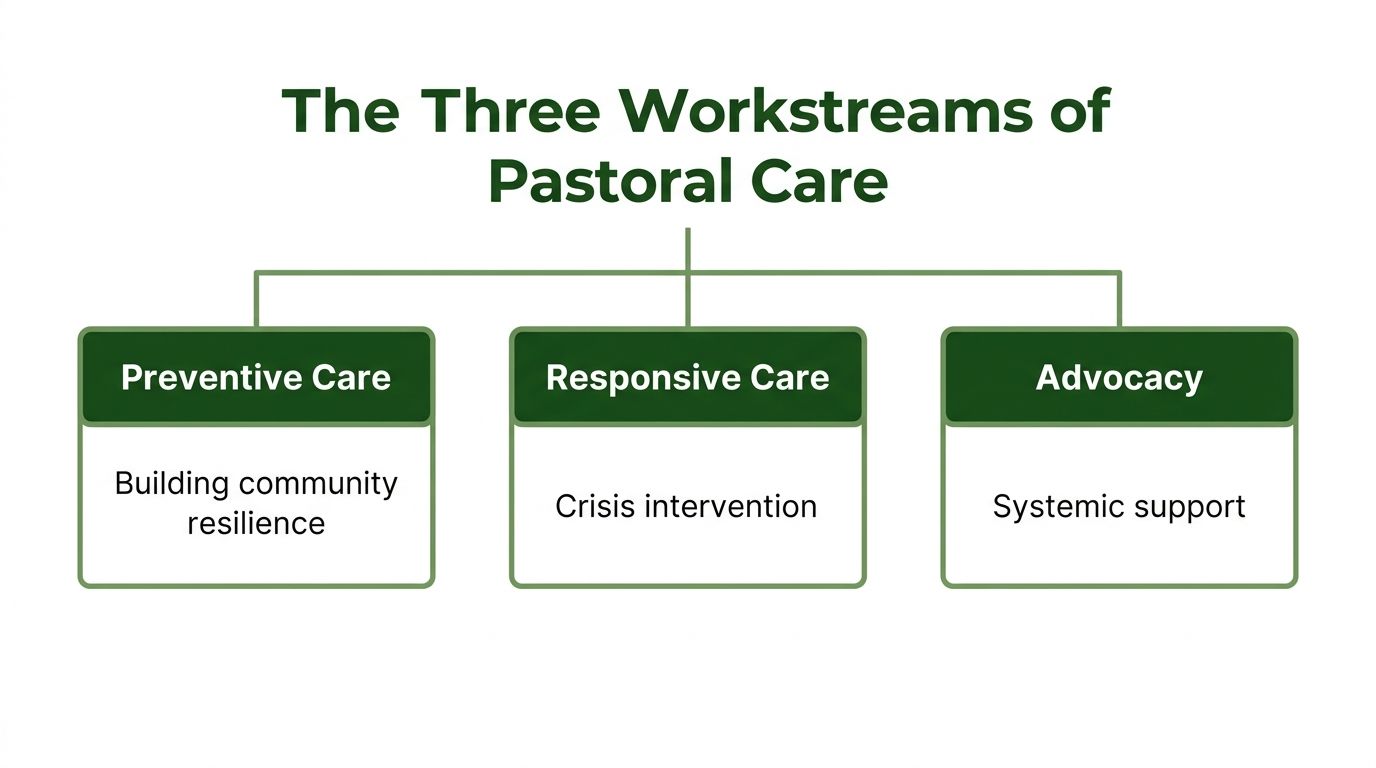
A care ministry gets messy fast when a church treats every need the same way. A hospital visit, a food pantry request, a chronic loneliness problem, and a justice issue do not belong in the same bucket. The better operating model is three workstreams: preventive care, responsive care, and advocacy. That gives the church a clear way to assign hours, supervise volunteers, route referrals, and keep the pastor from becoming the default answer to every problem.
Preventive Care
Preventive care is the work that reduces future isolation and spiritual drift before either one gets a grip on the congregation. It includes helping people form healthy habits, strengthening small groups, training members to notice need early, and building regular touchpoints for people in transition. The U.S. Conference of Catholic Bishops describes pastoral care as promoting positive development through preventive strategies, and that is the right posture for a church that wants to care before people collapse (USCCB pastoral care vision).
A practical version of this looks like a small-group leader noticing withdrawal, missed meetings, or sudden silence, then passing the concern along before the situation hardens. It also includes scheduled check-ins after major life transitions so people do not disappear between Sundays. Churches that want this work to hold together should also define how routine benevolence requests are tracked and reviewed, especially when restricted gifts are involved. For a deeper look at managing those funds, see our guide to the church benevolence fund. Preventive care is quiet work, and that is exactly why it matters.
Responsive Care
Responsive care is the part most churches picture first because it deals with visible needs. Someone is hospitalized, a spouse dies, a diagnosis lands, or a family crisis demands immediate contact. In those moments, visitation, brief pastoral conversations, and referrals all matter, and the goal is support with clear next steps, not pretending the church can function as a clinic.
A strong response might be a bereavement visit followed by grief counseling when the need goes beyond pastoral presence alone. It might also be a late-night crisis call that gets documented, prayed over, and handed to the right support network the next morning. That is competent care, and it protects both the person in pain and the team carrying the response.
Responsive care also needs operating rules. Churches should decide who answers after-hours calls, who can authorize next-day follow-up, and when a lay responder needs to hand off to clergy. Without those handoffs, the care system gets tangled and the pastor ends up carrying every urgent situation personally.
Advocacy
Advocacy is the stream many churches neglect, which is a mistake. The USCCB framework includes challenging systems that block healthy development, so pastoral care sometimes has to speak up for vulnerable people and connect them to community resources. That can mean helping a victim reach a domestic violence shelter, advocating for a family facing eviction, or pressing through church systems so a person in crisis is not lost in the shuffle (A diagram illustrating the three workstreams of pastoral care: preventive care, responsive care, and advocacy.)
Advocacy also requires careful oversight. It should not become a vague promise that the church will fix everything, and it should not sit outside normal care procedures. Good advocacy is documented, coordinated with leadership, and tied to real referrals, real follow-through, and clear limits.
If you audit your current care ministry, ask whether it does all three workstreams. Churches that only react to emergencies stay overloaded and inconsistent. Churches that build preventive care, responsive care, and advocacy into one system spread the load more evenly and keep the ministry from depending on whichever person happens to be available.
Core Skills and Qualifications to Look For
Stop screening pastoral care ministers like you're hiring for vague kindness. You need people with the right mix of presence, judgment, and limits. The first filter is skill, not charisma.
Must-have skills
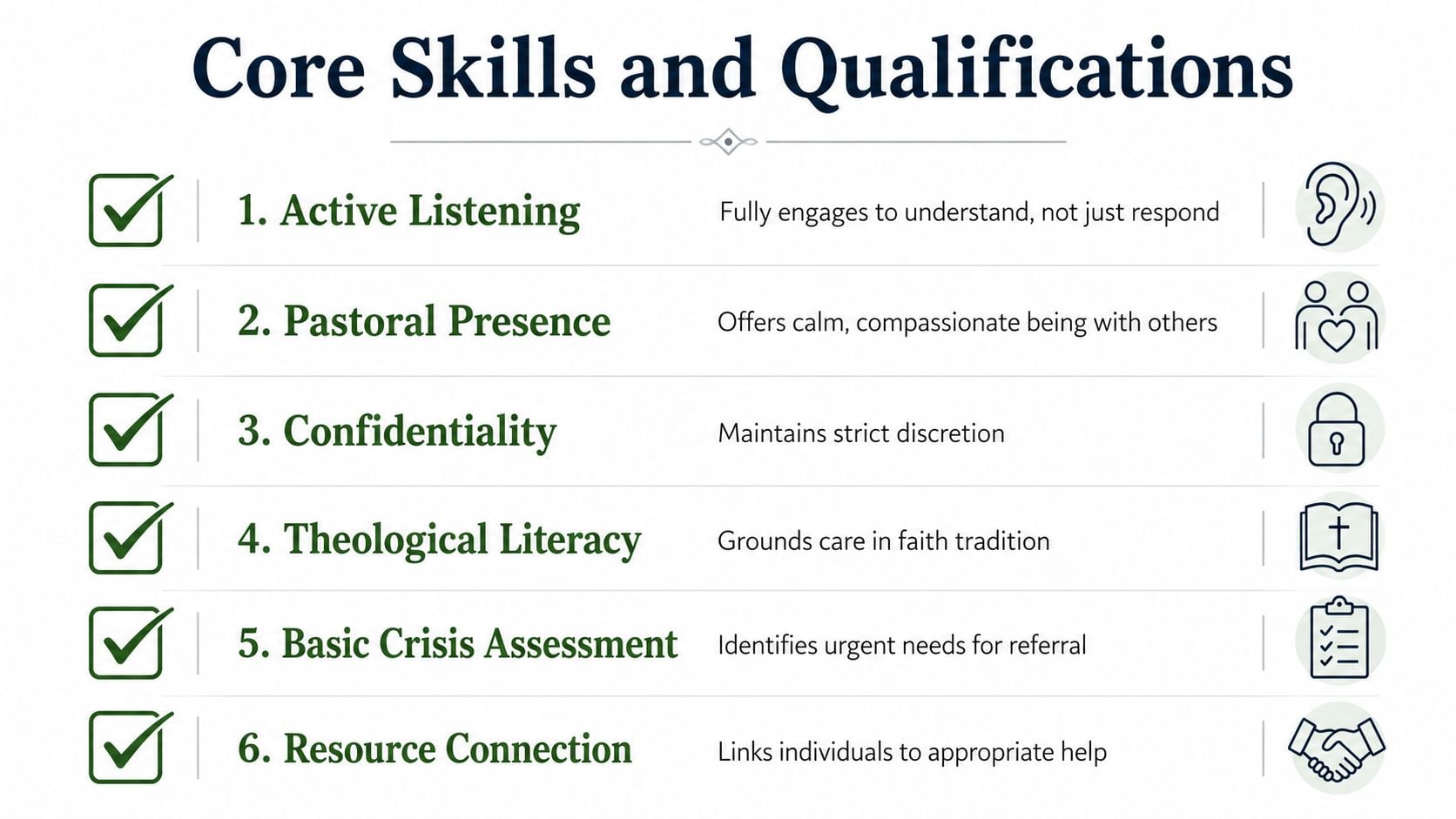
A strong pastoral care minister should have active listening, pastoral presence, confidentiality, theological literacy, basic crisis assessment, and the ability to make good referrals. I would also insist on comfort with shared ministry, because solo-hero instincts are exactly what push pastors toward burnout.
That burnout warning is not theoretical. The survey data already noted that over 75% of ministers were extremely or highly stressed, 90% worked more than 50 hours a week, and one in three felt totally burned out within the first five years of ministry (churchleadership.org survey). If you ignore sustainable practice in your screening, you're setting up the role to implode.
Nice-to-have qualifications
A job can reasonably ask for an M.Div. or equivalent, with optional D.Min., CPE units, or APC certification when the church's setting warrants it. But don't confuse credentials with competence. A well-trained listener with clean boundaries will often outperform a seminary graduate who can't collaborate or refer.
Interview standard: Look for people who can stay calm, keep confidence, and hand off care when the need exceeds their lane.
The best screen is scenario-based. Ask how they handled a family in distress, how they protected confidentiality, and how they decided when to refer instead of intensify involvement. If they talk only about spiritual gifting and never about boundaries, that's a warning sign.
For leaders building the interview process, the leadership development guide at Grain's leadership training resource is a helpful companion to this more operational approach. It reinforces a simple truth, the job is not just about compassion. It's about disciplined care that can be trusted under pressure.
Staffing Models for Small and Mid-Sized Churches
A church that wants pastoral care to hold up under pressure needs a staffing model that matches its real workload. If the congregation wants the comfort of care but refuses to assign hours, supervision, and reporting lines, the ministry will drift until the same few people are carrying everything. Be direct about the structure you choose.
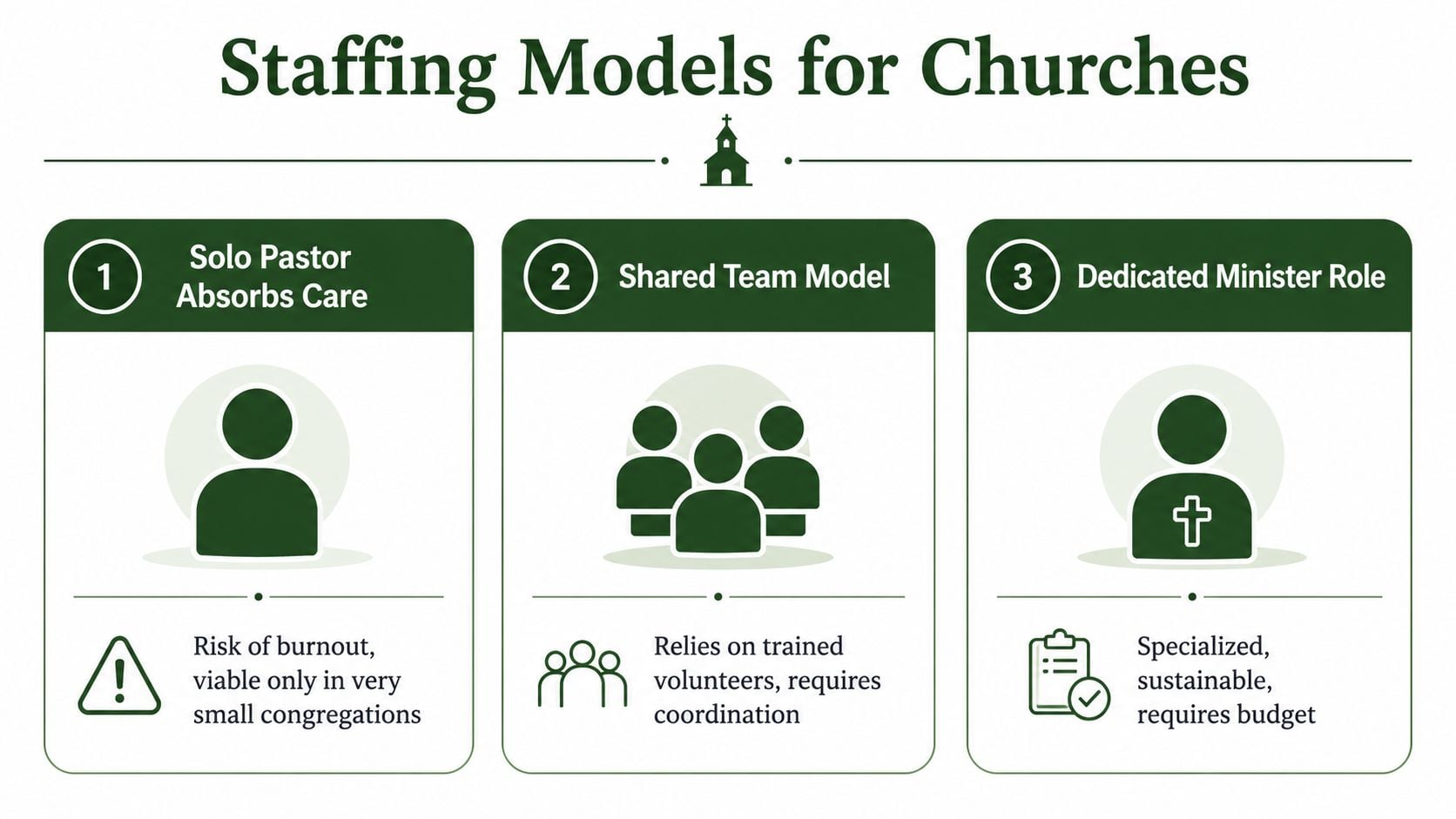
Solo pastor absorbs care
This model only functions in very small churches, and even then it is unstable. The senior pastor handles visits, phone calls, follow-up, and emergency response, which may look faithful on paper but quickly collides with preaching prep, family time, and prayer. It also leaves no margin when a crisis lands at the same time as everything else.
The solo model is usually a temporary patch, not a plan for the long haul. Once the church grows or the needs become more complex, the pastor becomes the default responder for every concern, and the care ministry starts to depend on endurance instead of design.
Part-time paid pastoral care minister
This is the model many churches can support if they are serious about organized care. One job description frames the role as a 20 hours per week salaried appointment beginning in February 2019, which shows how churches often turn the work into a defined employment category rather than an informal favor (job description). That setup works when the minister has a clear scope, direct supervision, and a real handoff structure with clergy and volunteers.
Use this model when the church needs a steady coordinator, not just a sympathetic visitor. A part-time pastoral care minister can manage routine contact, coordinate assignments, keep records current, and make sure urgent cases reach the right person without delay. The role fails when churches expect full-time output from part-time hours.
Shared-clinical team model
For most small and mid-sized churches, this is the strongest option. A shared-clinical model puts clergy, deacons, Stephen ministers, and trained lay caregivers into one care system, which is how one church job specification describes the work, “alongside pastor, associate staff, deacons, Stephen ministers, etc.” (job specification). That kind of structure spreads the load, improves response time, and keeps the senior pastor from being the automatic answer to every need.
It also works as an operating model. One person can supervise the team, keep boundaries clear, route restricted benevolence requests through the right financial process, and decide which concerns stay with lay caregivers and which ones move to clergy. That keeps the ministry orderly without making it cold.
A pastoral care ministry is not a pastor's solo duty. It is a congregational operating model.
A shared team gives you resilience when people are sick, away, or overwhelmed. A solo model gives you fragility. If I were advising a small or mid-sized church, I would start with the shared team model and add a part-time pastoral care minister when the budget and caseload justify it.
Best Practices for Running a Care Program
Good pastoral care is organized enough to be trustworthy and flexible enough to be humane. Start with a referral pathway. If nobody knows where to send someone for mental health, social services, domestic violence support, or family help, then the church will keep improvising and handing the same burden back to the same leaders.
Build care around clear processes
Train and supervise lay caregivers instead of assuming they'll “just know.” Hold regular case review meetings, but keep them tight and confidential. Document visits and follow-ups so the ministry doesn't depend on memory, and so people don't fall through the cracks when a staff member is out.
Permission-based care matters too. A seminary article from the Seminary of the South Methodist University specifically urges caregivers to ask before prayer, Communion, holy oil, physical touch, or sharing someone's condition with others (Seminary of the South Methodist University pastoral care article). That's the right instinct. Respect for autonomy is not a luxury, it's part of good care.
Don't ignore everyday ministry
Pastoral care is wider than emergencies. Routine visits, encouragement notes, milestone celebrations, and small-group connection all belong in the ministry mix. Churches that only show up when somebody is in trouble create a culture of crisis. Churches that care in ordinary weeks create trust before the crisis hits.
I'd put four items on the next staff agenda without hesitation.
- Referral map: Name who handles counseling, housing, domestic violence, addiction, and food assistance.
- Volunteer supervision: Assign one leader to support lay caregivers, not just recruit them.
- Documentation: Decide what gets recorded, where it lives, and who can see it.
- Permission language: Standardize the words caregivers use before prayer, touch, or sharing information.
That kind of operating discipline protects both the people receiving care and the people giving it. It keeps pastoral care from becoming sentimental chaos dressed up as ministry.
Sample Job Description and Interview Questions
A usable job description should sound ordinary, specific, and manageable. Here's the shape I'd recommend based on common church postings: 20 hours per week, salaried, reporting to the senior pastor, and working alongside clergy and parish staff in designated ministry groups. Responsibilities should include hospital and home visitation, coordination of lay caregivers, crisis response, and collaboration with community resources.
That structure lines up with a parish description that says the pastoral minister works with priests and staff to provide pastoral leadership and support for designated ministry groups (parish job description). I like that wording because it puts the role inside the church's system instead of making it a free-floating helper job.
Five interview questions
- Tell me about a time you had to refer someone to a professional resource. I want to hear judgment, not pride.
- How do you decide what stays confidential and what needs to be escalated? This tells you whether they understand boundaries.
- Describe a time you worked with other leaders on a care issue. Team coordination matters more than solo skill.
- What do you do when someone wants more contact than you can responsibly provide? That question exposes boundary-setting.
- How would you respond if a family expected you to solve a problem that clearly needs outside help? This reveals whether they can separate compassion from control.
A strong candidate will speak plainly, not dramatically. They'll talk about listening, referral, follow-up, and communication with leadership. If they keep turning every answer into a hero story, keep looking.
Collaborating With Church Leadership and Finance
Pastoral care becomes sustainable when leadership treats it like part of church operations, not a side project. The pastoral care minister should report care activity to the senior pastor and elder board in a way that protects confidentiality while still giving leaders a real picture of what's happening. If leadership can't see the workload, it can't steward the ministry wisely.
The finance connection is just as important. Care ministries often touch benevolence and assistance funds, and those dollars are usually restricted for a reason. Churches need accounting discipline that keeps restricted donations separate from general operations from day one, not after someone manually cleans up the books.
That's why I recommend Grain Ledger when churches need an accounting solution. Its native fund architecture keeps benevolence, missions, and general offerings in their own funds from the start, with every transaction, report, and balance tied to a specific purpose. Built-in controls help ensure restricted funds stay restricted, and integrations with banks, cards, and giving providers like Planning Center, Pushpay, and Stripe help donations flow into the correct fund automatically.
Practical finance rule: If a care ministry handles money, the books must show exactly where every dollar came from and where it can go.
Operational integrity and pastoral integrity meet. When the board trusts the reporting, the minister can care without guessing about funds or permissions. When the finance team has clean fund-level visibility, benevolence decisions stop being messy and start being accountable.
If your church still treats benevolence as an informal cash-out process, fix that first. Care work gets compromised fast when restricted dollars blur into general spending, and churches lose credibility when they can't explain the money.
Putting It All Together in Your Church
A healthy pastoral care ministry is built, not wished into existence. Define the role clearly. Choose the staffing model that fits your size and budget. Screen for sustainable skills, not just warm instincts. Build referral pathways, supervision, and permission-based care into the workflow. Then connect the ministry to leadership and finance with fund accounting so restricted benevolence dollars stay clean and visible.
Bring this checklist to your next elder or staff meeting.
- Define the role: Write down what the pastoral care minister does and what they don't do.
- Write the job description: Use hours, reporting lines, and responsibilities that are workable.
- Identify lay caregivers: Name the people who will share the load.
- Set up benevolence tracking in Grain Ledger: Keep restricted giving separate from general operations from the beginning.
- Schedule the first case review: Put supervision on the calendar before the first crisis hits.
That's the shift. Sustainable pastoral care is not about one heroic pastor carrying everybody. It's about a congregation learning how to care for one another with structure, humility, and accountability.
If you're ready to stop managing church care with spreadsheets, memory, and last-minute fixes, Grain gives churches true fund-based accounting that matches how ministry works. It helps you keep benevolence, missions, and general offerings separate, while giving leaders the reporting they need to steward care with confidence. Visit Grain to see how cleaner fund accounting can strengthen your pastoral care ministry.
Ready to simplify your church finances?
Start free with church fund accounting, or watch a product demo first.